Using Linguistically Motivated Features
for Paragraph Boundary Identification
Katja Filippova and Michael Strube
EML Research gGmbH Schloss-Wolfsbrunnenweg 33
69118 Heidelberg, Germany
http://www.eml-research.de/nlp
Abstract
In this paper we propose a machine-learning approach to paragraph boundary identification which utilizes linguistically motivated features. We investigate the re-lation between paragraph boundaries and discourse cues, pronominalization and in-formation structure. We test our algorithm on German data and report improvements over three baselines including a reimple-mentation of Sporleder & Lapata’s (2006) work on paragraph segmentation. An analysis of the features’ contribution sug-gests an interpretation of what paragraph boundaries indicate and what they depend on.
1 Introduction
Our work is concerned with multi-document sum-marization, namely with the merging of multiple documents about the same topic taken from the web. We view summarization as extraction of im-portant sentences from the text. As a consequence of the merging process the layout of the documents is lost. In order to create the layout of the out-put, the document structure (Power et al., 2003) has to be regenerated. One aspect of this struc-ture is of particular importance for our work: the paragraph structure. In web documents paragraph boundaries are used to anchor figures and illustra-tions, so that the figures are always aligned with the same paragraph even when the font size or the window size is changed. Since we want to include figures in the generated summaries, paragraph seg-mentation is an important subtask in our applica-tion.
Besides multi-document summarization of web documents, paragraph boundary identification
(PBI) could be useful for a number of different ap-plications, such as producing the layout for tran-scripts provided by speech recognizers and opti-cal character recognition systems, and determin-ing the layout of documents generated for output devices with different screen size.
Though related to the task of topic segmenta-tion which stimulated a large number of studies (Hearst, 1997; Choi, 2000; Galley et al., 2003, inter alia), paragraph segmentation has not been thoroughly investigated so far. We explain this by the fact that paragraphs are considered a stylistic phenomenon and that there is no unanimous opin-ion on what the functopin-ion of the paragraph is. Some authors (Irmscher (1972) as cited by Stark (1988)) suggest that paragraph structure is arbitrary and can not be determined based solely on the prop-erties of the text. Still, psycholinguistic studies report that humans agree, at least to some extent, on placing boundaries between paragraphs. These studies also note that paragraph boundaries are in-formative and make the reader perceive paragraph-initial sentences as being important (Stark, 1988). In contrast to topic segmentation, paragraph seg-mentation has the advantage that large amounts of annotated data are readily availabe for supervised learning.
In this paper we describe our approach to para-graph segmentation. Previous work (Sporleder & Lapata, 2004; 2006) mainly focused on superficial and easily obtainable surface features like punctu-ation, quotes, distance and words in the sentence. Their approach was claimed to be domain- and language-independent. Our hypothesis, however, is that linguistically motivated features, which we compute automatically, provide a better paragraph segmentation than Sporleder & Lapata’s surface ones, though our approach may loose some of the
domain-independence. We test our hypothesis on a corpus of biographies downloaded from the Ger-man Wikipedia1. The results we report in this pa-per indicate that linguistically motivated features outperform surface features significantly. It turned out that pronominalization and information struc-ture contribute to the determination of paragraph boundaries while discourse cues have a negative effect.
The paper is organized as follows: First, we de-scribe related work in Section 2, then in Section 3 our data is introduced. The baselines, the ma-chine learners, the features and the experimental setup are given in Section 4. Section 5 reports and discusses the results.
2 Related Work
Compared to other text segmentation tasks, e.g. topic segmentation, PBI has received relatively lit-tle attention. We are aware of three studies which approach the problem from different perspectives. Bolshakov & Gelbukh (2001) assume that split-ting text into paragraphs is determined by text co-hesion: The link between a paragraph initial sen-tence and the preceding context is weaker than the links between sentences within a paragraph. They evaluate text cohesion using a database of collo-cations and semantic links and insert paragraph boundaries where the cohesion is low.
The algorithm of Sporleder & Lapata (2004, 2006) uses surface, syntactic and language model features and is applied to three different languages and three domains (fiction, news, parliament). This study is of particular interest to us since one of the languages the algorithm is tested on is Ger-man. They investigate the impact of different fea-tures and data size, and report results significantly better than a simple baseline. However, their re-sults vary considerably between the languages and the domains. Also, the features determined impor-tant is different for each setting. So, it may be possible that Sporleder & Lapata do not provide conclusive results.
Genzel (2005) considers lexical and syntactic features and reports accuracy obtained from En-glish fiction data as well as from the WSJ corpus. He points out that lexical coherence and structural features turn out to be the most useful for his algo-rithm. Unfortunately, the only evaluation measure he provides is accuracy which, for the PBI task,
1http://de.wikipedia.org
does not describe the performance of a system suf-ficiently.
In comparison to the mentioned studies, our goal is to examine the influence of cohesive fea-tures on the choice of paragraph boundary inser-tion. Unlike Bolshakov & Gelbukh (2001), who have similar motivation but measure cohesion by collocations, we explore the role of discourse cues, pronominalization and information structure.
The task of topic segmentation is closely related to the task of paragraph segmentation. If there is a topic boundary, it is very likely that it coin-cides with a paragraph boundary. However, the reverse is not true and one topic can extend over several paragraphs. So, if determined reliably, topic boundaries could be used as high precision, low recall predictors for paragraph boundaries. Still, there is an important difference: While work on topic segmentation mainly depends on content words (Hearst, 1997) and relations between them which are computed using lexical chains (Galley et al., 2003), paragraph segmentation as a stylistic phenomenon may depend equally likely on func-tion words. Hence, paragraph segmentation is a task which encompasses the traditional borders between content and style.
3 Data
The data we used is a collection of biographies from the German version of Wikipedia. We se-lected all biographies under the Wikipedia cate-gories of physicists, chemists, mathematicians and biologists and obtained 970 texts with an average length of 20 sentences and 413,776 tokens in total. Although our corpus is substantially smaller than the German corpora of Sporleder & Lapata (2006), it should be big enough for a fair com-parison between their algorithm and the algorithm proposed here. Having investigated the effect of the training size, Sporleder & Lapata (2006) came to the conclusion that their system performs well being trained on a small data set. In particular, the learning curve for German shows an improve-ment of only about 2% when the amount of train-ing data is increased from 20%, which in case of German fiction approximately equals 370,000 to-kens, to 100%.
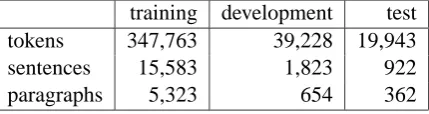
training development test tokens 347,763 39,228 19,943 sentences 15,583 1,823 922 paragraphs 5,323 654 362
Table 1: Number of tokens and sentences per set
is purged from Wiki tags and comments, the in-formation on subtitles and paragraph structure is preserved. Second, sentence boundaries are iden-tified with a Perl CPAN module2 whose perfor-mance we improved by extending the list of abbre-viations and modifying the output format. Next, the sentences are split into tokens. The TnT tag-ger (Brants, 2000) and the TreeTagtag-ger (Schmid, 1997) are used for tagging and lemmatizing. Fi-nally, the texts are parsed with the CDG depen-dency parser (Foth & Menzel, 2006). Thus, the text is split on three levels: paragraphs, sentences and tokens, and morphological and syntactic in-formation is provided.
A publicly available list of about 300 discourse connectives was downloaded from the Internet site of the Institute for the German Language3 (Insti-tut f¨ur Deutsche Sprache, Mannheim) and slightly extended. These are identified in the text and an-notated automatically as well. Named entities are classified according to their type using informa-tion from Wikipedia: person, locainforma-tion,
organiza-tion or undefined. Given the peculiarity of our
cor-pus, we are able to identify all mentions of the bi-ographee in the text by simple string matching. We also annotate different types of referring expres-sions (first, last, full name) and resolve anaphora by linking personal pronouns to the biographee provided that they match in number and gender.
The annotated corpus is split into training (85%), development (10%) and testing (5%) sets. Distribution of data among the three sets is pre-sented in Table 1. Sentences which serve as sub-titles in a text are filtered out because they make identifying a paragraph boundary for the follow-ing sentence trivial.
4 Experiments
4.1 Machine Learners
The PBI task was reformulated as a binary classifi-cation problem: every training instance
represent-2
http://search.cpan.org/˜holsten/Lingua-DE-Sentence-0.07/Sentence.pm
3http://hypermedia.ids-mannheim.de/index.html
ing a sentence was classified either as paragraph-initial or not.
We used two machine learners: BoosTexter (Schapire & Singer, 2000) and TiMBL (Daele-mans et al., 2004). BoosTexter was developed for text categorization, and combines simple rules (decision stumps) in a boosting manner. Sporleder & Lapata used this learner because it has the abil-ity to combine many only moderately accurate hypotheses. TiMBL is a memory-based learner which classifies every test instance by finding the most similar examples in the training set, hence it does not abstract from the data and is well suited to handle features with many values, e.g. the list of discourse cues. For both classifiers, all experi-ments were run with the default settings.
4.2 Baselines
We compared the performance of our algorithm against three baselines. The first one (distance) trivially inserts a paragraph break after each third sentence, which is the average number of sen-tences in a paragraph. The second baseline
(Gal-ley) hypothesizes that paragraph breaks coincide
with topic boundaries and utilizes Galley et al.’s (2003) topic boundary identification tool LCseg. The third baseline (Sporleder) is a reimplementa-tion of Sporleder & Lapata’s 2006 algorithm with the following features:
Word and Sentence Distances from the current
sentence to the previous paragraph break;
Sentence Length and Relative Position (relPos)
of the sentence in a text;
Quotes encodes whether this and the previous
sentences contain a quotation, and whether the quotation is continued in the current sen-tence or not;
Final Punctuation of the previous sentence;
Words – the first (word1), the first two (word2),
the first three and all words from the sen-tence;
Parsed has positive value in case the sentence is
parsed, negative otherwise;
Number of S, VP, NP and PP nodes in the
sen-tence;
Signature is the sequence of PoS tags with and
Children of Top-Level Nodes are two features
representing the sequence of syntactic labels of the children of the root of the parse tree and the children of the highest S-node;
Branching Factor features express the average
number of children of S, VP, NP and PP nodes in the parse;
Tree Depth is the average length of the path from
the root to the leaves;
Per-word Entropy is a feature based on
Gen-zel & Charniak’s (2003) observation that paragraph-initial sentences have lower en-tropy than non-initial ones;
Sentence Probability according to a language
model computed from the training data;
Character-level n-gram models are built using
the CMU toolkit (Clarkson & Rosenfeld, 1997).
Since the parser we used produces dependency trees as an output, we could not distinguish be-tween such features as children of the root of the
tree and children of the top-level S-node. Apart
from this minor change, we reimplemented the al-gorithm in every detail.
4.3 Our Features
For our algorithm we first selected the features of Sporleder & Lapata’s (2006) system which per-formed best on the development set. These are relative position, the first and the first two words (relPos, word1, word2). Quote and final punctu-ation features, which were particularly helpful in Sporleder & Lapata’s experiments on the German fiction data, turned out to be superfluous given the infrequency of quotations and the prevalent use of the period as sentence delimiter in our data.
We experimented with text cohesion features as-suming that the paragraph structure crucially de-pends on cohesion and that paragraph breaks are likely to occur between sentences where cohesive links are weak. In order to estimate the degree of cohesion, we looked at lexical cohesion, pronom-inalization, discourse cues and information struc-ture.
4.3.1 Lexical Cohesion
nounOver, verbOver: Similar to Sporleder &
Lapata (2006), we introduced an overlap fea-ture, but measured the degree of overlap as
a number of common noun and verb lem-mas between two adjacent sentences. We pre-ferred lemmas over words in order to match all possible forms of the same word in Ger-man.
LCseg: Apart from the overlap, a boolean feature
based on LCseg (Galley et al., 2003) marked whether the tool suggests that a new topic be-gins with the current sentence. This feature, relying on lexical chains, was supposed to provide more fine-grained information on the degree of similarity between two sentences.
4.3.2 Pronominalization
As Stark (1988) points out, humans tend to in-terpret over-reference as a clue for the beginning of a new paragraph: In a sentence, if a non-pronominal reference is preferred over a pronom-inal one where the pronoun would be admissi-ble, humans are likely to mark this sentence as a paragraph-initial one. In order to check whether over-reference indeed correlates with paragraph-initial sentences, we described the way the bi-ographee is referred to in the current and the pre-vious sentences.
prevSPerson, currSPerson: This feature4 with
the values NA, biographee, other indicates whether there is a reference to the biographee or some other person in the sentence.
prevSRE, currSRE: This feature describes the
biographee’s referring expression and has three possible values: NA, name, pronoun.
Although our annotation distinguishes between first, last and full names, we found out that, for the PBI task, the distinction is spurious and unify-ing these three under the same category improves the results.
REchange: Since our classifiers assume feature
independence and can not infer the informa-tion on the change in referring expression, we explicitly encoded that information by merg-ing the values of the previous feature for the current and the preceding sentences into one, which has nine possible values (name-name,
NA-name, pronoun-name, etc.).
4Prefixes prevS-, currS- stand for the previous and the
4.3.3 Discourse Cues
The intuition behind these features is that cue words and phrases are used to signal the relation between the current sentence and the preceding sentence or context (Mann & Thompson, 1988). Such connectives as endlich (finally), abgesehen
davon (apart from that), danach (afterwards)
ex-plicitly mark a certain relation between the sen-tence they occur in and the preceding context. We hypothesize that the relations which hold across paragraph boundaries should differ from those which hold within paragraphs and that the same is true for the discourse cues. Absence of a connec-tive is supposed to be informaconnec-tive as well, being more typical for paragraph-initial sentences.
Three features describe the connective of the current sentence. Another three features describe the one from the preceding sentence.
prevSCue, currSCue: This feature is the
con-nective itself (NA in case of none).
prevSCueClass, currSCueClass: This feature represents the semantic class of the cue word or phrase as assigned by the IDS Mannheim. There are 25 values, including NA in case of no connective, altogether, with the most frequent values being temporal, concessive,
conclusive, etc.
prevSProCue, currSProCue: The third binary
feature marks whether the connective is proadverbial or not (NA if there is no connec-tive). Being anaphors, proadverbials, such as
deswegen (because of that), dar¨uber (about that) explicitly link a sentence to the
preced-ing one(s).
4.3.4 Information Structure
Information structure, which is in German to a large extent expressed by word order, provides additional clues to the degree of connectedness between two sentences. In respect to the PBI task, Stark (1988) reports that paragraph-initial sentences are often theme-marking which means that the subject of such sentences is not the first element. Given the lower frequency of paragraph-initial sentences, this feature can not be considered reliable, but in combination with others it provides an additional clue. In German, the first element best corresponds to the prefield (Vorfeld) – nor-mally, the single constituent placed before the fi-nite verb in the main clause.
currSVF encodes whether the constituent in
the prefield is a NP, PP, ADV, CARD, or
Sub.Clause. Values different from NP
un-ambiguously represent theme-marking sen-tences, whereas the NP value may stand for both: marking as well as not theme-marking sentence.
4.4 Discussion
Note, that we did not exclude text-initial sentences from the study because the encoding we used does not make such cases trivial for classification. Al-though some of the features refer to the previous sentence, none of them has to be necessarily re-alized and therefore none of them explicitly indi-cates the absence of the preceding sentence. For example, the label NA appears in cases where there is no discourse cue in the preceding sentence as well as in cases where there is no preceding sen-tence. The same holds for all other features pre-fixed with prevS-.
Another point concerns the use of pronominalization-based features. Sporleder & Lapata (2006) waive using such features be-cause they consider pronominalization dependent on the paragraph structure and not the other way round. At the same time they mention speech and optical character recognition tasks as possible application domains for the PBI. There, pronouns are already given and need not be regenerated, hence for such applications features which utilize pronouns are absolutely appropriate. Unlike the recognition tasks, for multi-document summarization both decisions have to be made, and the order of the two tasks is not self-evident. The best decision would probably be to decide simultaneously on both using optimization methods (Roth & Yih, 2004; Marciniak & Strube, 2005). Generating pronouns before inserting boundaries seems as reasonable as doing it the other way round.
4.5 Feature Selection
We determine the relevant feature set and evaluate which features from this set contribute most to the performance of the system by the following pro-cedures.
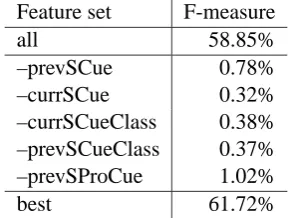
Feature set F-measure
all 58.85%
–prevSCue 0.78% –currSCue 0.32% –currSCueClass 0.38% –prevSCueClass 0.37% –prevSProCue 1.02%
[image:6.595.108.254.63.172.2]best 61.72%
Table 2: Removed features
Feature set F-measure relPos, word1, word2 48.06%
+currSRE +10.50%
+currSVF +0.49%
+currSPerson +0.57% +prevSPerson +1.32%
best 60.94%
Table 3: Best features
feature space. We start with a model based on all available features. Then we train models obtained by removing one feature at a time. We choose the worst performing feature, namely the one whose removal gives the largest improvement based on the F-measure, and remove it from the model. We then train classifiers removing each of the remain-ing features separately from the enhanced model. The process is iteratively run as long as significant improvement is observed.
To measure the contribution of the relevant fea-tures we start with the three best feafea-tures from Sporleder & Lapata (2006) (see Section 4.3) and train TiMBL combining the current feature set with each feature in turn. We then choose the best performing feature based on the F-measure and add it to the model. We iterate the process until all features are added to the three-feature system.
Thus, we optimize the default setting and obtain the information on what the paragraph structure crucially depends.
5 Results
Having trained our algorithm on the development data, we then determined the optimal feature com-bination and finally evaluated the performance on the previously unseen test data.
Table 2 and Table 3 present the ranking of the least and of the most beneficial features respec-tively. Somewhat surprising to us, Table 2 shows
that basically all features capturing information on discourse cues actually worsened the performance of the classifier. The bad performance of the
prevSCue and currSCue features may be caused
by their extreme sparseness. To test these fea-tures reasonably, we plan to increase the data set size by an order of magnitude. Then, at least, it should be possible to determine which discourse cues, if any, are correlated with paragraph bound-aries. The bad performance of the prevSCueClass and currSCueClass features may be caused by the categorization provided by the IDS. This question also requires further investigation, maybe with a different categorization.
Table 3 also provides interesting insights in the feature set. First, with only the three features
relPos, word1 and word2 the baseline performs
almost as well as the full feature set used by Sporleder & Lapata. Then, as expected, currSRE provides the largest gain in performance, fol-lowed by currSVF, currSPerson and prevSPerson. This result confirms our hypothesis that linguisti-cally motivated features capturing information on pronominalization and information structure play an important role in determining paragraph seg-mentation.
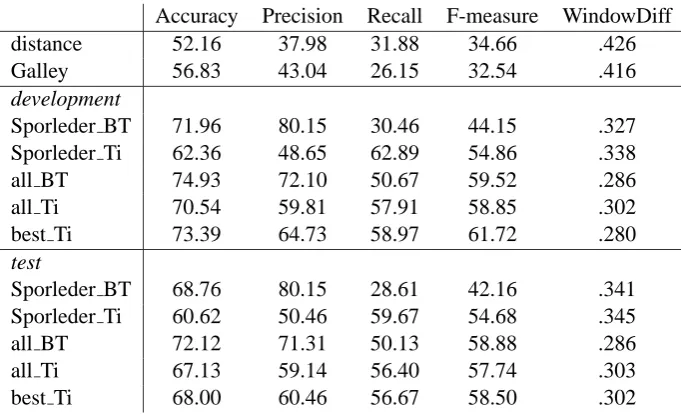
The results of our system and the baselines for different classifiers (BT stands for BoosTex-ter and Ti for TiMBL) are summarized in Table 4. Accuracy is calculated by dividing the num-ber of matches over the total numnum-ber of test in-stances. Precision, recall and F-measure are ob-tained by considering true positives, false positives and false negatives. The latter metric, WindowDiff (Pevzner & Hearst, 2002), is supposed to over-come the disadvantage of the F-measure which pe-nalizes near misses as harsh as more serious mis-takes. The value of WindowDiff varies between 0 and 1, where a lesser count corresponds to better performance.
The significance of our results was computed using the
test. All results are significantly better (on the level or below) than
Accuracy Precision Recall F-measure WindowDiff distance 52.16 37.98 31.88 34.66 .426
Galley 56.83 43.04 26.15 32.54 .416
development
Sporleder BT 71.96 80.15 30.46 44.15 .327 Sporleder Ti 62.36 48.65 62.89 54.86 .338
all BT 74.93 72.10 50.67 59.52 .286
all Ti 70.54 59.81 57.91 58.85 .302
best Ti 73.39 64.73 58.97 61.72 .280
test
Sporleder BT 68.76 80.15 28.61 42.16 .341 Sporleder Ti 60.62 50.46 59.67 54.68 .345
all BT 72.12 71.31 50.13 58.88 .286
all Ti 67.13 59.14 56.40 57.74 .303
[image:7.595.128.469.61.268.2]best Ti 68.00 60.46 56.67 58.50 .302
Table 4: Results for the development and test sets with the two classifiers
does not hold. This is also confirmed by the results reported in Table 3 where only three of their fea-tures perform surprisingly strong. In contrast, on our feature set TiMBL and BoosTexter perform al-most equally. However, BoosTexter achieves in all cases a much higher precision which is preferable over the higher recall provided by TiMBL.
6 Conclusion
In this paper, we proposed a novel approach to paragraph boundary identification based on lin-guistic features such as pronominalization, dis-course cues and information structure. The results are significantly higher than all baselines and a reimplementation of Sporleder & Lapata’s (2006) system and achieve an F-measure of about 59%.
We investigated to what extent the paragraph structure is determined by each of the three fac-tors and came to the conclusion that it crucially depends on the use of pronouns and information structure. Surprisingly, discourse cues did not turn out to be useful for this task and even negatively affected the results which we explain by the ex-tremely sparseness of the cues in our data.
It turned out that the best results could be achieved by a combination of surface features
(rel-Pos, word1, word2) and features capturing text
cohesion. This indicates that paragraph bound-ary identification requires features usually used for style analysis and ones describing cohesive rela-tions. Therefore, paragraph boundary identifica-tion is in fact a task which crosses the borders be-tween content and style.
An obvious limitation of our study is that we trained and tested the algorithm on one-genre do-main where pronouns are used extensively. Ex-perimenting with different genres should shed light on whether our features are in fact domain-dependent. In the future, we also want to ex-periment with a larger data set for determining whether discourse cues really do not correlate with paragraph boundaries. Then, we will move on towards multi-document summarization, the ap-plication which motivates the research described here.
Acknowledments: This work has been funded by the Klaus Tschira Foundation, Heidelberg, Ger-many. The first author has been supported by a KTF grant (09.009.2004). We would also like to thank the three anonymous reviewers for their comments.
References
Bolshakov, Igor A. & Alexander Gelbukh (2001). Text segmentation into paragraph based on local text cohesion. In Text, Speech and Dialogue, pp. 158–166.
Brants, Thorsten (2000). TnT – A statistical Part-of-Speech tagger. In Proceedings of the 6th
Conference on Applied Natural Language Pro-cessing, Seattle, Wash., 29 April – 4 May 2000,
pp. 224–231.
Pro-ceedings of the 1st Conference of the North American Chapter of the Association for Com-putational Linguistics, Seattle, Wash., 29 April
– 3 May, 2000, pp. 26–33.
Clarkson, Philip & Roni Rosenfeld (1997). Sta-tistical language modeling. In Proceedings
of ESCA, EuroSpeech’97. Rhodes, pp. 2707–
2710.
Daelemans, Walter, Jakub Zavrel, Ko van der Sloot & Antal van den Bosch (2004). TiMBL:
Tilburg Memory Based Learner, version 5.1, Reference Guide. Technical Report ILK 04-02:
ILK Tilburg.
Foth, Kilian & Wolfgang Menzel (2006). Robust parsing: More with less. In Proceedings of the
11th Conference of the European Chapter of the Association for Computational Linguistics,
Trento, Italy, 3–7 April 2006, pp. 25–32.
Galley, Michel, Kathleen R. McKeown, Eric Fosler-Lussier & Hongyan Jing (2003). Dis-course segmentation of multi-party conversa-tion. In Proceedings of the 41st Annual Meeting
of the Association for Computational Linguis-tics, Sapporo, Japan, 7–12 July 2003, pp. 562–
569.
Genzel, Dmitriy (2005). A paragraph bound-ary detection system. In Proceedings of the
Sixth International Conference on Intelligent Text Processing and Computational Linguistics,
Mexico City, Mexico.
Genzel, Dmitriy & Eugene Charniak (2003). Vari-ation of entropy and parse trees of sentences as a function of the sentence number. In
Proceed-ings of the 2003 Conference on Empirical Meth-ods in Natural Language Processing, Sapporo,
Japan, 11–12 July 2003, pp. 65–72.
Hearst, Marti A. (1997). TextTiling: Segment-ing text into multi-paragraph subtopic passages.
Computational Linguistics, 23(1):33–64.
Irmscher, William F. (1972). The Holt Guide to
English. New-York: Holt, Rinehart Winston.
Kohavi, Ron & George H. John (1997). Wrap-pers for feature subset selection. Artificial
In-telligence Journal, 97(1-2):273–324.
Mann, William C. & Sandra A. Thompson (1988). Rhetorical structure theory. Toward a functional theory of text organization. Text, 8(3):243–281.
Marciniak, Tomacz & Michael Strube (2005). Be-yond the pipeline: Discrete optimization in NLP. In Proceedings of the 9th Conference
on Computational Natural Language Learning,
Ann Arbor, Mich., USA, 29–30 June 2005, pp. 136–145.
Pevzner, Lev & Marti Hearst (2002). A critique and improvement of an evaluation metric for text segmentation. Computational Linguistics, 28(1):19–36.
Power, Richard, Donia Scott & Nadjet Bouayad-Agha (2003). Document structure.
Computa-tional Linguistics, 29(2):211–260.
Roth, Dan & Wen-tau Yih (2004). A linear pro-gramming formulation for global inference in natural language tasks. In Proceedings of the
8th Conference on Computational Natural Lan-guage Learning, Boston, Mass., USA, 6–7 May
2004, pp. 1–8.
Schapire, Robert E. & Yoram Singer (2000). BoosTexter: A boosting-based system for text categorization. Machine Learning,
39(2/3):135–168.
Schmid, Helmut (1997). Probabilistic part-of-speech tagging using decision trees. In Daniel Jones & Harold Somers (Eds.), New Methods
in Language Processing, pp. 154–164. London,
UK: UCL Press.
Sporleder, Caroline & Mirella Lapata (2004). Au-tomatic paragraph identification: A study across languages and domains. In Proceedings of the
2004 Conference on Empirical Methods in Nat-ural Language Processing, Barcelona, Spain,
25–26 July 2004, pp. 72–79.
Sporleder, Caroline & Mirella Lapata (2006). Broad coverage paragraph segmentation across languages and domains. ACM Transactions in
Speech and Language Processing. To appear.