Proceedings of the 2019 Conference on Empirical Methods in Natural Language Processing and the 9th International Joint Conference on Natural Language Processing, pages 2141–2152,
2141
TIGEr: Text-to-Image Grounding for Image Caption Evaluation
Ming Jiang1, Qiuyuan Huang3, Lei Zhang3, Xin Wang2 Pengchuan Zhang3, Zhe Gan3, Jana Diesner1, Jianfeng Gao3
1University of Illinois at Urbana-Champaign,2University of California, Santa Barbara 3Microsoft Research, Redmond
{mjiang17,jdiesner}@illinois.edu, [email protected] {qihua,leizhang,penzhan,zhe.gan,jfgao}@microsoft.com
Abstract
This paper presents a new metric called TIGEr for the automatic evaluation of image caption-ing systems. Popular metrics, such as BLEU and CIDEr, are based solely on text match-ing between reference captions and machine-generated captions, potentially leading to bi-ased evaluations because references may not fully cover the image content and natural language is inherently ambiguous. Building upon a machine-learned text-image ground-ing model, TIGEr allows to evaluate caption quality not only based on how well a cap-tion represents image content, but also on how well machine-generated captions match human-generated captions. Our empirical tests show that TIGEr has a higher consistency with human judgments than alternative exist-ing metrics. We also comprehensively assess the metric’s effectiveness in caption evaluation by measuring the correlation between human judgments and metric scores.
1 Introduction
Image captioning is a research topic at the nexus of natural language processing and computer vision, and has a wide range of practical applications ( Ho-dosh et al.,2013;Fang et al.,2015), such as image retrieval and human-machine interaction. Given an image as input, the task of image captioning is to generate a text that describes the image content. Overall, prior studies of this task have been focus-ing on two aspects: 1) buildfocus-ing large benchmark datasets (Lin et al., 2014; Hodosh et al., 2013), and 2) developing effective caption generation al-gorithms (Karpathy and Li,2015;Bernardi et al., 2016;Gan et al.,2017). Remarkable contributions that have been made, but assessing the quality of the generated captions is still an insufficiently ad-dressed issue. Since numerous captions with vary-ing quality can be produced by machines, it is
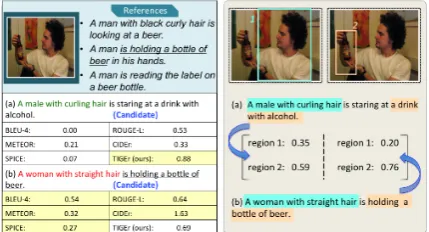
im-Figure 1: An example of caption evaluation challenge. Given two candidate captions: (a) correctly describes image content, but most words in this caption are not contained in references, while (b) overlaps with refer-ences (“is holding a bottle of beer”), but involves wrong information (“a woman with straight hair”). Prior met-rics based only on text-level comparisons fail to as-sess the quality of candidate captions, while our met-ric (TIGEr) can detect this inconsistency by matching a caption with image content. To explain the TIGEr re-sult, we show the grounding weights of two illustrative image regions with each candidate. The proper text in-formation matched with each region is highlighted by colors.
portant to propose an automatic evaluation metric that is highly consistent with human judges, easy to implement and interpret.
[image:1.595.309.524.224.340.2]met-rics that are based on text overlapping. As shown in Figure1, although Caption (a) describes the im-age properly, most words in this sentence are dif-ferent from the references. In contrast, Caption (b) contains wrong information (“a woman with straight hair”), but overlaps with human-written references (“is holding a bottle of beer”). Con-sequently, all existing metrics improperly assign a higher score to Caption (b).
In order to address the aforementioned chal-lenges, we propose a novel Text-to-Image Ground-ing based metric for image caption Evaluation (TIGEr), which considers both image content and human-generated references for evaluation. First, TIGEr grounds the content of texts (both refer-ence and generated captions) in a set of image re-gions by using a pre-trained image-text ground-ing model. Based on the grounding outputs, TIGEr calculates a score by comparing both the relevance ranking and distribution of grounding weights among image regions between the refer-ences and the generated caption. Instead of eval-uating image captions by exact n-gram matching, TIGEr compares the candidate caption with refer-ences by mapping them into vectors in a common semantic space. As a result, TIGEr is able to de-tect the paraphrases based on the semantic mean-ing of caption sentences. A systematic compari-son of TIGEr and other commonly used metrics shows that TIGEr improves the evaluation perfor-mance across multiple datasets and demonstrates a higher consistency with human judgments. For ex-ample, Figure1presents a case where only TIGEr is able to assign a higher score to the caption can-didate that is more consistent with human judg-ments. Our main contributions include:
• We propose a novel automatic evaluation metric, TIGEr1, to assess the quality of image captions by grounding text captions in image content.
• By performing an empirical study, we show that TIGEr outperforms other commonly used metrics, and demonstrates a higher and more stable consistency with human judg-ments.
• We conduct an in-depth analysis of the assessment of metric effectiveness, which
1Code is released at https://github.com/ SeleenaJM/CapEval.
deepens our understanding of the character-istics of different metrics.
2 Related Work
Caption Evaluation The goal of image caption evaluation is to measure the quality of a generated caption given an image and human-written refer-ence captions (Bernardi et al.,2016).
In general, prior solutions to this task can be di-vided into three groups. First, human evaluation is typically conducted by employing human anno-tators to assess captions (e.g., via Amazons Me-chanical Turk) (Bernardi et al.,2016;Aditya et al., 2015a;Wang et al.,2018b).
Second, automatic rule-based evaluation mea-sures assess the similarity between references and generated captions. Many metrics in this group were extended from other related tasks ( Pa-pineni et al., 2002; Banerjee and Lavie, 2005; Lin, 2004). BLEU (Papineni et al., 2002) and METEOR (Banerjee and Lavie, 2005) were ini-tially developed to evaluate machine translation outcomes based on n-gram precision and recall. ROUGE (Lin, 2004) was originally used in text summarization, which measures the overlap of n-grams using recall. Recently, two metrics were specifically built for visual captioning: 1) CIDEr (Vedantam et al., 2015) measures n-gram simi-larity based on TF-IDF; and 2) SPICE ( Ander-son et al.,2016) quantifies graph similarity based on the scene graphs built from captions. Overall, these metrics focus on text-level comparisons, as-suming that the information contained in human-written references can well represent the image content. Differing from prior work, we argue in this study that references may not fully cover the image content because both references and cap-tions are incomplete and selective translacap-tions of image contents made by human judges or auto-mated systems. The ground truth can only be fully revealed by taking the images themselves into ac-count for evaluation.
caption evaluation based on image and text fea-tures. This work mainly focuses on the generation of adversarial data used for model training. De-spite improving the consistency with human de-cisions, this approach may involve high compu-tational cost and lead to overfitting (Gao et al., 2019). Besides, the interpretability of the eval-uation is limited due to the black-box nature of end-to-end learning models. An even more serious problem of using machine-learned metrics is the so-called “gaming of the metric”: if a generation system is optimized directly for a learnable met-ric, then the system’s performance is likely to be over-estimated. See a detailed discussion inGao et al.(2019).
Though caption evaluation is similar to tradi-tional text-to-text generation evaluation in terms of testing targets and evaluation principles, this task additionally need to synthesize image and refer-ence contents as ground truth information for fur-ther evaluation, which is hard to achieve by using a rule-based method with a strong human prior. In this study, we propose a new metric that combines the strengths of learning-based and rule-based ap-proaches in terms of: 1) utilizing a pre-trained grounding model2 to combine the image and text information; and 2) scoring captions by defining principle rules based on the grounding outputs to make the evaluation interpretable.
Image-Text Matching The task of image-text matching can be defined as the measurement of semantic similarity between visual data and text data. The main strategy of solutions designed for this task is to map image data and text data into a common semantic vector space (Fang et al.,2015; Wang et al.,2018a;Lee et al.,2018). Prior studies usually consider this issue from two perspectives: From the perspective of data encoding, prior work either regards an image/text as a whole or applies bottom-up attention to encode image regions and words/phrases (Karpathy et al.,2014;Kiros et al., 2014). From the perspective of algorithm develop-ment, prior work has often applied a deep learning framework to build a joint embedding space for images and texts, and some of these studies train a model with ranking loss (Fang et al.,2015;Lee et al.,2018;Frome et al.,2013) and some use
clas-2
[image:3.595.314.517.62.174.2]We find in our experiments that we can simply use the pre-trained model as is to evaluate systems developed on dif-ferent datasets, and the pre-trained model is very efficient to run. Thus, the cost of computing TIGEr is not much higher than that of computing other traditional metrics.
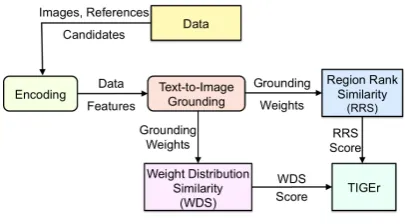
Figure 2: TIGEr framework.
sification loss (e.g., softmax function) (Jabri et al., 2016;Fukui et al., 2016). In this work, we take advantage of a state-of-the-art model for image-text matching (Lee et al., 2018) and propose an automatic evaluation metric for image captioning based on the matching results. Our goal is to cap-ture comprehensive information from input data while also providing an explainable method to as-sess the quality of an image description.
3 The TIGEr Metric
The overall framework of TIGEr is shown in Fig-ure2. With the assumption that a good machine-generated captionCshould generate a description of an imageV like a human would, we compare Cagainst a set of reference captions produced by humansR={R1, ..., Rk}in two stages.
The first stage is text-image grounding, where for each caption-image pair, we compute a vector ofgrounding scores, one for each specific region of the image, indicating how likely the caption is grounded in the region. The grounding vector can also be interpreted as estimating how much atten-tion a human judge or the to-be-evaluated image captioning system pays on each image region in generating the caption. A good system is expected to distribute its attention among different regions of an image similarly to that of human judges. For example, if a human judge wrote a caption solely based on a particular region of an image (e.g., a human face or a bottle as shown in Figure 1) while ignoring the rest of the image, then a good machine-generated caption would be expected to describe only the objects in the same region.
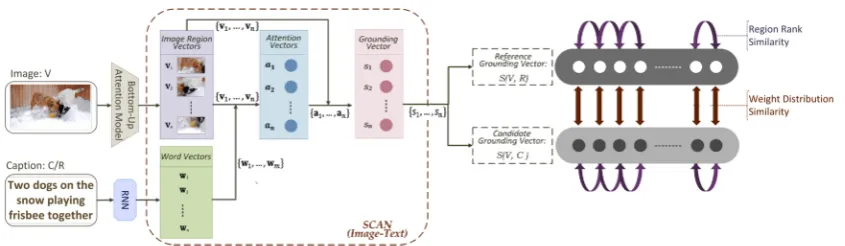
Figure 3: Overview of TIGEr calculation. For each pair of image and caption sentence, the pre-trained SCAN model generates a similarity vector where each dimension denotes the grounding relevance between an image region and the caption sentence in this region context. Given two similarity vectors denoting the grounding out-comes of reference versus candidate captions, we measure: 1) region rank disagreement, and 2) the similarity of two grounding weight distributions.
using two metric systems. The first one mea-sures how similarly these image regions are or-dered (by their grounding scores) in the two vec-tors. The second one measures how similarly the attention (indicated by grounding scores) is dis-tributed among different regions of the image in the two vectors. The TIGEr score is the average score of the resulting two similarity scores.
In the rest of this section, we describe the two stages in detail.
3.1 Text-Image Grounding
To compute the grounding scores of an image-caption pair, we need to map the image and its paired caption into vector representations in the same vector space. We achieve this by us-ing a Stacked Cross Attention Neural Network (SCAN) (Lee et al., 2018), which is pre-trained on the 2014 MS-COCO train/val dataset with de-fault settings3. The training data contains 121,287 images, of which each is annotated with five text descriptions. The architecture of SCAN is shown in Figure3.
We first encode caption C or R, which is a sequence of m words, into a sequence of d-dimensional (d = 300) word embedding vec-tors, {w1, ...,wm}, using a bi-directional
recur-rent neural network (RNN) models with gated re-current units (GRU) (Bahdanau et al.,2015). We then map imageV into a sequence of feature vec-tors in two steps. First, we extract fromV a set of n = 36 region-level 2048-dimensional fea-ture vectors using a pre-trained bottom-up atten-tion model (Anderson et al.,2018). Then, we use linear projection to convert these vectors into a
3Github link: https://github.com/kuanghuei/SCAN
sequence of d-dimensional image region vectors
{v1, ...,vn}.
We compute how much captionC, represented as {w1, ...,wm}, is grounded to each image
re-gionvi,i = 1...n, as follows. First, we compute
an attention feature vector for eachvias
ai = m X
j=1
αijwj (1)
αij =
exp(λsim(vi,wj)) Pm
k=1exp(λsim(vi,wk))
(2)
whereλis a smoothing factor, and sim(v,w)is a normalized similarity function defined as
sim(vi,wj) =
max(0,score(vi,wj)) pPn
k=1max(0,score(vk,wj))2
(3)
score(vi,wj) =
vi·wj kvi kkwj k
(4)
Then, we get the grounding vector ofCandV as
s(V, C) ={s1, ..., sn} (5)
si :=s(vi, C) =
vi·ai kvi kkai k
(6)
where the absolute value ofsiindicates how much
caption C is grounded to the i-th image region or, in other words, to what degreeC is generated based on thei-th image region.
Given an imageV, in order to evaluate the qual-ity of a machine-generated caption C based on a set of reference captions R = {R1, ..., Rk},
we generate two grounding vectors,s(V, C)as in Equation5ands(V,R)which is a mean ground-ing vector over all references inRas
3.2 Grounding Vector Comparison
The quality of C is measured by comparing
s(V, C) and s(V,R) using two metric systems, Region Rank Similarity (RRS) and Weight Distri-bution Similarity (WDS).
3.2.1 Region Rank Similarity (RRS)
RRS is based on Discounted Cumulative Gain (DCG) (J¨arvelin and Kek¨al¨ainen,2002), which is widely used to measure document ranking qual-ity of web search engines. Using a graded rele-vance scale of documents in a rank list returned by a search engine, DCG measures the usefulness, or
gain, of a document based on its position in the ranked list.
In the image captioning task, we view a cap-tion as a query, an image as a colleccap-tion of docu-ments, one for each image region, and the ground-ing scores based on reference captions as human-labeled relevance scores. Note thats(V, C) con-sists of a set of similarity scores {s1, s2, ..., sn}
for all image regions. If we views(v, C)as a rel-evance score between caption (query)C and im-age region (document)v, we can sort these image regions by their scores to form a ranked list, simi-lar to common procedure in Information Retrieval of documents from data collections via search en-gines.
Then, the quality of the ranked list, or equiva-lently the quality ofC, can be measured via DCG, which is the sum of the graded relevance values of all image regions inV, discounted based on their positions in the rank list derived froms(V, C):
DCGs(V,C) = n X
k=1
relk
log2(k+ 1) (8)
whererelkis the human-labeled graded relevance
value of the image region at position k in the ranked list.
Similarly, we can generate an ideal ranked list froms(V,R)where all regions are ordered based on their human-labeled graded relevance values. We compute the Ideal DCG (IDCG) as
IDCGs(V,R) = n X
k=1
relk
log2(k+ 1) (9)
Finally, RRS betweens(V, C)ands(V,R) is de-fined as Normalized DCG (NDCG) as
RRS(V,C,R) :=NDCG(V,C,R)=
DCGs(V,C)
IDCGs(V,R) (10)
The assumption made in using RRS is that C is generated based mainly on a few highly impor-tant image regions, rather than the whole image. A high-qualityCshould be generated based on a similar set or the same set of highly important im-age regions based on which human judges write reference captions. One limitation of RRS is that it is not suitable to measure the quality of captions that are generated based on many equally impor-tant image regions. In these cases, we assume that humans produce captions by distributing their at-tention more or less evenly across all image re-gions rather than focusing on a small number of highly important regions. The remedy to this lim-itation is the new metric we describe next.
3.2.2 Weight Distribution Similarity (WDS)
WDS measures how similarly a system and hu-man judges distribute their attention among differ-ent regions of an image when generating captions. LetP andQbe the attention distributions derived from the grounding scores ins(V,R)ands(V, C), respectively. We measure the distance between the two distributions via KL Divergence (Kullback and Leibler,1951) as
DKL(P||Q) = n X
k=1
P(k) logP(k)
Q(k) (11)
where P(k) = softmax(s(vk,R)) and Q(k) =
softmax(s(vk, C)).
In addition, we also find it useful to capture the difference in caption-image relevance between (V, C) and (V,R). The relevance value of a caption-image pair can be approximated by using the module of each grounding vector. We useDrel
to denote the value difference term, defined as
Drel((V,R)||(V, C)) = log
ks(V,R)k ks(V, C)k (12)
Finally, letting D(R||C) = DKL(P||Q) +
Drel((V,R)||(V, C)), we get WDS between two
grounding vectors using a sigmoid function as
WDS(V,C,R):= 1−
exp (τ D(R||C))
exp (τ D(R||C)) + 1 (13)
3.2.3 TIGEr Score
The TIGEr score is defined as the average value4of RRS and WDS:
TIGEr(V,C,R) :=
RRS(V,C,R)+WDS(V,C,R)
2 (14)
The score is a real value of[0,1]. A higher TIGEr score indicates a better caption as it matches better with the human generated captions for the same image.
4 Experiments
4.1 Dataset
Composite Dataset The multisource dataset (Aditya et al., 2015a) we used contains testing captions for 2007 MS-COCO images, 997 Flickr 8k pictures, and 991 Flickr 30k images. In total, there are 11,985 candidates graded by annotators on the description relevance from 1 (not relevant) to 5 (very relevant). Each image has three candi-date captions, where one is extracted from human-written references, and the other two are generated by recently proposed captioning models (Karpathy and Fei-Fei,2015;Aditya et al.,2015b).
Flickr 8K The Flickr 8K dataset was collected by Hodosh et al. (2013), and contains 8092 im-ages. Each picture is associated with five reference captions written by humans. This dataset also in-cludes 5822 testing captions for 1000 images. Un-like the aforementioned two datasets, where test-ing captions are directly generated based on an image, candidates in Flickr 8K were selected by an image retrieval system from a reference cap-tion pool. For grading, native speakers were hired to give a score from 1 (not related to the image content) to 4 (very related). Each caption was graded by three human evaluators, and the inter-coder agreement was around 0.73. Because 158 candidates are actual references of target images, we excluded these for further analysis.
Pascal-50S The PASCAL-50S dataset ( Vedan-tam et al., 2015) contains 1000 images from the UIUC PASCAL Sentence dataset, of which 950 images are associated with 50 human-written cap-tions per image as references, and the remainder of the images has 120 references for each picture. This dataset also contains 4000 candidate caption
4We selected arithmetic mean by empirically observing
the value variance between RRS and WDS in the [0, 1] inter-val.
pairs with human evaluation, where each annota-tor was asked to select one candidate per pair that is closer to the given reference description. Can-didate pairs are grouped by four types: 1) human-human correct (HC) contains two human-human-written captions for the target image, 2) human-human in-correct (HI) includes two captions written by hu-man but describing different images, 3) the group of machine (HM) is contains a human-written and a machine-generated caption, and 4) machine-machine (MM) includes two matching-generated captions focusing on the same image.
4.2 Compared Metrics
Given our emphasis on metric interpretability and efficiency, we selected six rule-based metrics that have been widely used to evaluate image captions for comparison. The metrics are 1, BLEU-4, ROUGE-L, METEOR, CIDEr, and SPICE. We use MS COCO evaluation tool5 to implement all metrics. Before testing, the input texts were lower-cased and tokenized by using the ptbtokenizer.py script from the same tool package.
4.3 Evaluation
Our examination of metric performances mainly focuses on the caption-level correlation with hu-man judgments. Following prior studies ( Ander-son et al.,2016;Elliott and Keller,2014), we use Kendall’s tau (τ) and Spearman’s rho (ρ) rank cor-relation to evaluate pairwise scores between met-rics and human decisions in the Composite and Flickr 8K datasets.
Composite Flickr8k
τ ρ τ ρ
BLEU-1 0.280 0.353 0.323 0.404
BLEU-4 0.205 0.352 0.138 0.387
ROUGE-L 0.307 0.383 0.323 0.404
METEOR 0.379 0.469 0.418 0.519
CIDEr 0.378 0.472 0.439 0.542
SPICE 0.419 0.514 0.449 0.596
Ours
RRS 0.388 0.479 0.418 0.521
WDS 0.433 0.526 0.464 0.572
[image:6.595.333.496.512.658.2]TIGEr 0.454 0.553 0.493 0.606
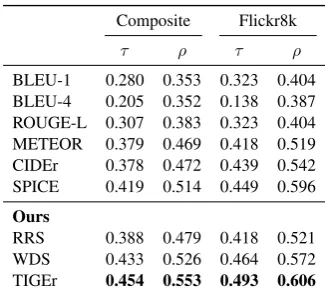
Table 1: Caption-level correlation between metrics and human grading scores in Composite and Flickr 8K dataset by using Kendall tau and Spearman rho. All p-values<0.01.
Since human annotation of the Pascal-50S data is a pairwise ranking instead of scoring, we kept
Figure 4: Average metric score based on human score group.
consistency with the prior work (Vedantam et al., 2015;Anderson et al.,2016) that evaluates metrics by accuracy. Different fromAnderson et al.(2016) who considered equally-scored pairs as correct cases, our definition of a correct case is that the metric should assign a higher score to a candidate that was preferred by human annotators.
4.4 Result on Composite & Flickr 8K
Metric Performance Table 1 displays the cor-relation between metrics and human judgments in terms ofτ andρ. Based on both correlation co-efficients, we achieved a noticeable improvement in the assessment of caption quality on Compos-ite and Flick8K compared to the previous best re-sults produced with existing metrics (Anderson et al., 2016; Elliott and Keller, 2014). Regard-ing the isolated impact of two similarity measures, we observe that WDS contributes more to caption evaluation than RRS. This finding indicates that the micro-level comparison of grounding similar-ity distribution is more sensitive to human judges than the macro-level contrast of image region rank by grounding scores.
TIGEr Score Analysis To understand the eval-uation results of TIGEr, we further analyzed our metric scores based on the group of human scoring on caption quality. As shown in Figure4, our met-ric scores are increasing according to the growth of human scores in both datasets. Overall, the growth rate of RRS is similar with the WDS score per dataset. Interestingly, the value of the metric scores increase more slowly in high-scored cap-tion groups than in low-scored groups (Flickr8k), which suggests that the difference in caption rele-vance between adjacent high-scored groups (e.g., 3 vs. 4) is smaller than the descriptions in nearby low-scored groups. A more detailed error analy-sis and qualitative analyanaly-sis is addressed in the Ap-pendix.
HC HI HM MM All
BLEU-1 51.20 95.70 91.20 58.20 74.08
BLEU-4 53.00 92.40 86.70 59.40 72.88
ROUGE-L 51.50 94.50 92.50 57.70 74.05
METEOR 56.70 97.60 94.20 63.40 77.98
CIDEr 53.00 98.00 91.50 64.50 76.75
SPICE 52.60 93.90 83.60 48.10 69.55
[image:7.595.322.509.62.156.2]TIGEr (ours) 56.00 99.80 92.80 74.20 80.70
Table 2: Accuracy of metrics at matching human judg-ments on PASCAL-50S with 5 reference captions. The highest accuracy per pair type is shown in bold font. Column titles are explained in Section 4.1.
4.5 Result on Pascal-50S
Fixed Reference Number Table 2 reports the evaluation accuracy of metrics on PASCAL-50S with five reference captions per image. Our metric achieves higher accuracy in most pair groups ex-cept for HM and HC. Given all instances, TIGEr improves the closeness to human judgment by 2.72% compared to the best prior metric (i.e., METEOR). Among the four considered candidate groups, identifying irrelevant human-written cap-tions in HI is relatively easy for all metrics, and TIGEr achieves the highest accuracy (99.80%). In contrast, judging the quality of two correct human-annotated captions in HC is difficult with a lower accuracy per metric compared to other test-ing groups. For this pair group, TIGEr (56.00%) shows a comparable performance with the best al-ternative metric (METEOR: 56.70%). More im-portantly, TIGEr reaches a noteworthy improve-ment in judging machine-generated caption pairs (MM) with an increasing in terms of accuracy by about 10.00% compared to the best prior metric (CIDEr: 64.50%).
Figure 5: Pairwise comparison accuracy (y-axis) of metrics at matching human judgments with 1-50 reference captions (x-axis). TIGEr (solid line in light-purple) is the best performing metric in both all pair group and machine-machine pair group. The number of reference captions is obviously beneficial to all existing metrics except TIGEr, which is less dependent on excessive references and can therefore greatly reduce human annotation costs.
Figure 6: Visualization of text-to-image grounding.
4.6 Text Component Sensitivity
We also explore the metrics’ capability to identify specific text component errors (i.e., object, action, and property). We randomly sampled a small set of images from Composite and Pascal-50S. Given an image, we pick a reference caption and gener-ate two candidgener-ates by replacing a text component. For example, we replaced the action“walk”from a reference“People walk in a city square”with a similar action“stroll” and a different action“are running” as a candidate pair. We then calcu-lated the accuracy of pairwise ranking per metric for each component. As Figure 7 shows, TIGEr is sensitive to recognizing object-level changes while comparatively weak in detecting action dif-ferences. This implies that text-to-image ground-ing is more difficult at the action-level than the object-level. Similarly, SPICE also has a lower ca-pability to identify action inconsistencies, which shows the limitation of scene graphs to capture this feature. In contrast, the n-gram-based metrics prefer to identify movement changes. To further study the sensitivity of TIGEr to property-level (i.e., object attributes) differences, we manually grouped the compared pairs based on their asso-ciated attribute category such as color. Our results show that states (e.g., sad, happy), counting (e.g.,
Figure 7: Metric accuracy at three text component lev-els.
one, two), and color (e.g., red, green) are top at-tribute groups in the sampled data, where TIGEr can better identify the differences of the counting description (acc. 84.21%) compared to the expres-sion of state (69.70%) and color (69.23%).
4.7 Grounding Analysis
[image:8.595.315.518.393.503.2]ad-dressing “garage”. According to our observation, the image region typically has a higher ground-ing weight with the correspondground-ing caption than the other unrelated region. Our observations suggest that since captions are typically short, they may not cover the information of all regions of an im-age and hence taking imim-age content into account for captioning evaluation is necessary.
5 Conclusion and Future Work
We have presented a novel evaluation metric called TIGEr for image captioning by utilizing text-to-image grounding result based on a pre-trained model. Unlike traditional metrics that are solely based on text matching between reference captions and machine-generated captions, TIGEr also takes the matching between image contents and captions into account , and the similarity be-tween captions generated by human judges and automated systems, respectively. The presented experiments with three benchmark datasets have shown that TIGEr outperforms existing popular metrics, and has a higher and more stable corre-lation with human judgments. In addition, TIGEr is a fine-grained metric in that it identifies descrip-tion errors at the object level.
Though TIGEr was build upon SCAN, our met-ric is not tied to this grounding model. The improvements with grounding models focusing on the latent correspondence between object-level image regions and descriptions will allow TIGEr to be further improved in the future. Since the pre-trained data mainly contains photo-based images, TIGEr primarily focuses on the caption evaluation in this image domain. For other domains, we can retrain the SCAN model using the ground-truth image-caption pairs, where the process is similar to applying a learning-based metric. In our future work, we plan to extend the metric to other visual-text generation tasks such as storytelling.
Acknowledgments
We appreciate anonymous reviewers for their con-structive comments and insightful suggestions. This work was mostly done when Ming Jiang was interning at Microsoft Research.
References
Somak Aditya, Yezhou Yang, Chitta Baral, Cor-nelia Fermuller, and Yiannis Aloimonos. 2015a.
From images to sentences through scene description graphs using commonsense reasoning and knowl-edge. arXiv preprint arXiv:1511.03292.
Somak Aditya, Yezhou Yang, Chitta Baral, Cor-nelia Fermuller, and Yiannis Aloimonos. 2015b. From images to sentences through scene description graphs using commonsense reasoning and knowl-edge. arXiv preprint arXiv:1511.03292.
Peter Anderson, Basura Fernando, Mark Johnson, and Stephen Gould. 2016. Spice: Semantic proposi-tional image caption evaluation. InECCV.
Peter Anderson, Xiaodong He, Chris Buehler, Damien Teney, Mark Johnson, Stephen Gould, and Lei Zhang. 2018. Bottom-up and top-down attention for image captioning and vqa. InCVPR.
Dzmitry Bahdanau, Kyunghyun Cho, and Yoshua Ben-gio. 2015. Neural machine translation by jointly learning to align and translate. InICLR.
Satanjeev Banerjee and Alon Lavie. 2005. Meteor: An automatic metric for mt evaluation with improved correlation with human judgments. InProceedings of the ACL workshop.
Raffaella Bernardi, Ruket Cakici, Desmond Elliott, Aykut Erdem, Erkut Erdem, Nazli Ikizler-Cinbis, Frank Keller, Adrian Muscat, and Barbara Plank. 2016. Automatic description generation from im-ages: A survey of models, datasets, and evalua-tion measures. Journal of Artificial Intelligence Re-search.
Hongge Chen, Huan Zhang, Pin-Yu Chen, Jinfeng Yi, and Cho-Jui Hsieh. 2018. Attacking visual language grounding with adversarial examples: A case study on neural image captioning. InACL.
Simon Corston-Oliver, Michael Gamon, and Chris Brockett. 2001. A machine learning approach to the automatic evaluation of machine translation. In ACL.
Yin Cui, Guandao Yang, Andreas Veit, Xun Huang, and Serge Belongie. 2018. Learning to evaluate im-age captioning. InCVPR.
Bo Dai, Sanja Fidler, Raquel Urtasun, and Dahua Lin. 2017. Towards diverse and natural image descrip-tions via a conditional gan. InICCV.
Desmond Elliott and Frank Keller. 2014. Comparing automatic evaluation measures for image descrip-tion. InACL.
Andrea Frome, Greg S Corrado, Jon Shlens, Samy Bengio, Jeff Dean, Tomas Mikolov, et al. 2013. De-vise: A deep visual-semantic embedding model. In NeurIPS.
Akira Fukui, Dong Huk Park, Daylen Yang, Anna Rohrbach, Trevor Darrell, and Marcus Rohrbach. 2016. Multimodal compact bilinear pooling for vi-sual question answering and vivi-sual grounding. In EMNLP.
Zhe Gan, Chuang Gan, Xiaodong He, Yunchen Pu, Kenneth Tran, Jianfeng Gao, Lawrence Carin, and Li Deng. 2017. Semantic compositional networks for visual captioning. InCVPR.
Jianfeng Gao, Michel Galley, and Lihong Li. 2019. Neural approaches to conversational ai. Founda-tions and Trends in Information Retrieval.
Micah Hodosh, Peter Young, and Julia Hockenmaier. 2013. Framing image description as a ranking task: Data, models and evaluation metrics. Journal of Ar-tificial Intelligence Research.
Qiuyuan Huang, Zhe Gan, Asli Celikyilmaz, Dapeng Wu, Jianfeng Wang, and Xiaodong He. 2019. Hier-archically structured reinforcement learning for top-ically coherent visual story generation. InAAAI.
Allan Jabri, Armand Joulin, and Laurens van der Maaten. 2016. Revisiting visual question answering baselines. InECCV.
Kalervo J¨arvelin and Jaana Kek¨al¨ainen. 2002. Cumu-lated gain-based evaluation of ir techniques. ACM Transactions on Information Systems.
Andrej Karpathy and Li Fei-Fei. 2015. Deep visual-semantic alignments for generating image descrip-tions. InCVPR.
Andrej Karpathy, Armand Joulin, and Li F Fei-Fei. 2014. Deep fragment embeddings for bidirectional image sentence mapping. InNeurIPS.
Andrej Karpathy and Fei-Fei Li. 2015. Deep visual-semantic alignments for generating image descrip-tions. InCVPR.
Ryan Kiros, Ruslan Salakhutdinov, and Richard S. Zemel. 2014. Unifying visual-semantic embeddings with multimodal neural language models. arXiv preprint arXiv:1411.2539.
Alex Kulesza and Stuart M Shieber. 2004. A learn-ing approach to improvlearn-ing sentence-level mt evalu-ation. InProceedings of the 10th International Con-ference on Theoretical and Methodological Issues in Machine Translation.
Solomon Kullback and Richard A Leibler. 1951. On information and sufficiency. The annals of mathe-matical statistics.
Kuang-Huei Lee, Xi Chen, Gang Hua, Houdong Hu, and Xiaodong He. 2018. Stacked cross attention for image-text matching. InECCV.
Chin-Yew Lin. 2004. Rouge: A package for auto-matic evaluation of summaries. Text Summarization Branches Out.
Tsung-Yi Lin, Michael Maire, Serge Belongie, James Hays, Pietro Perona, Deva Ramanan, Piotr Doll´ar, and C Lawrence Zitnick. 2014. Microsoft coco: Common objects in context. InECCV.
Ryan Lowe, Michael Noseworthy, Iulian Vlad Ser-ban, Nicolas Angelard-Gontier, Yoshua Bengio, and Joelle Pineau. 2017. Towards an automatic Turing test: Learning to evaluate dialogue responses. In ACL.
Kishore Papineni, Salim Roukos, Todd Ward, and Wei-Jing Zhu. 2002. Bleu: a method for automatic eval-uation of machine translation. InACL.
Ramakrishna Vedantam, C Lawrence Zitnick, and Devi Parikh. 2015. Cider: Consensus-based image de-scription evaluation. InCVPR.
Liwei Wang, Yin Li, Jing Huang, and Svetlana Lazeb-nik. 2018a. Learning two-branch neural networks for image-text matching tasks.PAMI.
A Appendices
A.1 Error Analysis
To have a better understanding of inconsistent score ranks between TIGEr and human evalua-tion assigned to candidates in the Composite and Flick8k datasets, we further conducted an error analysis. Considering the score of TIGEr is con-tinuous [0, 1], while human scoring is done on an n-point scale, we map our metric score onto the n-point scale by sorting instances according to TIGEr results, and assigning a score group per in-stance based on the distribution of human scores. Figure 8 shows the distribution of score group differences between TIGEr and human evaluation for both datasets. We observe that true positives (i.e., the score group of TIGEr is equal to the hu-man score for a given caption) achieve higher fre-quency than each error group. On the other hand, inconsistent cases with the small differences of as-signed scores (e.g., TIGEr assigns 3, while human assigns 4 to a testing caption) get a higher fre-quency than the notable difference between two metric scores, especially for the test cases from the Flickr8k dataset. Our finding suggests that cap-tions with subtle quality difference are more diffi-cult to be discriminated than instances with signif-icant gaps.
A.2 Qualitative Analysis
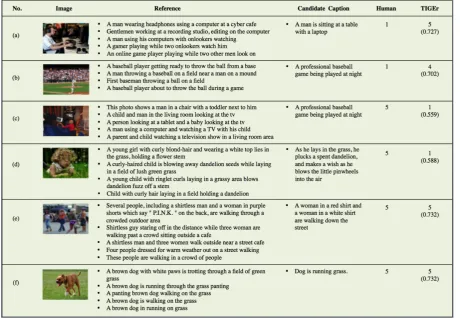
To illustrate some characteristics of TIGEr more in depth, we show human and TIGEr scores for a set of caption examples in Table 3. In order to make the result of two metrics comparable, both the score group and actual grading value of TIGEr are displayed. Note that we provide an equal num-ber of examples for each type of comparison result (i.e., either human or TIGEr score is higher than the other one & both scores are equal) in Table3.
We find that TIGEr is able to measure a caption quality by considering the semantic information of image contents. For example, human-written references in case (e) primarily provide an over-all description of over-all people shown in the image, while the candidate caption specifically describes two walking women in the image. Despite such difference at the text-level, TIGEr assigns a high score to this sentence - just like human evaluators. Case (b) also supports this finding to some ex-tent. Unlike the references that specially described a baseball payer in the game, the candidate caption in this example provides a general description that
is matching with the image content (e.g., “base-ball game”, “at night”). This observation may help to explain why TIGEr gave this sentence a high score.
Figure 8: Distribution of group score differences between TIGEr and human evaluation
[image:12.595.77.538.356.674.2]