Proceedings of the 2019 Conference on Empirical Methods in Natural Language Processing 2682
Modeling Event Background for If-Then Commonsense Reasoning Using
Context-aware Variational Autoencoder
Li Du, Xiao Ding, Ting Liu∗ and Zhongyang Li
Research Center for Social Computing and Information Retrieval Harbin Institute of Technology, China
{ldu, xding, tliu, zyli}@ir.hit.edu.cn
Abstract
Understanding event and event-centered com-monsense reasoning are crucial for natural lan-guage processing (NLP). Given an observed event, it is trivial for human to infer its in-tents and effects, while this type of If-Then reasoning still remains challenging for NLP systems. To facilitate this, a If-Then common-sense reasoning dataset Atomic is proposed, together with an RNN-based Seq2Seq model to conduct such reasoning. However, two fun-damental problems still need to be addressed: first, the intents of an event may be multiple, while the generations of RNN-based Seq2Seq models are always semantically close; sec-ond, external knowledge of the event back-ground may be necessary for understanding events and conducting the If-Then reasoning. To address these issues, we propose a novel context-aware variational autoencoder effec-tively learning event background information to guide the If-Then reasoning. Experimental results show that our approach improves the accuracy and diversity of inferences compared with state-of-the-art baseline methods.
1 Introduction
Recently, event-centered commonsense knowl-edge has attracted much attention (Chambers and Jurafsky, 2008; Segers et al., 2016; Wang et al.,
2017;Li et al., 2018), because of understanding events is an important component of NLP. Given a daily-life event, human can easily understand it and reason about its causes, effects, and so on. However, it still remains a challenging task for NLP systems. This is partly due to most of them are trained for task-specific datasets or objectives, which results in models that are adapt at finding task-specific underlying correlation patterns but have limited capability in simple and explainable commonsense reasoning (Sap et al.,2018).
∗
[image:1.595.309.525.222.294.2]Corresponding author
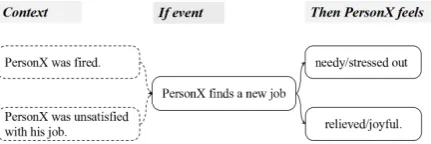
Figure 1: A illustration of two challenging problems in If-Then reasoning. (a) Given an observed event, the feelings about this event could be multiple. (b) Background knowl-edge is need for generating reasonable inferences, which is absent in the dataset (marked by dashed lines).
To facilitate this,Rashkin et al.(2018) build the Event2Mind dataset andSap et al. (2018) present the Atomic dataset, mainly focus on nine If-Then reasoning types to describe causes, effects, intents and participant characteristic about events. To-gether with these datasets, a simple RNN-based encoder-decoder framework is proposed to con-duct the If-Then reasoning.
However, there still remains two challenging problems. First, as illustrated in Figure 1, given an event “PersonX finds a new job”, the plausi-ble feeling of PersonX about that event could be multiple (such as “needy/stressed out” and “re-lieved/joyful”). Previous work showed that for the one-to-many problem, conventional RNN-based encoder-decoder models tend to generate generic responses, rather than meaningful and specific an-swers (Li et al.,2016;Serban et al.,2016).
Second, as a commonsense reasoning problem, rich background knowledge is necessary for gen-erating reasonable inferences. For example, as shown in Figure1, the feeling of PersonX upon the event “PersonX finds a new job” could be multi-ple. However, after given a context “PersonX was fired”, the plausible inferences would be narrowed down to “needy” or “stressed out”.
Vari-ational Autoencoder (VAE) based models have shown great potential in modeling the one-to-many problem and generate diversified inferences (Bowman et al.,2015;Zhao et al.,2017).
In addition to the traditional VAE structure, we introduces an extra context-aware latent variable in CWVAE to learn the event background knowl-edge. In the pretrain stage, CWVAE is trained on an auxiliary dataset (consists of three narra-tive story corpora and contains rich event back-ground knowledge), to learn the event backback-ground information by using the context-aware latent vari-able. Subsequently, in the finetune stage, CWVAE is trained on the task-specific dataset to adapt the event background information to each specific as-pect of If-Then inferential target (e.g., intents, re-actions, etc.).
Experiments on the Event2Mind and Atomic dataset show that our proposed approach outper-forms baseline methods in both the accuracy and diversity of inferences. The code is released at
https://github.com/sjcfr/CWVAE.
2 Background
Before specifically describing two dataset —-Event2Mind and Atomic used in this paper as well as the If-Then reasoning task, for clarity, we define the following terminologies:
Base event: the prerequisite event in If-Then reasoning, organized as a verb phrase with a predi-cate and its arguments, such as the event “PersonX finds a new job” shown in Figure1.
Inference dimension:a particular If-Then rea-soning type, e.g., intents, effects of the base event. Details are shown in Table1and Table2.
Target: the inferential results. For example, as shown in Figure 1, given a base event “Per-sonX finds a new job” and one inference dimen-sion “xReact”, the targets could be “relieved” or “needy”. Notice that each inference dimension can have multiple targets.
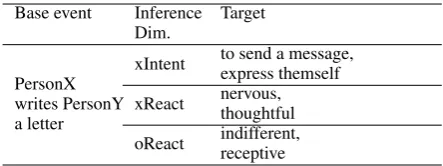
Event2Mind Dataset contains 25K base events and 300K targets, annotated through crowdsourc-ing. Event2Mind is organized in a hierarchical form: each base event has three types of inference dimensions, and given a base event, under one of inference dimensions, several targets may simul-taneously exist. Table 1 shows the (base event-inference dimension-target) hierarchical structure through an example from Event2Mind.
Atomic Dataset Inspired by Event2Mind, the
Base event Inference Dim.
Target
PersonX writes PersonY a letter
xIntent to send a message, express themself
xReact nervous, thoughtful
[image:2.595.306.528.61.144.2]oReact indifferent, receptive
Table 1: Hierarchical structure of Event2Mind dataset. For specific inference dimensions, “x” and “o” refers to PersonX and others respectively.
Base event Inference Dim.
Target
PersonX adopts a child
xIntent to help another person, to have a child
xNeed to visit adoption agency, to be approved for adoption
xAttr compassionate, generous
xEffect becomes a parent,
gains love and companionship
xWant take child home, buy child clothes
xReact happy, caring
oReact has a parent,
receives love and affection
oWant try on new clothes, to have a family
oEffect has a parent,
[image:2.595.308.528.200.400.2]Receives love and affection
Table 2: Hierarchical structure of Atomic dataset. For spe-cific inference dimensions, “x” and “o” refers to PersonX and others respectively.
Atomic dataset shares the same hierarchical struc-ture as Event2Mind, while scales up the size of dataset and expands the scope to nine types of inference dimensions. Table 2 shows the (base event-inference dimension-target) hierarchi-cal structure through an example from Atomic. Though Atomic covers the inference dimensions of Event2Mind, the base event collection of Event2Mind is nonidentical to that of Atomic. Problem Definition The If-Then reasoning task could be formally defined as a conditional one-to-many generation problem: given a base event x and one inference dimension d, the model is re-quired to generate targets y = f(x, d) as close to the ground truths as possible. Both x and y consist of sequence of words:x ={x1, . . . , xm},
andy ={y1, . . . , yn}, wheremandndenotes the
length ofxandy, respectively.
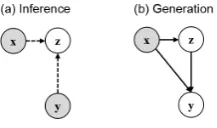
con-Figure 2: Illustration of inference and generation process of CVAE in a directed graph. Dashed lines represent the infer-ence ofz. Solid lines represent the generation process.
ditional variational autoencoder (CVAE) (Sohn et al.,2015) is an extension of VAE on the con-ditional generation problem. As shown in Fig-ure2(a), CVAE characterizes the conditional one-to-many generation problem using three random variables: event x, target y and a latent variable z, which is used for modeling the latent distri-bution of semantic over targets given an event. Hence, under a certain inference dimension, with regard to the latent semantic variablez, the condi-tional generation problem could be expressed as p(y|x) = R
p(y|x, z)p(z|x)dz. CVAE models p(y|x, z) andp(z|x) using deep neural networks (parameterized byθ)pθ(y|x, z)andpθ(z|x). Then
as illustrated in Figure2(b),ycould be generated fromxandz.
CVAE is trained to maximize the conditional likelihood p(y|x), which involves an intractable marginalization over the latent variable z. In-stead, following Kingma and Welling (2014), a practical way is to introduce another deep network (parameterized by φ) qφ(z|x, y) to approximate
the true posterior distributionp(z|x, y)and maxi-mize the evidence lower bound (ELBO) of the log-likelihood function:
LELBO(θ, φ) =Eqφ(z|x,y)log(pθ(y|x, z))−
KL(qφ(z|x, y)||pθ(z|x))
≤logp(y|x)
(1)
Therefore, CVAE is composed of three neural networks in general. We refer topθ(z|x)as a prior
network,qφ(z|x, y)as a recognition network, and
pθ(y|x, z)as a neural decoder.
3 Context-aware Variational Autoencoder
[image:3.595.124.233.64.128.2]Traditional CVAE can model the event-target relation. In other words, given an observed event, CVAE can generate its corresponding tar-gets. While in this paper we model the If-Then reasoning as a[(background), event]-target process. It means that in addition to the observed
Figure 3: Illustration of pretrain, finetune and generation process of CWVAE in a directed graph. Dashed lines rep-resent the inference ofz, zc andzc0. Solid lines represent
the generation process. Red circle denotes the context-aware latent variable.
event, we also want to involve the event back-ground knowledge (which can be learned from event contexts) to generate the reasonable targets.
To this end, we propose a context-aware varia-tional autoencoder (CWVAE), with two addivaria-tional latent variables: a context-acquiring latent vari-able zc to directly acquire context information,
and a context-aware latent variable zc0 to learn background knowledge fromzc, as shown in
Fig-ure3(a). However, the event context information is absent in the Event2Mind and Atomic dataset. To learn from the external event context informa-tion, we design the following two-stage training procedure for CWVAE.
Pretrain: Learning Event Background Knowl-edge from Auxiliary Dataset In the pretrain stage, CWVAE is trained on three narrative story corpora with rich event context information. As shown in Figure 3 (a), context-acquiring latent variablezcis directly conditioned on the contextc.
Hence,zc could be employed for acquiring
back-ground knowledge from event contexts. Then, we minimize the distance betweenzcand the
context-aware latent variablezc0, by which the event back-ground knowledge is transferred fromzctozc0.
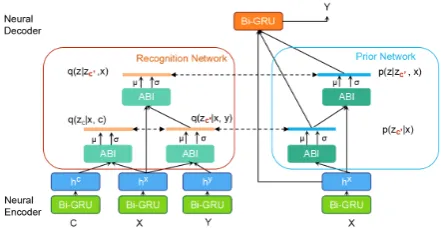
[image:3.595.315.521.64.153.2]Figure 4: Architecture of CWVAE. We mark Neural encoder in green, prior network in blue, recognition network in brown and neural decoder in orange, respectively.
3.1 Architecture of CWVAE
As shown in Figure 4, CWVAE is mainly com-posed of four parts: a neural encoder that provides distributed representations of base events/targets, a recognition network for inferring qφ(z|x, y),
qφ(zc|x, c) and qφ(z|zc0, x), a prior network for modelingpθ(zc0|x) andpθ(z|x, zc0), and a neural decoder that integrates the information fromzand zc0 to generate targets.
Neural EncoderWe employ a bidirectional GRU as neural encoder, which encodes contextc, event x and target y into distributed representations hc = {hc
1, . . . , hclc}, h
x = {hx
1, . . . , hxlx} and
hy = {hy1, . . . , hyl
y}, where lc, lx and ly is the
length ofc,xandy, respectively.
Recognition Network The recognition network models qφ(z|x, y), qφ(zc|x, c), qφ(z|zc0, x) based onhx,hy andhc.
Following traditional VAE, the above-mentioned three distributions are assumed to be multivariate Gaussian distribution with a diagonal covariance structure:
qφ(zc|x, c)∼N(µzc(x, c), σzc(x, c)I)
qφ(zc0|x, y)∼N(µz
c0(x, y), σzc0(x, y)I)
qφ(z|x, y)∼N(µz(x, y), σz(x, y)I)
(2)
where µ denotes the mean of the distribution, σ denotes the standard deviation of the distribution, andIdenotes the identity matrix.
Given hx, hy and hc, we propose a novel attention-based inferer (ABI) module to estimate the mean and standard deviation of qφ(zc|x, c),
qφ(zc0|x, y)andqφ(z|x, y):
µzc, σz= ABIc(h
c, hx)
µzc0, σz= ABIc0(h
y, hx)
µz, σz = ABIz(zc0, hx)
(3)
Briefly, through the attention mechanism, ABI can capture the semantic interaction between input sequences, and estimate the parameters of distri-butions based on it. We will introduce the specific structure of ABI in below.
Prior Network Prior Network models pθ(zc0|x) andpθ(z|x, zc0)based onhx. The distribution of pθ(zc0|x) and pθ(z|x, zc0) are still assumed to be multivariate Gaussian, whereas the parameters are different:
pθ(z|x)∼N(µ
0
z(x), σ
0
z(x)I)
pθ(zc0|x)∼N(µ 0
zc0(x), σ
0
zc0(x)I)
(4)
whereµ0 denotes the mean of the distribution, σ0 denotes the standard deviation of the distribution andIdenotes the identity matrix.
Then the attention-based inferer module is still employed to estimate parameters of distributions:
µ0z
c0, σ
0
z = ABI
0
c0(hy, hx) µ0z, σz0 = ABI0z(zc0, hx)
(5)
Neural DecoderGiven the base event x, the se-mantic latent variablez, and the context-aware la-tent variable zc0, the neural decoder defines the generation probability ofyas following:
p(y|x, z, zc0) =
n
Y
j=1
p(yj|y < j, z, zc0, x) (6)
wherep(yj|y < j, z, zc0, x) = g(yj−1, sj−1, ej), g(·) is an attention-based feed forward model, ej = Piαjihxi is the context vector and sj−1
is the hidden state of the decoder. We obtain g(·) and ej the same way as Bahdanau et al.
(2014). Whereas our decoder differs from Bah-danau et al. (2014) in that our model integrates the context-aware latent variable zc0 and seman-tic latent variable z in the computation of sj =
GRU([Eyj;sj−1, z, zj−1]), whereEyjis the word
embeddings of target words.
Note that through concatenatingzandzc0 with Eyj and sj−1, sj could be affected by
context-aware latent variablezc0 and semantic latent vari-ablez. This allows model to directly access to the event background knowledge from zc0. In addi-tion, the randomness ofz andzc0 would increase the diversity of model generation.
the mean and standard deviation of a distribution belongs topθ(·)orqφ(·)by capturing semantic
in-teractions of input sequences.
Specifically, given two input sequences (e.g., representations of contexts and events) a =
{a1, . . . , ala} andb = {b1, . . . , blb} with length
laandlb, we first obtain the attention scores from
each side through:
γat =
exp[(Wahat)T(Wbhbi)]
P
iexp[(Wah
a
t)T(Wbhbi)]
γtb=
exp[(Wahai)T(Wbhbt)]
P
iexp[(Wahai)T(Wbhbt)]
(7)
whereWa∈Rd×da andWb∈Rd×db are
parame-ter weights.
With these attention scores, the context vectors of both sequences are given by:
cat =aγta
cbt =bγtb (8)
Then we perform a mean pooling operation on context vectors of both sequences:
¯ ca= 1
la la
X
t=1
cat
¯ cb= 1
lb lb
X
t=1
cbt
(9)
To obtain the mean and standard deviation, the pooled context vectors c¯a andc¯b which carry
se-mantic interaction between two sequences, are concatenated and projected into a latent semantic space through a nonlinear transformation:
hz = tanh(W[¯ca; ¯cb] +bz) (10)
Finally the mean and standard deviation are generated through a nonlinear transformation over hz:
µ=Wµhz+bµ
σ= softplus(Wσhz+bσ)
(11)
3.2 Optimizing
With the incorporation ofzc0, the original loglike-lihood could be decomposed as:
logp(y|x) =
Z Z
p(y|z, zc0, x)dzdzc0 (12)
Then following traditional CVAE, the ELBO of CWVAE is defined as follows:
LELBO(θ, φ) =
Eqφ(z|x,zc0)qφ(zc0|x,y)logpθ(y|x, z, zc0)
| {z }
Reconstruction Loss
−
Z
qφ(z|x, y)KL(qφ(zc0|x, y)||pθ(zc0|x))dz
| {z }
KL term −
Z
qφ(zc0|x, y)KL(qφ(z|x, zc0)||pθ(z|x, zc0))dzc0
| {z }
KL term
(13)
which is the objective function at the finetune stage.
While in the pretrain stage, as we aim to learn background knowledge through minimizing the distance betweenzcandzc0, in addition toLELBO, a context-aware regulation term is introduced:
LP T(θ, φ) =LELBO(θ, φ)
−λ
Z
KL(qφ(zc|x, c)||qφ(zc0|x, y))dzc0
| {z }
context-aware regulation
(14)
where the context aware regularization term is the KL distance between z and zc0. Through mini-mizing the context aware regularization term, we aim to pass event context knowledge fromzcto the
context aware latent variablezc0.
3.3 Training Details
To test the performance of CWVAE, we split the Event2Mind and Atomic dataset into training, de-velopment and test sets (80%, 10%, 10%) in the same way asRashkin et al. (2018) andSap et al.
(2018), respectively.
We initialize the embedding layer from 300d GloVe word embeddings. The neural encoder is chosen to be biGRU with 300 hidden units. For the ABI module, size ofWa andWb is set to be
100×da and100×db respectively. The
dimen-sion ofzc, zc0 andz is all set as 40. The neural decoder is set to be GRU with 300d hidden state. Regulation coefficientλof context-aware regula-tion term is set to be 0.1. Models are trained using an Adam optimizer (Kinga and Adam,2015) with a learning rate of 0.001.
4 Experiments
4.1 Auxiliary Dataset
Context Event Inference Target 1
jason had been really stressed out at work. 2
he decided he needed a different kind of job. 3
jason applied for a job in a different field. 4
[image:6.595.89.509.60.104.2]he got the job . 5 jason was much happier at his new job .
Table 3: An example for the construction of auxiliary dataset. For a five-sentence-paragraph, the first three sentences are taken as event context, while the fourth and fifth sentence is taken as base event and target respectively.
et al.,2016), VIST (Huang et al.,2016) and Writ-ingPrompts (Fan et al., 2018). ROCStories and VIST are composed of short stories with five sen-tences. We filter out stories of more than 1,000 words in WritingPrompts, and cut the remaining stories into five-sentence-paragraphs.
For each five-sentence-paragraph, we define the first three sentences as contexts of the base event, the fourth sentence as the base event, and the fifth sentence as the inference target. For example, as shown in Table3, the first three sentences describe a context that Jason was unsatisfied about his job and applied for a new job. Hence, after happening the event “he got the job”, a plausible react about the event could be “jason was much happier at his new job”. In total, the auxiliary dataset contains 192,316(context, event, target)triples.
4.2 Baselines
We compared our proposed model with the follow-ing four baseline methods:
• RNN-based Seq2Seq proposed by Sap et al.
(2018) for the If-Then reasoning on Atomic. • Variational Seq2Seq combines a latent
vari-able with the encoder-decoder structure through converting the last hidden state of RNN en-coder into a Gaussian distributed latent variable (Bowman et al.,2015).
• VRNMTPropose bySu et al.(2018), VRNMT combines CVAE with attention-based encoder-decoder framework through introduces a latent variable to model the semantic distribution of targets.
• CWVAE-Unpretrained refers to the CWVAE model without the pretrain stage.
Note that, for each baseline method, we train dis-tinct models for each disdis-tinct inference dimension, respectively.
4.3 Evaluation Metrics
Automatic Evaluation We first compare the perplexity of CWVAE with baseline methods. Per-plexity measures the probability of model to re-generate the exact targets, which is particular
suit-Metric Methods xIntent xReact oReact
PPL
RNN-based Seq2Seq 44.12 29.18 14.08 Variational Seq2Seq 42.06 28.22 12.62
VRNMT 33.45 25.54 11.93
CWVAE-Unpretrained 31.32 24.07 11.37
CWVAE 29.23 23.17 11.04
BLEU
RNN-based Seq2Seq 2.75 2.11 5.18 Variational Seq2Seq 2.84 2.43 2.08
VRNMT 3.94 4.81 6.61
CWVAE-Unpretrained 5.52 7.36 5.33
[image:6.595.307.525.151.267.2]CWVAE 5.65 12.98 6.97
Table 4: Average perplexity and BLEU score (reported in percentages) for the top 10 generations under each inference dimension of Event2Mind. The the best result for each di-mension is emboldened.
Metric Methods xIntent xReact oReact
dist-1
RNN-based Seq2Seq 0.0002 0.0002 0.0001 Variational Seq2Seq 0.0006 0.0003 0.0001 VRNMT 0.0002 0.0002 0.0003 CWVAE-Unpretrained 0.0023 0.0017 0.0004 CWVAE 0.0052 0.0033 0.0025
dist-2
RNN-based Seq2Seq 0.0005 0.0002 0.0002 Variational Seq2Seq 0.0014 0.0002 0.0001 VRNMT 0.0005 0.0003 0.0001 CWVAE-Unpretrained 0.0061 0.0040 0.0013 CWVAE 0.0146 0.0099 0.0063
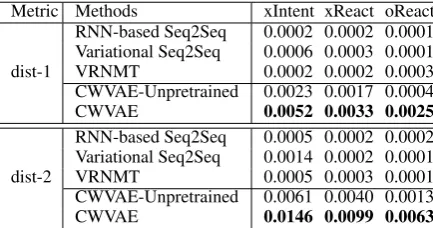
Table 5: Distinct-1 and distinct-2 scores for the top 10 gen-erations under each inference dimension of Event2Mind. The the best result for each dimension is emboldened.
able for evaluating the model performance on one-to-many problem (Serban et al., 2017). Further, we employ BLEU score to evaluate the accuracy of generations (Papineni et al., 2002), and the number of distinct n-gram to evaluate the diver-sity of generations (Li et al.,2016). The distinct is normalized to[0,1] by dividing the total number of generated tokens.
Human Evaluation Since automatic evaluation of generations is still a challenging task (Liu et al.,
[image:6.595.308.525.323.437.2]eval-Metric Methods xIntent xNeed xAttr xEffect xReact xWant oWant oReact oEffect
PPL
RNN-based Seq2Seq 22.54 24.69 33.54 65.13 29.52 26.63 16.76 14.99 35.17 Variational Seq2Seq 26.48 28.31 33.00 68.62 29.93 29.50 16.98 14.25 34.20 VRNMT 21.04 24.28 24.87 61.05 26.62 28.57 14.45 14.86 30.12 CWVAE-Unpretrained 20.73 23.72 25.80 60.62 25.75 26.71 15.93 12.82 32.00 CWVAE 15.93 20.32 23.85 50.74 21.39 24.02 14.02 11.70 29.13
BLEU
RNN-based Seq2Seq 8.17 12.35 2.96 5.26 3.43 13.44 7.08 4.09 6.42 Variational Seq2Seq 8.31 12.05 2.13 6.07 2.52 11.71 7.40 4.08 6.38
VRNMT 9.52 13.35 4.87 4.42 7.64 9.80 10.79 5.28 13.71
CWVAE-Unpretrained 11.37 14.64 4.07 14.11 7.86 12.70 12.09 8.16 14.93
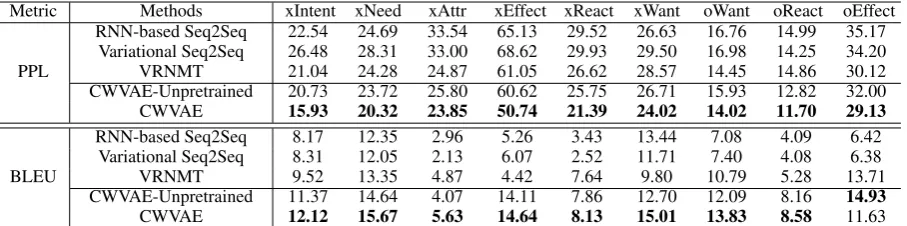
[image:7.595.74.528.62.175.2]CWVAE 12.12 15.67 5.63 14.64 8.13 15.01 13.83 8.58 11.63 Table 6: Average perplexity and BLEU scores (reported in percentages) for the top 10 generations under each inference dimension of Atomic. The the best result for each dimension is emboldened.
Metric Methods xIntent xNeed xAttr xEffect xReact xWant oWant oReact oEffect
dist-1
RNN-based Seq2Seq 0.0012 0.0029 0.0004 0.0019 0.0001 0.0022 0.0006 0.0001 0.0006 Variational Seq2Seq 0.0006 0.0018 0.0002 0.0002 0.0001 0.0013 0.0007 0.0001 0.0002 VRNMT 0.0002 0.0001 0.0053 0.0005 0.0018 0.0022 0.0005 0.0001 0.0004 CWVAE-Unpretrained 0.0019 0.0036 0.0119 0.0046 0.0021 0.0013 0.0018 0.0005 0.0006 CWVAE 0.0055 0.0045 0.0142 0.0028 0.0043 0.0040 0.0021 0.0030 0.0033
dist-2
[image:7.595.77.526.210.324.2]RNN-based Seq2Seq 0.0036 0.0081 0.0002 0.0018 0.0002 0.0006 0.0013 0.0001 0.0011 Variational Seq2Seq 0.0013 0.0042 0.0001 0.0003 0.0002 0.0026 0.0002 0.0003 0.0006 VRNMT 0.0002 0.0011 0.0002 0.0005 0.0001 0.0034 0.0005 0.0001 0.0004 CWVAE-Unpretrained 0.0060 0.0088 0.0136 0.0113 0.0043 0.0029 0.0041 0.0011 0.0009 CWVAE 0.0162 0.0112 0.0146 0.0072 0.0013 0.0107 0.0044 0.0068 0.0093
Table 7: Distinct-1 and distinct-2 scores for the top 10 generations under each inference dimension of Atomic. The the best result for each dimension is emboldened.
uation. Finally we report three overall averaged scores ofcoherence,diversityandfluencyon both datasets, respectively.
4.4 Overall Results
We list the perplexity and BLEU score of CWVAE and baseline methods on Event2Mind and Atomic in Table4and Table6, respectively, and show the distinct-1 and distinct-2 score on Event2Mind and Atomic in Table 5and Table 7, respectively. We find that:
(1) As shown in Table5and Table7, compari-son between RNN-based Seq2Seq and variational-based methods, including Variational Seq2Seq, VRNMT, CWVAE-unpretrained and CWVAE shows that, variational-based methods could in-crease the diversity of generations. This con-firms one of our motivations that variational-based methods could capture the latent semantic distri-bution within targets and increase the diversity of If-Then reasoning.
(2) Comparing CWVAE-unpretrained with other baseline methods shows that, in general CW-VAE improves the accuracy and diversity on both dataset. These results indicate the efficiency of CWVAE in capturing the latent semantic distribu-tion of targets, and generate more reasonable in-ferential results.
(3) Comparison between CWVAE and CWVAE-unpretrained shows that the
pre-Methods Coherence Diversity Fluency RNN-based Seq2Seq 0.28 2.03 0.73 Variational Seq2Seq 0.33 1.67 0.92
VRNMT 0.32 2.60 0.83
CWVAE-Unpretrained 0.36 2.10 0.92
CWVAE 0.43 2.85 0.96
Table 8: Human evaluation results on Event2Mind.
Methods Coherence Diversity Fluency RNN-based Seq2Seq 0.21 2.66 0.78 Variational Seq2Seq 0.22 2.70 0.90
VRNMT 0.24 2.61 0.78
CWVAE-Unpretrained 0.25 2.72 0.83
CWVAE 0.32 3.03 0.90
Table 9: Human evaluation results on Atomic.
train stage could enhance the performance of CWVAE in both the accuracy and diversity. This is mainly because event knowledge could offer the guidance for If-Then reasoning. In the pretrain stage, CWVAE could capture the event background knowledge through context-aware latent variable, and such knowledge could be be adapted to our task through the fintune stage.
Base event Inference dim.
Generations
Ground truth
CWVAE RNN-based Seq2Seq
PersonX works
tirelessly xIntent
be productive and hardworking finish his work soon
earn more money and accomplish goal finish his work and make money finish his work and accomplish goal be productive and successful
get the job done get the job done on time get the job done in the way get the job done for his life make money for his own future make money for his own money
be productive
[image:8.595.84.521.62.128.2]finish the project as soon as possible reach goal
Table 10: An example of inferences made by CWVAE and RNN-based Seq2Seq model under inference dimension “xIntent”.
on coherence and fluency. The main reasons are twofold: first, the CWVAE has advantage in cap-turing the semantic distribution of targets; second, event background learned from the pretrain stage is helpful for the If-Then reasoning.
4.5 Case Study
Table 10 provides an example of model genera-tions given the base event “PersonX works tire-lessly” and the inference dimension “xIntent”. The generations under CWVAE mainly contain four kinds of semantics: (1) be productive, (2) fin-ish his work soon, (3) accomplfin-ish goal, (4) earn more money. While the semantics of generations using baseline RNN-based Seq2Seq model is rel-atively limited. Furthermore, the first three kinds of semantic overlap the three ground truth targets, and the fourth kind of semantic is in accordance with daily-life commonsense. Compared to RNN-based Seq2Seq model, our approach can increase the diversity and rationality of generations, mean-while keep the accuracy.
5 Related Work
5.1 Event-Centered Commonsense Reasoning
Understanding events and constructing event-centered commonsense knowledge are crucial to many NLP applications, such as intention recog-nition (Goldwasser and Zhang, 2016) and dialog generation (Wen et al.,2017). Recently a growing number of studies focus on event-centered com-monsense reasoning, which mainly concentrates on two areas, script event prediction and story end-ing generation/choosend-ing.
Script event prediction concerns with the temporal relationships between script events (Granroth-Wilding and Clark, 2016), which re-quires models to choose a correct subsequent triple-organized event among the candidates (Wang et al., 2017). Prior work mainly focused on modeling event pairs (Granroth-Wilding and Clark,2016), event chains (Wang et al.,2017) and event graph (Li et al.,2018) to predict the
subse-quent event. Story ending generation focuses on generating plausible story endings (Mostafazadeh et al.,2016), which requires models to understand the story context, and keep generated endings log-ically consistent with it (Peng et al., 2017;Guan et al., 2019). The above tasks mainly investi-gate the logical orders of events, whereas the If-Then reasoning task focuses on inferring the men-tal state of event participants.
5.2 Variational AutoEncoder-Decoder Based Natural Language Generation
VAE (Kingma and Welling,2014) has been widely applied in various of text generation tasks, such as dialogue and machine translation.
In dialogue generation, Zhao et al. (2017) adapts VAE with encoder-decoder framework to model the latent semantic distribution of answers, which can increase the diversity of generations. For the task of machine translation, Su et al.
(2018) and Zhang et al. (2016) employ a latent variable to capture the semantic interaction be-tween the source and target sentence, and regard the latent variable as a supplementation of atten-tion mechanism. WhileWang et al.(2019) use the latent variable to model topic distributions in text generation. In this paper, we introduce an addi-tional context-aware latent variable to effectively learn background knowledge and conduct If-Then reasoning on the guidance of it.
6 Conclusion
7 Acknowledgments
We thank the anonymous reviewers for their constructive comments, and gratefully acknowl-edge the support of the National Key Re-search and Development Program of China (SQ2018AAA010010), the National Key Re-search and Development Program of China (2018YFB1005103), the National Natural Science Foundation of China (NSFC) via Grant 61702137.
References
Dzmitry Bahdanau, Kyunghyun Cho, and Yoshua Ben-gio. 2014. Neural machine translation by jointly learning to align and translate. arXiv preprint arXiv:1409.0473.
Samuel R Bowman, Luke Vilnis, Oriol Vinyals, An-drew M Dai, Rafal Jozefowicz, and Samy Ben-gio. 2015. Generating sentences from a continuous space. arXiv preprint arXiv:1511.06349.
Nathanael Chambers and Dan Jurafsky. 2008. Unsu-pervised learning of narrative event chains. Proc. of ACL-08: HLT, pages 789–797.
Angela Fan, Mike Lewis, and Yann Dauphin. 2018. Hierarchical neural story generation. In Proceed-ings of the 56th Annual Meeting of the Association for Computational Linguistics (Volume 1: Long Pa-pers), pages 889–898.
Dan Goldwasser and Xiao Zhang. 2016. Understand-ing satirical articles usUnderstand-ing common-sense. Transac-tions of the Association for Computational Linguis-tics, 4:537–549.
Yichen Gong, Heng Luo, and Jian Zhang. 2017. Natu-ral language inference over interaction space. arXiv preprint arXiv:1709.04348.
Mark Granroth-Wilding and Stephen Clark. 2016. What happens next? event prediction using a com-positional neural network model. InAAAI.
Jian Guan, Yansen Wang, and Minlie Huang. 2019. Story ending generation with incremental encoding and commonsense knowledge.
Ting-Hao Kenneth Huang, Francis Ferraro, Nasrin Mostafazadeh, Ishan Misra, Aishwarya Agrawal, Ja-cob Devlin, Ross Girshick, Xiaodong He, Pushmeet Kohli, Dhruv Batra, et al. 2016. Visual storytelling. InProceedings of the 2016 Conference of the North American Chapter of the Association for Computa-tional Linguistics: Human Language Technologies, pages 1233–1239.
D Kinga and J Ba Adam. 2015. A method for stochas-tic optimization. InICLR, volume 5.
Diederik P Kingma and Max Welling. 2014. Auto-encoding variational bayes.stat, 1050:10.
Jiwei Li, Michel Galley, Chris Brockett, Jianfeng Gao, and Bill Dolan. 2016. A diversity-promoting objec-tive function for neural conversation models. In Pro-ceedings of NAACL-HLT, pages 110–119.
Zhongyang Li, Xiao Ding, and Ting Liu. 2018. Con-structing narrative event evolutionary graph for script event prediction. InProceedings of the 27th International Joint Conference on Artificial Intelli-gence, pages 4201–4207. AAAI Press.
Chia-Wei Liu, Ryan Lowe, Iulian Serban, Mike Nose-worthy, Laurent Charlin, and Joelle Pineau. 2016. How not to evaluate your dialogue system: An em-pirical study of unsupervised evaluation metrics for dialogue response generation. InProceedings of the 2016 Conference on Empirical Methods in Natural Language Processing, pages 2122–2132.
Nasrin Mostafazadeh, Nathanael Chambers, Xiaodong He, Devi Parikh, Dhruv Batra, Lucy Vanderwende, Pushmeet Kohli, and James Allen. 2016. A cor-pus and cloze evaluation for deeper understanding of commonsense stories. InProceedings of the 2016 Conference of the NAACL: Human Language Tech-nologies, pages 839–849.
Kishore Papineni, Salim Roukos, Todd Ward, and Wei-Jing Zhu. 2002. Bleu: a method for automatic eval-uation of machine translation. InProc. of the 40th ACL, pages 311–318.
Ankur Parikh, Oscar T¨ackstr¨om, Dipanjan Das, and Jakob Uszkoreit. 2016. A decomposable attention model for natural language inference. In Proceed-ings of the 2016 Conference on Empirical Methods in Natural Language Processing, pages 2249–2255.
Haoruo Peng, Snigdha Chaturvedi, and Dan Roth. 2017. A joint model for semantic sequences: Frames, entities, sentiments. In Proceedings of the 21st Conference on Computational Natural Lan-guage Learning (CoNLL 2017), pages 173–183.
Hannah Rashkin, Maarten Sap, Emily Allaway, Noah A Smith, and Yejin Choi. 2018. Event2mind: Commonsense inference on events, intents, and re-actions. InProc. of the 56th ACL, volume 1, pages 463–473.
Maarten Sap, Ronan LeBras, Emily Allaway, Chan-dra Bhagavatula, Nicholas Lourie, Hannah Rashkin, Brendan Roof, Noah A Smith, and Yejin Choi. 2018. Atomic: An atlas of machine commonsense for if-then reasoning. arXiv preprint arXiv:1811.00146.
Iulian V Serban, Alessandro Sordoni, Yoshua Bengio, Aaron Courville, and Joelle Pineau. 2016. Building end-to-end dialogue systems using generative hier-archical neural network models. InThirtieth AAAI Conference on Artificial Intelligence.
Iulian Vlad Serban, Alessandro Sordoni, Ryan Lowe, Laurent Charlin, Joelle Pineau, Aaron Courville, and Yoshua Bengio. 2017. A hierarchical latent variable encoder-decoder model for generating dialogues. In
AAAI.
Kihyuk Sohn, Honglak Lee, and Xinchen Yan. 2015. Learning structured output representation using deep conditional generative models. InAdvances in neural information processing systems, pages 3483– 3491.
Jinsong Su, Shan Wu, Deyi Xiong, Yaojie Lu, Xianpei Han, and Biao Zhang. 2018. Variational recurrent neural machine translation. InAAAI.
Wenlin Wang, Zhe Gan, Hongteng Xu, Ruiyi Zhang, and Lawrence Carin. 2019. Topic-guided variational autoencoders for text generation.
Zhongqing Wang, Yue Zhang, and Ching-Yun Chang. 2017. Integrating order information and event rela-tion for script event predicrela-tion. InProc. of the 2017 EMNLP, pages 57–67.
Tsung-Hsien Wen, Yishu Miao, Phil Blunsom, and Steve Young. 2017. Latent intention dialogue mod-els. In Proc. of the 34th ICML-Volume 70, pages 3732–3741. JMLR. org.
Biao Zhang, Deyi Xiong, Hong Duan, Min Zhang, et al. 2016. Variational neural machine translation. InProc. of the 2016 EMNLP, pages 521–530.