Proceedings of the 2019 Conference on Empirical Methods in Natural Language Processing 4094
Rethinking Cooperative Rationalization: Introspective Extraction and
Complement Control
Mo Yu⇤~ Shiyu Chang⇤ |~ Yang Zhang⇤ |~ Tommi S. Jaakkola ~IBM Research |MIT-IBM Watson AI Lab MIT
[email protected] {shiyu.chang, yang.zhang2}@ibm.com [email protected]
Abstract
Selective rationalization has become a com-mon mechanism to ensure that predictive mod-els reveal how they use any available features. The selection may be soft or hard, and iden-tifies a subset of input features relevant for prediction. The setup can be viewed as a co-operate game between the selector (aka ratio-nale generator) and the predictor making use of only the selected features. The co-operative setting may, however, be compromised for two reasons. First, the generator typically has no direct access to the outcome it aims to justify, resulting in poor performance. Second, there’s typically no control exerted on the information left outside the selection. We revise the overall co-operative framework to address these chal-lenges. We introduce an introspective model which explicitly predicts and incorporates the outcome into the selection process. Moreover, we explicitly control the rationale complement via an adversary so as not to leave any useful information out of the selection. We show that the two complementary mechanisms maintain both high predictive accuracy and lead to com-prehensive rationales.1
1 Introduction
Rapidly expanding applications of complex neu-ral models also bring forth criteria other than mere performance. For example, medical (Yala et al., 2019) and other high-value decision appli-cations require some means of verifying reasons for the predicted outcomes. This area of self-explaining models in the context of NLP appli-cations has primarily evolved along two parallel tracks. On one hand, we can design neural ar-chitectures that expose more intricate mechanisms
⇤Authors contributed equally to this work.
1The code and data for our method is publicly available at https://github.com/Gorov/three_player_ for_emnlp.
Label:negative
Original Text:reallycloudy,lots of sediment, washed out yellow color . lookspretty gross, actually , like swamp water .no head,no lacing.
Rationale from (Lei et al.,2016):
[“really cloudy lots”, “yellow”, “no”, “no”]
Rationale from cooperative introspection model: [“. looks”, “no”, “no”]
Rationale from our full model:
[“cloudy”, “lots”, “pretty gross”, “no lacing”]
Table 1:An example of the rationales extracted by different models on the sentiment analysis task of beer reviews (ap-pearance aspect). Redwords are human-labeled rationales. Details of the experiments can be found in AppendixB.
of reasoning such as module networks (Andreas et al.,2016a,b;Johnson et al.,2017). While impor-tant, such approaches may still require adopting specialized designs and architectural choices that do not yet reach accuracies comparable to black-box approaches. On the other hand, we can im-pose limited architectural constraints in the form of selective rationalization (Lei et al., 2016; Li et al.,2016b;Chen et al.,2018a,b) where the goal is to only expose the portion of the text relevant for prediction. The selection is done by a separately trained model called rationale generator. The re-sulting text selection can be subsequently used as an input to an unconstrained, complex predictor, i.e., architectures used in the absence of any ra-tionalization.2 The main challenge of this track is how to properly coordinating the rationale gener-ator with the powerful predictor operating on the selected information during training.
In this paper, we build on and extend selec-tive rationalization. The selection process can be thought of as a cooperative game between the gen-erator and the predictor operating on the selected,
partial input text. The two players aim for the shared goal of achieving high predictive accuracy, just having to operate within the confines imposed by rationale selection (a small, concise portion of input text). The rationales are learned entirely in an unsupervised manner, without any guidance other than their size, form. An example of ground-truth and learned rationales are given in Table1.
The key motivation for our work arises from the potential failures of cooperative selection. Since the generator typically has no direct access to the outcome it aims to justify, the learning process may converge to a poorly performing solution. Moreover, since only the selected portion is eval-uated for its information value (via the predictor), there is typically no explicit control over the re-maining portion of the text left outside the ratio-nale. These two challenges are complementary and should be addressed jointly.
Performance The clues in text classification tasks are typically short phrases (Zaidan et al., 2007). However, diverse textual inputs offer a sea of such clues that may be difficult to disentangle in a man-ner that geman-neralizes to evaluation data. Indeed, the generator may fail to disentangle the informa-tion about the correct label, offering misleading rationales instead. Moreover, as confirmed by the experiments presented in this paper, the collabo-rative nature of the game may enable the play-ers to select a sub-optimal communication code that does not generalize, rather overfits the training data. Regression tasks considered in prior work typically offer greater feedback for the generator, making it less likely that such communication pat-terns would arise.
We address these concerns by proposing an in-trospective rationale generator. The key idea is to force the generator to explicitly understand what to generate rationales for. Specifically, we make the label that would be predicted with the full text as an additional input to the generator thereby en-suring better overall performance.
Rationale quality The cooperative game setup does not explicitly control the information left out of the rationale. As a result, it is possible for the rationales to degenerate as in containing only select words without the appropriate context. In fact, the introspective generator proposed above can aggravate this problem. With access to the pre-dicted label as input, the generator and the predic-tor can find a communication scheme by encoding
the predicted label with special word patterns (e.g. highlighting “.” for positive examples and “,” neg-ative ones). Table1shows such degenerate cases for the two cooperative methods.
In order to prevent degenerate rationales, we propose athree-player gamethat renders explicit control over the unselected parts. In addition to the generator and the predictor as in conventional cooperative rationale selection schemes, we add a third adversarial player, called thecomplement predictor, to regularize the cooperative commu-nication between the generator and the predictor. The goal of the complement predictor is to predict the correct label using only words left out of the ra-tionale. During training, the generator aims to fool the complement predictor while still maintaining high accuracy for the predictor. This ensures that the selected rationale must contain all/most of the information about the target label, leaving out ir-relevant parts, within size constraints imposed on the rationales.
We also theoretically show that the equilibrium of the three-player game guarantees good proper-ties for the extracted rationales. Moreover, we em-pirically show that (1) the three-player framework on its own helps cooperative games such as (Lei et al., 2016) to improve both predictive accuracy and rationale quality; (2) by combining the two solutions – introspective generator and the three player game – we can achieve high predictive ac-curacy and non-degenerate rationales.
2 Problem Formulation
This section formally defines the problem of ratio-nalization, and then proposes a set of conditions that desirable rationales should satisfy, which ad-dresses problems of previous cooperative frame-works. Here are some notations throughout this paper. Bolded upper-cased letters,e.g. X, denote
random vectors; unbolded upper-cased letters,e.g. X, denote random scalar variables; bolded lower-cased letters,e.g. x, denote deterministic vectors
or vector functions; unbolded lower-cased letters, e.g. x, denote deterministic scalars or scalar
func-tions.pX(·|Y)denotes conditional probability den-sity/mass function conditional onY. H(·)denotes
Shannon entropy.E[·]denotes expectation.
2.1 Problem Formulation of Rationalization
X =X1:Las a sequence of words in an input text with lengthL. DenoteY as a label. Our goal is to generate a rationale, denoted as r(X) = r1:L(X), which is a selection of words in X that accounts
forY. Formally,r(X)is a hard-masked version of
Xthat takes the following form at each positioni:
ri(X) =zi(X)·Xi, (1)
wherezi 2{0,1}N is the binary mask. Many pre-vious works (Lei et al.,2016;Chen et al.,2018a) follows the above definition of rationales. In this work, we further define the complement of ratio-nale, denoted asrc(X), as
rci(X) = (1 zi(X))·Xi. (2)
For notational ease, define
R=r(X), Rc=rc(X), Z=z(X). (3)
2.2 Rationale Conditions
An ideal rationale should satisfy the following conditions.
Sufficiency:Ris sufficient to predictY,i.e.
pY(·|R) =pY(·|X). (4)
Comprehensiveness: Rc does not contain suffi-cient information to predictY,i.e.
H(Y|Rc) H(Y|R) +h, (5)
for some constanth.
Compactness: the segments in X that are
in-cluded inRshould be sparse and consecutive,i.e.,
X
i
Zis,
X
i
|Zi Zi 1|c, (6)
for some constantssandc.
Here is an explanation of what each of these conditions means. The sufficiency condition is the core one of a legitimate rationale, which es-sentially stipulates that the rationale maintains the same predictive power as X to predict Y. The compactness condition stipulates that the rationale should be continuous and should not contain more words than necessary. For example, without the compactness condition, a trivial solution to Eq. (4) would be X itself. The first inequality in Eq. (6)
constrains the sparsity of rationale, and the second one constrains the continuity. The comprehensive-ness condition requires some elaboration, which we will discuss in the next subsection.
2.3 Comprehensiveness and Degeneration
There are two justifications of the comprehensive-ness condition. First, it regulates the information outside the rationale, so that the rationale contains all the relevant and useful information, hence the name comprehensiveness. Second and more im-portantly, we will show there exists a failure case, called degeneration, which can only be prevented by the comprehensiveness condition.
Degeneration refers to the situation where, rather than finding words in X that explains Y,
R attempts to encode the probability of Y using trivial information,e.g. punctuation and position. Consider the following toy example of binary clas-sification (Y 2 {0,1}), where X can always
per-fectly predictY. Then the following rationale sat-isfies the sufficiency and compactness:Rincludes
only the first word ofXwhenY = 0, and only the
last word when Y = 1. It is obvious that this R
is sufficient to predictY (by looking at if the first
word or the last word is chosen), and thus satis-fies the sufficiency condition. Apparently thisRis
perfectly compact (only one word). However, this rationale does not provide a valid explanation.
Theoretically, any previous cooperative frame-work may suffer from the above ill-defined prob-lem, if the generator has the potential to accurately guess Y with sufficient capacity.3 This problem happens because they have no control of the words unselected byR. Intuitively, in the presence of
de-generation, some key predictors inX will be left
unselected byR. Thus by looking at the predictive
power ofRc, we can determine if degeneration
oc-curs. Specifically, when degeneration is present, all the useful information is left unselected byR,
and so H(Y|Rc) is low. That is why the lower
bound in Eq. (5) rules out the degeneration cases.
3 The Proposed Three-Player Models
This section introduces our new rationalization so-lutions, which is theoretically guaranteed to be able to find the rationales that satisfy Eqs. (4-6).
3.1 The Basic Three-Player Model
This section introduces our basic three-player model. The model consists of three players: a ra-tionale generator that generates the rationale R
and its complementRcfrom text, apredictorthat predicts the probability ofY based on R, a
!"# %
&
'(")
*̂(-|&)
!"# %
&
'(")
*̂(-|&)
&0
*̂0(-|&0)
'(") 0
(a) (b)
%
&
'(")
*̂(-|&)
&0
*̂0(-|&0)
'(") 0
123
45(%)
Introspective Generator
!"#
[image:4.595.134.461.65.233.2](c)
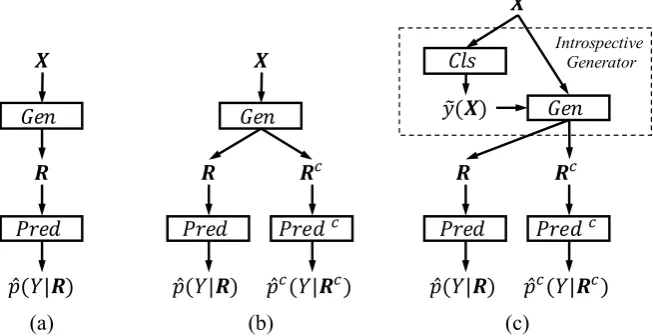
Figure 1: Illustration of different rationalization frameworks. (a) The cooperative framework from (Lei et al.,2016), which consists of two players,i.e.,a generator (Gen) and a predictor (Pred). (b) A straightforward extension of the model (a) with a compliment predictor (Predc). The generator plays a cooperative game with the predictor and plays a mini-max game with the compliment predictor. (c) The introspective three-player framework. The introspective module first predicts the possible outcomey˜based on the full textsxand then generate rationales using bothxandy˜. The third framework (c) is a special case of (b). Such an inductive bias in model design preserves the predictive performance.
plement predictorthat predicts the probability of Y based onRc.
Figure 1(b) illustrates the basic three-player model. Compared with (Lei et al.,2016), as shown in Figure1(a), the three-player model introduces an additional complement predictor, which plays a minimax game in addition to the cooperative game in (Lei et al.,2016). For clarity, we will describe the game backward, starting from the two predic-tors followed by the generator.
Predictors:The predictor estimates probability of Y conditioned onR, denoted aspˆ(Y|R). The
com-plement predictor estimates probability ofY con-ditioned onRc, denoted aspˆc(Y|R). Both
predic-tors are trained using the cross entropy loss, i.e.
Lp= min ˆ
p(·,·) H(p(Y|R); ˆp(Y|R))
Lc= min ˆ
pc(·,·) H(p(Y|R c); ˆpc(Y
|Rc)), (7)
where H(p;q) denotes the cross entropy between
p andq. p(·|·) denotes the empirical distribution.
It is worth emphasizing that Lp and Lc are both functions of the generator.
Generator: The generator extracts Rand Rc by generating the rationale mask, z(·), as shown in
Eqs. (1-2). Specifically,z(·)is determined by
min-imizing the weighted combination of four losses:
min
z(·)Lp+ gLg+ sLs+ cLc, (8) whereLgencourages the gap betweenLpandLcto be large,i.e.
Lg = max{Lp Lc+h,0}. (9)
It stipulates the comprehensiveness property of the rationale (Eq. (5)). Intuitively, if the complement rationale is less informative of Y than the ratio-nale, thenLcshould be larger thanLp.
LsandLcimpose the sparsity and continuity re-spectively, which correspond to Eq. (6):
Ls= max
n X
i
Zi s,0
o ,
Lc=
X
i
max{||Zi Zi 1|| c,0}.
(10)
From Eq. (7), we can see that the generator plays acooperative game with the predictor, be-cause both tries to maximize the predictive per-formance ofR. On the other hand, the generator
plays an adversarial game with the complement predictor, because the latter tries to maximize the predictive performance ofRc, but the former tries
to reduce it. Without the complement predictor, and thus the lossLg, the framework reduces to the method in (Lei et al.,2016).
Training During training, the three players per-form gradient descent steps with respect to their own losses. For the generator, Sincez(X)is a set of binary variables, we cannot apply the regular gradient descent algorithm. Instead we will use policy gradient (Williams, 1992) to optimize the models. We maximize the reward that is defined as the negative loss in Eq. (8). In order to have bounded rewards for training stability, the nega-tive lossesLpandLcare replaced with accuracy.
simultane-ously satisfies the conditions in Eqs. (4) to (6), as stated in the following theorem:
Theorem 1. A rationalization scheme z(X) that
simultaneously satisfies Eqs. (4)-(6) is the global optimizer of Eq.(8).
The proof is given in Appendix A. The basic idea is that there is a correspondence between each term in Eq. (8) and each of the properties Eqs. (4)-(6). The minimization of each loss term is equiva-lent to satisfying the corresponding property.
3.2 The Introspection Generator
As discussed in Section 1, in the existing generator-predictor framework, the generator may fail to disentangle the information about the cor-rect label, offering misleading rationales instead. To address this problem, we propose a new gener-ator module, called theIntrospective Generator, which explicitly predicts the label before making rationale selections.
Figure 1(c) illustrates the model with the in-trospection generator. Specifically, the improved generator still fits into the basic three-player framework in Section 3.1. The only difference is in how the generator generates the maskz(X),
which now breaks down into two steps.
First, the module uses a regular classifier that takes the inputX and predicts the label, denoted
˜
y(X). For classification tasks, we use the
maxi-mum likelihood estimate,i.e.
˜
y(X) = argmax
y
˜
p(Y =y|X), (11)
wherep˜(Y = y|X)is the predicted probability by
maximizing the cross entropy, which is pretrained. Second, a label-aware rationale generator gen-erates the binary mask of the rationales,i.e.
z(X) = ˜z(X,y˜(X)). (12)
Note thaty˜is a function ofX, so the entire
intro-spective generator is essentially a function ofX.
In this way, all the formulations in Section3.1and the Theorem1still hold for the three-player game with the introspective generator.
In the implementation, the classifier can use the same architecture like the predictor and the com-plement predictor. The generator is of the same architecture in Section3.1, but with the additional input ofyˆ(X).
Remark on degeneration Obviously, when working in a cooperative game, the introspec-tion generator will make the degeneraintrospec-tion problem more severe: when the classifier p˜(·|X) becomes
sufficiently accurate during training, the generator only needs to encode the information ofy˜intoR.
Therefore our three-player game, while improving over any existing generator-predictor frameworks on its own, is critical for the introspective model.
4 Experimental Settings 4.1 Datasets
We construct three text classification tasks, in-cluding two sentiment classification tasks from the BeerAdvocate review dataset (McAuley et al., 2012)4, and a more complex relation classifica-tion task from SemEval 2010 Task 8 (Hendrickx et al.,2009). Table2gives examples of the above tasks. Finally, as suggested by an anonymous re-viewer, we evaluate on the text matching bench-mark AskUbuntu, followingLei et al.(2016). The experimental setting and results are reported in AppendixF.
Multi-aspect beer review This is the same data used in (Lei et al., 2016). Each review evaluates multiple aspects of a kind of beer, including ap-pearance, smell, palate, and an overall score. For each aspect, a rating2[0,1] is labeled. We limit ourselves to the appearance aspect only and use a threshold of 0.6 to create balanced binary classi-fication tasks for each aspect. Then, the task be-comes to predict the appearance aspect of a beer based on multi-aspect text inputs. The advantage of this dataset is that it enables automatic eval-uation of rationale extraction. The dataset pro-vides sentence-level annotations on about 1,000 reviews, where each sentence is labeled by the as-pect it covers. Note that in this dataset, each asas-pect is often described by a single sentence with clear polarity. Thus, a generator can select a sentence based on the topic distribution of words. The se-lected sentence often has very high overlap with the ground truth annotations and also contains suf-ficient information for predicting the sentiment. This characteristic of the dataset makes it a rela-tively easy task, and thus we further consider two more challenging tasks.
Single-aspect beer review To construct a more challenging task, for each review, we extract the
Task Label Input Texts
Multi-Aspect Beer Review positive (regarding theaspect ofappearance) Clear, burnished copper-brown topped by a large beige headthat displays impressive persistance and leaves a small to
mod-erate amount of lace in sheets when it eventually departs. The nose is sweet and spicy and the flavor is malty sweet, accented nicely by honey and by abundant caramel/toffee notes. There’s some spiciness (especially cinnamon), but it’s not overdone. The finish contains a moderate amount of bitterness and a trace of alcohol. The mouthfeel is exemplary· · ·
Single-Aspect Beer Review positive appearance : dark-brown/black color with ahuge tan headthat gradually collapses , leavingthick lacing.
Relation Classification Message-Topic(e1,e2) It was a friendlycalle1 to remindthem about the bille2 and
[image:6.595.74.520.66.215.2]make sure they have a copy of the invoice
Table 2: Example of the three tasks used for evaluation. Thered boldwords are sample rationales (created by the authors for illustration purpose only for the last two tasks).
sentences that are specifically about the appear-ance aspect from the aforementioned BeerAdvo-cate dataset5, and the task is to predict the senti-ment of the appearance only on the extracted sen-tences. The details of the dataset construction can be found in AppendixC. This new dataset is ob-viously more challenging in terms of generating meaningful rationales. This is because the gener-ator is required to select more find-grained ratio-nales. Since there are no rationale annotations, we rely on subjective evaluations to test the quality of the extracted rationales.
Multi-class relation classification To show the generalizability of our proposed approaches to other NLP applications, we further consider the SemEval 2010 Task 8 dataset (Hendrickx et al., 2009). Given two target entities e1 and e2 in a
sentence, the goal is to classify the relation type (with directions) between the two entities (includ-ing None if there is no relation). Similar to the single-aspect beer review, it is also a fine-grained rationalization task. The major difference is that the number of class labels in this task is much larger, and we hope to investigate its effects on de-generation and performance downgrade.
4.2 Implementation Details
For both the generators and the two predictors, we use bidirectional LSTMs with hidden dimension 400. In the introspection generator, the classi-fier consists of the same bidirectional LSTM, and
z(X,y˜)is implemented as an LSTM sequential
la-beler with the labely˜transformed to an embedding vector that serves as the initial hidden states of the
5We will release the single-aspect dataset.
10% Highlighting 20% Highlighting
Model Acc Prec Acc Rec
Random 65.70 17.75 72.31 19.84 Lei2016 82.05 86.14 83.88 79.98 +minimax 83.45 86.54 84.25 85.16 Intros 87.10 68.37 87.50 59.63 +minimax 86.16 85.67 86.86 79.40
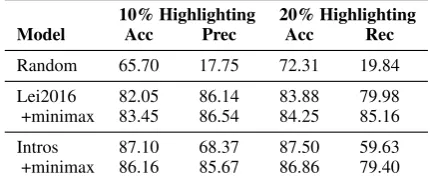
Table 3:Main results of binary classification on multi-aspect beer reviews. TheAcccolumn shows the accuracy of predic-tion. ThePrecandRecare precision and recall on the ex-tracted rationales compared to the human annotations. The accuracy of sentiment prediction with the full texts is87.59.
LSTM. For the relation classification task, since the model needs to be aware of the two target en-tities, we add the relative position features follow-ing Nguyen and Grishman (2015). We map the relative position features to learnable embedding vectors and concatenate them with word embed-dings as the inputs to the LSTM encoder of each player. All hyper-parameters are tuned on the de-velopment sets according to predictive accuracy. In other words, all the models are tuned without
seeing any rationale annotations.
5 Experiments
5.1 Multi-Aspect Beer Review
[image:6.595.308.524.270.361.2]recall for 20%6. In addition to the precision/recall, we also report the predictive accuracy of the ex-tracted rationales on predicting the sentiment.
When only 10% of the words are used,Lei et al. (2016) has a significant performance downgrade compared to the accuracy when using the whole passage (82.05 v.s. 87.59). With the additional third player added, the accuracy is slightly im-proved, which validates that controlling the un-selected words improves the robustness of ratio-nales. On the other hand, our introspection mod-els are able to maintain higher predictive accuracy (86.16 v.s. 82.05) compared to (Lei et al.,2016), while only sacrificing a little loss on highlighting precision (0.47% drop).
Similar observations are made when 20% of the words required to highlight with one exception. Comparing the model of (Lei et al.,2016) with and without the proposed mini-max module, there is a huge gap of more than 5% on recall of generated rationales. This confirms the motivation that the original cooperative game tends to generate less comprehensive rationales, where the three-player framework controls the unselected words to be less informative so the recall is significantly improved. It is worth mentioning that when a classifier is trained with randomly highlighted rationales (i.e. random dropout (Srivastava et al.,2014) on the in-puts), it performs significantly worse on both pre-dictive accuracy and highlighting qualities. This confirms that extracting concise and sufficient ra-tionales is not a trivial task. Moreover, our re-implementation of (Lei et al.,2016) for the origi-nal regression task achieves 90.1% precision when highlighting 10% words, which suggest that ratio-nalization for binary classification is more chal-lenging compared to the regression where finer su-pervision is available.
In summary, our three-player framework con-sistently improves the quality of extracted ratio-nales on both of the original (Lei et al.,2016) and the introspective framework. Particularly, without controlling the unselected words, the introspection model experiences a serious degeneration problem as expected. With the three-player framework, it manages to maintain both high predictive accuracy and high quality of rationalization.
6Previous work in (Lei et al.,2016) only evaluates the pre-cision for the 10% extraction.
Model Single-Aspect BeerAcc Accc AccRelationAccc
All (100%) 87.1 51.3 77.8 4.9 Random 74.3 83.1 51.8 64.9 Lei2016 81.4 74.6 73.5 36.8 +minimax 82.9 73.2 75.0 30.9 Intros 87.0 85.8 75.2 56.6 +minimax 85.3 73.6 76.2 29.1
Table 4: Predictive accuracy on the single-aspect beer ap-pearance review (left) and the relation classification (right). Acccrefers to the accuracy of the complement predictor. We restrict the extracted rationales to be on average eight words and four continuous pieces for the beer review and six words and three pieces for relation classification. A desired ratio-nalization method will have high Acc and low Accc.
5.2 Single-Aspect Beer Review
In this section, we evaluate the proposed meth-ods on the more challenging single-aspect beer dataset. Similar to previous experiments, we force all the methods to have comparable highlighting ratio and continuity constraints for fair evaluation. The highlighting ratio is determined from human estimation on a small set of data. We report two classification results, which are the accuracy of the predictor and complement predictor. For both cooperative methods, i.e. (Lei et al., 2016) with and without introspection , we train an indepen-dent extra predictor on the unselected words from the generator, which does not affect the training of the generator-predictor framework.
From the left part of Table4, we observe that the original model of (Lei et al.,2016) has a hard time maintaining the accuracy compared to the classi-fier trained with full texts. Transforming it into a three-player game helps to improve the perfor-mance of the evaluation set while lower the ac-curacy of the complement predictor. Since the extracted rationales are in a similar length, these results suggest that learning with a three-player game successfully enforces the generator not to leave informative words unselected. Similar to the multi-aspect results, the cooperative introspec-tion model suffers from the degeneraintrospec-tion problem, which produces a high complement accuracy. The three-player game yields a more comprehensive rationalization with small losses in accuracy.
hu-Model %UNK Acc Accw/o UNK
Lei2016 43.5 63.5 69.0 Intros+minimax 54.0† 58.0 66.3
Table 5: Subjective evaluations on the task of controlling the unselected rationale words. Acc denotes the accuracy in guessing sentiment labels. Accw/o UNKdenotes the sentiment accuracy for these samples that are not selected as “UNK” for the secondary task. †denotes p-value<0.005 in t-test. A desired rationalization method achieves high “UNK” rate and performance randomly for the Acc predictions.
man evaluators. The evaluators are asked to pre-dict the sentiment label as their first task. If a ratio-nalizing method successfully includes all informa-tive pieces in the rationale, subjects should have around 50% of accuracy in guessing the label. In addition, after providing the sentiment label, sub-jects are then asked to answer a secondary ques-tion, which is whether the provided text spans are sufficient for them to predict the sentiment. If they believe there are not enough clues and their sen-timent classification is based on a random guess, they are instructed to select unknown (denoted as “UNK”) as the answer to the second question. AppendixEelaborates why we design subjective evaluations in such a way in more details.
Table 5 shows the performance of subjective evaluations. Looking at the first column of the ta-ble, our model is better in confusing human, which gives a higher rate in selecting “UNK”. It con-firms that the three-player introspective model se-lects more comprehensive rationales and leave less informative texts unattended. Furthermore, the re-sults also show that human evaluators offer worse sentiment predictions on the proposed approach, which is also desired and expected.
5.3 Relation Classification
The predictive performances on the relation clas-sification task are shown in the right part of the Ta-ble4. We observe consistent results as in previous datasets. Clearly, the introspective generator helps the accuracy and the three-player game regularize the complement of the rationale selections.
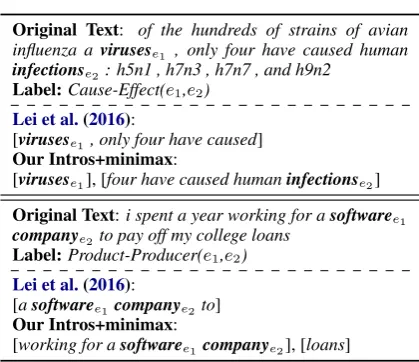
Examples of the extracted rationales For rela-tion classificarela-tion, it is difficult to conduct subjec-tive evaluations because the task requires people to have sufficient knowledge of the schema of rela-tion annotarela-tion. To further demonstrate the quality of generated rationales, we provide some illustra-tive examples. Since there is a rich form of
su-Original Text: of the hundreds of strains of avian influenza avirusese1 , only four have caused human
infectionse2: h5n1 , h7n3 , h7n7 , and h9n2
Label:Cause-Effect(e1,e2) Lei et al.(2016):
[virusese1, only four have caused]
Our Intros+minimax:
[virusese1], [four have caused humaninfectionse2]
Original Text:i spent a year working for asoftwaree1
companye2to pay off my college loans
Label:Product-Producer(e1,e2) Lei et al.(2016):
[asoftwaree1companye2to]
Our Intros+minimax:
[image:8.595.311.521.56.237.2][working for asoftwaree1companye2], [loans]
Table 6:Illustrative examples of generated rationales on the relation classification task. Entities are shown inbold.
pervised signal,i.e.,the number of class labels is large, the chance of any visible degeneration of the Lei et al.(2016)’s model should be low. However, we still spot quite a few cases. In the first example, Lei et al.(2016) fails to highlight the second entity while ours does. In the second example, the in-trospective three-player model selects more words than (Lei et al.,2016). In this case, the two entities themselves suffice to serve as the rationales. How-ever, our model preserves the words like “work-ing”. This problem might due to the bias of the dataset. For example, some words that are not rel-evant to the target entities may still correlate with the labels. In the case, our model will pick these words as a part of the rationale.
6 Related Work
Model interpretability Besides the two major categories of self-explaining models discussed in Section 1, model interpretability is widely stud-ied in the general machine learning field. For ex-ample, evaluating feature importance with gradi-ent information (Simonyan et al., 2013;Li et al., 2016a;Sundararajan et al., 2017) or local pertur-bations (Kononenko et al., 2010; Lundberg and Lee,2017); and interpreting deep networks by lo-cally fitting interpretable models (Ribeiro et al., 2016;Alvarez-Melis and Jaakkola,2018).
[image:8.595.84.275.65.105.2]sum-mary is a special type of rationale of a document. Another related concurrent work (Bastings et al., 2019) proposes differentiable solution to optimize the cooperative rationalization method.
Game-theoretical methods Though not having been explored much for self-explaining models, the minimax game setup has been widely used in many machine learning problems, such as self-playing for chess games (Silver et al.,2017), gen-erative models (Goodfellow et al.,2014) and many tasks that can be formulated as multi-agent rein-forcement learning (Busoniu et al., 2006). Our three-player game framework also shares a similar idea with (Zhang et al.,2017;Zhao et al.,2017), which aim to learn domain-invariant representa-tions with both cooperative and minimax games.
7 Conclusion
We proposed a novel framework for improving the predictive accuracy and comprehensiveness of the selective rationalization methods. This frame-work (1) addresses the degeneration problem in previous cooperative frameworks by regularizing the unselected words via a three-player game; and (2) augments the conventional generator with in-trospection, which can better maintain the perfor-mance for down-stream tasks. Experiments with both automatic evaluation and subjective studies confirm the advantage of our proposed framework.
References
David Alvarez-Melis and Tommi S Jaakkola. 2018. Towards robust interpretability with self-explaining neural networks. arXiv preprint arXiv:1806.07538. Jacob Andreas, Marcus Rohrbach, Trevor Darrell, and
Dan Klein. 2016a. Learning to compose neural net-works for question answering. In Proceedings of NAACL-HLT, pages 1545–1554.
Jacob Andreas, Marcus Rohrbach, Trevor Darrell, and Dan Klein. 2016b. Neural module networks. In Proceedings of the IEEE Conference on Computer Vision and Pattern Recognition, pages 39–48. Kristjan Arumae and Fei Liu. 2019. Guiding extractive
summarization with question-answering rewards. In Proceedings of the 2019 Conference of the North American Chapter of the Association for Computa-tional Linguistics: Human Language Technologies, Volume 1 (Long and Short Papers), pages 2566– 2577.
Joost Bastings, Wilker Aziz, and Ivan Titov. 2019. In-terpretable neural predictions with differentiable bi-nary variables.arXiv preprint arXiv:1905.08160.
Lucian Busoniu, Robert Babuska, and Bart De Schut-ter. 2006. Multi-agent reinforcement learning: A survey. In 2006 9th International Conference on Control, Automation, Robotics and Vision, pages 1– 6. IEEE.
Jianbo Chen, Le Song, Martin Wainwright, and Michael Jordan. 2018a. Learning to explain: An information-theoretic perspective on model interpre-tation. In International Conference on Machine Learning, pages 882–891.
Jianbo Chen, Le Song, Martin J Wainwright, and Michael I Jordan. 2018b. L-Shapley and C-Shapley: Efficient model interpretation for structured data. arXiv preprint arXiv:1808.02610.
Ian Goodfellow, Jean Pouget-Abadie, Mehdi Mirza, Bing Xu, David Warde-Farley, Sherjil Ozair, Aaron Courville, and Yoshua Bengio. 2014. Generative ad-versarial nets. In Advances in neural information processing systems, pages 2672–2680.
Iris Hendrickx, Su Nam Kim, Zornitsa Kozareva, Preslav Nakov, Diarmuid ´O S´eaghdha, Sebastian Pad´o, Marco Pennacchiotti, Lorenza Romano, and Stan Szpakowicz. 2009. Semeval-2010 task 8: Multi-way classification of semantic relations be-tween pairs of nominals. In Proceedings of the Workshop on Semantic Evaluations: Recent Achievements and Future Directions, pages 94–99. Association for Computational Linguistics.
Justin Johnson, Bharath Hariharan, Laurens van der Maaten, Judy Hoffman, Li Fei-Fei, C Lawrence Zit-nick, and Ross Girshick. 2017. Inferring and exe-cuting programs for visual reasoning. In Proceed-ings of the IEEE Conference on Computer Vision and Pattern Recognition, pages 2989–2998.
Igor Kononenko et al. 2010. An efficient explanation of individual classifications using game theory. Jour-nal of Machine Learning Research, 11(Jan):1–18.
Guang-He Lee, David Alvarez-Melis, and Tommi S Jaakkola. 2018. Game-theoretic interpretabil-ity for temporal modeling. arXiv preprint arXiv:1807.00130.
Tao Lei, Regina Barzilay, and Tommi Jaakkola. 2016. Rationalizing neural predictions. InProceedings of the 2016 Conference on Empirical Methods in Nat-ural Language Processing, pages 107–117.
Jiwei Li, Xinlei Chen, Eduard Hovy, and Dan Juraf-sky. 2016a. Visualizing and understanding neural models in NLP. InProceedings of the 2016 Con-ference of the North American Chapter of the Asso-ciation for Computational Linguistics: Human Lan-guage Technologies, pages 681–691.
Scott M Lundberg and Su-In Lee. 2017. A unified approach to interpreting model predictions. In Ad-vances in Neural Information Processing Systems, pages 4765–4774.
Julian McAuley, Jure Leskovec, and Dan Jurafsky. 2012. Learning attitudes and attributes from multi-aspect reviews. In 2012 IEEE 12th International Conference on Data Mining, pages 1020–1025. IEEE.
Thien Huu Nguyen and Ralph Grishman. 2015. Combining neural networks and log-linear mod-els to improve relation extraction. arXiv preprint arXiv:1511.05926.
Marco Tulio Ribeiro, Sameer Singh, and Carlos Guestrin. 2016. Why should I trust you?: Explain-ing the predictions of any classifier. In Proceed-ings of the 22nd ACM SIGKDD international con-ference on knowledge discovery and data mining, pages 1135–1144. ACM.
David Silver, Thomas Hubert, Julian Schrittwieser, Ioannis Antonoglou, Matthew Lai, Arthur Guez, Marc Lanctot, Laurent Sifre, Dharshan Kumaran, Thore Graepel, et al. 2017. Mastering chess and shogi by self-play with a general rein-forcement learning algorithm. arXiv preprint arXiv:1712.01815.
Karen Simonyan, Andrea Vedaldi, and Andrew Zisser-man. 2013. Deep inside convolutional networks: Vi-sualising image classification models and saliency maps. arXiv preprint arXiv:1312.6034.
Nitish Srivastava, Geoffrey Hinton, Alex Krizhevsky, Ilya Sutskever, and Ruslan Salakhutdinov. 2014. Dropout: a simple way to prevent neural networks from overfitting. The Journal of Machine Learning Research, 15(1):1929–1958.
Mukund Sundararajan, Ankur Taly, and Qiqi Yan. 2017. Axiomatic attribution for deep networks. In Proceedings of the 34th International Conference on Machine Learning-Volume 70, pages 3319–3328. JMLR. org.
Ronald J. Williams. 1992. Simple statistical gradient-following algorithms for connectionist reinforce-ment learning. Machine Learning.
Adam Yala, Constance Lehman, Tal Schuster, Tally Portnoi, and Regina Barzilay. 2019. A deep learn-ing mammography-based model for improved breast cancer risk prediction. Radiology, page 182716. Mo Yu, Shiyu Chang, and Tommi S Jaakkola. 2018.
Learning corresponded rationales for text matching. Omar Zaidan, Jason Eisner, and Christine Piatko. 2007. Using annotator rationales to improve ma-chine learning for text categorization. In Human language technologies 2007: The conference of the North American chapter of the association for com-putational linguistics; proceedings of the main con-ference, pages 260–267.
Yuan Zhang, Regina Barzilay, and Tommi Jaakkola. 2017. Aspect-augmented adversarial networks for domain adaptation. Transactions of the Association for Computational Linguistics, 5:515–528.