Proceedings of the 2019 Conference on Empirical Methods in Natural Language Processing 2422
A Non-commutative Bilinear Model for Answering Path Queries in
Knowledge Graphs
Katsuhiko Hayashi†,∗ [email protected]
Masashi Shimbo‡,∗ [email protected]
†Osaka University Suita, Osaka, Japan
‡NAIST Ikoma, Nara, Japan
∗Riken AIP Chuo-ku, Tokyo, Japan
Abstract
Bilinear diagonal models for knowledge graph embedding (KGE), such as DistMult and Com-plEx, balance expressiveness and computa-tional efficiency by representing relations as di-agonal matrices. Although they perform well in predicting atomic relations, composite rela-tions (relation paths) cannot be modeled nat-urally by the product of relation matrices, as the product of diagonal matrices is commuta-tive and hence invariant with the order of rela-tions. In this paper, we propose a new bilin-ear KGE model, called BlockHolE, based on block circulant matrices. In BlockHolE, rela-tion matrices can be non-commutative, allow-ing composite relations to be modeled by ma-trix product. The model is parameterized in a way that covers a spectrum ranging from diag-onal to full relation matrices. A fast compu-tation technique is developed on the basis of the duality of the Fourier transform of circu-lant matrices.
1 Introduction
Large-scale knowledge graphs (Nickel et al.,
2016a) are indispensable resources for knowledge-intensive applications such as question answering, dialog systems, and distantly supervised relation extraction. A knowledge graph is a collection of triplets(s, r, o)representing the fact that (binary) relationrholds between subject entitysand object entityo. Although efforts continue to enrich exist-ing knowledge graphs with more facts, many facts are still missing (Nickel et al.,2016a). Knowledge graph completion (KGC) aims to automatically detect missing facts in anincomplete knowledge graph, and has become an active field of research in recent years.
Knowledge graph embedding (KGE) is a promis-ing approach to KGC. It embeds entities and rela-tions in vector space, and defines ascoring function
William
Harry
Charles
. . .
Elizabeth
Andrew
Beatrice
Eugenie . . .
(a)
motherOf motherOf
motherOf motherOf
fatherOf
−1
fatherOf
fatherOf
fatherOf
fatherOf brotherOf
brotherOf
fatherOf
−1
William
(b) fatherOf−1 brotherOf fatherOf
William
(c) brotherOf fatherOf−1 fatherOf
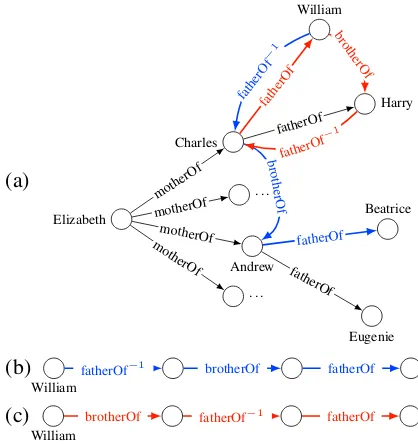
Figure 1: (a) A knowledge graph and (b,c) two relation paths starting from William.
φ(s, r, o)to evaluate the degree of factuality of a given triplet(s, r, o)in terms of vector operations. Bilinear KGE models are a popular choice for a scoring function, along with those based on transla-tion and neural networks. RESCAL (Nickel et al.,
[image:1.595.314.523.224.446.2]overfit-ting, and the performance is usually better. While all these models were designed with a specific task of KGC in mind, i.e., computing the factuality of triplets, another important task on knowledge graphs was pursued byGuu et al.
(2015) and Lin et al. (2015). This latter task, calledpath query answering (path QA), is to an-swer composite queries that consist of a cascade of relations, as opposed to an atomic relation. See Figure 1 for instance. A query “Is Beatrice a child of a paternal uncle of William?” can be an-swered by predicting the truth value of the triplet (William, fatherOf−1/brotherOf/fatherOf, Beatrice) where fatherOf−1/brotherOf/fatherOf is a binary relation not present in the knowledge graph as a relation (edge) label but is composed of a cascade of three atomic relations.1Composite queries are also calledpath queries, as they can be represented as paths in a knowledge graph; see, e.g., the blue line in Figure1(a). Notice however that some of the edges in the path may be missing due to the incompleteness of the knowledge graph; even in such circumstances, the model must ideally be able to answer path queries correctly.
Guu et al.(2015) extended the existing KGE ap-proaches to path QA. For example, to answer a gen-eral path query(s, r1/ . . . /rk, o)with RESCAL, a composite relationr1/· · ·/rkis modeled by ma-trix product Rr1· · ·Rrk, and the score for the
given query is modeled byeTsRr1· · ·Rrkeo. This
formulation is also applicable to DistMult and Com-plEx, which use diagonal relation matrices. In di-agonalized models, however, relation matrices are commutative, in the sense thatRrRr0 = Rr0Rr
for any pair of relationsr, r0.
Commutativity of relation matrices was not rec-ognized as an issue in the past research because the main focus was on predicting the truth value of atomic triplets. However, when path queries are concerned, commutativity poses a problem. Con-sider, for example, a relation sequence
fatherOf−1/brotherOf/fatherOf and its permutation
brotherOf/fatherOf−1/fatherOf.
Although these are two distinct paths (cf. Fig-ure1(b, c)), in bilinear models with commutative relation matrices, they are represented by the same
1We regard inverse relations (e.g., fatherOf−1
) also as atomic relations.
Symbol Description
R,C sets of real/complex numbers
[v]j jth component of vectorv
[M]jk (j, k)-component of matrixM
MT
transpose ofM M conjugate ofM
componentwise (Hadamard) product ∗ circular convolution
? circular correlation
Re(x) real part of complex numberx diag(v) diagonal matrix with main diagonalv
circ(v) circulant matrix determined byv
hx,y,zi sum of the componentwise products ofx,y,z F discrete Fourier matrix
E set of entities R set of relations
F set of observed facts (triplets) F∗
set of ground truth facts
G(F) Knowledge graph induced by factsF
Table 1: List of symbols. See Secs.2and3for detail.
product of relation matrices, which thereby makes the truth values of these permutated queries indis-tinguishable by their scores.
Drawing on the observation above, this paper proposes a new KGE model called BlockHolE, wherein relations are represented by block circu-lant matrices. This makes relation matrices non-commutative, and thus it does not suffer from the issues arising from commutativity, yet in general manages to reduce the number of parameters com-pared with RESCAL. It can be interpreted as a generalization of HolE and ComplEx, and also sub-sumes RESCAL as an extreme case. We report experimental results in both path and atomic QA tasks.
2 Notation and preliminaries
We first introduce symbols and notation used in this paper, followed by some preliminaries on cir-culant matrices, circular convolution, correlation, and Fourier transform. The summary of symbols can be found in Table1.
Let R be the set of reals, andC be the set of
complex numbers. Let[v]j denote thejth compo-nent of vectorv, and let[M]jk the(j, k)element of matrixM. For a complex numberz, vectorz, and matrixZ, letz,z, andZdenote their complex conjugate, respectively.
[image:2.595.307.531.64.267.2][xy]i = [x]i[y]i,i = 1, . . . , n. We also write
hx,y,zi=xTdiag(y)z=Pn
i=1[x]i[y]i[z]i.
Forn-dimensional real vectors2x,y∈Rn,x∗y andx?ydenotecircular convolutionandcircular correlation, respectively defined by
[x∗y]i= n X
j=1
[x]i−j+1[y]j,
[x?y]i= n X
j=1
[x]j−i+1[y]j, i= 1, . . . , n,
where vector indices that do not fall in the range 1, . . . , nmust be interpreted by0 =n,−1 =n−
1, . . . ,−n+ 1 = 1.
Forn-dimensional real vectorv∈Rn, let
circ(v) =
[v]1 [v]n . . . [v]3 [v]2
[v]2 [v]1 [v]n [v]3
..
. [v]2 [v]1 . .. ...
[v]n−1 . .. . .. [v]n [v]n [v]n−1 . . . [v]2 [v]1
be an operation that converts a vectorvto a circu-lant matrix of sizen×n.
A circulant matrix circ(v) ∈ Rn×n can be di-agonalized as circ(v) = F−1diag(Fv)F, where
F∈Cn×nis the discrete Fourier matrix of ordern. Also, circular convolution and correlation can be written in terms of circ(·):x∗y=circ(x)y, and
x?y=circ(x)Ty. It follows that
x∗y=F−1(FxFy), (1)
x?y=F−1(FxFy). (2)
These equations imply that circular convolution and correlation can be computed in timeO(nlogn) using the fast Fourier transform (FFT).
3 Knowledge graph embedding using bilinear maps
A knowledge graph is a labeled multigraph (E,R,F), where E is the set of entities (or
ver-tices), R is the set of relation labels (or edge la-bels), andF ⊂E ×R×E defines the observed instances of binary relations over entities (or la-beled edges). An item (s, r, o) ∈ E ×R×E is called atriplet, withsandocalled itssubjectand object, respectively. For every entity ine∈E, it is
2Generally, circular convolution, circular correlation, and circulant matrices are defined overCn. However, in this paper, it suffices to define them overRn.
assumed thatF contains at least one triplet(s, r, o) withs=eoro=e; likewise, for every relation in
r∈R,F is assumed to contain at least one triplet (s, r, o). BecauseF determines the setsE andR
of entities and relations, we writeG(F)to denote the knowledge graph(E,R,F)determined byF. Aside from observed tripletsF, we also assume the presence of a setF∗ ⊂E ×R×E of(ground truth) facts, which is a strict superset ofF, i.e.,
F ⊂F∗. Thus,F∗is not fully observable.
3.1 Knowledge graph completion
Knowledge graph completion(KGC) is the task of identifying the set of ground truth factsF∗ from observed factsF ⊂ F∗ (or equivalently, G(F∗) fromG(F)).
A popular approach to KGC is to design a scor-ing function φ(s, r, o) quantifying how likely a triplet (s, r, o) is true. This scoring function is learned from the observed tripletsF, in a way that it generalizes well to unobserved tripletsF∗\F; i.e., the score must be high for both observed and unobserved facts, and it must be low for nonfactual triplets.
In knowledge graph embedding(KGE)–based approaches to KGC, the scoring functionφ(s, r, o) is defined in terms of the embeddings of entities and relations; i.e., s, r, and o are embedded as objects in a vector space, andφis defined in terms of some operations over these objects.
3.2 Bilinear models for knowledge graph
embedding
Below, we describe some of the popular KGE mod-els that use bilinear maps to define scoring func-tions.
3.2.1 RESCAL
RESCAL (Nickel et al.,2011) provides the most general form of bilinear scoring function.
φRESCAL(s, r, o) =eTsRreo, (3)
wherees,eo ∈ Rnare the vector embeddings of
entitiessando, respectively, andRr∈Rn×nis the
matrix representing relationr. Thus,n2parameters are required per relation, which is not only a com-putational burden but also the cause of overfitting during training (Kazemi and Poole,2018).
3.2.2 DistMult
to diagonal; i.e.,Rr =diag(wr),wr ∈ Rn. The
scoring function is thus
φDistMult(s, r, o) =esTdiag(wr)eo =hwr,es,eoi. (4)
Although the number of parameters is reduced con-siderably, the scoring function (4) is symmetric with respect to the entities, i.e.,φDistMult(s, r, o) =
φDistMult(o, r, s). This is a severe limitation
be-cause most real-world relations are non-symmetric.
3.2.3 ComplEx: Complex embedding
The complex embedding (ComplEx) (Trouillon et al., 2016) represents entities and relations as
n-dimensional vectors as in DistMult, but their components are complex-valued.
The scoring function of ComplEx is given by
φComplEx(s, r, o) =Re(esTdiag(wr)eo) =Re(hwr,es,eoi),
wherees,eo,wr ∈Cnare the embeddings ofs,o,
andr, respectively. The number of parameters in ComplEx is2n|E|+ 2n|R|, and the score is com-putable in time linear in the dimension of vector space. Unlike DistMult, ComplEx can model non-symmetric relations, sinceφ(s, r, o) 6= φ(o, r, s) in general.
3.2.4 HolE: Holographic embedding
Theholographic embedding(HolE) (Nickel et al.,
2016b) uses circular correlation to define a scoring function
φHolE(s, r, o) =wTr(es?eo), (5)
wherewr,es,eo∈Rnaren-dimensional real
vec-tors representing relationr, and entitiessando, re-spectively. HolE has onlynparameters per relation, and it can model non-symmetric relations since
φHolE(s, r, o)6=φHolE(o, r, s)in general.
Comput-ing circular correlation requiresO(nlogn)time if FFT is employed. Eq. (5) is not a bilinear form, but it has been shown (Hayashi and Shimbo,2017) that HolE is isomorphic to ComplEx, and thus any model in HolE can be converted to an equivalent model in ComplEx, and vice versa.
4 Path question answering over a knowledge graph
4.1 Path query answering
Let F∗ be the set of ground truth facts, and let
G(F∗) = (E,R,F∗) be its induced knowledge
graph. Fork relations r1, . . . , rk ∈ R, we call
r1/ . . . /rk a relation path of length k. When
k = 1, the relation path isatomic; otherwise, it iscomposite. Let s, o∈ E. We say apath query (s, r1/ . . . /rk, o)holds (or “is true”) inG(F∗)(or with respect toF∗) if
∃e1, . . . , ek−1 ∈E ∀j= 1, . . . , k
(ej−1, rj, ej)∈F∗, wheree0 =sandek =o. Path query answering (path QA) is the task of predicting the truth value of path queries with respect to the unobserved setF∗
of ground truth facts, when its incomplete subset
F ⊂F∗is only available. In other words, we want to predict that (s, r1/ . . . /rk, o) is true if a path fromstooexists inG(F∗), although some of the edges that constitute the path may be missing in the observed graphG(F).
For atomic path queries (i.e., those with length
k = 1), path QA reduces to that of knowledge graph completion introduced in Section3.1. Thus, it is natural to address general path QA by extend-ing the scorextend-ing functionφ(s, r, o) of KGC meth-ods so that composite relation r1/ . . . /rk is al-lowed in place of atomic relationr; i.e., by defin-ingφ(s, r1/ . . . /rk, o). Previous work (Guu et al.,
2015) explored this direction, which is also pursued in the rest of this paper.
4.2 Issues in existing KGE models applied to
path QA
We now discuss the extension of existing bilinear KGE models to path QA. We begin with RESCAL, which is the most general among existing bilinear models. In RESCAL, if we assumeRTres ≈ eo for true triplets(s, r, o), we can model path QA as computing
φRESCAL(s, r1/ . . . /rk, o)
=eTsRr1· · ·Rrkeo. (6)
As seen in this formula, a composite relation is rep-resented by the product of the matrices for atomic relations (Guu et al.,2015).
Likewise, DistMult and ComplEx can also be used for path QA, by computing
φDistMult(s, r1/ . . . /rk, o)
and
φComplEx(s, r1/ . . . /rk, o)
=Re(eTs diag(wr1)· · ·diag(wrk)eo),
respectively. However, because diagonal matrices are commutative, the score of (s, r1/ . . . /rk, o) is equal to any path query in which r1,· · · , rk are permutated, such as (s, rk/rk−1/ . . . /r1, o). That is, because
φ(s, r1/ . . . /rk, o) = φ(s, rk/rk−1/ . . . /r1, o),
their truth values cannot be distinguished by the magnitude of scores. More recent bilinear models such as ANALOGY3(Liu et al.,2017) and SimplE (Kazemi and Poole,2018) also represent relations by diagonal matrices, and thus they can only model commutative relation paths. Moreover, for SimplE, which represents subject and object entities in different vector spaces, it is not clear how it can be applied to path QA.
In the translation-based model TransE (Bordes et al.,2013), the scoring function is given by4
φTransE(s, r, o) =−||es+wr−eo||22. (7)
Guu et al.(2015) extended this function for a path query by
φTransE(s, r1/ . . . /rk, , o)
=−kes+wr1+· · ·+wrk −eok
2 2. (8)
Thus, a composite relation is represented as the sum of the embedding vectors for its constituent atomic relations. Unfortunately, Eq. (8) is also invariant with the permutation of relations r1, . . . , rk, and their order is not respected.
5 Knowledge graph embedding with block circulant matrices
5.1 BlockHolE
In this section, we propose a bilinear KGE model suitable for path QA. In this model, the relation matrices are non-commutative. It thus respects the order of relations in a path query. Further, it has a smaller number of parameters than RESCAL in
3We categorize ANALOGY as a diagonal model because each2×2block diagonal element of its relation matrices can be substituted by a single equivalent complex-valued compo-nent.
4The original TransE defines a
penaltyfunction, which
gives a smaller value if a triplet is more likely to be true. We thus changed the sign to make it a scoring function in Eq. (7).
general. To be specific, our model constrains the relation matrices to be block circulant.
A matrix isblock circulantif it can be written in the form
W(11) · · · W(1b)
..
. . .. ...
W(b1) · · · W(bb)
, (9)
where each W(ij) = circ(w(ij)), i, j = 1, . . . , b,
is a circulant matrix determined byw(ij) ∈ Rm. Thus, if the dimension of the matrix in Eq. (9) is
n×n, we have n = bm. A block circulant ma-trix is non-commutative whenb≥2; i.e., for two block circulant matricesA,B∈Rbm×bm,A6=B,
AB6=BAin general.
Substituting a block circulant matrix of Eq. (9) for matrix Rr in the bilinear scoring function (Eq. (3)) yields
φBlockHolE(s, r, o) =eTsRreo
=
eT
s
z }| {
[e(1)Ts · · ·e(sb)T]
Rr
z }| {
W(11)r · · · W(1rb) ..
. . .. ...
W(rb1) · · · W(rbb)
eo z }| {
e(1)o .. .
e(ob)
,
(10)
wheree(si),e(oi)∈Rm, andW(rij) =circ(w(rij))∈
Rm×m,i, j = 1, . . . , b. Recall thatn= bm, and
thuses,eo ∈ Rn,Rr ∈ Rn×n. Using equalities
xT(y∗z) =yT(x?z)(Nickel et al.,2016b) and
circ(x)y=x∗yto rewrite Eq. (10), we have
φBlockHolE(s, r, o)
= [e(1)Ts . . .e(sb)T]
Pb j=1w
(1j)
r ∗e(oj) ..
. Pb
j=1w (bj)
r ∗e(oj)
= b X
i=1 e(si)T
b X
j=1
w(rij)∗e(oj)
= b X
i,j=1 w(rij)T
e(oj)?e(si)
. (11)
We call this modelBlockHolE, after the fact that it reduces to HolE whenb= 1; cf. Eq. (5). Also, BlockHolE is identical tob-dimensional RESCAL whenm= 1(or equivalentlyb=n).
The number of parameters in BlockHolE is
computation of Eq. (11) takes timeO(b2mlogm) using FFT. However, we can make this computa-tion faster by exploiting the duality of the Fourier transform, as shown below.
5.2 Fast computation in complex space
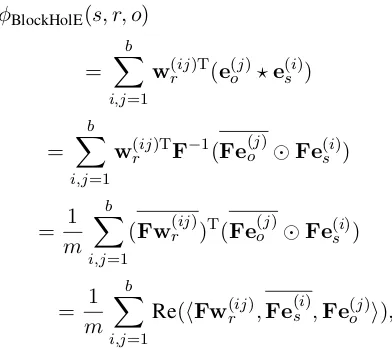
Using a similar technique used by Hayashi and Shimbo(2017) to show the equivalence of Com-plEx and HolE, we can eliminate Fourier transform to speed up the computation of BlockHolE scores. We first rewrite Eq. (11) as follows:
φBlockHolE(s, r, o)
= b X
i,j=1
wr(ij)T(eo(j)?e(si))
= b X
i,j=1
wr(ij)TF−1(Feo(j)Fe(si))
= 1
m
b X
i,j=1
(Fw(rij))T(Feo(j)Fe(si))
= 1
m
b X
i,j=1
Re(hFw(ij)
r ,Fe
(i)
s ,Fe(oj)i),
whereFis the discrete Fourier matrix. Here we used Eq. (1) to derive the second equation, and
F−1 = (1/m)FT to derive the third. Defining complex vectors w0(rij) = (1/m)Fwr(ij),e0(si) =
Fe(si), ande0(oj)=Fe
(j)
o yields
φBlockHolE(s, r, o)
= b X
i,j=1
Re
hw0(rij),e0s(i),e0(oj)i
. (12)
On the basis of Eq. (12), we traine0(ki) ∈ Cm
di-rectly in complex space (i.e., the Fourier domain) instead of e(kj) ∈ Rm and use it as the vector
embedding of entity k, for all k ∈ E; similarly,
w0(rij) ∈Cm is directly trained in complex space to represent relationr∈R. The number of param-eters in this model is2n|E|+ 2bn|R|, and Eq. (12) can be computed in O(bn) time. Typically, we set b n. For instance, in the experiment of Section 6, we setb = 2 andm = 50, and thus
n=bm= 100. In this case, factorbis negligible and the computational complexity is linear inn.
WN11 FB13
Train 112,581 316,232 Base Valid 2,609 5,908 Test 10,544 23,733
Train 2,129,539 6,266,058
[image:6.595.319.514.63.160.2]Path Valid 11,277 27,163 Test-Deduction 24,749 77,883 Test-Induction 21,828 31,674
Table 2: Dataset provided byGuu et al.(2015).
5.3 Modeling path QA
BlockHolE can be used in path QA as follows. First, for any`∈E andr ∈R, let
e0T` = [e0(1)T` · · ·e0(`b)T],
W0r =
diag(w0(11)r ) · · · diag(w0(1rb)) ..
. . .. ... diag(w0(rb1)) · · · diag(w0(rbb))
.
Then, Eq. (12) can be rewritten as
φBlockHolE(s, r, o) =Re
e0TsW0re0o
,
and we can compute the score of relation paths by
φBlockHolE(s, r1/ . . . /rk, o)
=Re(e0TsW0r1. . .W0r
ke
0 o).
Since W0riW0rj 6= W0rjW0ri for b ≥ 2, this scoring function respects the order of relations in
r1/ . . . /rk.
6 Experiments
In this section, we report the results of empirical evaluation investigating the commutativity property of bilinear KGE models on the path QA task. As ex-pected, the proposed BlockHolE model, which uses non-commutative relation matrices, outperformed commutative bilinear KGE models.
6.1 Dataset and evaluation protocol
The comparison of KGE models was performed in two path QA tasks: (i) ranking and (ii) binary classification tasks.
6.1.1 Path QA ranking
[image:6.595.83.279.242.418.2]WN11 FB13
Base Deduction Induction Base Deduction Induction
P@10 MQ P@10 MQ P@10 MQ P@10 MQ P@10 MQ P@10 MQ
DistMult 45.6 83.0 33.5 97.7 29.6 79.8 62.7 91.6 63.6 86.4 59.3 86.5 ComplEx 60.9 83.1 68.7 99.2 46.1 79.7 76.8 93.0 71.5 90.0 70.5 88.9 RESCAL 51.8 74.2 43.2 97.9 51.2 76.8 65.2 91.1 66.9 88.4 69.8 89.0
[image:7.595.80.519.63.170.2]b= 2, m= 25 80.9 83.4 70.2 99.5 54.9 81.0 79.2 93.2 75.0 91.5 71.3 90.0 b= 4, m= 25 80.5 75.6 69.3 99.2 54.5 77.4 76.2 92.1 72.1 90.5 70.9 89.5
Table 3: Path QA ranking result: Comparing BlockHolE (b = 2, m = 25andb = 4, m = 25) to other bilinear models. The dimension of the embedding space for DistMult, ComplEx and RESCAL was set ton = 50as the result of grid search.
0 20 40 60 80
100 150 200 250 300 350 400 450 500
Time (cpu sec.)
Block size (b) × Vec size (m) ComplEx
HolE b=2 b=4 b=8 RESCAL(n=100)
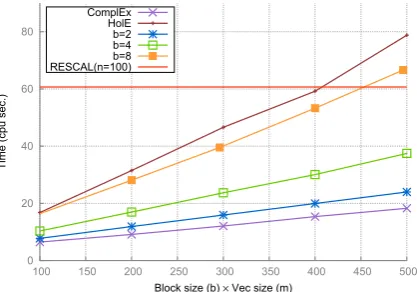
Figure 2: CPU run time per epoch of BlockHolE on WN11 Base with single CPU thread.
The Base part only contains facts (i.e., path queries withk = 1), and thus it is essentially for evaluating KGC performance. Its training samples constitute the observed factsF, and the facts in the entire Base part (training/validation/test sets) make the ground truth factsF∗.
The Path part contains path queries sampled from the same F and F∗ as the Base part. The test samples in the Path part is divided into “de-duction” and “in“de-duction” sets. In the “de“de-duction” set, test samples were sampled from the Base train-ing graphG(F). By contrast, in the “induction” set, the test samples were chosen from the ground truth graph G(F∗) such that none of them have a corresponding path inG(F). Thus, the “induc-tion” set is intended to measure how well a model generalizes to unobserved paths, whereas the “de-duction” set is to test its ability to faithfully encode the observed training graph.
At the time of evaluation, for each a test sample (s, r1/ . . . /rk, o), acandidate set
T(rk) ={t:∃h∈E (h, rk, t)∈F∗},
was first computed. In other words, the candidates
are the entities for whichrk(i.e., the last relation in the test query) takes as its object at least once inF∗. Then, for each compared model, we made the ranking of the candidates entities inT(rk)by the scoreφ(s, r1/ . . . /rk, e), whereφis learned by the model from the training set.
The quality of the ranking was measured by two evaluation metrics: averaged mean quantile (MQ) and P@10 (percentage of correct answers ranked in the top 10). Forq=s/pwherep=r1/ . . . /rk,
the correct answer setJqKis the set of all entities
that can be reached from sby traversingp over
G(F∗). Formally, let
JsK= {s}, and the answer
set can be recursively defined:Jq/rK={t:∃h∈
JqK,(h, r, t)∈F
∗}. With these definitions, MQ is computed by the following formula:
|{o0|o0 ∈N(q) :φ(s, p, o0)≤φ(s, p, o)}|
|N(q)| , (13)
whereN(q) =T(rk)\JqKis the set of incorrect
answers. Eq. (13) cannot be computed for queries with whichT(rk) = JqK, and these queries were
excluded from evaluation. For further details, see the original paper byGuu et al.(2015).
6.1.2 Path QA classification
In the path QA classification task, we simply re-port classification accuracy. After the scoring func-tionφwas trained with logistic regression, a path queryq= (s, r1/ . . . /rk, o)was classified as true ifφ(q)≥0, or false otherwise.
Since the test and validation sets of Path in Ta-ble 2 contain only correct queries, we sampled negative ones by the following procedure: For a correct query q = (s, r1/ . . . /rk, o) (k ≥ 2), we generated its reverse relation path queryq0 = (s, rk/rk−1/ . . . /r1, o). If q0 does not exist in
[image:7.595.76.285.241.387.2]40 50 60 70 80 90 100
DistMult ComplEx b=2,m=25 b=2,m=50 RESCAL
Accuracy (%)
WN11 Path
Deduction Induction
40 50 60 70 80 90 100
DistMult ComplEx b=2,m=25 b=2,m=50 RESCAL
Accuracy (%)
FB13 Path
[image:8.595.84.509.68.216.2]Deduction Induction
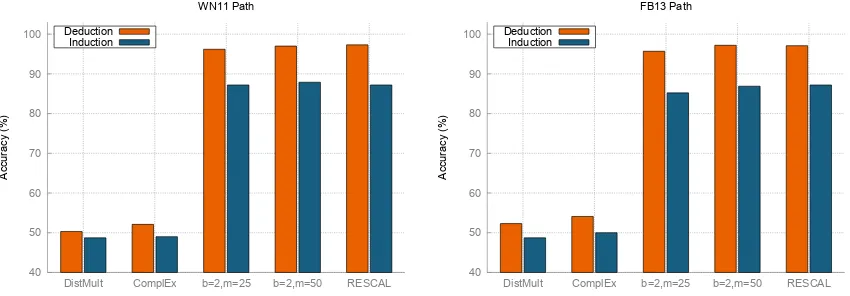
Figure 3: Path QA classification result comparing BlockHolE (b = 2, m= 25andb = 2, m= 50) to DistMult, ComplEx and RESCAL models (all withn= 50as the result of grid search).
6.2 Experiment setup
We compared BlockHolE with state-of-the-art bi-linear KGE models: DistMult, RESCAL and Com-plEx. We have implemented BlockHolE in Java. BlockHolE reduces to ComplEx whenb= 1, and with the imaginary parts of parameters set to0, it reduces to RESCAL whenm= 1and to DistMult whenb= 1. For a fair run time comparison, how-ever, we separately implemented RESCAL using jblas-1.2.4 for matrix computation. Through all experiments, we optimized the logistic loss with L2 regularization on the parametersΘ:
min
Θ
X
(q,y)∈D
log{1 + exp(−yφ(q; Θ))}+λ||Θ||22
where y denotes the truth value of a query q in a training data D. Given a correct query q = (s, r1/ . . . /rk, o), we generated negative samples by replacing owith an entity randomly sampled fromE.
We selected the hyperparameters via grid search such that on the validation set they maximize classification accuracy in the path QA classifi-cation task and MQ in the path QA ranking task. For all models except BlockHolE, all combinations of λ ∈ {0.0001,0}, learning rate
η ∈ {0.005,0.01,0.025,0.05}, and the embed-ding size n ∈ {50,100,150,200} were tried during grid search. For BlockHolE, all com-binations of (b, m) ∈ {(2,25),(2,50),(2,100),
(4,25),(4,50),(8,25)},λ∈ {0.0001,0}andη∈ {0.005,0.01,0.025,0.05} were tried. The maxi-mum number of training epochs was set to 500. The number of negatives generated per positive sample was 5 during training.
Label Relation Path ComplEx BlockHolE
[image:8.595.310.522.270.310.2]+ */parents/religion/* 96.7 100.0 - */religion/parents/* 3.3 100.0
Table 4: Classification accuracy on selected queries.
6.3 Results
6.3.1 Path QA ranking
Table3shows the results on the path QA ranking data. BlockHolE outperforms other bilinear KGE models considerably both on deductive and induc-tive test settings. These results strongly suggest that BlockHolE is more expressive in modeling path QA than DistMult and ComplEx, while effec-tively reducing redundant parameters in RESCAL which can cause model overfitting. Figure2shows the empirical scalability of BlockHolE. Whenbis small, BlockHolE scales linearly in the dimension
n=bmof the embedding space.
6.3.2 Path QA classification
Figure 3 shows the accuracy of path QA classi-fication. DistMult and ComplEx were consider-ably worse than BlockHolE and RESCAL for both WN11 and FB13. This result confirms our claim: The non-commutativity of relation matrices plays a critical role in modeling path QA. The performance of BlockHolE (b = 2, m = 25) was comparable to that of RESCAL but the former was 12 times faster.
6.4 Analysis
G(F∗)of FB13 that consist of an interpretable re-lation path */parents/religion/* where ∗ denotes “can match any relation path”. For such queries (s,∗/parents/religion/∗, o), we also generated meaningless queries (s,∗/religion/parents/∗, o) as negatives. Table4 shows the classification ac-curacies of ComplEx and BlockHolE (b= 2, m= 25). The results clearly show that ComplEx cannot correctly answer the negative queries at all due to the lack of the non-commutative property.
7 Summary
In this paper, we have pointed out the problems of existing bilinear KGE models in path QA, and pro-posed a new model that overcomes these problems. This model, called BlockHolE, represents relations as block circulant matrices. As a result, it respects the order of relations in path queries, while enjoy-ing linear-time computation of scorenjoy-ing functions when the numberb2of blocks is sufficiently small. It generalizes HolE/ComplEx, and it can also be interpreted as an interpolation between RESCAL and HolE/ComplEx. Its effectiveness was shown empirically in path QA.
Our proposal can be useful in not only path QA but also many tasks such as associative rule min-ing (Yang et al., 2015), path regularization (Lin et al., 2015), and more complex QA (Hamilton et al., 2018), in which composite relations need to be embedded as a vector. Other future direc-tions include reducing the increased parameters in the proposed block circulant matrices, such as by using multiplicative L1 regularization for Com-plEx (Manabe et al.,2018).
Acknowledgments
We thank anonymous reviewers for helpful com-ments. This work was partially supported by JSPS Kakenhi Grant Numbers 19H04173, 18K11457, and 18H03288.
References
Antoine Bordes, Nicolas Usunier, Alberto Garcia-Duran, Jason Weston, and Oksana Yakhnenko. 2013. Translating embeddings for modeling multi-relational data. InAdvances in Neural Information Processing Systems 26 (NIPS), pages 2787–2795.
Kelvin Guu, John Miller, and Percy Liang. 2015.
Traversing knowledge graphs in vector space. In Proceedings of the 2015 Conference on Empirical Methods in Natural Language Processing (EMNLP), pages 318–327.
William L. Hamilton, Payal Bajaj, Marinka Zitnik, Dan Jurafsky, and Jure Leskovec. 2018. Embed-ding logical queries on knowledge graphs. In Ad-vances in Neural Information Processing Systems 31 (NeurIPS), pages 2030–2041.
Katsuhiko Hayashi and Masashi Shimbo. 2017. On the equivalence of holographic and complex embed-dings for link prediction. In Proceedings of the 55th Annual Meeting of the Association for Compu-tational Linguistics (ACL), volume 2: Short Papers, pages 554–559.
Seyed Mehran Kazemi and David Poole. 2018.SimplE embedding for link prediction in knowledge graphs. In Advances in Neural Information Processing Sys-tems 31 (NeurIPS), pages 4284–4295.
Yankai Lin, Zhiyuan Liu, Huan-Bo Luan, Maosong Sun, Siwei Rao, and Song Liu. 2015. Modeling rela-tion paths for representarela-tion learning of knowledge bases. InProceedings of the 2015 Conference on Empirical Methods in Natural Language Processing (EMNLP), pages 705–714.
Hanxiao Liu, Yuexin Wu, and Yiming Yang. 2017.
Analogical inference for multi-relational embed-dings. InProceedings of the 34th International Con-ference on Machine Learning (ICML), pages 2168– 2178.
Hitoshi Manabe, Katsuhiko Hayashi, and Masashi Shimbo. 2018. Data-dependent learning of symmetric/anti-symmetric relations for knowledge base completion. InProceedings of the 32nd AAAI Conference on Artificial Intelligence (AAAI), pages 3754–3761.
Maximilian Nickel, Kevin Murphy, Volker Tresp, and Evgeniy Gabrilovich. 2016a. A review of relational machine learning for knowledge graphs. Proceed-ings of the IEEE, 104(1):11–33.
Maximilian Nickel, Lorenzo Rosasco, and Tomaso Poggio. 2016b. Holographic embeddings of knowl-edge graphs. In Proceedings of the 30th AAAI Conference on Artificial Intelligence (AAAI), pages 1955–1961.
Maximilian Nickel, Volker Tresp, and Hans-Peter Kriegel. 2011. A three-way model for collective learning on multi-relational data. In Proceedings of the 28th International Conference on Machine Learning (ICML), pages 809–816.
Th´eo Trouillon, Johannes Welbl, Sebastian Riedel, ´Eric Gaussier, and Guillaume Bouchard. 2016. Complex embeddings for simple link prediction. In Proceed-ings of the 33rd International Conference on Ma-chine Learning (ICML), pages 2071–2080.