Applications of Knowledge-Based
Expert Systems to Feng Shui Knowledge
Michael Y Mak
Abstract—Feng Shui is a traditional Chinese wisdom which aimed at creating a harmony between environment, buildings and people. With a desire to improve the relationship between human and the environment, there is an increasing interest for architects and other building professionals to apply the concepts of Feng Shui in building design and the built environment. While Feng Shui has been practiced in China for more than three thousand years, little research has been done to capture the Feng Shui knowledge in a systematic manner. Knowledge-based expert systems (KBES) approach is one of the artificial intelligent techniques possessing a high potential to deal with intuitive expertise which is appropriate to structure and represent the Feng Shui knowledge. This paper outlines the design and development process of a prototype model of Feng Shui knowledge using knowledge-based expert systems approach.
Index Terms—Feng Shui, knowledge-based expert systems, building design.
I. INTRODUCTION
Feng Shui, which translates as “wind” and “water”, is a body of ancient Chinese knowledge for improving the relationship between environment, buildings and people. The “Form School” is based on the understanding of physical configuration of geographical features and is the most dominant approach that has had a great impact on Chinese architecture. In the 19th century, Western scholars first classified Feng Shui as a mixture of superstition, religious sentiment, and observational science [1]-[2]. However, since the 1970’s, Western scientists have changed to accept the development of a new complexity paradigm, and began to recognize that there are similarities between modern science and Eastern philosophy [3]-[4]. Westerners sought deeper understandings of the relationships between the human and natural environments, and embraced Feng Shui as a broadly ecological and architecturally connected paradigm [5]. However, the development of Feng Shui principles and Form School practices are complicated and there is little research into the application of Feng Shui knowledge to the built environment.
It is suggested that interpreting Feng Shui knowledge would enable the development of an alternative design evaluation tool. In particular, the Form School provided a holistic approach that allows integrated components and elements to be considered for the built environment [6]. Although contemporary Form School practices for architectural design have been expressed through various
forms [6]-[11], there is a lack of a structured way to represent the Feng Shui knowledge in a scientific manner.
Manuscript received December 8, 2009.
Dr Michael Y Mak, School of Architecture and Built Environment, The University of Newcastle, Australia. Phone: +612 4921 7450; Fax: +612 4921 6913; Email: [email protected]
The development of Artificial Intelligence (AI) aims to understand the human reasoning process and to develop intelligent computer systems to supplement human brainpower. It appears that the interrelationship and complexity of Feng Shui knowledge and the intuitive aspect of Form school practices processing by the human experts could be structured and simulated in AI techniques by using heuristic rules and conceptual networks. The Knowledge-Based Expert systems (KBES) approach is one of the AI techniques that possess the potential to deal with intuitive expertise and complexity of Feng Shui knowledge [12]. However, the design of a KBES model for the Feng Shui knowledge being applied to preliminary design evaluation is ground-breaking and costly to develop, it is sensible to develop them in stages, starting with a smaller developmental prototype model. Satzinger et al. [13] suggested a four-stage developmental prototyping approach: (1) conceptual framework, (2) prototype design, (3) prototype development, and (4) prototype evaluation (Figure 1). This aim of this paper is to outline the design and development process of the KBES prototype model for Feng Shui preliminary design evaluation.
Conceptual Framework
Prototype Design
(1) Fundamental Concepts
(2) Hierarchical Structure
(3) Evaluation
(4) Refinement
(1) Domain Specific Area
(2) Target Decision
(3) Dependency Diagrams
(4) Decision Table
Prototype Development
(1) Development Tool
(2) Data Flow Diagram
(3) Prototype Architecture
(4) Prototype Features
Prototype Evaluation
(1) Verification
Consistency Completeness
(2) Validation
Accuracy Appropriateness
[image:1.595.307.548.464.576.2]
Figure 1 Four stages of KBES prototyping process [14]
II. CONCEPTUALFRAMEWORK
A conceptual framework creates the full scope of a KBES, which consists of high-level descriptions of the tasks the KBES will perform and provides a classification of the characteristics of the system. According to Dologite [15], the first step when preparing a conceptual framework is to establish knowledge elicitation from literature and domain experts. The main focus of a conceptual framework is on the knowledge acquisition process and the hierarchy of the knowledge base of the KBES model. The knowledge acquisition process continues until the conceptual framework is sufficiently complete to translate into a prototype model.
of grounded theory through the analysis of literature [16]. Hence, the hierarchies of Feng Shui concepts are identified and constructed in a form of hierarchical structure utilizing concept hierarchy approach [17]. The processes of the establishment of the conceptual framework are detailed in [16] and [18]. A questionnaire survey of architects in Sydney and Hong Kong was used to evaluate the four fundamental concepts of Form School approach and the developed hierarchical structure of the conceptual framework. The results of the survey demonstrated that these fundamental concepts and the conceptual framework are accepted by architects [16]. Overall, there was very strong correlation between both groups of architects in Sydney and Hong Kong notwithstanding the fact that they have very different cultural, educational and geographical backgrounds [19]. The differences between the survey results and the recommendations from Feng Shui scholars have been reviewed and refinements have been made to the final hierarchical structure [16].
III. PROTOTYPEDESIGN
After the knowledge elicitation process, the Feng Shui knowledge acquired from the conceptual framework has to be converted into a form that the expert system can understand. Satzinger et al. [13] recognized that the prototype design stage defines the structure of the prototype model and creates a logical structure of the inference network. Dologite [15] suggested four basic steps in the design process of a knowledge-based system: (A) an isolated domain specific area is selected; (B) selected decisions are targeted to be prototyped; (C) dependency diagrams are created; and (D) decision tables are generated.
A. Domain Specific Area
Dologite [15] recognized that one isolated area of the knowledge domain has to be defined and a problem in the area is targeted to be prototyped for an initial concept testing. It is suggested that the holistic nature and intuitiveness of Feng Shui knowledge provides an integrative analysis at the early stage of building design [16]. The area selected for this prototype model was based on the principles of Feng Shui knowledge, the Form School approach and its practices for dwellings for the living. The domain area for this prototype model was further specified to the design of residential buildings in urban settings according to the knowledge hierarchy and the conceptual framework developed in [18].
B. Targeted Decision
[image:2.595.314.547.234.584.2]When the domain specific area is defined, the precise problem area is then targeted for the prototype model. In order to organize the Feng Shui knowledge into a hierarchy specifically applicable to the preliminary design stages, the identified four stages of preliminary design were related to the four design modules in the hierarchical structure of Feng Shui knowledge [14] as shown in Table 1.
Table 1 Target Preliminary Design Stages related to Feng Shui [14]
Preliminary Design Stages Feng Shui Design Modules
Site Analysis Surrounding Environment
Concept Design External Layout
Sketch Design Internal Layout
Schematic Design Interior Arrangement
The hierarchical structure for the target decision of the prototype model was expressed in a block diagram as shown in Figure 2. This block diagram was derived from the hierarchical structure of Feng Shui knowledge established in the conceptual framework stage in relation to the identified preliminary design stages [16]. The block diagram illustrated the sequence in which the four design modules should perform and helps to define the critical factors in the target decision areas to be prototyped. Based on the structure of the target decision of the prototype model, input action of the preliminary design stages was first identified to determine which design module(s) is/are required. There were three levels in the decision structure of the prototype model: (1) decision at design criteria level, (2) decision at Feng Shui model level, and (3) decision at overall evaluation level.
Conditions Conditions Conditions Conditions Conditions
Conditions Conditions Conditions
Conditions Conditions Conditions
Conditions Conditions Conditions Conditions Conditions Conditions Conditions Conditions Conditions Conditions Conditions
Conditions Conditions
Rear of SIte Front of Site Topography Sides of Site
Street location Water view Wind direction
Sides
Front Back
Water
Cave Sand Dragon
Direction
Surround-ing
Environ-ment
Outer Form
Shape of Site Entrance
Trees
Shape of Building Pond Orientation
Sides
Front Back
Water
Cave Sand Dragon
Direction
External Layout
Layout Doors Shape of Rooms
Staircase Windows Ceiling
Sides
Front Back
Water
Cave Sand Dragon
Direction
Internal Layout
Bedroom Kitchen
Living room Door Opening Bathroom
Sides
Front Back
Water
Cave Sand Dragon
Direction
Interior Arrange-ment
Inner Form
Feng Shui Preliminary Design Evaluation
Schematic Design Stage Sketch Design Stage Concept
Design Stage Site Analysis
Stage Preliminary
Design Stages
Input Action
Decision Structure
Target Decision
Intermediate Level
Feng Shui Model Level Design
Criteria Level
Overall Evaluation
Level
Figure 2 Block Diagram for the Target Decision of the Prototype Model [14]
C. Dependency Diagram
The next step in the prototype design process is the transformation of the block diagram into dependency diagrams. It is recognized that a dependency diagram is the analysis of judgmental knowledge that defines reasoning steps and produces the structure of inference [15].
[image:2.595.52.284.721.786.2]prototype model to be translated into the code of the actual prototype model in the development stage. Figure 3 shows an example that illustrated the components of a detailed dependency diagram.
A3 Rear of site A301 Back with mountain or higher ground
(yes, no, Not_known) A302 Back with rocky hill or cliff (yes, no, Not_known ) A303 Back with lower ground (yes, no, Not_known)
A1 Topography of site A101 Topographical location of site (Higher_ground, Level_ground Lower_ground, Not_known)
Set Rules SEB
SEB SE_Back (F, N, U) Set Rules
A3 A3_P Rear of Site
(F, N, U) A304 Back with trees
(yes, no, Not_known) A305 Back with buildings (yes, no, Not_known)
Set Rules A1
A1_P Topogrpahy
(F, N, U) Variable with code
used in the prototype program
input line
Possible Value of the Variable
Possible Outcome of the Critical Factor
Rule Set with Code used in the prototype
program Critical Factor with
Code used in the prototype program Design Criteria with
code used in the prototype program
input line
[image:3.595.54.278.108.268.2]Note: F = Favourable N = Neutral U = Unfavourable
Figure 3 Components of a Detail Dependency Diagram [14]
D. Decision Table
Creating decision tables is the final step in the design process of the prototype model. Relationships are represented in the form of decision tables to capture the conclusion of the inference structure. Each triangle in the dependency diagrams has to be supported with a decision table. The decision tables present the factual knowledge that defined and classified characteristics, and organized facts and relationships. The decision tables are created to show the interrelationships between the values of the outcome at any intermediate stage of evaluation or final recommendation of the prototype model.
However, it is difficult to formulate the decisions. Decisions require evaluation of all values listed and require the expert to determine what would be concluded from the values given. It is recognized that experts would sometime use a variety of special-purpose heuristics called “pseudorules” or “rules of thumb” to make a decision [15].
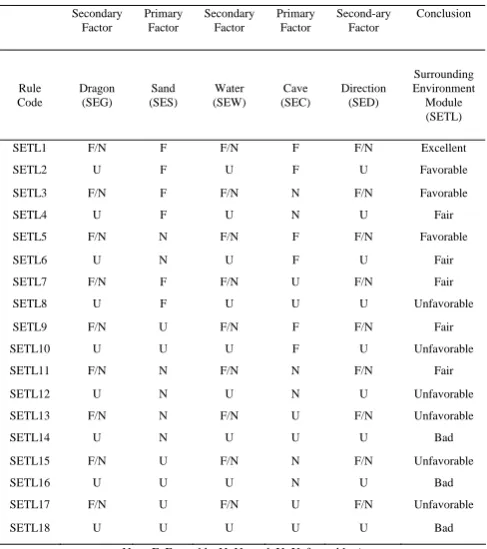
According to the Form School principles, there are five secret factors in the Feng Shui model. It is recognized that no one secret factor is ever considered individually [20]. Consideration needs to be given to all these five factors in a single process and they are always interrelated to each other. However, when considering all possible outcomes from these five factors within the 3-level classifications, there are total 243 (= 35) possible outcomes in one Feng Shui model. To create decision tables for this large number of combinations is not practical in the prototype model, therefore, it is necessary to prioritize these possible outcomes in order to develop a workable prototype model. Xu [6] recognized that the process of prioritization in problem solving similar to the complex characteristics of human Feng Shui experts. Based on the evaluation of the conceptual framework, rankings of design criteria in four design modules and the structure of the detail dependency diagrams of the four design modules, the priorities in inference are derived for each of the four design modules at the Feng Shui model level [16]. In this study, the prototype design considered the first two highest-ranking
factors as primary factors and the remaining three factors as secondary factors.
When the inference priorities were established and, the primary and secondary factors were determined, the inference structure of decisions at the Feng Shui model level was constructed as shown in Figure 4. Each of the two identified primary factors has three possible outcomes: favorable, neutral and unfavorable, and they were derived from the inference structure and decision tables at the design criteria level and the intermediate level. To reduce the combinations of the inference structure, the remaining three secondary factors with possible outcomes were grouped into two possible results, as “favorable or neutral” (F/N) and “unfavorable” (U). As a result, there were a total of 18 possible combinations of conditions that can occur at this decision point in the prototype model.
Initial Primary Factor
Subsequent Primary
Factor F
N
U
Secondary Factors
Excellent F/N
U Favourable
Secondary Factors
Favourable F/N
U Fair
Secondary Factors
Fair F/N
U Unfavourable
Subsequent Primary
Factor F
N
U
Secondary Factors
Favourable F/N
U Fair
Secondary Factors
Fair F/N
U Unfavourable
Secondary Factors
Unfavourable F/N
U Bad
Subsequent Primary
Factor F
N
U
Secondary Factors
Fair F/N
U Unfavourable
Secondary Factors
Unfavourable F/N
U Bad
Secondary Factors
Unfavourable F/N
U Bad
F
N
U
[image:3.595.309.544.253.555.2]Note: F = Favourable N = Neutral U = Unfavourable
Figure 4 Inference Structure at Feng Shui Model Level [14]
In the traditional Form School approach, judgments were explained as consequences of auspicious or inauspicious situations and the evaluation was broadly described as either lucky or unlucky to the family who lived in the dwellings [21]. Contemporarily, Xu [6] classified Feng Shui evaluation for landscaping into four categories as “best, good, okay and evil”.
Table 3 Decision Table for the Surrounding Environment [14] Secondary Factor Primary Factor Secondary Factor Primary Factor Second-ary Factor Conclusion Rule Code Dragon (SEG) Sand (SES) Water (SEW) Cave (SEC) Direction (SED) Surrounding Environment Module (SETL)
SETL1 F/N F F/N F F/N Excellent
SETL2 U F U F U Favorable
SETL3 F/N F F/N N F/N Favorable
SETL4 U F U N U Fair
SETL5 F/N N F/N F F/N Favorable
SETL6 U N U F U Fair
SETL7 F/N F F/N U F/N Fair
SETL8 U F U U U Unfavorable
SETL9 F/N U F/N F F/N Fair
SETL10 U U U F U Unfavorable
SETL11 F/N N F/N N F/N Fair
SETL12 U N U N U Unfavorable
SETL13 F/N N F/N U F/N Unfavorable
SETL14 U N U U U Bad
SETL15 F/N U F/N N F/N Unfavorable
SETL16 U U U N U Bad
SETL17 F/N U F/N U F/N Unfavorable
SETL18 U U U U U Bad
Note: F=Favorable, N=Neutral, U=Unfavorable, / = or
IV. PROTOTYPEDEVELOPMENT
After the design stage, the prototype model for the Feng Shui knowledge is actually constructed at the development stage. Dologite [15] recognized that the development process involves: (A) the selection of appropriate computer languages and software, (B) the data flow diagrams, (C) the architecture of the prototype model, (D) the program structure, and (E) the input /output of the prototype model.
A. Selection of Computer Languages and Software
Two basic types of development tools for expert system are available: high-level programming languages and shell programs. Shell programs pre-define how knowledge is to be represented and contain pre-constructed inference engines for accessing the knowledge base to reach conclusions. These shell programs are easy to use and especially good for developing prototype systems that can test the feasibility and soundness of the structure and concepts of systems before expensive development efforts are undertaken for larger systems [15], [22].
There are basically two types of shell programs for knowledge-based expert systems: rule-based and frame-based programs. Rule-based programs store information in a knowledge base in the form of rules or conditions to act on information in the working memory. Rule-based systems are very powerful and flexible, and they are capable of manipulating large amounts of data, as well as handling logical steps and possible decisions. VP-EXPERT was a shell program developed for the early stages of rule-based programs and was widely used for training and educational purposes [15], [ 23], [24].
B. Data Flow Diagrams
As the dependency diagrams and decision tables of the prototype model were established in the design stage, it is necessary to identify a suitable process to transform the flow
of information into relevant activities to develop the prototype model. When analysing the flow of information around a system, a graphical representation can eliminate thousands of words. Stair and Reynolds [25] recognized that Data Flow Diagrams (DFDs) technique provides a meaningful way of modelling objects, associations and activities and it is commonly used to develop conceptual frameworks for information systems [26]-[27]. The DFDs technique uses a graphical network of symbols to provide an overview of the flow of information. It is a logical representation of “what” a system does rather than a physical model showing “how” it works [28]. The DFDs for the prototype model are presented are shown in Figure 5.
Designer Design Module Design Criteria Analysis Feng Shui Model Assessment Design Module Evaluation Overall Evaluation Overall Evaluation Explanations & Recommendations
Explanation Facility Input Design Conditions Questions Design Module Knowledge Base Preliminary Design Stages Explanations & Recommendations
Output / Export to designer
Project Information
[image:4.595.319.536.217.368.2]Design Stage
Figure 5 Data Flow Diagrams for the Prototype Model
C. Architecture
Based on the design process and the data flow process of the prototype model as discussed in previous sections, the architecture of the prototype model has been developed. The prototype model was called the Feng Shui Expert Evaluator for the design evaluation of residential buildings at preliminary design stages, and was abbreviated as FSEE. It consisted of seven interrelated modules.
Each of the first four design modules was designated for evaluating various types of design data at the four identified preliminary design stages. The fifth module, overall evaluation integrated all four design modules together. In addition, input and output modules were provided for user interaction with prototype model. Figure 6 shows the architecture of the FSEE prototype model and interactions between these seven modules.
Input Design Conditions Design Criteria Analysis Feng Shui Model Assessment Preliminary Design Stage Input Design Conditions Design Criteria Analysis Feng Shui Model Assessment Site Analysis Site Analysis Explanation Facility Feng Shui Model Assessment Detail Surrounding Environment Evaluation External Layout Evaluation Site Analysis Concept Design Data on Design Conditions Sketch Design Schematic Design Outer Form Evaluation Design Module Evaluation Summary Inner Form Evaluation Overall Evaluation Internal Layout Evaluation Interior Arrangement Evaluation Feng Shui Model Assessment Feng Shui Model Assessment Input Design Conditions Design Criteria Analysis Input Design Conditions Design Criteria Analysis Data on Design Conditions Overall Evaluation Explanations & Recommendations Project Data Output Module Interior Arrangement Module Internal Layout Module External Layout Module Surrounding Environment Module Input Module Overall Evaluation Module Surrounding Environment Knowledge Base External Layout Knowledge Base Internal Layout Knowledge Base Interior Arrangement Knowledge Base Storage Project Location & Building Type
[image:4.595.311.542.591.767.2]D. Program Structure
The shell program, VP-Expert Version 3.1 was selected as the development tool for the programming of the FSEE prototype model. It used a production rules approach and backward chaining process to solve a specific problem on the rules in its knowledge base was called a “consultation”. The program structure of the FSEE prototype model consisted of three main parts:
(1) Actions: which define the planning, analysis and
sequence of the solutions.
(2) Rules: which contain the domain knowledge base.
(3) Questions: which contain information about the
planning process.
Production rules are the most popular form of knowledge representation used in expert systems, because rules are relatively easy to understand and create. Rosenman [29] recognized that rules are an intuitively appealing form of representation because of their ability to relate causal effects in a natural way and their ability to allow a natural format of language. FSEE used a production rules approach to represent recommendations, directives or strategies when the knowledge to be represented consists of the results of much experience in solving problems in a particular knowledge domain. Each rule consists of two parts, an “IF” and a “THEN”, which establishes a relationship that produces the core purpose of the rule.
FSEE used the backward chaining process as its reasoning control strategy. It starts by knowing the goal variable for which the consultation session must determine a value. The first rule found with the goal in its conclusion causes the condition of that rule to become a sub-goal. All the sub-goals must be determined or known for the “THEN” part of the rule to fire the goal variable and pass control back to the “Actions” block. If at any point a sub-goal cannot be satisfied with another sub-goal in another rule, the inference engine looks for an “ASK” statement in the “Questions” block to obtain the value from the user [15].
E. Input and Output
In the FSEE program, variables that do not appear as the consequence of some rules in the knowledge base, but are considered potential questions for the user. If the inference engine attempts to “FIND” such a variable, the user will be prompted for its value. This input mechanism was provided with “ASK” and “CHOICES” statements in the “Questions” block in the prototype program.
The form of the prompt for a variable was defined by an “ASK” statement. These prompts should be informative and they should tell the user how to gather and enter the information required. In this prototype program, there were finite numbers of possible answers to a question and they were defined by a “CHOICES” statement. An example of the “ASK” and “CHOICES” statements in the input screen of the FSEE program is shown in Figure 7. In this example, there were four possible answers to the question. Brief descriptions of the choices were provided to help the user to select the most appropriate answer.
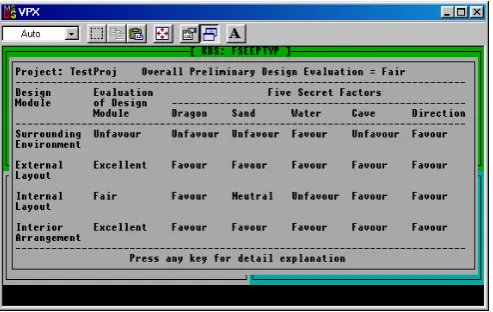
When the value of the overall evaluation was derived, a summary report of evaluation results was displayed at the end of the consultation. This screen first provided a summary of the general settings, including project name, location, building type and the preliminary design stage selected. Then, the result of the overall preliminary design evaluation
[image:5.595.304.549.95.248.2]was presented. A brief explanation of the overall evaluation was supported by the Outer form and Inner form results. An example of the summary report is shown in Figure 8.
[image:5.595.306.548.276.428.2]Figure 7 An example of the Input Screen of the FSEE
Figure 8 An example of a Summary Report of the FSEE
[image:5.595.306.553.617.773.2]Following the summary report, the detail report screen of the FSEE consultation provided more detail results to the evaluation of design modules and the five secret factors of the Feng Shui model. Evaluation of each activated design module was provided, and individual results for each of the five Feng Shui secret factors were also tabulated as shown in Figure 9. These detailed results provided an overall indication of the strength and weakness of the design of the proposed project. As this consultation represents the preliminary design evaluation process, the designer has the opportunity to go back to the drawing board to review the design of the proposed project and pay special attention to any weaknesses indicated by the FSEE prototype model.
V. PROTOTYPEEVALUATION
At the final stage of the prototyping process, testing and evaluation is required to determine the suitability and desirability of a prototype system. The verification and validation process for the prototype model will be addressed. The verification focuses on ensuring the prototype model is developed correctly and accurately, and checking for consistency and completeness are involved. The validation of the prototype model concentrates on evaluating the accuracy of the solutions provided by the prototype model and its performance. The Turing test and Face validation techniques are used to assess the performance of the prototype model. The results of the Turing test indicated that the solutions generated by the FSEE are accurate and its performance are highly satisfied by both architectural and Feng Shui experts. The results of the Face validation with experienced practicing architects recognized that the FSEE is an effective alternative decision supporting tool and has considerable potential benefits in evaluating design decisions objectively, increasing consistency and providing better training to practicing architects [16].
VI. CONCLUSION
Knowledge-Base Expert Systems (KBES) approach demonstrates distinct advantages to the structuring and representation of Feng Shui knowledge. The prototyping process involved four stages process with conceptual framework, prototype design, prototype development and prototype evaluation. Derived from the established conceptual framework, the design stage involves four basic steps to define the structure of the prototype model and create a logical structure of the inference network. The development stage actually constructed the prototype model through the selection of shell program, the creation of the data flow diagrams and the establishment of the architecture of the prototype model. The Feng Shui Expert Evaluator (FSEE) was programmed using production rules and backward chaining approach, and the input & output of the consultation were presented.
Although the Feng Shui knowledge provides a broad understanding of the Chinese architectural approach, a systematic development of Feng Shui knowledge has never been constructed. In this paper, the design and development process of a KBES prototype model for Feng Shui knowledge has been established. The applications of the knowledge-based expert systems approach provided a detail understanding of the logic of the Form School approach and created a structured framework for the evaluation of architectural design using the ancient Chinese wisdom of Feng Shui knowledge.
REFERENCE
[1] Yates, M.T. (1868) Ancestral Worship and Feng-shui. Chinese
Recorder and Missionary Journal. July, Vol. 1, No. 3, p.41.
[2] Eitel, E.J. (1873) Feng Shui or the Rudiments of Natural Science in
China. Hong Kong, Trubner. Reprinted 1984, London, Synergetic
Press.
[3] Needham, J. (1959) Science and Civilisation in China, vol 3,
Mathematics and the Sciences of the Heavens and the Earth.
Cambridge, Cambridge University Press.
[4] Anderson, E. and Anderson, M. (1973) Changing Patterns of Land
Use in Rural Hong Kong. IN: Anderson, E. et al. (eds.) Mountains and
water: Essays on the Cultural Ecology of South Coastal China.
Taipei: Orient Cultural Service. pp. 45-50.
[5] Hwangbo, A. B. (1999) In Search of Alternative Traditions in
Architecture: a Cross-Cultural Interdisciplinary Study. PhD Thesis in
Architecture, University of Sheffield.
[6] Xu, Ping (1990) Feng Shui: A model for Landscape Analysis. DrDes
Thesis, Harvard University.
[7] Lip, E. (1979) Chinese Geomancy. Singapore, Times Books
International.
[8] Rossbach, S. (1984) Feng Shui. London, Rider.
[9] Lee, Sang-Hae (1986) Feng Shui: Its Context and Meaning. PhD
Thesis, Cornell University.
[10] Han, Ke-Tsung (1995) Basic Theory of Landscape Feng Shui. Taipei,
Lamper Enterprises [Chinese].
[11] Choy, H. (1999) Go with the Flow. IN: Property Council of Australia,
Residential Property Investors Guide, p.19.
[12] Mak, M.Y. and Ng, S.T. (2006) Applying Knowledge-Based Expert
System Approach for Feng Shui Design Evaluation. Proceedings of
Joint International Conference on Computing and Decision Making
in Civil and Building Engineering, Montreal, Canada, pp.1332-1344.
[13] Satzinger, J.W., Jackson, R.B. and Burd, S.D. (2002) System Analysis
and Design in a Changing World. Canada, Course Technology.
[14] Mak, M.Y. and Ng, S.T. (2008) Prototype Design of the Feng Shui Expert Systems for Design Evaluation. IN Ren, A., Ma, Z. and Lu, X.
(eds.) Proceedings of 12th International Conference on Computing in
Civil and Building Engineering and 2008 International Conference
on Information Technology in Construction. Tsinghua University
Press, Beijing, China. (CD Proceedings).
[15] Dologite, D.G. (1993) Developing Knowledge-Based Systems Using
VP-Expert. New York, Macmillan.
[16] Mak, M.Y. (2009) Scientific Feng Shui: Application of Feng Shui
Knowledge to Preliminary Building Design Evaluation Using
Knowledge-Based Expert Systems Approach. VDM Verlag Dr Muller,
Saarbrucken, Germany.
[17] Tam, K.Y. (1993) Applying Conceptual Clustering to
Knowledge-Bases Construction. Decision Support Systems, 10,
pp.173-198.
[18] Mak, M.Y., Ng, S.T. and Chen, S.E. (2005) Formulating a hierarchical structure of Feng Shui knowledge. IN: Ribeiro, F.L., Love, P.D.E.,
Davidson, C.H., Egbu, C.O. & Dimitrijevic, B. (eds) Information and
Knowledge Management in a Global Economy (Proceedings of
CIB-W102 2005), Instituto Superior Técnico, Lisbon, Portugal,
pp.395-404.
[19] Mak, M.Y. and Ng, S.T. (2005) The Art and Science of Feng Shui – A
Study on Architects’ Perception. Building and Environment, 40,
pp.427-434
[20] He, Xiaoxin (1998) Feng Shui: Chinese Tradition in a Manchester
Context. PhD Thesis, University of Manchester.
[21] Feuchtwang, S.D.R. (1974). An Anthropological Analysis of Chinese
Geomancy. Vientiane, Laos, Vithagna
[22] Poon, J., Potts, K. and Musgrove, P. (2003) CONBPS: An Expert
System to Improve the Efficiency of the Construction Process.
London, RICS Foundation Research Paper, Vol.4, No. 21.
[23] Luce, T. (1992) Using VP-Expert in Business. New York, Mitchell
McGraw-Hill.
[24] Pigford, D.V. and Baur, G. (1995) Expert Systems for Business:
Concepts and Applications, 2nd edition. USA, Boyd & Fraser
Publishing.
[25] Stair, R.M. and Reynolds, G.W. (2001) Fundamentals of Information
Systems. Boston, Course Technology.
[26] Pollard, A. and Plume, J. (1993) Can Architectural Design Learn from
Software Engineering? Proceedings of the Third International
Building Performance Simulation Association Conference, Adelaide,
Australia, August, pp.327-333.
[27] Baldwin, A.N., Austin, S.A., Hassan, T.M. and Thorpe, A. (1999) Modelling Information Flow During the Conceptual and Schematic
Stages of Building Design. Construction Management and
Economics, v. 17, pp.155-167.
[28] Kozar, K.A. (1997) The Technique of Data Flow Diagramming.
[Internet] Available from:
<http://spot.colorado.edu/~kozar/DFDtechnique.html> [Accessed 19 September 2002].
[29] Rosenman, M. A., Gero, J. S. and Oxman, R. (1986) An Expert
System for Design Codes and Design Rules. Proceedings of the First
International Conference: Applications of Artificial Intelligence in
Engineering Problems, Southampton University, Springer-Verlag.
![Figure 1 Four stages of KBES prototyping process [14]](https://thumb-us.123doks.com/thumbv2/123dok_us/1304257.660201/1.595.307.548.464.576/figure-stages-kbes-prototyping-process.webp)
![Table 1 Target Preliminary Design Stages related to Feng Shui [14]](https://thumb-us.123doks.com/thumbv2/123dok_us/1304257.660201/2.595.314.547.234.584/table-target-preliminary-design-stages-related-feng-shui.webp)
![Figure 4 Inference Structure at Feng Shui Model Level [14]](https://thumb-us.123doks.com/thumbv2/123dok_us/1304257.660201/3.595.309.544.253.555/figure-inference-structure-feng-shui-model-level.webp)