Data-driven Multilingual Coreference Resolution using Resolver Stacking
Anders Bj¨orkelund and Rich´ard Farkas Institute for Natural Language Processing
University of Stuttgart
{anders,farkas}@ims.uni-stuttgart.de
Abstract
This paper describes our contribution to the CoNLL 2012 Shared Task.1 We present a
novel decoding algorithm for coreference res-olution which is combined with a standard pair-wise coreference resolver in a stacking approach. The stacked decoders are evaluated on the three languages of the Shared Task. We obtain an official overall score of 58.25 which is the second highest in the Shared Task.
1 Introduction
In this paper we present our contribution to the CoNLL 2012 Shared Task (Pradhan et al., 2012). We follow the standard architecture where mentions are extracted in the first step, then they are clustered using a pair-wise classifier (see e.g., (Ng, 2010)). For English, the set of extracted mentions is filtered by removing non-referential occurrences of certain pronouns. Our coreference resolver at its core re-lies on a pair-wise classifier. To overcome the prob-lems associated with the isolated pair-wise deci-sions, we devised a novel decoding algorithm which compares a mention to partially built clusters. For our Shared Task contribution we combined this al-gorithm with conventional pair-wise decoding algo-rithms in a stacking approach.
In the Shared Task evaluation, our system re-ceived an overall official score of 58.25, which is the second highest among the sixteen participants.2
1
The system is available for download onhttp://www. ims.uni-stuttgart.de/˜anders/
2The overall score is the average of MUC, B3
, and CEAFE, averaged over all three languages
2 Mention Extraction
Since all mentions are not annotated in Shared Task data, but only mentions that take part in coreference chains, training a general-purpose anaphoricity clas-sifier is non-trivial. We thus implemented a high-recall, low-precision mention extraction module that allows the coreference resolver to see most of the possible mentions, but has to learn to sort out the non-referential mentions.
The mention extraction module relies mainly on the syntactic parse tree, but also on named entities (which were only provided for English in the pre-dicted versions of the Shared Task data).
Since the part-of-speech tags vary a bit across the languages, so do our extraction rules: For Arabic, we extract all NP’s, and all terminals with part-of-speech tags PRP and PRP$; for Chinese, we extract all NP’s, and all terminals with part-of-speech tags PN and NR; for English, we extract all NP’s, all ter-minals with part-of-speech tags PRP and PRP$, and all named entities.
Early experiments indicated that the English coreference resolver frequently makes mistakes re-lated to non-referential instances of the pronounsit (often referred to as expletive or pleonastic in the lit-erature),we, andyou(generic mentions, which are not annotated according to the OntoNotes annota-tion guidelines). To address this issue, we developed a referential/non-referential mention classifier in order to identify these mentions. The classifier acts as a filter after the mention extraction module and removes clear cases of non-referential mentions.
Our basic assumption was that when these
th= 0.5 th= 0.95
Precision Recall F1 Precision Recall F1 # occurrences
it 75.41 61.92 68 86.78 38.65 53.48 10,307
we 65.93 41.61 51.02 75.41 24.20 36.64 5,323
[image:2.612.141.470.57.125.2]you 79.10 74.26 76.60 88.36 51.59 65.15 11,297 Average 75.73 63.05 68.81 86.17 41.04 55.60 26,927
Table 1: Performance of the non-referential classifier used for English. Precision, recall, and F-measure are broken down by pronoun (top three rows), and the micro-average over all three (bottom row). The left side uses a probability threshold of 0.5, and the right one a threshold of 0.95. The last column denotes the number of occurrences of the corresponding token. All numbers are computed on the development set.
nouns do not participate in any coreference chain, they are examples of non-referential mentions. Based on this assumption, we extracted referential and non-referential examples from the training set and trained binary MaxEnt classifiers using the Mal-let toolkit (McCallum, 2002).
Since the mentions filtered by these classifiers are permanently removed, they are never presented as potential mentions to the coreference resolver. Hence, we aim for a classifier that yields few false positives (i.e., mentions classified as non-referential although they were not). False negatives, on the other hand, may be passed on to the resolver, which, ideally, does not assign them to a cluster. The pre-cision/recall tradeoff can easily be controlled by ad-justing the threshold of the posterior probability of these classifiers, requiring a very high probability that a mention is non-referential. Preliminary ex-periments indicated that a threshold of0.95worked best when the coreference resolver was trained and evaluated on these filtered mentions.
We also found that the target pronouns should be handled separately, i.e., instead of training one sin-gle classifier we trained independent classifiers for each of the target pronouns. The individual per-formance of the classifiers, as well as the micro-average over all three pronouns are shown in Ta-ble 1, both using the default probability threshold of0.5, and the higher0.95. In the final, fine-tuned English coreference system, we found that the use of the classifiers with the higher threshold improved in all coreference metrics, and gave an increase of about 0.5 in the official CoNLL score.
The feature set used by the classifiers describes the (in-sentence) context of the pronoun. It consists of the uni-, bi-, and trigrams of word forms and POS tags in a window of±5; the position inside the
sen-tence; the preceding and following verb and adjec-tive; the distance to the following named entity; the genre of the document; and whether the mention is between quotes. For English, we additionally ex-tended this general feature set by re-implementing the features of Boyd et al. (2005).
We investigated similar classifiers for Arabic and Chinese as well. We selected targets based on the frequency statistics of tokens being referential and non-referential on the training set and used the gen-eral feature set described above. However, these classifiers did not contribute to the more complex coreference system, hence the non-referential clas-sifiers are included only in the English system.
3 Training Instance generation
To generate training instances for the pair-wise clas-sifier, we employed the approach described by Soon et al. (2001). In this approach, for every extracted anaphoric mention mj, we create a positive
train-ing instance with its closest precedtrain-ing antecedent
mi: P = {(mi, mj)}. Negative examples are
con-structed by considering all the pairs ofmj and the
(non-coreferent) mentionsmkbetweenmiandmj: N = {(mk, mj)|i < k < j}. We extract the
train-ing examples on the version of the traintrain-ing set that uses predicted information, and restrict the mentions considered to the ones extracted by our mention ex-traction module. Using these training examples, we train a linear logistic regression classifier using the LIBLINEARpackage (Fan et al., 2008).
To create training examples for the English clas-sifier, which uses the non-referential classifier for pronouns, we made a 10-fold cross-annotation on the training set with this classifier. I.e., the docu-ments were partitioned into 10 setsD1, D2, ..., D10,
docu-ments inDp, the non-referential classifier trained on Dtp= S
i6=p
Di was applied.
4 Decoding
We implemented several decoding algorithms for our resolver. The two most common decoding al-gorithms often found in literature are the so-called BestFirst(henceforth BF) andClosestFirst(CF) al-gorithms (Ng, 2010). Both work in a similar man-ner and consider mentions linearly ordered as they occur in the document. They proceed left-to-right and for every mention mj, they consider all pairs
(mi, mj), where mi precedes mj, and queries the
classifier whether they are coreferent or not. The main difference between the two algorithms is that the CF algorithm selects theclosestpreceding men-tion deemed coreferent with mj by the classifier,
while the BF algorithm selects the most probable preceding mention. Most probable is determined by some sort of confidence measure of how likely two mentions are to corefer according to the classi-fier. For both algorithms, the threshold can also be tuned separately, e.g., requiring a probability larger than a certain thresholdthcoref in order to establish
a link between two mentions. Since the logistic clas-sifiers we use directly model a probability distribu-tion, we simply use the posterior probability of the
coref class as our confidence score.
Following Bj¨orkelund and Nugues (2011) we also implemented a decoder that works differently de-pending on whethermjis a pronoun or not.
Specifi-cally, for pronouns, the CF algorithm is used, other-wise the BF algorithm is used. In the remainder, we shall refer to this decoder asPronounsClosestFirst, or simply PCF.
4.1 Disallowing transitive nesting
A specific kind of mistake we frequently saw in our output is that two clearly disreferent nested mentions are put in the same cluster. Although nestedness can be used as a feature for the classifier, and this appeared to improve performance, two nested men-tions can still be put into the same cluster because they are both classified as coreferent with a different, preceding mention. The end result is that the two nested mentions are inadvertently clustered through transitivity.
For example, consider the two occurrences of the phraseher motherin (1) below. The spans in the ex-ample are labeled alphabetically according to their linear order in the document.3 Before the resolver considers the last mentiond, it has already success-fully placed(a, c)in the same cluster. The first pair involvingdis(c, d), which is correctly classified as disreferent (here, the feature set informs the classi-fier that(c, d)are nested). However, the pair (a, d) is easily classified as coreferent since the head noun ofaagrees in gender and number withd(and they are not nested).
A different problem is related to named entities in possessive constructions. Consider (2), where our mention extractor extractede, because it was an NP, andf, because it was tagged as a GPE by the named entity recognizer. Again, the pair(e, f)is correctly classified as disreferent, but botheandf are likely to be classified as coreferent with preceding men-tions of Taiwan, since our string matching feature ignores possessive markers.
(1) ... she seemed to have such a good relation-ship with [[her]bmother]a. Like [[her]dmother]c
treated her like a human being ...
(2) [[Taiwan]f ’s]e
To circumvent this problem, we let the decoders build the clusters incrementally as they work their way through a document and disallow this type of transitive nesting. For instance, when the decoder is trying to find an antecedent fordin (1),aandchave already been clustered together, and when the pair (c, d)is classified as disreferent, the decoder is con-strained to skip over other members ofc’s cluster as it moves backwards in the document. This modifi-cation gave an increase of about 0.6 in the CoNLL score for English, and about 0.4 for Arabic and Chi-nese, and we used this constraint whenever we use the above-mentioned decoders.
4.2 A Cluster-Mention Decoding Algorithm
The pair-wise classifier architecture has, justifiably, received much criticism as it makes decisions based on single pairs of mentions only. We therefore
de-3
vised a decoding algorithm that has a better perspec-tive on entire clusters.
The algorithm works by incrementally merging clusters as mentions are processed. Initially, every mention forms its own cluster. When the next men-tion mj is processed, it is compared to all the
pre-ceding mentions, M = {mi|i < j}. The score of
linkingmjwithmiis defined according to:
score(mi, mj) = (
Y
mc∈C
P(coref|(mc, mj)))1/|C|
whereP(coref|(mi, mj))is the posterior
probabil-ity that mi andmj are coreferent according to the
pair-wise classifier, and C denotes the cluster that
mi belongs to.
After considering all preceding mentions, the cluster ofmj is merged with the cluster of the
men-tion with which it had the highest score, assuming this score is higher than a given threshold thcoref.
Otherwise it remains in its own cluster.
The task of the score function is to capture cluster-level information. Whenmj is compared to
a mention mi, the score is computed as the
geo-metric mean of the product of the probabilities of linking mj to all mentions in the cluster that mi
belongs to. Also note that for two preceding men-tionsmi1 andmi2 that already belong to the same
cluster,score(mi1, mj) =score(mi2, mj). I.e., the
score is the same whenmj is compared to all
men-tions belonging to the same cluster. Since this algo-rithm works by maximizing the average probability for linking a mention, we dub this algorithm Aver-ageMaxProb, or AMP for short.
It should also be noted that other definitions of the cluster score function score are conceiv-able.4 However, initial experiments with other clus-ter score functions performed worse than the defi-nition above, and time prevented us from exploring this conclusively.
Contrary to the pair-wise decoding algorithms where pair-wise decisions are made in isolation, the order in which mentions are processed make a dif-ference to the AMP decoder. It is generally ac-cepted that named entities are more informative and
4
In the extreme case, one could take the maximum of the link probabilities over the mentions that belong to the cluster
C, in which case the algorithm collapses into the BF algorithm.
easier to resolve than common noun phrases and pronouns. To leverage this, we follow Sapena et al. (2010) who reorder mentions based on mention type. Specifically, we first process proper noun phrases, then common noun phrases, and finally pro-nouns. This implies that common noun phrases have to have a reasonable agreement not only with preceding proper noun phrases of a cluster, but all proper noun phrases in a document (where reason-able means that the geometric average of all poste-rior probabilities stay reasonably high). Similarly, pronouns are forced agree reasonably with all proper and common nouns phrases in a given cluster, and not only the preceding ones. Early experiments showed an increase in performance using reorder-ing, and we consequently used reordering for all lan-guages in the experiments.
5 Features
An advantage of the pair-wise model and of the lin-ear classifiers we use is that they can easily accom-modate very large feature spaces, while still remain-ing reasonably fast. We exploited this by buildremain-ing a large number of parametrized feature templates, that allowed us to experiment easily and quickly with different feature sets. Additionally, since our clas-sifiers are linear, we also evaluated a large number of feature conjunctions, which proved to be crucial to gain reasonable performance.
and Clark (2011) for Chinese.
While Chinese and English display no or rela-tively small variety in morphological inflection, Ara-bic has a very complex morphology. This means that Arabic suffers from greater data sparseness with respect to lexical features. This is exaggerated by the fact that the Arabic training set is considerably smaller than the Chinese and English ones. Hence, we used the lemmas and unvocalised Buckwalter forms that were provided in the Arabic dataset.
We also tried to extract number and gender in-formation based on affixes of Arabic surface forms. These features did, however, not help much. We did however see a considerable increase in perfor-mance when we added features that correspond to the Shortest Edit Script (Myers, 1986) between sur-face forms and unvocalised Buckwalter forms, re-spectively. We believe that edit scripts are better at capturing the differences in gender and number sig-naled by certain morphemes than our hand-crafted rules.
6 Resolver Stacking
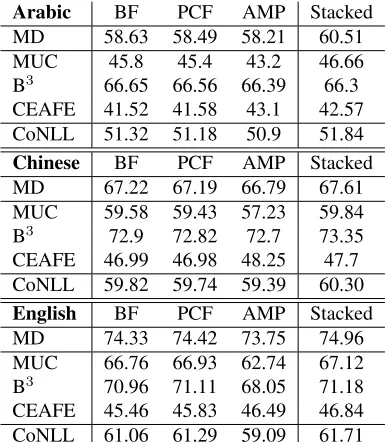
In Table 2 we present a comparison of the BF, PCF, and AMP resolvers. We omit the results of the CF decoder, since it always did worse and the corre-sponding numbers would not add more to the pic-ture. The table shows F-measures of mention de-tection (MD), the MUC metric, the B3 metric, and the entity-based CEAF metric. The CoNLL score, which is computed as the arithmetic mean of MUC, B3, and CEAFE, is shown in the last row.
Comparing the AMP decoder to the pair-wise de-coders, we find that it generally – i.e., with respect to the CoNLL average – performs worse though it always obtains higher scores with the CEAFE met-ric. When we looked at the precision and recall for mention detection, we also found that the AMP de-coder suffers from lower recall, but higher precision. This led us to conclude that this decoder is more con-servative in terms of clustering mentions, and builds smaller, but more consistent clusters. We could also verify this when we computed average cluster sizes on the output of the different decoders.
In order to combine the strengths of the AMP decoder and the pair-wise decoders we employed stacking, i.e., we feed the output of one resolver
Arabic BF PCF AMP Stacked
MD 58.63 58.49 58.21 60.51
MUC 45.8 45.4 43.2 46.66
B3 66.65 66.56 66.39 66.3
CEAFE 41.52 41.58 43.1 42.57
CoNLL 51.32 51.18 50.9 51.84
Chinese BF PCF AMP Stacked
MD 67.22 67.19 66.79 67.61
MUC 59.58 59.43 57.23 59.84
B3 72.9 72.82 72.7 73.35
CEAFE 46.99 46.98 48.25 47.7 CoNLL 59.82 59.74 59.39 60.30
English BF PCF AMP Stacked
MD 74.33 74.42 73.75 74.96
MUC 66.76 66.93 62.74 67.12
B3 70.96 71.11 68.05 71.18
[image:5.612.329.522.57.278.2]CEAFE 45.46 45.83 46.49 46.84 CoNLL 61.06 61.29 59.09 61.71
Table 2: Performance of different decoders on the devel-opment set for each language. The configuration of the Stacked systems is described in detail in Section 7.
as input to a second. The second resolver is in-formed about the decision of the first one by intro-ducing an additional feature that encodes the deci-sion of the first resolver. This feature can take five values, depending on how the first resolver treated the two mentions in question: NEITHER, when none of the mentions were placed in a cluster; IONLY, when only the first (antecedent) mention was placed in a cluster; JONLY, when only the second (anaphor) mention was placed in a cluster; COREF, when both mentions were placed in the same cluster; and DIS
-REF, when both mentions were clustered, but in dif-ferent clusters.
In addition to the stacking feature, the second solver uses the exact same feature set as the first re-solver. To generate the information for the stack fea-ture for training, we made a 10-fold cross-annotation on the training set, in the same way that we cross-annotated the non-referential classifier for English.
step, and a pair-wise decoder as the second, we saw an increase in performance, particularly with respect to the CEAFE metric.
7 Feature and Parameter Tuning
For every language we tuned decoder parameters and feature sets individually. The feature sets were tuned semi-automatically by evaluating the addition of a new feature template (or template conjunction) to a baseline set. Ideally, we would add feature templates to the baseline set incrementally one at a time, following a cross-validation on the training set. However, to reduce computational effort and time consumption, we resorted to doing only one or two folds out of a 4-fold cross-validation, and adding the two to three most contributing templates in every it-eration to the baseline set. The feature sets were op-timized to maximize the official CoNLL score using the standard BF decoder.
For the final submission we tuned the thresholds for each decoder, and the choice of pair-wise de-coder to use as the second dede-coder for each lan-guage. Modifying the threshold of the AMP decoder gave very small differences in overall score and we kept the threshold for this decoder at 0.5. How-ever, when we increased the probability threshold for the second resolver, we found that performance increased across all languages.
The choice of decoder for the second resolver, and the probability threshold for this, was determined by a 4-fold cross-validation on the training set. For our final submission, as well as in the column Stacked in Table 2, we used the following combinations: For Arabic, the threshold was set to 0.60, and the PCF decoder was used; for Chinese, the threshold was set to 0.65, and the BF decoder was used; for English, the threshold was set to 0.65, and the PCF decoder was used.
8 Official Results
The final scores of our system are presented in Ta-ble 3. The taTa-ble also includes the results on the sup-plementary tracks: gold mention boundaries (GB), when the perfect boundaries of mentions were given; and gold mentions (GM), when only the mentions in the gold standard were given (with gold boundaries). For all three settings we used the same model, which
Arabic PM GB GM
MD 60.55 60.61 76.43
MUC 47.82 47.90 60.81
B3 68.54 68.61 67.29
CEAFE 44.3 44 49.32
CoNLL 53.55 53.50 59.14
Chinese PM GB GM
MD 66.37 71.02 83.47
MUC 58.61 63.56 76.85
B3 73.10 74.52 76.30
CEAFE 48.19 50.20 56.61 CoNLL 59.97 62.76 69.92
English PM GB GM
MD 75.38 75.3 86.16
MUC 67.58 67.29 78.70
B3 70.26 69.70 72.67
[image:6.612.350.502.55.279.2]CEAFE 45.87 45.27 53.23 CoNLL 61.24 60.75 68.20
Table 3: Performance on the shared task test set. Us-ing predicted mentions (PM; i.e., the official evalua-tion), gold mentions boundaries (GB), and gold mentions (GM).
was trained on the concatenation of the training and the development sets.
Compared to the results on the development set (cf. Table 2), we see a slight drop for Chinese and English, but a fairly big increase for Arabic. Given that Chinese and English have the biggest training sets, we speculate that the increase in Arabic might stem from the increased lexical coverage provided by training on both the training and the development sets.
9 Conclusion
We have presented a novel cluster-based coreference resolution algorithm. This algorithm was combined with conventional pair-wise resolution algorithms in a stacking approach. We applied our system to all three languages in the Shared Task, and obtained an official overall final score of 58.25 which was the second highest in the Shared Task.
Acknowledgments
References
Anders Bj¨orkelund and Pierre Nugues. 2011. Explor-ing lexicalized features for coreference resolution. In Proceedings of the Fifteenth Conference on Compu-tational Natural Language Learning: Shared Task, pages 45–50, June.
Adriane Boyd, Whitney Gegg-Harrison, and Donna By-ron. 2005. Identifying non-referential it: A machine learning approach incorporating linguistically moti-vated patterns. In Proceedings of the ACL Workshop on Feature Engineering for Machine Learning in Nat-ural Language Processing, pages 40–47, June. Jinho D. Choi and Martha Palmer. 2010. Robust
Constituent-to-Dependency Conversion for English. In Proceedings of 9th Treebanks and Linguistic The-ories Workshop (TLT), pages 55–66.
Rong-En Fan, Kai-Wei Chang, Cho-Jui Hsieh, Xiang-Rui Wang, and Chih-Jen Lin. 2008. LIBLINEAR: A li-brary for large linear classification. Journal of Ma-chine Learning Research, 9:1871–1874.
Xiaoqiang Luo and Imed Zitouni. 2005. Multi-lingual coreference resolution with syntactic features. In Pro-ceedings of Human Language Technology Conference and Conference on Empirical Methods in Natural Lan-guage Processing, pages 660–667, October.
Andrew Kachites McCallum. 2002.
Mal-let: A machine learning for language toolkit. http://mallet.cs.umass.edu.
Eugene W. Myers. 1986. An O(ND) difference algo-rithm and its variations.Algorithmica, 1:251–266. Vincent Ng. 2010. Supervised noun phrase coreference
research: The first fifteen years. InProceedings of the 48th Annual Meeting of the Association for Computa-tional Linguistics, pages 1396–1411, July.
Sameer Pradhan, Alessandro Moschitti, Nianwen Xue, Olga Uryupina, and Yuchen Zhang. 2012. CoNLL-2012 shared task: Modeling multilingual unrestricted coreference in OntoNotes. In Proceedings of the Sixteenth Conference on Computational Natural Lan-guage Learning (CoNLL 2012).
Emili Sapena, Llu´ıs Padr´o, and Jordi Turmo. 2010. A global relaxation labeling approach to coreference res-olution. In Coling 2010: Posters, pages 1086–1094, August.
Wee Meng Soon, Hwee Tou Ng, and Daniel Chung Yong Lim. 2001. A machine learning approach to corefer-ence resolution of noun phrases. Computational Lin-guistics, 27(4):521–544.