Investigating Multilingual Dependency Parsing
Richard Johansson Department of Computer Science
LTH, Lund University 221 00 Lund, Sweden
Pierre Nugues
Department of Computer Science LTH, Lund University 221 00 Lund, Sweden [email protected]
Abstract
In this paper, we describe a system for the CoNLL-X shared task of multilin-gual dependency parsing. It uses a base-line Nivre’s parser (Nivre, 2003) that first identifies the parse actions and then la-bels the dependency arcs. These two steps are implemented as SVM classifiers using LIBSVM. Features take into account the static context as well as relations dynami-cally built during parsing.
We experimented two main additions to our implementation of Nivre’s parser: N -best search and bidirectional parsing. We trained the parser in both left-right and right-left directions and we combined the results. To construct a single-head, rooted, and cycle-free tree, we applied the Chu-Liu/Edmonds optimization algorithm. We ran the same algorithm with the same pa-rameters on all the languages.
1 Nivre’s Parser
Nivre (2003) proposed a dependency parser that cre-ates a projective and acyclic graph. The parser is an extension to the shift–reduce algorithm. As with the regular shift–reduce, it uses a stack S and a list of input words W. However, instead of finding con-stituents, it builds a set of arcs Grepresenting the graph of dependencies.
Nivre’s parser uses two operations in addition to shift and reduce: left-arc and right-arc. Given a se-quence of words, possibly annotated with their part
of speech, parsing simply consists in applying a se-quence of operations: left-arc (la), right-arc (ra), reduce (re), and shift (sh) to the input sequence.
2 Parsing an Annotated Corpus
The algorithm to parse an annotated corpus is straightforward from Nivre’s parser and enables us to obtain, for any projective sentence, a sequence of actions taken in the set{la,ra,re,sh}that parses
it. At a given step of the parsing process, letT OP be the top of the stack andF IRST, the first token of the input list, andarc, the relation holding between a head and a dependent.
1. ifarc(T OP, F IRST)∈G,thenra;
2. else ifarc(F IRST, T OP)∈G,thenla;
3. else if ∃k ∈ Stack, arc(F IRST, k) ∈ Gor arc(k, F IRST)∈G,thenre;
4. elsesh.
Using the first sentence of the Swedish corpus as input (Table 1), this algorithm produces the se-quence of 24 actions: sh,sh,la,ra,re,la,sh, sh,sh,la,la,ra,ra,sh,la,re,ra,ra,ra, re,re,re,re, andra(Table 2).
3 Adapting Nivre’s Algorithm to Machine–Learning
3.1 Overview
We used support vector machines to predict the parse action sequence and a two step procedure to
Table 1: Dependency graph of the sentence Äkten-skapet och familjen är en gammal institution, som funnits sedan 1800-talet ‘Marriage and family are an old institution that has been around from the 19th century’.
ID Form POS Head Rel.
1 Äktenskapet NN 4 SS
2 och ++ 3 ++
3 familjen NN 1 CC
4 är AV 0 ROOT
5 en EN 7 DT
6 gammal AJ 7 AT
7 institution NN 4 SP
8 , IK 7 IK
9 som PO 10 SS
10 funnits VV 7 ET
11 sedan PR 10 TA
12 1800-talet NN 11 PA
13 . IP 4 IP
produce the graph. We first ran the classifier to se-lect unlabeled actions,la,ra,sh,re. We then ran a second classifier to assign a function toraandla parse actions.
We used the LIBSVM implementation of the SVM learning algorithm (Chang and Lin, 2001). We used the Gaussian kernel throughout. Optimal val-ues for the parameters (Candγ) were found using a grid search. The first predicted action is not always possible, given the parser’s constraints. We trained the model using probability estimates to select the next possible action.
3.2 Feature Set
We used the following set of features for the classi-fiers:
• Word and POS ofTOPandFIRST
• Word and POS of the second node on the stack
• Word and POS of the second node in the input list
• POS of the third and fourth nodes in the input list
• The dependency type ofTOPto its head, if any
• The word, POS, and dependency type of the leftmost child ofTOPtoTOP, if any
• The word, POS, and dependency type of the rightmost child ofTOPtoTOP, if any
• The word, POS, and dependency type of the leftmost child ofFIRSTtoFIRST, if any
For the POS, we used the Coarse POS, the Fine POS, and all the features (encoded as boolean flags). We did not use the lemma.
Table 2: Actions to parse the sentence Äktenskapet och familjen är en gammal institution, som funnits sedan 1800-talet.
Ac. Top word First word Rel.
sh nil Äktenskapet sh Äktenskapet och
la och familjen ++
ra Äktenskapet familjen CC re familjen är
la Äktenskapet är SS
sh nil är
sh är en
sh en gammal
la gammal institution AT
la en institution DT
ra är institution SP
ra institution , IK
sh , som
la som funnits SS
re , funnits
ra institution funnits ET
ra funnits sedan TA
ra sedan 1800-talet PA re 1800-talet .
re sedan .
re funnits . re institution .
ra är . IP
4 Extensions to Nivre’s Algorithm
4.1 N-best Search
[image:2.612.325.523.272.613.2]we computed a probability score using LIBSVM. These scores can then be used to carry out an N -best search through the set of possible sequences of actions.
We measured the improvement over a best-first strategy incrementing values ofN. We observed the largest difference betweenN = 1 and N = 2, then leveling off and we used the latter value.
4.2 Bidirectionality and Voting
Tesnière (1966) classified languages as centrifuge (head to the left) and centripetal (head to the right) in a table (page 33 of his book) that nearly exactly fits corpus evidence from the CONLL data. Nivre’s parser is inherently left-right. This may not fit all the languages. Some dependencies may be easier to capture when proceeding from the reverse direc-tion. Jin et al. (2005) is an example of it for Chinese, where the authors describe an adaptation of Nivre’s parser to bidirectionality.
We trained the model and ran the algorithm in both directions (left to right and right to left). We used a voting strategy based on probability scores. Each link was assigned a probability score (simply by using the probability of thelaorraactions for each link). We then summed the probability scores of the links from all four trees. To construct a single-head, rooted, and cycle-free tree, we finally applied the Chu-Liu/Edmonds optimization algorithm (Chu and Liu, 1965; Edmonds, 1967).
5 Analysis
5.1 Experimental Settings
We trained the models on “projectivized” graphs fol-lowing Nivre and Nilsson (2005) method. We used the complete annotated data for nine langagues. Due to time limitations, we could not complete the train-ing for three languages, Chinese, Czech, and Ger-man.
5.2 Overview of the Results
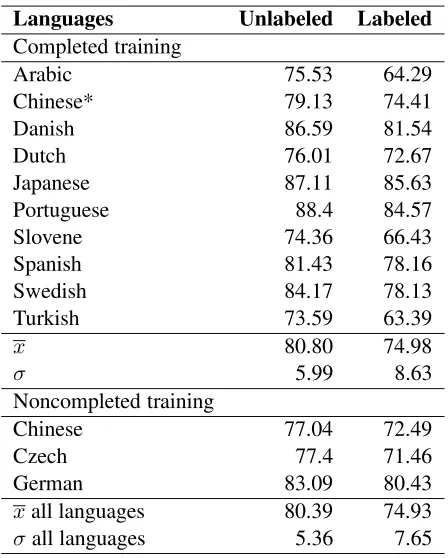
We parsed the 12 languages using exactly the same algorithms and parameters. We obtained an average score of 74.93 for the labeled arcs and of 80.39 for the unlabeled ones (resp. 74.98 and 80.80 for the languages where we could train the model using the complete annotated data sets). Table 3 shows the
results per language. As a possible explanation of the differences between languages, the three lowest figures correspond to the three smallest corpora. It is reasonable to assume that if corpora would have been of equal sizes, results would have been more similar. Czech is an exception to this rule that ap-plies to all the participants. We have no explanation for this. This language, or its annotation, seems to be more complex than the others.
The percentage of nonprojective arcs also seems to play a role. Due to time limitations, we trained the Dutch and German models with approximately the same quantity of data. While both languages are closely related, the Dutch corpus shows twice as much nonprojective arcs. The score for Dutch is significantly lower than for German.
Our results across the languages are consistent with the other participants’ mean scores, where we are above the average by a margin of 2 to 3% ex-cept for Japanese and even more for Chinese where we obtain results that are nearly 7% less than the av-erage for labeled relations. Results are similar for unlabeled data. We retrained the data with the com-plete Chinese corpus and you obtained 74.41 for the labeled arcs, still far from the average. We have no explanation for this dip with Chinese.
5.3 Analysis of Swedish and Portuguese Results
5.3.1 Swedish
We obtained a score of 78.13% for the labeled at-tachments in Swedish. The error breakdown shows significant differences between the parts of speech. While we reach 89% of correct head and dependents for the adjectives, we obtain 55% for the preposi-tions. The same applies to dependency types, 84% precision for subjects, and 46% for the OA type of prepositional attachment.
There is no significant score differences for the left and right dependencies, which could attributed to the bidirectional parsing (Table 4). Distance plays a dramatic role in the error score (Table 5). Preposi-tions are the main source of errors (Table 6).
5.3.2 Portuguese
Table 3: Summary of results. We retrained the Chi-nese* model after the deadline.
Languages Unlabeled Labeled
Completed training
Arabic 75.53 64.29
Chinese* 79.13 74.41
Danish 86.59 81.54
Dutch 76.01 72.67
Japanese 87.11 85.63
Portuguese 88.4 84.57
Slovene 74.36 66.43
Spanish 81.43 78.16
Swedish 84.17 78.13
Turkish 73.59 63.39
x 80.80 74.98
σ 5.99 8.63
Noncompleted training
Chinese 77.04 72.49
Czech 77.4 71.46
German 83.09 80.43
xall languages 80.39 74.93
σall languages 5.36 7.65
parts of speech, with a score of 94% for adjectives and only 67% for prepositions.
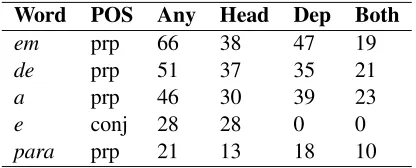
As for Swedish, there is no significant score dif-ferences for the left and right dependencies (Ta-ble 7). Distance also degrades results but the slope is not as steep as with Swedish (Table 8). Prepositions are also the main source of errors (Table 9).
5.4 Acknowledgments
[image:4.612.314.537.99.156.2]This work was made possible because of the anno-tated corpora that were kindly provided to us: Ara-bic (Hajiˇc et al., 2004), Bulgarian (Simov et al., 2005; Simov and Osenova, 2003), Chinese (Chen et al., 2003), Czech (Böhmová et al., 2003), Danish (Kromann, 2003), Dutch (van der Beek et al., 2002), German (Brants et al., 2002), Japanese (Kawata and Bartels, 2000), Portuguese (Afonso et al., 2002), Slovene (Džeroski et al., 2006), Spanish (Civit Tor-ruella and Martí Antonín, 2002), Swedish (Nilsson et al., 2005), and Turkish (Oflazer et al., 2003; Ata-lay et al., 2003).
Table 4: Precision and recall of binned HEAD direc-tion. Swedish.
Dir. Gold Cor. Syst. R P
[image:4.612.316.538.213.296.2]to_root 389 330 400 84.83 82.50 left 2745 2608 2759 95.01 94.53 right 1887 1739 1862 92.16 93.39
Table 5: Precision and recall of binned HEAD dis-tance. Swedish.
Dist. Gold Cor. Syst. R P
to_root 389 330 400 84.83 82.50 1 2512 2262 2363 90.05 95.73 2 1107 989 1122 89.34 88.15 3-6 803 652 867 81.20 75.20 7-... 210 141 269 67.14 52.42
Table 6: Focus words where most of the errors occur. Swedish.
Word POS Any Head Dep Both
till PR 48 20 45 17
i PR 42 25 34 17
på PR 39 22 32 15
med PR 28 11 25 8
för PR 27 22 25 20
Table 7: Precision and recall of binned HEAD direc-tion. Portuguese.
Dir. Gold Cor. Syst. R P
to_root 288 269 298 93.40 90.27 left 3006 2959 3020 98.44 97.98 right 1715 1649 1691 96.15 97.52
Table 8: Precision and recall of binned HEAD dis-tance. Portuguese.
Dist. Gold Cor. Syst. R P
[image:4.612.323.531.354.437.2] [image:4.612.316.536.496.554.2] [image:4.612.316.538.613.696.2]Table 9: Focus words where most of the errors occur. Portuguese.
Word POS Any Head Dep Both
em prp 66 38 47 19
de prp 51 37 35 21
a prp 46 30 39 23
e conj 28 28 0 0
para prp 21 13 18 10
References
A. Abeillé, editor. 2003. Treebanks: Building and Us-ing Parsed Corpora, volume 20 of Text, Speech and Language Technology. Kluwer Academic Publishers, Dordrecht.
S. Afonso, E. Bick, R. Haber, and D. Santos. 2002. “Flo-resta sintá(c)tica”: a treebank for Portuguese. InProc. of the Third Intern. Conf. on Language Resources and Evaluation (LREC), pages 1698–1703.
N. B. Atalay, K. Oflazer, and B. Say. 2003. The annota-tion process in the Turkish treebank. InProc. of the 4th Intern. Workshop on Linguistically Interpreteted Cor-pora (LINC).
A. Böhmová, J. Hajiˇc, E. Hajiˇcová, and B. Hladká. 2003. The PDT: a 3-level annotation scenario. In Abeillé (Abeillé, 2003), chapter 7.
S. Brants, S. Dipper, S. Hansen, W. Lezius, and G. Smith. 2002. The TIGER treebank. In Proc. of the First Workshop on Treebanks and Linguistic Theories (TLT).
Chih-Chung Chang and Chih-Jen Lin, 2001.LIBSVM: a library for support vector machines.
K. Chen, C. Luo, M. Chang, F. Chen, C. Chen, C. Huang, and Z. Gao. 2003. Sinica treebank: Design criteria, representational issues and implementation. In Abeillé (Abeillé, 2003), chapter 13, pages 231–248.
Y.J. Chu and T.H. Liu. 1965. On the shortest arbores-cence of a directed graph. Science Sinica, 14:1396– 1400.
M. Civit Torruella and MaA. Martí Antonín. 2002. De-sign principles for a Spanish treebank. InProc. of the First Workshop on Treebanks and Linguistic Theories (TLT).
S. Džeroski, T. Erjavec, N. Ledinek, P. Pajas, Z. Žabokrt-sky, and A. Žele. 2006. Towards a Slovene depen-dency treebank. InProc. of the Fifth Intern. Conf. on Language Resources and Evaluation (LREC).
J. Edmonds. 1967. Optimum branchings.Journal of Re-search of the National Bureau of Standards, 71B:233– 240.
J. Hajiˇc, O. Smrž, P. Zemánek, J. Šnaidauf, and E. Beška. 2004. Prague Arabic dependency treebank: Develop-ment in data and tools. InProc. of the NEMLAR In-tern. Conf. on Arabic Language Resources and Tools, pages 110–117.
Meixun Jin, Mi-Young Kim, and Jong-Hyeok Lee. 2005. Two-phase shift-reduce deterministic depen-dency parser of Chinese. InProceedings of the Second International Joint Conference on Natural Language Processing.
Y. Kawata and J. Bartels. 2000. Stylebook for the Japanese treebank in VERBMOBIL. Verbmobil-Report 240, Seminar für Sprachwissenschaft, Univer-sität Tübingen.
M. T. Kromann. 2003. The Danish dependency treebank and the underlying linguistic theory. InProc. of the Second Workshop on Treebanks and Linguistic Theo-ries (TLT).
J. Nilsson, J. Hall, and J. Nivre. 2005. MAMBA meets TIGER: Reconstructing a Swedish treebank from an-tiquity. InProc. of the NODALIDA Special Session on Treebanks.
Joakim Nivre and Jens Nilsson. 2005. Pseudo-projective dependency parsing. InProceedings of the 43rd An-nual Meeting of the Association for Computational Linguistics (ACL’05), pages 99–106, Ann Arbor, June.
Joakim Nivre. 2003. An efficient algorithm for projec-tive dependency parsing. InProceedings of the 8th In-ternational Workshop on Parsing Technologies (IWPT 03), pages 149–160, Nancy, 23-25 April.
K. Oflazer, B. Say, D. Zeynep Hakkani-Tür, and G. Tür. 2003. Building a Turkish treebank. In Abeillé (Abeillé, 2003), chapter 15.
K. Simov and P. Osenova. 2003. Practical annotation scheme for an HPSG treebank of Bulgarian. InProc. of the 4th Intern. Workshop on Linguistically Inter-preteted Corpora (LINC), pages 17–24.
K. Simov, P. Osenova, A. Simov, and M. Kouylekov. 2005. Design and implementation of the Bulgarian HPSG-based treebank. InJournal of Research on Lan-guage and Computation – Special Issue, pages 495– 522. Kluwer Academic Publishers.
Lucien Tesnière. 1966.Éléments de syntaxe structurale. Klincksieck, Paris, 2e edition.