Abstract— The effects of vibration has been known for many years which causes illness to operators using the vibrating tools or hand held power tools. Muscle weakness, particularly affecting the long finger flexors and affecting grip strength, may occur in association with long-term vibration exposure from hand-held tools. In order to quantify and assess safe levels of human exposure to vibration, empirical measurements and analysis of vibrations are therefore necessary. The aim of the study is to identify the effect of hand held vibrating tools on muscle activity and grip strength. The study was conducted on seven subjects (three male and four female). The experiments were performed with two kinds of exposure time, 5 and 15 minutes. Subjects were required to drill wood material using electric drill. Electromyography (EMG) and Vernier Labpro with 3 axis accelerometer used in the experiment. The results showed that mean vibration level for electric drill was 10.53 m/s2 for 15 minutes and 10.39 m/s2 for 5 minutes duration. The most affected muscle by vibration factor was found to be the extensor Carpi radials muscle. Extensor Carpi radials is one of the muscle at the forearm. The results in the study indicated that right extensor carpi radialis muscle was recorded the maximum % MVC (27.66%) compared to others muscle for all condition. It was indicated that forearm is the most part of arm that will affected compare to the other part. Muscle activity and grip strength increasing as the vibration level increasing.
Index Terms— Vibration, Muscle activity, Electromyography and Electric Drill
I. INTRODUCTION
Industrial mechanization has progressed rapidly in developing countries, particularly in Southeast Asia. Hand held vibrating tools have come into widespread use with the progress of industrialization in this area [1]. The use of hand-held vibrating tools is common in many different professions and the tools vary in size, weight, acceleration amplitude and frequency [2]. Apart from other issues
Manuscript received January 11, 2010. Investigation on Upperlimb Muscle Activity and Grip Strength during Drilling Task.
Mirta Widia is a master student in Department of Engineering Design and Manufacture, Faculty of Engineering, University of Malaya, Malaysia. She received a Degree in industrial engineering from Department of Industrial Engineering, Faculty of Engineering, University of Andalas, Indonesia in 2007. She is working as a research assistant in Department of Engineering Design and Manufacture at University of Malaya. Her research area is the effect of hand held vibrating tools on humans. Her email address is <[email protected]>
Siti Zawiah Md. Dawal is a Senior Lecturer in Department of Engineering Design and Manufacture, Faculty of Engineering, University of Malaya,
Malaysia. She received a Doctoral Degree fromDepartment of Engineering
Design and Manufacture, Faculty of Engineering, University of Malaya, Malaysia in 2005. Her teaching and research interests include industrial
ergonomics and work system design. Her email address is
concerning the operator‟s safety, one of the main sources of problems usually produced by power tools is the transmission of vibration to the hand and arm [3].
Vibration may cause damage to the vascular, neurological and musculoskeletal systems of the upper limbs which may manifest as Hand Arm Vibration Syndrome (HAVS), carpal tunnel syndrome (CTS) or both [4] which may occur in workers who use vibrating handheld tools, in particular pneumatic drills, grinders, electric drills and saws, and jackhammers [3]. Cold-induced Raynaud‟s phenomenon, often referred to as attacks of „blanching‟ or „white finger‟, typifies the vascular component of HAVS. The neurological symptoms manifest as tingling and numbness in the fingers, resulting in reductions in sensory perception, tactile discrimination and manipulative dexterity. The musculoskeletal symptoms include pain, swelling and stiffness in the hands and wrists, and may result in reduced grip strength. Collectively, the signs and symptoms of HAVS manifest as difficulty in using the hands in everyday activities both domestically and at work. HAVS may also increase the potential risk of accidents in the workplace, and impair job performance [5]. In particular, the European Union (EU) adopted its Human Vibration directive on April 5, 2002. This directive [5] established guidelines with respect to human exposure to hand-arm and whole body vibration that recommend threshold values for occupational exposure to vibration and have now become law in the member nations of the EU.
The relevance of studying hand-arm vibration in power tools for industry is highlighted by a statistical portrait revealing that 17% of European workers report being exposed to vibration from handheld tools or machinery for at least half of their working time [5]. In the same study, about 13% of workers consider that their work affects their health in the form of muscular pain in the upper limbs.
The most critical Ergonomics Risk Factors (ERF) industries in Malaysia is vibration [6]. Occupational Safety and Health Malaysia in 2003 stated that it has been a great issue for hand arm vibration in Malaysia. In order to quantify and assess safe levels of human exposure to vibration, measurements and analysis of vibrations are therefore necessary.
Thus the aim of the study is to identify the significant effect of hand held vibrating tools on muscle activity and grip strength.
II. METHODOLOGY
A. Subject
Seven healthy participants‟, three males and four males,
Investigation on Upperlimb Muscle Activity and
Grip Strength During Drilling Task
participated in the study. The subjects have no history of previous injury in shoulder or arm. The subjects were between the ages of 22 and 38 to match the age range of the target working population in Malaysian industry. Height and weight of each subject were measured. All subjects were thoroughly informed of the experimental procedure and gave consent prior to participation. Subject demographic data is shown in Table 1.
TABLE I. SUBJECT DEMOGRAPHIC
Parameters Value Age (years)
Mean (SD) Range Height (cm)
Mean (SD) Range Weight (kg)
Mean (SD) Range
27 (4.09) 23-38
160.73 (6.02) 152-170
56.69 (8.87) 42-70
B. Experiment Procedures
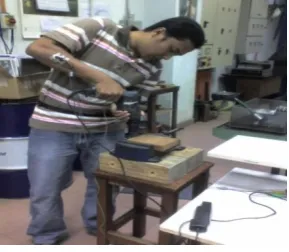
Each subject was required to drill the wood under two different exposure duration (5 minutes and 15 minutes). The size of the work piece is 10 x 10 cm. Thickness of the work piece is 3cm. Each subject was asked to drill the work piece using a 1.5 kg electric drill (Bosch GBM 450 RE Professional Rotary Drill) was fitted with a steel rod bit 7.3 cm long and 0.4 cm in diameter. Subjects were required to perform the drilling task in an upright standing position. Subjects were given a min 15 minutes rest after each experiment. There were two experiments taken for each subject using equipments to drill wood materials for two different duration periods.
Figure 1. Posture using electric drill
C. Experiment Apparatus
apparatus that used for this experiment are :
1) Drilling machine
The portable drilling machine (Bosch GBM 450 RE, approx. weight 1.5 kg,
ø
4 mm, 450 W) was used in this study. The tool was in good working condition.2) Noraxon EMG and Sensor system
EMG (Noraxon. Myoresearch XP, Basic Edition V.1.06.69) with sampling rate 1000 Hz was used to measure muscle activity during drilling.
3) Vernier Labpro with 3 axis accelerometer
Vernier Labpro with 3 axis accelerometer (3D-BTA1) was used to measure vibration level create during drilling task of wood material.
4) Hand Dynamometer
Vernier Labpro with hand dynamometer was used to measure static strength of subjects before and after drilling tasks for every duration period.
D. Measurement
1) Vibration level measurement
The equipment for measuring vibration acceleration intensity was vernier labpro with tri axis accelerometer. Vibration was measured at locations on the tool in closest contact with the hands by mounting accelerometers directly to the handles. Vibration was measured in three orthogonal coordinate axes in accordance with the ISO 5349 hand and arm basicentric coordinate system [3,7,8]. This method provides a means of simultaneous measurement in three directions. Data was analyzed by observing each of the X, Y and Z axes separately as well as by integrating all three dimensions through computing the vector magnitude unit calculated by the following equation:
= Where: is RMS acceleration is acceleration in x axis is acceleration in y axis is acceleration in z axis
2) Physiological measurement (% MVC)
Electromyography was used to determine the level of strain created in the muscles by repetitive movement of hand arm shoulder system. Surface EMG electrodes pick up the electrical activity of superficial muscles and the amplitude and power spectrum of the signals can be determined [9]. The amplitude reflects the number and size of action potential in the muscle over a given period [9].
Bipolar Ag/AgCl surface electrodes were placed with an inter-electrode distance of 25 mm at three muscles at the subject‟s arm and shoulder (right and left): extensor carpi radialis muscle, biceps brachii muscle and trapezius pars descendens muscle. For each muscle, the skin was first cleaned with alcohol and then disposable electrode pairs were affixed to the skin over the muscle.
[image:2.595.99.244.560.686.2]order to relate the variables to human muscles fatigue.
III. RESULTS
The results of this study are :
A. Objective Measurement
[image:3.595.47.299.160.301.2]1) Muscle Activity
TABLE II. MEANS AND STANDARD DEVIATIONS OF THE %MVC
Muscle Hand Experiment1 Experiment 2
% MVC % MVC
Mean SD Mean SD
Muscle Extensor carpi radialis
R L
27.66 13.89
26.8 9.71
25.25 8.72
22.19 6.61
Muscle Biceps brachii
R L
5.04 9.64
8.34 2.85
5.15 8.67
7.64 2.5 Muscle
Trapezius p.descendens
R L
14.83 3.83
17.2 4.28
15.88 3.77
18.03 3.97
The differences in EMG between experiment 1 and experiment 2 were obtained for each muscle separately. The means of the % MVC are shown in Table II.
Table II represents that right extensor carpi radialis is the most affected muscle with 27.66%MVC for 5 minutes and 25.25%MVC for 15 minutes. The majority of muscles reacted and the %MVC as follow: left extensor carpi radialis 13.89% for 5 minutes and 8.72% for 15 minutes, right biceps brachii 5.04% for 5 minutes and 5.15% for 15 minutes, left biceps brachii 9.64% for 5 minutes and 8.67% for 15 minutes, right upper trapezius p.descendez 14.83% for 5 minutes and 15.88% for 15 minutes, left upper trapezius p.descendez 3.83% for 5 minutes and 3.77% for 15 minutes. No significant differences were found between the experiments for the extensor carpi radialis, biceps brachii and trapezius pars descendens muscles.
[image:3.595.318.550.433.686.2]2) Vibration Level
Figure 2. Vibration Level Drilling Wood Material
Paired T-test was performed to compare the vibration level during two exposure duration. From the graph we can see that 15 minutes exposure duration give higher vibration level those 5 minutes, but the paired t-test result didn‟t show significant difference. Mean vibration level for electric drill
was 10.53 m/s2 for 15 minutes and 10.39 m/s2 for 5 minutes duration.
3) Grip Strength
Table III below shows the grip strength for all subjects before and after experiment. Hand grip strength after experiment was decreased. Grip Strength after drilling for 15 minutes has highest decrease ratio value (37.17N)
TABLE III. GRIP STRENGTH FOR ALL EXPERIMENT
B. Statistical Analysis
1) Muscle Activity
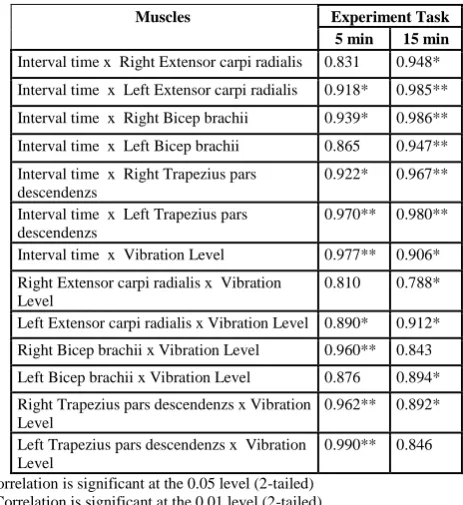
Pearson correlation was used to determine the relationship between muscles, interval time and vibration level during drilling activity in two type of exposure duration (5 and 15 minutes)
TABLE IV. CORRELATION BETWEEN MUSCLES
* Correlation is significant at the 0.05 level (2-tailed) ** Correlation is significant at the 0.01 level (2-tailed)
Data in Table IV indicates that there were high and positive correlations between muscles, interval time and vibration level during drilling in 5 and 15 minutes.
2) Grip Strength
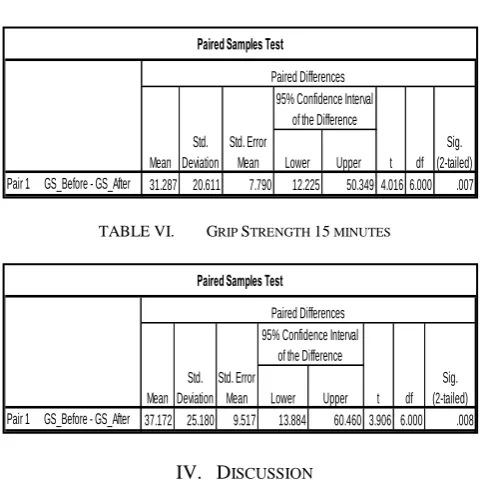
A set of paired T-test was performed to compare the mean of grip strength value before and after experiment with an alpha value 0.05.
9.6 9.8 10 10.2 10.4 10.6 10.8
S1 S2 S3 S4 S5 S6 S7
vi
b
ration
Level
(m
/s
2)
Subjects
Vibration Level
15 MIN ELECTRIC DRILL
5 MIN ELECTRIC DRILL
GS (Before) GS (After) Decrease GS (Before) GS (After) Decrease
(N) (N) Ratio (N) (N) Ratio
S1 147.69 114.51 33.18 101.91 91.66 10.25
S2 121.50 52.01 69.50 119.32 36.73 82.59
S3 138.90 128.89 10.01 159.76 141.03 18.73
S4 72.36 34.65 37.71 75.24 20.78 54.46
S5 106.02 75.91 30.11 103.49 73.71 29.78
S6 90.01 58.49 31.52 103.65 59.78 43.88
S7 75.09 68.10 6.98 67.19 46.68 20.51
Mean 107.37 76.08 31.29 104.37 67.20 37.17
Subjects
5 min electric drill 15 min electric drill
Muscles
Experiment Task 5 min 15 min
Interval time x Right Extensor carpi radialis 0.831 0.948*
Interval time x Left Extensor carpi radialis 0.918* 0.985**
Interval time x Right Bicep brachii 0.939* 0.986**
Interval time x Left Bicep brachii 0.865 0.947**
Interval time x Right Trapezius pars descendenzs
0.922* 0.967**
Interval time x Left Trapezius pars descendenzs
0.970** 0.980**
Interval time x Vibration Level 0.977** 0.906*
Right Extensor carpi radialis x Vibration Level
0.810 0.788*
Left Extensor carpi radialis x Vibration Level 0.890* 0.912*
Right Bicep brachii x Vibration Level 0.960** 0.843
Left Bicep brachii x Vibration Level 0.876 0.894*
Right Trapezius pars descendenzs x Vibration Level
0.962** 0.892*
Left Trapezius pars descendenzs x Vibration Level
[image:3.595.50.293.528.681.2]TABLE V. GRIP STRENGTH 5 MINUTES
TABLE VI. GRIP STRENGTH 15 MINUTES
IV. DISCUSSION
The effect of hand-held vibrating tools on significant muscle was studied. The experiment demonstrated that the effect of vibration on muscles of the arm and shoulder system. Vibration was transmitted from a handle to the arm and shoulder in upright standing posture and affected the muscles. The different parameters of vibrations in the human body, and work-related factors such as gripping force and posture also have influence on this.[4]
The extensor carpi radialis was the one which showed the greatest increase in % MVC value in all condition. Extensor Carpi Radialis is one of the muscles in the forearm part and one of the five main muscles that control movements at the wrist. This muscle is an extensor at the wrist joint, it manipulates the wrist so as to move the hand towards the thumb. According to some studies [4], the muscles of the hand adjacent to the base of the thumb may be most affected. Radwin et.al (1987) found that EMG increased 32% for forearm extensors in a forearm gripping a handle with vibration compared with that obtained without vibration. These findings showed that forearm is the most part of arm that will affected compare to the other part.
We also found the greatest increase % MVC value in trapezius pars descendenz. It can probably be explained by the fact that the trapezius pars descendenz muscle is sensitive to changes in working posture and responds with increased muscle activity when the hand is exposed to vibration. The different parameters of vibration influence the transmission of vibrations in the human body, and work-related factors such as gripping, pushing force and posture [4,10,11].
Biceps muscle activity showed the lowest % of MVC. This can be explained by the fact that it is not a prime mover in pushing the drill. The length of the bicep muscle for the posture is shorter relative to the other muscles. Since it is known that the initial muscle length and the degree of muscle contraction facilitates the tonic vibration reflex (TVR), it is reasonable to assume that the biceps muscle is not a prime mover in pushing and is, therefore, not affected greatly by vibration.
Relationship between EMG, Vibration Level, interval time and grip strength
Result in experiment 1 showed high and positive correlation between the %MVC of the left extensor carpi radialis, right bicep brachii, right trapezius pars descendenz with interval time (p<0.05), left trapezius pars descendenz with interval time (p<0.01) left extensor carpi radialis with vibration level (p<0.05) and right bicep brachii, right and left trapezius pars descendenz, with vibration level (p<0.01). High and positive correlation also existed in experiment 2 between right extensor carpi radialis with interval time (p<0.05), left extensor carpi radialis, right and left bicep brachii, right and left trapezius pars descendenz with interval time (p<0.01), right extensor carpi radialis, left bicep brachii, and right trapezius pars descendenz with vibration level (p<0.05).
Decrease ratio of grip strength increasing as the vibration level and exposure duration increasing. According to T.W.Mcdowell et al (2006), a tight hand-tool coupling can increases the transmissibility of vibration to the hand and arm. This finding also support by Radwin et.al (1987), a higher grip force is often applied to vibration tools to maintain stability in performing prolonged task. This condition makes the subjects loss of grip strength after do the experiments.
We also found a strong relationship between muscle activity, interval time and vibration level. The reason is that % MVC value increasing (maximum 25%) as the vibration level increasing between interval times. The increase in muscle activity may partially be explained by what is understood about the relationship between vibration and the force that a muscle produces when it is exposed to vibration. This result is in line with S.Z Dawal et.al [12] studied that also found the incremental of vibration levels while performing manual drilling task increased heart rate and RMS value.
Our findings shows that vibration can affect the muscles greatly and one can regard the increased muscular activity as a contributory factor in arm disorders among power hand tool operators. Similar result also found by other researcher Muzammil [13], Muzammil [13] showed that the level of vibrations generated while performing manual drilling task had a statistically significant effect on operators. Previous research also found that workers using the tools have been found to suffer from pains, muscular weakness and fatigue causing a reduction in their performance. [13,14,15] .
V. CONCLUSION
The In Conclusion:
Drilling using electric drill showed that right extensor carpi radialis muscle was recorded the maximum % MVC (27.66%) during drilling compared to others muscle for all condition. It was indicated that forearm is the most part of arm that will affect compare to the others part. Muscle activity increasing as vibration level increasing between interval time
Decrease ratio of grip strength increase as the vibration level.
REFERENCES
[1] Futatsuka et.al, “Hand Arm Vibration Syndrome among Quarry
Workers in Vietnam,” J Occup Health 47, 165-170, 2005.
Lower Upper
Pair 1 GS_Before - GS_After 31.287 20.611 7.790 12.225 50.349 4.016 6.000 .007
Paired Samples Test
Paired Differences
Mean Std. Deviation
Std. Error Mean
95% Confidence Interval of the Difference
t df
Sig. (2-tailed)
Lower Upper
Pair 1 GS_Before - GS_After 37.172 25.180 9.517 13.884 60.460 3.906 6.000 .008
Paired Samples Test
Paired Differences
Mean Std. Deviation
Std. Error Mean
95% Confidence Interval of the Difference
t df
[2] Gerhardsson L., et al, “Vascular and nerve damage inworkers exposed to vibrating tools. The importance of objective measurements of exposure time, ” Applied Ergonomics 36, 55-60, 2005.
[3] M.Vergara et.al, “Hand-transmitted vibration in power tools:
Accomplishment of standards and users‟ perception,” International Journal of Industrial Ergonomics 38, 652–660, 2008.
[4] M.J. Griffin, “Handbook of Human Vibration,” Academic Press,
London, 1990.
[5] European Commission, Work and health in the EU, “A statistical portrait. Data 1994–2002,” European Commission, 2002.
[6] M.Zainal Baird, “Managing Ergonomics Risk Factors On Construction
Sites,” Faculty of Civil Engineering Universiti Teknologi Malaysia
,2007(unpublished).
[7] M.Milosevic and K.M.V McConville, “Measurement of Vibrations
and Evaluation of Protective Gloves for Work with Hand-held Tools in Industrial Settings”, Proceedings of the 29th Annual International Conference of the IEEE EMBS Cite Internationale, Lyon, France, 2007.
[8] Occupational Safety and Health Malaysia, “Guidelines on
Occupational Vibration”, Department of Occupational Safety and Health Ministry of Human Resources Malaysia, 2003.
[9] De Luca, C.J, “The use of surface electromyography in biomechanics”.
J. Appl. Biomech, 13:135 – 163, 1997.
[10] B.K.B. Venkata, “Effect of Overhead Drilling support on Muscular Activity of Shoulder”,Agricultural and Mechanical College, Lousiana State University, 2006.
[11] W.Rohmert et.al, “Effects of Vibration on arm and Shoulder Muscles
in Three Body Postures,” Eur J Appl Physiol, 59, 243-248, 1989. [12] S. Z. Dawal, W. Mirta, Y. H. Ling and H. R. Zadry. The Effect of
Bench Drill Laboratory Hand Tool on Muscle Activity and Heart Rate Measurement. IFMBE Proceedings, 4th Kuala Lumpur International Conference on Biomedical Engineering 2008. ISSN: 1680-0737. Volume 21.
[13] M Muzammil, et.al, “Effect of Vibration, Feed Force and Exposure Duration on Operators Performing Drilling Task,” J. Human. Ergol, 32: 77-86, 2003.
[14] T.J.Amstrong et.al, “Exposure to Forceful Exertions and Vibration in a Foundry”, International Journal of Industrial Ergonomics 30, 163–179, 2002.