Ade A Oladapo & Henry A Odeyinka
Tender evaluation methods in construction
projects: a comparative case study
Peer reviewed Abstract
A review of tender evaluation practices from around the world revealed the inadequacy of the ‘lowest bidder’ criterion for contractor selection. In response to this inadequacy, many countries have introduced qualifications to this cri terion and established procedures for the evaluation process. The objective of the qualifications is to select a suitable contractor whilst fostering compet itiveness. Using a multi criteria decision making (MCDM) approach, the study identified eight contractor attributes from the literature, which are thought to be indicators of contractors’ capability to execute a contract and meet certain project specific criteria. Employing a case study project, the tenders of eight contractors short listed for the project were evaluated with the attributes using the “lowest bid”, multi attribute analysis (MAA) and analytic hierarchy process (AHP) methods. The results showed that the two multi criteria decision making methods indicated the selection of contractors other than what the ‘lowest bidder’ criterion indicated. Comparing the results of the MAA and AHP meth ods, it is evident that the two methods differed very little in their ranking of the contractors. This implies that the more complex nature of AHP and the extra efforts it requires have only a minor influence on the final ranking of contrac tors and seems to suggest that the extra cost of using AHP is not justified. Keywords: analytic hierarchy process, contractor selection, multi attribute analysis, pre qualification, tender evaluation
Abstrak
’n Oorsig van tender evaluerings praktyke van reg oor die wêreld, het die ontoereikendheid van die ‘laagste bod’ kriteria vir kontrakteur keuse bekend gemaak. In reaksie op hierdie ontoereikendheid, het baie lande kwalifikasies tot hierdie kriteria asook prosedures vir die evalueringsproses ingestel. Die doel van die kwalifikasies is om toepaslike kontrakteurs te kies terwyl mededingend heid gekweek word. ’n Multi kriteria besluitnemings benadering is gebruik in die studie en hieruit is agt kontrakteur bydraes geidentifiseer uit die literatuur wat gesien kan word as indikators van kontrakteurs se vermoëns om ’n kontrak te kan uitvoer en terselfdertyd te voldoen aan sekere projek spesifieke kriteria. Deur van ’n gevallestudie gebruik te maak, is die tenders van agt kontrakteurs op ’n kortlys geplaas en is ge evalueer deur die ‘laagste bod’ multi bydrae analise en analitiese hierargie proses metodes te gebruik. Die resultate het aangetoon dat hierdie twee multi kriteria besluitnemings metodes die seleksie van kontrakteurs ander as die ‘laagste bod’ kriteria aangedui het. Wanneer die resultate van die twee metodes vergelyk word, is daar min verskil in die plasing in volgorde van keuse van die kontrakteurs. Dit impliseer dat die meer komplekse natuur van die analitiese hierargie proses en die ekstra werk wat dit vereis slegs ’n klein uitwerking het op die finale plasing van kontrakterus en verder blyk dit dat die ekstra koste om van hierdie analitiese hierargie proses gebruik te maak, nie die gebruik daarvan regverdig nie.
1.
Introduction
T
endering is the process of selecting the most suitable contractor for a construction project. The tendering process involves two distinct mutually exclusive activities. The first activity, according to Moselhi & Martinelli (1990), involves the preparation of tender estimates by contractors for the purpose of submitting a bid. The second activity deals with the evaluation of the bids submitted by contractors to enable the best contractor(s) to be selected and is normally carried out by owners and/or their professional advisors such as quantity surveyors and project managers. The tender evalu-ation method used is critical to the success of the project because it strongly affects the subsequent outcome of the project (Jaselskis & Russell, 1992). Thus contractor selection and evaluation methods can make or mar a project. Indeed a common contention of vari-ous investigations into the problems of the construction industry in the UK (Simon, 1944; Banwell, 1964; BEDC, 1967; CIC, 1994; Latham, 1993, 1994) has been that problems can be brought to a project as soon as the ‘wrong’ contractor is chosen. This study focuses on tender evaluation and is concerned with the issue of contractor selection; largely due to the confirmation by IOB (1979) that judicious selection of procurement route and contractor were prerequisites to project success. The study compares the traditional lowest bidder approach and the non-traditional multi-criteria decision making methods of multi-attribute analysis (MAA) and analytic hierarchy process (AHP).2.
Tender evaluation methods
after the process of pre-qualification. This is based on the assump-tion that the pre-qualificaassump-tion exercise eliminates all incompetent contractors and guarantees that a pre-qualified lowest bidder will successfully execute the project. The reality, however, is that con-tractor pre-qualification alone is not a definite indicator of project success. According to Cagno et al.(1999), this approach is hardly appropriate in environments in which increasing competition and client expectations have broadened the number of non-financial factors which should be considered in the evaluation of the ‘best’ tender.
In Nigeria, the use of the lowest bidder criterion is common for con-tractor selection, especially on public sector projects. In his com-parative study of criteria for the award of contract in the public and private sectors of the Nigerian construction industry, Oyediran (1995) found that price was the overriding criterion for contract award. Jagboro & Ogunsemi (1997) also studied the effectiveness of cost criteria for appraising tenders and submitted that the lowest ten-der, the quantity surveyor’s estimate and the average of contrac-tors’ tenders were all reliable cost criteria for appraising tenders in Nigeria. However, in the UK, the Latham report (1994) questioned the frequent practice of selecting the lowest tenderer. Instead, the report called for proper consideration and weighting of a range of selection criteria to be taken into account during contractor selection. According to Russell et al.(1990) and Crowley & Hancher (1995), awarding a construction contract to the lowest bidder with-out considering other factors can lead to cost and time overruns and other problems. Recognising the inadequacy of the ‘lowest bidder’ criterion, many countries have introduced qualifications to this criterion and established procedures for the evaluation pro-cess (Martinelli-Bello, 1986). These procedures include multi-attribute analysis (MAA) and analytic hierarchy process (AHP). This study com-pares the lowest bidder approach, MAA and AHP.
2.1
The Multi-criteria Decision-making (MCDM)
Approach
attributes to consider in contractor selection includes: capital cost (bid amount), life cycle cost, number of years in business, volume of business, financial capacity, previous performance, project man-agement organisation, technical expertise, time of execution, and relation with subcontractors. In their survey of contractors’ opinion on the use of multi-criteria in contractor’s selection, Jennings and Holt (1998) employed the following criteria: low price, company experience of similar construction, company reputation, company financial standing, prior business relationship, early completion dates, experience of contractors’ key persons, company image, qualifi-cations of contractors’ key persons, company negotiating skill, cur-rent workload of company, company informal contacts, company proximity to project, company nationality and company trade union record. In their survey of tendering practices in the Nigerian con-struction industry, Yusif & Odeyinka (2000) identified factors to be considered in contractor selection other than price to include: technical ability, financial base, relationship with client/consultants and past performance among others.
Although the rationale and need for contractor pre-qualification are obvious and well appreciated, the process is often performed in an ill-structured and intuitive manner (Russell et al., 1990). Ac-cording to Mahdi et al. (2002), this is because the process depends largely on the skill, experience and knowledge of the decision maker, with no minimum standards that can help to evaluate a contractor for a specific project in hand. Frequently, the evalua-tion is performed in an ad-hoc manner with variaevalua-tions in the amount of effort expended and focus of evaluation effort without an understanding of how these variations influence the achieved project outcome (Russell & Jaselskis, 1992). It is against this back-ground that more objective, structured contractor selection metho-dologies have been introduced. Among them are the bespoke approaches (BA), multi-attribute analysis (MAA), multi-attribute utility theory (MAUT), multiple regression (MR), cluster analysis (CA), fuzzy set theory (FST) and multivariate discriminant analysis (MDA) which are detailed in Holt (1998). They also include the analytic hierarchy process (AHP) which is described in detail by Saaty (1990), Cagno
2.1.1 Multi-Attribute Analysis (MAA)
MAA considers a decision alternative with respect to several of that alternative’s attributes. In this respect, an attribute is a character-istic that can be measured. An objective is a charactercharacter-istic against which an attribute is measured and should be pursued to its fullest. Hence, a contractor attribute represents one aspect of a decision option with respect to a client’s objective (Holt et al., 1995). Attributes may be measured quantitatively or otherwise. Indeed, a feature of MAA is that some or all of the attributes may not be quantifiable (Hwang & Yoon, 1981). The simplest MAA equation may be express-ed as:
n
ACrj = ∑ Vij (Equation 1)
i=1
where: ACrj = aggregate score for contractor j; Vij = variable (attribute) iscore in respect of contractor j; and n= the number of attributes considered in the analysis. These are termed ‘simple scor-ing’ MAA models and because of their simplicity are frequently employed by Decision Makers (DMs) in industry. Their biggest fail-ing is that Vi(albeit numeric) is often a very subjective measure. That is;
n
Vi = ∑ f (xi) (Equation 2)
i=1
where: f(xi) are the nfunctions of Vinormally subjectively (often plicitly) considered by the practitioner during evaluation. An im-provement of Equation (1)is the attachment of weighting indices (Wi) to Vi to accentuate the aggregated scores of contractors who perform better in higher weighted criteria and vice versa. Hence;
n
ACrj = ∑ VijWi (Equation 3)
Wimay be a function of:
1. sole practitioner experience/predilection 2. group consensus opinion
3. survey and analysis of data, from a sample pertinent to the selection setting in which the model will be applied (Holt
et al., 1994).
Where the components (Viand Wiin this instance) are represented by an infinite range of integers, then a unified aggregate contractor score (designated UACrj, i.e. 0 ≤ UACrj≤ 1.0) may be achieved via:
ACrj
UACrj = __________ACr (Equation 4) j max
where the components are as previously described; and ACrj max is the maximum attainable aggregate score utilising Wi. Holt (1998), however, suggested that the derivation of essential Vi and the strength of Wishould be further investigated (e.g. with respect to geographical location of project, nature of work, form of procure-ment option employed, etc.) in the light of previous research
2.1.2 Multi-Attribute Utility Theory (MAUT)
MAUT is an extension of MAA and, according to Holt (1998), is par-ticularly suited to the problem of contractor selection. MAUT utilises ‘utility’ to quantify the subjective components of MAA. According to Moselhi & Martinnelli (1990), in order to facilitate the understand-ing of MAUT, it is important to define the main terms used, which are stated below:
‘Objectives’: An objective generally indicates the direction where efforts should be concentrated to do better. In contradistinction from goals, goals are defined as the level of achievement of ob-jectives.
‘Utility’ (normally expressed as Ui) is a measure of desirability or satis-faction of a characteristic (attribute), of an alternative (contractor). The utility concept was introduced to provide a uniform scale to compare and/or combine tangible and intangible attributes. According to Holt (1998), the overall concept of MAUT can be very complex with respect to both models and utility weight derivation. According to him, MAUT may be applied to the contractor selec-tion problem in one of two fundamental ways. Consider:
n
ACrj = ∑ Ui (Equation 5)
i=1
where: Ui represents the n attributes considered by the Decision Maker (DM). These are a function of several dimensions i.e. Ui= ∑ f(uxi). (ref. Equation 2). Hence the sum of integers Uiyield an ag-gregate score as described in Equation 4. Alternatively, Uimay be used in conjunction with scaling constants or weighting coeffi-cients as follows:
n
ACrj = ∑ UiWi (Equation 6)
i=1
where components are as described previously and nis the number of attributes. According to Moselhi & Martinnelli (1990), Equation 6
can be applied by the DM (e.g. an owner or his representative such as the Quantity Surveyor) following the 3-step procedure described below:
to determine the order of priorities among the attributes. This can be done using the approach of subjective assess-ment suggested by Dalkey (1972) and known as the Delphi method. Experts in the field are asked to establish an order of preference among the different attributes, which may also include preference of an attribute over a combination of others. A ‘cardinal ranking’ is then used in the second step to assign weights to each one of the attributes and justify their judgements.
Step 3: Construct the utility functions associated with the attributes being considered. These functions represent the satisfaction of the decision maker over the range of achievement levels that could be attained on each attribute. They are the most important input to a multi-attribute decision analysis. In order to construct a utility function, the most and least desirable outcomes for each attribute are first identified, and then assigned arbitrary values of 1.0 and 0.0, respectively. More information on how the utility functions are constructed and their characteristics can be found in Moselhi & Martinnelli (1990) and Martinelli-Bello (1986).
According to Holt (1998), MAUT is similar to MAA in modelling terms but utilises a quantitative method of determining values for inclusion therein. Hence, MAUT can quantitatively consider both tangible (e.g. safety record) and intangible (e.g. contractor image) attributes during evaluation. The existence of such subjective measures char-acterises the contractor selection problem. According to Holt (1998), there is scope for future research with the developing of utility curves in respect of alternative scenarios and with respect to differing owner groupings.
2.1.3 The Analytic Hierarchy Process (AHP)
process (AHP) is an effective approach in dealing with this kind of decision problems. An argument going for AHP in such a situation, according to Emblemsvag & Tonning, (2003), is that it also allows a check of the logical consistency of the answers provided by participants in the priority setting exercise.
Ramadhan et al. (1999) stated that when a set of criteria is con-sidered for evaluation by a group of people, the main objectives of this group are:
• to provide judgment on the relative importance of these activities; and
• to ensure that the judgments are quantified to an extent which also permits a quantitative interpretation of the judgment among these criteria.
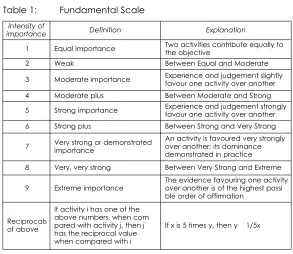
Table 1: Fundamental Scale Intensity of
importance Definition Explanation
1 Equal importance Two activities contribute equally tothe objective
2 Weak Between Equal and Moderate
3 Moderate importance Experience and judgement slightlyfavour one activity over another
4 Moderate plus Between Moderate and Strong
5 Strong importance Experience and judgement stronglyfavour one activity over another
6 Strong plus Between Strong and Very Strong
7 Very strong or demonstratedimportance An activity is favoured very stronglyover another; its dominance demonstrated in practice
8 Very, very strong Between Very Strong and Extreme
9 Extreme importance The evidence favouring one activityover another is of the highest possi ble order of affirmation
Reciprocals of above
If activity ihas one of the above numbers, when com pared with activity j, then j
has the reciprocal value
when compared with i
If x is 5 times y, then y 1/5x
Source: Saaty, 2001
The fundamental scale is a one-to-one mapping between the set of discrete linguistic choices available to the decision maker and a discrete set of numbers which quantify the linguistic choices. Many scales exist but the most popular is the one proposed by Saaty (2001) and shown in Table 1.
In comparing criterion A to criterion B, a decision maker may deter-mine from the scale in Table 1 that A is of weak importance over B and accordingly assign a relative importance value of 2 to A. This means that the value of the relative importance of B to A is 1/2. The quantified judgment on pairs of criteria ci, and cj (pair-wise comparisons) are represented by an n-by-n matrix
A = (aij), ij= 1,2,3……,n)
Rule 2. If Ciis judged to be of equal relative importance to Cj, then aij= aij= 1. Obviously aij= 1 for all i.
Thus the matrix A has the form:
A =
1 a12...a1n
1/a12 1...a1n
1/a1n 1/a1n 1
... ...
where the aijis the relative importance of criterion ito criterion j. Having recorded the quantified judgments of comparisons on pairs (Ci, Cjj ) as numerical entries aijin the matrix A, what is left is to assign to the ncontingencies C1, C2, C3, ..., Cn a set of numer-ical weights w1, w2, w3, ..., wn that should reflect the recorded judgments.
The eigenvector of the comparison matrix provides the priority ordering (weight), and the eigenvalue is a measure of consisten-cy. To find the weight of each criterion included in the ranking analysis, the eigenvector corresponding to the maximum value is to be determined from matrix analysis. The principal eigen-vector is computed and normalised to give the eigen-vector of weights. Ramadhan et al. (1999) have suggested a simplified method to reduce the excessive computing time needed to solve the prob-lem exactly. By their method a good estimate of the vector is obtained by normalising each column (i.e. dividing the elements of each column by the sum of that column) in the comparison matrix. The elements in each resulting row are then added and their sum divided by the number of elements in the row. This is expressed mathematically as
(Equation 7)
1 a11 a12 a1n
Wi = + +...+
n ∑ ai1 ∑ ai2 ∑ ain
i i i
or in general
where aijis the entry of row iand column jin a comparison matrix of order n.
Compared to MAA, which uses direct absolute estimates to rank decision criteria, AHP uses pair-wise comparisons. According to Cagno et al.(1999), this makes AHP a robust and flexible MCDM technique which gives a better decision support with the following advantages:
• It effectively manages to organise the decisional problem into a hierarchical structure. Structuring any decision problem hierarchically is an efficient way of dealing with complexity and identifying the major components of the problem
• The methodology is reliable due to the pairwise compari-son process and the consistency check tool. It is common experience that estimates based on pairwise comparison are more reliable than direct absolute estimates. This is even truer for qualitative factors and also for quantitative factors where insufficient data is available to make absolute esti-mates. In addition, the elicitation of redundant judgements, which characterises the standard application of AHP, is useful to check the consistency of the DM’s opinion. The level of inconsistency can be calculated and, if it exceeds a threshold value 0.1 (Saaty, 1990), the expert must review judgements more carefully.
• It deals effectively with group decision-making.
The use of AHP has been successfully demonstrated and/or applied in such diverse areas of construction research as architecture (Saaty & Beltran, 1982), facility location decisions (Yang & Lee, 1997),
build-1 aij
Wi = ∑
n ∑ aij i
ing maintenance (Shen et al., 1998), construction management (Fong & Choi, 2000), business performance (Cheng & Li, 2001), con-struction procurement (Cheung et al., 2001; Wong & Chan 2003), evaluation of oil pipeline project (Dey, 2004), benchmarking facility management (Gilleard & Yat-lung, 2004) and construction con-flict analysis and resolution (Al-Tabtabai & Thomas, 2004) as well as contractor selection in competitive bidding (Cagno et al., 1999; Fong & Choi, 2000; Mahdi et al., 2002). It must be mentioned, how-ever, that compared to other methods, AHP has the disadvan-tage that it takes much time (Zavadskas et al., 2005) and requires more complex calculations and expert knowledge. This is why Cheng et al. (2002) have warned that the method could be mis-used to produce defective results if the underlying principles are not properly understood and mastered.
3.
Data and methodology
Table 2: Details of Contractors’ Tenders
Contractor
Number submitted (N)*Tender sum
Completion duration (Weeks)
Number of years in business
Client's QS estimate (N)
1 62,988,555.25 40 8
63,331,648.67
2 65,800,510.00 48 8
3 64,713,640.00 40 9
4 67,080,000.00 44 5
5 62,900,420.00 40 6
6 62,853,000.00 40.5 7
7 65,634,421.00 52 8
8 66,577,600.00 48 7
* N135 US$1
4.
Applying the tender evaluation methods
On the basis of the ‘lowest bidder’ criterion, the conventional prac-tice will be to award the contract to contractor number 6 after the eight contractors have been found suitable through a pre-qualifi-cation exercise. MAA and AHP are now applied using the same set of data to determine the best contractor for the job.
4.1
Evaluation of the Tenders Using Multi-attribute
Analysis (MAA)
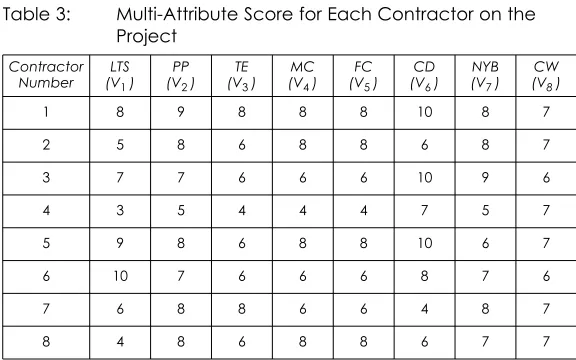
The data obtained from the Quantity Surveyor’s scoring of each of the eight identified attributes for each contractor that tendered in each project is presented in Table 3. Using this data set, the multi-attribute analysis (MAA) was employed using the additive model in Equation 3, which is re-stated as follows:
n
ACrj = ∑ VijWi (Equation 3)
i=1
Table 3: Multi-Attribute Score for Each Contractor on the Project
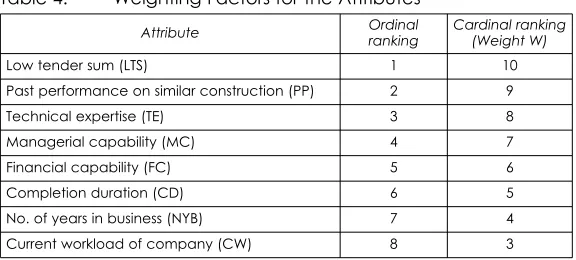
The Wicomponent, which represents the weighting factor, is to be determined for the model to be useful for tender evaluation. In order to determine the weighting factor, the two-step approach suggested by Moselhi & Martinnelli (1990) was employed. This pro-cedure is described under step 2 of the three-step propro-cedure used in MAUT described above. Using the Delphi method, experi-enced construction professionals were asked to rank the eight identified attributes. This helped to produce an ordered list shown in column 2 of Table 4. This ordered list shows that construction pro-fessionals ranked ‘low tender sum’ first. In order to be able to attach the weighting factor (wi) to each attribute, the technique of cardinal ranking was then employed. The procedure employed was to give the highest ‘weight’ to the attribute ranked first. Thus, using the maximum weight of 10, the attribute ‘low tender sum’ which was ranked first, was assigned the maximum weight of 10. This procedure was continued until the last attribute ranked eighth which was assigned the weight of 3, following the cardinal rank-ing. The result of this exercise is shown in column 3 of Table 4. Thus, the weighting factors generated in column 3 of Table 4 represents the Wicomponent of Equation 3.
Contractor Number (VLTS1 )
PP (V2 )
TE (V3 )
MC (V4 )
FC (V5 )
CD (V6 )
NYB (V7 )
CW (V8)
1 8 9 8 8 8 10 8 7
2 5 8 6 8 8 6 8 7
3 7 7 6 6 6 10 9 6
4 3 5 4 4 4 7 5 7
5 9 8 6 8 8 10 6 7
6 10 7 6 6 6 8 7 6
7 6 8 8 6 6 4 8 7
Table 4: Weighting Factors for the Attributes
Attribute Ordinalranking Cardinal ranking(Weight W)
Low tender sum (LTS) 1 10
Past performance on similar construction (PP) 2 9
Technical expertise (TE) 3 8
Managerial capability (MC) 4 7
Financial capability (FC) 5 6
Completion duration (CD) 6 5
No. of years in business (NYB) 7 4
Current workload of company (CW) 8 3
In order to determine the values for the MAA additive model of
Equation 3 and the unified aggregate score (Equation 4), the attribute scores (Vij) in Table 3 were used to multiply the weighting factors (Wi) in Table 4. These values are shown in Table 5 as ACrj representing values determined by the MAA model represented by Equation 3 and UACrjrepresenting values determined by Equation 4. For instance, in order to determine these stated values for con-tractor number 1 on Table 5, the following procedure was followed:
Acr1 = [(8x10) + (9x9) + (8x8) + (8x7) + (8x6) + (10x5) + (8x4) + (7x3)] 432
ACrj max= [(10x10) + (10x9) + (10x8) + (10x7) + (10x6) + (10x5) + (10x4) + (10x3)]
= 520 (note that the maximum attribute score of 10 has been used
here against the pre determined weighting factor)
UACrj = 432/520 0.831
[image:17.420.63.351.76.206.2]123
O
adapo & Odeyinka
•
Tender eva
uation methods
Contractor
Number V1 W1 V2 W2 V3 W3 V4 W4 V5 W5 V6 W6 V7 W7 V8 W8 ACrj ACRj max UACrj Rank
1 8 10 9 9 8 8 8 7 8 6 10 5 8 4 7 3 432 520 0.831 1
2 5 10 8 9 6 8 8 7 8 6 6 5 8 4 7 3 357 520 0.681 5
3 7 10 7 9 6 8 6 7 6 6 10 5 9 4 6 3 363 520 0.698 4
4 3 10 5 9 4 8 4 7 4 6 7 5 5 4 7 3 235 520 0.452 8
5 9 10 8 9 6 8 8 7 8 6 10 5 6 4 7 3 409 520 0.787 2
6 10 10 7 9 6 8 6 7 6 6 8 5 7 4 6 3 375 520 0.721 3
7 6 10 8 9 8 8 6 7 6 6 4 5 8 4 7 3 347 520 0.668 6
[image:18.420.67.538.74.229.2]Likely Final Cost (LFC)
Likely Completion
Time (LCT)
Assurance of Project Quality (APQ)
Environmental & Safety Considerations
(ESC)
First Leve
Second Leve
Selecting the Best
Tender
4.2
Evaluation of the Tenders Using the Analytic
Hierarchy Process (AHP)
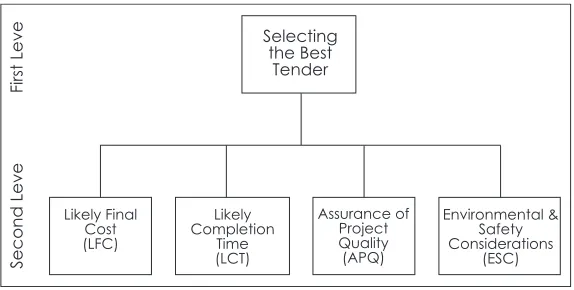
Using the simplified approach of Shen et al. (1998), the contractor selection problem was broken into a two-level hierarchy of inter-related decision elements as shown in Figure 1. This simple approach was chosen in preference to the more complex methods of Mahdi
et al. (2002) and Dey (2004) to enable the decision makers (the client and his advisers) understand the new approach being intro-duced for the very first time in tender evaluation in Nigeria.
Figure 1: Decision hierarchy of competitive criteria and factors for the case study
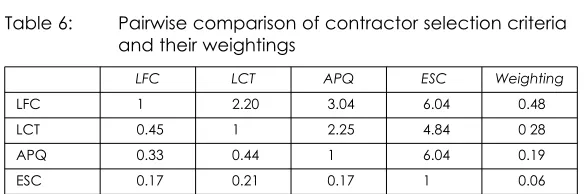
[image:19.420.63.350.197.342.2]The comparison matrix determined by the decision makers and the vector of priorities (weightings) of the four selection criteria are shown in Table 6. The eigenvector of the comparison matrix rep-resents the priority weightings of the four criteria and is calculated using the approach of Ramadhan et al. (1999) earlier described. The next step in the analysis is to determine the logical consistency of the decision makers in their pairwise comparison of the criteria. This is done by calculating the consistency ratio (CR) of the com-parison matrix in Table 6 using Equation 10.
ConsistencyIndex(CI)
[image:20.420.69.361.237.334.2]CR= _______________________________ (Equation 10) RandomIndex(RI)
Table 6: Pairwise comparison of contractor selection criteria and their weightings
RI is obtained from tables created by Saaty (1990) and its value depends on the size of the comparison matrix. For the 4x4 matrix in this analysis, its value is 0.90. CI is obtained from CI=(λmax
-n)/(n-1), where n is the size of the matrix and λmaxis the principal
eigen-value of the comparison matrix. The computation of λmax is very
complex but again Saaty (1990) has proposed a simple practical approach. To obtain λmax, we multiply the comparison matrix M
on the right by the eigenvector V and divide the corresponding components of the resulting column vector by the eigenvector to get a new column vector
LFC LCT APQ ESC Weighting
LFC 1 2.20 3.04 6.04 0.48
LCT 0.45 1 2.25 4.84 0 28
APQ 0.33 0.44 1 6.04 0.19
We then find the mean of the components of this new vector to give 4.19 which is the value of λmax.. Hence CI=(4.19-4)/(4-1)= 0.063 and CR=0.063/0.90=0.07. Since the acceptable consistency ratio is 0.10 or less (Saaty, 1990), the value of 0.07 obtained indicates that the decision makers were very consistent in their pair-wise rating of the four criteria. With this assurance of consistency, the analysis can proceed to rank the contractors with the four criteria.
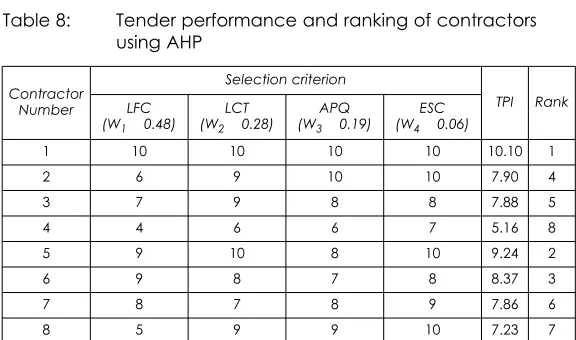
From the literature and discussions with construction industry prac-titioners, the eight contractor attributes used for the MAA (described earlier) were matched with the four selection criteria according to the relevance of each attribute to a criterion. This is shown in Table 7. The decision maker, i.e. the project owner and his professional advisors, scored each of the eight short-listed contractors on a scale of 1 to 10 for each of the four selection criteria using the attributes in Table 7. Applying the method of Shen et al. (1998) to the resulting scores, the tender performance index TPI jfor contractor jwas ob-tained from the formula
TPIj= TPIj1*W1+ TPIj2*W2+ TPIj3*W3+ TPIj4*W4, (Equation 13)
where TPIj1is contractor j’s score for criterion 1 and W1, …..W4
rep-resent the relative weights of criteria 1 to 4 respectively as
deter-1 2.20 3.04 6.04
0.45 1 2.25 4.84
0.33 0.44 1 6.04
0.17 0.21 0.17 1
M = (Equation 11)
4.25
4.32
4.37 3.83
mined by pairwise comparison. Table 8 shows the contractors’ scores, performance indices and rankings using AHP.
Table 7: Relevant contractor attributes for tender evaluation
Contractor Number
Selection criterion
TPI Rank LFC
(W1 0.48)
LCT (W2 0.28)
APQ (W3 0.19)
ESC (W4 0.06)
1 10 10 10 10 10.10 1
2 6 9 10 10 7.90 4
3 7 9 8 8 7.88 5
4 4 6 6 7 5.16 8
5 9 10 8 10 9.24 2
6 9 8 7 8 8.37 3
7 8 7 8 9 7.86 6
8 5 9 9 10 7.23 7
Table 8: Tender performance and ranking of contractors using AHP
Criterion Relevant contractor attributes
Likely final cost (LFC) Tender sum, financial capability, managerialcapability
Likely completion time (LCT) Completion duration, technical expertise,current workload Assurance of project quality
(APQ) Technical expertise, number of years in business,past performance
Environmental and safety
considerations (ESC) Technical expertise, past performance
[image:22.420.70.358.246.416.2]Table 9: Comparison of contractors’ rankings using three methods
Contractor
Number Lowest bidmethod methodMAA methodAHP
1 3 1 1
2 6 5 4
3 4 4 5
4 8 8 8
5 2 2 2
6 1 3 3
7 5 6 6
8 7 7 7
5.
Summary and conclusion
This study has attempted to apply two multi-criteria decision mak-ing (MCDM) approaches (i.e. MAA and AHP) to tender evaluation using the case study approach. Results from the case study pro-ject evaluated showed that the two MCDM analyses indicated the selection of contractors other than what the ‘lowest bidder’ criterion indicated. In view of the wide criticism against the use of the ‘lowest bidder’ criterion, it is suggested in the light of this finding that quantity surveyors and other construction managers should endeavour to embrace the use of the multi-criteria approach in tender selection so as to ensure contract performance, rather than cheaper price and poor or no performance.
References
AlTabtabai, H.M. & Thomas, V.P. 2004. Negotiation and resolution of conflict using AHP: an application to project management. Engineering Construction and Architectural Management, 11(2), pp. 90-100.
Banwell, H. 1964. The Placing and Management of Contracts for Building and Civil Engineering Work.Report of the Committee of Sir Harold Banwell. London: HMSO.
BEDC. 1967. Action on the Banwell report. Building Economic Development Committee. London: HMSO.
Cagno, E., Caron, F., Perego, A. & Trucco, P. 1999. A Multicriteria framework for competitive bidding. Project Management, 5(1), pp. 74-79.
Cheng, E.W.L. & Li, H. 2001. Analytic hierarchy process: an approach to deter mine measures for business performance. Measuring Business Excellence, 5(3), pp. 30-36.
Cheng, E.W.L., Li, H. & Ho, D.C.K. 2002. Analytic hierarchy process (AHP): a defective tool when used improperly. Measuring Business Excellence, 6(4), pp.3-37.
Cheung, S., Lam, T., Leung, M. & Wan, A. 2001. An analytical hierarchy process based procurement selection method. Construction Management and Economics, 19(4), pp. 427-437.
CIC. 1994. The Procurement of Professional Services, Guidelines for the Value Assessment of Competitive Tenders. The Construction Industry Council. Crowley, L. & Hancher, D. 1995. Risk assessment competitive procurement. Journal of Construction Engineering and Management, ASCE, 121, pp. 241-248.
Dalkey, N.C. 1972. Studies in the Quality of Life: Delphi and Decision Making. Massachusetts: Lexington Books (Heath), Lexington.
Dey, P.K. 2004. Analytic hierarchy process helps evaluate project in Indian oil pipelines industry. International Journal of Operations and Production Management, 24(6), pp. 588-604.
Emblemsvag, J & Tonning, L. 2003. Decision support in selecting maintenance organisation. Journal of Quality in Maintenance Engineering, 9(1), pp. 11-24.
Fong, P. & Choi, S. 2000. Final contractor selection using the analytical hier archy process. Construction Management and Economics, 18, pp. 547-557.
Holt, G.D., Olomolaiye, P.O. & Harris, F.C. 1994. Evaluation prequalification criteria in contractor selection. Building and Environment, 29(4), pp. 437-448.
Holt, G.D., Olomolaiye, P.O. & Harris, F.C. 1995. A review of contractor selec tion practices in the UK construction industry. Building and Environment, 30(4), pp. 553-561.
Hwang, C.L. & Yoon, K. 1981. Multiple attribute decision making; methods and applications. New York: SpringerVerlag.
IOB. 1979. Contractor Selection: A Guide to Good Practice. Estimating information service guide No. 34, The (then) Institute of Building, Chartered Institute of Building, Ascot.
Jagboro, G.O. & Ogunsemi, D.R. 1997. The effectiveness of cost criteria for appraising tenders. Construction in Nigeria, 12(2), pp. 15-23.
Jaselskis, E.J. & Russell, J.S. 1992. Risk analysis approach to contractor evalu ation method, Journal of Construction Engineering and Management, ASCE, 118(4), pp. 814-821.
Jennings, P. & Holt, D.G. 1998. Prequalification and multicriteria selection: a measure of contractors’ opinions. Construction Management and Eco
-nomics, 16(6), pp. 651-660.
Latham, M. 1993. Trust and Money, Interim Report of the joint Government/ Industry Review of Procurement and Contractual Arrangements in the United Kingdom Construction Industry. London: HMSO.
Latham, M. 1994. Constructing the Team, Final Report of the joint Govern ment/Industry Review of Procurement and Contractual Arrangements in the United Kingdom Construction Industry. London: HMSO.
Mahdi, I.M., Riley, M.J., Fereig, S.M. & Alex, A.P. 2002. A multicriteria ap proach to contractor Selection. Engineering Construction and Architectural Management, 9(1), pp. 29-37.
MartinelliBello, A. 1986. Bids Evaluation: A Multi attribute Utility Approach, M.Eng. Major Technical Report, Centre for Building Studies, Concordia University, Montreal.
Moselhi, O. & Martinelli, M. 1990. Analysis of bids using multiattribute utility theory. In: Proceedings of the International Symposium on Building Eco
-nomics and Construction Management, Sydney, Australia, 1990. pp. 335-345.
Ramadhan, R.H., Wahhab, H.I.A. & Duffua, S.O. 1999. The use of an analytic hierarchy process in pavement maintenance priority ranking. Journal of Quality in Maintenance Engineering, 5(2), pp. 25-39.
Russell, J.S. & Jaselskis, E.J. 1992. Predicting construction contractor failure prior to contract Award. Journal of Construction Engineering and Manage ment, ASCE, 118(4), pp. 791-811.
Russell, J.S., Skibniewski, M.J. & Cozier, D.R. 1990. Qualifier2: knowledge based system for contractor prequalification. Journal of Construction Engineering and Management, ASCE, 116(1), pp. 157-171.
Saaty, T.L. 1990. The analytic hierarchy processplanning, priority setting, resource allocation. Pittsburg: RWS Publications, University of Pittsburgh. Saaty, T.L. 2001. Decision making with dependence and feedback: the analytical network process. Pittsburg: RWS Publications University of Pittsburg. Saaty, T.L. & Beltran, M.H. 1982. The analytic hierarchy process: a new approach to deal with fuzziness in architecture. Architectural Science Review, 25(3), pp. 64-69.
Seeley, I.H. 1984. Quantity Surveying Practice. London: Macmillan Education Limited.
Shen, Q., LO, K. & WANG, Q. 1998. Priority setting in maintenance manage ment: a modified multiattribute approach using analytic hierarchy process. Construction Management and Economics, 16, pp. 693-702.
Simon Committee 1944. The Placing and Management of Building Contracts, Report of the Simon Committee, London: HMSO.
Triantaphyllou, E. & Mann, S.H. 1995. Using the analytic hierarchy process for decision making in engineering application: some challenges. International Journal of Industrial Engineering: Applications and Practice, 2(1), pp. 35-44.
Wong, Y. & Chan, T.S. 2003. Application of analytic hierarchy process in construction procurement. Proc. of the CIB Student Chapters International Symposium Innovation in Construction and Real Estate, The Hong Kong Polytechnic University, Hong Kong.
Yang, J. & Lee, H. 1997. An AHP decision model for facility location selection. Facilities, 15(9/10), pp. 241-254.