Proceedings of the 15th SIGMORPHON Workshop on Computational Research in Phonetics, Phonology, and Morphology, pages 140–150 140
An Arabic Morphological Analyzer and Generator with Copious Features
Dima Taji, Salam Khalifa, Ossama Obeid, Fadhl Eryani, and Nizar Habash
Computational Approaches to Modeling Languages Lab New York University Abu Dhabi
{dima.taji, salamkhalifa, oobeid, fadhl.eryani, nizar.habash}@nyu.edu
Abstract
We introduce CALIMAStar, a very rich
Ara-bic morphological analyzer and generator that provides functional and form-based morpho-logical features as well as built-in tokeniza-tion, phonological representatokeniza-tion, lexical ra-tionality and much more. This tool includes a fast engine that can be easily integrated into other systems, as well as an easy-to-use API and a web interface. CALIMAStar also
sup-ports morphological reinflection. We evaluate CALIMAStaragainst four commonly used
an-alyzers for Arabic in terms of speed and mor-phological content.
1 Introduction
Work on Modern Standard Arabic (MSA) mor-phological modeling has been ongoing for the past thirty years resulting in many resources with high degrees of accuracy for analysis, genera-tion, and tokenization (Beesley et al., 1989; Al-Sughaiyer and Al-Kharashi,2004;Habash,2010;
Pasha et al., 2014;Abdelali et al., 2016). These previous efforts addressed many of the important challenges of Arabic morphology such as its high degree of ambiguity resulting from optional dia-critization and templatic morphemes. However, while there are several commonly used systems for Arabic morphology, we observe that there are still some unresolved challenges.
First, some aspects of Arabic’s rich morphology are not fully or consistently modeled. Examples include the discrepancy between form and func-tion (in gender, number, case and state) as well as the rationality feature. The commonly used Penn Arabic Treebank (PATB) (Maamouri et al.,2004) and Buckwalter Arabic Morphological Analyzer (BAMA) (Buckwalter,2002) do not model nom-inal functional features or rationality. Some previ-ous attempts did not cover all these phenomena or focused on limited data sets (Smrž,2007; Alkuh-lani and Habash,2011).
Second, the different existing tools do not all provide the same kind of information, which of-ten led researchers to improvise exof-tensions to ac-commodate their downstream task needs. One example is the phonological representation map-pings thatBiadsy et al. (2009) devised on top of the MADA disambiguation system (Habash et al.,
2009) instead of using Elixir-FM (Smrž, 2007), which already included phonology. This is par-tially because Elixir-FM was not connected to a disambiguation system. Another example is the work byHabash et al. (2009) to provide genera-tion capability on top of the BAMA (Buckwalter,
2002) algorithm and databases because BAMA, which was used to annotate the PATB, was analy-sis focused, unlike the finite-state solutions to Ara-bic morphology (Beesley et al.,1989).
Third, many of the existing tools have differ-ent use requiremdiffer-ents (operating system, program-ming language, etc.), and some have no easy-to-use APIs.
In this paper, we introduce CALIMAStar,1
a very rich Arabic morphological analyzer and generator that includes functional features, built-in tokenization, phonological representation, and numerous other features. CALIMAStar comes
with a fast engine that can be easily integrated into other systems, and an easy-to-use web in-terface. CALIMAStar also supports
morpholog-ical reinflection. While in this paper we focus on MSA only for the database discussion, the en-gine itself is independent of the variant choice. CALIMAStar will be made publicly available as
part of a large suite of tools to support research on Arabic natural language processing (NLP).2
1
In Arabic,
éÒÊ¿
/kalima/ means ‘word’. We follow and extend the naming convention fromHabash et al.(2012) who developed CALIMAEGY, andKhalifa et al.(2017) who de-veloped CALIMAGLF. TheStardesignation in CALIMAStar is intended to eventually represent all Arabic variants (MSA and dialects), and all possible features.2 Related Work
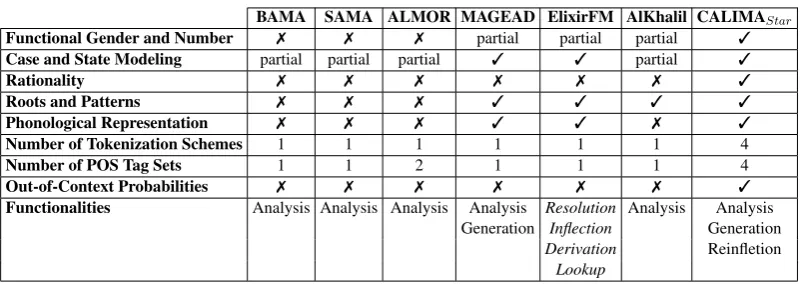
In this section, we discuss previous work on Arabic morphological analysis and generation in terms of (a) algorithms and representations, (b) morphological knowledge, and (c) morphological disambiguation and tokenization. Table 1 com-pares the features supported by CALIMAStar and
a number of analyzers discussed below.
2.1 Algorithms and Representations
There are a number of dimensions over which so-lutions to Arabic morphology modeling have var-ied (Beesley et al.,1989;Beesley,1996;Habash and Rambow,2006;Smrž,2007;Altantawy et al.,
2010, 2011). One important aspect is the de-gree of explicitness of representing morphological rules and their interactions. Some approaches use very abstract and linguistically rich representa-tions and rules to derive surface forms of the words (Beesley et al.,1989;Beesley,1996;Habash and Rambow, 2006;Smrž, 2007). Other approaches pre-compile representations of the different com-ponents needed by the system: BAMA ( Buck-walter, 2002), SAMA (Graff et al., 2009), and ALMORGEANA (ALMOR for short) (Habash,
2007) are examples of such systems. They use a six-table representation consisting of three lex-ical tables (for prefixes, suffixes, and stems), and three compatibility tables (suffix, prefix-stem, and stem-suffix). Altantawy et al. (2011) described a method to bridge between these two types of solutions. The type of representation used naturally needs to synchronize with the ap-propriate algorithms for analysis and generation. CALIMAStaris of the second category (tabulated
pre-compiled solutions), and it builds on the popu-larly used BAMA, SAMA, and ALMOR morpho-logical analyzers.
2.2 Morphological Knowledge
Previous efforts show a wide range for the depth that morphological analyzers can produce. Some efforts include very shallow analyses such as in the Temple Translator’s Workstation Project (Vanni and Zajac,1996) which only provided En-glish glossing. Others include a range of form-based features, functional features, and morpheme forms, in addition to lexical features (Buckwalter,
2002;Smrž,2007;Boudlal et al.,2010;Alkuhlani and Habash,2011;Boudchiche et al.,2017).
Alkuhlani and Habash(2011) extended part of the PATB to include functional gender and num-ber, and rationality, but did not cover the entire database used by BAMA or SAMA. ElixirFM (Smrž,2007) includes functional gender and num-ber, as well as full case and state modeling, but not rationality. ElixirFM, MAGEAD (Altantawy et al., 2010; Habash and Rambow, 2006) and AlKhalil Morpho Sys (Boudlal et al.,2010; Boud-chiche et al.,2017) include roots, with varying de-grees of accuracy. ElixirFM includes phonological forms; but ALMOR does not. However, Biadsy et al.(2009) presented orthography-to-phonology rules that can be used on automatically diacritized text to generate pronunciation dictionaries.
Our goal is to make all these features be built-in as part of our CALIMAStar databases, and to fill
in any gaps that were left by other efforts.
2.3 Analysis, Disambiguation and Tokenization
We distinguish between analysis and disambigua-tion: analysis refers to identifying all of the differ-ent readings (analyses) of a word out of context; while disambiguation is about identifying the spe-cific analysis in context. Tokenization is the pro-cess of segmenting a word into different units for downstream applications. There are many possi-ble tokenizationschemesand techniques to apply them (Habash and Sadat, 2006). The tokenized form of a word varies depending on the specific analysis of the word. Systems such as MADA (Habash et al.,2009), AMIRA (Diab et al.,2004), and MADAMIRA (Pasha et al.,2014) handle dis-ambiguation and tokenization differently. Both MADA and MADAMIRA disambiguate the anal-yses that are produced by a morphological ana-lyzer. The chosen analyses are then used to to-kenize the words using morphological regenera-tion. AMIRA, on the other hand, has a different two step process in which a toeknization compo-nent is followed by part-of-speech (POS) tagging. The FARASA system (Abdelali et al., 2016) relies on probabilistic models of stems, prefixes, and suffixes, instead of using context informa-tion to produce high tokenizainforma-tion accuracy. YA-MAMA (Khalifa et al.,2016) is a MADAMIRA-like (analysis/disambiguation) system that disam-biguates using a maximum likelihood model in-spired by FARASA.
BAMA SAMA ALMOR MAGEAD ElixirFM AlKhalil CALIMAStar
Functional Gender and Number 7 7 7 partial partial partial 3
Case and State Modeling partial partial partial 3 3 partial 3
Rationality 7 7 7 7 7 7 3
Roots and Patterns 7 7 7 3 3 3 3
Phonological Representation 7 7 7 3 3 7 3
Number of Tokenization Schemes 1 1 1 1 1 1 4
Number of POS Tag Sets 1 1 2 1 1 1 4
Out-of-Context Probabilities 7 7 7 7 7 7 3
Functionalities Analysis Analysis Analysis Analysis Resolution Analysis Analysis Generation Inflection Generation
Derivation Reinfletion
[image:3.595.99.502.59.201.2]Lookup
Table 1: A comparison of the different features in a number of morphological tools. A3denotes a feature that is present in the system, while an7denotes a feature that is not. ElixirFM uses different terminology to denote the analysis, generation, and reinflection functionalities.
analysis and generation system. Its database in-cludes pre-compiled out-of-context probabilities for POS and lemmas. In Section6, we report on how well these probability features do in terms of disambiguation. CALIMAStar also produces
tok-enizations in different schemes from features that are pre-compiled in its database.
3 Baseline Arabic Morphology: Algorithm and Database
In this section, we describe the basic database and algorithm used in a number of morphological analyzers, all following the work of Buckwalter
(2002), including our system CALIMAStar.
3.1 Database Structure
The database we use has six tables. Three are lex-icon tables for prefixes, suffixes, and stems. Each lexicon table entry has three columns: a lookup form, a compatibility category to control behavior and agreement, and a list of feature-value pairs. The lookup form is an orthographically normal-ized surface form, which can appear with multi-ple categories and feature-value pairs. The other three tables are compatibility tables: prefix-suffix, prefix-stem, and stem-suffix. These tables are used to ensure that any analysis that is produced by the system contains a prefix, a stem, and a suffix that are compatible with each other. This means, for example, that a nominal prefix will not be com-bined with a verbal stem. The compatibility tables are based on the compatibility categories appear-ing in the lexicon tables.
The differences among the many analyzers based on this model are mostly in features. BAMA and SAMA have four features: the diacritized
sur-face form, the lemma, the Buckwalter POS tag, and the English gloss (Buckwalter, 2002; Graff et al., 2009). ALMOR automatically extends these features with 17 others: MADA POS tag (Pasha et al.,2014), four possible proclitics, per-son, aspect, voice, mood, gender, number, state, case, enclitic, rationality, stem, and stem cate-gory. The ALMOR database also includes feature definitions specifying the values each feature can take, and default feature values for every POS tag. CALIMAStar extends on the ALMOR database
feature list as will be discussed in Section4.
3.2 Analysis Algorithm
The analyzer follows the algorithm description in
Buckwalter (2002). The input of the algorithm is a word. The output is all the possible out-of-context analyses for this word. We match the input word using an orthographically normalized form of it that is consistent with the look up forms in the database. Orthographic normalization is nec-essary because, according to Habash (2010), the most common spelling errors in Arabic involve Hamzated Alifs and Alif-Maqsura/Ya confusion, affecting 11% of all words (or 4.5 errors per sen-tence) in the PATB. We normalize by removing diacritics, converting Hamzated Alif occurrences
@
Â,@
Aˇ,@
A¯,3to bare Alif@
A, Alif-Maqsuraø
ýto Yaø
y, and Ta-Marbutaè
¯hto Haè
h.The word is then segmented into all possible prefix-stem-suffix triplets. The segment validity is restricted by the minimum length of stem and the maximum lengths of the prefix and suffix which are inferred from the database, in addition to the
3Arabic transliteration is presented in the
existence of all segments in their respective lex-icon tables. Each segmentation triplet is tested for compatibility using the three-way compatibil-ity tables in the database. For each valid triplet combination, the features from the prefix, stem and suffix are merged to produce a single feature-set for the word. The merging process involves four operations depending on the feature: (i) catenation of the Buckwalter POS tag; (ii) con-catenation and rewriting of the final diacritized form; (iii) value overwrite for the remaining fea-tures, where, first, the suffix features overwrite the stem features, and then the prefix features over-write all features; and (iv) producing the source
feature by the analyzer depending on whether the analysis is from the lexicon, a backoff, or a default analysis of punctuation, digits, or foreign words. The result of this process is a unique set of out-of-context analyses for the input word. The first two operations above are used in BAMA and SAMA; and all are used in ALMOR. When no valid anal-ysis is found, a backoff solution suspends the re-quirement for having a valid stem from the stem table. However, the prefixes and suffixes must still be compatible. We discuss the CALIMAStar
al-gorithm extensions beyond ALMOR in Section5.
3.3 Generation Algorithm
The generation algorithm follows the description of the generation component in ALMOR (Habash,
2007). It minimally expects a lemma and POS as input. The other features are handled in one of two ways. All inflectional features, such as per-son, gender and number, are considered obliga-tory, and as such, all their values are generated if no value was specified. Clitics, on the other hand, are considered optional, and are only gen-erated when specified.
For the input lemma and POS, we retrieve all stems in the database. For each stem, the stem categories are then used to retrieve all stem-compatible prefixes and suffixes. Only stem-compatible prefixes and suffixes (as per the prefix-suffix com-patibility tables) are used, with the stem, to gener-ate inflected words and corresponding full ses. The same merging process used in the analy-sis component is used here also. The input feature-list is used in filtering which prefixes and suffixes to consider. For clitics, this is done before merg-ing, but for inflectional features, this is done after merging.
4 CALIMAStar Database
In this section we detail our specific CALIMAStar
database extensions to the basic ALMOR database structure presented in Section3.
4.1 Gender and Number Functional Features
Smrž (2007) and Alkuhlani and Habash (2011) pointed out the common discrepancy between the form of some Arabic words and their function. A prime example is the very common broken plu-ral4— almost 55% of all plurals look like singu-lar words, but are functionally plural (Alkuhlani and Habash, 2011). For example,
l'@Qå
šrAˆyH‘sections, slices, slivers’ is the broken plural of the feminine singular word
ém'Qå
šryH¯h‘section, slice, sliver’. ALMOR considers this (functionally feminine and plural) noun, masculine and lar because it has the form of a masculine singu-lar noun. Alkuhlani and Habash(2011) modeled functional gender and number on a portion of the PATB, which is based on BAMA/SAMA. Smrž(2007) and Boudlal et al. (2010) modeled func-tional gender and number for part of their data.
Our contribution in CALIMAStar is that we
ex-tended all lexical databases, which are based on SAMA and ALMOR, with functional gender and number. We built on the work and guidelines by
Alkuhlani and Habash (2011). While Alkuhlani and Habash (2011) only annotated the inflected words that appear in the PATB, we wanted to an-notate our entire database. To do this properly, we inflected the 31,610 nominal lemmas5 in the database for gender and number, making sure that each database stem is used at least once. Our dataset contained 77,023 inflected words, which were manually annotated by two annotators for functional gender and number. This effort took 130 hours to complete.
In our database, we renamed ALMOR’sgenand
numfeatures asform_genandform_num, and used
genandnumas the names for the functional gen-der and number features, respectively. To opera-tionalize the use of the functional gender and num-ber features in the database, we assigned them the value-when the corresponding functional feature matches the form feature for all inflected forms of the stem. This value is then overwritten by the
4
The ‘broken’ part of the name refers to the change in the template associated with forming these plurals.
5Verbs are regular and have no discrepancy between form
form feature value coming from the suffix when producing an analysis. If the functional features does not match the form feature, then the func-tional feature is assigned an explicit value in the database, which can be masculine (m), or femi-nine(f) for gender, andsingular(s),plural(p), or
dual(d) for number. These explicit values in the stem are not overwritten by the suffix correspond-ing feature values.
4.2 State and Case Features
We follow the functional classification of the Ara-bic state feature into definite, indefinite, or con-struct values as described and implemented by
Smrž (2007). Our contribution here is applying this classification to the latest SAMA/ALMOR database which we use in CALIMAStar.
The ALMOR handling of state has two prob-lems. First, the definite state is only assigned by the definite article proclitic +
È@
Al+. This is linguistically incorrect, as there are nouns that can be definite without the definite arti-cle (e.g., directly addressed vocatives such as@ñPX@ XBð
@ AK
yA ÂwlAd AdrswA ‘O children, study’); and the definite article can appear with construct state adjectives in what is called false idafa(e.g.,éÓA
®Ë@ ÉKñ¢Ë@
AlTwyl AlqAm¯h‘The tall of stature’). Second, a number of nominal suf-fixes are ambiguous but that ambiguity is not rep-resented. For example, the suffix +u indicating nominative case can appear with both definite and construct states, but ALMOR only assigns it the construct value. In CALIMAStar we address bothof these issues: (i) we do not allow the definite ar-ticle to assign a state value and relegate state spec-ification to the suffixes completely; and (ii) we en-sure all ambiguous suffix lexicon entries are dupli-cated and assigned explicit state analyses.
Case is properly handled for the most part in ALMOR, except for a few cases where it interacts with state, such as diptotes. Diptotes are nomi-nals whose genitive case marker is the same as their accusative case marker when they are in an indefinite state (Habash,2010). An example of a diptote is
l'@Qå
šrAˆyH ‘sections, slices, slivers’. When it is indefinite, the genitive diacritized form of this word isl
'
@
Qå
šarAˆyiHa. The state feature
extension that produces a definite analysis for the word without a definite article morpheme required an extension of the case feature to produce the def-inite genitive diacritized form
l
'
@
Qå
šarAˆyiHi.
4.3 Rationality
Rationality (or +Human) is a lexical feature in Arabic that affects noun-adjective and subject-verb agreement. Nouns that are exclusive to humans, such as
£ñÓ
mw ˇDf ‘employee’ are considered rational, while others, such asém'Qå
šryH¯h ‘slice’ are considered irrational. Rational nouns take adjectives and verbs that agree with them in gender and number. Irrational nouns, on the other hand, agree with their verbs and adjec-tives when they are singular, however they take the singular feminine form of a verb or adjective when they are plural, regardless of what the gender of the noun is. The plural word
l'@Qå
šrAˆyH‘slices’ is irrational and as such would take the adjectiveéªJ
¯P
rfyς¯h ‘thin [feminine singular]’ instead ofHAªJ
¯P
rfyςAt‘thin [feminine plural]’.Alkuhlani and Habash (2011) manually anno-tated a part of PATB for rationality. ALMOR and MAGEAD include a rationality feature, but it was automatically populated and not fully checked. Our contribution in CALIMAStaris fully
annotat-ing the SAMA/ALMOR database for rationality. We build on the work of Alkuhlani and Habash
(2011), and use their manual annotation guide-lines. We manually annotated all the noun and proper noun lemmas in the database (18,120 en-tries). This effort took approximately 60 hours.
4.4 Roots and Patterns
Arabic templatic morphology, or the use of roots and patterns, has been modeled successfully in a number of systems (Beesley et al., 1989; Smrž,
2007). MAGEAD (Habash and Rambow, 2006;
Altantawy et al.,2010) made extensive use of the ElixirFM database. However, roots and patterns are not part of the SAMA/ALMOR database that we base our work on.
Our contribution is to fully specify the roots and patterns in the CALIMAStar database. This
manual effort started from the MAGEAD and ElixirFM lemma root information when available. The roots are linked to the lemmas directly and specified in the lexicon stem entries. The pat-terns we include are concrete patpat-terns (Habash and Rambow, 2006) that are generated automatically by subtracting the root from the diacritized stem.
4.5 Phonological Representation
Ara-bic speech recognition (Biadsy et al., 2009). In MSA, most Arabic letters have a one-to-one map-ping to phonemes. However, there are some ex-ceptions. The Arabic definite article +
È@
Al+ as-similates to the first consonant in the nominal it modifies if this consonant is one of the so-called Sun Letters (Habash, 2010). For instance, the phonology of the nounl
'
@
Qå
Ë@
AlšarAˆyiHais / a sh sh a r aa 2 i 7 a /,6 as opposed to
*/ a l sh a r aa 2 i 7 a /, because the letter
š is a Sun Letter. Another exception is the silent Alif in the suffix@ð
++uwA, which indicates a masculine plural conjugation in verbs. The phonology of the masculine plural verb@ñJ.
J
»
katabuwA‘they wrote’ is / k a t a b uu /, as opposed to */ k a t a b uu aa /. This feature does not exist in SAMA or AL-MOR. We extended our database entries with their respective phonological representation through an automatic process comparable to Biadsy et al.(2009). The definite article assimilation is han-dled through rewrite rules because it involves an interaction between a stem and a prefix.
4.6 Tokenization Schemes
Tokenization is important for NLP tasks such as machine translation because it reduces word sparsity (Habash and Sadat, 2006; Zalmout and Habash,2017b). Many tokenization schemes with different granularities and normalization rules ex-ist, and the selection of tokenization scheme de-pends on the task on hand.
In MADAMIRA, tokenization happens after analysis and disambiguation through an expensive regeneration process. Our contribution is the in-sight that since a particular tokenization is com-pletely dependent on the analysis, we can spec-ify the tokenization details in the database entry. This is a tradeoff of a bigger database (space) with a faster tokenization (time). We specifically add four tokenization schemes D1, D2, D3 and ATB (Habash,2010), in both normalized and unnormal-ized forms. We refer to the normalunnormal-ized schemes as tokenization, and to the unnormalized schemes as segmentation. A normalized ATB tokenization for the word
AëñJ.
J»
ktbwhA‘they wrote it’ isAë
+@ñJ.
J»
ktbwA+hA ‘they_wrote +it’, whereas an unnor-malized ATB tokenization (segmentation) for the same word would be
Aë
+ñJ.
J»
ktbw+hA. In thelex-6The phonological representation we use follows the
CAMEL Arabic Phonetic Inventory (CAPHI) (Habash et al., 2018), which is inspired by Arpabet (Shoup,1980).
icon, the entry for the suffix in this analysis has a different feature for each of these schemes.
We extended our database with the tokenization features in a semi-automated process. For each scheme, we manually determined the list of affixes that would be detached. For each of these affixes, we generated the tokenized form. Stems do not have any parts to detach, but some stems have to be normalized for some tokenization schemes. We used our CALIMAStargenerator to automatically
get the normalized forms of these stems. The re-sulting tokenizations of a word are the concatena-tion of the tokenizaconcatena-tions of the prefix, stem, and suffix of the word’s analysis.
4.7 Multiple POS Tag Sets
There are many Arabic POS tag sets used by different researchers and in different tools, e.g., Buckwalter (Buckwalter, 2002), MADA (Pasha et al.,2014), Columbia Arabic Treebank (CATiB) (Habash and Roth,2009), CATiBex (Marton et al.,
2013), Universal Dependencies (UD) (Nivre et al.,
2016), and Kulick (Kulick et al., 2006). It is de-sirable to link these POS tag sets to each other. CALIMAStar currently supports four POS tag
sets: the Buckwalter POS tag set, and the MADA POS tag set, both of which are part of the AL-MOR database, as well as the CATiB and UD POS tag sets. We chose to start our extension with the CATiB and UD POS tag sets for their importance to the work on Arabic dependency parsing. This goal steered us to output the CATiB and UD POS tags following the ATB tokenization, which is the commonly used tokenization format in treebank-ing and parstreebank-ing. This extension was an automatic mapping from both the Buckwalter and MADA POS tag sets. We plan to add more POS tag sets to our database in the future.
4.8 Lemma and POS Probability
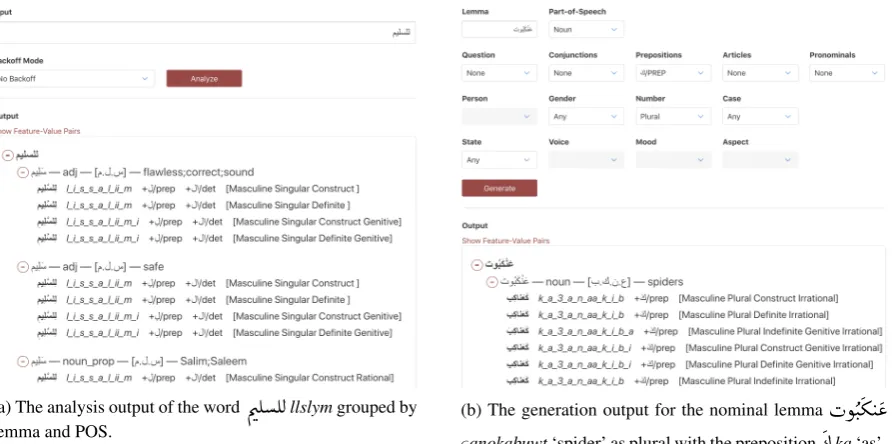
(a) The analysis output of the word
ÕæÊÊË
llslymgrouped by lemma and POS.(b) The generation output for the nominal lemma
HñJ.
º J
«
[image:7.595.79.526.69.291.2]ςanokabuwt‘spider’ as plural with the preposition
¼
ka‘as’.Figure 1: A screen capture of the CALIMAStaranalyzer and generator interfaces.
5 CALIMAStar Engine
The CALIMAStar engine is a new
implementa-tion of the analysis and generaimplementa-tion algorithms de-scribed in Section3with some extensions. It uses the database described in Section4.
CALIMAStar API The CALIMAStar engine is
implemented in Python. We provide a command-line tool interface as well as an API. CALIMAStar
is a part of a collection of Arabic NLP tools we plan to release.
Analysis and Generation Extensions All of the algorithmic extensions in the CALIMAStarengine
are minor, and intended to accommodate the addi-tional features in the database. Examples include the special handling of functional gender and num-ber as discussed in Section4.1, the concatenation of prefix, stem and suffix features for added POS tags and tokenization schemes. The concatena-tion of the CAPHI string and the pattern requires rewrite rules because of prefix-stem interactions.
Reinflection Inspired by the SIGMORPHON 2016 Shared Task on morphological reinflection (Cotterell et al., 2016), we provide a reinflec-tion funcreinflec-tionality in the CALIMAStar API, which
makes use of the existing analysis and generation components. The input to the CALIMAStar
re-inflector is an already inflected word and a de-sired set of feature-value changes. The system an-alyzes the word, adjusts its features given the input
feature-value pairs, and generates the reinflected form(s). The reinflector is also used as a backoff mode for the generator when the input lemma is not recognized.
Web Interface We created a web interface for the CALIMAStar analyzer and generator – see
Figures 1(a) and (b), respectively. The analyzer interface expects an input word and a selected backoff mode. Options for backoff include no backoff, proper-noun backoff, or any POS back-off. The generator interface minimally expects a lemma and POS for input; feature values can be specified as needed. The generator interface changes which features are allowed to select val-ues for depending on the input POS. For example, in Figure1(b), the verbal features, person, voice, mood and aspect, are disabled because the input POS is a noun. There are two output modes for both analyzer and generator interfaces. The first output mode is a user-friendly display of words grouped by lemma, POS tag, root and English gloss. For each inflected word, the interface shows its diacritization, phonology, clitics, and inflec-tional features, in a human-readable form. This output mode is what Figures1 (a) and (b) show. The second mode presents the output in a feature-value pair format more suitable for debugging and programming interfaces.
The engine and web interface are linked from
6 Evaluation
In this section we validate our system and evalu-ate it against other systems in terms of speed and coverage.
6.1 Internal Validation
We ran a number of tests to validate our database extensions. All these tests were run on the PATB
dev set (Diab et al., 2013) from PATB parts 1, 2 and 3, except where indicated.
Analysis This test aimed to validate that we are producing all the analyses that are produced by ALMOR. We ran the tokens in the dataset through ALMOR and CALIMAStar, and verified that
ev-ery analysis produced by ALMOR is also pro-duced by CALIMAStar. CALIMAStar produced
more analyses on average than ALMOR. And nat-urally, the CALIMAStaranalyses were richer than
the ALMOR analyses.
Generation Since we do not have a manually annotated version of this data set with all of our extensions, we relied on automatic match-ing of CALIMAStaranalyses against the ALMOR
analyses used to train and evaluate MADAMIRA (Pasha et al., 2014).7 This matching allowed us to extend the ALMOR analyses with functional gender and number features. We used the lemma and extended features as input to the CALIMAStar
generation component. CALIMAStar produced
the full diacritized word in all cases.
Reinflection Validating the reinflection compo-nent required us to have a source inflected word, and a target inflected word. We grouped the ex-tended ALMOR analyses from the Generation test above by lemma and POS tag, and generated all possible pairs of words that share a lemma and POS tag. For each pair, we used the features of the first word to reinflect the second word, and vice versa. Our system produced the correct diacritized word in all cases.
Functional Gender and Number Analysis
This test aimed to validate that the database exten-sion for functional gender and number was con-sistent with the manual annotation. For this test, we analyzed every word that was manually anno-tated for functional gender and number, and
con-7The ALMOR analyses were themselves automatically
matched against the gold PATB annotations in a similar man-ner toHabash and Rambow(2005).
firmed that the analyzer is producing an analysis with the expected functional feature values. Our system produced the expected values in all cases.
Tokenization We tested our D3 tokenization ex-tensions, as it is the most complex tokeniza-tion scheme in our database. We ran our test set in MADAMIRA to produce the D3 tokeniza-tion. We then compared the tokenization duced by MADAMIRA to the tokenization pro-duced by CALIMAStar for the analysis that is
equivalent to MADAMIRA’s top analysis (mod-ulo our extensions). We matched MADAMIRA’s diacritized tokenization in 99.5% of the cases, and we matched the undiacritized tokenization in 99.9% of the cases. The only undiacritized mis-matches are the result of MADAMIRA tokeniza-tion errors in words such as
IJm'.
bHyθ‘with/by + where; whereby’, which MADAMIRA tok-enizes asIJm'.
+H.
b+ bHyθinstead ofIJk
+H.
b+ Hyθ. This validation test also brought to light some minor cases which we intend to fix in future releases of the database.
Lemma and POS Probability We carried out preliminary experiments on the use of the dif-ferent probability scores (Section4.8) for out-of-context POS and lemma selection. We found that the top-one choice among the CALIMAStar
anal-yses ranked using the joint lemma-POS score pre-formed the highest with 92%, 90% and 88% accu-racy in terms of POS, lemma, and POS+lemma, respectively. The results are comparable to the maximum likelihood disambiguation baseline re-ported by Zalmout and Habash (2017a), which supports the use of morphological analyzers as a backbone for the different NLP task.
6.2 Comparison with other Systems
We compare CALIMAStar to four other
morpho-logical analyzers: AraMorph,8 SAMA 3.1 (Graff et al., 2009), ALMOR and MADAMIRA,9 in
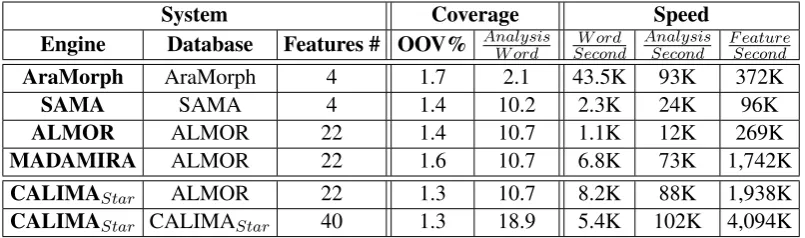
terms of coverage (out-of-vocabulary (OOV) rate and analyses per word) and speed performance (words, analyses, and features per second). We ran the experiments on one million words from the Arabic Gigaword corpus (Parker et al.,2011). The results of the comparison are in Table2.
8We used the AraMorph 1.2.1 version, and
imple-mentation of BAMA 1.2 that was optimized by Jon De-hdari from SourceForgehttps://sourceforge.net/ projects/aramorph/files/aramorph/1.2.1/.
System Coverage Speed
Engine Database Features # OOV% AnalysisW ord SecondW ord AnalysisSecond F eatureSecond
AraMorph AraMorph 4 1.7 2.1 43.5K 93K 372K
SAMA SAMA 4 1.4 10.2 2.3K 24K 96K
ALMOR ALMOR 22 1.4 10.7 1.1K 12K 269K
MADAMIRA ALMOR 22 1.6 10.7 6.8K 73K 1,742K
CALIMAStar ALMOR 22 1.3 10.7 8.2K 88K 1,938K
[image:9.595.98.501.62.181.2]CALIMAStar CALIMAStar 40 1.3 18.9 5.4K 102K 4,094K
Table 2: A comparison of five systems, AraMorph, SAMA, ALMOR, MADAMIRA and CALIMAStar,
in terms of coverage (OOV and analyses per word) and speed (word, analyses, features per second).
The first three columns of Table 2 specify the systems, the databases, and the number of fea-tures in the databases. AraMorph was run on the AraMorph database, and SAMA was run on the SAMA database. Both of these con-tain four features: the diacritization, Buckwalter POS tag, lemma, and English gloss. ALMOR and MADAMIRA both use the ALMOR database, which produces 22 features: the same four fea-tures of AraMorph/SAMA in addition to the MADA POS tag, four proclitic features, person, aspect, voice, mood, gender, number, state, case, enclitic, rationality, source, stem, and stem cate-gory. CALIMAStar was run on the CALIMAStar
database described in Section4, which has 40 fea-tures: the 22 ALMOR features in addition to func-tional gender and number, CAPHI, root, pattern, tokenization and segmentation in four schemes (D1, D2, D3, and ATB), CATiB and UD POS tags, and POS, lemma, and joint lemma-POS probabil-ity scores. We also ran the CALIMAStar engine
with the ALMOR database as a comparison point.
Coverage The OOV rates of the different an-alyzers are generally close to each other. The differences stem from two sources. First, AraMorph’s database is an older version of SAMA/ALMOR/CALIMAStar with less lemmas
(∼38K vs∼40K lemmas). And secondly, differ-ent engines handle numbers, foreign words, and digits in different ways, with the CALIMAStar
en-gine outperforming all others.
The number of analyses per word is strongly connected to the database being used. AraMorph has less coverage, in terms of affixes and stems, and that is why it produces a smaller number of analyses per word. ALMOR and MADAMIRA both use the same database, thus producing the same number of analyses per word. CALIMAStar
extends the suffix lexicon to fully cover the state and case analyses resulting in the largest number of analyses per word.
Speed The last three columns of Table 2 com-pare the speed of the systems, in terms of words per second, analyses per second, and features per second. In terms of words per second, AraMorph is the fastest system. Comparing the ALMOR, MADAMIRA and CALIMAStar engines using
the same database (ALMOR), CALIMAStaris the
fastest of the three. However, using the larger CALIMAStar database slows the CALIMAStar
engine down to second place in this three-way comparison. That said, CALIMAStar produces
more analyses per seconds and features per second than all the other systems.
7 Conclusion and Future Work
CALIMAStar is an Arabic analyzer and
genera-tor that supports a large number of morphologi-cal features. It has as an API and a web interface, and will be released publicly. Compared with four commonly used Arabic analyzers, CALIMAStar
has better coverage and is very competitive speed-wise.
In the future, we will extend our database in terms of lexical entries, features, and dialects. We will also integrate our system into existing disam-biguators and parsers (Pasha et al.,2014;Shahrour et al., 2016; Zalmout and Habash, 2017a). Fi-nally, we plan on conducting task-based evalua-tions where we can assess the added value of some of the new features.
References
Ahmed Abdelali, Kareem Darwish, Nadir Durrani, and Hamdy Mubarak. 2016. Farasa: A fast and furious segmenter for Arabic. In Proceedings of the 2016 Conference of the North American Chapter of the Association for Computational Linguistics: Demon-strations, pages 11–16, San Diego, California.
Imad A. Al-Sughaiyer and Ibrahim A. Al-Kharashi. 2004. Arabic morphological analysis techniques: A comprehensive survey. Journal of the Ameri-can Society for Information Science and Technology, 55(3):189–213.
Sarah Alkuhlani and Nizar Habash. 2011. A Corpus for Modeling Morpho-Syntactic Agreement in Ara-bic: Gender, Number and Rationality. In Proceed-ings of the 49th Annual Meeting of the Association for Computational Linguistics (ACL’11), Portland, Oregon, USA.
Mohamed Altantawy, Nizar Habash, and Owen Ram-bow. 2011. Fast Yet Rich Morphological Analysis. In Proceedings of the 9th International Workshop on Finite-State Methods and Natural Language Pro-cessing (FSMNLP 2011), Blois, France.
Mohamed Altantawy, Nizar Habash, Owen Rambow, and Ibrahim Saleh. 2010. Morphological Analy-sis and Generation of Arabic Nouns: A Morphemic Functional Approach. InProceedings of the seventh International Conference on Language Resources and Evaluation (LREC), Valletta, Malta.
Kenneth Beesley, Tim Buckwalter, and Stuart New-ton. 1989. Two-Level Finite-State Analysis of Ara-bic Morphology. InProceedings of the Seminar on Bilingual Computing in Arabic and English.
Kenneth R. Beesley. 1996. Arabic finite-state morpho-logical analysis and generation. In Proceedings of COLING-96, the 16th International Conference on Computational Linguistics, Copenhagen.
Fadi Biadsy, Nizar Habash, and Julia Hirschberg. 2009. Improving the Arabic Pronunciation Dictionary for Phone and Word Recognition with Linguistically-Based Pronunciation Rules. InProceedings of Hu-man Language Technologies: The 2009 Annual Conference of the North American Chapter of the Association for Computational Linguistics, pages 397–405, Boulder, Colorado.
Mohamed Boudchiche, Azzeddine Mazroui, Mohamed Ould Abdallahi Ould Bebah, Abdelhak Lakhouaja, and Abderrahim Boudlal. 2017. AlKhalil Morpho Sys 2: A robust Arabic morpho-syntactic analyzer. Journal of King Saud University-Computer and In-formation Sciences, 29(2):141–146.
Abderrahim Boudlal, Abdelhak Lakhouaja, Azzeddine Mazroui, Abdelouafi Meziane, MOAO Bebah, and M Shoul. 2010. Alkhalil Morpho Sys1: A mor-phosyntactic analysis system for Arabic texts. In International Arab conference on information tech-nology, pages 1–6. Benghazi Libya.
Tim Buckwalter. 2002. Buckwalter Arabic Morpho-logical Analyzer Version 1.0. Linguistic Data
Con-sortium, University of Pennsylvania, 2002. LDC Catalog No.: LDC2002L49.
Ryan Cotterell, Christo Kirov, John Sylak-Glassman, David Yarowsky, Jason Eisner, and Mans Hulden. 2016. The SIGMORPHON 2016 shared task on morphological reinflection. In Proceedings of the 14th SIGMORPHON Workshop on Computational Research in Phonetics, Phonology, and Morphol-ogy, pages 10–22.
Mona Diab, Nizar Habash, Owen Rambow, and Ryan Roth. 2013. LDC Arabic treebanks and associated corpora: Data divisions manual. arXiv preprint arXiv:1309.5652.
Mona Diab, Kadri Hacioglu, and Daniel Jurafsky. 2004. Automatic Tagging of Arabic Text: From Raw Text to Base Phrase Chunks. In Proceed-ings of the 5th Meeting of the North American Chapter of the Association for Computational Lin-guistics/Human Language Technologies Conference (HLT-NAACL04), pages 149–152, Boston, MA.
David Graff, Mohamed Maamouri, Basma Bouziri, Sondos Krouna, Seth Kulick, and Tim Buckwal-ter. 2009. Standard Arabic Morphological Analyzer (SAMA) Version 3.1. Linguistic Data Consortium LDC2009E73.
Nizar Habash. 2007. Arabic Morphological Repre-sentations for Machine Translation. In A. van den Bosch and A. Soudi, editors, Arabic Computa-tional Morphology: Knowledge-based and Empiri-cal Methods. Springer.
Nizar Habash. 2010. Introduction to Arabic Natural Language Processing. Morgan & Claypool Publish-ers.
Nizar Habash, Fadhl Eryani, Salam Khalifa, Owen Rambow, Dana Abdulrahim, Alexander Erdmann, Reem Faraj, Wajdi Zaghouani, Houda Bouamor, Nasser Zalmout, et al. 2018. Unified guidelines and resources for Arabic dialect orthography. In Pro-ceedings of the International Conference on Lan-guage Resources and Evaluation (LREC).
Nizar Habash, Ramy Eskander, and Adbelati Hawwari. 2012. A Morphological Analyzer for Egyptian Arabic. In NAACL-HLT 2012 Workshop on Com-putational Morphology and Phonology (SIGMOR-PHON2012), pages 1–9.
Nizar Habash and Owen Rambow. 2005. Arabic to-kenization, part-of-speech tagging and morphologi-cal disambiguation in one fell swoop. In Proceed-ings of the 43rd Annual Meeting of the Association for Computational Linguistics (ACL’05), pages 573– 580, Ann Arbor, Michigan. Association for Compu-tational Linguistics.
Nizar Habash and Owen Rambow. 2006. MAGEAD: A Morphological Analyzer and Generator for the Arabic Dialects. InProceedings of ACL, pages 681– 688, Sydney, Australia. Association for Computa-tional Linguistics.
tagging, stemming and lemmatization. In Proceed-ings of the Second International Conference on Ara-bic Language Resources and Tools. The MEDAR Consortium.
Nizar Habash and Ryan M Roth. 2009. CATiB: The Columbia Arabic Treebank. InProceedings of the ACL-IJCNLP 2009 Conference Short Papers, pages 221–224.
Nizar Habash and Fatiha Sadat. 2006. Arabic Pre-processing Schemes for Statistical Machine Transla-tion. InProceedings of the Human Language Tech-nology Conference of the NAACL, Companion Vol-ume: Short Papers, pages 49–52, New York City, USA.
Nizar Habash, Abdelhadi Soudi, and Tim Buckwalter. 2007. On Arabic Transliteration. In A. van den Bosch and A. Soudi, editors, Arabic Computa-tional Morphology: Knowledge-based and Empiri-cal Methods. Springer.
Salam Khalifa, Sara Hassan, and Nizar Habash. 2017. A morphological analyzer for Gulf Arabic verbs. InProceedings of the Workshop for Arabic Natural Language Processing 2017 (co-located with EACL 2017), Valencia, Spain.
Salam Khalifa, Nasser Zalmout, and Nizar Habash. 2016. YAMAMA: Yet Another Multi-Dialect Ara-bic Morphological Analyzer. In Proceedings of the International Conference on Computational Lin-guistics (COLING): System Demonstrations, pages 223–227.
Seth Kulick, Ryan Gabbard, and Mitch Marcus. 2006. Parsing the Arabic Treebank: Analysis and Improve-ments. In Proceedings of the 5th Conference on Treebanks and Linguistics Theories, pages 31–32.
Mohamed Maamouri, Ann Bies, Tim Buckwalter, and Wigdan Mekki. 2004. The Penn Arabic Treebank: Building a Large-Scale Annotated Arabic Corpus. In NEMLAR Conference on Arabic Language Re-sources and Tools, pages 102–109, Cairo, Egypt.
Yuval Marton, Nizar Habash, and Owen Rambow. 2013. Dependency parsing of Modern Standard Arabic with lexical and inflectional features. Com-putational Linguistics, 39(1):161–194.
Joakim Nivre, Marie-Catherine de Marneffe, Filip Gin-ter, Yoav Goldberg, Jan Hajic, Christopher D. Man-ning, Ryan McDonald, Slav Petrov, Sampo Pyysalo, Natalia Silveira, Reut Tsarfaty, and Daniel Zeman. 2016. Universal dependencies v1: A multilingual treebank collection. InProceedings of the Tenth In-ternational Conference on Language Resources and Evaluation (LREC 2016), Portorož, Slovenia.
Robert Parker, David Graff, Ke Chen, Junbo Kong, and Kazuaki Maeda. 2011. Arabic Gigaword Fifth Edi-tion. LDC catalog number No. LDC2011T11, ISBN 1-58563-595-2.
Arfath Pasha, Mohamed Al-Badrashiny, Mona Diab, Ahmed El Kholy, Ramy Eskander, Nizar Habash, Manoj Pooleery, Owen Rambow, and Ryan M Roth. 2014. MADAMIRA: A Fast, Comprehensive Tool for Morphological Analysis and Disambiguation of
Arabic. InProceedings of the Language Resources and Evaluation Conference (LREC), Reykjavik, Ice-land.
Anas Shahrour, Salam Khalifa, Dima Taji, and Nizar Habash. 2016. CamelParser: A system for Arabic syntactic analysis and morphological disambigua-tion. InProceedings of COLING 2016, the 26th In-ternational Conference on Computational Linguis-tics: System Demonstrations, pages 228–232.
June E Shoup. 1980. Phonological aspects of speech recognition. Trends in speech recognition, pages 125–138.
Otakar Smrž. 2007. ElixirFM — Implementation of Functional Arabic Morphology. InProceedings of the 2007 Workshop on Computational Approaches to Semitic Languages: Common Issues and Re-sources, pages 1–8, Prague, Czech Republic.
Andreas Stolcke. 2002. SRILM an Extensible Lan-guage Modeling Toolkit. InProceedings of the In-ternational Conference on Spoken Language Pro-cessing.
Michelle Vanni and Rémi Zajac. 1996. The Temple Translator’s Workstation Project. InProceedings of a workshop on held at Vienna, Virginia: May 6-8, 1996, pages 101–106.
Nasser Zalmout and Nizar Habash. 2017a. Don’t throw those morphological analyzers away just yet: Neural morphological disambiguation for Arabic. In Pro-ceedings of the 2017 Conference on Empirical Meth-ods in Natural Language Processing, pages 704– 713, Copenhagen, Denmark.