Learning Sentiment Memories for Sentiment Modification
without Parallel Data
Yi Zhang, Jingjing Xu, Pengcheng Yang, Xu Sun
MOE Key Lab of Computational Linguistics, School of EECS, Peking University
{zhangyi16,jingjingxu,yang pc,xusun}@pku.edu.cn
Abstract
The task of sentiment modification requires re-versing the sentiment of the input and preserv-ing the sentiment-independent content. How-ever, aligned sentences with the same content but different sentiments are usually unavail-able. Due to the lack of such parallel data, it is hard to extract sentiment independent content and reverse the sentiment in an unsupervised way. Previous work usually can not reconcile sentiment transformation and content preser-vation. In this paper, motivated by the fact the non-emotional context (e.g., “staff”) provides strong cues for the occurrence of emotional words (e.g., “friendly”), we propose a novel method that automatically extracts appropriate sentiment information from the learned senti-ment memories according to the specific con-text. Experiments show that our method sub-stantially improves the content preservation degree and achieves the state-of-the-art perfor-mance.1
1 Introduction
Sentiment modification of natural language texts is a special task that connects sentiment analy-sis and natural language generation. It facili-tates many NLP applications, such as news rewrit-ing and automatic conversion of review attitude, which reduce the human effort. Sentiment mod-ification presents two requirements: one is that the sentiment or the attitude of the text needs to be transformed to the opposite; the other is that the transformed text should maintain semantic rel-evance to the input text as much as possible.
Recently, there have been some researches which focus on the work of editing a sentence to alter specific attributes, like style and sentiment (Shen et al., 2017; Hu et al., 2017). Typically,
1The code is available at https://github.com/
lancopku/SMAE
the parallel data with the same content but differ-ent sdiffer-entimdiffer-ent is not available. This line of work attempts to extract the attribute-independent con-tent from a dense sentence representation by ad-versarial learning. However, it is hard to extract the attribute-independent content in such implicit ways, which makes these methods tend to generate input-irrelevant texts.
Most existing methods can not reconcile the performance of sentiment transformation and con-tent preservation. Direct replacement of emotional words can keep the context but may lead to low-quality sentences. For example, given an input “The food is cold like rock”, this method probably outputs “The food is warm like rock”. State-of-the-art models using neural networks struggle to generate high-quality sentences. However, these models usually lead to poor content preservation. For instance, when the source text is “This is a wonderful movie”, we expect an output like “This movie is disappointing”. However, the generated sentence may be “The waiters are very rude”, which has little relevance to the source text. In general, it is difficult to preserve semantic content and reverse the sentiment at the same time without parallel data.
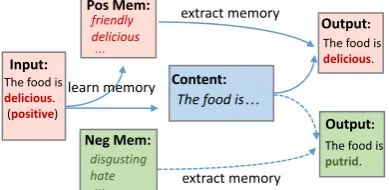
perfor-Pos Mem:
Content: Input:
Output: friendly
delicious
disgusting hate
The food is…
Neg Mem: ⋯
⋯
The food is delicious.
(positive)
The food is delicious.
The food is putrid.
Output: learn memory
extract memory
[image:2.595.82.277.65.160.2]extract memory
Figure 1: Illustration of the proposed model with a pos-itive input. Solid and dashed lines indicate the training process and the testing process, respectively. The pro-cess with a negative input is in a similar way.
mance, especially improves content preservation degree by a large margin.
Our contributions are concluded as follows:
• We propose a method that uses sentiment memories to accomplish sentiment modifica-tion without any help of the parallel data.
• The proposed method improves the content preservation degree by a large margin when compared with current systems.
2 Related Work
Recently, there has been some studies for senti-ment modification.Shen et al.(2017) learn an en-coder that maps a sentence with its original style to a style-independent content representation. This is then passed to a style-dependent decoder for ren-dering.Fu et al.(2017) implement a multi-decoder auto-encoder (Bengio et al., 2009; Dai and Le,
2015) where the encoder is used to capture the content and the sentiment-specific decoders are used to generate target sentence. Hu et al.(2017) augment the unstructured variables z in vanilla VAE with a set of structured variables c each of which targets a salient and independent seman-tic feature of sentences, to control sentence sen-timent. However, all of these work attempt to im-plicitly separate the non-emotional content from the emotional information in a dense sentence rep-resentation. Xu et al.(2018) explicitly filter out emotional words. They use two sentiment-specific decoders to attach sentiments to non-emotional context. The decoders bear all the burdens to generate sentiments. In our model, we use sen-timent memories to assist generating sensen-timents with only one decoder, which results in fewer pa-rameters.
The proposed sentiment-memory based auto-encoder (Bengio et al., 2009; Ma et al., 2018b) learns the idea of memory network (Weston et al.,
2014;Sukhbaatar et al., 2015) but simplifies the process. Our work is also related to the generation tasks (Wang et al.,2017;Liu et al.,2018;Ma et al.,
2018a;Lin et al.,2018). These tasks usually gen-erate texts that preserve main information of input texts.
3 Proposed Model
We first use a variant of self-attention(Lin et al.,
2017;Kim et al.,2017) mechanism to distinguish the emotional and non-emotional words. Then the positive words and negative words are used to up-date the corresponding memory modules. Finally, the decoder uses the target sentiment information extracted from the memory and the content repre-sentation to perform decoding.
3.1 Emotional Words Detection Model
We first find the emotional words that have the most discriminative power for sentiment polarity. This work is done by training a sentiment classi-fier with a simple self-attention mechanism. Here the sequence of inputs{h1, ..., hT}are the hidden
states of a LSTM, running over the words in the source sentence {x1, ..., xT}. The context vector
can then be computed using a simple sum:
c=
T
X
t=1
at·ht (1)
whereat denotes the attention weight of thet-th
word. The sentence vector c is then fed into a fully connected layer to predict the sentiment po-larity of the source text. Since the words with ob-vious emotional tendencies will be given greater weights compared to those non-emotional words during training,at can be used to distinguish
be-tween emotional and non-emotional words. The weights of standard attention mechanism sum to 1. When there are several emotional words, the sum 1 is distributed by these words. How-ever, we expect that each emotional word has a weight close to 1 to identify its sentiment attribute. Hence, following (Kim et al., 2017), we modify the calculation of attention weights as follows to get more distinguishable weights:
at= sigmoid(vTht) (2)
where v is the parameter vector. The sigmoid
in-put word a distinguishable weight which is close to 1 or 0. However, these weights falls between 0 and 1. They still can not thoroughly distin-guish the emotional words from non-emotional words without redundant information. Following
Xu et al.(2018), we map attention weights to dis-crete values, 0 or 1, and we adopt their disdis-crete method. The weights greater than the averaged at-tention value are assigned to 1 and the weights less than the averaged attention value are assigned to 0. The weightatafter discretization is denoted asaˆt.
Then, aˆt can be regarded as the emotional word
identifier. 1 −aˆt becomes non-emotional word
identifier.
3.2 Sentiment-Memory Based Auto-Encoder
After the separation of emotional and non-emotional words, the proposed SMAE is used to process these two kinds of information. We employ the seq2seq based auto-encoder. Both the encoder and the decoder are LSTM networks (Hochreiter and Schmidhuber,1997).
If xi is a context word, then aˆi is 0, causing (1−aˆi)xito bexi. Therefore, the sequence{(1−
ˆ
a1)x1,· · · ,(1−aˆT)xT}can be regarded as
non-emotional word embedding sequence. It is fed into the LSTM encoder sequentially. we select hT in
the last state tuple (hT,cT) of the encoder as the
content representation of the input.
Meanwhile, the embeddings of the emotional words of the source text are used to update the sentiment-memory. Since we have two kinds of sentiments, positive and negative, we useMpos∈ Re×γ andMneg ∈ Re×γ to denote the positive
memory and the negative memory, respectively. e is the embedding size andγ is a hyper-parameter which controls the size of the memory.
We illustrate the following part by using posi-tive input as an example. We first sum the embed-ding of the emotional words to get a vector rep-resentation of the emotional information, which is denoted asspos ∈ Re. We then use a simple
at-tention mechanism to find the columns in Mpos
that are most closely related to the emotional in-formation. The outer product of the transposition of emotional information spos and the attention
weightswbroadcasts the sentiment vectorspos to a matrix. Then, the matrix is added to the exist-ing memory Mpos. Due to the attention weight w, the columns that are most closely related to the emotional information are updated more with the
sentiment informationspos. Formally, we have:
spos=
T
X
i=1
ˆ
ai·xi (3)
w=sof tmax (spos)TMpos (4)
Mpos =Mpos+spos⊗w (5)
where⊗denotes the outer product.
Previous work employ two sentiment-specific decoders to generate text based on the supposed non-emotional representation. The decoders bear all the burdens to generate sentiments. In our model, we extract some sentiment information from the sentiment-memories to assist decod-ing. Intuitively, the context word “staff” is more likely to be associated with the emotional word “friendly”, and “food” is more likely to be asso-ciated with “delicious”. So we use the context vectorsconto extract the corresponding sentiment memory that is more likely to be used in the future decoding. The context vectorscon is represented as the sum of the embedding of non-emotional words. Thenscon is used to compute the attention weightsuover the columns of sentiment memory matrix. We sum these weighted columns as the ex-tracted memorym˜ and addm˜ to the last cell state
cT of the encoder:
scon=
T
X
i=1
(1−aˆi)·xi (6)
u=sof tmax (scon)TMpos (7)
˜
m=
γ
X
j=1
uj ·Mjpos (8)
˜
cT =cT +Wm˜ (9)
whereujdenotes thej-th value in vectoru,Mjpos
denotes the j-th column of Mpos and W is the parameter matrix. The new tuple (hT,c˜T) then
acts as the initial state of the decoder.
The negative input is processed in the same way. At the training stage, the decoder is encouraged to restore the source text. Therefore, the cross en-tropy loss function is optimized.
4 Experiments
4.1 Data Preprocessing
We use the Yelp Review Dataset (Yelp) provided by Yelp Dataset Challenge2 to conduct experi-ments. Each item is a sentence from the review
2https://www.yelp.com/dataset/
Model ACC BLEU
CEA 71.96 2.77
MAE 74.59 5.45
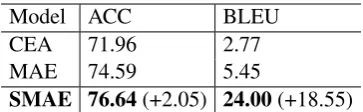
SMAE 76.64(+2.05) 24.00(+18.55)
Table 1: Performance of the proposed method and state-of-the-art systems.
on Yelp and is labeled as having either negative or positive sentiment. We train a CNN sentence clas-sifier (Kim,2014) to filter examples with ambigu-ous sentiment polarities (category probability < 0.8). The processed dataset contains 510K, 20K, and 20K pairs for training, validation, and testing, respectively. The classifier achieves an accuracy of 94% on the processed dataset and is also used to test transformation accuracy.
4.2 Experiment Settings
We tune our hyper-parameters on the development set. The word embeddings are initialized ran-domly with a size of 128. The hidden size of the sentiment-memory based auto-encoder is 300. We use Adam optimizer (Kingma and Ba,2014) with an initial learning rate set to 0.001 to train our model and the batch size is set to 64. The hyper-parameter γ which controls the size of memory matrix is 60.
4.3 Baselines
We compare our proposed method with two state-of-the-art systems that have been used for senti-ment modification. We run the released code on our dataset.
Cross-aligned Auto-Encoder (CAE): This sys-tem, proposed byShen et al.(2017), uses a shared latent content space across different sentiments and leverages refined alignment of latent represen-tations to perform sentiment modification.
Multi-decoder Auto-Encoder (MAE): This sys-tem is proposed byFu et al. (2017). They use a multi-decoder seq2seq model (Bengio et al.,2009;
Dai and Le,2015) where the encoder captures con-tent information by adversarial learning ( Goodfel-low et al., 2014) and the sentiment-specific de-coders are used to generate target sentences.
4.4 Results and Discussions
We use ACC to denote the transformation accu-racy. FollowingGan et al. (2017), we also com-pute BLEU (Papineni et al., 2002) between the
Model Sentiment Content Fluency
CAE 6.55 4.46 5.98
MAE 6.64 4.43 5.36
[image:4.595.306.528.60.339.2]SMAE 6.57 5.98 6.69
Table 2: Results of human evaluation.
Input:Very helpful and informative staff!
CAE:Worst service ever.
MAE:Very nice here and poor!
Proposed:Very rude and careless staff !
Input:I will never go here again.
CAE:I love this place here!
MAE:I had say this place here.
Proposed:I will never go anywhere else.
Input:The worst and would never recommend anyone to use them.
CAE:The best place I ’ve been to go here!
MAE:The first experience is so happy and nice.
Proposed: The best and would definitely rec-ommend anyone to use them.
Table 3: Examples generated by the proposed method and baselines. In comparison, our model changes the sentiment of inputs with higher semantic relevance.
output and the source text to evaluate the con-tent preservation degree. A high BLEU score pri-marily indicates that the system can correctly pre-serve content by retaining the same words from the source sentence.
The experimental results of our proposed model and the baselines are shown in Table1. Both base-line models have low BLEU score but high ac-curacy, which indicates that they may be trapped in a situation that they simply output a sentence with the target sentiment regardless of the content. The main reason is that these methods using adver-sarial learning attempt to implicitly separate the emotional information from the context informa-tion in a sentence vector. However, without paral-lel data, it is difficult to achieve such a goal. Our proposed SMAE model takes advantage of self-attention mechanism and explicitly removes the emotional words, leading to a significant improve-ment of content preservation and the state-of-the-art performance in terms of both metrics.
[image:4.595.89.271.61.117.2]annota-Models ACC BLEU
SMEA 76.64 24.00
SMEA (w/o memories) 14.08 26.09
Table 4: Ablation test of memory module.
The staff here isvery rude. It really is n’tworth cominghere .
Very pleasedwith this business. Been here once andlovedgoinghere.
Table 5: The effectiveness of the memory module with examples. The red words are absent in the input but generated with the help of sentiment memories.
tors have no idea about which system the output is from. They are asked to score the output on three criteria on a scale from 1 to 10: the transformed sentiment degree, the content preservation degree, and the fluency. Table2shows the evaluation re-sults. Our model has obvious advantage over the baseline systems in content preservation, and also performs well in other aspects.
Several randomly selected examples generated by different models are shown in Table3. These examples clearly show our proposed model can generate sentences that are more semantically rel-evant to the input text compared to the baselines.
4.5 Effectiveness of Sentiment-Memories
To verify the effectiveness of the memory mod-ule of our model, we conduct ablation study by excluding the sentiment-memory module. The re-sult is shown in Table 4. According to the re-sult, the complete model achieves an improve-ment of 62.56% on transformation accuracy over the model that excludes the sentiment memories, which means the sentiment memories are key components to ensure successful sentiment mod-ification. In addition, several examples are shown in Table 5 to visually demonstrate the effective-ness of the memory module. we can find that the proposed model is capable of generating appro-priate emotional words (red words in Table 5) to adapt different contexts.
4.6 Error Analysis
To better interpret our model, we also analyze the failure examples whose sentiments are not trans-formed. We observe that in most cases, these in-puts do not have emotional tendencies. Although we have filtered the sentiment-ambiguous
exples in preprocessing, there are still a few am-biguous inputs such as “What can I say ?” and “Been here twice.”. Since our model tries to pre-serve non-emotional content. These words are easily kept and then the decoder barely depends on sentiment-memories. Thus, it is difficult to handle the sentiment transformation with these examples.
5 Conclusion
In this paper, we propose a model that first learns sentiment memories without parallel data and then automatically extracts sentiment information to adapt different contexts when decoding. Exper-imental results show that our method substan-tially improves the content preservation degree and achieves the state-of-the-art performance.
Acknowledgements
This work was supported in part by National Natu-ral Science Foundation of China (No. 61673028). We thank all the reviewers for providing the con-structive suggestions. Xu Sun is the corresponding author of this paper.
References
Yoshua Bengio et al. 2009. Learning deep architec-tures for ai. Foundations and trendsR in Machine Learning, 2(1):1–127.
Andrew M. Dai and Quoc V. Le. 2015. Semi-supervised sequence learning. InAdvances in Neu-ral Information Processing Systems 28: Annual Conference on Neural Information Processing Sys-tems 2015, December 7-12, 2015, Montreal, Que-bec, Canada, pages 3079–3087.
Zhenxin Fu, Xiaoye Tan, Nanyun Peng, Dongyan Zhao, and Rui Yan. 2017. Style transfer in text: Ex-ploration and evaluation. CoRR, abs/1711.06861.
Chuang Gan, Zhe Gan, Xiaodong He, Jianfeng Gao, and Li Deng. 2017. Stylenet: Generating attractive visual captions with styles. In 2017 IEEE Confer-ence on Computer Vision and Pattern Recognition, CVPR 2017, Honolulu, HI, USA, July 21-26, 2017, pages 955–964.
Ian Goodfellow, Jean Pouget-Abadie, Mehdi Mirza, Bing Xu, David Warde-Farley, Sherjil Ozair, Aaron Courville, and Yoshua Bengio. 2014. Generative ad-versarial nets. In Advances in neural information processing systems, pages 2672–2680.
Zhiting Hu, Zichao Yang, Xiaodan Liang, Ruslan Salakhutdinov, and Eric P. Xing. 2017. Controllable text generation.CoRR, abs/1703.00955.
Yoon Kim. 2014. Convolutional neural networks for sentence classification. CoRR, abs/1408.5882.
Yoon Kim, Carl Denton, Luong Hoang, and Alexan-der M. Rush. 2017. Structured attention networks.
CoRR, abs/1702.00887.
Diederik P. Kingma and Jimmy Ba. 2014. Adam: A method for stochastic optimization. CoRR, abs/1412.6980.
Junyang Lin, Xu SUN, Shuming Ma, and Qi Su. 2018. Global encoding for abstractive summarization. In
Proceedings of the 56th Annual Meeting of the As-sociation for Computational Linguistics, ACL 2018, pages 163–169.
Zhouhan Lin, Minwei Feng, C´ıcero Nogueira dos San-tos, Mo Yu, Bing Xiang, Bowen Zhou, and Yoshua Bengio. 2017. A structured self-attentive sentence embedding. CoRR, abs/1703.03130.
Tianyu Liu, Kexiang Wang, Lei Sha, Baobao Chang, and Zhifang Sui. 2018. Table-to-text generation by structure-aware seq2seq learning. InProceedings of the Thirty-Second AAAI Conference on Artificial In-telligence, New Orleans, Louisiana, USA, February 2-7, 2018.
Shuming Ma, Xu Sun, Junyang Lin, and Xuancheng Ren. 2018a. A hierarchical end-to-end model for jointly improving text summarization and sentiment classification. InProceedings of the Twenty-Seventh International Joint Conference on Artificial Intelli-gence, IJCAI 2018, July 13-19, 2018, Stockholm, Sweden., pages 4251–4257.
Shuming Ma, Xu SUN, Junyang Lin, and Houfeng WANG. 2018b. Autoencoder as assistant supervi-sor: Improving text representation for chinese social media text summarization. In Proceedings of the 56th Annual Meeting of the Association for Compu-tational Linguistics, ACL 2018, pages 725–731.
Kishore Papineni, Salim Roukos, Todd Ward, and Wei-Jing Zhu. 2002. Bleu: a method for automatic eval-uation of machine translation. In Proceedings of the 40th annual meeting on association for compu-tational linguistics, pages 311–318. Association for Computational Linguistics.
Tianxiao Shen, Tao Lei, Regina Barzilay, and Tommi S. Jaakkola. 2017. Style transfer from non-parallel text by cross-alignment. CoRR, abs/1705.09655.
Sainbayar Sukhbaatar, Arthur Szlam, Jason Weston, and Rob Fergus. 2015. End-to-end memory net-works. CoRR, abs/1503.08895.
Kexiang Wang, Tianyu Liu, Zhifang Sui, and Baobao Chang. 2017. Affinity-preserving random walk for multi-document summarization. In Proceedings of
the 2017 Conference on Empirical Methods in Nat-ural Language Processing, EMNLP 2017, Copen-hagen, Denmark, September 9-11, 2017, pages 210– 220.
Jason Weston, Sumit Chopra, and Antoine Bordes. 2014. Memory networks.CoRR, abs/1410.3916.