Phrase-based Compressive Cross-Language Summarization
Jin-ge Yao Xiaojun Wan Jianguo Xiao
Institute of Computer Science and Technology, Peking University, Beijing 100871, China Key Laboratory of Computational Linguistic (Peking University), MOE, China
{yaojinge, wanxiaojun, xiaojianguo}@pku.edu.cn
Abstract
The task of cross-language document summarization is to create a summary in a target language from documents in a dif-ferent source language. Previous meth-ods only involve direct extraction of au-tomatically translated sentences from the original documents. Inspired by phrase-based machine translation, we propose a phrase-based model to simultaneously perform sentence scoring, extraction and compression. We design a greedy algo-rithm to approximately optimize the score function. Experimental results show that our methods outperform the state-of-the-art extractive systems while maintaining similar grammatical quality.
1 Introduction
The task of cross-language summarization is to produce a summary in a target language from documents written in a different source language. This task is particularly useful for readers to quickly get the main idea of documents written in a source language that they are not familiar with. Following Wan (2011), we focus on English-to-Chinese summarization in this work.
The simplest and the most straightforward way to perform cross-language summarization is pipelining general summarization and machine translation. Such systems either translate all the documents before running generic summarization algorithms on the translated documents, or sum-marize from the original documents and then only translate the produced summary into the target lan-guage. Wan (2011) show that such pipelining ap-proaches are inferior to methods that utilize in-formation from both sides. In that work, the au-thor proposes graph-based models and achieves fair amount of improvement. However, to the best
of our knowledge, no previous work of this task tries to focus on summarization beyond pure sen-tence extraction.
On the other hand, cross-language summariza-tion can be seen as a special kind of machine trans-lation: translating the original documents into a brief summary in a different language. Inspired by phrase-based machine translation models (Koehn et al., 2003), we propose a phrase-based scoring scheme for cross-language summarization in this work.
Since our framework is based on phrases, we are not limited to produce extractive summaries. We can use the scoring scheme to perform joint sentence selection and compression. Unlike typi-cal sentence compression methods, our proposed algorithm does not require additional syntactic preprocessing such as part-of-speech tagging or syntactic parsing. We only utilize information from translated texts with phrase alignments. The scoring function consists of a submodular term of compressed sentences and a bounded distortion penalty term. We design a greedy procedure to efficiently get approximate solutions.
For experimental evaluation, we use the DUC2001 dataset with manually translated refer-ence Chinese summaries. Results based on the ROUGE metrics show the effectiveness of our pro-posed methods. We also conduct manual evalua-tion and the results suggest that the linguistic qual-ity of produced summaries is not decreased by too much, compared with extractive counterparts. In some cases, the grammatical smoothness can even be improved by compression.
The contributions of this paper include:
• Utilizing the phrase alignment information, we design a scoring scheme for the cross-language document summarization task.
• We design an efficient greedy algorithm to generate summaries. The greedy algorithm is
partially submodular and has a provable con-stant approximation factor to the optimal so-lution up to a small constant.
• We achieve state-of-the-art results using the extractive counterpart of our compressive summarization framework. Performance in terms of ROUGE metrics can be significantly improved when simultaneously performing extraction and compression.
2 Background
Document summarization can be treated as a spe-cial kind of translation process: translating from a bunch of related source documents to a short tar-get summary. This analogy also holds for cross-language document summarization, with the only difference that the languages of source documents and the target summary are different.
Our design of sentence scoring function for cross-language document summarization purpose is inspired by phrase-based machine translation models. Here we briefly describe the general idea of phrase-based translation. One may refer to Koehn (2009) for more detailed description.
2.1 Phrase-based Machine Translation
Phrase-based machine translation models are cur-rently giving state-of-the-art translations for many pairs of languages and dominating modern statis-tical machine translation. Classical word-based IBM models cannot capture local contextual in-formation and local reordering very well. Phrase-based translation models operate on lexical entries with more than one word on the source language and the target language. The allowance of multi-word expressions is believed to be the main rea-son for the improvements that phrase-based mod-els give. Note that these multi-word expressions, typically addressed as phrases in machine transla-tion literature, are essentially continuous n-grams and do not need to be linguistically integrate and meaningful constituents.
Define y as a phrase-based derivation, or more precisely a finite sequence of phrases
p1, p2, . . . , pL. For any derivation y we usee(y)
to refer to the target-side translation text defined by y. This translation is derived by concatenat-ing the strconcatenat-ingse(p1), e(p2), . . . , e(pL). The
scor-ing scheme for a phrase-based derivationy from
the source sentence to the target sentencee(y)is:
f(y) = XL k=1
g(pk) +LM(e(y))
+LX−1 k=1
η|start(pk+1)−1−end(pk)|
where LM(·) is the target-side language model score,g(·)is the score function of phrases,η <0
is the distortion parameter for penalizing the dis-tance between neighboring phrases in the deriva-tion. Note that the phrases addressed here are typically continuous n-grams and need not to be grammatical linguistic phrasal units. Later we will directly use phrases provided by modern machine translation systems.
Searching for the best translation under this score definition is difficult in general. Thus approximate decoding algorithms such as beam search should be applied. Meanwhile, several con-straints should be satisfied during the decoding process. The most important one is to set a con-stant limit of the distortion term |start(pk+1) −
1−end(pk)| ≤δ to exhibit derivations with
dis-tant phrase translations.
3 Phrase-based Cross-Language Summarization
Inspired by the general idea of phrase-based machine translation, we describe our proposed phrase-based model for cross-language summa-rization in this section.
3.1 Phrase-based Sentence Scoring
In the context of cross-language summarization, here we assume that we can also have phrases in both source and target languages along with phrase alignments between the two sides. For summarization purposes, we may wish to se-lect sentences containing more important phrases. Then it is plausible to measure the scores of these aligned phrases via importance weighing.
Inspired by phrase-based translation models, we can assign phrase-based scores to sentences from the translated documents for summarization pur-poses. We define our scoring function for each sentencesas:
F(s) = X p∈s
d0g(p) +bg(s)
Here in the first termg(·)is the score of phrasep, which can be simply set to document frequency. The phrase score is penalized with a constant damping factor d0 to decay scores for repeated phrases. The second term bg(s) is the bigram score of sentence s. It is used here to simu-late the effect of language models in phrase-based translation models. Denoting y(s) as the phrase-based derivation (as mentioned earlier in the previ-ous section) of sentences, the last distortion term
dist(y(s)) =PLk=1|start(pk+1)−1−end(pk)|
is exactly the same as the distortion penalty term in phrase-based translation models. This term can be used as a reflection of complexity of the trans-lation. All the above terms can be derived from bilingual sentence pairs with phrase alignments.
Meanwhile, we may also wish to exclude unim-portant phrases and badly translated phrases. Our definition can also be used to guide sentence com-pression by trying to remove redundant phrase.
Based on the definition over sentences, we de-fine our summary scoring measure over a sum-maryS:
F(S) = X p∈S
countX(p,S)
i=1
di−1g(p) +X
s∈S
bg(s)
+ηX
s∈S
dist(y(s))
wheredis a predefined constant damping factor to penalize repeated occurrences of the same phrases,
count(p, S) is the number of occurrences in the summaryS for phrasep. All other terms are in-herited from the sentence score definition.
In the next section we describe our framework to efficiently utilize this scoring function for cross-language summarization.
3.2 A Greedy Algorithm for Compressed Sentence Selection
Utilizing the phrase-based score definition of sen-tences, we can use greedy algorithms to simulta-neously perform sentence selection and sentence compression. Assuming that we have a predefined budget B (e.g. total number of Chinese charac-ters allowed) to restrict the total length of a gen-erated summary. We useC(S)to denote the cost of a summaryS, measured by the number of Chi-nese characters contained in total. The greedy al-gorithm we will use for our compressive summa-rization is listed in Algorithm 1.
Algorithm 1A greedy algorithm for phrase-based summarization
1: S← ∅ 2: i←1
3: single best=argmaxs∈U,C({s})≤BF({s}) 4: whileU 6=∅do
5: si =argmaxs∈U F(Si−1∪{s})−F(Si−1) C({s})r 6: ifC(Si−1∪ {s})≤B then
7: Si←Si−1∪ {s}
8: i←i+ 1
9: end if
10: U ←U\ {si} 11: end while
12: returnS∗=argmax
S∈{single best,Si}F(S)
The spaceUdenotes the set of all possible com-pressed sentences. In each iteration, the algorithm tries to find the compressed sentence with maxi-mum gain-cost ratio (Line 5, where we will fol-low previous work to setr = 1), and merge it to the summary set at the current iteration (denoted asSi). The target is to find the compression with
maximum gain-cost ratio. This will be discussed in the next section. Note that the algorithm is also naturally applicable to extractive summarization. For extractive summarization, Line 5 corresponds to direct calculations of sentence scores based on our proposed phrase-based function andUwill de-note all full sentences from the original translated documents.
The outline of this algorithm is very similar to the greedy algorithm used by Morita et al. (2013) for subtree extraction, except that in our context the increase of cost function when adding a sen-tence is exactly the cost of that sensen-tence.
When the distortion term is ignored (η = 0), the scoring function is clearly submodular1 (Lin and
Bilmes, 2010) in terms of the set of compressed sentences, since the score now only consists of functional gains of phrases along with bigrams of a compressed sentence. Morita et al. (2013) have proved that when r = 1, this greedy algo-rithm will achieve a constant approximation factor
1
2(1−e−1)to the optimal solution. Note that this only gives us the worst case guarantee. What we can achieve in practice is usually far better.
On the other hand, settingη < 0will not affect
1A set functionF : 2U → Rdefined over subsets of a universe setU is said to besubmodulariff it satisfies the diminishing returnsproperty: ∀S ⊆ T ⊆ U \u, we have
the performance guarantee too much. Intuitively this is because in most phrase-based translation models a distortion limit constraint|start(pk+1)−
1 − end(pk)| ≤ δ will be applied on
distor-tion terms, while performing sentence compres-sion can never increase distortion. The main con-clusion is formulated as:
Theorem 1. If Algorithm 1 outputsSgreedy while
the optimal solution isOP T, we have
F(Sgreedy)≥ 12(1−e−1)F(OP T) +12ηγ.
Here γ > 0 is a constant controlled by distor-tion difference between sentences, which is rel-atively small in practice compared with phrase scores. η < 0 is the distortion parameter. Note that whenη is set to be0, the scoring function is submodular and then we recover the 1
2(1−e−1) approximation factor as studied by Morita et al. (2013). We leave the proof of Theorem 1 to sup-plementary materials due to space limit. The sub-modularity term in the score plays an important role in the proof.
3.3 Finding the Maximum Density Compression
In Algorithm 1, the most important part is the greedy selection process (Line 5). The greedy se-lection criteria here is to maximize the gain-cost ratio. For compressive summarization, we are try-ing to compress each unselected sentencesto ˜s, aiming at maximizing the gain-cost ratio, where the gain corresponds to
F(Si−1∪ {s})−F(Si−1)
= X
p∈s
countX(p,S)
i=1
di−1g(p) +bg(s) +ηdist(s),
and then add the compressed sentences˜with max-imum gain-cost ratio to the summary. We will also address the compression process for each sentence as finding the maximum density compression. The whole framework forms a joint selection and com-pression process.
In our phrase-based scoring for sentences, al-though there exist no apparent optimal substruc-ture available for exact dynamic programming due to nonlocal distortion penalty, we can have a tractable approximate procedure since the search space is only defined by local decisions on whether a phrase should be kept or dropped.
Our compression process for each sentencesis displayed in Algorithm 2. It gradually expands the set of phrases to be kept in the final compression, from the initial set of large density phrases (Line 4, assuming that phrases with large scores and small costs will always be kept), we can recover the compression with maximum density. The function
dist(·,·) is the unit distortion penalty defined as
dist(a, b) = |start(b)−1−end(a)|. We define
p.scoreto be the sum of damped phrase score for phrasep, i.e. p.score= Pcount(p,Si−1)
i=1 di−1g(p), when the current partial summary isSi−1. There-fore during each iteration of the greedy selection process, the compression procedure will also be affected by sentences that have already been in-cluded. Define p.cost as the number of wordsp
contains.
Algorithm 2A growing algorithm for finding the maximum density compressed sentence
1: functionGET MAX DENSITY COMPRESSION(s, Si−1)
2: queueQ← ∅, kept← ∅ 3: foreach phrasepins.phrasesdo
4: ifp.score/p.cost>1then
5: kept←kept∪{p} 6: Q.enqueue(p)
7: end if
8: end for
9: whileQ6=∅do
10: p←Q.deque()
11: ppv←p.previous phrase,pnx←p.next phrase 12: if ppv.score+bg(ppv,p)+ηdist(ppv,p)
ppv.cost+p.cost >1then 13: Q.enqueue(ppv), kept←kept∪{ppv}
14: end if
15: if pnx.score+bg(pnx,p)+ηdist(p,pnx)
p.cost+pnx.cost >1then 16: Q.enqueue(pnx), kept←kept∪{pnx}
17: end if
18: end while
19: returns˜=kept, ratio = F(Si−1∪{˜s})−F(Si−1)
˜
s.cost
20: end function
Empirically we find this procedure gives al-most the same results with exhaustive search while maintaining efficiency. Assuming that sentence length is no more thanL, then the asymptotic com-plexity of Algorithm 2 will beO(L)since the al-gorithm requires two passes of all phrases. There-fore the whole framework requiresO(kNL)time for a document cluster containingN sentences in total to generate a summary withksentences.
the original documents.
Later we will see that this compression process will not hurt grammatical fluency of translated sentences in general. In many cases it may even improve fluency by deleting redundant parenthe-ses or removing incorrectly reordered (unimpor-tant) phrases.
4 Experiments
4.1 Data
Currently there are not so many available datasets for our particular setting of the cross-language summarization task. Hence we only evaluate our method on the same dataset used by Wan (2011). The dataset is created by manually translating the reference summaries into Chinese from the origi-nal DUC 2001 dataset in English. We will refer to this dataset as the DUC 2001 dataset in this paper. There are 30 English document sets in the DUC 2001 dataset for multi-document summarization. Each set contains several documents related to the same topic. Three generic reference English sum-maries are provided by NIST annotators for each document set. All these English summaries have been translated to Chinese by native Chinese an-notators.
All the English sentences in the original docu-ments have been automatically translated into Chi-nese using Google Translate. We also collect the phrase alignment information from the responses of Google Translate (stored in JSON format) along with the translated texts. We use the Stanford Chi-nese Word Segmenter2for Chinese word
segmen-tation.
The parameters in the algorithms are simply set to ber = 1, d= 0.5, η=−0.5.
4.2 Evaluation
We will report the performance of our compres-sive solution, denoted as PBCS (for Phrase-Based Compressive Summarization), with comparisons of the following systems:
• PBES: The acronym comes from Phrase-Based Extractive Summarization. It is the extractive counterpart of our solution without calling Algorithm 2.
• Baseline (EN): This baseline relies on merely the English-side information for
En-2http://nlp.stanford.edu/software/ segmenter.shtml
glish sentence ranking in the original doc-uments. The scoring function is designed to be document frequencies of English bi-grams, which is similar to the second term in our proposed sentence scoring function in Section 3.1 and is submodular. 3 The
ex-tracted English summary is finally automati-cally translated into the corresponding Chi-nese summary. This is also known as the summary translation scheme.
• Baseline (CN): This baseline relies on merely the Chinese-side information for Chi-nese sentence ranking. The scoring function is similarly defined by document frequency of Chinese bigrams. The Chinese summary sentences are then directly extracted from the translated Chinese documents. This is also known as the document translation scheme.
• CoRank: We reimplement the graph-based CoRank algorithm, which gives the state-of-the-art performance on the same DUC 2001 dataset for comparison.
• Baseline (ENcomp): This is a compressive baseline where the extracted English sen-tences in Baseline (EN) will be compressed before being translated to Chinese. The com-pression process follows from an integer lin-ear program as described by Clarke and La-pata (2008). This baseline gives strong per-formance as we have found on English DUC 2001 dataset as well as other monolingual datasets.
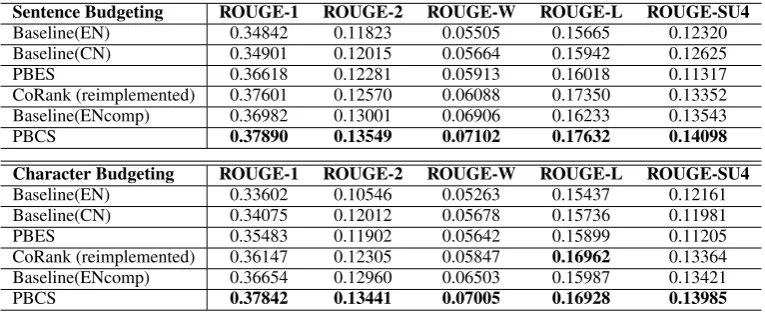
We experiment with two kinds of summary bud-gets for comparative study. The first one is limit-ing the summary length to be no more than five sentences. The second one is limiting the total number of Chinese characters of each produced summary to be no more than 300. They will be addressed as Sentence Budgeting and Character Budgeting in the experimental results respectively. Similar to traditional summarization tasks, we use the ROUGE metrics for automatic evalua-tion of all systems in comparison. The ROUGE metrics measure summary quality by counting overlapping word units (e.g. n-grams) between the candidate summary and the reference sum-mary. Following previous work in the same
task, we report the following ROUGE F-measure scores: ROUGE-1 (unigrams), ROUGE-2 (bi-grams), ROUGE-W (weighted longest common subsequence; weight=1.2), ROUGE-L (longest common subsequences), and ROUGE-SU4 (skip bigrams with a maximum distance of 4). Here we investigate two kinds of ROUGE metrics for Chinese: ROUGE metrics based on words (after Chinese word segmentation) and ROUGE metrics based on singleton Chinese characters. The latter metrics will not suffer from the problem of word segmentation inconsistency.
To compare our method with extractive base-lines in terms of information loss and grammati-cal quality, we also ask three native Chinese stu-dents as annotators to carry out manual evalua-tion. The aspects considered during evaluation include Grammaticality (GR), Non-Redundancy (NR), Referential Clarity (RC), Topical Focus (TF) and Structural Coherence (SC). Each aspect is rated with scores from 1 (poor) to 5 (good) 4.
This evaluation is performed on the same random sample of 10 document sets from the DUC 2001 dataset. One group of the gold-standard sum-maries is left out for evaluation of human-level performance. The other two groups are shown to the annotators, giving them a sense of topics talked about in the document sets.
4.3 Results and Discussion
Table 1 and Table 2 display the ROUGE results for our proposed methods and the baseline methods, including both word-based and character-based evaluation. We also conduct pairwise t-test and find that almost all the differences between PBCS and other systems are statistically significant with
p0.015except for the ROUGE-W metric.
We have the same observations with previous work on the inferiority of using information from only one-side, while using Chinese-side infor-mation only is more beneficial than English-side only. The CoRank algorithm utilizes both sides of information together and achieves significantly better performance over Baseline(EN) and Base-line(CN). Our compressive system outperforms the CoRank algorithm6in all metrics.
4Fractional numbers are allowed for cases where the an-notators feel uncertain about.
5The significance level holds after Bonferroni adjustment, for the purpose of multiple testing.
6There exists ignorable difference between the results of our reimplemented version of CoRank and those reported by
Also our system overperforms the compressive pipelining system (Baseline(ENcomp)) as well. Note that the latter only considers information from the source language side. Meanwhile sen-tence compression may sometimes causes worse translations compared with translating the full original sentence.
For manual evaluation, the average score and standard deviation for each metric is displayed in Table 3. From the comparison between com-pressive summarization and the extractive ver-sion, there exist slight improvements of non-redundancy. This exactly matches what we can expect from sentence compression that keeps only important part and drop redundancy. We also ob-serve certain amount of improvements on refer-ential clarity. This may be a result of deletions of some phrases containing pronouns, such ashe said. Most of such phrases are semantically unim-portant and will be dropped during the process of finding the maximum density compression.
Despite not directly using syntactic informa-tion, our compressive summaries do not suffer too much loss of grammaticality. This suggest that bigrams can be treated as good indicators of lo-cal grammatilo-cal smoothness. We reckon that sen-tences describing the same events may partially share descriptive bigram patterns, thus sentences selected by the algorithm will consist of mostly important patterns that appear repeatedly in the original document cluster. Only those words that are neither semantically important nor syntacti-cally pivotal will be deleted.
Figure 1 lists the summaries for the first docu-ment set D04 in the DUC 2001 dataset produced by the proposed compressive system. The Chi-nese side sentences have been split with spaces ac-cording to phrase alignment results. Phrases that have been compressed are grayed out. We also include original English sentences for reference, with deletions according to word alignments from the Chinese sentences. We can observe that our compressive system tries to compress sentences by removing relatively unimportant phrases. The ef-fect of translation errors (e.g. the wordwatchinon storm watchhas been incorrectly translated in the example) can also be reduced since those incor-rectly translated words will be dropped for having low information gains. In some cases the
Sentence Budgeting ROUGE-1 ROUGE-2 ROUGE-W ROUGE-L ROUGE-SU4
Baseline(EN) 0.23655 0.03550 0.05324 0.12559 0.06410
Baseline(CN) 0.23454 0.03858 0.05753 0.13120 0.06962
PBES 0.25313 0.04073 0.06103 0.13583 0.06970
CoRank (reported) N/A 0.04282 0.06158 0.14521 0.07805
CoRank (reimplemented) 0.24257 0.04115 0.06076 0.13717 0.07453 Baseline(ENcomp) 0.24879 0.04441 0.05865 0.13233 0.07543
PBCS 0.26872 0.04815 0.06425 0.14607 0.08065
Character Budgeting ROUGE-1 ROUGE-2 ROUGE-W ROUGE-L ROUGE-SU4
Baseline(EN) 0.21460 0.03494 0.05150 0.12343 0.06278
Baseline(CN) 0.21589 0.03732 0.05420 0.12867 0.06405
PBES 0.22825 0.04037 0.05527 0.12856 0.06894
CoRank (reimplemented) 0.22593 0.04069 0.05887 0.12818 0.07241 Baseline(ENcomp) 0.23663 0.04245 0.06134 0.13070 0.07365
[image:7.595.108.491.260.416.2]PBCS 0.24917 0.04632 0.06252 0.13591 0.07953
Table 1: Results of word-based ROUGE evaluation
Sentence Budgeting ROUGE-1 ROUGE-2 ROUGE-W ROUGE-L ROUGE-SU4
Baseline(EN) 0.34842 0.11823 0.05505 0.15665 0.12320
Baseline(CN) 0.34901 0.12015 0.05664 0.15942 0.12625
PBES 0.36618 0.12281 0.05913 0.16018 0.11317
CoRank (reimplemented) 0.37601 0.12570 0.06088 0.17350 0.13352 Baseline(ENcomp) 0.36982 0.13001 0.06906 0.16233 0.13543
PBCS 0.37890 0.13549 0.07102 0.17632 0.14098
Character Budgeting ROUGE-1 ROUGE-2 ROUGE-W ROUGE-L ROUGE-SU4
Baseline(EN) 0.33602 0.10546 0.05263 0.15437 0.12161
Baseline(CN) 0.34075 0.12012 0.05678 0.15736 0.11981
PBES 0.35483 0.11902 0.05642 0.15899 0.11205
CoRank (reimplemented) 0.36147 0.12305 0.05847 0.16962 0.13364 Baseline(ENcomp) 0.36654 0.12960 0.06503 0.15987 0.13421
PBCS 0.37842 0.13441 0.07005 0.16928 0.13985
Table 2: Results of character-based ROUGE evaluation
System GR NR RC TF SC
CoRank 3.00±0.75 3.35±0.57 3.55±0.82 3.90±0.79 3.55±0.74 PBES 2.90±0.89 3.25±0.70 3.50±0.87 3.96±0.80 3.45±0.50 PBCS 2.90±0.83 3.60±0.49 3.75±0.82 3.93±0.68 3.40±0.58 Human 4.60±0.49 4.15±0.73 4.35±0.73 4.93±0.25 3.90±0.94
Table 3: Manual evaluation results
matical fluency can even be improved from sen-tence compression, as redundant parentheses may sometimes be removed. We leave the output sum-maries from all systems for the same document set to supplementary materials.
In our experiments, we also study the influ-ence of relevant parameter settings. Figure 2a de-picts the variation of ROUGE-2 F-measure when changing the damping factordfrom different val-ues in {1,2−1,3−1,4−1,5−1}, while η = −0.5 being fixed. We can see that under proper range the value of d does not effect the result for too much. No damping or too much damping will severely decrease the performance. Figure 2b shows the performance change under different set-tings of the distortion parameter η taking values
from {0,−0.2,−0.5,−1,−3}, while fixing d = 0.5. The results suggest that, for our purposes of summarization, the difference of considering dis-tortion penalty or not is obvious. At certain level, the effect brought by different values distortion pa-rameter becomes stable.
We also empirically study the effect of approx-imation. The compressive summarization frame-work proposed in this paper can be trivially cast into an integer linear program (ILP), with the number of variables being too large to make the problem tractable 7. In this experiment, we use
凯特女士硬朗,紧急服务在佛罗里达州的戴德县,承担了风暴的冲击主
任估计,安德鲁已经造成 150亿美元到 200亿美元的损害( 75亿英镑,
100亿英镑)。
Ms Kate Hale, director of emergency services in Florida's Dade County, which bore the brunt of the storm, estimated that Andrew had already caused Dollars 15bn to Dollars 20bn (Pounds 7.5bn-Pounds 10bn) of damage.
雨果飓风,袭击东海岸在 1989年9月,花费了保险业约 42亿美元。
Hurricane Hugo, which hit the east coast in September 1989, cost the insurance industry about Dollars 4.2bn.
美国城市沿墨西哥湾的阿拉巴马州到得克萨斯州东部是在风暴手表昨晚安
德鲁飓风向西横跨佛罗里达州南部席卷后,造成至少八人死亡和严重的财
产损失。
US CITIES along the Gulf of Mexico from Alabama to eastern Texas were on storm watch last night as Hurricane Andrew headed west after sweeping across southern Florida, causing at least eight deaths and severe property damage.
过去的严重飓风美国,雨果,袭击南卡罗来纳州于1989年,耗资从保险
损失行业 42亿美元,但造成的总伤害的估计 60亿美元和 100亿美元之间
不等。
The last serious US hurricane, Hugo, which struck South Carolina in 1989, cost the industry Dollars 4.2bn from insured losses, though estimates of the total damage caused ranged between Dollars 6bn and Dollars 10bn.
最初的报道称,至少有一人已经死亡, 75 人受伤,数千取得沿着路易斯安
那州海岸无家可归, 14 证实在佛罗里达州和死亡三巴哈马群岛后。
Initial reports said at least one person had died, 75 been injured and thousands made homeless along the Louisiana coast, after 14 confirmed deaths in Florida and three in the Bahamas.
Figure 1: Example compressive summary
lp solve package 8 as the ILP solver to
ob-tain an exact solution on the first document cluster (D04) in DUC 2001 dataset. In Figure 2c, we de-pict the objective value achieved by ILP as exact solution, comparing with results from sentences which are gradually selected and compressed by our greedy algorithm. We can see that the approx-imation is close.
5 Related Work
The task focused in this paper is cross-language document summarization. Several pilot studies have investigated this task. Before Wan (2011)’s work that explicitly utilizes bilingual information in a graph-based framework, earlier methods often use information only from one language (de Chal-endar et al., 2005; Pingali et al., 2007; Orasan and Chiorean, 2008; Litvak et al., 2010).
This work is closely related to greedy algo-rithms for budgeted submodular maximization. Many studies have formalized text summarization tasks as submodular maximization problems (Lin and Bilmes, 2010; Lin and Bilmes, 2011; Morita et al., 2013). A more recent work (Dasgupta et al., 2013) discussed the problem of maximiz-ing a function with a submodular part and a non-submodular dispersion term, which may appear to be closer to our scoring functions.
In recent years, some research has made progress beyond extractive summarization,
espe-the original maximization problem with pruned brute-force enumeration and therefore exactly optimal but too costly.
8http://lpsolve.sourceforge.net/
cially in the context of compressive summariza-tion. Zajic et al. (2006) tries a pipeline strat-egy with heuristics to generate multiple candidate compressions and extract from this compressed sentences. Berg-Kirkpatrick et al. (2011) cre-ate linear models of weights learned by struc-tural SVMs for different components and tried to jointly formulate sentence selection and syntax tree trimming in integer linear programs. Wood-send and Lapata (2012) propose quasi tree sub-stitution grammars for multiple rewriting oper-ations. All these methods involve integer lin-ear programming solvers to generate compressed summaries, which is time-consuming for multi-document summarization tasks. Almeida and Martins (2013) form the compressive summariza-tion problem in a more efficient dual decomposi-tion framework. Models for sentence compression and extractive summarization are trained by multi-task learning techniques. Wang et al. (2013) ex-plore different types of compression on constituent parse trees for query-focused summarization. Li et al. (2013) propose a guided sentence compres-sion model with ILP-based summary sentence se-lection. Their following work (Li et al., 2014) in-corporate various constraints on constituent parse trees to improve the linguistic quality of the com-pressed sentences. In these studies, the best-performing systems require supervised learning for different subtasks. More recent work tries to formulate document summarization tasks as opti-mization problems and use their solutions to guide sentence compression(Li et al., 2015; Yao et al., 2015). Bing et al. (2015) employ integer linear programming for conducting phrase selection and merging simultaneously to form compressed sen-tences after phrase extraction.
6 Conclusion and Future Work
in-0.02 0.025 0.03 0.035 0.04 0.045 0.05
1 1/2 1/3 1/4 1/5 1/10
R
OUGE
-2F
d
(a) Effect of damping factord
0.0435 0.044 0.0445 0.045 0.0455 0.046 0.0465 0.047 0.0475 0.048 0.0485 0.049
0 -0.2 -0.5 -1 -3
R
OUGE
-2F
η
(b) Effect of distortion parameterη
0 20 40 60 80 100 120 140 160
1 2 3 4 5
obj
ec
ti
ve
va
lue
number of sentences
Greedy
Exact
(c) Comparison with exact solution
Figure 2: Experimental analysis
spired by earlier phrase-based machine translation models. Our next step is to try more fine-grained scoring schemes using similar techniques from modern approaches of statistical machine transla-tion. To further improve grammaticality of gener-ated summaries, we may try to sacrifice the time efficiency for a little bit and use syntactic informa-tion provided by syntactic parsers.
Our framework currently uses only the single best translation. It will be more powerful to inte-grate machine translation and summarization, uti-lizing multiple possible translations.
Currently many successful statistical machine translation systems are phrase-based with align-ment information provided and we utilize this fact in this work. It is interesting to explore how will the performance be affected if we are only pro-vided with parallel sentences and then alignments can only be derived using an independent aligner.
Acknowledgments
We thank all the anonymous reviewers for help-ful comments and suggestions. This work was supported by National Hi-Tech Research and Development Program (863 Program) of China (2015AA015403, 2014AA015102) and National Natural Science Foundation of China (61170166, 61331011). The contact author of this paper, ac-cording to the meaning given to this role by Peking University, is Xiaojun Wan.
References
Miguel Almeida and Andre Martins. 2013. Fast and robust compressive summarization with dual de-composition and multi-task learning. In Proceed-ings of the 51st Annual Meeting of the Association for Computational Linguistics (Volume 1: Long Pa-pers), pages 196–206, Sofia, Bulgaria, August. As-sociation for Computational Linguistics.
Taylor Berg-Kirkpatrick, Dan Gillick, and Dan Klein.
2011. Jointly learning to extract and compress. In
Proceedings of the 49th Annual Meeting of the Asso-ciation for Computational Linguistics: Human Lan-guage Technologies, pages 481–490, Portland, Ore-gon, USA, June. Association for Computational Lin-guistics.
Lidong Bing, Piji Li, Yi Liao, Wai Lam, Weiwei Guo, and Rebecca Passonneau. 2015. Abstractive multi-document summarization via phrase selection and merging. InProceedings of the 53rd Annual Meet-ing of the Association for Computational LMeet-inguistics and the 7th International Joint Conference on Natu-ral Language Processing (Volume 1: Long Papers), pages 1587–1597, Beijing, China, July. Association for Computational Linguistics.
James Clarke and Mirella Lapata. 2008. Global in-ference for sentence compression: An integer linear programming approach. Journal of Artificial Intelli-gence Research, 31:273–381.
Anirban Dasgupta, Ravi Kumar, and Sujith Ravi. 2013. Summarization through submodularity and disper-sion. InProceedings of the 51st Annual Meeting of the Association for Computational Linguistics (Vol-ume 1: Long Papers), pages 1014–1022, Sofia, Bul-garia, August. Association for Computational Lin-guistics.
Ga¨el de Chalendar, Romaric Besanc¸on, Olivier Ferret, Gregory Grefenstette, and Olivier Mesnard. 2005. Crosslingual summarization with thematic extrac-tion, syntactic sentence simplificaextrac-tion, and bilin-gual generation. In Workshop on Crossing Barri-ers in Text Summarization Research, 5th Interna-tional Conference on Recent Advances in Natural Language Processing (RANLP2005).
Philipp Koehn, Franz Josef Och, and Marcu Daniel. 2003. Statistical phrase-based translation. In Hu-man Language Technologies: The 2003 Annual Conference of the North American Chapter of the Association for Computational Linguistics, pages 48–54, Edmonton, May-June. Association for Com-putational Linguistics.
Chen Li, Fei Liu, Fuliang Weng, and Yang Liu. 2013. Document summarization via guided sentence com-pression. InProceedings of the 2013 Conference on Empirical Methods in Natural Language Process-ing, pages 490–500, Seattle, Washington, USA, Oc-tober. Association for Computational Linguistics. Chen Li, Yang Liu, Fei Liu, Lin Zhao, and Fuliang
Weng. 2014. Improving multi-documents summa-rization by sentence compression based on expanded constituent parse trees. InProceedings of the 2014 Conference on Empirical Methods in Natural Lan-guage Processing (EMNLP), pages 691–701, Doha, Qatar, October. Association for Computational Lin-guistics.
Piji Li, Lidong Bing, Wai Lam, Hang Li, and Yi Liao. 2015. Reader-aware multi-document summariza-tion via sparse coding. InIJCAI.
Hui Lin and Jeff Bilmes. 2010. Multi-document sum-marization via budgeted maximization of submod-ular functions. InHuman Language Technologies: The 2010 Annual Conference of the North American Chapter of the Association for Computational Lin-guistics, pages 912–920, Los Angeles, California, June. Association for Computational Linguistics. Hui Lin and Jeff Bilmes. 2011. A class of
submodu-lar functions for document summarization. In Pro-ceedings of the 49th Annual Meeting of the Associ-ation for ComputAssoci-ational Linguistics: Human Lan-guage Technologies, pages 510–520, Portland, Ore-gon, USA, June. Association for Computational Lin-guistics.
Marina Litvak, Mark Last, and Menahem Friedman. 2010. A new approach to improving multilingual summarization using a genetic algorithm. In Pro-ceedings of the 48th Annual Meeting of the Associa-tion for ComputaAssocia-tional Linguistics, pages 927–936, Uppsala, Sweden, July. Association for Computa-tional Linguistics.
Hajime Morita, Ryohei Sasano, Hiroya Takamura, and Manabu Okumura. 2013. Subtree extractive sum-marization via submodular maximization. In Pro-ceedings of the 51st Annual Meeting of the Associa-tion for ComputaAssocia-tional Linguistics (Volume 1: Long Papers), pages 1023–1032, Sofia, Bulgaria, August. Association for Computational Linguistics.
Constantin Orasan and Oana Andreea Chiorean. 2008. Evaluation of a cross-lingual romanian-english multi-document summariser. InLREC.
Prasad Pingali, Jagadeesh Jagarlamudi, and Vasudeva Varma. 2007. Experiments in cross language query focused multi-document summarization. In Work-shop on Cross Lingual Information Access Address-ing the Information Need of MultilAddress-ingual Societies in IJCAI2007. Citeseer.
Xiaojun Wan. 2011. Using bilingual information for cross-language document summarization. In
Pro-ceedings of the 49th Annual Meeting of the Associ-ation for ComputAssoci-ational Linguistics: Human Lan-guage Technologies, pages 1546–1555, Portland, Oregon, USA, June. Association for Computational Linguistics.
Lu Wang, Hema Raghavan, Vittorio Castelli, Radu Flo-rian, and Claire Cardie. 2013. A sentence com-pression based framework to query-focused multi-document summarization. In Proceedings of the 51st Annual Meeting of the Association for Compu-tational Linguistics (Volume 1: Long Papers), pages 1384–1394, Sofia, Bulgaria, August. Association for Computational Linguistics.
Kristian Woodsend and Mirella Lapata. 2012. Mul-tiple aspect summarization using integer linear pro-gramming. In Proceedings of the 2012 Joint Con-ference on Empirical Methods in Natural Language Processing and Computational Natural Language Learning, pages 233–243. Association for Compu-tational Linguistics.
Jin-ge Yao, Xiaojun Wan, and Jianguo Xiao. 2015. Compressive document summarization via sparse optimization. InIJCAI.
David M Zajic, Bonnie Dorr, Jimmy Lin, and Richard Schwartz. 2006. Sentence compression as a compo-nent of a multi-document summarization system. In