Context-Dependent Knowledge Graph Embedding
Yuanfei Luo1,2, Quan Wang1∗, Bin Wang1, Li Guo1
1Institute of Information Engineering, Chinese Academy of Sciences, Beijing, China
{luoyuanfei,wangquan,wangbin,guoli}@iie.ac.cn
2University of Chinese Academy of Sciences, Beijing, China
Abstract
We consider the problem of embedding knowledge graphs (KGs) into continuous vector spaces. Existing methods can on-ly deal with explicit relationships within each triple, i.e., local connectivity pattern-s, but cannot handle implicit relationship-s acrorelationship-srelationship-s different triplerelationship-s, i.e., contextual connectivity patterns. This paper proposes context-dependent KG embedding, a two-stage scheme that takes into account both types of connectivity patterns and obtain-s more accurate embeddingobtain-s. We evaluate our approach on the tasks of link predic-tion and triple classificapredic-tion, and achieve significant and consistent improvements over state-of-the-art methods.
1 Introduction
Knowledge Graphs (KGs) like WordNet (Miller, 1995), Freebase (Bollacker et al., 2008), and DB-pedia (Lehmann et al., 2014) have become ex-tremely useful resources for many NLP-related ap-plications. A KG is a directed graph whose nodes correspond to entities and edges to relations. Each edge is a triple of the form(h, r, t), indicating that entities h andt are connected by relationr. Al-though powerful in representing complex data, the symbolic nature makes KGs hard to manipulate.
Recently, knowledge graph embedding has at-tracted much attention (Bordes et al., 2011; Bor-des et al., 2013; Socher et al., 2013; Wang et al., 2015). It attempts to embed entities and relations in a KG into a continuous vector space, so as to simplify the manipulation while preserving the in-herent structure of the original graph.
Most of the existing KG embedding methods model triples individually, ignoring the fact that
∗Corresponding author: Quan Wang.
Shaquille_O_Neal Phoenix_Suns
NBA
Ath
lete Pla
ysF orT
eam
Te am
Pla y sIn
Lea gu
e
Nevada USA
Utah
Sta teL
oca
ted
InC
ou ntr
y Sta
te Lo
ca ted
InC ou
n try
[image:1.595.312.521.203.305.2]LCPs CCPs
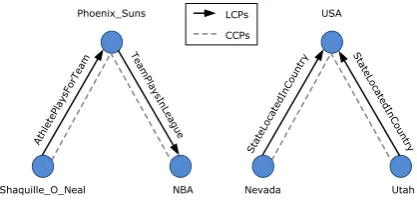
Figure 1: LCPs and CCPs.
entities connected to a same node are usually im-plicitly related to each other, even if they are not directly connected. Figure 1 gives two examples.
Shaquille O NealandNBAin the former ex-ample andNevadaandUtahin the latter exam-ple are implicitly related to each other, through the intermediate nodesPhoenix SunsandUSA re-spectively. We refer to such implicit relationships as contextual connectivity patterns (CCPs). Re-lationships explicitly represented in triples are re-ferred to aslocal connectivity patterns(LCPs). In most of the existing methods, only LCPs are ex-plicitly modeled.
This paper proposes a two-stage embedding scheme that explicitly takes into account both C-CPs and LC-CPs, calledcontext-dependent KG em-bedding. In the first stage, each CCP is formalized as a knowledge path, i.e., a sequence of entities and relations occurring in the pattern. A word em-bedding model is adopted to learn emem-beddings of entities and relations, by taking them as pseudo-words. The embeddings are enforced compatible within each knowledge path, and hence can cap-ture CCPs. In the second stage, the learned em-beddings are fine-tuned by an existing KG embed-ding technique. Since such a technique requires the embeddings to be compatible on each individ-ual triple, LCPs are also encoded.
The advantages of our approach are three-fold. 1) It fully exploits both CCPs and LCPs, and can
obtain more accurate embeddings. 2) It is a gen-eral scheme, applicable to a wide variety of word embedding models in the first stage and KG em-bedding models in the second. 3) No auxiliary data is further required in the two-stage process, except for the original graph.
We evaluate our approach on two publicly avail-able data sets, and achieve significant and consis-tent improvements over state-of-the-art methods in the link prediction and triple classification tasks. The learned embeddings are not only more accu-rate but also more stable.
2 Context-Dependent KG Embedding We are given a KG with nodes corresponding to entities and edges to relations. Each edge is denot-ed by a triple(h, r, t), whereh is the head entity,
tthe tail entity, andr the relation between them. Entities and relations are represented as vectors, matrices, or tensors in a continuous vector space. Context-dependent KG embedding aims to auto-matically learn entity and relation embeddings, by using observed triplesOin a two-stage process.
2.1 Modeling CCPs
The first stage models CCPs conveyed in the KG. Each CCP is formalized as a knowledge path, i.e., a sequence of entities and relations occurring in the pattern. For the CCPs in Figure 1, the associ-ated knowledge paths are:
“Shaquille O Neal, AthletePlaysForTeam,
Phoenix Suns, TeamPlaysInLeague, NBA”
“Nevada, StateLocatedInCountry, USA,
StateLocatedInCountry, Utah”.
We fix the length of knowledge paths to 5. Dur-ing path extraction, we ignore the directionality of edges, and treat the KG as an undirected graph.1
Given the extracted knowledge paths, we ploy word embedding models to pre-train the em-beddings of entities and relations, by taking them as pseudo-words. We use two word embedding models: CBOW and Skip-gram (Mikolov et al., 2013a; Mikolov et al., 2013b). In CBOW, words in the context are projected to their embeddings and then summed. Based on the summed embedding, log-linear classifiers are employed to predict the current word. In Skip-gram, the current word is projected to its embedding, and log-linear classi-fiers are further adopted to predict its context. We
1Two entities connected to a same node are always
expect-ed to have some implicit relationships, no matter how they are connected to the intermediate node.
restrain the context of a word (i.e. entity/relation) within each knowledge path. The entity and lation embeddings ptrained in this way are re-quired to be compatible within each knowledge path, and thus can encode CCPs.
Perozzi et al. (2014) and Goikoetxea et al. (2015) have proposed similar ideas, i.e., to gener-ate random walks from online social networks or from the WordNet knowledge base, and then em-ploy word embedding techniques on these random walks. But our approach has two differences. 1) It deals with heterogeneous graphs with differen-t differen-types of edges. Bodifferen-th nodes (endifferen-tidifferen-ties) and edges (relations) are included during knowledge path ex-traction. However, the previous studies focus only on nodes. 2) We devise a two-stage scheme where the embeddings learned in the first stage will be fine-tuned in the second one, while the previous studies take such embeddings as final output.
2.2 Modeling LCPs
The second stage models LCPs conveyed in the KG. We employ three state-of-the-art KG embed-ding models, namely SME (Bordes et al., 2014), TransE (Bordes et al., 2013), and SE (Bordes et al., 2011) to fine-tune the pre-trained embeddings. These three models work in the following way. First, entities are represented as vectors, and re-lations as operators in an embedding space, char-acterized by vectors (SME and TransE) or matri-ces (SE). Then, for each triple(h, r, t), an energy functionfr(h, t) is defined to measure its plausi-bility. Plausible triples are assumed to have low energies. Finally, to obtain entity and relation em-beddings, a margin-based ranking loss, i.e.,
L= X
t+∈O X
t−∈N t+
γ+fr(h, t)−fr(h0, t0)+,
is minimized. Here,t+ = (h, r, t) ∈ O is an ob-served (positive) triple;Nt+ is the set of negative
triples constructed by replacing entities int+, and
t− = (h0, r, t0) ∈ N
t+; γ is a margin separating
positive and negative triples; [x]+ = max(0, x). Table 1 summarizes the entity/relation embed-dings and the energy functions used in SME, TansE, and SE. For other KG embedding models, please refer to (Nickel et al., 2011; Riedel et al., 2013; Wang et al., 2014; Chang et al., 2014).
Method Entity/Relation embedding Energy function SME (linear) (Bordes et al., 2014) h,t∈Rk,r∈Rk f
r(h,t) = (Wu1r+Wu2h+bu)T(Wv1r+Wv2t+bv)
SME (bilinear) (Bordes et al., 2014) h,t∈Rk,r∈Rk f
r(h,t) = ((Wuׯ3r)h+bu)T((Wvׯ3r)t+bv)
TransE (Bordes et al., 2013) h,t∈Rk,r∈Rk f
r(h,t) =kh+r−tk`1
SE (Bordes et al., 2011) h,t∈Rk,R
[image:3.595.71.537.64.131.2]u,Rv∈Rk×k fr(h,t) =kRuh−Rvtk`1
Table 1: Entity/Relation embeddings and energy functions used in KG embedding methods.
# rel. # ent. # trip. (train/valid/test) # path WN18 18 40,943 141,442 5,000 5,000 5,674,308 NELL186 186 14,463 31,134 5,000 5,000 1,914,475
Table 2: Statistics of the data sets.
initial values.2 The entity and relation embeddings
fine-tuned in this way are required to be compati-ble within each triple, and thus can encode LCPs.
Socher et al. (2013) have proposed a similar idea, i.e., to use embeddings learned from an aux-iliary corpus as initial values. However, linking entities recognized in an auxiliary corpus to those occurring in the KG is always a non-trivial task. Our approach requires no auxiliary data, and nat-urally avoids the entity linking task.
3 Experiments
We test our approach on the tasks of link predic-tion and triple classificapredic-tion. Two publicly avail-able data sets are used. The first is WN18 released by Bordes et al. (2013)3. It is a subset of
Word-Net, consisting of 18 relations and the entities con-nected by them. The second is NELL186 released by Guo et al. (2015)4, containing the most
fre-quent 186 relations in NELL (Carlson et al., 2010) and the associated entities. Triples are split into training/validation/test sets, used for model train-ing, parameter tuntrain-ing, and evaluation respectively. Knowledge paths are extracted from training sets. Table 2 gives some statistics of the data sets.
To perform context-dependent KG embedding, we use CBOW and Skip-gram in the pre-training stage, and SME, TransE, and SE in the fine-tuning stage. We take randomly initialized SME, TransE, and SE as baselines, denoted as *-Random. We do not compare to the setting that employs only CBOW or Skip-gram, since it does not provide an energy function to calculate triple plausibility, which hinders the evaluation of both tasks.
2For SE, only entity vectors are initialized by pre-trained
embeddings. Relation matrices are randomly initialized.
3https://everest.hds.utc.fr/doku.php?id=en:smemlj12 4http://www.aclweb.org/anthology/P/P15/
3.1 Link Prediction
Link prediction is to predict whether there is a spe-cific relation between two entities.
Evaluation Protocol. For each test triple, the head is replaced by every entity in the KG, and the energy is calculated for each corrupted triple. Ranking the energies in ascending order, we get the rank of the correct answer. We can get another rank by corrupting the tail. We report two metrics on the test sets: Mean (averaged rank) and Hit-s@10 (proportion of ranks no larger than 10).
Implementation Details. To train CBOW and Skip-gram, we use the word2vec implementation-s5. 20 negative samples are drawn for each
pos-itive one. The context size is fixed to 5. To train SME, TransE, and SE, we use the implementation-s provided by the authorimplementation-s6, with 100 mini-batches.
We vary the learning rate in{0.01,0.1,1,10}, the dimension k in {20,50}, and the margin γ in {1,2,4}. The best model is selected by monitor-ing Hits@10 on the validation sets, with a total of at most 1000 iterations over the training sets.
Results. Table 3 reports the results on the test sets of WN18 and NELL186. The improvements of CBOW/Skip-gram over Random are also given. Statistically significant improvements are marked by‡(sign test, significance level 0.05). The result-s result-show that a pre-training result-stage conresult-siresult-stently im-proves over the baselines for all the methods on both data sets. Almost all of the improvements are statistically significant.
3.2 Triple Classification
Triple classification aims to verify whether an un-seen triple is correct or not.
Evaluation Protocol. Triples in the validation and test sets are labeled as positive instances. For each positive instance, we construct a negative in-stance by randomly corrupting the entities. During
Mean Hits@10 (%)
Random CBOW Skip-gram Random CBOW Skip-gram
WN18
SME (linear) 463.2 ‡286.5 (↓38%) 226.9 (↓51%) 63.98 ‡68.65 (↑7%) ‡70.01 (↑9%)
SME (bilinear) 551.8 ‡308.8 (↓44%) ‡279.2 (↓49%) 63.83 ‡67.65 (↑6%) ‡67.53 (↑6%)
TransE 723.1 ‡293.0 (↓59%) ‡290.0 (↓60%) 78.50 ‡79.67 (↑1%) ‡79.87 (↑2%)
SE 960.0 ‡426.2 (↓56%) ‡289.4 (↓70%) 71.53 ‡76.05 (↑6%) ‡75.89 (↑6%)
NELL186
SME (linear) 595.5 ‡371.9 (↓38%) ‡340.3 (↓43%) 29.82 ‡34.22 (↑15%) ‡35.57 (↑19%)
SME (bilinear) 375.2 ‡305.0 (↓19%) ‡292.9 (↓22%) 37.45 ‡39.31 (↑ 5%) ‡39.70 (↑ 6%)
TransE 732.6 ‡384.6 (↓48%) ‡384.6 (↓48%) 27.60 ‡28.71 (↑ 4%) ‡30.52 (↑11%)
[image:4.595.72.528.221.338.2]SE 2307.0 ‡1314.7 (↓43%) ‡412.2 (↓82%) 19.53 ‡26.15 (↑34%) ‡31.12 (↑59%)
Table 3: Link prediction results on the test sets of WN18 and NELL186.
Micro-ACC (%) Macro-ACC (%)
Random CBOW Skip-gram Random CBOW Skip-gram
WN18
SME (linear) 84.70 89.54 (↑6%) 89.16 (↑5%) 85.11 89.11 (↑5%) 90.57 (↑6%) SME (bilinear) 84.30 91.83 (↑9%) 90.68 (↑8%) 85.36 90.49 (↑6%) 89.89 (↑5%) TransE 94.60 96.98 (↑3%) 97.23 (↑3%) 86.74 93.46 (↑8%) 94.49 (↑9%) SE 94.71 96.46 (↑2%) 96.42 (↑2%) 87.99 92.05 (↑5%) 91.70 (↑4%)
NELL186
SME (linear) 88.59 89.95 (↑2%) 91.19 (↑3%) 84.42 85.70 (↑2%) 86.67 (↑3%) SME (bilinear) 88.74 93.22 (↑5%) 92.86 (↑5%) 83.41 89.70 (↑8%) 89.65 (↑7%) TransE 82.54 85.65 (↑4%) 85.33 (↑3%) 76.74 80.06 (↑4%) 80.06 (↑4%) SE 89.00 93.37 (↑5%) 93.07 (↑5%) 83.01 87.89 (↑6%) 87.98 (↑6%)
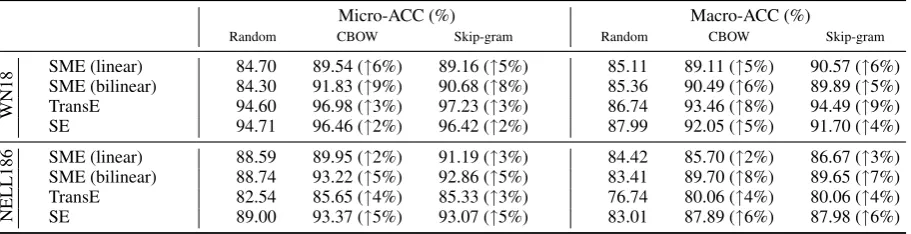
Table 4: Triple classification results on the test sets of WN18 and NELL186.
classification, a triple is predicted to be positive if the energy is below a relation-specific thresh-oldδr; otherwise negative. We report two metric-s on the temetric-st metric-setmetric-s: micro-averaged accuracy (per-instance average) and macro-averaged accuracy (per-relation average).
Implementation Details. We use the same pa-rameter settings as in the link prediction task. The relation-specific thresholdδris determined by maximizing Micro-ACC on the validation sets.
Results. Table 4 reports the results on the test sets of WN18 and NELL186. The results again demonstrate both the superiority and the generali-ty of our approach.
3.3 Discussions
This section is to explore why pre-training helps in KG embedding, specifically in link prediction.
We first test different random initializations in traditional KG embedding models. We run SME (linear) twice on WN18, with two different initial-ization settings. Both are randomly sampled from the same uniform distribution, but with differen-t seeds, referred differen-to as I and Random-II. Each setting finally gets 10,000 ranks on the test set.7 To better understand the difference
be-7For each of the 5,000 test triples, both the head and the
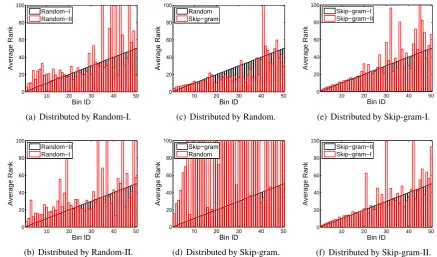
tween the two settings, we analyze the ranks indi-vidually, rather than reporting aggregated metrics (Mean and Hits@10). Specifically, we distribute the 10,000 instances into different bins according to the ranks given by one setting (e.g. Random-I). Instances assigned to thei-th bin have the same rank ofi, that means, they are all ranked in thei-th position by this setting. Then, within each bin, we calculate the average rank of the instances given by the other setting (e.g. Random-II). If the av-erage rank differs drastically from the bin ID, the instances in this bin are ranked significantly dif-ferently by the two settings. Figures 2(a) and 2(b) show the results, with the instances distributed ac-cording to Random-I and Random-II respectively. In both cases, we retain the bins with ID no larger than 50, covering about 85% of the instances. In most of the bins, the average rank (red bars in the figures) differs drastically from the bin ID (black bars in the figures), indicating that the ranks giv-en by Random-I and Random-II are significantly different at the instance level. The results demon-strate the non-convexity of SME (linear): different initial values lead to different local minimum.
10 20 30 40 50 0
20 40 60 80 100
Bin ID
Average Rank
Random−I Random−II
(a) Distributed by Random-I.
10 20 30 40 50
0 20 40 60 80 100
Bin ID
Average Rank
Random−II Random−I
(b) Distributed by Random-II.
10 20 30 40 50
0 20 40 60 80 100
Bin ID
Average Rank
Random Skip−gram
(c) Distributed by Random.
10 20 30 40 50
0 20 40 60 80 100
Bin ID
Average Rank
Skip−gram Random
(d) Distributed by Skip-gram.
10 20 30 40 50
0 20 40 60 80 100
Bin ID
Average Rank
Skip−gram−I Skip−gram−II
(e) Distributed by Skip-gram-I.
10 20 30 40 50
0 20 40 60 80 100
Bin ID
Average Rank
Skip−gram−II Skip−gram−I
[image:5.595.75.513.66.323.2](f) Distributed by Skip-gram-II.
Figure 2: Ranks obtained by different initialization strategies (best viewed in color).
(Skip-gram). The results are given in Figures 2(c) and 2(d). In most of the bins Skip-gram has an average rank lower than the bin ID (Figure 2(c)), while Random has an average rank much higher than the bin ID (Figure 2(d)), implying that Skip-gram performs better than Random-I at the in-stance level. The results indicate that pre-training might help in finding better initial values which lead to better local minimum.
Finally we test our two-stage KG embedding scheme where the skip-gram model itself is giv-en two differgiv-ent initialization settings, say Skip-gram-I and Skip-Skip-gram-II. The results are given in Figures 2(e) and 2(f). In each of the first 20 bins, Skip-gram-I and Skip-gram-II get an average rank almost the same with the bin ID, implying that the two settings perform quite similarly, particularly at the highest ranking levels. The results indicate that a pre-training stage might help in obtaining more stable embeddings.
4 Conclusion
We have proposed a novel two-stage scheme for KG embedding, called context-dependent KG em-bedding. In the pre-training stage CCPs are encod-ed by a word embencod-edding model, and in the fine-tuning stage LCPs are encoded by a traditional KG embedding model. Since both types of
connectiv-ity patterns are explicitly taken into account, our approach can obtain more accurate embeddings. Moreover, our approach is quite general, applica-ble to various word embedding and KG embed-ding models. Experimental results on link predic-tion and triple classificapredic-tion demonstrate the supe-riority, generality, and stability of our approach.
As future work, we plan to 1) Investigate the ef-ficacy of longer CCPs (i.e. knowledge paths with lengths longer than 5). 2) Design a joint model that encodes LCPs and CCPs simultaneously. More-over, our approach actually reveals the possibili-ty of a broad idea, i.e., initializing an embedding model by another embedding model. We would also like to test the feasibility of other such strate-gies, e.g., initializing SME by TransE, so as to combine the benefits of both models.
Acknowledgments
References
Kurt Bollacker, Colin Evans, Praveen Paritosh, Tim S-turge, and Jamie Taylor. 2008. Freebase: A collab-oratively created graph database for structuring hu-man knowledge. In Proceedings of the 2008 ACM SIGMOD International Conference on Management of Data, pages 1247–1250.
Antoine Bordes, Jason Weston, Ronan Collobert, and Yoshua Bengio. 2011. Learning structured em-beddings of knowledge bases. In Proceedings of the 25th AAAI Conference on Artificial Intelligence, pages 301–306.
Antoine Bordes, Nicolas Usunier, Alberto Garcia-Duran, Jason Weston, and Oksana Yakhnenko. 2013. Translating embeddings for modeling multi-relational data. InAdvances in Neural Information Processing Systems, pages 2787–2795.
Antoine Bordes, Xavier Glorot, Jason Weston, and Yoshua Bengio. 2014. A semantic matching en-ergy function for learning with multi-relational data.
Machine Learning, 94(2):233–259.
Andrew Carlson, Justin Betteridge, Bryan Kisiel, Bur-r Settles, Estevam R. HBur-ruschka JBur-r., and Tom M. Mitchell. 2010. Toward an architecture for never-ending language learning. In Proceedings of the 24th AAAI Conference on Artificial Intelligence, pages 1306–1313.
Kai-Wei Chang, Wen-tau Yih, Bishan Yang, and Christopher Meek. 2014. Typed tensor decompo-sition of knowledge bases for relation extraction. In
Proceedings of the 2014 Conference on Empirical Methods on Natural Language Processing, pages 1568–1579.
Josu Goikoetxea, Aitor Soroa, and Eneko Agirre. 2015. Random walks and neural network language models on knowledge bases. InProceedings of the 2015 Conference of the North American Chapter of the Association for Computational Linguistics: Hu-man Language Technologies, pages 1434–1439. Shu Guo, Quan Wang, Bin Wang, Lihong Wang, and
Li Guo. 2015. Semantically smooth knowledge graph embedding. InProceedings of the 53rd An-nual Meeting of the Association for Computational Linguistics and the 7th International Joint Confer-ence on Natural Language Processing, pages 84–94. Jens Lehmann, Robert Isele, Max Jakob, Anja Jentzsch, Dimitris Kontokostas, Pablo N. Mendes, Sebastian Hellmann, Mohamed Morsey, Patrick van Kleef, S¨oren Auer, et al. 2014. Dbpedia: A large-scale, multilingual knowledge base extracted from wikipedia.Semantic Web Journal.
Tomas Mikolov, Kai Chen, Greg Corrado, and Jeffrey Dean. 2013a. Efficient estimation of word represen-tations in vector space. InProceedings of Workshop at International Conference on Learning Represen-tations.
Tomas Mikolov, Ilya Sutskever, Kai Chen, Greg S. Cor-rado, and Jeff Dean. 2013b. Distributed representa-tions of words and phrases and their compositional-ity. InAdvances in Neural Information Processing Systems, pages 3111–3119.
George A Miller. 1995. Wordnet: A lexical
database for english. Communications of the ACM, 38(11):39–41.
Maximilian Nickel, Volker Tresp, and Hans-Peter Kriegel. 2011. A three-way model for collective learning on multi-relational data. In Proceedings of the 28th International Conference on Machine Learning, pages 809–816.
Bryan Perozzi, Rami Al-Rfou, and Steven Skiena. 2014. Deepwalk: Online learning of social repre-sentations. InProceedings of the 20th ACM SIGKD-D International Conference on Knowledge SIGKD- Discov-ery and Data Mining, pages 701–710.
Sebastian Riedel, Limin Yao, Andrew McCallum, and Benjamin M. Marlin. 2013. Relation extraction with matrix factorization and universal schemas. In
Proceedings of the 2013 Conference on North Amer-ican Chapter of the Association for Computational Linguistics: Human Language Technologies, pages 74–84.
Richard Socher, Danqi Chen, Christopher D. Manning, and Andrew Ng. 2013. Reasoning with neural ten-sor networks for knowledge base completion. In Ad-vances in Neural Information Processing Systems, pages 926–934.
Zhen Wang, Jianwen Zhang, Jianlin Feng, and Zheng Chen. 2014. Knowledge graph embedding by trans-lating on hyperplanes. In Proceedings of the 28th AAAI Conference on Artificial Intelligence, pages 1112–1119.