Higher-order logical inference with compositional semantics
Koji Mineshima1,3
[email protected] Pascual Mart´ınez-G´omez
1,2,3
Yusuke Miyao2
[email protected] Daisuke Bekki
1,2,3
1Ochanomizu University Tokyo, Japan
2National Institute of Informatics Tokyo, Japan
3CREST, JST Saitama, Japan
Abstract
We present a higher-order inference sys-tem based on a formal compositional semantics and the wide-coverage CCG parser. We develop an improved method to bridge between the parser and seman-tic composition. The system is evaluated on the FraCaS test suite. In contrast to the widely held view that higher-order logic is unsuitable for efficient logical inferences, the results show that a system based on a reasonably-sized semantic lexicon and a manageable number of non-first-order ax-ioms enables efficient logical inferences, including those concerned with general-ized quantifiers and intensional operators, and outperforms the state-of-the-art first-order inference system.
1 Introduction
Entailment relations are of central importance in the enterprise of both formal and computational semantics. Traditionally, formal semanticists have concentrated on a relatively small set of linguis-tic inferences. However, since the emergence of statistical parsers based on sophisticated syntac-tic theories (Clark and Curran, 2007), an open do-main system has been developed that supports cer-tain degree of robust semantic interpretation with wide coverage (Bos et al., 2004). It is then rea-sonable to expect that a state-of-the-art formal se-mantics provides an accurate computational basis of natural language inferences.
However, there are still obstacles in the way of achieving this goal. One is that the statistical parsers on which semantic interpretations rely do not necessarily reflect the best syntactic analysis as assumed in the formal semantics literature (Honni-bal et al., 2010). Another persistent problem is the gap between the logics employed in the two
com-munities; while it is generally assumed among for-mal semanticists that adequate semantic represen-tations for natural language demand higher-order logic or type theory (Carpenter, 1997), the domi-nant view in computational linguistics is that infer-ences based on higher-order logic are hopelessly inefficient for practical applications (Bos, 2009a). Accordingly, it is claimed that some approxima-tion of higher-order representaapproxima-tions in terms of first-order logic (Hobbs, 1985), or a more efficient “natural logic” system based on surface structures is needed. However, it is often not a trivial task to give an approximation of rich higher-order in-formation within a first-order language (Pulman, 2007). Moreover, the coverage of existing natu-ral logic systems is limited to single-premise in-ferences (MacCartney and Manning, 2008).
In this paper, we first present an improved com-positional semantics that fills the gap between the parser syntax and a composition derivation. We then develop an inference system that is capable of higher-order inferences in natural languages. We combine a state-of-the-art higher-order proof sys-tem (Coq) with a wide-coverage parser based on a modern syntactic theory (Combinatory Catego-rial Grammar, CCG). The system is designed to handle multi-premise inferences as well as single-premise ones.
We test our system on the FraCaS test suite (Cooper et al., 1994), which is suitable for eval-uating the linguistic coverage of an inference sys-tem. The experiments show that our higher-order system outperforms the state-of-the-art first-order system with respect to the speed and accuracy of making logical inferences.
2 CCG and Compositional Semantics
As an initial step of compositional semantics, we use the C&C parser (Clark and Curran, 2007), a statistical CCG parser trained on CCGbank (Hockenmaier and Steedman, 2007). Parser
category:S\NP
[image:2.595.322.515.60.136.2]semantics:λQ.Q(λx.True)(λx.E(x))
Figure 1: Schematic lexical entry (semantic tem-plate) for intransitive verbs. E is a position in which a particular lexical item appears.
category:NP/N
semantics:λFλGλH.∀x(Fx ∧Gx →Hx)
surf: every
Figure 2: The lexical entry for determinerevery
puts are mapped onto semantic representations in a standard way (Bos, 2008), usingλ-calculus as an interface between syntax and semantics.
The strategy we use to build a semantic lexicon is similar to that of Bos et al. (2004). A lexical en-try for each open word class consists of a syntac-tic category in CCG (possibly with syntacsyntac-tic fea-tures) and a semantic representation encoded as a
λ-term. Fig. 1 gives an example.1 For a limited
number of closed words such as logical or func-tional expressions, aλ-term is directly assigned to a surface form (see Fig. 2). The output formula is obtained by combining eachλ-term in accordance with meaning composition rules and then by ap-plyingβ-conversion.
There is a non-trivial gap between the parser output and the standard CCG-syntax as presented in Steedman (2000). Due to this gap, it is not straightforward to obtain desirable semantic repre-sentations for a wide range of constructions. One major difference from the standard CCG-syntax is the treatment of post-NP modifiers; for instance, the relative clause who worksis assigned not the categoryN\N, but the categoryNP\NP, which applies to the whole NP. To derive correct truth-conditions for quantificational sentences, we as-sign to determiners a semantic term having an ex-tra predicate variable as shown in Fig. 2, namely,
λFλGλH.∀x(Fx ∧Gx→Hx), in a similar way to the continuation semantics for event predicates (Bos, 2009b; Champollion, 2015). The extra pred-icate variableG can be filled by the semantically empty predicate λx.True in a verb phrase (see Fig. 1). Fig. 3 gives an example derivation.
Note that the changes in the lexical entries as il-lustrated in Fig. 1 and Fig. 2 are made for the cor-rect semantic parsing, namely, the compositional
1Here we use a non-standard semantics for intransitive
verbs. We will explain it in the next paragraph.
Examples Semantic Types
most (E→Prop)→(E→Prop)→Prop might Prop→Prop
true Prop→Prop manage Prop→E→Prop believe Prop→E→Prop
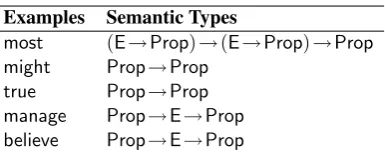
Table 1: A classification of key linguistic elements having higher-order denotations.
derivation of semantic representations. Usually, inferences are conducted on those output seman-tic representations in which additional complexi-ties, such as lambda operators and extra predicate variables, disappear. Accordingly, the changes in the lexical entries do not affect the efficiency of inferences.
The present analysis of post NP-modifiers can also handle non-restrictive relative clauses such as “the president, who ...”. In this case, the modi-fier “who ...” can be taken to apply to the whole NP the president, thus its syntactic category can be regarded asNP\NP, not asN\N. Thus, al-though theNP\NP analysis of relative clauses is a non-standard one, it has an advantage in that it provides a unified treatment of restrictive and non-restrictive relative clauses.
3 Representation and Inference in HOL
We present a higher-order representation language and describe apparently higher-order phenomena that have received attention in formal semantics.
3.1 Semantic representations in HOL
We use the language of higher-order logic (HOL) with two basic types, Efor entities andPropfor propositions. Here we distinguish between propo-sitions and truth-values, as is standard in modern type theory (Ranta, 1994; Luo, 2012). Key higher-order constructs are summarized in Table 1.2 A
first-order language can be taken as a fragment of this language. Thus, adopting a higher-order lan-guage does not lead to the loss of the expressive power of the first-order language.
Apart from sub-sentential utterances such as short answers to wh-questions (Ginzburg, 2005), there are important constructions that are naturally
2We write a function from objects of typeAto objects of
Every
NP/N
λF GH.∀x(F x∧Gx→Hx)
student
N λx.student(x)
NP
λGH.∀x(student(x)∧Gx→Hx)
>
who (NP\NP)/(S\NP)
λV QF.Q(λx.(V(λGH.Hx)∧F x))
works
S\NP λQ.Q(λx.True)(λx.work(x))
NP\NP λQF.Q(λx.(work(x)∧F x))
>
NP
λF H.∀x(student(x)∧work(x)∧F x→Hx)
< comes
S\NP
λQ.Q(λx.True)(λx.come(x))
S
∀x(student(x)∧work(x)∧True→come(x))
[image:3.595.79.528.63.136.2]<
Figure 3: A CCG derivation of the semantic representation for the sentence Every student who works comes. λFGH.X is an abbreviation for λFλGλH.X. “True” denotes the tautology, hence the final formula is equivalent to∀x(student(x)∧work(x)→come(x)).
represented in higher-order languages.3
Generalized quantifiers A classical example of non-first-orderizable expressions is a proportional generalized quantifier likemostandhalf of (Bar-wise and Cooper, 1981). Model-theoretically, they denote relations between sets. We represent them as a two-place higher-order predicate taking first-order predicates as arguments. For instance,Most students workis represented as follows.
(1) most(λx.student(x), λx.work(x))
Here,mostis a higher-order predicate in the sense that it takes first-order predicates λx.student(x)
andλx.work(x)as arguments. We take the entail-ment patterns governingmostas axioms, along the same lines of natural logic and monotonicity cal-culus (Icard and Moss, 2014), where determiners are taken as primitive two-place operators.
Standard quantifiers likeevery andsomecould also be treated as binary operators in the same way as the binarymostin (1). But we choose to adopt the first-order decomposition in such cases (see Fig. 2 for the lexical entry ofevery).
Modals Modal auxiliary expressions likemight, must andcan are represented as unary sentential operators. For instance, the sentenceSome student might comeis represented as:
(2) ∃x(student(x)∧might(come(x))). An important inference role of such a modal op-erator is to distinguish modal contexts from actual contexts and thus block an inference from one con-text to another (mightAdoes not entailA).
Alternatives to the higher-order approach in-clude the first-order decomposition of modal op-erators using world variables (Blackburn et al., 2001) and the first-order modal semantic represen-tations implemented in Boxer (Bos, 2005). We
3See also Blackburn and Bos (2005) for some discussion
on inferences that go beyond first-order logic.
prefer the higher-order approach, because the first-order approaches introduce additional quantifiers and variables at the level of the semantic represen-tations on which one makes inferences.
Veridical and anti-veridical predicates A sen-tential operatorO is veridicalif O(A) entailsA, and anti-veridical if O(A) entails ¬A. While modal auxiliary verbs likemightare neither veridi-cal nor anti-veridiveridi-cal, there is a class of ex-pressions licensing these patterns of inference. Typical examples are adjectives taking an em-bedded proposition, such as true/correct and false/incorrect. Note that sentences like Every-thing/what he said is false involve a quantifica-tion over proposiquantifica-tions, which is problematic for the first-order approach.
The so-called implicative verbs likemanageand fail (Nairn et al., 2006) are also an instance of this class. For example,Some student manages to comeis formalized as
(3) ∃x(student(x)∧manage(x,come(x)))
where manage is a veridical predicate taking a proposition as the second argument; it licenses an inference to∃x(student(x)∧come(x)).
Attitude verbs A wide range of propositional at-titude verbs such asbelieve andhopeare similar to modals in that they do not license an inference from attitude contexts to actual contexts. But fac-tives like know and remember are an exception; they are veridical.4
A first-order translation can be given along the lines of Hintikka (1962). (4) is translated as (5).
(4) know(john,∃x(student(x)∧come(x)))
(5) ∀w1(Rjohnw0w1 →
∃x(student(w1, x)∧come(w1, x)))
4Factive predicates show the important inference patterns
Inference pattern Axiom
Existential import ∀F∀G(most(F, G) → ∃x(F x∧Gx)) Conservativity ∀F∀G(most(F, G)
→most(F, λx.(F x∧Gx))) Monotonicity ∀F∀G∀H(most(F, G) (right-upward) →(∀x(Gx→Hx)
→most(F, H))) Veridicality ∀P(true(P)→P)
∀x∀P(manage(x, P)→P) ∀x∀P(know(x, P)→P) Anti-veridicality ∀P(false(P)→ ¬P)
[image:4.595.307.524.61.145.2]∀x∀P(fail(x, P)→ ¬P)
Table 2: Axioms for non-first-order constructions.
However, one drawback is that the compositional semantics becomes complicated, so we prefer the non-decomposition approach for attitude verbs.
3.2 Inferences in HOL
Following Chatzikyriakidis and Luo (2014), we use a proof-assistant Coq (Cast´eran and Bertot, 2004) to implement a specialized prover for higher-order features in natural languages, and combine it with efficient first-order inferences. We use Coq’s built-in tactics for first-order inferences. Coq also has a language called Ltac for user-defined automated tactics (Delahaye, 2000). The additional axioms and tactics specialized for natu-ral language constructions are written in Ltac. We ran Coq fully automated, by feeding to its inter-active mode a set of predefined tactics combined with user-defined proof-search tactics.
Table 2 shows the axioms we implemented. Modals and non-veridical predicates (by which we mean predicates that are neither veridical nor anti-veridical) do not have particular axioms, with the consequence that actual and hypothetical contexts are correctly distinguished.
4 Experiments
We evaluated our system on the FraCaS test suite (Cooper et al., 1994), a set of entailment prob-lems that is designed to evaluate theories of for-mal semantics.5 We used the version provided by
MacCartney and Manning (2007). The whole data set is divided into nine sections, each devoted to linguistically challenging problems. Of these, we used six sections, excluding three sections (nomi-nal anaphora, ellipsis and temporal reference) that
5Our system will be publicly available at
https://github.com/mynlp/ccg2lambda.
Section # Ours Nut L&S 13 Tian 14 Quantifiers 74 .77 .53 .62 .80
Plurals 33 .67 .52 − −
Adjectives 22 .68 .32 − −
Comparatives 31 .48 .45 − −
Verbs 8 .62 .62 − −
Attitudes 13 .77 .46 − −
Total 181 .69 .50 − −
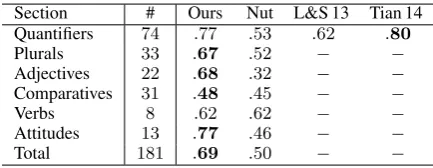
Table 3: Accuracy on the FraCaS test suite. The first column shows the number of problems. Of the total188problems, we excluded seven prob-lems that lack a well-defined answer.
involve a task of resolving context-dependency, a task beyond the scope of this paper. Each prob-lem consists of one or more premises, followed by a hypothesis. There are three types of answer: yes(the premise set entails the hypothesis),no(the premise set entails the negation of the hypothesis), andunknown (the premise set entails neither the hypothesis nor its negation). Fig. 4 shows some examples.
Currently, our system has 57 templates for gen-eral syntactic categories and 80 lexical entries for closed words. In a similar way to Bos et al. (2004), closed words are confined to a limited range of logical and functional expressions such as quanti-fiers and connectives. These templates and lexical entries are not specific with respect to the FraCaS test suite. We use WordNet (Miller, 1995) as the knowledge base for antonymy; logical axioms rel-evant to given inferences are extracted from this knowledge base.
We compared our system with the state-of-the-art CCG-based first-order system Boxer (Bos, 2008), which is one of the most well-known logic-based approaches to textual entailment. We used the Nutcracker system based on Boxer that utilizes a first-order prover (Bliksem) and a model builder (Mace) with the option enabling access to Word-Net. We did not use the option enabling modal semantics, since it did not improve the results. All experiments were run on a [email protected], 8GB RAM and SSD machine with Ubuntu.
Experimental results are shown in Table 3. Our system improved on Nutcracker. We set a time-out of30seconds, after which we output the label “unknown”. Nutcracker timed-out in one third of the problems (57 out of 181), whereas there was no time-out in our system.
[image:4.595.79.283.61.225.2]fracas-067
Premise 1 All residents of the North American continent can travel freely within Europe.
Premise 2 Every Canadian resident is a resident of the North American continent.
Hypothesis All Canadian residents can travel freely within Europe.
Answer Yes fracas-074
Premise 1 Most Europeans can travel freely within Europe.
Hypothesis Most Europeans who are resident outside Europe can travel freely within Europe.
Answer Unknown
Figure 4: Examples of entailment problems from the FraCaS test suite
Parsing and inference sec
/problem CCG Parsing (C&C parser) 3.76 Our system with higher-order inference 3.72 Our system with higher-order rules ablated 3.46 Nutcracker with first-order inference 11.23 (first-order prover + model builder)
Table 4: Comparison of inference time on the Fra-CaS test suite. CCG parsing is common to both our system and Nutcracker.
of our system is significantly higher than that of Nutcracker. Our system’s total accuracy with higher-order rules is 69%, and drops to 59% when ablating the higher-order rules.
We are aware of two other systems tested on FraCaS that are capable of multiple-premise infer-ences: the CCG-based first-order system of Lewis and Steedman (2013) and the dependency-based compositional semantics of Tian et al. (2014). These systems were only evaluated on the Quan-tifier section of FraCaS. As shown in Table 3, our results improve on the former and are comparable with the latter.
Other important studies on FraCaS are those based on natural logic (MacCartney and Manning, 2008; Angeli and Manning, 2014). These sys-tems are designed solely for single-premise in-ferences and hence are incapable of handling the general case of multiple-premise problems (which cover about 45% of the problems in FraCaS). Our system improves on these natural-logic-based sys-tems by making multiple-premise inferences as well.
Main errors we found are due to various parse errors caused by the CCG parser, including the failure to handle multiwords likea lot of. The per-formance of our system will be further improved
with correct syntactic analyses. Our experiments on FraCaS problems do not constitute an evalua-tion on real texts nor on unseen test data. Note, however, that a benefit of using a linguistically controlled set of entailment problems is that one can check not only whether, but alsohoweach se-mantic phenomenon is handled by the system. In contrast to the widely held view that higher-order logic is less useful in computational linguistics, our results demonstrate the logical capacity of a higher-order inference system integrated with the CCG-based compositional semantics.
5 Conclusion
We have presented a framework for a composi-tional semantics based on the wide-coverage CCG parser, combined with a higher-order inference system. The experimental results on the FraCaS test suite have shown that a reasonable number of lexical entries and non-first-order axioms enable various logical inferences in an efficient way and outperform the state-of-the-art first-order system. Future work will focus on incorporating a robust model of lexical knowledge (Lewis and Steedman, 2013; Tian et al., 2014) to our framework.
Acknowledgments
References
Gabor Angeli and Christopher D. Manning. 2014. NaturalLI: Natural logic inference for common sense reasoning. InProceedings of the Conference on Empirical Methods in Natural Language Pro-cessing (EMNLP-2014), pages 534–545.
Jon Barwise and Robin Cooper. 1981. Generalized quantifiers and natural language. Linguistics and Philosophy, 4(2):159–219.
Patrick Blackburn and Johan Bos. 2005. Represen-tation and Inference for Natural Language: A First Course in Computational Semantics. CSLI.
Patrick Blackburn, Maarten de Rijke, and Yde Venema. 2001.Modal Logic. Cambridge University Press.
Johan Bos, Stephen Clark, Mark Steedman, James R. Curran, and Julia Hockenmaier. 2004. Wide-coverage semantic representations from a CCG parser. In Proceedings of the 20th Interna-tional Conference on ComputaInterna-tional Linguistics (COLING-2004), pages 104–111.
Johan Bos. 2005. Towards wide-coverage semantic in-terpretation. In Proceedings of Sixth International Workshop on Computational Semantics (IWCS-6), pages 42–53.
Johan Bos. 2008. Wide-coverage semantic analysis with Boxer. InProceedings of the 2008 Conference on Semantics in Text Processing, pages 277–286.
Johan Bos. 2009a. Applying automated deduction to natural language understanding. Journal of Applied Logic, 7(1):100–112.
Johan Bos. 2009b. Towards a large-scale formal se-mantic lexicon for text processing. In Proceed-ings of the Biennal GSCL Conference From Form to Meaning: Processing Texts Automatically, pages 3–14.
Bob Carpenter. 1997. Type-Logical Semantics. MIT Press.
Pierre Cast´eran and Yves Bertot. 2004. Interac-tive Theorem Proving and Program Development. Coq’Art: The Calculus of Inductive Constructions. Springer.
Lucas Champollion. 2015. The interaction of compo-sitional semantics and event semantics. Linguistics and Philosophy, 38(1):31–66.
Stergios Chatzikyriakidis and Zhaohui Luo. 2014. Natural language inference in Coq. Journal of Logic, Language and Information, 23(4):441–480.
Stephen Clark and James R Curran. 2007. Wide-coverage efficient statistical parsing with CCG and log-linear models. Computational Linguistics, 33(4):493–552.
Robin Cooper, Richard Crouch, Jan van Eijck, Chris Fox, Josef van Genabith, Jan Jaspers, Hans Kamp, Manfred Pinkal, Massimo Poesio, Stephen Pulman, et al. 1994. FraCaS: A Framework for Computa-tional Semantics. Deliverable, D6.
David Delahaye. 2000. A Tactic Language for the Sys-tem Coq. InLogic for Programming and Automated Reasoning (LPAR), volume 1955 ofLecture Notes in Computer Science, pages 85–95. Springer.
Jonathan Ginzburg. 2005. Abstraction and ontology: Questions as propositional abstracts in type theory with records. Journal of Logic and Computation, 15(2):113–130.
Jaakko Hintikka. 1962. Knowledge and Belief. Cor-nell University Press.
Jerry R. Hobbs. 1985. Ontological promiscuity. In Proceedings of the 23rd annual meeting on Asso-ciation for Computational Linguistics (ACL-1985), pages 60–69.
Julia Hockenmaier and Mark Steedman. 2007. CCG-bank: a corpus of CCG derivations and dependency structures extracted from the Penn Treebank. Com-putational Linguistics, 33(3):355–396.
Matthew Honnibal, James R. Curran, and Johan Bos. 2010. Rebanking CCGbank for improved NP inter-pretation. InProceedings of the 48th Annual Meet-ing of the Association for Computational LMeet-inguistics (ACL-2010), pages 207–215.
Thomas Icard and Lawrence Moss. 2014. Recent progress in monotonicity. Linguistic Issues in Lan-guage Technology (LiLT), 9.
Mike Lewis and Mark Steedman. 2013. Combin-ing distributional and logical semantics. Transac-tions of the Association for Computational Linguis-tics, 1:179–192.
Zhaohui Luo. 2012. Formal semantics in modern type theories with coercive subtyping. Linguistics and Philosophy, 35(6):491–513.
Bill MacCartney and Christopher D. Manning. 2007. Natural logic for textual inference. InProceedings of the ACL-PASCAL Workshop on Textual Entail-ment and Paraphrasing, pages 193–200.
Bill MacCartney and Christopher D. Manning. 2008. Modeling semantic containment and exclusion in natural language inference. In Proceedings of the 22nd International Conference on Computational Linguistics, pages 521–528.
George A Miller. 1995. WordNet: a lexical database for English. Communications of the ACM, 38(11):39–41.
Stephen Pulman. 2007. Formal and computational se-mantics: a case study. InProceedings of the Seventh International Workshop on Computational Seman-tics (IWCS-7), pages 181–196.
Aarne Ranta. 1994. Type-Theoretical Grammar. Ox-ford University Press.
Mark Steedman. 2000. The Syntactic Process. MIT Press.
Ran Tian, Yusuke Miyao, and Takuya Matsuzaki. 2014. Logical inference on dependency-based com-positional semantics. In Proceedings of the 52nd Annual Meeting of the Association for Computa-tional Linguistics (ACL-2014), pages 79–89. Rob van der Sandt. 1992. Presupposition