Conversation Trees: A Grammar Model for Topic Structure in Forums
Annie Louis and Shay B. Cohen School of Informatics University of Edinburgh Edinburgh, EH8 9AB, UK
{alouis,scohen}@inf.ed.ac.uk
Abstract
Online forum discussions proceed differ-ently from face-to-face conversations and any single thread on an online forum con-tains posts on different subtopics. This work aims to characterize the content of
a forum thread as a conversation tree of
topics. We present models that jointly per-form two tasks: segment a thread into sub-parts, and assign a topic to each part. Our core idea is a definition of topic
struc-ture using probabilistic grammars. By
leveraging the flexibility of two grammar formalisms, Context-Free Grammars and Linear Context-Free Rewriting Systems, our models create desirable structures for forum threads: our topic segmentation is hierarchical, links non-adjacent segments on the same topic, and jointly labels the topic during segmentation. We show that our models outperform a number of tree generation baselines.
1 Introduction
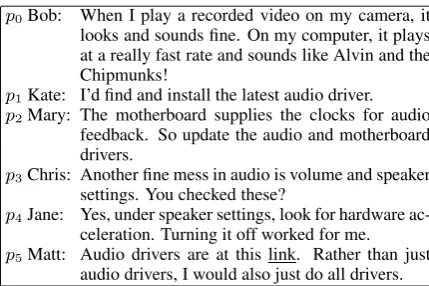
Online forums are commonplace today and used for various purposes: product support and trou-bleshooting, opining about events and people, and student interaction on online course platforms. Threads in these forums become long, involve posts from multiple users, and the chronological order of the posts in a thread does not represent a continuous flow of dialog. Adding structure to these threads is important for tasks such as infor-mation extraction, search, and summarization.
One such aspect of structure istopic. Figure 1
shows a computer-troubleshooting related thread with six posts. The first post is the troubleshoot-ing question and the remaintroubleshoot-ing posts can be seen
as focusing on either of two topics, thedriver
soft-ware (posts p1, p2, p5) or the speaker hardware
p0Bob: When I play a recorded video on my camera, it looks and sounds fine. On my computer, it plays at a really fast rate and sounds like Alvin and the Chipmunks!
p1Kate: I’d find and install the latest audio driver. p2Mary: The motherboard supplies the clocks for audio
feedback. So update the audio and motherboard drivers.
p3Chris: Another fine mess in audio is volume and speaker settings. You checked these?
p4Jane: Yes, under speaker settings, look for hardware ac-celeration. Turning it off worked for me. p5Matt: Audio drivers are at this link. Rather than just
[image:1.595.306.521.205.348.2]audio drivers, I would also just do all drivers.
Table 1: Example forum thread conversation
(p3, p4). By categorizing posts into such topics,
we can provide a useful division of content in a thread and even across multiple threads. Note that the drivertopic is not a contiguous sequence but
present in non-adjacent parts,(p1, p2)and(p5).
We tackle the problem of joint topic segmenta-tion and topic labeling of forum threads. Given a thread’s posts in chronological order (the order in which they were posted), we create a phrase structure tree indicating how the posts are grouped hierarchically into subtopics and super-topics. In
these conversation trees, leaves span entire posts.
Each non-terminal identifies the topic character-izing the posts in its span. Topics are concepts or themes which summarize the content of a group of posts. Specifically, a topic is a set of words which frequently co-occur in posts which are similar in content and other conversation regularities.
Our key insight in this work is to formalize topic structure using probabilistic grammars. We define a base grammar for topic structure of fo-rum threads and refine it to represent finer topics and subtrees. We learn to predict trees under our grammar based on two formalisms: Probabilis-tic Context-Free Grammars (PCFG) and Proba-bilistic Linear Context-Free Rewriting Systems (PLCFRS). In the PCFG model, a non-terminal
spans a contiguous sequence of posts. In the
PLCFRS model, non-terminals are allowed to span discontinuous segments of posts. We lever-age algorithms from probabilistic parsing of nat-ural language sentences and modify them for our domain. We show that our model performs well and sidesteps a number of limitations of prior topic segmentation approaches. In particular:
• Our models perform joint topic segmentation
and topic labeling while most existing models identify unlabeled segments. Labeling topics on segments creates richer annotation, and links non-adjacent segments on the same topic.
• Our grammar-based probabilistic models have
two key benefits. They naturally create tree struc-tures which are considered linguistically suitable for topic segmentation but were difficult to create under previous approaches. Second, the flexibility of grammars such as PLCFRS allow our models to seamlessly learn to produce trees where non-adjacent segments on the same topic are explicitly linked, an issue that was not addressed before.
We present large-scale experiments on a col-lection of forum threads from the
computer-troubleshooting domain.1 We show that our
gram-mar models achieve a good balance between iden-tifying when posts should be in the same topic ver-sus a different topic. These grammar models out-perform other tree generation baselines by a sig-nificant margin especially on short threads.
2 Related work
The ideas in this paper are related to three areas of prior research.
Forum thread analysis. Finding structure in fo-rum threads has been previously addressed in two ways. The first is reply structure prediction where a parent post is linked to its children (replies) which were posted later in time (Wang et al., 2008; Cong et al., 2008). Reply links are some-times augmented with a dialog act label indicat-ing whether the child post is a question, answer, or confirmation to the parent post (Kim et al., 2010; Wang et al., 2011). The second set of methods partition sentences in emails or blog comments into topical clusters and then show salient words per cluster as topic tags (Joty et al., 2013).
We focus on producing rich hierarchical seg-mentation going beyond clusters which do not contain any cluster-internal structure. We also
be-1
Our corpus is available from http:// kinloch.inf.ed.ac.uk/public/CTREES/ ConversationTrees.html
lieve that topic structure is complementary to di-alog act and reply link annotations. Tasks on fo-rum data such as user expertise (Lui and Baldwin, 2009) and post quality prediction (Agichtein et al., 2008), and automatic summarization (Nenkova and Bagga, 2003) can be carried out on a fine-grained level using topic information.
Conversation disentanglement. A related prob-lem of clustering utterances is defined specifically for Internet Relay Chat (IRC) and speech conver-sations. In this case, multiple conversations, on different topics, are mixed in and systems extract threads which separate out individual conversa-tions (Shen et al., 2006; Adams and Martell, 2008; Elsner and Charniak, 2010).
Disentanglement is typically applied for the coarse-level problem of identifying a coherent conversation. In addition, these methods do not create any structure upon the clustered utterances in contrast to the focus of this work.
Topic Segmentation. is a task which directly fo-cuses on the topic aspect of text and speech. This task is of greater importance for speech which lacks explicit structure such as paragraphs and sections. Many approaches perform linear seg-mentation where boundaries are inserted in the text or speech to divide it into a flat set of topic segments (Hearst, 1994; Utiyama and Isahara, 2001; Galley et al., 2003; Malioutov and Barzilay, 2006; Eisenstein and Barzilay, 2008). Very few methods recursively combine smaller segments into larger ones. Such hierarchical models (Eisen-stein, 2009) have been applied at a coarse level for segmenting very long texts such as books into sections. Other work has focused on linear seg-mentation for documents within the same domain and having a regular structure (Chen et al., 2009; Jeong and Titov, 2010; Du et al., 2015). These latter approaches rely on three assumptions: that the documents contain a regular set of topics, that these topics are discussed in a fairly regular con-sensus order, and that the same topic does not re-cur in the same document.
seg-mentation algorithms. The second limitation of prior studies is assuming that topics do not recur in the same document. But linguistic theories al-low for non-adjacent utterances to belong to the same topic segment (Grosz and Sidner, 1986) and this fact is empirically true in chat and forum con-versations (Elsner and Charniak, 2010; Wang et al., 2011). Our models can flexibly handle and link recurring topics within and across threads.
As a final note, because of the annotations re-quired, most prior work on forums or IRC chats
have typically used few hundred threads. We
present a heuristically derived large corpus of topic structure on which we evaluate our models.
3 Background
Our topic discovery methods are based on two constituency grammar formalisms.
3.1 Probabilistic Context-Free Grammars
A PCFG is defined by a 5-tuple GC =(N, T,
P, S,D) where N is a set of non-terminal
sym-bols, T a set of terminal symbols, and S is the
start symbol. P is a set of production rules of
the form A → β whereAis a non-terminal and
β ∈ {N ∪T}∗. D is a function that associates
each production rule with a conditional
probabil-ity of the formp(A →β|A). This probability
in-dicates how often the non-terminalAexpands into
β. The probabilities of all the rules conditioned on
a particular non-terminal should sum to 1.
The joint probability of a treeT with yieldY,
P(T, Y), is the product of the probabilities of all
the productions used to constructT. The parsing
problem is to find the treeTˆwhich is most likely
given the yield Y. Tˆ = arg maxTP(T|Y) =
arg maxT P(T, Y).
Given training trees, we can enumerate the pro-ductions and compute their probabilities using maximum likelihood estimates (MLE):
p(A→β|A) = count(A→β) count(A)
which is the fraction of the times the non-terminal
Aexpands intoβ.
The most likely parse tree can be found using a number of algorithms. In this work, we use the CYK algorithm for PCFGs in Chomsky
Nor-mal Form. This algorithm has complexity O(n3)
wherenis the length of the yield.
PCFGs do not capture a frequently occurring property of forum threads, discontinuous
seg-ments on the same topic. Indirectly however, a PCFG may assign the same non-terminal for each of these segments. To model these discontinuities more directly, we present a second model based on PLCFRS where non-terminals are allowed to span discontinuous yield strings.
3.2 Probabilistic Linear Context-Free Rewriting Systems
LCFRS grammars (Vijay-Shanker et al., 1987) generalize CFGs, where non-terminals can span
discontinuous constituents. Formally, the span
of an LCFRS non-terminal is a tuple, with size
k ≥ 1, of strings, where k is the non-terminal
“fan-out”. As such, the fan-out of a CFG non-terminal is 1.
An LCFRSGL =(N,T,P,S,V) whereN is
the set of non-terminals,T the terminals andSis
the start symbol. A function f : N → Ngives
the fan-out of each non-terminal. P is the set of
productions or otherwise called rewriting rules of
the LCFRS.V is a set of variables used to indicate
the spans of each non-terminal in these rules. A rewriting rule has the form:
A(α1, α2, . . . , αf(A))→ A1(x1
1. . . , x1f(A1)), . . . , Am(xm1 , . . . , xmf(Am))
Here A,A1,. . .,Am ∈ N. Since there are m
non-terminals on the RHS, this rule has rank m.
xi
j ∈V for1≤i≤ mand1≤j ≤f(Ai)
indi-cate thef(Ai)discontinuous spans dominated by
Ai. αi ∈(T ∪V)∗,1 ≤i ≤f(A) are the spans
of the LHS non-terminalA.
A rewriting rule explains how the left-hand side (LHS) non-terminal’s span can be com-posed from the yields of the right-hand side (RHS) non-terminals. For example, in the rule
A(x1x2, x3) → B(x1)C(x2, x3), Aand C have
fan-out 2, B has fan-out 1. The two spans ofA,
x1x2 andx3, are composed from the spans ofB
andC. For comparison, the productions of a CFG
take the single spans of each non-terminal on the RHS and concatenate them in the same order to yield a single span of the LHS non-terminal.
A Probabilistic LCFRS (PLCFRS) (Levy,
2005) also contains D, a function which assigns
conditional probabilities p(A(~x) → ~φ|A(~x)) to
the rules. The probabilities conditioned on a
par-ticular non-terminal and span configuration,A(~x)
To find the most likely parse tree, we use the parsing algorithm proposed by Kallmeyer and Maier (2013) for binary PLCFRS. The approach uses weighted deduction rules (Shieber et al., 1995; Nederhof, 2003), which specify how to compute a new item from other existing items.
Each item is of the form [A, ~ρ] where A is a
non-terminal and~ρis a vector indicating the spans
dominated by A. A weightwis attached to each
item which gives the |log| of the Viterbi inside
probability of the subtree under that item. A set of goal items specify the form of complete parse trees. By using the Knuth’s generalization (Knuth, 1977) of the shortest paths algorithm, the most likely tree can be found without exhaustive pars-ing as in Viterbi parspars-ing of CFGs. The complexity
of parsing isO(n3k)wherekis the fan-out of the
grammar (the maximum fan-out of its rules).
4 Problem Formulation
Given a thread consisting of a sequence of posts
(p1, p2, . . . ,pn) in chronological order, the task
is to produce a constituency tree with yield (p1,
p2 . . .pn). A leaf in this tree spans an entire
post. Non-terminals identify the topic of the posts within their span. Non-terminals at higher levels of the tree represent coarser topics in the conver-sation (the span covered by these nodes contain more posts) than those lower in the tree. The root topic node indicates the overall topic of the thread. Below we define a Context-Free Grammar (CFG) for such trees.
4.1 A Grammar for Conversation Trees
GB is our base grammar which is context-free
and has four non-terminals {S, X, T, C}. Each
postpin the corpus is a terminal symbol (i.e. a
ter-minal symbol is a bag of words). The productions
inGBare: S→T X∗,X→T X∗andT →p.
GBgenerates trees with the following structure.
A root-level topic S characterizes the content of
the entire thread. Thread-startingrules are of the
form,S →T X∗, whereX∗indicates a sequence
of zero or more X non-terminals. T nodes are
pre-terminals analogous to part-of-speech tags in the case of syntactic parsing. In our grammar,
the T → p rule generates a post in the thread.
In the thread-starting rules,T generates the first
post of the thread which poses the query or com-ment that elicits the rest of the conversation. The
X∗ sequence denotestopic branches, the subtree
under each X is assumed to correspond to a
dif-S[11]
T[3]
p0
X[5]
T[6]
p1 X[8]
T[7]
p2
X[12]
T[2]
p3 X[7]
T[4]
p4
X[5]
T[6]
[image:4.595.336.497.64.156.2]p5
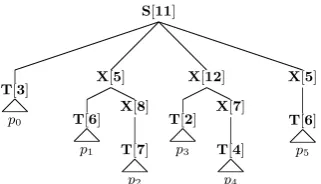
Figure 1: Example conversation tree for the thread in Table 1
ferent topic. These X’s characterize all but the
first post of the thread. The continuation rules,
X →T X∗, recursively subdivide theXsubtrees
into topics spanning fewer posts. In each case, the
T node on the right-hand side of these rules
gener-ates the first post (in terms of posting time) in that subtree. Therefore posts made earlier in time al-ways dominate (in the tree structure) those which come later in the thread. We define the head of a non-terminal as the first post as per the chronolog-ical order of posts in the span of the non-terminal. This grammar does not generate binary trees.
We binarize the tree with C nodes to obtain an
equivalent grammar in Chomsky Normal Form (CNF) (CNF yields parsing algorithms with lower
complexity)2: S → T C|T, X → T C|T,
T → p and C → X|X X|X C. TheC nodes
can be collapsed and its daughters attached to the
parent ofCto revert back to the non-binary tree.
While this CFG defines the structure of conver-sation trees, by itself this grammar is insufficient for our task. In particular, it contains a single
non-terminal of each type (S, X, T, C) and so does
not distinguish between topics. We extend this
grammar to create GE which has a set of
non-terminals corresponding to each non-terminal in
GB, these fine-grained non-terminals correspond
to different topics. GE is created using latent
an-notations (Matsuzaki et al., 2005) on the X, T,
S and C non-terminals from GB. The resulting
non-terminals for GE are S[i], X[j], T[k] and
C[l], such that 1 ≤ i ≤ NS, 1 ≤ j ≤ NX,
1 ≤k ≤NT,1 ≤l ≤NC. i,j,kandlidentify
specific topics attached to a particular node type.
Our output trees are created withGE to depict
the topic segmentation of the thread and are non-binary. The binary trees produced by our
algo-rithms are converted by collapsing the C. As a
result, conversation trees haveS[i],X[j]andT[k]
2
nodes but noC[l]nodes.
[image:5.595.308.508.71.222.2]An example conversation tree for the thread in
Table 1 is shown in Figure 1. At level 1,T[3]
de-scribes the topic of the first post while the
remain-ing posts are under X[5] which may indicate a
drivertopic, andX[12], aspeaker hardwaretopic.
Note howX[5]may re-occur in the conversation
to accommodate postp5on thedrivertopic.
4.2 Supervised learning framework
We use a supervised framework for learning the models. We assume that we have training trees
according to the base grammar,GB. The
follow-ing section describes our data and how we obtain
these GB-based trees. In Section 6, we present
a method for creating GE-type trees with
non-terminal refinements. Estimates of rule probabili-ties from this augmented training corpus are used to develop the parsers for topic segmentation.
5 Data
We collected 13,352 computer-troubleshooting
related threads fromhttp://forums.cnet.
com/. The number of posts per thread varies
greatly between 1 and 394, and the average is around 5 posts. We divide these threads into train-ing, development and test sets. The most frequent 100 words from the training set are used as stop-words. After filtering stopwords, a post contains 39 tokens on average and the vocabulary size of our corpus is 81,707. For development and test-ing, we only keep threads with a minimum of 3 posts (so that the problem is non-trivial) and a maximum of 50 posts (due to complexity of pars-ing). We have 9,243 training threads, 2,014 for development, and 2,071 for testing.
A particular feature of the forums on cnet.
comis the explicit reply structure present in the
threads. The forum interface elicits these reply re-lationships as users develop a thread. When a user replies in a particular thread, she has to choose (only) one of the earlier posts in the thread (in-cluding the question post) to attach her reply to. In this way, each post is linked to a unique post ear-lier in time in the same thread. This reply structure forms a dependency tree. Figure 2 (a) is a possible reply tree for the thread in Table 1.
5.1 Deriving conversation trees
Next we convert these reply-link trees into phrase-structure conversation trees. We developed a de-terministic conversion method that uses the
gen-(a) hp0h hp1h hp2h hp3h hp4h hp5h
(b) S
T X X
p0 T X T X
p1 T T T X
p2 p3 p4 T
p5 Figure 2: (a) A reply structure tree for the thread in Table 1 and (b) the derived conversation tree
erative process defined by the base grammarGB.
The key idea is to track when the conversation branches into sub-topics and when the replies are proceeding within the same topic.
The algorithm traverses the nodes of the
depen-dency treeDin breadth-first order, starting at the
root (first) post. We create a root S node in the
phrase structure treeH. Then thethread-starting
rule from GB,S → T X∗, is used to create one
T andk X nodes as children ofS. The first post
p0is attached as a child of theT node. kis equal
to the number of replies to p0 (children of p0 in
D). For each of these k X nodes, we
instanti-ate a X → T X∗ rule inH. Thekreplies of p0
are attached one each as a child of the T nodes
in these rules. Any set of children are always in-stantiated in chronological order. So the span of a
non-terminal inH always contains posts in
non-decreasing time order. We continue the procedure
with the next post fromDin the traversal order.
This procedure converts the reply tree of Figure 2 (a) into the conversation tree (b). Note that (a) is a possible reply structure for our example thread in Table 1. The conversation tree (b) derived ac-cording to this reply structure has a non-projective
structure wherep1,p2andp5are linked under one
X node (at level 1). Such a tree can be produced
by our LCFRS model. The ideal PCFG tree will repeat the topic branch as in Figure 1.
The derived trees at this stage follow GB and
contain only the S,X, T non-terminals (without
any latent annotations). This tree is converted into
Chomsky Normal Form usingCnodes.
5.2 Discontinuous topic segments
As in our example above, non-projective edges
total threads in our corpus 14.5% contain a non-projective edge. A thread should have a mini-mum of four posts to have the possibility of non-projective edges. Among the 7,691 threads with at least four posts, the percentage of non-projective trees is even higher, 25%. This finding suggests that in any thread of reasonable size which we wish to summarize or categorize, non-projective edges will be common. Hence a direct approach for addressing discontinuous segments such as our PLCFRS model is important for this domain.
6 Parsers for Conversation Trees
The training data are conversation trees with rules
from GB. We refine the non-terminals to
cre-ateGE, extract PCFG or PLCFRS rules from the
training trees, and build a CYK parser that
pre-dicts the most likely tree according toGE.
6.1 Refining the non-terminals
We use a clustering approach, akin to the spectral algorithm of Cohen et al. (2013) and Narayan and
Cohen (2015),3 to create finer grained categories
corresponding to GB’s non-terminals: S, X, C
andT. Each node in each tree in the training data
is associated with a feature vector, which is a func-tion of the tree and the anchor node. These vectors are clustered (for each of the non-terminals sepa-rately) and then, each node is annotated with the corresponding cluster. This process gives us the
non-terminalsS[i],X[j],T[k]andC[l]ofGE.
The features for a nodenlare: depth ofnlin the
tree, root is at depth 0; maximum depth of the
sub-tree undernl; number of siblings ofnl; number of
children ofnl; number of posts in the span ofnl;
average length (in terms of tokens) of the posts in
the span ofnl; average similarity of the span ofnl
with the span ofnl’s siblings4; similarity ofnl’s
span with the span of its left-most sibling; elapsed
time between the first and last posts innl’s span.
We use CLUTO toolkit (Karypis, 2002) to
per-form clustering. The algorithm maximizes the
pairwise cosine similarity between the feature
vectors of nodes within the same cluster. The
3
The main difference between our algorithm and the al-gorithm by Narayan and Cohen (2015) is that we do not de-compose the trees into “inside” trees and “outside” trees, or use a singular value decomposition step before clustering the features.
4The span ofnland that of a sibling are each represented
by binary vectors indicating the presence and absence of a term in the span. The similarity value is computing using cosine overlap between the vectors and the average across all siblings is recorded.
best number of clusters for the four non-terminal node types are tuned jointly to give the best per-formance on our final topic segmentation task.
6.2 Learning rule probabilities
As mentioned previously, each terminal in our
grammar is an entire post’s text. For the
pre-terminal to pre-terminal productions in our grammar
T[j] → pi, we compute p(T[j] → pi|T[j]) as
the probability under a unigram language model
Lj which is trained on the collection of the posts
from the training corpus which are dominated by
T[j]nodes. p(T[j] → pi|T[j]) = QNk=1pi Lj(wik) wherew1i, w2i...wiN
pi are the tokens in postpi.
The rest of the production probabilities are learned using MLE on the training trees. In the case of LCFRS rules, the gap information is also obtained during the extraction.
6.3 CYK parsing
For both PCFG and LCFRS we use CYK style
algorithms, as outlined in §3, to obtain the most
likely tree. For the more computationally com-plex LCFRS model, we make a number of addi-tions to improve speed. First, we restrict the fan-out of the grammar to 2, i.e. any non-terminal can only span a maximum of two discontinuous segments. 97% of the productions in fact have
only non-terminals with fan-out ≤2. Second, we
use A∗ search (Maier et al., 2012) to prioritize
our agenda. Last, we reduce the number of items
added to the agenda. An item has the form [A,
~ρ], A is a non-terminal and ~ρ is the spans
cov-ered byA. For every span, we only keep the top 5
non-terminal items according to the score. In ad-dition, we only allow spans with a gap of at most
2 since 77% of all gaps (dominated by fan-out≤
2) non-terminals are ≤ 2 posts. Moreover, after
a certain number of items (10,000) are added to the chart, we only allow the creation of new items which have a contiguous span.
7 Systems for comparison
We compare our models to two types of systems.
7.1 STRUCTURE ONLY
The first type generate tree structures without con-sidering the content of the threads.
with the rules{S → T X, X → T X, X → T,
T → p}. This method does not perform
use-ful topic segmentation as it produces only a single topic branch containing all the posts.
Attach-to-root tree (ART).attaches each post to the root of the tree. The grammar rules are
{S → T X1...Xn,X → T, T → p}, wherenis
the number of posts in the thread. This approach assumes each post belongs to a different topic in the thread. In contrast to RBT, ART contains too many topic branches, one per post in the thread.
Random tree (RAND).mixes decisions to cre-ate a new topic branch or continue in the same branch. The generation process is top down, at each step, the algorithm chooses a certain
num-ber of topic branches (Xs) to create (≤number of
posts left to add to the tree). Then, the number of posts under each branch is sampled (such that each branch has at least one post). This process is then recursively done at the new topic branches.
7.2 STRUCTURE AND CONTENT
These approaches produce tree structures
in-formed by content. We build these parsers by
modifying prior models for chat disentanglement and linear topic segmentation of documents.
Similarity tree (SIM). produces trees by at-taching each post as a child of the most similar of the previous (by time) posts (Wang et al., 2008). We use cosine similarity between vector represen-tations of two posts in order to compute similar-ity. When the similarity exceeds a threshold value, the post is added under the topic branch of the prior post. Otherwise the post is under a new topic branch attached to the root of the tree. A thresh-old of 0.15 was chosen after tuning on the devel-opment data.
Cluster tree (CLUS). uses an approach re-lated to chat disentanglement (Elsner and
Char-niak, 2010). The posts withineachthread are
clus-tered separately into kl clusters where kl = l/h
depends on the number of posts in the thread, l.
h = 6was chosen by tuning. The posts in each
cluster are ordered by time and a right branching
tree is created over them. These kl cluster-level
trees are then attached as children of a new node to create a thread-level tree. The cluster-trees are ordered left to right in the thread-tree according to the time of the earliest post in each cluster.
Linear segmentation tree (LSEG). is based on postprocessing the output of a Bayesian linear topic segmentation model (Eisenstein and
Barzi-lay, 2008). Each post’s content is treated as a
sen-tence and a document is created foreachthread by
appending its posts in their time order. The model
is then used to group consecutive sentences intokl
segments. For each thread of length l, kl = l/h,
h = 6was chosen by tuning. For each segment, a
right branching tree is created and these segment-level trees are made siblings in a thread-segment-level tree. The segments are added left to right in the thread-tree as per their order in the text.
All STRUCTURE trees contain thread structure but no topic labels. In other words, they have
coarse non-terminals (X, T and S) only. The
STRUCTURE AND CONTENT trees, LSEG and CLUS contain topics or groups but only at one top level, and further the number and labels of these topics are different per thread. Hence there is no linking across threads. Within a thread, the SIM and CLUS tree can link non-adjacent posts under the same topic. These links are also not available from a LSEG tree.
8 Evaluation metrics
To evaluate the topic segmentation, we develop a node-governance based measure. Our score
com-pares two conversation trees g and h, where gis
the gold-standard tree and h is the hypothesized
one. We assume that g and h are in dependency
format, reversing the transformation from§5.1.
We breakg(andh) into a set of pairs, for each
pair of nodes in the tree (each node is a post in the
thread). For each such pair,pandq, we find their
least common ancestor, ℓ(p, q|g) (orℓ(p, q|h). If
these nodes are in a governing relation (p
domi-natesqor vice versa), thenℓ(p, q)is the
dominat-ing node. We then define the followdominat-ing sets and
quantities for· ∈ {g, h}:
• S1(·) ={(p, q, ℓ(p, q))|ℓ(p, q|·)∈ {p, q}}.
• S2(·) ={(p, q, ℓ(p, q))|ℓ(p, q|·)∈ {/ p, q}}.
• n1(g, h) =|S1(g)∩S1(h)|.
• n2(g, h) =|S2(g)∩S2(h)|.
s1(·) and s2(·) are defined as the size of
S1(·) and S2(·), repsectively. Let g1, . . . , gnand
h1, . . . , hn be a corpus of gold-standard conver-sation trees and their corresponding hypothesized
conversation trees. Then the evaluation metric
G-p=
Pn
i=1n1(gi, hi)
Pn
i=1s1(hi) .
Traditional parsing evaluation measures such as constituency bracketting and dependency attach-ment scores were too local for our purpose. For example, if a long chain of posts is placed in a dif-ferent topic but their local dependencies are main-tained, we only penalize one constituent and one node’s parent in the constituency and dependency scores respectively. But the topic segmentation created by this change has several posts placed in the wrong topic branch. Our scores overcome this problem by considering the relationship between all pairs of posts and also dividing the relationship in the pair as governing or non-governing.
9 Results and discussion
We tune the number of latent topic annotations for the non-terminals using grid search on the
devel-opment set. The best settings are 40S, 100X, 20
C, 80T clusters for PCFG and 10S, 5X, 15C,
40T for LCFRS.
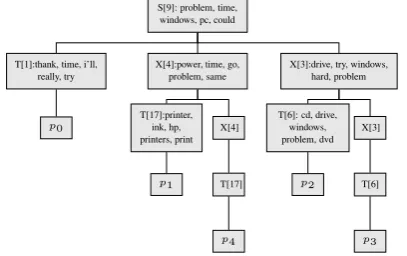
Below we show an example non-projective tree created by our LCFRS parser. The topics are indi-cated with the most frequent 5 words in the match-ing cluster.
S[9]: problem, time, windows, pc, could
T[1]:thank, time, i’ll, really, try
p0
X[4]:power, time, go, problem, same
T[17]:printer, ink, hp, printers, print
p1
X[4]
T[17]
p4
X[3]:drive, try, windows, hard, problem
T[6]: cd, drive, windows, problem, dvd
p2
X[3]
T[6]
p3
Here postp4though later in posting time is
pre-dicted to be on the same topic asp1.
The non-terminals in our trees enable useful topic segmentation and we found that perfor-mance is extremely sensitive to the number of
non-terminals of each typeS, X, Cand T.
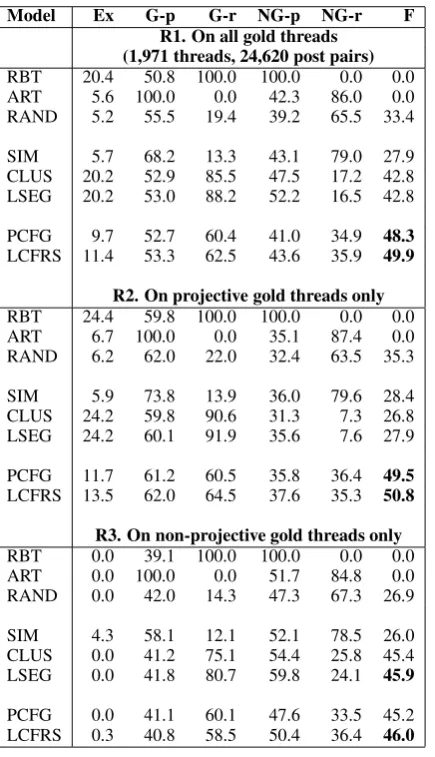
[image:8.595.80.284.419.547.2]Cur-rently, we do not have a direct method to evaluate the non-terminals in our tree but we plan to use the information in other applications as an evaluation. Table 2 and 3 shows the segmentation perfor-mance of the models (as percentages). The per-formance varied greatly depending on the length of the threads and hence we show the results
sepa-rately for threads with up to 15 posts (SHORT) and
those with 16 to 50 posts (LONG). The results are
divided into sections based on the subset of test
data on which the evaluation is performed. The first section (R1.) is performance on all threads, (R2.) only on the projective threads in the test data, and (R3.) only on the non-projective threads. Among the baselines, the Right-branching trees (RBT) or Attaching to the root (ART) have some advantages: the RBT receives 100% recall of the governing pairs and the ART tree has high recall of the non-governing pairs. However, their Fs-cores are 0. Recall that the RBT contains a single topic branch and hence no useful segmentation is done; ART is the other extreme where every post is put in a separate topic branch. RAND is the av-erage performance of 3 randomly generated trees for each thread. This method has a better balance between branching and depth leading to 33.4
Fs-core forSHORTand 21.5 forLONGthreads.
The PCFG and the LCFRS models clearly out-perform these baselines. The Fscore improves up
to 15% over RAND onSHORTandLONGthreads.
The grammar models also consistently outperform SIM systems.
With regard to CLUS and LSEG, there is a
difference in performance between SHORT and
LONG threads and based on whether the desired
structure was projective or non-projective. On
SHORT threads, the grammar models outperform LSEG and CLUS particularly on the projective threads (the LCFRS model has a 22% higher Fs-core). On the longer threads however, the CLUS and LSEG models perform best overall and for non-projective threads. CLUS and LSEG directly model the content similarity of posts while the grammar models make many decisions at level of topic nodes. Remember that the clustering is done per thread in CLUS and LSEG compared to using a common set of topics across all threads. Making such fine-grained similarity comparison appears to be helpful especially for longer threads and even though LSEG does not make non-projective decisions, its accuracy is high on the attachments it makes leading to good performance on non-projective threads too. In future work, we plan to explore how we can combine the advantages of direct similarity with the grammar models.
Model Ex G-p G-r NG-p NG-r F R1. On all gold threads
(1,971 threads, 24,620 post pairs)
RBT 20.4 50.8 100.0 100.0 0.0 0.0
ART 5.6 100.0 0.0 42.3 86.0 0.0
RAND 5.2 55.5 19.4 39.2 65.5 33.4
SIM 5.7 68.2 13.3 43.1 79.0 27.9
CLUS 20.2 52.9 85.5 47.5 17.2 42.8 LSEG 20.2 53.0 88.2 52.2 16.5 42.8
PCFG 9.7 52.7 60.4 41.0 34.9 48.3
LCFRS 11.4 53.3 62.5 43.6 35.9 49.9
R2. On projective gold threads only
RBT 24.4 59.8 100.0 100.0 0.0 0.0
ART 6.7 100.0 0.0 35.1 87.4 0.0
RAND 6.2 62.0 22.0 32.4 63.5 35.3
SIM 5.9 73.8 13.9 36.0 79.6 28.4
CLUS 24.2 59.8 90.6 31.3 7.3 26.8
LSEG 24.2 60.1 91.9 35.6 7.6 27.9
PCFG 11.7 61.2 60.5 35.8 36.4 49.5
LCFRS 13.5 62.0 64.5 37.6 35.3 50.8
R3. On non-projective gold threads only
RBT 0.0 39.1 100.0 100.0 0.0 0.0
ART 0.0 100.0 0.0 51.7 84.8 0.0
RAND 0.0 42.0 14.3 47.3 67.3 26.9
SIM 4.3 58.1 12.1 52.1 78.5 26.0
CLUS 0.0 41.2 75.1 54.4 25.8 45.4
LSEG 0.0 41.8 80.7 59.8 24.1 45.9
PCFG 0.0 41.1 60.1 47.6 33.5 45.2
[image:9.595.255.510.60.442.2]LCFRS 0.3 40.8 58.5 50.4 36.4 46.0
Table 2: Results on threads with up to 15 posts: for the grammar models (PCFG and LCFRS) and comparison systems (See Section 7). ‘Ex’ is per-centage of fully correct trees and other scores are from Section 8. Top two Fscores are in bold.
For the PCFG model, only the projective data can be used for training.
Overall, the LCFRS model is powerful on
pro-jective threads andSHORTnon-projective threads.
Compared to PCFG, the LCFRS model has a num-ber of advantages: we can use more data, can pre-dict non-projective trees. Some of the constraints we imposed on the LCFRS parser, such as restrict-ing the gap degree are likely to have limited the ability of the model to generate more flexible non-projective edges. We believe that as we figure out how to make these parsers faster, we will see even more improvements from the LCFRS models.
10 Conclusions
This work represents a first approach to learn dis-course structure of forum threads within an ex-plicit grammar framework. We show that a coarse
Model Ex G-p G-r NG-p NG-r F R1. On all gold threads
(100 threads, 27,590 post pairs)
RBT 0.0 21.2 100.0 100.0 0.0 0.0
ART 0.0 100.0 0.0 69.8 88.6 0.0
RAND 0.0 38.9 10.0 65.4 78.4 21.5
SIM 0.0 37.0 8.9 67.2 80.9 19.6
CLUS 0.0 32.6 37.3 73.3 70.5 42.0
LSEG 0.0 35.4 50.4 76.8 68.0 48.4
PCFG 0.0 24.6 54.1 54.3 36.8 36.6
LCFRS 0.0 22.8 71.4 68.7 29.4 36.5
R2. On projective gold threads only
RBT 0.0 36.7 100.0 100.0 0.0 0.0
ART 0.0 100.0 0.0 57.1 90.3 0.0
RAND 0.0 59.9 11.0 56.0 82.6 24.3
SIM 0.0 45.9 8.3 54.4 80.2 19.1
CLUS 0.0 42.0 38.1 60.0 63.2 45.3
LSEG 0.0 51.3 55.0 68.0 65.1 56.9
PCFG 0.0 42.2 66.6 34.5 22.9 39.9
LCFRS 0.0 49.0 65.3 51.6 41.7 52.3
R3. On non-projective gold threads only
RBT 0.0 19.6 100.0 100.0 0.0 0.0
ART 0.0 100.0 0.0 71.1 88.5 0.0
RAND 0.0 36.1 9.9 66.3 78.1 20.9
SIM 0.0 35.8 9.0 68.5 81.0 19.7
CLUS 0.0 31.2 37.1 74.6 71.1 41.3
LSEG 0.0 33.2 49.6 77.6 68.2 46.8
PCFG 0.0 22.3 51.6 55.8 37.9 34.8
[image:9.595.74.292.63.442.2]LCFRS 0.0 20.9 72.6 71.6 28.4 34.8
Table 3: Results on threads with>15 posts
grammar for structure can be refined using latent annotations to indicate the finer topic differences. Our trees have good segmentation performance and provide useful summaries of the thread con-tent at the non-terminal nodes. A main goal for future work is to incorporate further domain spe-cific constraints on the models to improve parsing speed and at the same time allow more flexible trees. We also plan to evaluate the usefulness of conversation trees in tasks such as predicting if a thread is resolved, and user expertise.
Acknowledgements
References
P. H. Adams and C. H. Martell. 2008. Topic detection and extraction in chat. InProceedings of the IEEE International Conference on Semantic Computing, pages 581–588.
E. Agichtein, C. Castillo, D. Donato, A. Gionis, and G. Mishne. 2008. Finding high-quality content in social media. InProceedings of WSDM, pages 183– 194.
H. Chen, S. R. K. Branavan, R. Barzilay, and D. R. Karger. 2009. Content modeling using latent per-mutations. Journal of Artificial Intelligence Re-search, 36(1):129–163.
S. B. Cohen, K. Stratos, M. Collins, D. P. Foster, and L. Ungar. 2013. Experiments with spectral learn-ing of latent-variable PCFGs. In Proceedings of NAACL.
G. Cong, L. Wang, C. Lin, Y. Song, and Y. Sun. 2008. Finding question-answer pairs from online forums. InProceedings of SIGIR, pages 467–474.
L. Du, J. K. Pate, and M. Johnson. 2015. Topic seg-mentation with an ordering-based topic model. In
Proceedings of AAAI, pages 2232–2238.
J. Eisenstein and R. Barzilay. 2008. Bayesian un-supervised topic segmentation. In Proceedings of EMNLP, pages 334–343.
J. Eisenstein. 2009. Hierarchical text segmentation from multi-scale lexical cohesion. InProceedings of HLT:NAACL, pages 353–361.
M. Elsner and E. Charniak. 2010. Disentangling chat.
Computational Linguistics, 36(3):389–409.
M. Galley, K. McKeown, E. Fosler-Lussier, and H. Jing. 2003. Discourse segmentation of multi-party conversation. InProceedings of ACL, pages 562–569.
B. J. Grosz and C. L. Sidner. 1986. Attention, inten-tions, and the structure of discourse.Computational Linguistics, 12(3):175–204, July.
M.A. Hearst. 1994. Multi-paragraph segmentation of expository text. InProceedings of ACL, pages 9–16.
M. Jeong and I. Titov. 2010. Unsupervised discourse segmentation of documents with inherently paral-lel structure. InProceedings of ACL: Short papers, pages 151–155.
S. Joty, G. Carenini, and R. T. Ng. 2013. Topic seg-mentation and labeling in asynchronous conversa-tions. Journal of Artificial Intelligence Research, 47(1):521–573.
L. Kallmeyer and W. Maier. 2013. Data-driven pars-ing uspars-ing probabilistic linear context-free rewritpars-ing systems.Computational Linguistics, 39(1):87–119.
G. Karypis. 2002. Cluto - a clustering toolkit. Techni-cal Report TR-02-017, Dept. of Computer Science, University of Minnesota.
S. Kim, L. Cavedon, and T. Baldwin. 2010. Clas-sifying dialogue acts in one-on-one live chats. In
Proceedings of EMNLP, pages 862–871.
D. E. Knuth. 1977. A generalization of dijkstra’s al-gorithm.Information Processing Letters, 6(1):1–5.
R. Levy. 2005. Probabilistic models of word order and syntactic discontinuity. Ph.D. thesis, Stanford University.
M. Lui and T. Baldwin. 2009. Classifying user forum participants: Separating the gurus from the hacks, and other tales of the internet. InProceedings of the 2010 Australasian Language Technology Workshop, pages 49–57.
W. Maier, M. Kaeshammer, and L. Kallmeyer. 2012. Plcfrs parsing revisited: Restricting the fan-out to two. InProceedings of the 11th International Work-shop on Tree Adjoining Grammar and Related For-malisms.
I. Malioutov and R. Barzilay. 2006. Minimum cut model for spoken lecture segmentation. In Proceed-ings of COLING-ACL, pages 25–32.
T. Matsuzaki, Y. Miyao, and J. Tsujii. 2005. Proba-bilistic cfg with latent annotations. InProceedings of ACL, pages 75–82.
S. Narayan and S. B. Cohen. 2015. Diversity in spec-tral learning for natural language parsing. In Pro-ceedings of EMNLP.
M. Nederhof. 2003. Weighted deductive parsing and knuth’s algorithm. Computational Linguistics, 29(1):135–143.
A. Nenkova and A. Bagga. 2003. Facilitating email thread access by extractive summary generation. In
Proceedings of RANLP.
D. Shen, Q. Yang, J. Sun, and Z. Chen. 2006. Thread detection in dynamic text message streams. In Pro-ceedings of SIGIR, pages 35–42.
S. M. Shieber, Y. Schabes, and F. C. N. Pereira. 1995. Principles and implementation of deductive parsing.
Journal of Logic Programming, 24(1&2):3–36.
M. Utiyama and H. Isahara. 2001. A statistical model for domain-independent text segmentation. In Pro-ceedings of ACL, pages 499–506.
K. Vijay-Shanker, D. J. Weir, and A. K. Joshi. 1987. Characterizing structural descriptions produced by various grammatical formalisms. InProceedings of ACL, pages 104–111.
![Table 1 is shown in Figure 1. At level 1,An example conversation tree for the thread in T [ 3] de-scribes the topic of the first post while the remain-ing posts are under X[ 5] which may indicate adriver topic, and X[ 12] , a speaker hardware topic.Note how X[ 5] may re-occur in the conversationto accommodate post p 5 on the driver topic.](https://thumb-us.123doks.com/thumbv2/123dok_us/1362505.669032/5.595.308.508.71.222/figure-example-conversation-scribes-indicate-hardware-conversationto-accommodate.webp)