Learning Distributions over Logical Forms
for Referring Expression Generation
Nicholas FitzGerald Yoav Artzi Luke Zettlemoyer
Computer Science & Engineering University of Washington
Seattle, WA 98195
{nfitz,yoav,lsz}@cs.washington.edu
Abstract
We present a new approach to referring ex-pression generation, casting it as a density es-timation problem where the goal is to learn distributions over logical expressions identi-fying sets of objects in the world. Despite an extremely large space of possible expres-sions, we demonstrate effective learning of a globally normalized log-linear distribution. This learning is enabled by a new, multi-stage approximate inference technique that uses a pruning model to construct only the most likely logical forms. We train and evaluate the approach on a new corpus of references to sets of visual objects. Experiments show the approach is able to learn accurate models, which generate over 87% of the expressions people used. Additionally, on the previously studied special case of single object reference, we show a 35% relative error reduction over previous state of the art.
1 Introduction
Understanding and generating natural language re-quires reasoning over a large space of possible meanings; while many statements might achieve the same goal in a certain situation, some are more likely to be used than others. In this paper, we model these preferences by learning distributions over sit-uated meaning use.
We focus on the task of referring expression gen-eration (REG), where the goal is to produce an ex-pression which uniquely identifies a pre-defined ob-ject or set of obob-jects in an environment. In prac-tice, many such expressions can be produced.
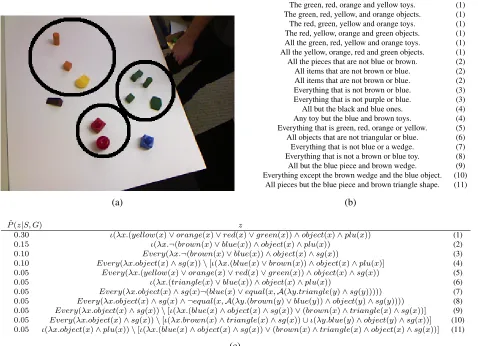
Fig-ure 1 shows referring expressions provided by hu-man subjects for a set of objects (Figure 1a), demon-strating variation in utterances (Figure 1b) and their corresponding meaning representations (Figure 1c). Although nearly a third of the people simply listed the colors of the desired objects, many other strate-gies were also used and no single option dominated. Learning to model such variation would enable sys-tems to better anticipate what people are likely to say and avoid repetition during generation, by pro-ducing appropriately varied utterances themselves. With these goals in mind, we cast REG as a den-sity estimation problem, where the goal is to learn a distribution over logical forms.
Learning such distributions is challenging. For a target set of objects, the number of logical forms that can be used to describe it grows combinatori-ally with the number of observable properties, such as color and shape. However, only a tiny fraction of these possibilities are ever actually used by peo-ple. We must learn to efficiently find these few, and accurately estimate their associated likelihoods.
We demonstrate effective learning of a globally normalized log-linear distribution with features to account for context dependence and communicative goals. We use a stochastic gradient descent algo-rithm, where the key challenge is the need to com-pute feature expectations over all possible logical forms. For that purpose, we present a multi-stage inference algorithm, which progressively constructs meaning representations with increasing complex-ity, and learns a pruning model to retain only those that are likely to lead to high probability expres-sions. This approach allows us to consider a large
(a)
The green, red, orange and yellow toys. (1) The green, red, yellow, and orange objects. (1) The red, green, yellow and orange toys. (1) The red, yellow, orange and green objects. (1) All the green, red, yellow and orange toys. (1) All the yellow, orange, red and green objects. (1) All the pieces that are not blue or brown. (2) All items that are not brown or blue. (2) All items that are not brown or blue. (2) Everything that is not brown or blue. (3) Everything that is not purple or blue. (3) All but the black and blue ones. (4) Any toy but the blue and brown toys. (4) Everything that is green, red, orange or yellow. (5) All objects that are not triangular or blue. (6) Everything that is not blue or a wedge. (7) Everything that is not a brown or blue toy. (8) All but the blue piece and brown wedge. (9) Everything except the brown wedge and the blue object. (10)
All pieces but the blue piece and brown triangle shape. (11)
(b)
ˆ
P(z|S, G) z
0.30 ι(λx.(yellow(x)∨orange(x)∨red(x)∨green(x))∧object(x)∧plu(x)) (1)
0.15 ι(λx.¬(brown(x)∨blue(x))∧object(x)∧plu(x)) (2)
0.10 Every(λx.¬(brown(x)∨blue(x))∧object(x)∧sg(x)) (3)
0.10 Every(λx.object(x)∧sg(x))\[ι(λx.(blue(x)∨brown(x))∧object(x)∧plu(x)] (4)
0.05 Every(λx.(yellow(x)∨orange(x)∨red(x)∨green(x))∧object(x)∧sg(x)) (5)
0.05 ι(λx.(triangle(x)∨blue(x))∧object(x)∧plu(x)) (6)
0.05 Every(λx.object(x)∧sg(x)¬(blue(x)∨equal(x,A(λy.triangle(y)∧sg(y))))) (7)
0.05 Every(λx.object(x)∧sg(x)∧ ¬equal(x,A(λy.(brown(y)∨blue(y))∧object(y)∧sg(y)))) (8)
0.05 Every(λx.object(x)∧sg(x))\[ι(λx.(blue(x)∧object(x)∧sg(x))∨(brown(x)∧triangle(x)∧sg(x))] (9)
0.05 Every(λx.object(x)∧sg(x))\[ι(λx.brown(x)∧triangle(x)∧sg(x))∪ι(λy.blue(y)∧object(y)∧sg(x))] (10)
0.05 ι(λx.object(x)∧plu(x))\[ι(λx.(blue(x)∧object(x)∧sg(x))∨(brown(x)∧triangle(x)∧object(x)∧sg(x))] (11)
[image:2.612.71.549.60.406.2](c)
Figure 1: An example scene from our object selection dataset. Figure 1a shows the image shown to subjects on Amazon Mechanical Turk. The target setGis the circled objects. Figure 1b shows the 20 sentences provided as responses. Figure 1c shows the empirical distributionPˆ(z|G, S) for this scene, estimated by labeling the sentences in Figure 1b. The correspondence between a sentence in 1b and its labeled logical expression in 1c is indicated by the number in parentheses. Section 5.1 presents a discussion of the space of possible logical forms.
set of possible meanings, while maintaining compu-tational tractability.
To represent meaning we build on previous ap-proaches that use lambda calculus (Carpenter, 1997; Zettlemoyer and Collins, 2005; Artzi and Zettle-moyer, 2013b). We extend these techniques by mod-eling the types of plurality and coordination that are prominent in expressions which refer to sets.
We also present a new corpus for the task of re-ferring expression generation.1 While most previ-ous REG data focused on naming single objects,
1The corpus was collected using Amazon Mechanical Turk
and is available on the authors’ websites.
to the best of our knowledge, this is the first cor-pus with sufficient coverage for learning to name sets of objects. Experiments demonstrate highly ac-curate learned models, able to generate over 87% of the expressions people used. On the previously studied special case of single object reference, we achieve state-of-the-art performance, with over 35% relative error reduction over previous state of the art (Mitchell et al., 2013).
2 Related Work
community, dating as far back as SHRDLU (Wino-grad, 1972). Most work has built on variations of the Incremental Algorithm (Dale and Reiter, 1995), a deterministic algorithm for naming single ob-jects that constructs conjunctive logical expressions. REG systems are used in generation pipelines (Dale and Reiter, 2000) and are also commonly designed to be cognitively plausible, for example by following Gricean maxims (Grice, 1975). Krahmer and van Deemter (2012) and van Deemter et al. (2012a) sur-vey recent literature on REG.
Different approaches have been proposed for gen-erating referring expressions for sets of objects. Van Deemter (2002) extended the Incremental Al-gorithm to allow disjunction and negation, enabling reference to sets. Further work attempted to re-solve the unnaturally long expressions which could be generated by this approach (Gardent, 2002; Ho-racek, 2004; Gatt and van Deemter, 2007). Later, de-scription logic was used to name sets (Areces et al., 2008; Ren et al., 2010). All of these algorithms are manually engineered and deterministic.
In practice, human utterances are surprisingly varied, loosely following the Gricean ideals (van Deemter et al., 2012b). Much recent work in REG has identified the importance of modeling the vari-ation observed in human-generated referring ex-pressions (Viethen and Dale, 2010; Viethen et al., 2013; van Deemter et al., 2012b; Mitchell et al., 2013), and some approaches have applied machine-learning techniques to single-object references (Vi-ethen and Dale, 2010; Mitchell et al., 2011a,b). Re-cently, Mitchell et al. (2013) introduced a proba-bilistic approach for conjunctive descriptions of sin-gle objects, which will provide a comparison base-line for experiments in Section 8. To the best of our knowledge, this paper presents the first learned probabilistic model for referring expressions defin-ing sets, and is the first effort to treat REG as a den-sity estimation problem.
REG is related to content selection, which
has been studied for generating text from
databases (Konstas and Lapata, 2012), event streams (Chen et al., 2010), images (Berg et al., 2012; Zitnick and Parikh, 2013), and text (Barzilay and Lapata, 2005; Carenini et al., 2006). However, most approaches to this problem output bags of con-cepts, while we construct full logical expressions,
allowing our approach to capture complex relations between attributes.
Finally, our approach to modeling meaning us-ing lambda calculus is related to a number of ap-proaches that used similar logical representation in various domains, including database query in-terfaces (Zelle and Mooney, 1996; Zettlemoyer and Collins, 2005, 2007), natural language instruc-tions (Chen and Mooney, 2011; Matuszek et al., 2012b; Kim and Mooney, 2012; Artzi and Zettle-moyer, 2013b), event streams (Liang et al., 2009; Chen et al., 2010), and visual descriptions (Ma-tuszek et al., 2012a; Krishnamurthy and Kollar, 2013). Our use of logical forms follows this line of work, while extending it to handle plurality and co-ordination, as described in Section 4.1. In addition, lambda calculus was shown to enable effective nat-ural language generation from logical forms (White and Rajkumar, 2009; Lu and Ng, 2011). If com-bined with these approaches, our approach would allow the creation of a complete REG pipeline.
3 Technical Overview
Task LetZbe a set of logical expressions that se-lect a target set of objectsGin a world state S, as formally defined in Section 5.1. We aim to learn a probability distributionP(z|S, G), withz∈ Z.
For example, in the referring expressions domain we work with, the stateS = {o1, . . . , on}is a set
ofnobjectsoi. Eachoi has three properties: color,
shape and type. The target setG⊆Sis the subset of objects to be described. Figure 1a shows an example scene. The world stateS includes the 11 objects in the image, where each object is assigned color ( yel-low, green . . .), shape (cube, cylinder . . .) and type (broccoli, apple . . .). The target set Gcontains the circled objects. Our task is to predict a distribution which closely matches the empirical distribution in Figure 1c.
Sec-tion 5.3 presents a detailed descripSec-tion of the infer-ence procedure.
Learning We use stochastic gradient descent to learn both the global scoring model and the explicit pruning model, as described in section 6. Our data consists of human-generated referring expressions, gathered from Amazon Mechanical Turk. These sentences are automatically labelled with logical forms with a learned semantic parser, providing a stand-in for manually labeled data (see Section 7).
Evaluation Our goal is to output a distribution that closely matches the distribution that would be produced by humans. We therefore evaluate our model with gold standard labeling of crowd-sourced referring expressions, which are treated as samples from the implicit distribution we are trying to model. The data and evaluation procedure are described in Section 7. The results are presented in Section 8.
4 Modeling Referring Expressions
4.1 Semantic Modeling
Our semantic modeling approach uses simply-typed lambda-calculus following previous work (Carpen-ter, 1997; Zettlemoyer and Collins, 2005; Artzi and Zettlemoyer, 2013b), extending it in one important way: we treat sets of objects as a primitive type, rather than individuals. This allows us to model plu-rality, cardinality, and coordination for the language observed in our data, and is further motivated by re-cent cognitive science evidence that sets and their properties are represented as single units in human cognition (Scontras et al., 2012).
Plurals Traditionally, noun phrases are identified with the entity-type e and pick out individual ob-jects (Carpenter, 1997). This makes it difficult to interpret plural noun-phrases which pick out a set of objects, like “The red cubes”. Previous approaches would map this sentence to the same logical expres-sion as the singular “The red cube”, ignoring the se-mantic distinction encoded by the plural.
Instead, we define the primitive entityeto range over sets of objects. he,ti-type expressions are therefore functions from sets to a truth-value. These are used in two ways, modeling bothdistributiveand
collectivepredicates (cf. Stone, 2000):
1. Distributive predicates are he,ti-type expres-sions which will returntrueif every individual in the set has a given property. For example, the expressionλx.red(x) will be true for all sets which contain only objects for which the value redistrue.
2. Collective predicates are he,ti-type expres-sions which indicate a property of the set it-self. For example, in the phrase “the two cubes”, “two” corresponds to the expression λx.cardinality2(x) which will return true
only for sets which have exactly two members.
We define semantic plurality in terms of two spe-cial collective predicates: sg for singular and plu for plural. For examples, “cube” is interpreted as λx.cube(x)∧sg(x), whereas “cubes” is interpreted asλx.cube(x) ∧plu(x). The sg predicate returns trueonly for singleton sets. Theplu predicate re-turnstruefor sets that contain two or more objects. We also model three kinds of determiners, functional-type hhe,ti,ei-type expressions which select a single set from the power-set represented by their he,ti-type argument. The definite deter-miner “the” is modeled with the predicateι, which resolves to the maximal set amongst those licensed by its argument. The determinerEveryonly accepts he,ti-type arguments that define singleton sets (i.e. the argument includes thesg predicate) and returns a set containing the union of these singletons. For example, although “red cube” is a singular expres-sion, “Every red cube” refers to a set. Finally, the indefinite determiner “a” is modeled with the logical constantA, which picks a singleton set by implic-itly introducing an existential quantifier (Artzi and Zettlemoyer, 2013b).2
Coordination Two types of coordination are prominent in set descriptions. The first is attribute coordination, which is typically modeled with the boolean operators:∧for conjunction and∨for dis-junction. For example, the phrase “the red cubes and green rectangle” involves a disjunction that joins two conjunctive expressions, both within the scope of the definite determiner:ι(λx.(red(x)∧cube(x)∧ plu(x))∨(green(x)∧rectangle(x)∧sg(x))).
2This treatment of the indefinite determiner is related to
The second kind of coordination, a new addition of this work, occurs when two sets are coordinated. This can either be set union (∪) as in the phrase “The cubes and the rectangle” (ι(λx.cube(x)∧plu(x))∪ ι(λx.rectangle(x) ∧ sg(x)))), or set difference (\) as in the phrase “All blocks except the green cube”: (ι(λx.object(x)∧plu(x))\ι(λx.green(x)∧ cube(x)∧sg(x))).
4.2 Visual Domain
Objects in our scenes are labeled with attribute val-ues for four attribute types: color(7 values, such as red, green), shape (9 values, such as cube, sphere),type(16 values, such asbroccoli,apple) and a specialobject property, which is truefor all objects. The specialobjectproperty captures the role of descriptions that are true for all objects, such as “toy” or “item”. Each of these 33 attribute values corresponds to anhe,ti-type predicate.
5 Model and Inference
In this section, we describe our approach to mod-eling the probabilityP(z | S, G)of a logical form z∈ Zthat names a set of objectsGin a worldS, as defined in Section 3. We first defineZ(Section 5.1), and then present the distribution (Section 5.2) and an approximate inference approach that makes use of a learned pruning model (Section 5.3).
5.1 Space of Possible Meanings
The setZ defines logical expressions that we will consider for picking the target setGin state S. In general, we can construct infinitely many such ex-pressions. For example, every z ∈ Z can be triv-ially extended to form a new candidate z0 for Z by adding a true clause to any conjunct it contains. However, the vast majority of such expressions are overly complex and redundant, and would never be used in practice as a referring expression.
To avoid this explosion, we limit the type and complexity of the logical expressions that are in-cluded inZ. We consider onlye-type expressions, since they name sets, and furthermore only include expressions that name the desired target setG.3 We
3
We do not attempt to model underspecified or otherwise incorrect expressions, although our model could handle this by considering alle-type expressions.
• p:hhe,ti,ei, e1:he,ti →p(e1) :e
e.g.
p=ι:hhe,ti,ei
e1=λx.cube(x)∧sg(x) :he,ti
ι(λx.cube(x)∧sg(x)) :e
• p:ht,ti, e1:he,ti →λx.p(e1(x)) :he,ti
e.g.
p=¬:ht,ti
e1=λx.red(x) :he,ti
λx.¬(red(x)) :he,ti
• p:he,he,tii, e1:e→λx.(p(x))(e1)
e.g.
p=equal:he,he,tii
e1=A(λy.cube(y)∧sg(y)) :e
λx.equal(x,A(λy.cube(y)∧sg(y)))
• p:he,he,eii, e1:e, e2:e→(p(e1))(e2) :e
e.g.
p=\:he,he,eii
e1=ι(λx.cube(x)∧plu(x)) :e
e2=Every(λx.object(x)∧sg(x)) :e
Every(λx.object(x)∧sg(x))\
ι(λx.cube(x)∧plu(x)) :e
• p:ht,ht,tii, e1:he,ti, e2he,ti →
λx.(p(e1(x)))(e2(x)) :he,ti
e.g.
p=∧:ht,ht,tii
e1=λx.red(x) :he,ti
e2=λx.cube(x) :he,ti
[image:5.612.324.512.61.376.2]λx.red(x)∧cube(x) :e
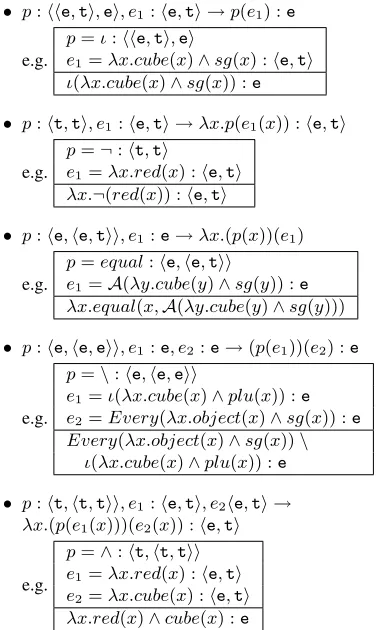
Figure 2: The five rules used during generation. Each rule is a template which takes a predicatep:t of typetand one or two argumentsei:ti, with type
ti. The output is the logical expression after the
ar-row→, constructed using the inputs as shown.
also limit the overall complexity of eachz ∈ Z, to contain not more thanM logical constants.
To achieve these constraints, we define an induc-tive procedure for enumeratingZ, in order of com-plexity. We first defineAj to be the set of alle- and he,ti-type expressions that contain exactly j logi-cal constants. Figure 2 presents five rules that can be used to constructAjby induction, forj= 1, . . . ,∞, by repeatedly adding new constants to expressions inAj0 for j0 < j. Intuitively, Aj is the set of all complexity j expressions that can be used as sub-expressions for higher complexity entires in our final setZ. Next, we defineZj to be thee-type
expres-sions inAjthat name the correct setG. And, finally,
Z = ∪j=1...MZj of all correct expressions up to a maximum complexity ofM.
empirical coverage, as we will see in the experi-ments in Section 8. However,Zis still prohibitively large for the maximum complexities used in practise (for exampleM = 20). Section 5.3 presents an ap-proach for learning models to prune Z, while still achieving good empirical coverage.
5.2 Global Model
Given a finite Z, we can now define our desired globally normalized log-linear model, conditioned on the stateSand set of target objectsG:
PG(z|S, G;θ) = 1
Ce
θ·φ(z,S,G) (1)
whereθ ∈ Rn is a parameter vector, φ(z, S, G) ∈ Rnis a feature function andC is the normalization
constant. Section 5.4 defines the features we use.
5.3 PruningZ
As motivated in Section 5.1, the key challenge for our global model in Equation 1 is that the set Z is too large to be explicitly enumerated. Instead, we designed an approach for learning to approximateZ with a subset of the highly likely entries, and use this subset as a proxy forZduring inference.
More specifically, we define a binary distribution that is used to classify whether eacha∈ Aj is likely
to be used as a sub-expression inZ, and prune each Aj to keep only the topkmost likely entries. This
distribution is a logistic regression model:
Pj(a|S, G;πj) =
eπj·φ(a,S,G)
1 +eπj·φ(a,S,G) (2)
with featuresφ(a, S, G)∈Rnand parametersπj ∈
Rn. This distribution uses the same features as the
global model presented in Equation 1, which we de-scribe in Section 5.4.
Together, the pruning model and global model de-fine the distributionPˆ(z | G, S;θ,Π)overz ∈ Z, conditioned on the world stateS and target set G, and parameterized by both the parametersθ of the global model and the parametersΠ ={π1, . . . , πM}
of the pruning models.
5.4 Features
We use three kinds of features: logical expression structure features, situated features and a complexity feature. All features but the complexity feature are
shared between the global model in Equation 1 and the pruning model in Equation 2. In order to avoid overly specific features, the attribute value predi-cates in the logical expressions are replaced with their attribute type (ie. red → color). In addition, the special constantssg and pluare ignored when computing features.
In the following description of our features, all examples are computed for the logical expression ι(λx.red(x)∧object(x)∧plu(x)), with respect to the scene and target set in Figure 1a.
Structure Features We use binary features that account for the presence of certain structures in the logical form, allowing the model to learn common usage patterns.
• Head Predicate - indicator for use of a logi-cal constant as a head predicate in every sub-expression of the sub-expression. A head predicate is the top-level operator of an expression. For example, the head predicate of the expression “λx.red(x)∧object(x)” is “∧” and the head ofλx.red(x)isred. For our running example, the head features areι,∧,color,object.
• Head-Predicate Bigrams and Trigrams -head-predicate bigrams are defined to be the head predicate of a logical form, and the head predicate of one of its children. Trigrams are similarly defined. E.g. bigrams: [ι,∧],
[∧, color],[∧, object], and trigrams:[ι,∧, red],
[ι,∧, object].
• Conjunction Duplicate- this feature fires if a conjunctive expression contains duplicate sub-expressions amongst its children.
• Coordination Children- this feature set indi-cates the presence of a coordination subexpres-sion (∧, ∨, ∪ or\) and the head expressions of all pairs and triples of its child expressions. E.g.[∧;red, object].
• Head Predicate and Coverage - this fea-ture set indicates the head predicate of ev-ery sub-expression of the logical form, com-bined with a comparison between the execu-tion of the sub-expression and the target set G. The possible values for this comparison (which we call the “coverage” of the expres-sion with respect toG) are: EQUAL,SUBSET (SUB),SUPERSET (SPR),DISJOINT, ALL, EMPTY and OTHER. E.g. [ι,SUB], [∧,SUB],
[color,SUB],[object,ALL]
• Coordination Child Coverage - this feature set indicates the head-predicate of a coordina-tion subexpression, combined with the cover-age of all pairs and triples of its child expres-sions. E.g.[∧;SUB,ALL].
• Coordination Child Relative Coverage- this feature set indicates, for every pair of child sub-expressions of coordination sub-expressions in the logical form, the coverage of the child sub-expressions relative to each other. The pos-sible relative coverage values are: SUB-SPR, DISJOINT,OTHER. E.g.[∧;SUB-SPR].
Complexity Features We use a single real-numbered feature to account for the complexity of the logical form. We define the complexity of a log-ical form to be the number of loglog-ical constants used. Our running example has a complexity of 4. This feature is only used in the global model, since the pruning model always considers logical expressions of fixed complexity.
6 Learning
Figure 3 presents the complete learning algorithm. The algorithm is online, using stochastic gradi-ent descgradi-ent updates for both the globally scored density estimation model and the learned pruning model. The algorithm assumes a dataset of the form {(Zi, Si, Gi) : i = 1. . . n} where each example
scene includes a list of logical expressions Zi, a
world stateSi, and a target set of objects,Gi, which
will be identified by the resulting logical expres-sions. The output is learned parameters for both the globally scored density estimation modelθ, and for the learned pruning modelsΠ.
Inputs:Training set{(Zi, Si, Gi) :i= 1. . . n}, whereZiis
a list of logical forms,Siis a world state, andGiis a target
set of objects. Number of iterationsT. Learning rate α0. Decay parameterc. Complexity thresholdM, as described in Section 5.3.
Definitions: LetPˆ(z | Gi, Si;θ,Π)be the predicted global
probability from Equation 1. LetPˆj(z | Gi, Si;πj)be the
predicted pruning probability from Equation 2. LetAˆjbe
the set of all complexity-M logical expressions, after prun-ing (see Section 5.1). LetSU B(j, z) be all complexity-j
sub-expressions of logical expressionz. LetQi(z |Si, Gi)
be the empirical probability over z ∈ Z, estimated from
Zi. Finally, letφi(z)be a shorthand for the feature function φ(z, Si, Gi)as defined in Section 5.4.
Algorithm:
Initializeθ←~0,πj←~0forj= 1. . . M
Fort= 1. . . T, i= 1. . . n:
Step 1:(Update Global Model) a. Compute the stochastic gradient:
∆θ←EQi(z|Si,Gi)[φi(z)]−EPˆ(z|Gi,Si;θ,Π)[φi(z)]
b. Update the parameters:
γ← α0
1+c×τ whereτ =i+t×n θ←θ+γ∆θ
Step 2:(Update Pruning Model) Forj= 1. . . M
a. Construct a set of positive and negative examples:
D+←S
z∈ZiSU B(j, z).
D−←Aˆ
j\ D+
b. Compute mini-batch stochastic gradient, normalizing for data skew:
∆πj ←
1
|D+|
P
z∈D+(1−Pj(z|Si, Gi;πj))φi(z)
− 1
|D−|
P
z∈D−Pj(z|Si, G;πj)φi(z)
c. Update complexity-jpruning parameters:
πj←πj+γ∆πj
Output:θandΠ = [π1, . . . , πM]
Figure 3: The learning algorithm.
6.1 Global Model Updates
The parametersθof the globally scored density es-timation model are trained to maximize the log-likelihood of the data:
Oi = log
Y
z∈Zi
PG(z|Si, Gi) (3)
Taking the derivative of this objective with re-spect to θ yields the gradient in Step 1a of Fig-ure 3. The marginals, EPˆ(z|Gi,Si;θ,Π)(φi(z)), are
6.2 Pruning Model Updates
To update each of the M pruning models, we first construct a set of positive and negative examples (Step 2a). The positive examples,D+, include those
sub-expressions which should be in the beam - these are all complexity j sub-expressions of logical ex-pressions in Zi. The negative examples, D−,
in-clude all complexity-jexpressions constructed dur-ing beam search, minus those which are inD+. The
gradient (Set 2b) is a binary mini-batch gradient, normalized to correct for data skew.
7 Experimental Setup
Data Collection Our dataset consists of 118 im-ages, taken with a Microsoft Kinect camera. These are the same images used by Matuszek et al. (2012a), but we create multiple prompts for each im-age by circling different objects, giving 269 scenes in total. These scenes were shown to workers on Amazon Mechanical Turk4who were asked to imag-ine giving instructions to a robot and complete the sentence “Please pick up ” in reference to the circled objects. Twenty referring expressions were collected for each scene, a total of 5380 expressions. From this data, 43 scenes (860 expressions) were held-out for use in a test set. Of the remaining scenes, the sentences of 30 were labeled with log-ical forms. 10 of these scenes (200 expressions) are used as a labeled initialization set, and 20 are used as a development test set (400 expressions). A small number of expressions (∼5%) from the labeled ini-tial set were discarded, either because they did not correctly name the target set, or because they used very rare attributes (such as texture, or location) to name the target objects.
Surrogate Labeling To avoid hand labeling the large majority of the scenes, we label the data with a learned semantic parser (Zettlemoyer and Collins, 2005). We created a hand-made lexicon for the entire training set, which greatly simplifies the learning problem, and learned the parameters of the parsing moder on the 10-scene initialization set. The weights were then further tuned using semi-supervised techniques (Artzi and Zettlemoyer, 2011, 2013b) on the data to be labeled. Testing on
4
http://www.mturk.com
the development set shows that this parser achieves roughly 95% precision and 70% recall.
Using this parser, we label the sentences in our training set. We only use scenes where at least 15 sentences were successfully parsed. This gives a training set of 141 scenes (2587 expressions). Com-bining the automatically labeled training set with the hand-labelled initialization, development and held-out data, our labelled corpus totals 3938 labeled ex-pressions. By contrast, the popular TUNA furniture sub corpus (Gatt et al., 2007) contains 856 descrip-tions of 20 scenes, and although some of these refer to sets, these sets contain two objects at most.
Framework Our experiments were implemented using the University of Washington Semantic Pars-ing Framework (Artzi and Zettlemoyer, 2013a).
Hyperparameters Our inference procedure re-quires two hyperparameters:M, the maximum com-plexity threshold, andk, the beam size. In practice, we set these to the highest possible values which still allow for training to complete in a reasonable amount of time (under 12 hours). M is set to 20, which is sufficient to cover 99.5% of the observed expressions. The beam-size k is 100 for the first three complexity levels, and 50 thereafter.
For learning, we use the following hyperparam-eters, which were tuned on the development set: learning rateα0 = .25, decay rate c = .02,
num-ber of epochsT = 10.
Evaluation Metrics Evaluation metrics used in REG research have assumed a system that produces a single output. Our goal is to achieve a distribution over logical forms that closely matches the distribu-tion observed from human subjects. Therefore, we compare our learned model to the labeled test data with mean absolute error:
M AE= 1 2n
n X
i=1
X
z∈Z
|P(z|Si, Gi)−Q(z|Si, Gi)|
– MAE %dup %uniq Top1
VOA 39.7 98.2 92.5 72.7
[image:9.612.96.280.61.110.2]GenX 25.8(5.0) 100(0) 100(0) 72.7(0)
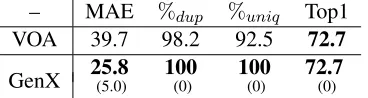
Table 1: Single object referring expression gener-ation results. Our approach (GenX) is compared to the approach from Mitchell et al. (2013) (VOA). Standard deviation over five shuffles of training set is reported in parentheses.
This metric is quite strict; small differences in the estimated probabilities over a large number of logi-cal expressions can result in a large error, even if the relative ordering is quite similar. Therefore, we re-port the percentage of observed logical expressions which the model produces, either giving credit mul-tiple times for duplicates (%dup) or counting each
unique logical expression in a scene once (%uniq).
Put another way,%dupcounts logical expression to-kens, whereas%uniq counts types. We also report
the proportion of scenes where the most likely log-ical expression according to the model matched the most common one in the data (Top1).
Single Object Baseline In order to compare our method against the state of the art for generating referring expressions for single objects, we use the subset of our corpus where the target set is a sin-gle object. This sub-corpus consists of 44 scenes for training and 11 held out for testing.
For comparison we re-implemented the proba-bilistic Visual Objects Algorithm (VOA) of Mitchell et al. (2013). We refer the readers to the original paper for details of the approach. The parameters of the model were tuned on the training data: the prior likelihood estimates for each of the four at-tribute types (αatt) were estimated as the relative
frequency of each attribute in the data. We pick the ordering of attributes and the length penalty,λ, from the cross-product of all possible4!orderings and all integers on the range of [1,10], choosing the setting which results in the lowest average absolute error (AAE) on the training set. This process resulted in the following parameter settings: αcolor = .916,
αshape = .586, αtype = .094, αobject = .506, AP
ordering =[type, shape, object, color],λ = 4. In-ference was done using 10,000 samples per scene.
– MAE %dup %uniq Top1
Full GenX 54.3(4.5) 87.4(0.6) 72.9(1.1) 52.6(8.3)
NoPrune 71.8(2.5) 42.2(2.7) 16.1(1.7) 40.0(5.0)
NoCOV 87.0(6.7) 26.0(3.7) 11.2(2.1) 14.9(9.7)
NoSTRUC 60.2(1.7) 79.6(0.3) 61.9(0.5) 44.6(4.5)
HeadExpOnly 88.8(6.4) 21.9(8.6) 9.3(3.5) 14.0(7.9)
Table 2: Results on the complete corpus for the complete system (Full GenX), ablating the pruning model (NoPrune) and the different features: without coverage features (NoCOV), without structure fea-tures (NoSTRUC) and using only the logical expres-sion HeadExp features (HeadExpOnly). Standard deviation over five runs is shown in parentheses.
8 Results
We report results on both the single-object subset of our data and the full dataset. Since our approach is online, and therefore sensitive to data ordering, we average results over 5 different runs with randomly ordered data, and report variance.
Single Objects Table 1 shows the different metrics for generating referring expression for single objects only. Our approach outperforms VOA (Mitchell et al., 2013) on all metrics, including an average of approximately 35% relative reduction in MAE. In addition, unlike VOA, our system (GenX) produces every logical expression used to refer to single ob-jects in our dataset, including a small number which use negation and equality.
Object Sets Table 2 lists results on the full dataset. Our learned pruning approach produces an average 72.9% of the unique logical expressions used present in our dataset – over 87% when these counts are weighted by their frequency. The globally scored model achieves a mean absolute error of 54.3, and correctly assigns the highest probability to the most likely expression over 52% of the time.
[image:9.612.315.537.61.185.2]inappropri-Q Pˆ z
.750 .320 ι(λx.object(x)∧(yellow(x)∨red(x)))
.114 ι(λx.lego(x))∪ι(λx.red(x)∧apple(x))
.114 ι(λx.yellow(x)∧lego(x)))∪ι(λx.apple(x))
.044 ι(λx.lego(x)∨(red(x)∧apple(x)))
.044 ι(λx.(yellow(x)∧lego(x))∨apple(x))
.036 ι(λx.lego(x))∪ι(λx.red(x)∧sphere(x))
.026 ι(λx.red(x)∧lego(x))∪ι(λx.red(x)∧sphere(x))
.050 .021 ι(λx.(lego(x)∧yellow(x))∨(red(x)∧apple(x)))
.017 ι(λx.(lego(x)∧yellow(x))∨(red(x)∧sphere(x)))
.014 ι(λx.yellow(x)∧lego(x))∪ι(λx.red(x)∧sphere(x))
.100 .010 ι(λx.yellow(x)∧object(x))∪ι(λx.apple(x))
.050 .007 ι(λx.yellow(x)∧object(x))∪ι(λx.red(x)∧sphere(x))
.050 .005 ι(λx.yellow(x)∧object(x))∪ι(λx.red(x)∧object(x))
[image:10.612.77.531.60.214.2](a) (b)
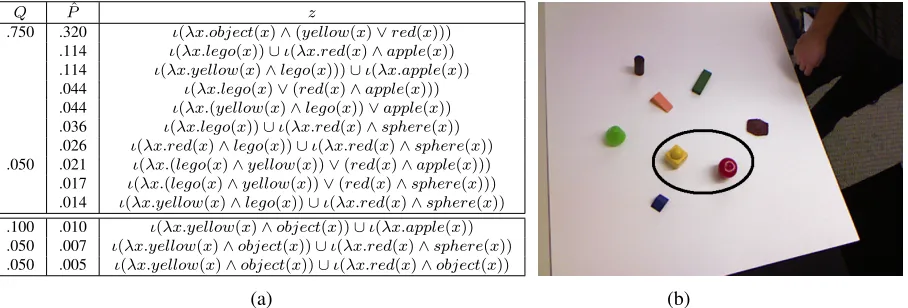
Figure 4: Example output of our system for the scene on the right. We show the top 10 expressions (z) from the predicted distribution (Pˆ) compared to the empirical distribution estimated from our labeled data (Q). The bottom section shows the predicted probability of the three expressions which were not in the top 10 of the predicted distribution. Although the mean absolute error (M AE) ofPˆandQis 63.8,Pˆcovers all of the entries inQin the correct relative order and also fills in many other plausible candidates.
ate for pruning. We also ablate subsets of our fea-tures, demonstrating that the coverage and structural features are both crucial for performance.
Qualitatively, we found the learned distributions were often higher quality than the seemingly high mean absolute error would imply. Figure 4 shows an example output where the absolute error of the predicted distribution was 63.8. Much of the error can be attributed to probability mass assigned to log-ical expressions which, although not observed in our test data, are reasonable referring expressions. This might be due to the fact that our estimate of the em-pirical distribution comes from a fairly small sample (20), or other factors which we do not model that make these expressions less likely.
9 Conclusion
In this paper, we modeled REG as a density-estimation problem. We demonstrated that we can learn to produce distributions over logical referring expressions using a globally normalized model. Key to the approach was the use of a learned pruning model to define the space of logical expression that are explicitly enumerated during inference. Exper-iments demonstrate state-of-the-art performance on single object reference and the first results for learn-ing to name sets of objects, correctly recoverlearn-ing over 87% of the observed logical forms.
This approach suggests several directions for
fu-ture work. Lambda-calculus meaning represen-tations can be designed for many semantic phe-nomena, such as spatial relations, superlatives, and graded properties, that are not common in our data. Collecting new datasets would allow us to study the extent to which the approach would scale to domains with such phenomena.
Although the focus of this paper is on REG, the approach is also applicable to learning distributions over logical meaning representations for many other tasks. Such learned models could provide a range of possible inputs for systems that map logical ex-pressions to sentences (White and Rajkumar, 2009; Lu and Ng, 2011), and could also provide a valuable prior on the logical forms constructed by semantic parsers in grounded settings (Artzi and Zettlemoyer, 2013b; Matuszek et al., 2012a).
Acknowledgements
References
Areces, C., Koller, A., and Striegnitz, K. (2008). Referring expressions as formulas of description logic. In Proceedings of the International Natu-ral Language Generation Conference.
Artzi, Y. and Zettlemoyer, L. (2011). Bootstrapping semantic parsers from conversations. In Proceed-ings of the Conference on Empirical Methods in Natural Language Processing.
Artzi, Y. and Zettlemoyer, L. (2013a). UW SPF: The University of Washington Semantic Parsing Framework.
Artzi, Y. and Zettlemoyer, L. (2013b). Weakly su-pervised learning of semantic parsers for mapping instructions to actions. Transactions of the As-sociation for Computational Linguistics, 1(1):49– 62.
Barzilay, R. and Lapata, M. (2005). Collective content selection for concept-to-text generation. In Proceedings of the Conference on Empirical Methods in Natural Language Processing. Berg, A. C., Berg, T. L., Daume, H., Dodge, J.,
Goyal, A., Han, X., Mensch, A., Mitchell, M., Sood, A., Stratos, K., et al. (2012). Under-standing and predicting importance in images. In
IEEE Conference on Computer Vision and Pattern Recognition.
Carenini, G., Ng, R. T., and Pauls, A. (2006). Multi-document summarization of evaluative text. In
Proceedings of the Conference of the European Chapter of the Association for Computational Linguistics.
Carpenter, B. (1997). Type-Logical Semantics. The MIT Press.
Chen, D., Kim, J., and Mooney, R. (2010). Train-ing a multilTrain-ingual sportscaster: usTrain-ing perceptual context to learn language. Journal of Artificial In-telligence Research, 37(1):397–436.
Chen, D. and Mooney, R. (2011). Learning to inter-pret natural language navigation instructions from observations. InProceedings of the National Con-ference on Artificial Intelligence.
Dale, R. and Reiter, E. (1995). Computational in-terpretations of the gricean maxims in the
gener-ation of referring expressions. Cognitive Science, 19:233–264.
Dale, R. and Reiter, E. (2000).Building natural lan-guage generation systems. Cambridge University Press.
Gardent, C. (2002). Generating minimal definite de-scriptions. InProceedings of the Annual Meeting of the Association for Computational Linguistics. Gatt, A. and van Deemter, K. (2007). Incremental generation of plural descriptions: Similarity and partitioning. InProceedings of the Conference on Empirical Methods in Natural Language Process-ing.
Gatt, A., Van Der Sluis, I., and Van Deemter, K. (2007). Evaluating algorithms for the generation of referring expressions using a balanced corpus. InProceedings of the European Workshop on Nat-ural Language Generation.
Grice, H. P. (1975). Logic and conversation. 1975, pages 41–58.
Horacek, H. (2004). On referring to sets of objects naturally. InNatural Language Generation, pages 70–79. Springer.
Kim, J. and Mooney, R. J. (2012). Unsupervised PCFG induction for grounded language learning with highly ambiguous supervision. In Proceed-ings of the Conference on Empirical Methods in Natural Language Processing.
Konstas, I. and Lapata, M. (2012). Unsupervised concept-to-text generation with hypergraphs. In
Proceedings of the Conference of the North Amer-ican Chapter of the Association for Computa-tional Linguistics.
Krahmer, E. and van Deemter, K. (2012). Computa-tional generation of referring expressions: A sur-vey. Computational Linguistics, 38(1):173–218. Krishnamurthy, J. and Kollar, T. (2013). Jointly
learning to parse and perceive: Connecting nat-ural language to the physical world. Transactions of the Association for Computational Linguistics, 1(2):193–206.
Lu, W. and Ng, H. T. (2011). A probabilis-tic forest-to-string model for language generation from typed lambda calculus expressions. In Pro-ceedings of the Conference on Empirical Methods in Natural Language Processing.
Matuszek, C., FitzGerald, N., Zettlemoyer, L., Bo, L., and Fox, D. (2012a). A joint model of lan-guage and perception for grounded attribute learn-ing. Proceedings of the International Conference on Machine Learning.
Matuszek, C., Herbst, E., Zettlemoyer, L. S., and Fox, D. (2012b). Learning to parse natural lan-guage commands to a robot control system. In
Proceedings of the International Symposium on Experimental Robotics.
Mitchell, M., van Deemter, K., and Reiter, E. (2011a). Applying machine learning to the choice of size modifiers. In Proceedings of the PRE-CogSci Workshop.
Mitchell, M., Van Deemter, K., and Reiter, E. (2011b). Two approaches for generating size modifiers. InProceedings of the European Work-shop on Natural Language Generation.
Mitchell, M., van Deemter, K., and Reiter, E. (2013). Generating expressions that refer to visible ob-jects. InProceedings of Conference of the North American Chapter of the Association for Compu-tational Linguistics.
Ren, Y., Van Deemter, K., and Pan, J. Z. (2010). Charting the potential of description logic for the generation of referring expressions. In Proceed-ings of the International Natural Language Gen-eration Conference.
Scontras, G., Graff, P., and Goodman, N. D. (2012). Comparing pluralities. Cognition, 123(1):190– 197.
Steedman, M. (2011).Taking Scope. The MIT Press. Stone, M. (2000). On identifying sets. In Proceed-ings of the International Conference on Natural Language Generation.
van Deemter, K. (2002). Generating referring ex-pressions: Boolean extensions of the incremental algorithm. Computational Linguistics, 28:37–52. van Deemter, K., Gatt, A., Sluis, I. v. d., and Power, R. (2012a). Generation of referring expressions:
Assessing the incremental algorithm. Cognitive Science, 36(5):799–836.
van Deemter, K., Gatt, A., van Gompel, R. P., and Krahmer, E. (2012b). Toward a computational psycholinguistics of reference production. Topics in Cognitive Science, 4(2):166–183.
Viethen, J. and Dale, R. (2010). Speaker-dependent variation in content selection for referring ex-pression generation. In Proceedings of the Aus-tralasian Language Technology Workshop. Viethen, J., Mitchell, M., and Krahmer, E. (2013).
Graphs and spatial relations in the generation of referring expressions. InProceedings of the Eu-ropean Workshop on Natural Language Genera-tion.
White, M. and Rajkumar, R. (2009). Perceptron reranking for ccg realization. In Proceedings of the Conference on Empirical Methods in Natural Language Processing.
Winograd, T. (1972). Understanding natural lan-guage. Cognitive Psychology, 3(1):1–191. Zelle, J. and Mooney, R. (1996). Learning to parse
database queries using inductive logic program-ming. InProceedings of the National Conference on Artificial Intelligence.
Zettlemoyer, L. and Collins, M. (2005). Learning to map sentences to logical form: Structured clas-sification with probabilistic categorial grammars. InProceedings of the Conference on Uncertainty in Artificial Intelligence.
Zettlemoyer, L. and Collins, M. (2007). Online learning of relaxed CCG grammars for parsing to logical form. InProceedings of the Joint Confer-ence on Empirical Methods in Natural Language Processing and Computational Natural Language Learning.
Zitnick, C. L. and Parikh, D. (2013). Bringing se-mantics into focus using visual abstraction. In