Max-Violation Perceptron and Forced Decoding for Scalable MT Training
Heng Yu1∗
1Institute of Computing Tech. Chinese Academy of Sciences
Liang Huang2† Haitao Mi3
2Queens College & Grad. Center City University of New York
{[email protected],kzhao@gc}.cuny.edu
Kai Zhao2
3T.J. Watson Research Center IBM
Abstract
While large-scale discriminative training has triumphed in many NLP problems, its defi-nite success on machine translation has been largely elusive. Most recent efforts along this line are not scalable (training on the small dev set with features from top∼100 most
fre-quent words) and overly complicated. We in-stead present a very simple yet theoretically motivated approach by extending the recent framework of “violation-fixing perceptron”, using forced decoding to compute the target derivations. Extensive phrase-based transla-tion experiments on both Chinese-to-English and Spanish-to-English tasks show substantial gains in BLEUby up to +2.3/+2.0 on dev/test
over MERT, thanks to 20M+ sparse features.
This is the first successful effort of large-scale online discriminative training for MT.
1 Introduction
Large-scale discriminative training has witnessed great success in many NLP problems such as
pars-ing (McDonald et al., 2005) and tagging (Collins,
2002), but not yet for machine translation (MT)
de-spite numerous recent efforts. Due to scalability is-sues, most of these recent methods can only train on a small dev set of about a thousand sentences rather than on the full training set, and only with 2,000–10,000 rather “dense-like” features (either unlexicalized or only considering highest-frequency
words), as in MIRA(Watanabe et al., 2007;Chiang
et al., 2008;Chiang, 2012), PRO(Hopkins and May,
2011), and RAMP(Gimpel and Smith, 2012).
How-ever, it is well-known that the most important fea-tures for NLP are lexicalized, most of which can not
∗Work done while visiting City University of New York. †Corresponding author.
be seen on a small dataset. Furthermore, these meth-ods often involve complicated loss functions and intricate choices of the “target” derivations to
up-date towards or against (e.g.k-best/forest oracles, or
hope/fear derivations), and are thus hard to replicate.
As a result, the classical method of MERT (Och,
2003) remains the default training algorithm for MT
even though it can only tune a handful of dense
fea-tures. See also Section6for other related work.
As a notable exception, Liang et al. (2006) do
train a structured perceptron model on the train-ing data with sparse features, but fail to outperform
MERT. We argue this is because structured
percep-tron, like many structured learning algorithms such
as CRF and MIRA, assumes exact search, and search
errors inevitably break theoretical properties such as
convergence (Huang et al., 2012). Empirically, it
is now well accepted that standard perceptron
per-forms poorly when search error is severe (Collins
and Roark, 2004;Zhang et al., 2013).
To address the search error problem we propose a very simple approach based on the recent framework
of “violation-fixing perceptron” (Huang et al., 2012)
which is designed specifically for inexact search, with a theoretical convergence guarantee and excel-lent empirical performance on beam search pars-ing and taggpars-ing. The basic idea is to update when search error happens, rather than at the end of the search. To adapt it to MT, we extend this framework to handle latent variables corresponding to the hid-den derivations. We update towards “gold-standard” derivations computed by forced decoding so that each derivation leads to the exact reference transla-tion. Forced decoding is also used as a way of data selection, since those reachable sentence pairs are generally more literal and of higher quality, which the training should focus on. When the reachable subset is small for some language pairs, we augment
it by including reachable prefix-pairs when the full sentence pair is not.
We make the following contributions:
1. Our work is the first successful effort to scale online structured learning to a large portion of the training data (as opposed to the dev set).
2. Our work is the first to use a principled learning method customized for inexact search which updates on partial derivations rather than full ones in order to fix search errors. We adapt it to MT using latent variables for derivations.
3. Contrary to the common wisdom, we show that simply updating towards the exact reference translation is helpful, which is much simpler
than k-best/forest oracles or loss-augmented
(e.g. hope/fear) derivations, avoiding
sentence-level BLEUscores or other loss functions.
4. We present a convincing analysis that it is the search errors and standard perceptron’s inabil-ity to deal with them that prevent previous
work, esp.Liang et al. (2006), from
succeed-ing.
5. Scaling to the training data enables us to engi-neer a very rich feature set of sparse, lexical-ized, and non-local features, and we propose various ways to alleviate overfitting.
For simplicity and efficiency reasons, in this paper we use phrase-based translation, but our method has the potential to be applicable to other translation paradigms. Extensive experiments on both Chinese-to-English and Spanish-Chinese-to-English tasks show
statis-tically significant gains in BLEUby up to +2.3/+2.0
on dev/test over MERT, and up to +1.5/+1.5 over
PRO, thanks to 20M+ sparse features.
2 Phrase-Based MT and Forced Decoding
We first review the basic phrase-based decoding
al-gorithm (Koehn, 2004), which will be adapted for
forced decoding.
2.1 Background: Phrase-based Decoding
We will use the following running example from
Chinese to English fromMi et al. (2008):
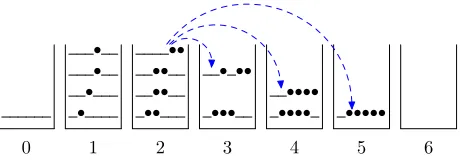
[image:2.612.311.542.56.138.2]0 1 2 3 4 5 6
Figure 1: Standard beam-search phrase-based decoding.
B`ush´ı
Bush
yˇu
with
Sh¯al´ong
Sharon
jˇux´ıng
hold
le
-ed
hu`ıt´an
meeting ‘Bush held a meeting with Sharon’
Phrase-based decoders generate partial target-language outputs in left-to-right order in the form ofhypotheses (or states) (Koehn, 2004). Each
hy-pothesis has acoverage vectorcapturing the
source-language words translated so far, and can be ex-tended into a longer hypothesis by a phrase-pair translating an uncovered segment. For example, the following is one possible derivation:
(0 ) : (0,“”)
(•1 ) : (s1,“Bush”)
r1
(• •••6) : (s2,“Bush held talks”)
r2
(•••3•••) : (s3,“Bush held talks with Sharon”)
r3
where a•in the coverage vector indicates the source
word at this position is “covered” and where each
si is the score of each state, each adding the rule
score and the distortion cost (dc) to the score of the
previous state. To compute the distortion cost we also need to maintain the ending position of the last
phrase (e.g., the 3 and 6 in the coverage vectors).
In phrase-based translation there is also a
distortion-limitwhich prohibits long-distance reorderings.
The above states are called−LM states since they
do not involve language model costs. To add a
bi-gram model, we split each−LM state into a series
of+LM states; each+LM state has the form(v,a)
whereais the last word of the hypothesis. Thus a
+LM version of the above derivation might be:
(0 ,<s>) : (0,“<s>”) (•1 ,Bush) : (s0
1,“<s>Bush”) r1
(• •••6,talks) : (s0
2,“<s>Bush held talks”) r2
(•••3•••,Sharon) : (s0
0 1 2 3 4 5 6
Bush held
held talks
talks with with Sharon
[image:3.612.337.528.56.259.2]Sharon
Figure 2: Forced decoding andy-good derivation lattice.
where the score of applying each rule now also
in-cludes acombination costdue to the bigrams formed
when applying the phrase-pair, e.g.
s03=s02+s(r3) +dc(|6−3|)−logPlm(with|talk)
To make this exponential-time algorithm practi-cal, beam search is the standard approximate search
method (Koehn, 2004). Here we group+LM states
intonbins, with each binBihosting at mostbstates
that cover exactlyiChinese words (see Figure1).
2.2 Forced Decoding
The idea of forced decoding is to consider only those (partial) derivations that can produce (a prefix of) the exact reference translation (assuming single
ref-erence). We call these partial derivations “y-good”
derivations (Daum´e, III and Marcu, 2005), and those
that deviate from the reference translation “y-bad”
derivations. The forced decoding algorithm is very
similar to+LM decoding introduced above, with the
new “forced decoding LM” to be defined as only accepting two consecutive words on the reference
translation, ruling out anyy-bad hypothesis:
Pforced(b|a) =
(
1 if∃j, s.t. a=yj andb=yj+1
0 otherwise
In the +LM state, we can simply replace the
boundary word by the index on the reference trans-lation:
(0 ,0) : (0,“<s>”) (•1 ,1) : (w0
1,“<s>Bush”) r1
(• •••6,3) : (w0
2,“<s>Bush held talks”) r2
(•••3•••,5) : (w03,“<s>Bush held talks with Sharon”) r3
The complexity of this forced decoding algorithm
is reduced to O(2nn3) where n is the source
sen-tence length, without the expensive bookkeeping for English boundary words.
Li´an h´egu
´o
p`aiqi ˇan 50 gu¯an
ch´aiy u´an
ji¯and ¯u B¯ol`ıw
´eiy`a hu¯ıf`um´ınzh
ˇu zh`en
gzh`ı yˇıl´aishˇou
c`ı qu´an
g´uo d`axu
ˇan
P
U.N.
P sent
P 50
P
observers to
P
monitor
P
the
P 1st
PP
election
P
since
P
Bolivia
P
restored
PP democracy
5
3 3
4
Figure 3: Example of unreachable sentence pair and reachable prefix-pair. The first big jump is disallowed for a distortion limit of 4, but we can still extract the top-left box as a reachable prefix-pair. Note that this example is perfectly reachable in syntax-based MT.
2.3 Reachable Prefix-Pairs
In practice, many sentence pairs in the parallel text fail in forced decoding due to two reasons:
1. distortion limit: long-distance reorderings are
disallowed but are very common between lan-guages with very different word orders such as English and Chinese.
2. noisy alignment and phrase limit: the
word-alignment quality (typically from GIZA++) are usually very noisy, which leads to unnecessar-ily big chunks of rules beyond the phrase limit.
If we only rely on the reachable whole sentence pairs, we will not be able to use much of the training set for Chinese-English. So we propose to augment the set of reachable examples by considering
reach-able prefix-pairs (see Figure3for an example).
3 Violation-Fixing Perceptron for MT
Huang et al. (2012) establish a theoretical frame-work called “violation-fixing perceptron” which is tailored for structured learning with inexact search and has provable convergence properties. The high-level idea is that standard full update does not fix search errors; to do that we should instead up-date when search error occurs, e.g., when the
[image:3.612.73.306.56.120.2]standard derivation falls below the beam. Huang et al. (2012) show dramatic improvements in the qual-ity of the learned model using violation-fixing per-ceptron (compared to standard perper-ceptron) on incre-mental parsing and part-of-speech tagging.
Since phrase-based decoding is also an incremen-tal search problem which closely resembles beam-search incremental parsing, it is very natural to em-ploy violation-fixing perceptron here for MT train-ing. Our goal is to produce the exact reference
trans-lation, or in other words, we want at least oney-good
derivation to survive in the beam search.
To adapt the violation-fixing perceptron frame-work to MT we need to extend the frameframe-work to handle latent variables since the gold-standard derivation is not observed. This is done in a way similar to the latent variable structured perceptron (Zettlemoyer and Collins, 2005;Liang et al., 2006;
Sun et al., 2009) where each update is from the best
(y-bad) derivation towards the best y-good
deriva-tion in the current model; the latter is a constrained search which is exactly forced decoding in MT.
3.1 Notations
We first establish some necessary notations. Let
hx, yibe a sentence pair in the training data, and
d=r1◦r2◦. . .◦r|d|
be a (partial) derivation, where each ri =
hc(ri), e(ri)i is a rule, i.e., a Chinese-English
phrase-pair. Let |c(d)| =∆ P
i|c(ri)|be the
num-ber of Chinese words covered by this derivation, and
e(d)=∆ e(r1)◦e(r2). . .◦e(r|d|)be the English
pre-fix generated so far. LetD(x)be the set of all
pos-sible partial derivations translating part of the input
sentence x. Letpre(y) =∆ {y[0:j] | 0 ≤ j ≤ |y|}
be the set of prefixes of the reference translation y,
andgoodi(x, y)be the set of partialy-good
deriva-tions whose English side is a prefix of the reference
translationy, and whose Chinese projection covers
exactlyiwords on the input sentencex, i.e.,
goodi(x, y)=∆{d∈D(x)|e(d)∈pre(y),|c(d)|=i}.
Conversely, we define the set ofy-bad partial
deriva-tions coveringiChinese words to be:
badi(x, y)
∆
={d∈D(x)|e(d)∈/pre(y),|c(d)|=i}.
Basically, at each bin Bi, y-good derivations
goodi(x, y) andy-bad onesbadi(x, y)compete for
thebslots in the bin:
B0 ={} (1)
Bi=topb
[
j=1..l
{d◦r|d∈Bi−j,|c(r)|=j} (2)
where r is a rule covering j Chinese words, l is
the phrase-limit, and topb S is a shorthand for
argtopb
d∈Sw · Φ(x, d) which selects the top b
derivations according to the current modelw.
3.2 Algorithm 1: Early Update
As a special case of violation-fixing perceptron,
early update (Collins and Roark, 2004) stops
decod-ing whenever the gold derivation falls off the beam, makes an update on the prefix so far and move on to the next example. We adapt it to MT as
fol-lows: if at a certain bin Bi, all y-good derivations
ingoodi(x, y)have fallen off the bin, then we stop
and update, rewarding the besty-good derivation in
goodi(x, y) (with respect to current modelw), and
penalizing the besty-bad derivation in the same step:
d+i (x, y)=∆ argmax
d∈goodi(x,y)
w·Φ(x, d) (3)
d−i (x, y)=∆ argmax
d∈badi(x,y)∩Bi
w·Φ(x, d) (4)
w←w+ ∆Φ(x, d+
i (x, y), d −
i (x, y)) (5)
where∆Φ(x, d, d0)=∆Φ(x, d)−Φ(x, d0)is a
short-hand notation for the difference of feature vectors.
Note that the setgoodi(x, y) is independent of the
beam search and current model and is instead pre-computed in the forced decoding phase, whereas the
negative signald−i (x, y)depends on the beam.
In practice, however, there are exponentially
many y-good derivations for each reachable
sen-tence pair, and our goal is just to make sure (at least)
one y-good derivation triumphs at the end. So it
is possible that at a certain bin, all y-good partial
derivations fall off the bin, but the search can still continue and produce the exact reference translation
through some othery-good path that avoids that bin.
For example, in Figure1, they-good states in steps
3 and 5 are not critical; it is totally fine to miss them
e
a
rl
y
ma
x-vi
o
la
ti
o
n
best in the beam
worst in the beam di
d+
i
d+
i⇤
di⇤
d+
|x|
dy|x|
st
d
lo
ca
l
standard update is invalid
mo
d
e
l
w
[image:5.612.79.294.67.151.2]d|x|
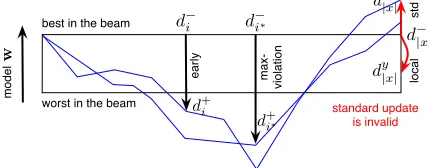
Figure 4: Illustration of four update methods. The blue paths denote (possibly lots of) gold-standard derivations from forced decoding. Standard update in this case is invalid as it reinforces the error ofw(Huang et al., 2012).
in bins 1, 4 and 6. So we actually use a “softer” version of the early update algorithm: only stop and update when there is no hope to continue. To be
more concrete, letldenote the phrase-limit then we
stop where there arelconsecutive bins without any
y-good states, and update on the first among them.
3.3 Algorithm 2: Max-Violation Update
While early update learns substantially better mod-els than standard perceptron in the midst of inex-act search, it is also well-known to be converging much slower than the latter, since each update is
on a (short) prefix. Huang et al. (2012) propose an
improved method “max-violation” which updates at
the worst mistake instead of the first, and converges much faster than early update with similar or better accuracy. We adopt this idea here as follows: decode
the whole sentence, and find the step i∗ where the
difference between the best y-good derivation and
the besty-bad one is the biggest. This amount of
dif-ference is called the amount of “violation” inHuang
et al. (2012), and the place of maximum violation is intuitively the site of the biggest mistake during the search. More formally, the update rule is:
i∗ =∆argmin
i
w·∆Φ(x, d+i (x, y), d−i (x, y)) (6)
w←w+ ∆Φ(x, d+i∗(x, y), d−i∗(x, y)) (7)
3.4 Previous Work: Standard and Local Updates
We compare the above new update methods with the
two existing ones fromLiang et al. (2006).
Standard update (also known as “bold update”
in Liang et al. (2006)) simply updates at the very end, from the best derivation in the beam towards the best gold-standard derivation (regardless of whether
it survives the beam search):
w←w+ ∆Φ(x, d+|x|(x, y), d−|x|(x, y)) (8)
Local update, however, updates towards the
derivation in the final bin that is most similar to the
referencey, denoteddy|x|(x, y):
dy|x|(x, y) =argmax
d∈B|x|
Bleu+1(y, e(d)) (9)
w←w+ ∆Φ(x, dy|x|(x, y), d−|x|(x, y))
(10)
whereBleu+1(·,·)returns the sentence-level BLEU.
Liang et al. (2006) observe that standard update performs worse than local update, which they at-tribute to the fact that the former often update to-wards a gold derivation made up of “unreasonable” rules. Here we give a very different but theoreti-cally more reasonable explanation based on the
the-ory of Huang et al. (2012), who define an update
∆Φ(x, d+, d−) to be invalid if d+ scores higher
than d− (i.e., w·∆Φ(x, d+, d−) > 0, or update
∆wpoints to the same direction aswin Fig.4), in
which case there is no “violation” or mistake to fix. Perceptron is guaranteed to converge if all updates are valid. Clearly, early and max-violation updates are valid. But standard update is not: it is possible
that at the end of search, the besty-good derivation
d+|x|(x, y), though pruned earlier in the search, ranks
even higher in the current model than anything in the
final bin (see Figure4). In other words, there is no
mistake at the final step, while there must be some
search error in earlier steps which expels they-good
subderivation. We will see in Section5.3that invalid
updates due to search errors are indeed the main rea-son why standard update fails. Local update, how-ever, is always valid in that definition.
Finally, it is worth noting that in terms of imple-mentation, standard and max-violation are the easi-est, while early update is more involved.
4 Feature Design
Our feature set includes the following 11 dense fea-tures: LM, four conditional and lexical translation
probabilities (pc(e|f), pc(f|e), pl(e|f), pl(f|e)),
length and phrase penalties, distortion cost, and three lexicalized reordering features. All these
(•1 ,Bush) : (s0
1,“<s>Bush”) (• •••6,talks) : (s0
2,“<s>Bush held talks”) r2
</s>
jˇux´ıng le hu`ıt´an yˇu Sh¯al´ong
B`ush´ı
<s>
held talks Bush
<s>
r1 r2
features for applyingr2on spanx[3:6]
WordEdges
c(r2)[0]=jˇux´ıng, c(r2)[−1] =hu`ıt´an
e(r2)[0]=held, e(r2)[−1]=talks
x[2:3]=Sh¯al´ong, x[6:7]=</s>,|c(r2)|= 3
... (combosof the aboveatomicfeatures) ...
non-local e(r0◦r1)[−2:]◦id(r2)
[image:6.612.76.526.58.155.2]id(r1)◦id(r2)
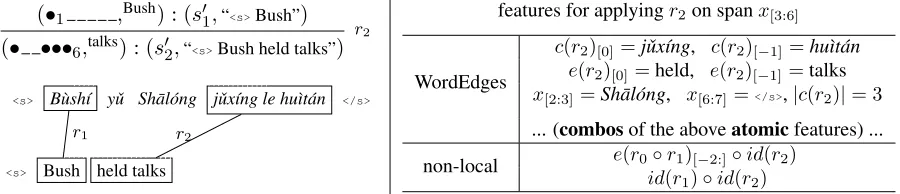
Figure 5: Examples of WordEdges and non-local features. The notation uses the Python style subscript syntax.
4.1 Local Sparse Features: Ruleid & WordEdges
We first add the rule identification feature for each
rule: id(ri). We also introduce lexicalized
Word-Edgesfeatures, which are shown to be very
effec-tive in parsing (Charniak and Johnson, 2005) and
MT (Liu et al., 2008; He et al., 2008) literatures. We use the following atomic features when
apply-ing a ruleri =hc(ri), e(ri)i: the source-side length
|c(ri)|, the boundary words of bothc(ri)ande(ri),
and the surrounding words ofc(ri)on the input
sen-tencex. See Figure5for examples. These atomic
features are concatenated to generate all kinds of
combo features.
Chinese English class size budget
word 52.9k 64.2k 5
characters - 3.7k - 3
Brown cluster, full string 200 3
Brown cluster, prefix 6 6 8 2
Brown cluster, prefix 4 4 4 2
POS tag 52 36 2
[image:6.612.72.302.380.496.2]word type - 4 - 1
Table 1: Various levels of backoff for WordEdges fea-tures. Class size is estimated on the small Chinese-English dataset (Sec. 5.3). The POS tagsets are ICT-CLAS for Chinese (Zhang et al., 2003) and Penn Tree-bank for English (Marcus et al., 1993).
4.2 Addressing Overfitting
With large numbers of lexicalized combo features we will face the overfitting problem, where some combo features found in the training data are too rare to be seen in the test data. Thus we propose three ways to alleviate this problem.
First, we introduce various levels of backoffs for
each wordw (see Table1). We includew’s Brown
cluster and its prefixes of lengths 4 and 6 (Brown et
al., 1992), andw’s part-of-speech tag. Ifwis
Chi-nese we also include its word type (punctuations, digits, alpha, or otherwise) and (leftmost or right-most) character. In such a way, we significantly in-crease the feature coverage on unseen data.
However, if we allow arbitrary combinations, we can extract a hexalexical feature (4 Chinese + 2
En-glish words) for a local window in Figure5, which
is unlikely to be seen at test time. To control model
complexity we introduce afeature budget for each
level of backoffs, shown in the last column in
Ta-ble 1. The total budget for a combo feature is the
sum of the budgets of all atomic features. In our ex-periments, we only use the combo features with a total budget of 10 or less, i.e., we can only include bilexical but not trilexical features, and we can in-clude for example combo features with one Chinese word plus two English tags (total budget: 9).
Finally, we use two methods to alleviate overfit-ting due to one-count rules: for large datasets, we simply remove all one-count rules, but for small datasets where out-of-vocabulary words (OOVs) abound, we use a simple leave-one-out method:
when training on a sentence pair(x, y), do not use
the one-count rules extracted from(x, y)itself.
4.3 Non-Local Features
Following the success of non-local features in
pars-ing (Huang, 2008) and MT (Vaswani et al., 2011),
we also introduce them to capture the contextual in-formation in MT. Our non-local features, shown in
Figure5, include bigram rule-ids and the
concatena-tion of a rule id with the translaconcatena-tion history, i.e. the last two English words. Note that we also use
back-offs (Table1) for the words included. Experiments
(Section5.3) show that although the set of non-local
features is just a tiny fraction of all features, it
Scale LanguagePair # sent.Training Data# words sent.Reachabilitywords # feats # refs∆BLEUdev/test Sections
small C
H-EN 30K 0.8M/1.0M 21.4% 8.8% 7M 4 +2.2/2.0 5.2,5.3
large 230K 6.9M/8.9M 32.1% 12.7% 23M +2.3/2.0 5.2,5.4
[image:7.612.83.530.56.129.2]large SP-EN 174K 4.9M/4.3M 55.0% 43.9% 21M 1 +1.3/1.1 5.5
Table 2: Overview of all experiments. The∆BLEUcolumn shows the absolute improvements of our method MAX
-FORCEon dev/test sets over MERT. The Chinese datasets also use prefix-pairs in training (see Table3).
5 Experiments
In order to test our approach in different language pairs, we conduct three experiments, shown in
Ta-ble 2, on two significantly different language pairs
(long vs. short distance reorderings),
Chinese-to-English (CH-EN) and Spanish-to-English (SP-EN).
5.1 System Preparation and Data
We base our experiments on Cubit, a state-of-art
phrase-based system in Python (Huang and Chiang,
2007).1 We set phrase-limit to 7 in rule extraction,
and beam size to 30 and distortion limit 6 in de-coding. We compare our violation-fixing
percep-tron with two popular tuning methods: MERT(Och,
2003) and PRO(Hopkins and May, 2011).
For word alignments we use GIZA++-`0
(Vaswani et al., 2012) which produces sparser align-ments, alleviating the garbage collection problem.
We use the SRILM toolkit (Stolcke, 2002) to train a
trigram language model with modified Kneser-Ney smoothing on 1.5M English sentences.
Our dev and test sets for CH-ENtask are from the
newswire portion of 2006 and 2008 NIST MT Eval-uations (616/691 sentences, 18575/18875 words),
with four references.2 The dev and test sets for SP
-EN task are from newstest2012 and newstest2013,
with only one reference. Below both MERTand PRO
tune weights on the dev set, while our method on the training set. Specifically, our method only uses the dev set to know when to stop training.
5.2 Forced Decoding Reachability on Chinese
As mentioned in Section2.2, we perform forced
de-coding to select reachable sentences from the
train-1
http://www.cis.upenn.edu/˜lhuang3/cubit/. We
will release the new version athttp://acl.cs.qc.edu. 2We use the “average” reference length to compute the brevity penalty factor, which does not decrease with more ref-erences unlike the “shortest” heuristic.
0% 10% 20% 30% 40% 50% 60% 70% 80% 90% 100%
10 20 30 40 50 60 70
Ratio of complete coverage
Sentence length dist-unlimited
dist-6 dist-4 dist-2 dist-0
Figure 6: Reachability ratio vs. sentence length on the small CH-ENtraining set.
small large
sent. words sent. words
full 21.4% 8.8% 32.1% 12.7%
[image:7.612.317.530.187.337.2]+prefix 61.3% 24.6% 67.3% 32.8%
Table 3: Ratio of sentence reachability and word cover-age on the two CH-ENtraining data (distortion limit: 6).
ing data; this part is done with exact search
with-out any beam pruning. Figure6 shows the
reacha-bility ratio vs. sentence length on the small CH-EN
training data, where the ratio decreases sharply with sentence length, and increases with distortion limit. We can see that there are a lot of long distance re-orderings beyond small distortion limits. In the ex-treme case of unlimited distortion, a large amount of sentences will be reachable, but at the cost of much
slower decoding (O(n2V2) in beam search
decod-ing, andO(2nn3)in forced decoding). In fact forced
decoding is too slow in the unlimited mode that we only plot reachability for sentences up to 30 words.
Table3shows the statistics of forced decoding on
[image:7.612.322.527.392.449.2]0 10000 20000 30000 40000 50000 60000 70000 80000 90000 100000
5 10 15 20 25 30 35 40 45 50
Average number of derivations
Sentence length dist-6
[image:8.612.77.290.64.216.2]dist-4 dist-2 dist-0
Figure 7: Average number of derivations in gold lattices.
small data-set, 21.4% sentences are fully reachable which only contains 8.8% words (since shorter sen-tences are more likely to be reachable). Larger data improves reachable ratios significantly thanks to bet-ter alignment quality, but still only 12.7% words can be used. In order to add more examples for per-ceptron training, we pick all non-trivial reachable prefix-pairs (with 5 or more Chinese words) as
addi-tional training examples (see Section2.2). As shown
in Table3, with prefix-pairs we can use about 1/4 of
small data and 1/3 of large data for training, which is 10x and 120x bigger than the 616-sentence dev set.
After running forced decoding, we obtain gold translation lattice for each reachable sentence (or
prefix) pair. Figure 7 shows, as expected, the
av-erage number of gold derivations in these lattices grows exponentially with sentence length.
5.3 Analysis on Small Chinese-English Data
Figure8shows the BLEUscores of different
learn-ing algorithms on the dev set. MAXFORCE3
per-forms the best, peaking at iteration 13 while early update learns much slower (the first few iterations are faster than other methods due to early stopping but this difference is immaterial later). The local and
standard updates, however, underperform MERT; in
particular, the latter gets worse as training goes on.
As analysized in Section3.4, the reason why
stan-dard update (or “bold update” inLiang et al. (2006))
fails is that inexact search leads to many invalid
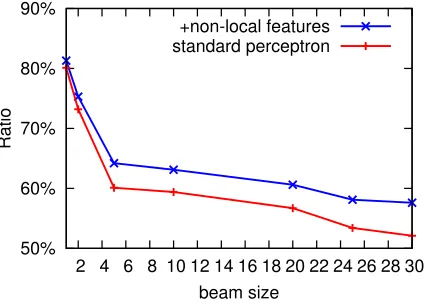
up-dates. This is confirmed by Figure9, where more
3Stands forMax-Violation Perceptron w/Forced Decoding
17 18 19 20 21 22 23 24 25 26
2 4 6 8 10 12 14 16 18 20
BLEU
Number of iteration
MaxForce
MERT early
local
[image:8.612.317.530.64.215.2]standard
Figure 8: BLEUscores on the heldout dev set for different
update methods (trained on small CH-ENdata).
50% 60% 70% 80% 90%
2 4 6 8 10 12 14 16 18 20 22 24 26 28 30
Ratio
beam size +non-local features standard perceptron
Figure 9: Ratio of invalid updates in standard update.
than half of the updates remain invalid even at a beam of 30. These analyses provide an alternative but theoretically more reasonable explanation to the
findings of Liang et al. (2006): while they blame
“unreasonable” gold derivations for the failure of standard update, we observe that it is the search er-rors that make the real difference, and that an up-date that respects search errors towards a gold sub-derivation is indeed helpful, even if that subderiva-tion might be “unreasonable”.
In order to speedup training, we use mini-batch
parallelization ofZhao and Huang (2013) which has
been shown to be much faster than previous paral-lelization methods. We set the mini-batch size to
24 and train MAXFORCE with 1, 6, and 24 cores
[image:8.612.318.530.281.434.2]22 23 24
0 0.5 1 1.5 2 2.5 3 3.5 4
BLEU
Time
MERT PRO-dense
[image:9.612.317.530.62.214.2]minibatch(24-core) minibatch(6-core) minibatch(1 core) single processor
Figure 10: Minibatch parallelization speeds up learning.
10 12 14 16 18 20 22 24 26
2 4 6 8 10 12 14 16
BLEU
Number of iteration MaxForce
[image:9.612.75.287.62.217.2]MERT PRO-dense PRO-medium PRO-large
Figure 11: Comparison between different training meth-ods. Ours trains the training set while others on dev set.
tences. The number of sentence pairs in this subset is 1,032, which contains similar number of words to our 616-sentence dev set (since reachable sentences are much shorter). Thus, it is reasonable to compare different learning algorithms in terms of speed and
performance. Figure10shows that first of all,
mini-batch improves BLEUeven in the serial setting, and
when run on 24 cores, it leads to a speedup of about 7x. It is also interesting to know that on 1 CPU, minibatch perceptron takes similar amount of time
to reach the same performance as MERTand PRO.
Figure11compares the learning curves of MAX
-FORCE, MERT, and PRO. We test PRO in three
different ways: PRO-dense (dense features only),
PRO-medium (dense features plus top 3K most
fre-18 19 20 21 22 23 24 25 26
2 4 6 8 10 12 14 16
BLEU
Number of iteration MERT
[image:9.612.75.291.268.420.2]+non-local +word-edges +ruleid dense
Figure 12: Incremental contributions of different feature sets (dense features, ruleid, WordEdges, and non-local).
type count % BLEU
dense 11 - 22.3
+ruleid +9,264 +0.1% +0.8
+WordEdges +7,046,238 +99.5% +2.0
+non-local +22,536 +0.3% +0.7
[image:9.612.314.537.283.369.2]all 7,074,049 100% 25.8
Table 4: Feature counts and incremental BLEU
improve-ments. MAXFORCEwith all features is +2.2 over MERT.
quent sparse features4), and PRO-large (dense
fea-tures plus all sparse feafea-tures). The results show that
PRO-dense performs almost the same as MERTbut
with a stabler learning curve while PRO-medium
im-proves by +0.6. However, PRO-large decreases the
performance significantly, which indicates PRO is
not scalable to truly sparse features. By contrast, our method handles large-scale sparse features well and outperforms all other methods by a large margin and with a stable learning curve.
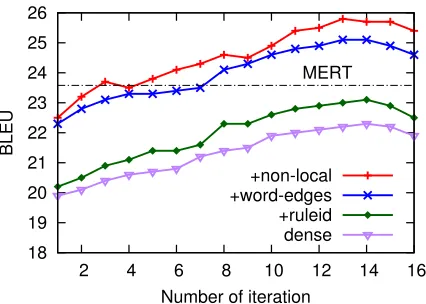
We also investigate the individual contribution from each group of features (ruleid, WordEdges, and non-local features). So we perform experiments by
adding each group incrementally. Figure12 shows
the learning curves and Table4lists the counts and
incremental contributions of different feature sets.
With dense features alone MAXFORCEdoes not do
system algorithm # feat. dev test
Moses MERT 11 25.5 22.5
Cubit
MERT 11 25.4 22.5
PRO
11 25.6 22.6
3K 26.3 23.0
36K 17.7 14.3
[image:10.612.77.297.57.157.2]MAXFORCE 23M 27.8 24.5
Table 5: BLEU scores (with four references) using the
large CH-ENdata. Our approach is +2.3/2.0 over MERT.
well because perceptron is known to suffer from fea-tures of vastly different scales. Adding ruleid helps, but still not enough. WordEdges (which is the vast
majority of features) improves BLEUby +2.0 points
and outperforms MERT, when sparse features totally
dominate dense features. Finally, the 0.3% non-local
features contribute a final +0.7 in BLEU.
5.4 Results on Large Chinese-English Data
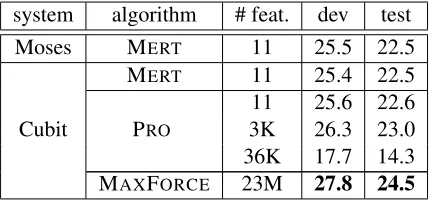
Table 5 shows all BLEU scores for different
learn-ing algorithms on the large CH-ENdata. The MERT
baseline on Cubit is essentially the same as Moses.
Our MAXFORCE activates 23M features on
reach-able sentences and prefixes in the training data, and takes 35 hours to finish 15 iterations on 24 cores, peaking at iteration 13. It achieves significant im-provements over other approaches: +2.3/+2.0 points
over MERTand +1.5/+1.5 over PRO-medium on
de-v/test sets, respectively.
5.5 Results on Large Spanish-English Data
In SP-EN translation, we first run forced
decod-ing on the traindecod-ing set, and achieve a very high reachability of 55% (with the same distortion limit of 6), which is expected since the word order be-tween Spanish and English are more similar than
than between Chinese and English, and most SP
-EN reorderings are local. Table6shows that MAX
-FORCE improves the translation quality over MERT
by +1.3/+1.1 BLEU on dev/test. These gains are
comparable to the improvements on the CH-ENtask,
since it is well accepted in MT literature that a
change ofδin 1-reference BLEUis roughly
equiva-lent to a change of2δwith 4 references.
system algorithm # feat. dev test
Moses MERT 11 27.4 24.4
[image:10.612.321.531.58.103.2]Cubit MAXFORCE 21M 28.7 25.5
Table 6: BLEUscores(with one reference)on SP-EN.
6 Related Work
Besides those discussed in Section 1, there are also some research on tuning sparse features on the train-ing data, but they integrate those sparse features into the MT log-linear model as a single feature weight,
and tune its weight on the dev set (e.g. (Liu et al.,
2008;He et al., 2008;Wuebker et al., 2010; Simi-aner et al., 2012; Flanigan et al., 2013; Setiawan and Zhou, 2013;He and Deng, 2012;Gao and He,
2013)). By contrast, our approach learns sparse
fea-tures only on the training set, and use dev set as held-out to know when to stop.
Forced decoding has been used in the MT litera-ture. For example, open source MT systems Moses
and cdec have implemented it. Liang et al. (2012)
also use the it to boost the MERTtuning by adding
morey-good derivations to the standardk-best list.
7 Conclusions and Future Work
We have presented a simple yet effective approach of structured learning for machine translation which scales, for the first time, to a large portion of the whole training data, and enables us to tune a rich set of sparse, lexical, and non-local features. Our
ap-proach results in very significant BLEU gains over
MERTand PRO baselines. For future work, we will
consider other translation paradigms such as hierar-chical phrase-based or syntax-based MT.
Acknowledgement
References
Peter Brown, Peter Desouza, Robert Mercer, Vincent Pietra, and Jenifer Lai. 1992. Class-based n-gram models of natural language. Computational linguis-tics, 18(4):467–479.
Eugene Charniak and Mark Johnson. 2005. Coarse-to-fine n-best parsing and maxent discriminative rerank-ing. InProceedings of ACL, pages 173–180, Ann Ar-bor, Michigan, June.
David Chiang, Yuval Marton, and Philip Resnik. 2008. Online large-margin training of syntactic and struc-tural translation features. InProceedings of EMNLP 2008.
David Chiang. 2012. Hope and fear for discriminative training of statistical translation models. J. Machine Learning Research (JMLR), 13:1159–1187.
Michael Collins and Brian Roark. 2004. Incremental parsing with the perceptron algorithm. InProceedings of ACL.
Michael Collins. 2002. Discriminative training meth-ods for hidden markov models: Theory and experi-ments with perceptron algorithms. InProceedings of EMNLP.
Hal Daum´e, III and Daniel Marcu. 2005. Learning as search optimization: Approximate large margin meth-ods for structured prediction. InProceedings of ICML. Jeffrey Flanigan, Chris Dyer, and Jaime Carbonell. 2013. Large-scale discriminative training for statistical ma-chine translation using held-out line search. In Pro-ceedings of NAACL 2013.
Jianfeng Gao and Xiaodong He. 2013. Training mrf-based phrase translation models using gradient ascent. In Proceedings of NAACL:HLT, pages 450–459, At-lanta, Georgia, June.
Kevin Gimpel and Noah A. Smith. 2012. Structured ramp loss minimization for machine translation. In
Proceedings of NAACL 2012.
Xiaodong He and Li Deng. 2012. Maximum expected bleu training of phrase and lexicon translation models. InProceedings of ACL.
Zhongjun He, Qun Liu, and Shouxun Lin. 2008. Im-proving statistical machine translation using lexical-ized rule selection. InProceedings of COLING, pages 321–328, Manchester, UK, August.
Mark Hopkins and Jonathan May. 2011. Tuning as rank-ing. InProceedings of EMNLP.
Liang Huang and David Chiang. 2007. Forest rescor-ing: Fast decoding with integrated language models. InProceedings of ACL, Prague, Czech Rep., June.
Liang Huang, Suphan Fayong, and Yang Guo. 2012. Structured perceptron with inexact search. In Proceed-ings of NAACL.
Liang Huang. 2008. Forest reranking: Discriminative parsing with non-local features. InProceedings of the ACL: HLT, Columbus, OH, June.
P. Koehn, H. Hoang, A. Birch, C. Callison-Burch, M. Federico, N. Bertoldi, B. Cowan, W. Shen, C. Moran, R. Zens, C. Dyer, O. Bojar, A. Constantin, and E. Herbst. 2007. Moses: open source toolkit for statistical machine translation. InProceedings of ACL: Demonstrations.
Philipp Koehn. 2004. Pharaoh: a beam search decoder for phrase-based statistical machine translation mod-els. InProceedings of AMTA, pages 115–124. Percy Liang, Alexandre Bouchard-Cˆot´e, Dan Klein, and
Ben Taskar. 2006. An end-to-end discriminative approach to machine translation. In Proceedings of COLING-ACL, Sydney, Australia, July.
Huashen Liang, Min Zhang, and Tiejun Zhao. 2012. Forced decoding for minimum error rate training in statistical machine translation. Journal of Computa-tional Information Systems, (8):861868.
Qun Liu, Zhongjun He, Yang Liu, and Shouxun Lin. 2008. Maximum entropy based rule selection model for syntax-based statistical machine translation. In
Proceedings of EMNLP, pages 89–97, Honolulu, Hawaii, October.
Mitchell P. Marcus, Beatrice Santorini, and Mary Ann Marcinkiewicz. 1993. Building a large annotated cor-pus of English: the Penn Treebank. Computational Linguistics, 19:313–330.
Ryan McDonald, Koby Crammer, and Fernando Pereira. 2005. Online large-margin training of dependency parsers. InProceedings of the 43rd ACL.
Haitao Mi, Liang Huang, and Qun Liu. 2008. Forest-based translation. InProceedings of ACL.
Franz Joseph Och. 2003. Minimum error rate training in statistical machine translation. InProceedings of ACL, pages 160–167.
Hendra Setiawan and Bowen Zhou. 2013. Discrimi-native training of 150 million translation parameters and its application to pruning. In Proceedings of NAACL:HLT, pages 335–341, Atlanta, Georgia, June. ACL.
Patrick Simianer, Stefan Riezler, and Chris Dyer. 2012. Joint feature selection in distributed stochastic learn-ing for large-scale discriminative trainlearn-ing in SMT. In
Andreas Stolcke. 2002. Srilm - an extensible lan-guage modeling toolkit. InProceedings of ICSLP, vol-ume 30, pages 901–904.
Xu Sun, Takuya Matsuzaki, and Daisuke Okanohara. 2009. Latent variable perceptron algorithm for struc-tured classification. InProceedings of IJCAI.
Ashish Vaswani, Haitao Mi, Liang Huang, and David Chiang. 2011. Rule markov models for fast tree-to-string translation. InProceedings of ACL 2011, Port-land, OR.
Ashish Vaswani, Liang Huang, and David Chiang. 2012. Smaller Alignment Models for Better Translations: Unsupervised Word Alignment with the L0-norm. In
Proceedings of ACL.
Taro Watanabe, Jun Suzuki, Hajime Tsukada, and Hideki Isozaki. 2007. Online large-margin training for statis-tical machine translation. InProceedings of EMNLP-CoNLL.
Joern Wuebker, Arne Mauser, and Hermann Ney. 2010. Training phrase translation models with leaving-one-out. InProceedings of ACL, pages 475–484, Uppsala, Sweden, July.
Luke Zettlemoyer and Michael Collins. 2005. Learning to map sentences to logical form: Structured classifi-cation with probabilistic categorial grammars. In Pro-ceedings of UAI.
Hua-Ping Zhang, Hong-Kui Yu, De-Yi Xiong, and Qun Liu. 2003. Hhmm-based chinese lexical analyzer ict-clas. InProceedings of the second SIGHAN workshop on Chinese language processing, pages 184–187. Hao Zhang, Liang Huang, Kai Zhao, and Ryan
McDon-ald. 2013. Online learning with inexact hypergraph search. InProceedings of EMNLP 2013.