Subcat-LMF: Fleshing out a standardized format
for subcategorization frame interoperability
Judith Eckle-Kohler‡ and Iryna Gurevych†‡ †Ubiquitous Knowledge Processing Lab (UKP-DIPF)
German Institute for Educational Research and Educational Information ‡Ubiquitous Knowledge Processing Lab (UKP-TUDA)
Department of Computer Science Technische Universit¨at Darmstadt
http://www.ukp.tu-darmstadt.de
Abstract
This paper describes Subcat-LMF, an ISO-LMF compliant lexicon representation for-mat featuring a uniform representation of subcategorization frames (SCFs) for the two languages English and German. Subcat-LMF is able to represent SCFs at a very fine-grained level. We utilized Subcat-LMF to standardize lexicons with large-scale SCF information: the English Verb-Net and two German lexicons, i.e., a subset of IMSlex and GermaNet verbs. To evalu-ate our LMF-model, we performed a cross-lingual comparison of SCF coverage and overlap for the standardized versions of the English and German lexicons. The Subcat-LMF DTD, the conversion tools and the standardized versions of VerbNet and IMS-lex subset are publicly available.1
1 Introduction
Computational lexicons providing accurate
lexical-syntactic information, such as subcatego-rization frames (SCFs) are vital for many NLP applications involving parsing and word sense
disambiguation. In parsing, SCFs have been
successfully used to improve the output of sta-tistical parsers (Klenner (2007), Deoskar (2008), Sigogne et al. (2011)) which is particularly significant in high-precision domain-independent
parsing. In word sense disambiguation, SCFs
have been identified as important features for verb sense disambiguation (Brown et al., 2011), which is due to the correlation of verb senses and SCFs (Andrew et al., 2004).
SCFs specify syntactic arguments of verbs and
other predicate-like lexemes, e.g. the verb say
1
http://www.ukp.tu-darmstadt.de/data/uby
takes two arguments that can be realized, for in-stance, as noun phrase and that-clause as in He says that the window is open.
Although a number of freely available, large-scale and accurate SCF lexicons exist, e.g. COM-LEX (Grishman et al., 1994), VerbNet (Kipper et al., 2008) for English, availability and limita-tions in size and coverage remain an inherent is-sue. This applies even more to languages other than English.
One particular approach to address this issue is the combination and integration of existing
man-ually built SCF lexicons. Lexicon integration
has widely been adopted for increasing the cover-age of lexicons regarding lexical-semantic infor-mation types, such as semantic roles, selectional restrictions, and word senses (e.g., Shi and Mi-halcea (2005), the Semlink project2, Navigli and Ponzetto (2010), Niemann and Gurevych (2011), Meyer and Gurevych (2011)).
Currently, SCFs are represented idiosyncrati-cally in existing SCF lexicons. However, inte-gration of SCFs requires a common, interopera-ble representation format. Monolingual SCF in-tegration based on a common representation for-mat has already been addressed by King and Crouch (2005) and just recently by Necsulescu et al. (2011) and Padr´o et al. (2011). However, nei-ther King and Crouch (2005) nor Necsulescu et al. (2011) or Padr´o et al. (2011) make use of ex-isting standards in order to create a uniform SCF representation for lexicon merging. The defini-tion of an interoperable representadefini-tion format ac-cording to an existing standard, such as the ISO standard Lexical Markup Framework (LMF, ISO 24613:2008, see Francopoulo et al. (2006)), is the
2
http://verbs.colorado.edu/semlink/
prerequisite for re-using this format in different contexts, thus contributing to the standardization and interoperability of language resources.
While LMF models exist that cover the rep-resentation of SCFs (see Quochi et al. (2008), Buitelaar et al. (2009)), their suitability for repre-senting SCFs at a large scale remains unclear: nei-ther of these LMF-models has been used for stan-dardizing lexicons with a large number of SCFs, such as VerbNet. Furthermore, the question of their applicability to different languages has not been investigated yet, a situation that is compli-cated by the fact that SCFs are highly language-specific.
The goal of this paper is to address these gaps for the two languages English and German by pre-senting a uniform LMF representation of SCFs for English and German which is utilized for the standardization of large-scale English and
Ger-man SCF lexicons. The contributions of this
paper are threefold: (1) We present the LMF model Subcat-LMF, an LMF-compliant lexicon representation format featuring a uniform and very fine-grained representation of SCFs for En-glish and German. Subcat-LMF is a subset of Uby-LMF (Eckle-Kohler et al., 2012), the LMF model of the large integrated lexical resource Uby (Gurevych et al., 2012). (2) We convert lexicons with large-scale SCF information to Subcat-LMF: the English VerbNet and two German lexicons, i.e., GermaNet (Kunze and Lemnitzer, 2002) and a subset of IMSlex3(Eckle-Kohler, 1999). (3) We perform a comparison of these three lexicons re-garding SCF coverage and SCF overlap, based on the standardized representation.
The remainder of this paper is structured as fol-lows: Section 2 gives a detailed description of Subcat-LMF and section 3 demonstrates its use-fulness for representing and cross-lingually com-paring large-scale English and German lexicons. Section 4 provides a discussion including related work and section 5 concludes.
2 Subcat-LMF
2.1 ISO-LMF: a meta-model
LMF defines a meta-model of lexical resources,
covering NLP lexicons and Machine Readable Dictionaries. This meta-model is based on the Unified Modeling Language (UML) and
speci-3
http://www.ims.uni-stuttgart.de/projekte/IMSLex/
fies a core package and a number of extensions for modeling different types of lexicons, includ-ing subcategorization lexicons.
The development of an LMF-compliant lexi-con model requires two steps: in the first step, the structure of the lexicon model has to be de-fined by choosing a combination of the LMF core package and zero to many extensions (i.e. UML packages). While the LMF core package models a lexicon in terms of lexical entries, each of which is defined as the pairing of one to many forms and zero to many senses, the LMF extensions provide UML classes for different types of lexicon orga-nization, e.g., covering the synset-based organiza-tion of WordNet and the class-based organizaorganiza-tion of VerbNet. The first step results in a set of UML classes that are associated according to the UML diagrams given in ISO LMF.
In the second step, these UML classes may be enriched by attributes. While neither attributes nor their values are given by the standard, the standard states that both are to be linked to Data Categories (DCs) defined in a Data Category
Reg-istry (DCR) such as ISOCat.4 DCs that are not
available in ISOCat may be defined and submit-ted for standardization. The second step results in a so-called Data Category Selection (DCS).
DCs specify the linguistic vocabulary used in
an LMF model. Consider as an example the
linguistic term direct objectthat often occurs in SCFs of verbs taking an accusative NP as argu-ment. In ISOCat, there are two different specifi-cations of this term, one explicitly referring to the capability of becoming the clause subject in pas-sivization5, the other not mentioning passivization at all.6 Consequently, the use of a DCR plays a major role regarding thesemantic interoperability
of lexicons (Ide and Pustejovsky, 2010). Different resources that share a common definition of their linguistic vocabulary are said to besemantically interoperable.
2.2 Fleshing out ISO-LMF
Approach: We started our development of Subcat-LMF with a thorough inspection of large-scale English and German resources providing
SCFs for verbs, nouns, and adjectives. For
4
http://www.isocat.org/, the implementation of the ISO 12620 DCR (Broeder et al., 2010).
5http://www.isocat.org/datcat/DC-1274 6
English, our analysis included VerbNet7 and FrameNet syntactically annotated example sen-tences from Ruppenhofer et al. (2010). For Ger-man, we inspected GermaNet, SALSA annota-tion guidelines (Burchardt et al., 2006) and IM-Slex documentation (Eckle-Kohler, 1999). In ad-dition, the EAGLES synopsis on morphosyntactic
phenomena8(Calzolari and Monachini, 1996), as
well as the EAGLES recommendations on subcat-egorization9have been used to identify DCs rele-vant for SCFs.
We specified Subcat-LMF by a DTD yielding an XML serialization of ISO-LMF. Thus, existing lexicons can be standardized, i.e. converted into
Subcat-LMF format, based on the DTD.10
Lexicon structure: Next, we defined the lexicon structure of Subcat-LMF. In addition to the core package, Subcat-LMF primarily makes use of the LMF Syntax and
Seman-tics extension. Figure 1 shows the most
important classes of Subcat-LMF including
SynsemCorrespondence where the linking of syntactic and semantic arguments is encoded. It might by worth noting that both synsets from Ger-maNet and verb classes from VerbNet can be
rep-resented in Subcat-LMF by using theSynsetand
SubcategorizationFrameSetclass.
Diverging linguistic properties of SCFs in English and German: For verbs (and also for predicate-like nouns and adjectives), SCFs spec-ify the syntactic and morphosyntactic properties of their arguments that have to be present in con-crete realizations of these arguments within a sen-tence. While some properties of syntactic argu-ments in English and German correspond (both English and German are Germanic languages and hence closely related), there are other properties, mainly morphosyntactic ones that diverge. By way of examples, we illustrate some of these di-vergences in the following (we contrast English examples with their German equivalents):
• overt case marking in German:
He helps him. vs.Er hilft ihm.(dative)
• specific verb form in verb phrase arguments:
He suggested cleaning the house.(ing-form)
7SCFs in VerbNet also cover SCFs in VALEX, a lexicon automatically extracted from corpora.
8
http://www.ilc.cnr.it/EAGLES96/morphsyn/ 9http://www.ilc.cnr.it/EAGLES96/synlex/ 10
Available at http://www.ukp.tu-darmstadt.de/data/uby
vs.
Er schlug vor, das Haus zu putzen. (to-infinitive)
• morphosyntactic marking of verb phrase
ar-guments in the main clause:He managed to
win.(no marking) vs.
Er hat es geschafft zu gewinnen. (obligatory
es)
• morphosyntactic marking of clausal
argu-ments in the main clause: That depends on
who did it.(preposition) vs.
Das h¨angt davon ab, wer es getan hat.
(pronominal adverb)
Uniform Data Categories for English and
Ger-man: Thus, the main challenge in developing
Subcat-LMF has been the specification of DCs (attributes and attribute values) in such a way, that a uniform specification of SCFs in the two languages English and German can be achieved. The specification of DCs for Subcat-LMF in-volved fleshing out ISO-LMF, because it is a meta-standard in the sense that it provides only few linguistic terms, i.e. DCs, and these DCs are not linked to any DCR: in the Syntax Exten-sion, the standard only provides 7 class names, see Figure 1), complemented by 17 example at-tributes given in an informative, non-binding An-nex F. These are by far not sufficient to repre-sent the fine-grained SCFs available in such large-scale lexicons as VerbNet.
In contrast, the Syntax part of Subcat-LMF comprises 58 DCs that are properly linked to ISOCat DCs; a number of DCs were missing in
ISOCat, so we entered them ourselves.11 The
majority of the attributes in SubcLMF are
at-tached to the SyntacticArgument class. The
corresponding DCs can be divided into two main groups:
Cross-lingually valid DCs for the
spec-ification of grammatical functions (e.g.
subject, prepositionalComplement)
and syntactic categories (e.g. nounPhrase,
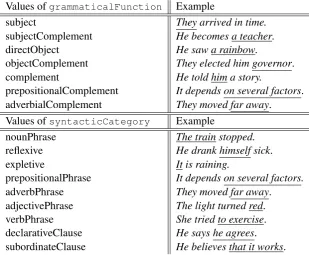
prepositionalPhrase), see Table 1.
Partly language-specific morphosyntactic DCsthat further specify the syntactic arguments
(e.g. attribute case, attribute verbForm and
11
Figure 1: Selected classes of Subcat-LMF.
Values ofgrammaticalFunction Example
subject They arrived in time.
subjectComplement He becomes a teacher.
directObject He saw a rainbow.
objectComplement They elected him governor.
complement He told him a story.
prepositionalComplement It depends on several factors.
adverbialComplement They moved far away.
Values ofsyntacticCategory Example
nounPhrase The train stopped.
reflexive He drank himself sick.
expletive It is raining.
prepositionalPhrase It depends on several factors.
adverbPhrase They moved far away.
adjectivePhrase The light turned red.
verbPhrase She tried to exercise.
declarativeClause He says he agrees.
subordinateClause He believes that it works.
Table 1: Cross-lingually valid (English-German) attributes and values of theSyntacticArgumentclass.
values toInfinitive, bareInfinitive,
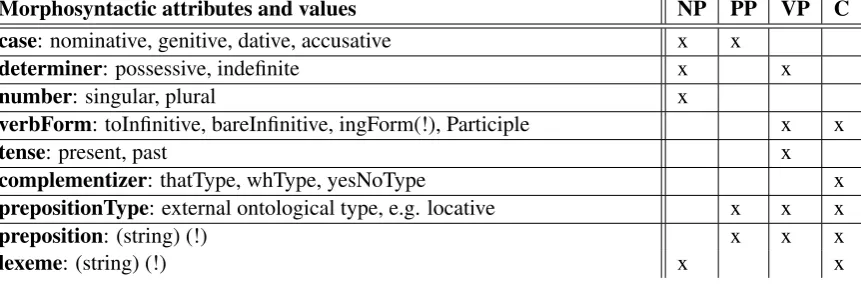
ingForm, participle), see Table 2.
In the classLexemeProperty, we introduced
an attribute syntacticProperty to encode
control and raising properties of verbs taking in-finitival verb phrase arguments.12
In Subcat-LMF, syntactic arguments can be specified by a selection of appropriate attribute-value pairs. While all syntactic arguments are uni-formly specified by a grammatical function and a syntactic category, the use of the morphosyntactic attributes depends on the particular type of syn-tactic argument. Different phrase types are
spec-12
Control or raising specify the co-reference between the implicit subject of the infinitival argument and syntactic ar-guments in the main clause, either the subject (subject con-trol or raising) or direct object (object concon-trol or raising).
ified by different subsets of morphosyntactic at-tributes, see Table 2. The following examples il-lustrate some of these attributes:
• number: the number of a noun phrase argu-ment can be lexically governed by the verb as inThese types of fish mix well together.
• verbForm: the verb form of a clausal com-plement can be required to be a bare infini-tive as inThey demanded that he be there.
[image:4.595.143.453.240.495.2]Morphosyntactic attributes and values NP PP VP C
case: nominative, genitive, dative, accusative x x
determiner: possessive, indefinite x x
number: singular, plural x
verbForm: toInfinitive, bareInfinitive, ingForm(!), Participle x x
tense: present, past x
complementizer: thatType, whType, yesNoType x
prepositionType: external ontological type, e.g. locative x x x
preposition: (string) (!) x x x
[image:5.595.86.517.76.218.2]lexeme: (string) (!) x x
Table 2: Morphosyntactic attributes of SyntacticArgumentand phrase types for which the attributes are appropriate (NP: noun phrase, PP: prepositional phrase, VP: verb phrase, C: clause). Language-specific attributes are marked by (!).
3 Utilizing Subcat-LMF
3.1 Standardizing large-scale lexicons
Lexicon Data: We converted VerbNet (VN) and two German lexicons, i.e., GermaNet (GN) and a subset of IMSlex (ILS) to Subcat-LMF format. ILS has been developed independently from GN and the lexicon data were published in Eckle-Kohler (1999).
VNis organized in verb classes based on Levin-style syntactic alternations (Levin, 1993): verbs with common SCFs and syntactic alternation be-havior that also share common semantic roles are grouped into classes. VN (version 3.1) lists 568 frames that are encoded as phrase structure rules
(XML elementSYNTAX), specifying phrase types
and semantic roles of the arguments, as well as se-lectional, syntactic and morphosyntactic restric-tions on the arguments. Additionally, a descrip-tive specification of each frame is given (XML
element DESCRIPTION). The verb learn, for
in-stance, has the following VN frame:
DESCRIPTION (primary): NP V NP
SYNTAX: Agent V Topic
We extracted both the descriptive specifications and the phrase structure rules, using the API
available for VN13, resulting in 682 unique VN
frames.14
GN provides detailed SCFs for verbs, in
contrast to the Princeton WordNet: GN version
6.0 from April 2011 accessed by the GN API15
lists 202 frames. GN SCFs are represented as a
13
http://verbs.colorado.edu/verb-index/inspector/ 14
The VN API was used with the view options wrexyzsq for verb frame pairs and ctuqw for verb class information.
15
GermaNet Java API 2.0.2
dot-separated sequence of letter pairs. Each letter pair specifies a syntactic argument: the first letter encodes the grammatical function and the second letter the syntactic category.16 For instance, the following shows the GN code for transitive verbs:
NN.AN.
ILS is represented in delimiter-separated
values format and contains 784 verbs in total. Of these 784 verbs, 740 of them are also present in GN, and 44 are listed in ILS only. Although ILS contains only verbs that take clausal ar-guments and verb phrase arar-guments, a total number of 220 SCFs is present in ILS, also including SCFs without clausal and verb phrase
arguments. ILS lists for each verb lemma a
number of SCFs, thus specifying coarse-grained
verb senses given by a lemma-SCF pair.17 The
SCFs are represented as parenthesized lists. For instance, the ILS SCF for transitive verbs is:
(subj(NPnom),obj(NPacc)).
Automatic Conversion: We implemented Java tools for the conversion of VN, GN and ILS to Subcat-LMF. These tools convert the source lexi-cons based on a manual mapping of lexicon units and terms (e.g., VN verb class, GN synset) to Subcat-LMF. For the majority of SCFs, this map-ping is defined on argument level. Lexical data is extracted from the source lexicons by using the native APIs (VN, GN) and additional Perl scripts.
16
See http://www.sfs.uni-tuebingen.de/GermaNet/-verb frames.shtml
# LexicalEntry # Sense # Subcat.Frame # SemanticPred.
LMF-VN 3962 31891 284 617
orig. VN (3962 verbs) (31891 groups of verb,
frame, sem.pred.)
(568 frames) (572 sem. Pred.)
LMF-GN 8626 12981 147 84
orig. GN (8626 verbs) (12981 verb-synset pairs) (202 GN frames) (no sem. Pred.)
LMF-ILS 784 3675 217 10
[image:6.595.82.518.74.185.2]orig. ILS (784 verbs) (3675 verb-frame pairs) (220 SCFs) (no sem. Pred.)
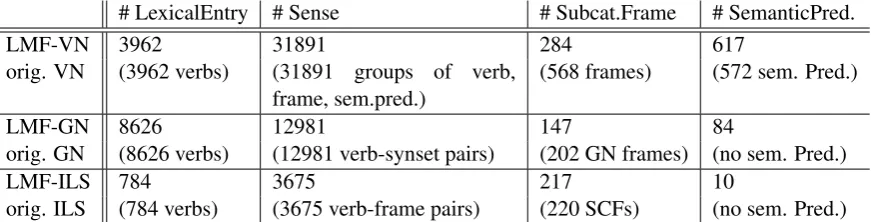
Table 3: Evaluation of the automatic conversion. Numbers of Subcat-LMF instances in the converted lexicons compared to numbers of corresponding units in original lexicons.
Evaluation of Automatic Conversion: Table 3 shows the mapping of the major source lexicon units (such as verb-synset pairs) to Subcat-LMF and lists the corresponding numbers of units.
For VN, groups of VN verb, frame and se-mantic predicate have been mapped to LMF
senses. VN classes have been mapped to
SubcategorizationFrameSet. Thus, the
original VN-sense, a pairing of verb lemma and class, can be recovered by grouping LMF senses that share the same verb class. There is a signif-icant difference between the original VN frames and their Subcat-LMF representation: the seman-tic information present in VN frames (seman-tic roles and selectional restrictions) is mapped to semantic arguments in Subcat-LMF, i.e. the mapping splits VN frames into a purely
syntac-tic and a purely semansyntac-tic part. Consequently,
the number of unique SCFs in the Subcat-LMF version of VN is much smaller than the num-ber of frames in the original VN. The conversion tool creates for each sense (specifying a unique verb, frame, semantic predicate combination) a
SynSemCorrespondence.
On the other hand, the Subcat-LMF version of VN contains more semantic predicates than VN. This is due to selectional restrictions for semantic ar-guments that are specified in Subcat-LMF within semantic predicates, in contrast to VN.
For GN, verb-synset pairs (i.e., GN lexical units), have been mapped to LMF senses. Few GN frame codes also specify semantic role in-formation, e.g. manner, location. These were mapped to the semantics part of Subcat-LMF re-sulting in 84 semantic predicates that encode the semantic role information in their semantic argu-ments.
ILS specifies similar semantic role information
as GN; these few cases were mapped in the same way as for GN. Therefore, the LMF version of ILS, too, specifies less SCFs, but additional se-mantic predicates not present in the original.
Discussion: Grammatical functions of argu-ments are specified distinctly in the three lexicons. While both GN and ILS specify grammatical functions, they are not explicitly encoded in VN. They have to be inferred on the basis of the phrase
structure rules given in theSYNTAXelement. We
assigned subjectto the noun phrase which
di-rectly precedes the verb and directObjectto
the noun phrase directly following the verb and
having the semantic role Patient. The semantic role information has to be considered at this point, because not all noun phrase arguments are able to become the subject in a corresponding passive
sentence. An example is the verb learn which
has the VN frame NP(Agent) V NP(Topic);
here, the Topic-NP is not able to become the sub-ject of a corresponding passive sentence. We
as-signed the grammatical functioncomplementto
all other phrase types.
Argument order constraints in SCFs are repre-sented in LMF by a list implementation of syntac-tic arguments. Most SCFs from VN require the subject to be the first argument, reflecting the ba-sic word order in English sentences. VN lists one exception to this rule for the verb appear,
illus-trated by the example On the horizon appears a
ship.
these SCFs marks optional (semantic) arguments by a ?-sign. GN, on the other hand, expresses argument optionality at the level of syntactic ar-guments, i.e., within the frame code. In Subcat-LMF, optionality is represented at the syntactic level by an (optional) attributeoptionalfor syn-tactic arguments, thus reflecting the explicit repre-sentation used in GN and the implicit representa-tion present in VN.18
GN frames specify syntactic alternations of ar-gument realizations, e.g. adverbial complements that can alternatively be realized as adverb phrase, prepositional phrase or noun phrase. We encoded this generalization in Subcat-LMF by introducing attribute values for these aggregated syntactic cat-egories.
3.2 Cross-lingual comparison of lexicons
Lexicons that are standardized according to Subcat-LMF can be quantitatively compared re-garding SCFs. For two lexicons, such a com-parison gives answers to questions, such as: how many SCFs are present in both lexicons (overlap-ping SCFs), how many SCFs are only listed in one of the lexicons (complementary SCFs). Answers to these questions are important, for instance, for assessing the potential gain in SCF coverage that can be achieved by lexicon merging.
In order to validate our claim that Subcat-LMF yields a cross-lingually uniform SCF represen-tation, we contrast the monolingual comparison of GN and ILS with the cross-lingual compari-son of VN, GN and VN and ILS. Assuming that our claim is valid, the cross-lingual comparisons can be expected to yield similar results regard-ing overlappregard-ing and complementary SCFs as the monolingual comparison.
Comparison: The comparison of SCFs from two lexicons that are in Subcat-LMF format can be performed on the basis of the uniform DCs. As Subcat-LMF is implemented in XML, we compared string representations of SCFs. SCFs from VN, GN and ILS were converted to strings by concatenating attribute values of syntactic
ar-guments and lexemeProperty. We created
string representations of different granularities: First, fine-grained, language-specific string SCFs have been generated by concatenating all
at-18As a consequence, all semantic arguments specified in the Subcat-LMF version of VN have a corresponding syn-tactic argument.
tribute values apart from the attributeoptional
which is specific to GN (resulting in a consid-erably smaller number of SCFs in GN). Sec-ond, fine-grained, but cross-lingual string SCFs were considered; these omit the attributescase, lexeme, preposition and the attribute value
ingForm. Finally, coarse-grained cross-lingual
string SCFs were compared. These only
con-tain the values of the attributes syntactic
category, complementizer and verbForm
(without the attribute value ingForm). For
in-stance, a coarse cross-lingual string SCF for
tran-sitive verbs isnounPhrasenounPhrase.
Table 4 lists the results of our quantitative com-parison. For each lexicon pair, the number of overlapping SCFs and the numbers of comple-mentary SCFs are given. Regarding VN and the German lexicons, the overlap at the language-specific level is (close to) zero, which is due to the specification of case, e.g. dative, for German ar-guments. However, the numbers for cross-lingual SCFs clearly validate our claim: the numbers of overlapping SCFs for the German lexicon pair and for the two German-English pairs are comparable, ranging from 12 to 18 for the fine-grained SCFs and from 20 to 21 for the coarse SCFs.
Based on the sets of cross-lingually overlap-ping SCFs, we made an estimation on how many high frequent verbs actually have SCFs that are in the cross-lingual SCF overlap of an English-German lexicon pair. For this, we used the lemma frequency lists of the English and German WaCky corpora (Baroni et al., 2009) and extracted verbs from VN, GN and ILS that are on 100 top ranked positions of these lists, starting from rank 100.19 Table 5 shows the results for the cross-lingual SCF overlap between VN – GN and between VN
– ILS. While only around 40% of the high
fre-quent verbs have an SCF in the fine-grained SCF overlap, more than70%are in the coarse overlap
between VN – GN, and even more than 80%in
the coarse overlap between VN – ILS.
Analysis of results: The small numbers of overlappingcross-lingualSCFs (relative to the to-tal number of SCFs), at both levels of granularity, indicate that the three lexicons each encode sub-stantially different lexical-syntactic properties of
19
language-specific cross-lingual cross-lingual
(fine-grained) (fine-grained) (coarse)
GN vs. ILS 72 GN 21 both, 196 ILS 61 GN, 23 both, 69 ILS 40 GN, 24 both, 23 ILS
VN vs. GN 284 VN, 0 both, 93 GN 96 VN,15both, 69 GN 29 VN,24both, 40 GN
[image:8.595.91.507.75.147.2]VN vs. ILS 283 VN, 1 both, 216 ILS 93 VN,18both, 74 ILS 31 VN,22both, 25 ILS
Table 4: Comparison of lexicon pairs regarding SCF overlap and complementary SCFs.
VN-GN overlap VN-GN overlap VN-ILS overlap VN-ILS overlap
fine-grained (15 SCFs) coarse (24 SCFs) fine-grained (18 SCFs) coarse (22 SCFs)
43%VN verbs 85%VN verbs 41%VN verbs 84%VN verbs
41%GN verbs 71%GN verbs 43%ILS verbs 87%ILS verbs
Table 5: Percentage of 100 high frequent verbs from VN, GN, ILS with a SCF in the cross-lingual SCF overlap (fine-grained vs. coarse) between VN – GN and VN – ILS.
verbs. This can at least partly be explained by the historic development of these lexicons in differ-ent contexts, e.g., Levin’s work on verb classes (VN), Lexical Functional Grammar (ILS), as well as their use for different purposes and applica-tions.
Another reason of the small SCF overlap is the comparison of strings derived from the XML format. A more sophisticated representation for-mat, notably one that provides semantic typing and type hierarchies, e.g., OWL, could be em-ployed to define hierarchies of grammatical func-tions (e.g. direct object would be a sub-type of complement) and other attributes. These would presumably support the identification of further overlapping SCFs.
During a subsequent qualitative analysis of the overlapping and complementary SCFs, we col-lected some enlightening background informa-tion. Overlapping SCFs in the cross-lingual com-parison (both fine-grained and coarse) include prominent SCFs corresponding to transitive and intransitive verbs, as well as verbs with that-clause and verbs with to-infinitive.
GN and ILS are highly complementary regard-ing SCFs: for instance, while many SCFs with ad-verbial arguments are unique in GN, only ILS pro-vides a fine-grained specification of prepositional complements including the preposition, as well as the case the preposition requires.20 VN, too, contains a large number of SCFs with a detailed specification of possible prepositions, partly
spec-20
In German, prepositions govern the case of their noun phrase.
ified as language-independent preposition types. A large number of complementary SCFs in VN vs. GN and GN vs. ILS are due to a diverging lin-guistic analysis of extraposed subject clauses with an es(it) in the main clause (e.g.,It annoys him that the train is late.). In GN, such clauses are not specified as subject, whereas in VN and ILS they are.
Regarding VN and ILS, only VN lists subject control for verbs, while both VN and ILS list ob-ject control and subob-ject raising. GN, on the other hand, does not specify control or raising at all.
4 Discussion
4.1 Previous Work
Merging SCFs: Previous work on merging SCF lexicons has only been performed in a mono-lingual setting and lacks the use of standards. King and Crouch (2005) describe the process of unifying several large-scale verb lexicons for En-glish, including VN and WordNet. They perform a conversion of these lexicons into a uniform, but non-standard representation format, resulting in a lexicon which is integrated at the level of verb senses, SCFs and lexical-semantics. Thus, the re-sult of their work is not applicable to cross-lingual settings.
Necsulescu et al. (2011) and Padr´o et al. (2011) report on approaches to automatic merging of
two Spanish SCF lexicons. As these lexicons
in (Padr´o et al., 2011) assumes that one of the lex-icons to be integrated is already represented in the target representation format, i.e. given two lexi-cons, they map one lexicon to the format of the other. Moreover, their approach requires a signif-icant overlap of SCFs and verbs in any two lex-icons to be merged. The authors state that it is presently unclear, how much overlap is required to obtain sufficiently precise merging results.
Standardizing SCFs: Much previous work on standardizing NLP lexicons in LMF has focused on WordNet-like resources. Soria et al. (2009) de-scribe WordNet-LMF, an LMF model for repre-senting wordnets which has been used in the
KY-OTO project.21 Later, WordNet-LMF has been
adapted by Henrich and Hinrichs (2010) to Ger-maNet and by Toral et al. (2010) to the Ital-ian WordNet. WordNet-LMF does not provide the possibility to represent subcategorization at all. The adaption of WordNet-LMF to GN (Hen-rich and Hin(Hen-richs, 2010) allows SCFs to be
re-spresented as string values. However, this
ex-tension is not sufficient, because it provides no means to model the syntax-semantics interface, which specifies correspondences between syntac-tic and semansyntac-tic arguments of verbs and other predicates. Quochi et al. (2008) report on an LMF model that covers the syntax-semantics mapping just mentioned; it has been used for standardizing an Italian domain-specific lexicon. Buitelaar et al. (2009) describe LexInfo, an LMF-model that is used for lexicalizing ontologies. LexInfo is imple-mented in OWL and specifies a linking of syntac-tic and semansyntac-tic arguments. For SCFs and argu-ments, a type hierarchy is defined. In their paper, Buitelaar et al. (2009) show only few SCFs and do not indicate what kinds of SCFs can be repre-sented with LexInfo in principle. On the LexInfo website22, the current LexInfo version 2.0 can be viewed, but no further documentation is given. We inspected LexInfo version 2.0 and found that it specifies a large number of fine-grained SCFs. However, LexInfo has not been evaluated so far on large-scale SCF lexicons, such as VerbNet.
4.2 Subcat-LMF
Subcat-LMF enables the uniform representation of fine-grained SCFs across the two languages
English and German. By mapping large-scale
21http://www.kyoto-project.eu/ 22
See http://lexinfo.net/
SCF lexicons to Subcat-LMF, we have demon-strated its usability for uniformly representing a wide range of SCFs and other lexical-syntactic in-formation types in English and German.
As our cross-lingual comparison of lexicons has revealed many complementary SCFs in VN, GN and ILS, mono- and cross-lingual alignments of these lexicons at sense level would lead to a major increase in SCF coverage. Moreover, the cross-lingually uniform representation of SCFs can be exploited for an additional alignment of the lexicons at the level of SCF arguments. Such a fine-grained alignment of SCFs can be used, for instance, to project VN semantic roles to GN, thus yielding a German resource for semantic role la-beling (see Gildea and Jurafsky (2002), Swier and Stevenson (2005)).
Subcat-LMF could be used for standardizing further English and German lexicons. The auto-matic conversion of lexicons to Subcat-LMF re-quires the manual definition of a mapping, at least for syntactic arguments. Furthermore, the auto-matic merging approach by Padr´o et al. (2011) could be tested for English: given our standard-ized version of VN, other English SCF lexicons could be merged fully automatically with the Subcat-LMF version of VN.
5 Conclusion
Subcat-LMF contributes to fostering the standard-ization of language resources and their interop-erability at the lexical-syntactic level across En-glish and German. The Subcat-LMF DTD in-cluding links to ISOCat, all conversion tools, and the standardized versions of VN and ILS23are publicly available at http://www.ukp.tu-darmstadt.de/data/uby.
Acknowledgments
This work has been supported by the Volks-wagen Foundation as part of the Lichtenberg-Professorship Program under grant No. I/82806. We thank the anonymous reviewers for their valu-able comments. We also thank Dr. Jungi Kim and Christian M. Meyer for their contributions to this paper, and Yevgen Chebotar and Zijad Mak-suti for their contributions to the conversion soft-ware.
23
References
Galen Andrew, Trond Grenager, and Christopher D. Manning. 2004. Verb sense and subcategoriza-tion: using joint inference to improve performance on complementary tasks. In Proceedings of the 2004 Conference on Empirical Methods in Natural Language Processing (EMNLP), pages 150–157, Barcelona, Spain.
Marco Baroni, Silvia Bernardini, Adriano Ferraresi, and Eros Zanchetta. 2009. The WaCky wide web: a collection of very large linguistically processed web-crawled corpora. Language Resources and Evaluation, 43(3):209–226.
Daan Broeder, Marc Kemps-Snijders, Dieter Van Uyt-vanck, Menzo Windhouwer, Peter Withers, Peter Wittenburg, and Claus Zinn. 2010. A Data Cat-egory Registry- and Component-based Metadata Framework. InProceedings of the Seventh Inter-national Conference on Language Resources and Evaluation (LREC), pages 43–47, Valletta, Malta. Susan Windisch Brown, Dmitriy Dligach, and Martha
Palmer. 2011. VerbNet Class Assignment as a WSD Task. InProceedings of the 9th International Conference on Computational Semantics (IWCS), pages 85–94, Oxford, UK.
Paul Buitelaar, Philipp Cimiano, Peter Haase, and Michael Sintek. 2009. Towards Linguistically Grounded Ontologies. In Lora Aroyo, Paolo Traverso, Fabio Ciravegna, Philipp Cimiano, Tom Heath, Eero Hyv¨onen, Riichiro Mizoguchi, Eyal Oren, Marta Sabou, and Elena Simperl, editors,The Semantic Web: Research and Applications, pages 111–125, Berlin Heidelberg. Springer-Verlag. Aljoscha Burchardt, Katrin Erk, Anette Frank, Andrea
Kowalski, Sebastian Pad´o, and Manfred Pinkal. 2006. The SALSA Corpus: a German Corpus Re-source for Lexical Semantics. In Proceedings of the Fifth International Conference on Language Re-sources and Evaluation (LREC), pages 969–974, Genoa, Italy.
Nicoletta Calzolari and Monica Monachini. 1996. EAGLES Proposal for Morphosyntactic Stan-dards: in view of a ready-to-use package. In G. Perissinotto, editor, Research in Humanities Computing, volume 5, pages 48–64. Oxford Uni-versity Press, Oxford, UK.
Tejaswini Deoskar. 2008. Re-estimation of lexi-cal parameters for treebank PCFGs. In Proceed-ings of the 22nd International Conference on Com-putational Linguistics (COLING), pages 193–200, Manchester, United Kingdom.
Judith Eckle-Kohler, Iryna Gurevych, Silvana Hart-mann, Michael Matuschek, and Christian M. Meyer. 2012. UBY-LMF – A Uniform Format for Standardizing Heterogeneous Lexical-Semantic Resources in ISO-LMF. InProceedings of the 8th International Conference on Language Resources
and Evaluation (LREC 2012), page (to appear), Is-tanbul, Turkey.
Judith Eckle-Kohler. 1999. Linguistisches Wissen zur automatischen Lexikon-Akquisition aus deutschen Textcorpora. Logos-Verlag, Berlin, Germany. PhDThesis.
Gil Francopoulo, Nuria Bel, Monte George, Nico-letta Calzolari, Monica Monachini, Mandy Pet, and Claudia Soria. 2006. Lexical Markup Framework (LMF). In Proceedings of the Fifth International Conference on Language Resources and Evaluation (LREC), pages 233–236, Genoa, Italy.
Daniel Gildea and Daniel Jurafsky. 2002. Automatic labeling of semantic roles. Computational Linguis-tics, 28:245–288, September.
Ralph Grishman, Catherine Macleod, and Adam Mey-ers. 1994. Comlex Syntax: Building a Computa-tional Lexicon. In Proceedings of the 15th Inter-national Conference on Computational Linguistics (COLING), pages 268–272, Kyoto, Japan.
Iryna Gurevych, Judith Eckle-Kohler, Silvana Hart-mann, Michael Matuschek, Christian M. Meyer, and Christian Wirth. 2012. Uby - A Large-Scale Unified Lexical-Semantic Resource. In Proceed-ings of the 13th Conference of the European Chap-ter of the Association for Computational Linguistics (EACL 2012), page (to appear), Avignon, France. Verena Henrich and Erhard Hinrichs. 2010.
Standard-izing wordnets in the ISO standard LMF: Wordnet-LMF for GermaNet. InProceedings of the 23rd In-ternational Conference on Computational Linguis-tics (COLING), pages 456–464, Beijing, China. Nancy Ide and James Pustejovsky. 2010. What Does
Interoperability Mean, anyway? Toward an Op-erational Definition of Interoperability. In Pro-ceedings of the Second International Conference on Global Interoperability for Language Resources, Hong Kong.
Tracy Holloway King and Dick Crouch. 2005. Uni-fying lexical resources. In Proceedings of the In-terdisciplinary Workshop on the Identification and Representation of Verb Features and Verb Classes, Saarbruecken, Germany.
Karin Kipper, Anna Korhonen, Neville Ryant, and Martha Palmer. 2008. A Large-scale Classification of English Verbs. Language Resources and Evalu-ation, 42:21–40.
Manfred Klenner. 2007. Shallow dependency la-beling. In Proceedings of the 45th Annual Meet-ing of the Association for Computational LMeet-inguis- Linguis-tics (ACL), Companion Volume Proceedings of the Demo and Poster Sessions, pages 201–204, Prague, Czech Republic.
(LREC), pages 1485–1491, Las Palmas, Canary Is-lands, Spain.
Beth Levin. 1993. English Verb Classes and Alterna-tions. The University of Chicago Press, Chicago, USA.
Christian M. Meyer and Iryna Gurevych. 2011. What Psycholinguists Know About Chemistry: Align-ing Wiktionary and WordNet for Increased Domain Coverage. InProceedings of the 5th International Joint Conference on Natural Language Processing (IJCNLP), pages 883–892, Chiang Mai, Thailand. Roberto Navigli and Simone Paolo Ponzetto. 2010.
BabelNet: Building a very large multilingual se-mantic network. InProceedings of the 48th Annual Meeting of the Association for Computational Lin-guistics (ACL), pages 216–225, Uppsala, Sweden. Silvia Necsulescu, N´uria Bel, Munsta Padr´o,
Montser-rat Marimon, and Eva Revilla. 2011. Towards the Automatic Merging of Language Resources. In Proceedings of the 2011 ESSLI Workshop on Lexi-cal Resources (WoLeR 2011), Ljubljana, Slovenia. Elisabeth Niemann and Iryna Gurevych. 2011. The
People’s Web meets Linguistic Knowledge: Auto-matic Sense Alignment of Wikipedia and WordNet. InProceedings of the 9th International Conference on Computational Semantics (IWCS), pages 205– 214, Oxford, UK.
Muntsa Padr´o, N´uria Bel, and Silvia Necsulescu. 2011. Towards the Automatic Merging of Lexical Resources: Automatic Mapping. InProceedings of the International Conference on Recent Advances in Natural Language Processing, pages 296–301, Hissar, Bulgaria.
Valeria Quochi, Monica Monachini, Riccardo Del Gratta, and Nicoletta Calzolari. 2008. A lexicon for biology and bioinformatics: the bootstrep expe-rience. In Proceedings of the Sixth International Conference on Language Resources and Evalua-tion (LREC’08), pages 2285–2292, Marrakech, Mo-rocco, may.
Josef Ruppenhofer, Michael Ellsworth, Miriam R. L. Petruck, Christopher R. Johnson, and Jan Schef-fczyk. 2010. FrameNet II: Extended Theory and Practice, September.
Lei Shi and Rada Mihalcea. 2005. Putting pieces to-gether: Combining FrameNet, VerbNet and Word-Net for robust semantic parsing. In Proceedings of the Sixth International Conference on Intelligent Text Processing and Computational Linguistics (CI-CLing), pages 100–111, Mexico City, Mexico. Anthony Sigogne, Matthieu Constant, and ´Eric
La-porte. 2011. Integration of data from a syntac-tic lexicon into generative and discriminative proba-bilistic parsers. InProceedings of the International Conference on Recent Advances in Natural Lan-guage Processing, pages 363–370, Hissar, Bulgaria.
Claudia Soria, Monica Monachini, and Piek Vossen. 2009. Wordnet-LMF: fleshing out a standardized format for Wordnet interoperability. InProceedings of the 2009 International Workshop on Intercultural Collaboration, pages 139–146, Palo Alto, Califor-nia, USA.
Robert S. Swier and Suzanne Stevenson. 2005. Ex-ploiting a verb lexicon in automatic semantic role labelling. InProceedings of the conference on Hu-man Language Technology and Empirical Methods in Natural Language Processing (HLT’05), pages 883–890, Vancouver, British Columbia, Canada. Antonio Toral, Stefania Bracale, Monica Monachini,