A Hierarchical Bayesian Model for
Unsupervised Induction of Script Knowledge
Lea Frermann1[email protected] Ivan Titov
2
1ILCC, School of Informatics, University of Edinburgh, United Kingdom 2ILLC, University of Amsterdam, Netherlands
3 Department of Computational Linguistics, Saarland University, Germany
Manfred Pinkal3
Abstract
Scripts representing common sense knowledge about stereotyped sequences of events have been shown to be a valu-able resource for NLP applications. We present a hierarchical Bayesian model for unsupervised learning of script knowledge from crowdsourced descriptions of human activities. Events and constraints on event ordering are induced jointly in one unified framework. We use a statistical model over permutations which captures event ordering constraints in a more flexible way than previous approaches. In order to alleviate the sparsity problem caused by using relatively small datasets, we incorporate in our hierarchical model an informed prior on word distributions. The resulting model substantially outperforms a state-of-the-art method on the event ordering task.
1 Introduction
A script is a “predetermined, stereotyped se-quence of actions that define a well-known sit-uation” (Schank and Abelson, 1975). While humans acquire such common-sense knowledge over their lifetime, it constitutes a bottleneck for many NLP systems. Effective question answer-ing and summarization are impossible without a form of story understanding, which in turn has been shown to benefit from access to databases of script knowledge (Mueller, 2004; Miikkulainen, 1995). Knowledge about the typical ordering of events can further help assessing document co-herence and generating coherent text. Here, we present a general method for acquiring data bases of script knowledge.
Our work may be regarded as complementary to existing work on learning script knowledge from
natural text (cf. (Chambers and Jurafsky, 2008)), as not all types of scripts are elaborated in natural text – being left implicit because of assumed read-ers’ world knowledge. Our model, operating on data obtained in a cheap way by crowdsourcing, is applicable to any kind of script and can fill this gap. We follow work in inducing script knowl-edge from explicit instantiations of scripts, so-called event sequence descriptions(ESDs) (Reg-neri et al., 2010). Our data consists of sets of ESDs, each set describing a well-known situation we will call scenario (e.g., “washing laundry”). An ESD consists of a sequence of events, each describing an action defining part of the scenario (e.g., “place the laundry in the washing machine”). We refer to descriptions of the same event across ESDs asevent types. We refer to entities involved in a scenario asparticipants(e.g., a “washing ma-chine” or a “detergent”), and to sets of participant descriptions describing the same entity as partici-pant types.
For each type of scenario, our model clusters descriptions which refer to the same type of event, and infers constraints on the temporal order in which the events types occur in a particular sce-nario. Common characteristics of ESDs such as event optionality and varying degrees of temporal flexibility of event types make this task nontrivial. We propose a model which, in contrast to previ-ous approaches, explicitly targets these character-istics. We develop a Bayesian formulation of the script learning problem, and present a generative model forjointlearning of event types and order-ing constraints, arguorder-ing that the temporal position of an event in an ESD provides a strong cue for its type, and vice versa. Our model is unsupervised in that no event- or participant labels are required for training.
We model constraints on the order of event types using a statistical model over permutations, the Generalized Mallows Model (GMM; Fligner
and Verducci (1986)). With the GMM we can flex-ibly model apparent characteristics of scripts, such as event type-specific temporal flexibility. Assum-ing that types of participants provide a strong cue for the type of event they are observed in, we use participant types as a latent variable in our model. Finally, by modeling event type occurrence using Binomial distributions, we can model event op-tionality, a characteristic of scripts that previous approaches did not capture.
We evaluate our model on a data set of ESDs collected via web experiments from non-expert annotators by Regneri et al. (2010) and compare our model against their approach. Our model achieves an absolute average improvement of 7% over the model of Regneri et al. on the task of event ordering.
For our unsupervised Bayesian model the lim-ited size of this training set constitutes an ad-ditional challenge. In order to alleviate this problem, we use an informed prior on the word distributions. Instead of using Dirichlet priors which do not encode a-priori correlations between words, we incorporate a logistic normal distri-bution with the covariance matrix derived from WordNet. While we will show that prior knowl-edge as defined above enables the application of our model to small data sets, we emphasize that the model is generally widely applicable for two reasons. First, the data, collected using crowd-sourcing, is comparatively easy and cheap to ex-tend. Secondly, our model is domain independent and can be applied to scenario descriptions from any domain without any modification. Note that parameters were tuned on held-out scenarios, and no scenario-specific tuning was performed.
2 Related Work
In the 1970s, scripts were introduced as a way to equip AI systems with world knowledge (Schank and Abelson, 1975; Barr and Feigenbaum, 1986). Task-specific script databases were developed manually. FrameNet (Baker et al., 1998) follows a similar idea, in defining verb frames together with argument types that can fill the verbs’ argument slots. Frames can then be combined into “scenario frames”. Manual composition of such databases, is arguably expensive and does not scale well.
This paper follows a series of more recent work which aims to infer script knowledge automati-cally from data. Chambers and Jurafsky (2008)
present a system which learns narrative chains from newswire texts. Relevant phrases are iden-tified based on shared protagonists. The phrases are clustered into equivalence classes and tempo-rally ordered using a pipeline of methods. We work with explicit event sequence descriptions of a specific scenario, arguing that large-scale com-mon sense knowledge is hard to acquire from nat-ural text, since it is often left implicit. Regneri et al. (2010) induce script knowledge from ex-plicit ESDs using a graph-based method. Event types and ordering constraints are induced by aligning descriptions of equivalent events using WordNet-based semantic similarity. On this basis an abstract graph-representation (Temporal Script Graph; TSG) of the scenario is computed, us-ing Multiple Sequence Alignment (MSA). Our work follows the work of Regneri et al. (2010), in that we use the same data and aim to focus on the same task. However, the two approaches de-scribed above employ a pipeline architecture and treat event learning and learning ordering con-straints as separate problems. In contrast, we pro-pose to learn both tasks jointly. We incorporate both tasks in a hierarchical Bayesian model, thus using one unified framework.
A related task, unsupervised frame induction, has also been considered in the past (Titov and Klementiev, 2011; Modi et al., 2012; O’Connor, 2012); the frame representations encode events and participants but ignore the temporal aspect of script knowledge.
We model temporal constraints on event type orderings with the Generalized Mallows Model (GMM; Mallows (1957); Fligner and Verducci (1986); Klementiev et al. (2008)), a statistical model over permutations. The GMM is a flexi-ble model which can specify item-specific sensi-tivity to perturbation from the item’s position in the canonical permutation. With the GMM we are thus able to model event type-specific temporal flexibility – a feature of scripts that MSA cannot capture.
or-der of events in their descriptions (Regneri et al., 2010)). Chen et al. show that for these domains their approach significantly outperforms Marko-vian modeling of topics. This is expected as Markov models (MMs) are not very appropriate for representing linear structure with potentially missing topics (e.g., they cannot encode that ev-ery topic is assigned to at most one continuous fragment of text). Also GMMs are preferable for smaller collections such as ours, as the parameter number is linear in the number of topics (i.e., for us, event types) rather than quadratic as in Markov models. We are not aware of previous work on modeling events with GMMs. Conversely, MMs were considered in the very recent work of Che-ung et al. (2013) in the context of script induction from news corpora where the Markovian assump-tion is much more natural.
There exists a body of work for learning par-ticipant types involved in scripts. Regneri et al. (2011) extend their work by inducing participant types on the basis of the TSG, using structural in-formation about participant mentions in the TSG as well as WordNet similarity, which they then combine into an Integer Linear Program. Simi-larly, Chambers and Jurafsky (2009) extend their work on narrative chains, presenting a system with which they jointly learn event types and semantic roles of the participants involved, but do not con-sider event orderings. We include participant types as a latent feature in our model, assuming that par-ticipant mentions in an event description are a pre-dictive feature for the corresponding event type.
One way of alleviating the problem of small data sets is incorporating informed prior knowl-edge. Raina et al. (2006) encode word correlations in a variance-covariance matrix of a multivariate normal distribution (MVN), and sample prior pa-rameter vectors from it, thus introducing depen-dencies among the parameters. They induce the covariances from supervised learning tasks in the transfer learning set-up. We use the same idea, but obtain word covariances from WordNet relations. In a slightly different setting, covariance matrices of MVNs have been used in topic models to induce correlation between topics in documents (Blei and Lafferty, 2006).
3 Problem Formulation
Our input consists of a corpus of scenario-specific ESDs, and our goal is to label each event
descrip-tion in an ESD with one event type e. We specify the number of possible event typesE a priori as a number exceeding the number of event types in all the scripts considered. The model will select an effective subset of those types.
Assume a scenario-specific corpus c, consist-ing of D ESDs, c = {d1, ..., dD}. Each ESD di consists of Nd event descriptions di =
{di,1, ..., di,Ni}. Boundaries between descriptions of single events are marked in the data. For each event descriptiondi,na bag of participant descrip-tions is extracted. Each participant description corresponds to one noun phrase as identified au-tomatically by a dependency parser (cf. Regneri et al. (2011)). We also associate participant types with participant descriptions, these types are latent and induced at the inference stage.
Given such a corpus of ESDs, our model assigns each event descriptiondi,nin an ESDdione event typezdi,n = e, wheree ∈ {1, ..., E}. Assuming that all ESDs are generated from the same under-lying set of event types, our objective is to assign the same event type to equivalent event descrip-tions across all ESDs in the corpus.
We furthermore assume that there exists a canonical temporal ordering of event types for each scenario type, and that events in observed scenarios tend to follow this ordering, but allowing for some flexibility. The event labeling sequence
zdi of an entire ESD should reflect this canonical ordering. This allows us to use global structural patterns of ESDs in the event type assignments, and thus introducing dependence between event types through their position in the sequence.
4 The Model
Before we describe our model, we briefly explain the Generalized Mallows Model (GMM) which we use to encode a preference for linear ordering of events in a script.
4.1 The (Generalized) Mallows Model
is arguably the most common choice. The proba-bility of an observed orderingπis defined as
P(π|ρ,σ) = e−ψρ d((ρπ),σ),
whereψ(ρ) is a normalization factor. The distri-bution is centered around the canonical ordering (as d(σ,σ) = 0), and the probability decreases exponentially with an increasing distance. For our purposes, without loss of generality, we can as-sume that σ is the identity permutation, that is σ= [1, . . . , n], wherenis the number of items.
The Mallows model has been generalized to take as a parameter a vector of item-specific dispersion parameters ρ (Fligner and Verducci, 1986). In order to introduce this extension, we first need to reformulate Kendall’s tau in a way that captures item-specific distance. An ordering π ofn items can be equivalently represented by a vector of inversion counts v of length n−1, where each component vi equals the number of items j > i that occur before item i in π. For example, for an observed orderingπ= [2,1,0] the inversion vectorv= (2,1).1Then the generalized
Mallows model (GMM) is defined as
GMM(π|ρ)∝Y
i
e−ρivi.
The GMM can be factorized into item-specific components, which allows for efficient inference:
GMMi(vi|ρi)∝e−ρivi. (1)
Intuitively, we will be able to induce event type-specific penalty parameters, and will thus be able to model individual degrees of temporal flexibility among the event types.
Since the GMM is member of the exponential family, a conjugate prior can be defined, which allows for efficient learning of the parameters ρ (Fligner and Verducci, 1990). Like the GMM, its prior distribution GMM0 can be factorized into
independent components for each itemi:
GMM0(ρi|vi,0, ν0)∝e−ρivi,0−log(ψi(ρi))ν0. (2)
The parameters vi,0 and ν0 represent our prior
beliefs about flexibility for each item i, and the strength of these beliefs, respectively.
1Trivially, the inversion count for the last element in the
canonical ordering is always 0.
4.2 The Generative Story
Our model encodes two fundamental assumptions, based on characteristics observed in the data: (1) We assume that each event type can occur at most once per ESD; (2) Each participant type is as-sumed to occur at most once per event type.
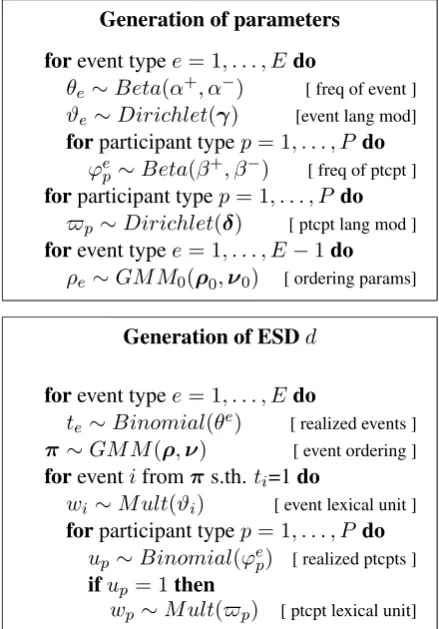
The formalized generative story is given in Fig-ure 1. For each document (ESD)d, we decide in-dependently for each event type ewhether to re-alize it or not by drawing from Binomial(θe).2 We obtain a binary event vectortwherete = 1if event typeeis realized andte= 0otherwise. We draw an event orderingπfromGMM(ρ), repre-sented as a vector of inversion counts.
Now, we pass event types in the order defined by π. For each realized event type i (i.e., i :
ti = 1), we first generate a word (normally a predicate) from the corresponding language model
Mult(ϑi). Then we independently decide for each participant typepwhether to realize it or not with the probability Binomial(ϕi
p). If realized, the participant word (its syntactic head) is generated from the participant language modelMult($p).
Note that though the distribution controlling frequency of participant generation (ϕi
j) is event type-specific, the language model associated with the participant (Mult($j)) is shared across events, thus, ensuring that participant types are de-fined across events.
The learnt binary realization parameters θ and ϕe should ensure that an appropriate number of events and participants is generated (e.g. the real-ization probability for obligatory events, observed in almost every ESD for a particular scenario, should be close to 1).
Priors We draw the parameters for the binomial distributions from the Beta distribution, which al-lows us to model a global preference for using only few event types and only few participant types for each event type. We draw the parame-ters of the multinomials from the Dirichlet distri-bution, and can thus model a preference towards sparsity. The GMM parameter vectorρ is drawn fromGMM0(c.f. Equation (2)).
4.3 Adding Prior Knowledge
Since we are faced with a limited amount of train-ing data, we augment the model described above
2We slightly abuse the notation by dropping the
Generation of parameters forevent typee= 1, . . . , E do
θe∼Beta(α+, α−) [ freq of event ]
ϑe∼Dirichlet(γ) [event lang mod] forparticipant typep= 1, . . . , P do
ϕe
p ∼Beta(β+, β−) [ freq of ptcpt ] forparticipant typep= 1, . . . , P do
$p ∼Dirichlet(δ) [ ptcpt lang mod ] forevent typee= 1, . . . , E−1do
ρe∼GMM0(ρ0,ν0) [ ordering params]
Generation of ESDd
forevent typee= 1, . . . , E do
te∼Binomial(θe) [ realized events ] π∼GMM(ρ,ν) [ event ordering ]
foreventifromπs.th.ti=1do
wi ∼Mult(ϑi) [ event lexical unit ] forparticipant typep= 1, . . . , P do
up ∼Binomial(ϕep) [ realized ptcpts ] ifup = 1then
[image:5.595.320.525.61.226.2]wp∼Mult($p) [ ptcpt lexical unit]
Figure 1: The generative story of the basic model.
to encode correlations between semantically simi-lar words in the priors for language models. We describe our approach by first introducing the model extension allowing for injecting prior cor-relations between words, and then explaining how the word correlations are derived from WordNet (Fellbaum, 1998). Since the event vocabulary and the participant vocabulary are separate in our model, the following procedure is carried out sep-arately, but equivalently, for the two vocabularies. 4.3.1 Modeling Word Correlation
Dirichlet distributions do not provide a way to en-code correlations between words. To tackle this problem we add another level in the model hier-archy: instead of specifying priors Dirichlet(γ) andDirichlet(δ) directly, we generate them for each event typeeand participant typepusing mul-tivariate normal distributions.
The modification for the generative story is shown in Figure 2. In this extension, each event typeeand participant typephas a different associ-ated (nonsymmetric) Dirichlet prior,γeandδp, re-spectively. The generative story for choosingγeis the following: A vectorηeis drawn from the zero-mean normal distributionN(Ση,0), whereΣη is
Generation of parametersϑeand$p forevent typee= 1, . . . , E do
ηe∼N(Σ η,0) forall wordswdo
γe
w=exp(ηwe)/Pw0exp(ηew0)[ Dir prior]
ϑe∼Dirichlet(γe) [event lang mod] forparticipant typep= 1, . . . , P do
ξp ∼N(Σξ,0) forall wordswdo
δpw=exp(ξwp)/Pw0exp(ξwp0) [ Dir prior]
[image:5.595.71.291.63.378.2]$p∼Dirichlet(δp) [ ptcpt lang mod ]
Figure 2: The modified parameter generation pro-cedure forϑeand$pto encode word correlations.
the covariance matrix encoding the semantic relat-edness of words (see Section 4.3.2). The vector’s dimensionality corresponds to size of the vocab-ulary of event words. Then, the vector is expo-nentiated and normalized to yieldγe.3 The same
procedure is used to chooseδpas shown in Figure 2.
4.3.2 Defining Semantic Similarity
We use WordNet to obtain semantic similarity scores for each pair of words in our vocabulary. Since we work on limited domains, we define a subset of WordNet as all synsets that any word in our vocabulary is a member of, plus the hypernym sets of all these synsets. We then create a feature vector for each wordf(wi)as follows:
f(wi)n=
(
1 any sense ofwi∈synsetn 0 otherwise
The similarity of two words wi and wj is de-fined as the dot productf(wi)·f(wj). We use this similarity to define the covariance matricesΣηand Σξ. Each component (i, j) stores the similarity between wordswi andwj as defined above. Note that the matrices are guaranteed to be valid covari-ance matrices, as they are positive semidefinite by construction.
5 Inference
Our goal is to infer the set of labelings z of our corpus of ESDs. A labeling z consists of event
3In fact, Dirichlet concentration parameters do not need
typest, participant typesuand event orderingπ. Additionally, we induce parameters of our model: ordering dispersion parameters (ρ) and the lan-guage model parametersηandξ. We induce these variables conditioned on all the observable words in the data setw. Since direct joint sampling from the posterior distributions is intractable, we use Gibbs sampling for approximate inference. Since we chose conjugate prior distributions over the pa-rameter distributions, we can “collapse” the Gibbs sampler by integrating out all parameters (Grif-fiths and Steyvers, 2004), except for the ones listed above. The unnormalized posterior can be written as the following product of terms:
P(z,ρ,η,ξ|w)∝Y
e
DCMe
Y
p
DCMp
Y
e
BBMe
Y
p
BBMep
Y
e
GMMe MNe
Y
p
MNp.
The termsDCMeandDCMp are Dirichlet com-pound multinomials associated with event-specific and participant-specific language models:
DCMe= Γ(
P
vγve) Γ(PvNe
v +γve)
Y
v Γ(Ne
v +γev) Γ(γe
v)
DCMp= Γ(
P
vδpv) Γ(PvNvp+δpv)
Y
v
Γ(Nvp+δpv) Γ(δpv) , where Ne
v and Nvp is the number of times word type v is assigned to event e and participant p, respectively. The termsBBMe andBBMep are the Beta-Binomial distributions associated with generating event types and generating participant types for each event type (i.e. encoding optionality of events and participants):
BBMe∝ Γ(N
+
e +α+)Γ(Ne−+α−) Γ(Ne++Ne−+α++α−)
BBMep∝
Y
e
Y
p
Γ(N+
ep+β+)Γ(Nep−+β−) Γ(N+
ep+Nep−+β++β−),
whereN+
e andNe−is the number of ESDs where event type is generated and the number of ESD where it is not generated, respectively. N+
ep and
N−
ep are analogously defined for participant types (for each event type e). The term GMMe is as-sociated with the inversion count distribution for event typeeand has the form
GMMe ∝GMM0(ρe;
P
dved+ve,0ν0
N +ν0 , N +ν0),
whereGMM0is defined in expression (2) andved is the inversion count for eventein ESDd. N is the cumulative number of event occurrences in the data set.
Finally, MNe and MNp correspond to the probability of drawing ηe and ξp from the cor-responding normal distributions, as discussed in Section 4.3.1.
Though, at each step of Gibbs sampling, com-ponents of z could potentially be sampled by considering the full unnormalized posterior, this clearly can be made much more efficient by ob-serving that only a fraction of terms affect the cor-responding conditional probability. For example, when sampling an event type for a given event in a ESDd, only the termsDCMe,BBMep and
BBMe for alleandpare affected. For DCMs it can be simplified further as only a few word types are affected. Due to space constraints, we cannot describe the entire sampling algorithms but it natu-rally follows from the above equations and is sim-ilar to the one described in Chen et al. (2009).
For sampling the other parameters of our model, ranking dispersion parametersρand the language model parametersηandξ, we use slice sampling (MacKay, 2002). For each event typeewe draw its dispersion parameterρeindependently from the slice sampler.
After every nth iteration we resample η and ξ for all language models to capture the corre-lations. However, to improve mixing time, we also resample components ηk
i andηli when word
i has changed event membership from type k to type l. In addition we define classes of closely related words (heuristically based on the covari-ance matrix) by classifying words as related when their similarity exceeds an empirically determined threshold. We also resample all components ηk j andηl
j for each wordjthat related to wordi. We re-normalizeηm andηn after resampling to up-date the Dirichlet concentration parameters. The same procedure is used for participant language models (parametersξ).
6 Evaluation
Scenario Name ]ESDs Avg len OMICS corpus
Cook in microwave 59 5.03
Answer the telephone 55 4.47
Buy from vending machine 32 4.53
Make coffee 38 5.00
R10 corpus
Iron clothes 19 8.79
Make scrambled eggs 20 10.3
Eat in fast food restaurant 15 8.93 Return food (in a restaurant) 15 5.93
Take a shower 21 11.29
[image:7.595.85.279.60.201.2]Take the bus 19 8.53
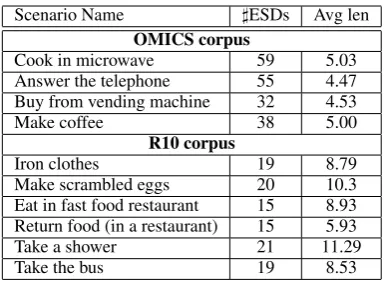
Table 1: Test scenarios used in experiments (left), the size of the corresponding corpus (middle), and the average length of an ESD in events (right).
6.1 Data
We use the data sets presented in Regneri et al. (2010) (henceforth R10) for development and test-ing. The data is comprised of ESDs from two cor-pora. R10 collected a corpus, consisting of sets of ESDs for a variety of scenarios, via a web exper-iment from non-expert annotators. In addition we use ESDs from the OMICS corpus4
(Kochender-fer and Gupta, 2003), which consists of instantia-tions of descripinstantia-tions of several ‘stories’, but is re-stricted to indoor activities. The details of our data are displayed in Table 1. For each event descrip-tion we extract all noun phrases, as automatically identified by Regneri et al. (2011), separating par-ticipant descriptions from action descriptions. We remove articles and pronouns, and reduce NPs to their head words.
6.2 Gold Standard and Evaluation Metrics We follow R10 in evaluating induced event types and orderings in a binary classification setting. R10 collected a gold standard by classifying pairs of event descriptions w.r.t. whether or not they are paraphrases. Our model classifies two event de-scriptions as equivalent wheneverze1 =ze2.
Equivalently, R10 classify ordered pairs of event descriptions as to whether they are presented in their natural order. Assuming the identity order-ing as canonical orderorder-ing in the Generalized Mal-lows Model, event types tending to occur earlier in the script should be assigned lower cluster IDs than event types occurring later. Thus, whenever
ze1 < ze2, our the model predicts that two event
descriptions occur in their natural order.
4http://csc.media.mit.edu/
Event Paraphrase Evt. Ordering
P R F P R F
[image:7.595.307.529.62.207.2]Ret. Food 0.92 0.52 0.67 0.87 0.72 0.79 -GMM 0.70 0.30 0.42 0.46 0.44 0.45 -COVAR 0.92 0.52 0.67 0.77 0.67 0.71 Vending 0.76 0.78 0.77 0.90 0.74 0.81 -GMM 0.74 0.39 0.51 0.64 0.47 0.54 -COVAR 0.74 0.87 0.80 0.85 0.73 0.78 Shower 0.68 0.67 0.67 0.85 0.84 0.85 -GMM 0.36 0.17 0.23 0.42 0.38 0.40 -COVAR 0.64 0.44 0.52 0.77 0.73 0.75 Microwave 0.85 0.80 0.82 0.91 0.74 0.82 -GMM 0.88 0.30 0.45 0.67 0.62 0.64 -COVAR 0.89 0.81 0.85 0.92 0.82 0.87
Table 2: Comparison of model variants: For each scenario: The full model (top), a version without the GMM (-GMM), and a version with a uniform Dirichlet prior over language models (-COVAR).
We evaluate the output of our model against the described gold standard, using Precision, Recall and F1 as evaluation metrics, so that our results are directly comparable to R10. We tune our parame-ters on a development set of 5 scenarios which are not used in testing.
6.3 Results
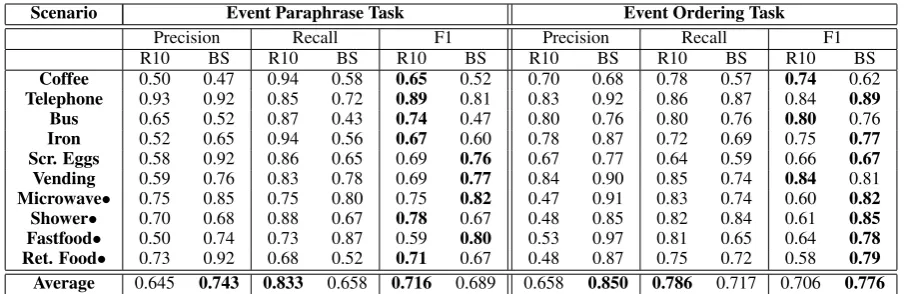
Table 3 presents the results of our two evaluation tasks. While on the event paraphrase task the R10 system performs slightly better, our model out-performs the R10 system on the event ordering task by a substantial margin of 7 points average F-score. While both systems perform similarly on the task of event type induction, we induce ajoint model for both objectives. The results show that, despite the limited amount of data, and the more complex learning objective, our model succeeds in inducing event types and ordering constraints.
In order to demonstrate the benefit of the GMM, we compare the performance of our model to a variant which excludes this component (-GMM), cf. Table 2. The results confirm our expectation that biasing the model towards encouraging a lin-ear ordering on the event types provides a strong cue for event cluster inference.
As an example of a clustering learnt by our model, consider the following event chain:
{get} → {open,take} → {put,place} → {close} → {set,select,enter,turn} → {start} → {wait} → {remove,take,open} → {push,press,turn}
Scenario Event Paraphrase Task Event Ordering Task
Precision Recall F1 Precision Recall F1
R10 BS R10 BS R10 BS R10 BS R10 BS R10 BS
[image:8.595.73.534.61.208.2]Coffee 0.50 0.47 0.94 0.58 0.65 0.52 0.70 0.68 0.78 0.57 0.74 0.62 Telephone 0.93 0.92 0.85 0.72 0.89 0.81 0.83 0.92 0.86 0.87 0.84 0.89 Bus 0.65 0.52 0.87 0.43 0.74 0.47 0.80 0.76 0.80 0.76 0.80 0.76 Iron 0.52 0.65 0.94 0.56 0.67 0.60 0.78 0.87 0.72 0.69 0.75 0.77 Scr. Eggs 0.58 0.92 0.86 0.65 0.69 0.76 0.67 0.77 0.64 0.59 0.66 0.67 Vending 0.59 0.76 0.83 0.78 0.69 0.77 0.84 0.90 0.85 0.74 0.84 0.81 Microwave• 0.75 0.85 0.75 0.80 0.75 0.82 0.47 0.91 0.83 0.74 0.60 0.82 Shower• 0.70 0.68 0.88 0.67 0.78 0.67 0.48 0.85 0.82 0.84 0.61 0.85 Fastfood• 0.50 0.74 0.73 0.87 0.59 0.80 0.53 0.97 0.81 0.65 0.64 0.78 Ret. Food• 0.73 0.92 0.68 0.52 0.71 0.67 0.48 0.87 0.75 0.72 0.58 0.79 Average 0.645 0.743 0.833 0.658 0.716 0.689 0.658 0.850 0.786 0.717 0.706 0.776
Table 3: Results of our model for the event paraphrase task (left) and event type ordering task (right). Our system (BS) is compared to the system in Regneri et al. (2010) (R10). We were able to obtain the R10 system from the authors and evaluate on additional scenarios for which no results are reported in the paper. These additional scenarios are marked with a dot (•).
inferred for the “Microwave” scenario. Clusters are sorted by event type ID. Note that the word ‘open’ is assigned to two event types in the se-quence, which is intuitively reasonable. This illus-trates why assuming a deterministic mapping from predicates to events (as in Chambers and Jurafsky (2008)) is limiting for our dataset.
We finally examined the influence of the in-formed prior component, comparing to a model variant which uses uniform Dirichlet parameters (-COVAR; see Table 2). As expected, using an in-formed prior component leads to improved perfor-mance on scenario types with fewer training ESDs available (‘Take a shower’ and ‘Return food’; cf. Table 1). For scenarios with a larger set of training documents no reliable benefit from the informed prior is observable. We did not optimize this com-ponent, e.g. by testing more sophisticated meth-ods for construction of the covariance matrix, but expect to be able to improve its reliability.
7 Discussion
The evaluation shows that our model is able to create meaningful event type clusters, which re-semble the underlying event ordering imposed by the scenario. We achieve an absolute average im-provement of 7% over a state-of-the-art model. In contrast to previous approaches to script induc-tion, our model does not include specifically cus-tomized components, and is thus flexibly applica-ble without additional engineering effort.
Our model provides a clean, statistical formula-tion of the problem of jointly inducing event types and their ordering. Using a Bayesian model
al-lows for flexible enhancement of the model. One straightforward next step would be to explore the influence of participants, and try to jointly infer them with our current set of latent variables.
Statistical models highly rely on a sufficient amount of training data in order to be able to induce latent structures. The limited amount of training data in our case is a bottleneck for the per-formance. The model performs best on the two scenarios with the most training data (‘Telephone’ and ‘Microwave’), which supports this assump-tion. We showed, however, that our model can be applied to small data sets through incorporation of informed prior knowledge without supervision. 8 Conclusion
We presented a hierarchical Bayesian model for joint induction of event clusters and constraints on their orderings from sets of ESDs. We incorporate the Generalized Mallows Model over orderings. The evaluation shows that our model successfully induces event clusters and ordering constraints.
We compare our joint, statistical model to a pipeline based model using MSA for event clus-tering. Our system outperforms the system on the task of event ordering induction by a substantial margin, while achieving comparable results in the event induction task. We could further explicitly show the benefit of modeling global ESD struc-ture, using the GMM.
Acknowledgments
We thank Michaela Regneri for substantial support with the script data, and Mirella Lapata for helpful comments.
References
Collin F. Baker, Charles J. Fillmore, and John B. Lowe. 1998. The berkeley framenet project. In Proceedings of the 36th Annual Meeting of the Association for Computational Linguistics and 17th International Conference on Compu-tational Linguistics, pages 86–90.
A. Barr and E.A. Feigenbaum. 1986. The hand-book of artificial intelligence. 1 (1981). The Handbook of Artificial Intelligence. Addison-Wesley.
David Blei and John Lafferty. 2006. Correlated topic models. InAdvances in Neural Informa-tion Processing Systems 18, pages 147–154. Nathanael Chambers and Dan Jurafsky. 2008.
Un-supervised learning of narrative event chains. In Proceedings of ACL-08: HLT, pages 789–797. Nathanael Chambers and Dan Jurafsky. 2009.
Un-supervised learning of narrative schemas and their participants. In Proceedings of the 47th Annual Meeting of the Association for Compu-tational Linguistics, pages 602–610.
H. Chen, S. R. K. Branavan, R. Barzilay, and D. R. Karger. 2009. Content modeling using latent permutations. Journal of Artificial Intelligence Research, 36(1):129–163.
Christiane Fellbaum, editor. 1998. WordNet: an electronic lexical database. MIT Press.
M. Fligner and J. Verducci. 1986. Distance based ranking models.Journal of the Royal Statistical Society, Series B, 48:359–369.
M. Fligner and J. Verducci. 1990. Posterior prob-abilities for a consensus ordering. Psychome-trika, 55:53–63.
T. L. Griffiths and M. Steyvers. 2004. Finding scientific topics. Proceedings of the National Academy of Sciences, 101(Suppl. 1):5228– 5235.
Alexandre Klementiev, Dan Roth, and Kevin Small. 2008. Unsupervised rank aggregation with distance-based models. InProceedings of the 25th International Conference on Machine Learning, pages 472–479.
Mykel J. Kochenderfer and Rakesh Gupta. 2003. Common sense data acquisition for indoor mo-bile robots. In Proceedings of the Nineteenth National Conference on Artificial Intelligence (AAAI-04), pages 605–610.
D. J. C. MacKay. 2002.Information Theory, Infer-ence & Learning Algorithms. Cambridge Uni-versity Press, New York, NY, USA.
C. L. Mallows. 1957. Non-null ranking models. Biometrika, 44:114–130.
Risto Miikkulainen. 1995. Script-based inference and memory retrieval in subsymbolic story pro-cessing. Applied Intelligence, pages 137–163. Ashutosh Modi, Ivan Titov, and Alexandre
Kle-mentiev. 2012. Unsupervised induction of frame-semantic representations. InProceedings of the NAACL-HLT Workshop on the Induction of Linguistic Structure, pages 1–7.
Erik T. Mueller. 2004. Understanding script-based stories using commonsense reasoning. Cogni-tive Systems Research, 5(4):307–340.
Brendan O’Connor. 2012. Bayesian unsupervised frame learning from text. Technical report, Carnegie Mellon University.
Rajat Raina, Andrew Y. Ng, and Daphne Koller. 2006. Constructing informative priors using transfer learning. InProceedings of the 23rd In-ternational Conference on Machine Learning, pages 713–720.
Michaela Regneri, Alexander Koller, and Manfred Pinkal. 2010. Learning script knowledge with web experiments. In Proceedings of the 48th Annual Meeting of the Association for Compu-tational Linguistics, pages 979–988.
Michaela Regneri, Alexander Koller, Josef Rup-penhofer, and Manfred Pinkal. 2011. Learning script participants from unlabeled data. In Pro-ceedings of RANLP 2011, pages 463–470. Roger C. Schank and Robert P. Abelson. 1975.
Scripts, plans, and knowledge. InProceedings of the 4th International Joint Conference on Ar-tificial Intelligence, IJCAI’75, pages 151–157. Ivan Titov and Alexandre Klementiev. 2011. A