A Multi-task Approach to Predict Likability of Books
Suraj MaharjanDept. of Computer Science University of Houston
Houston, TX, 77004
John Arevalo and Fabio A. Gonz´alez
Computing Systems and Industrial Engineering Dept. Universidad Nacional de Colombia
Bogot´a, Colombia
{jearevaloo, fagonzalezo}@unal.edu.co
Manuel Montes-y-G´omez Instituto Nacional de Astrofısica
Optica y Electronica Puebla, Mexico
Thamar Solorio Dept. of Computer Science
University of Houston Houston, TX, 77004
Abstract
We investigate the value of feature en-gineering and neural network models for predicting successful writing. Similar to previous work, we treat this as a binary classification task and explore new strate-gies to automatically learn representations from book contents. We evaluate our fea-ture set on two different corpora created from Project Gutenberg books. The first presents a novel approach for generating the gold standard labels for the task and the other is based on prior research. Us-ing a combination of hand-crafted and re-current neural network learned representa-tions in a dual learning setting, we obtain the best performance of 73.50% weighted F1-score.
1 Introduction
Every year millions of new books are published, but only a few of them turn into commercial suc-cesses, and even fewer achieve critical praise in the form of prestigious awards or meaningful sales. Editors have the difficult task of making the go/no-go decision for all manuscripts they receive, and the revenue for their publishing house depends on the accuracy of that judgment. The website www.litrejections.com documents some of the biggest mistakes in the history of the pub-lishing industry, including Agatha Christie, J.K. Rowling, and Dr. Seuss, all of whom received many rejection letters before landing their first publishing deal.
Many factors contribute to the eventual success of a given book. Internal factors such as plot, story line, and character development all have a role in the likability of a book. External factors such as author reputation and marketing strategy are ar-guably equally relevant. Some factors might even be out of the control of an author or publishing house, such as the current trends, the competition from books released simultaneously, and the his-torical and contextual factors inherent to society.
Previous work by Ganjigunte Ashok et al. (2013) demonstrated relevant results using stylis-tic features to predict the success of books. Their definition of success was a function of the number of downloads from Project Gutenberg. However downloading a book is not by itself an indicator of a highly liked or a commercially successful book. We instead propose to use the rating from review-ers collected from Goodreads as a measure of suc-cess. We also propose features and deep learning techniques that have not been used before on this problem, and validate their usefulness in two dif-ferent tasks: success prediction and genre classifi-cation. Our key contributions are the following:
• We provide a new benchmark dataset for pre-dicting successful books in a more realistic class distribution. This data set is available to the community from this link1.
• We show that sentiment analysis using Sen-ticNet sentics is an accurate way to model emotion in books.
1The data can be downloaded fromhttp://ritual.
uh.edu/resources/page.
• We provide the first results on using recurrent neural networks (RNN) to discover book con-tent representations that are useful for classi-fication tasks such as success prediction and genre detection.
• We show that the multitask approach, simul-taneously evaluating success and genre pre-diction, benefits from its constituent tasks to obtain better performance than the single suc-cess prediction task approach.
2 Previous work
Predicting the success of books is a difficult task, even for an experienced editor. Researchers have studied related tasks, for example predicting the quality of text from lexical features, syntactic fea-tures and different measures of density. Pitler and Nenkova (2008) found a strong correlation between user-perceived text quality and the like-lihood measures of the vocabulary as computed by a language model, as well as the likelihood measures of discourse relations, as determined by a language model trained on discourse relations. Louis and Nenkova (2013) proposed a combina-tion of genre-specific and readability features with topic-interest metrics for the prediction of great writing in science articles. While some of the fea-tures in this prior work were relevant to our task, our goal is different and more aligned to Ganji-gunte Ashok et al. (2013), since we aim to model success in books of different genres.
Ganjigunte Ashok et al. (2013) investigated the correlation between writing style and num-ber of downloads. The authors analyzed lexical features, production rules, constituents, and sen-timent features of books downloaded from Project Gutenberg2. They obtained an average accuracy of
70.38% using only unigram features with Support Vector Machines (SVM) as the classifier.
Deep learning representations have seen their share of successes in Natural Language Process-ing (NLP) tasks (Bahdanau et al., 2014; Zheng et al., 2013; Gao et al., 2014; Glorot et al., 2011; Samih et al., 2016). In particular, RNN models have been successfully applied in sev-eral scenarios where temporal dependencies pro-vide relevant information (Ian Goodfellow and Courville, 2016; LeCun et al., 2015). Kiros et al. (2015) used RNN models to learn language
2https://www.gutenberg.org/
models from books using an unsupervised ap-proach. Also, word embedding (Mikolov et al., 2013) and Paragraph Vector (Le and Mikolov, 2014) have been shown to achieve state-of-the-art performance in several text classification and sentiment classification tasks. These techniques are able to learn distributed vector representa-tions that capture semantic and syntactic rela-tionships between words. Collobert and Weston (2008) trained jointly a single Convolutional Neu-ral Network (CNN) architecture on different NLP tasks and showed that multitask learning increases the generalization of the shared tasks. Other re-searchers (Ian Goodfellow and Courville, 2016; Søgaard and Goldberg, 2016; Attia et al., 2016) have also reached to similar conclusions.
3 Dataset
We experimented with two book collections: one prepared by Ganjigunte Ashok et al. (2013)3 and
the other constructed by us to evaluate a new def-inition of success. We refer to the first dataset as EMNLP13 and the second dataset as Goodreads.
The EMNLP13 collection contained Project Gutenberg books from eight different genres. The authors created a balanced dataset containing 100 books per genre, resulting in a total of 800 books. We manually reviewed the dataset and found miss-ing or irrelevant content in 58 books: a total of 53 books contained Project Gutenberg license in-formation repeated verbatim, and five books con-tained only the audio recording certificate in place of the actual book content. We removed the license-related text, since lexical features might be erroneously biased, and replaced the five files with the actual content of the books. Except for these corrections, the data we used is the same as that presented in Ganjigunte Ashok et al. (2013).
We also identified some odd adjudications. For example, ‘The Prince And The Pauper’ is a pop-ular book by Mark Twain that was adapted into various films and stage plays. Also, ‘The Adven-tures of Captain Horn’ was the third best selling book of 1895 (Hackett, 1967). Both these books are labeled as unsuccessful due to their low down-load counts. We suspect as well that some of the counts are inflated by college students doing En-glish or Literature assignments that may not be di-rectly related to the potential commercial success
3The data can be downloaded fromhttp://www3.cs.
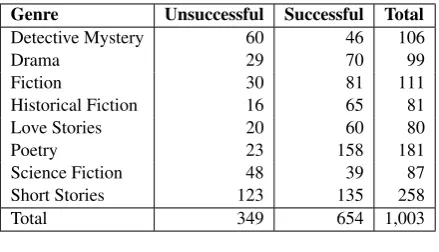
Genre Unsuccessful Successful Total
Detective Mystery 60 46 106
Drama 29 70 99
Fiction 30 81 111
Historical Fiction 16 65 81
Love Stories 20 60 80
Poetry 23 158 181
Science Fiction 48 39 87
Short Stories 123 135 258
Total 349 654 1,003
Table 1:Goodreads Data Distribution
EMNLP13 Success definition
Unsuccessful Successful
Goodreads
[image:3.595.72.292.61.187.2]Success definition Unsuccessful 73Successful 110 32184
Table 2: Confusion matrix between two different defini-tions of success.
of a book.
To address these concerns, we propose a new approach to creating gold labels for success-ful books based on public reviews rather than download counts. We collected a new set of Project Gutenberg books for this benchmarking. We mapped the books to their review pages on Goodreads4, a website where book lovers can
search, review, and rate books. We consider only those books that have been rated by at least 10 peo-ple. We use the average star rating and total num-ber of reviews for labeling each book. We then set an average rating of 3.5 as the threshold for suc-cess, such that books with average rating < 3.5 are classified asUnsuccessful. Table 1 shows the data distribution of our books. To our knowledge, we have one of the largest collection of books, as researchers generally work with a low number of books (Coll Ardanuy and Sporleder, 2014; Goyal et al., 2010; van Cranenburgh and Koolen, 2015).
Success Definitions Comparison: After com-piling and labeling both the datasets, we drew a comparison between the two definitions of success. To do this, we downloaded the Project Gutenberg download counts for the books in Goodreads dataset and labeled them using the Ganjigunte Ashok et al. (2013) definition of success. Since they only considered books in the extremes of download counts, we could only la-bel 399 books in the Goodreads dataset using their definition. We found that 142 books had differ-ent labels according to the two definitions. 19.7% of these mismatched books were labeled as
unsuc-4https://www.goodreads.com/
cessful despite having ratings≥3.5 and being re-viewed by more than 100 reviewers. Table 2 de-tails the discrepancies between the two definitions.
4 Methodology
We investigated a wide range of textual features in an attempt to capture the topic, sentiment, writ-ing style, and readability for each book. This set included both new and previously used fea-tures. We also explored techniques for automati-cally learning representations from text using neu-ral networks, which have been shown to be suc-cessful in various text classification tasks (Kiros et al., 2015; LeCun et al., 2015). These techniques include word embeddings, document embeddings, and recurrent neural networks.
4.1 Hand-crafted text features
Lexical: We used skip-grams, charn-grams, and typed char n-grams (Sapkota et al., 2015) with term frequency-inverse document frequency (TF-IDF) as the weighting scheme. Sapkota et al. (2015) showed that classical character n-grams lose some information in merging instances ofn -grams like the which could be a prefix (thesis), a suffix (breathe), or a standalone word (the). They separated character n-grams into ten cate-gories representing grammatical classes, like af-fixes, and stylistic classes, like beg-punct and mid-punct which reflect the position of mid-punctuation marks in then-gram. The purpose of these fea-tures is to correlate success with an author’s word choice.
Constituents: We computed the normalized counts of‘SBAR’, ‘SQ’, ‘SBARQ’, ‘SINV’,and‘S’ syntactic tag sets from the parse tree of each sen-tence in each book, following the method of Gan-jigunte Ashok et al. (2013) to determine the syn-tactic style of the authors.
Sentiment: We computed sentence neutrality, positive and negative, using SentiWordNet (Bac-cianella et al., 2010) along with the counts of nouns, verbs, adverbs, and adjectives. We aver-aged these scores for every 50 consecutive sen-tences in order to evaluate change in sentiment throughout the course of each book, because we anticipate emotions, like suspense, anger, and hap-piness to contribute to the success of the book.
well how has it been with you since
we met that last strange
time of
GRU GRU GRU
GRU GRU GRU
Genre Softmax Success Softmax
Cross-entrop
y
Loss
Input
[image:4.595.77.293.61.216.2]words embeddingword2vec representationAverage Recurrentlayers MultitaskClassifier
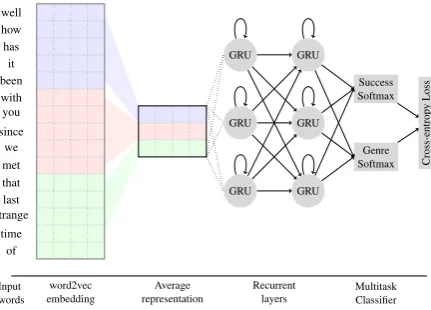
Figure 1: Multitask method. Words are represented in the Word2Vec space. Such representations are averaged per win-dow. Sequences are feed to GRU network. Finally, the fea-tures are feed to two softmax components to predict genre and success simultaneously.
Parser5. The parser chunks a sentence into noun
and verb clauses, and extracts concepts from them using Part Of Speech (POS) bigram rules. We modeled these as binary bag-of-concepts (BoC) features. We also extracted average polarity, sensitivity, attention, pleasantness, and aptitude scores for the concepts defined in the SenticNet-3.0 knowledgebase, which contains semantics and sentics associated with 30,000 common-sense concepts (Cambria and Hussain, 2015).
Writing density: We computed the number of words, characters, uppercase words, exclamations, question marks, as well as the average word length, sentence length, words per sentence, and lexical diversity of each book, with the expecta-tion that successful and unsuccessful writings will have dissimilar distributions of these density met-rics.
Readability: We computed multiple readability measures including Gunning Fog Index (Gunning, 1952), Flesch Reading Ease (Flesch, 1948), Flesch Kincaid Grade Level (Kincaid et al., 1975), RIX, LIX (Anderson, 1983), ARI (Senter and Smith, 1967), and Smog Index (Mc Laughlin, 1969) and used their mean normalized values for training. In-tuitively, the use of simple language will resonate with a larger audience and contribute to book suc-cess.
4.2 Neural network learned representations
Representation learning techniques are able to learn a set of features automatically from the raw data. Our hypothesis is that the learned representa-tion can capture the complex factors that influence the success of a book.
Word embeddings with Book2Vec: In contrast with Word2Vec, which learns a representation for individual words, Doc2Vec learns a representa-tion for text fragments or even for full docu-ments. We trained the Doc2Vec module of the Gensim ( ˇReh˚uˇrek and Sojka, 2010) Python library, on all the books in the Goodreads dataset to ob-tain a 500 dimensional dense vector representation for each book. Using Doc2Vec, we first trained a distributional memory (DM) model with two ap-proaches: concatenation of context vectors (DMC) and sum of context word vectors (DMM). Then we trained a distributional bag of words (DBoW) model and combined it with the DMC and the DMM for a total of five different models. We set the number of iterations to 50 epochs and shuf-fled the training data in each pass. We called these book vectors Book2Vec. Furthermore, we cre-ated two 300 dimensional vector representations for each book by averaging the vectors of each word in the book using pre-trained Word2Vec vec-tors from the Google News dataset6 and our own
Word2Vec trained with∼350M words from 5,000 random books crawled from Project Gutenberg.
Multitask RNN method: When dealing with variable length data such as time series or plain text, traditional approaches like feed-forward neu-ral networks are not easily adapted since they ex-pect fixed-size input to model sequential data. One limitation of RNNs is that it has problems dealing with long sequences (Pascanu et al., 2013). We propose a strategy to represent large documents, such as books, with an aggregated representation. Figure 1 depicts the proposed multitask method. The overall strategy uses a RNN to learn a model of sequences of sentences. Each sentence is repre-sented by the average of the Word2Vec represen-tation of its constituent words. The RNN is com-posed of 2 hidden layers with 32 hidden gated re-current units (GRU) (Cho et al., 2014) each, and the output is a softmax layer. We train the RNN
5https://github.com/pbhuss/
Sentimental/blob/master/parser/ SenticParser.py
6The pre-trained Word2Vec was downloaded
in a supervised fashion using the success catego-rization and the book genre as labels. The RNN serves a feature extractor and the last hidden states for each sequence acts as its representation. At training time, all sentences from one book are ex-tracted and divided in chunks of 128 sentences. The book’s success/genre labels are assigned to each sequence. A sentence is then represented as the average of its constituent word vectors. To make the book label assignment at testing time, we average the predictions of all sequences extracted from each book. Using 128 sentences has three-fold a motivation: (1) mitigate vanishing gradient problem (Pascanu et al., 2013), (2) obtain more examples from one book, and (c) be a power of 2 to efficiently use the GPU.
An interesting property of neural networks is that the same learning approach, i.e stochastic gra-dient descent, still holds for more complex archi-tectures as long as the objective cost function is differentiable. We take advantage of this property to build a unified neural network that addresses both genre and success prediction using a single model. These kinds of multitask architectures are also useful as regularizers (Ian Goodfellow and Courville, 2016). In particular, our cost function
J(X, Y)is defined as follows:
hi =rnn(xi)
ˆ
ysucci = ez
succ i P
kezksucc ˆ
yigen= ez
gen i P
lez gen l
J(X, Y) =−X
i
(ysucc
i ln ˆyisucc+yigenln ˆyigen)
wherexirepresents thei-th sample andysucc and ygenare success and genre labels respectively. The rnn(·) function represents the forward propaga-tion over the recurrent neural network and h rep-resents the last hidden state. yˆsucc andyˆgen rep-resent predictions for the two labels. Notice that both of them are computed using the same unified representationh.zsuccandzgenrepresent two dif-ferent linear transformations overhthat map to the number of classes.
5 Experiments and Results
5.1 Experiments on Goodreads dataset
We merged books from different genres, and then randomly divided the data into a 70:30
train-ing/test ratio, while maintaining the distribution ofSuccessfulandUnsuccessfulclasses per genre. As a preprocessing step we converted all words to lowercase and removed infrequent tokens hav-ing document frequency ≤ 2. For our tag-ging and parsing needs, we used the Stanford parser (Socher et al., 2013). We then trained a Li-bLinear Support Vector Machine (SVM)7
classi-fier with L2 regularization using the hand-crafted features described in Section 4. We tuned the C parameter in the training set with 3-fold grid search cross-validation over different values of 1e{-4,...,4}.
With the features used by Ganjigunte Ashok et al. (2013), we obtained the highest weighted F1-score of 0.659 with word bigram features. We set this value as our baseline. In order to study the effect of the multitask approach, we devised analogous experiments to our proposed multitask RNN method and predicted both genre and suc-cess together for the features described in Sec-tion 4. Hence we have two settings for the clas-sification experiments, Single task (ST) and Mul-titask (MT).
Since we had average rating information, we also modeled the problem as a regression prob-lem and predicted the average rating using only the content of the books. Our work differs from other researchers in this aspect, as most of them (Lei et al., 2016; Li et al., 2011; Mudambi et al., 2014) use review content instead of the actual book con-tent to predict the average rating. We used the Elastic Net regression algorithm with l1 ratio
tuned over range{0.01, 0.05, 0.25, 0.5, 0.75, 0.95, 0.99} with 3-fold grid search cross-validation of the training data.
Parameter tuning for RNN: We trained 25 mod-els with random hyper-parameter initialization for learning rate, weights initialization ranges and reg-ularization parameters. We chose the best valida-tion performance model. This is preferable over grid search when training deep models (Bergstra and Bengio, 2012). We used the ADAM algo-rithm (Kingma and Ba, 2014) to update the gra-dients. Since these models are prone to overfitting because of the high number of parameters, we ap-plied clip gradient, max-norm weights, early stop-ping and dropout regularization strategies.
7We use LibLinear SVM wrapper from http://
Features ST (F1) MT (F1) MSE
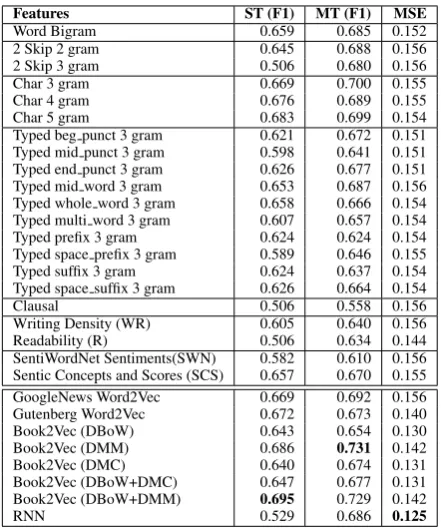
Word Bigram 0.659 0.685 0.152 2 Skip 2 gram 0.645 0.688 0.156 2 Skip 3 gram 0.506 0.680 0.156 Char 3 gram 0.669 0.700 0.155 Char 4 gram 0.676 0.689 0.155 Char 5 gram 0.683 0.699 0.154 Typed beg punct 3 gram 0.621 0.672 0.151 Typed mid punct 3 gram 0.598 0.641 0.151 Typed end punct 3 gram 0.626 0.677 0.151 Typed mid word 3 gram 0.653 0.687 0.156 Typed whole word 3 gram 0.658 0.666 0.154 Typed multi word 3 gram 0.607 0.657 0.154 Typed prefix 3 gram 0.624 0.624 0.154 Typed space prefix 3 gram 0.589 0.646 0.155 Typed suffix 3 gram 0.624 0.637 0.154 Typed space suffix 3 gram 0.626 0.664 0.154 Clausal 0.506 0.558 0.156 Writing Density (WR) 0.605 0.640 0.156 Readability (R) 0.506 0.634 0.144 SentiWordNet Sentiments(SWN) 0.582 0.610 0.156 Sentic Concepts and Scores (SCS) 0.657 0.670 0.155 GoogleNews Word2Vec 0.669 0.692 0.156 Gutenberg Word2Vec 0.672 0.673 0.140 Book2Vec (DBoW) 0.643 0.654 0.130 Book2Vec (DMM) 0.686 0.731 0.142 Book2Vec (DMC) 0.640 0.674 0.131 Book2Vec (DBoW+DMC) 0.647 0.677 0.131 Book2Vec (DBoW+DMM) 0.695 0.729 0.142
[image:6.595.71.292.60.325.2]RNN 0.529 0.686 0.125
Table 3:Results for classification (ST = Single task setting, MT = Multi-task setting) and regression tasks on Goodreads dataset. MSE = Mean Square Error, F1 score is weighted F1 scores acrossSuccessfulandUnsuccessfulclasses.
5.2 Results on Goodreads dataset
Table 3 shows the results with our new proposed feature sets for the classification and regression tasks. In the ST setting, except for the charactern -gram features, all proposed hand-crafted features individually had a weighted F1-score less than the word bigram baseline. On the other hand, the neu-ral network methods obtained better results than the baseline. We obtained the highest weighted F1-score of 0.695 and 0.731 with the Book2Vec method in the ST and MT settings, respectively. The results show that the MT approach is better than the ST approach. The genre prediction task must have acted as a regularizer for the success prediction task. Also, we found that modeling the entire book as a vector, rather than modeling it as the average of word vectors, gave better per-formance. Although the ST Book2Vec performs better than the MT RNN method, the difference is very small. We performed McNemar’s test on these methods and found that the results were not statistically significant, withp=0.5. The MT RNN method had the lowest mean square error (MSE) for the regression task, at 0.125.
The character ngram proved to be one of the most important hand-crafted features, whereas clausal feature was the least important one.
In-Features ST (F1) MT (F1) MSE
Unigram+Bigram 0.660 0.691 0.15 Unigram+Bigram+Trigram 0.660 0.700 0.149 Char 3,4,5 gram 0.682 0.689 0.153 All Typed ngram 0.663 0.691 0.144 SCS+WR+Typed mid word 0.720 0.710 0.155 SCS+Book2Vec 0.695 0.731 0.139 R+Book2Vec 0.695 0.729 0.139 WR+Book2Vec 0.693 0.726 0.139 Word Ngram+ RNN 0.691 0.688 0.125 Skip gram + RNN 0.689 0.683 0.125 Typed char ngram+ RNN 0.689 0.702 0.125 Char 3 gram + RNN 0.689 0.688 0.125 Clausal+ RNN 0.689 0.688 0.125 SCS + RNN 0.691 0.688 0.125 WR+Book2Vec+ RNN 0.701 0.735 0.129 SCS+WR+RNN 0.675 0.696 0.123
[image:6.595.305.526.60.245.2]All hand-crafted 0.670 0.689 0.148 All hand-crafted+neural 0.667 0.712 0.129
Table 4: Feature Combination Results for Goodreads dataset. (ST = Single Task, MT =Multi-task, SCS = Sentic concept+average scores of sensitivity, attention, pleasantness, aptitude, polarity, WR = Writing Density, R = Readability)
dividually, writing density and readability features seemed to be weak features. We assumed that the sentiment changes in books would be an important characteristic for the task. However, the results in Table 3 show an unimpressive F1-score of 0.610 for sentiment features. On the other hand, the bag of sentic concepts model with average scores for sensitivity, attention, pleasantness, aptitude, and polarity gave a more impressive F1-score of 0.670, much higher than the baseline. This result points to the relevance of performing a more nuanced sentiment analysis beyond lexical statistics for this task.
5.3 Results on EMNLP13 dataset
We tried to reproduce the results reported in Gan-jigunte Ashok et al. (2013) by re-implementing their system. Unlike our setup, they performed ex-periments on individual genres and reported aver-age accuracy across all genres. We obtained sim-ilar results, but not as close as we expected, even after extensive experimentation, and extending the search for parameter optimization. For most of their features we obtained a lower accuracy8. The
differences may be due to a combination of the cu-rating process we described in Section 3 that cor-rected content in the books used, as well as the dif-ferent set of parameter values we explored for tun-ing the classifier. As pointed out by Fokkens et al. (2013), even seemingly small differences in pre-processing can prevent reproducibility.Hence, we consider our best accuracy so far (71.25%) to be the state-of-the-art performance on this data set.
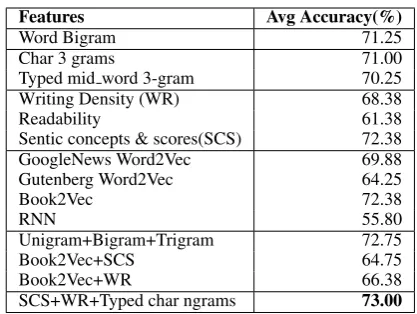
Table 5 shows the results from some of our best feature sets. The features that worked best for the Goodreads data also worked best for the EMNLP13 data. Significantly, with the combi-nation of the sentic concepts and scores, typed
ngrams, and writing density, we obtained an av-erage accuracy of 73.00%, much higher than the baseline score of 71.25% for this dataset.
The RNN performance was very low in compar-ison with the handcrafted features. We relate this behavior to the small size of this particular training dataset and evaluation setup. Notice that Ganji-gunte Ashok et al. (2013) experimented per genre, i.e. trained a single classifier per genre. Thus, in a 5-fold approach we only have 80 samples to train and 20 to test. Additionally, we must take out some samples from the training data for validation. It has been empirically shown that one of the key elements in the success of representation learning strategies is a large amount of data, on the order of tens of thousands of samples at least. Moreover, in the EMNLP13 dataset, it is not possible to take advantage of the multitask approach because there is only one target genre in each experiment.
6 Discriminative features
Table 6 lists some of the features that were highly-weighted by the classifier. For the sentic con-cepts, salient features included important adjec-tives, verbs and relations; all objects that might
8There was a maximum 4% difference for some features.
Features Avg Accuracy(%)
Word Bigram 71.25
Char 3 grams 71.00
Typed mid word 3-gram 70.25
Writing Density (WR) 68.38
Readability 61.38
Sentic concepts & scores(SCS) 72.38
GoogleNews Word2Vec 69.88
Gutenberg Word2Vec 64.25
Book2Vec 72.38
RNN 55.80
Unigram+Bigram+Trigram 72.75
Book2Vec+SCS 64.75
Book2Vec+WR 66.38
[image:7.595.311.520.59.216.2]SCS+WR+Typed char ngrams 73.00
Table 5: Average accuracy results with new feature and their combinations on EMNLP13 dataset.
Type Features
ngrams . “, . ”, said :, young man, very young man, the young man,boys, . i, father, his father, mother, he said, she said, said NE, princess, lord, colonel, captain, doctor, tour, mr, miss
Sentic concepts
conceive, grieve, zealous, emptiness, bitterness, corpse, hypothesis, irony, theory of the, wagon,deep blue, scarred, screaming, grudging, vigil, vein, beautiful place, rural, marriage, friendship, cats, 911 avg aptitude, polarity, pleasantness, attention scores Character and
typed character ngrams mr., mrs., john, thou, amor, pen, his, and,the, ing,n’s,ed, gg’, pt’, d’a, t”, i-t, , ,”i ,” ”, ” say,” s,” she
Table 6:Discriminative Features
Figure 2:Projection of Book2Vec from four different gen-res into 2D space for the Goodreads dataset.
Figure 3: Projection of successful and unsuccessful books using representation learned with the RNN model.
7 Analysis of learned representations
In order to investigate deep vectors, we projected them onto 2-dimensional space using t-SNE. Fig-ure 2 suggests that the vectors successfully captFig-ure genre-related concepts, as books from the same genre are close to each other in the 2D space. We then performed 8-way genre classification exper-iment using random stratified division of the data into 70:30 training/test ratio. We obtained an ac-curacy of 62.50% and F1 score of 69.30% for the EMNLP13 and Goodreads datasets, respectively. These scores were well above the random baseline of 12.50% accuracy and 15.23% F1-score for the EMNLP13 and Goodreads datasets, respectively. We further found that Poetry and Drama were the most accurately classified genres, whereas Fiction was the most difficult to classify.
In order to further investigate the representa-tions learned by RNN for successful and unsuc-cessful books, we plotted the 2D t-SNE projection of the book representations. Figure 3 shows the
projection of vectors for the Short stories genre. The visualization shows that the RNN is able to cluster the book vectors into two separate regions. Furthermore, to investigate what else the RNN might be learning, we plotted some books by the same authors. Figure 3 also shows books from authors Jack London and Alan E. Nourse. The four books by Jack London and the two books by Alan E. Nourse are very close to each other. We thus infer that along with learning peculiarities of successful and unsuccessful classes, the RNN was able to capture features related to the style of au-thors.
8 How much content is needed for success prediction?
Figure 4: Weighted F1 score for training and validation data for varying number of sentences with char 3 gram fea-ture.
Humans are good at detecting poor writing af-ter reading just a few pages. We wanted to in-vestigate if it is the same for machines. We de-vised stratified 3-fold cross-validation exploratory experiments on training data by gradually increas-ing the content of the books in the trainincreas-ing fold. The results are shown in Figure 4. We see that the cross-validation score gradually increases until we reach 200 sentences. After this point, it plateaued out. Hence, we conclude that 200 sentences is the minimum threshold for the classifier.
9 Conclusions
[image:8.595.320.509.304.459.2]learned features we proposed two different strate-gies based on neural networks. The first ex-tends Word2Vec-type representations to work in large documents such as books, and the second one uses an RNN to capture sequential patterns in large texts. We evaluated our methods on our Goodreads dataset, whose classes are not based on download counts, but rather are a function of average star ratings and number of reviewers. Our results outperform state-of-the-art methods. We conclude that instead of having either deep-learning or hand-crafted features outperform the other, both methods capture complementary infor-mation, which upon combination gives better per-formance. Also, the multitask setting is prefer-able to the single task setting, as the multitask ap-proach helps the classifier better generalize during learning by letting constituent tasks act as regu-larizers. As our next steps, we plan to investi-gate features that capture plot-related aspects, such as character profiles and interaction through so-cial network analysis, historical setting, and other feature-learning strategies.
Acknowledgments
We would like to thank the National Science Foundation for partially funding this work under awards 1462141 and 1549549. We also thank Si-mon Tice and the three anonymous reviewers for reviewing the paper and providing helpful com-ments and suggestions.
References
Jonathan Anderson. 1983. Lix and rix: Variations on a little-known readability index. Journal of Reading, 26(6):490–496.
Mohammed Attia, Suraj Maharjan, Younes Samih, Laura Kallmeyer, and Thamar Solorio. 2016. Cogalex-v shared task: Ghhh - detecting semantic relations via word embeddings. InProceedings of the 5th Workshop on Cognitive Aspects of the Lexi-con (CogALex - V), pages 86–91, Osaka, Japan, De-cember. The COLING 2016 Organizing Committee.
Stefano Baccianella, Andrea Esuli, and Fabrizio Sebas-tiani. 2010. Sentiwordnet 3.0: An enhanced lexical resource for sentiment analysis and opinion mining. InLREC, volume 10, pages 2200–2204.
Dzmitry Bahdanau, Kyunghyun Cho, and Yoshua Bengio. 2014. Neural machine translation by jointly learning to align and translate. CoRR, abs/1409.0473.
James Bergstra and Yoshua Bengio. 2012. Random search for hyper-parameter optimization. Journal of Machine Learning Research, 13(Feb):281–305.
Erik Cambria and Amir Hussain. 2015. Sentic Computing: A Common-Sense-Based Framework for Concept-Level Sentiment Analysis, volume 1. Springer.
Kyunghyun Cho, Bart van Merrienboer, Dzmitry Bah-danau, and Yoshua Bengio. 2014. On the properties of neural machine translation: Encoder–decoder ap-proaches. InProceedings of SSST-8, Eighth Work-shop on Syntax, Semantics and Structure in Statisti-cal Translation, pages 103–111, Doha, Qatar, Octo-ber. Association for Computational Linguistics.
Mariona Coll Ardanuy and Caroline Sporleder. 2014. Structure-based clustering of novels. InProceedings of the 3rd Workshop on Computational Linguistics for Literature (CLFL), pages 31–39, Gothenburg, Sweden, April. Association for Computational Lin-guistics.
Ronan Collobert and Jason Weston. 2008. A unified architecture for natural language processing: Deep neural networks with multitask learning. In Pro-ceedings of the 25th international conference on Machine learning, pages 160–167. ACM.
Rudolph Flesch. 1948. A new readability yardstick. Journal of Applied Psychology, 32(3):221–223.
Antske Fokkens, Marieke van Erp, Marten Postma, Ted Pedersen, Piek Vossen, and Nuno Freire. 2013. Off-spring from reproduction problems: What replica-tion failure teaches us. In Proceedings of the 51st Annual Meeting of the Association for Computa-tional Linguistics (Volume 1: Long Papers), pages 1691–1701, Sofia, Bulgaria, August. Association for Computational Linguistics.
Vikas Ganjigunte Ashok, Song Feng, and Yejin Choi. 2013. Success with style: Using writing style to predict the success of novels. In Proceedings of the 2013 Conference on Empirical Methods in Natu-ral Language Processing, pages 1753–1764, Seattle, Washington, USA, October. Association for Compu-tational Linguistics.
Jianfeng Gao, Xiaodong He, Wen-tau Yih, and Li Deng. 2014. Learning continuous phrase rep-resentations for translation modeling. In Proceed-ings of the 52nd Annual Meeting of the Association for Computational Linguistics (Volume 1: Long Pa-pers), pages 699–709, Baltimore, Maryland, June. Association for Computational Linguistics.
Amit Goyal, Ellen Riloff, and Hal Daume III. 2010. Automatically producing plot unit representations for narrative text. InProceedings of the 2010 Con-ference on Empirical Methods in Natural Language Processing, pages 77–86, Cambridge, MA, October. Association for Computational Linguistics.
Robert Gunning. 1952. The technique of clear writing. McGraw-Hill.
Alice Payne Hackett. 1967. Seventy years of best sell-ers, 1895-1965. RR Bowker Co.
Yoshua Bengio Ian Goodfellow and Aaron Courville. 2016. Deep learning. Book in preparation for MIT Press.
J. Peter Kincaid, Robert P. Fishburne Jr, Richard L. Rogers, and Brad S. Chissom. 1975. Derivation of new readability formulas (automated readability in-dex, fog count and flesch reading ease formula) for navy enlisted personnel. Technical report.
Diederik P. Kingma and Jimmy Ba. 2014. Adam: A method for stochastic optimization. CoRR, abs/1412.6980.
Ryan Kiros, Yukun Zhu, Ruslan R Salakhutdinov, Richard Zemel, Raquel Urtasun, Antonio Torralba, and Sanja Fidler. 2015. Skip-thought vectors. In C. Cortes, N. D. Lawrence, D. D. Lee, M. Sugiyama, and R. Garnett, editors, Advances in Neural Infor-mation Processing Systems 28, pages 3294–3302. Curran Associates, Inc.
Quoc V. Le and Tomas Mikolov. 2014. Distributed representations of sentences and documents. In ICML, volume 14, pages 1188–1196.
Yann LeCun, Yoshua Bengio, and Geoffrey Hinton. 2015. Deep learning. Nature, 521(7553):436–444.
Xiaojiang Lei, Xueming Qian, and Guoshuai Zhao. 2016. Rating prediction based on social sentiment from textual reviews. IEEE Transactions on Multi-media, 18(9):1910–1921.
Fangtao Li, Nathan Liu, Hongwei Jin, Kai Zhao, Qiang Yang, and Xiaoyan Zhu. 2011. Incorporating re-viewer and product information for review rating prediction. In Proceedings of the Twenty-Second International Joint Conference on Artificial Intel-ligence - Volume Volume Three, IJCAI’11, pages 1820–1825. AAAI Press.
Annie Louis and Ani Nenkova. 2013. What makes writing great? first experiments on article quality prediction in the science journalism domain. Trans-actions of the Association for Computational Lin-guistics, 1:341–352.
G. Harry Mc Laughlin. 1969. Smog grading-a new readability formula. Journal of reading, 12(8):639– 646.
Tomas Mikolov, Kai Chen, Greg Corrado, and Jeffrey Dean. 2013. Efficient estimation of word represen-tations in vector space. International Conference on Learning Representations (ICLR), Workshop. Susan M. Mudambi, David Schuff, and Zhewei Zhang.
2014. Why aren’t the stars aligned? an analysis of online review content and star ratings. In System Sciences (HICSS), 2014 47th Hawaii International Conference on, pages 3139–3147. IEEE.
Razvan Pascanu, Tomas Mikolov, and Yoshua Bengio. 2013. On the difficulty of training recurrent neural networks. InProceedings of the 30th International Conference on Machine Learning, ICML 2013, At-lanta, GA, USA, 16-21 June 2013, pages 1310–1318. Emily Pitler and Ani Nenkova. 2008. Revisiting readability: A unified framework for predicting text quality. InProceedings of the 2008 Conference on Empirical Methods in Natural Language Process-ing, pages 186–195, Honolulu, Hawaii, October. As-sociation for Computational Linguistics.
Radim ˇReh˚uˇrek and Petr Sojka. 2010. Software Framework for Topic Modelling with Large Cor-pora. InProceedings of the LREC 2010 Workshop on New Challenges for NLP Frameworks, pages 45– 50, Valletta, Malta, May. ELRA. http://is.
muni.cz/publication/884893/en.
Younes Samih, Suraj Maharjan, Mohammed Attia, Laura Kallmeyer, and Thamar Solorio. 2016. Mul-tilingual code-switching identification via lstm re-current neural networks. In Proceedings of the Second Workshop on Computational Approaches to Code Switching, pages 50–59, Austin, Texas, November. Association for Computational Linguis-tics.
Upendra Sapkota, Steven Bethard, Manuel Montes, and Thamar Solorio. 2015. Not all character n-grams are created equal: A study in authorship at-tribution. InProceedings of the 2015 Conference of the North American Chapter of the Association for Computational Linguistics: Human Language Tech-nologies, pages 93–102, Denver, Colorado, May– June. Association for Computational Linguistics. R.J. Senter and E.A. Smith. 1967. Automated
read-ability index. Technical report, DTIC Document. Richard Socher, John Bauer, Christopher D. Manning,
and Ng Andrew Y. 2013. Parsing with composi-tional vector grammars. InProceedings of the 51st Annual Meeting of the Association for Computa-tional Linguistics (Volume 1: Long Papers), pages 455–465, Sofia, Bulgaria, August. Association for Computational Linguistics.
Berlin, Germany, August. Association for Computa-tional Linguistics.
Andreas van Cranenburgh and Corina Koolen. 2015. Identifying literary texts with bigrams. In Proceed-ings of the Fourth Workshop on Computational Lin-guistics for Literature, pages 58–67, Denver, Col-orado, USA, June. Association for Computational Linguistics.