MT/IE: Cross-lingual Open Information Extraction
with Neural Sequence-to-Sequence Models
Sheng Zhang and Kevin Duh and Benjamin Van Durme
Johns Hopkins University
{zsheng2, kevinduh, vandurme}@cs.jhu.edu
Abstract
Cross-lingual information extraction is the task of distilling facts from foreign lan-guage (e.g. Chinese text) into represen-tations in another language that is pre-ferred by the user (e.g. English tuples). Conventional pipeline solutions decom-pose the task as machine translation fol-lowed by information extraction (or vice versa). We propose a joint solution with a neural sequence model, and show that it outperforms the pipeline in a cross-lingual open information extraction setting by 1-4 BLEUand 0.5-0.8F1.
1 Introduction
Suppose an English-speaking user is faced with the daunting task of distilling facts from a col-lection of Chinese documents. One solution is to first translate the Chinese documents into En-glish using a Machine Translation (MT) service, then extract the facts using an English-based In-formation Extraction (IE) engine. Unfortunately, imperfect translations negatively impact the IE en-gine, which may have been trained to expect nat-ural English input (Sudo et al., 2004). Another approach is to first run a Chinese-based IE engine and then translate the results, but this relies on IE resources in the source language. Such problems with pipeline systems compound when the IE en-gine relies on parsers or other analytics as features. We propose to solve the cross-lingual IE task with a joint approach. Further, we focus onOpen
IE, which allows for an open set of semantic rela-tions between a predicate and its arguments. Open IE in the monolingual setting has shown to be useful in a wide range of tasks, such as question answering (Fader et al., 2014), ontology learn-ing (Suchanek, 2014), and summarization
(Chris-克里斯想造一艘 船。 (a)
Chris wants Chris build
ARG ARG
ARG ARG
a boat
ARG
[image:1.595.312.518.220.318.2](b)
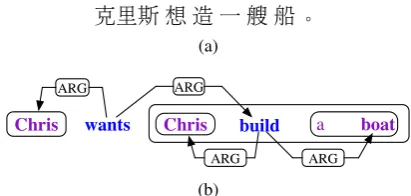
Figure 1: Example of input (a) and output (b) of cross-lingual Open IE.
tensen et al., 2013). A variety of work has achieved compelling results at monolingual Open IE (Banko et al., 2007; Fader et al., 2011; An-geli et al., 2015). But we are not aware of efforts that focus on both the cross-lingual and open as-pects of cross-lingual Open IE, despite significant work in related areas, such as cross-lingual IE on a closed, pre-defined set of events/entities (Sudo et al., 2004; Parton et al., 2009; Ji, 2009; Snover et al., 2011; Ji et al., 2016), or bootstrapping of monolingual Open IE systems in multiple lan-guages (Faruqui and Kumar, 2015; Kozhevnikov and Titov, 2013; van der Plas et al., 2014).
Inspired by the recent success of neural models in machine translation (Kalchbrenner and Blun-som, 2013; Cho et al., 2014; Bahdanau et al., 2014), syntactic parsing (Vinyals et al., 2015; Choe and Charniak, 2016), and semantic pars-ing (Dong and Lapata, 2016), we propose a sequence-to-sequence model that enables end-to-end cross-lingual Open IE. Essentially, we recast the problem as structured translation: the model encodes natural-language sentences and decodes predicate-argument forms (Figure 1). We show that the joint approach outperforms the pipeline on various metrics, and that the neural model is criti-cal for the joint approach because of its capability in generating complex open IE patterns.
2 Cross-lingual Open IE Framework Open IE involves the extraction of relations whose schema need not be specified in advance; typi-cally the relation name is represented by the text linking the arguments, which can be identified by manually-written patterns and/or parse trees. We define our extractions based on PredPatt1 (White et al., 2016), a lightweight tool for identifying predicate-argument structures with a set of Uni-versal Dependencies (UD) based patterns.
PredPatt represents predicates and arguments in a tree structure where a special dependencyARGis built between a predicate head token and its argu-ments’ head tokens, and original UD dependencies within predicate phrases and argument phrases are kept. For example, Fig 1b shows a tree structure identified by PredPatt from the sentence: “Chris wants to build a boat.”
Our framework assumes the availability of a bi-text, e.g. a corpus of Chinese sentences and their English translations. We run PredPatt on the tar-get side (e.g. English) to obtain (Chinese sentence, English PredPatt) pairs. This is used to train a cross-lingual Open IE system that maps directly from Chinese sentence to English PredPatt rep-resentations. Besides the UD parser required for running PredPatt on the target side, our framework requires no additional resources.
Compared to existing Open IE (Banko et al., 2007; Fader et al., 2011; Angeli et al., 2015), the use of manual patterns on Universal Dependencies means that the rules are interpretable, extensible and language-agnostic, which makes PredPatt a linguistically well-founded component for cross-lingual Open IE. Note that our joint model is ag-nostic to the IE representation, and can be adapted to other Open IE frameworks.
3 Proposed Method
Our goal is to learn a model which directly maps a sentence input A in the source language into predicate-argument structures outputBin the tar-get language. Formally, we regard the input as a sequenceA = x1,· · · , x|A|, and use alinearized
representation of the predicate-argument structure as the output sequenceB = y1,· · · , y|B|. While
tree-based decoders are conceivable (Zhang et al., 2016), linearization of structured outputs to se-quences simplifies decoding and has been shown
1https://github.com/hltcoe/PredPatt
effective in, e.g. (Vinyals et al., 2015), especially when a model with strong memory capabilities (e.g. LSTM’s) are employed. Our model maps
AintoB using a conditional probability which is decomposed as:
P(B|A) =
|B| Y
t=1
P(yt|y1,· · · , yt−1, A) (1)
3.1 Linearized PredPatt Representations
We begin by defining a linear form for our Pred-Patt predicate-argument structures. To convert a tree structure such as Figure 1b to a linear se-quence, we first take an in-order traversal of ev-ery node (token). We then label each token with the type it belongs to: pfor a predicate token, a
for an argument token,phfor a predicate head
to-ken, andahfor an argument head token. We insert parentheses to either the beginning or the end of an argument, and we insert brackets to either the be-ginning or the end of a predicate. Fig 2 shows the linearized PredPatt for the sentence: “Chris wants to build a boat.”.
[(Chris:ah) wants:ph[(Chris:ah) build:ph(a:aboat:ah)]] Figure 2: Linearized PredPatt Output
To recover the predicate-argument tree struc-ture, we simply build it recursively from the out-ermost brackets. At each layer of the tree, paren-theses help recover argument nodes. The labelsah
andph help identify the head token of a predicate
and an argument, respectively. We define that an auto-generated linearized PredPatt is malformed if it has unmatched brackets or parentheses, or a predicate (or an argument) has zero or more than one head token.
3.2 Seq2Seq Model
Our sequence-to-sequence (Seq2Seq) model con-sists of an encoder which encodes a sentence in-putAinto a vector representation, and a decoder which learns to decode a sequence of linearized PredPatt outputBconditioned on encoded vector. We adopt a model similar to that which is used in neural machine translation (Bahdanau et al., 2014). The encoder uses anL-layer bidirectional RNN (Schuster and Paliwal, 1997) which con-sists of a forward RNN reading inputs from x1 to x|A| and a backward RNN reading inputs in
the forward hidden state at time step iand layer
l; it is computed by states at the previous time-step and at a lower layer: −→hl
i = −→f(
−−→
hl i−1,
−−→
hl−i 1)
where −→f is a nonlinear LSTM unit (Hochreiter and Schmidhuber, 1997). The lowest layer−h→0
i is
the word embedding of the token xi. The
back-ward hidden state ←h−l
i is computed similarly
us-ing another LSTM, and the representation of each token xi is the concatenation of the top-layers: ht= [−→hLi
|
,←−hL i
| ]|.
The decoder is anL-layer RNN which predicts the next token yi, given all the previous words y<i =y1,· · ·, yi−1and the context vectorci that
captures the attention to the encoder side (Bah-danau et al., 2014; Luong et al., 2015), computed as a weighted sum of hidden representations:ci = Pl
j=1aijhj. The weightaij is computed by
aij = Plexp (eij) k=1exp (eik)
eij =va|tanh( L X
l=1
Wl
asli−1+Uahj)
(2)
whereva ∈ Rn, Wl
a ∈ Rn×n andUa ∈ Rn×2n
are weight matrices.
The conditional probability of the next tokenyi
is defined as:
P(yi |y<i, A) =g(yi,sLi ,ci)
=softmax(UosLi +Coci)[yi]
where Uo ∈ R|VB|×n and Co ∈ R|VB|×2n are
weight matrices.[j]indexesjth element of a vec-tor. sL
i is the top-layer hidden state at time step i, computed recursively bysl
i =f(sli−1,sl−i 1,ci)
wheres0
i = WB[yi−1]is the word vector of the previous tokenyi−1, withWB∈R|VB|×nbeing a
parameter matrix.
Training: The objective function is to minimize
the negative log likelihood of the target linearized PredPatt given the sentence input:
minimize− X
(A,B)∈D |A| X
i
logP(yi |y<i, A) (3)
whereDis the batch of training pairs, andP(yi | y<i, A)is computed by Eq.(3).
Inference: We use greedy search to decode tokens
one by one:yˆi = arg maxyi∈VBP(yi|yˆ<i, A)
4 Experiments
We describe the data for evaluation, hyperparam-eters, comparing approaches and evaluation re-sults.2
Data: We choose Chinese as the source language
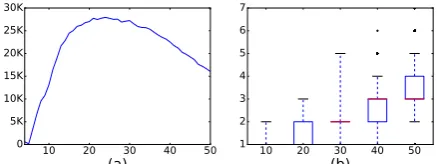
[image:3.595.307.526.351.433.2]and English as the target language. To prepare the data for evaluation, we first collect about 2M Chinese-English parallel sentences3. We then tok-enize Chinese sentences using Stanford Word Seg-menter (Chang et al., 2008), and generate En-glish linearized PredPatt by running SyntaxNet Parser (Andor et al., 2016) and PredPatt (White et al., 2016) on English sentences. After removing long sequences (length>50), we result in 990K pairs of Chinese sentences and English linearized PredPatt, which are then randomly divided for training (950K), validation (10K) and test (40K). Fig 3 shows the statistics of the data. Note that in general, the linearized PredPatt sequences are not short, and can contain multiple predicates.
10 20 30 40 50
(a)
0 5K 10K 15K 20K 25K 30K
10 20 30 40 50
(b)
1 2 3 4 5 6 7
Figure 3: Data Statistics: (a) Number of data pairs with respect to the lengths of English linearized PredPatt; (b) Boxplot of numbers of English pred-icate with respect to the lengths of English lin-earized PredPatt.
Hyperparameters: Our proposed model (
Joint-Seq2Seq) is trained using the Adam
opti-miser (Kingma and Ba, 2014), with mini-batch size 64 and step size 200. Both encoder and de-coder have 2 layers and hidden state size 512, but different LSTM parameters sampled fromU (-0.05,0.05). Vocabulary size is 40K for both sides. Dropout (rate=0.5) is applied to non-recurrent connections (Srivastava et al., 2014). Gradients are clipped when their norm is bigger than 5 (Pas-canu et al., 2013). We use sampled softmax to speed up training (Jean et al., 2015).
Comparisons: As an alternative, we train
a phrase-based machine translation system, 2The code is available at https://github.com/
sheng-z/cross-lingual-open-ie.
Moses (Koehn et al., 2007), directly on the same data we used to trainJoint-Seq2Seq, i.e. pairs of Chinese sentences and English linearized Pred-Patt. We call this system Joint-Moses. We also train aPipelinesystem which consists of a Moses system that translates Chinese sentence to English
sentence, followed by SyntaxNet Parser (Andor et al., 2016) for Universal Dependency parsing on English, and PredPatt for predicate-argument identification.
Results: We regard the generation of linearized
PredPatt or linearized predicates4 as a translation problem, and use BLEU score (Papineni et al., 2002) for evaluation. As shown in Table 1, Joint Seq2Seq achieves the best BLEU scores, with an improvement 1.7 BLEU for linearized PredPatt and improvement of 4.3 BLEU for linearized pred-icates compared to Pipeline.
PredPatt Predicates
Pipeline 17.19 17.24
Joint Moses 18.34 16.43 Joint Seq2Seq 18.94 21.55
Table 1: Evaluation results (BLEU) of linearized PredPatt and linearized predicates.
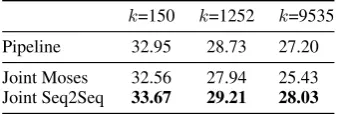
We also evaluate predicates in the same vein as event detection evaluation using the weighted F1 score.5 There are totally 9,535 predicate tokens in the test data. To enable a coarser-grain evaluation, we also partitioned these predicates intokclusters (k ∈ {150, 1252}) and evaluatedF1 on the clus-ter identities.The clusclus-ters are obtained by running Bisectingk-Means algorithm on pre-trained word embeddings (Rastogi et al., 2015).6Table 2 shows theF1scores: Joint Seq2Seq outperforms Pipeline by 0.5-0.8 at different granularities.
An important aspect of the auto-generated lin-earized PredPatt is its recoverability. Table 3 shows the number of unrecoverable outputs (in-cluding empty or malformed ones). Since the last step in Pipeline is to run PredPatt, Pipeline gen-erates no malformed output. However, 15% of its 4In linearized predicates, arguments are replaced by placeholders. For example, the linearized PredPatt in Fig 2 becomes “[ ?arg wants:phSth:= [ ?arg build:ph?arg ] ]” after
replacement. 5WeightedF
1 is the weighted average of individualF1
for each predicate, with weights proportional to predicate fre-quencies in the test data. We use token-levelF1score (Liu et
al., 2015) which gives partial credits to partial matches. 6Downloaded from: https://github.com/se4u/
mvlsa.
[image:4.595.332.503.63.120.2]k=150 k=1252 k=9535 Pipeline 32.95 28.73 27.20 Joint Moses 32.56 27.94 25.43 Joint Seq2Seq 33.67 29.21 28.03
Table 2: Evaluation results (weightedF1) of pred-icates at different cluster granularities.
outputs are empty. In contrast, Joint Seq2Seq gen-erates no empty output and very few malformed ones (1%). Joint Moses also generates no empty output, but a large amount (84%) of its outputs is malformed.
Pipeline Joint Moses Joint Seq2Seq 5965(15%) 33178(84%) 557(1%) Table 3: Number of unrecoverable outputs.
Table 4 shows an example output. While some arguments (e.g., “Thefocus of focus” in Table 4) are not correct, the output of Joint Seq2Seq is clos-est to the gold in terms of translation. Pipeline has the higher precision in predicting the same predi-cate head tokens as the gold, but its overall mean-ing is less close. Joint Moses often generates un-recoverable outputs (e.g., the predicate in Table 4 has two head tokens: “focus” and “related”.)
zh sent: 重点 审计关注与老百姓 生活密切相 关的专项资金.
en sent: The focus of the auditing will be on special item funds that are closely related to people ’s living .
gold: [(Thefocusof the auditing)will be on spe-cial spespe-cialfunds[(special itemfunds) are closelyrelatedto(people ’sliving)]] Pipeline: [(the key auditingconcernand ordinary
peo-ple)are closelyrelatedto(thelifeof the spe-cial funds)]
Joint-Moses: [((ordinarythe auditingpeoplefocus)are closely(attentionrelated)to(lifeto)with(the special funds)]
Joint-Seq2Seq: [(collectionThefocusof the specific fundsof focus)focusedon) [((the specialthe special
funds)relatedto(people ’slives)]]
Table 4: Example output. Arguments are shown in
blue, and predicates shown inpurple. Head tokens are underlined in bold. Token labels are omitted.
5 Conclusions
neu-ral sequence-to-sequence model. Our joint ap-proach outperforms the pipeline solution by 1-4 BLEU and 0.5-0.8F1. Future work includes min-imum risk training (Shen et al., 2016) for directly optimizing the cross-lingual open IE metrics of in-terest. Furthermore, as PredPatt works on any lan-guage that has UD parsers available, we plan to evaluate cross-lingual Open IE on other target lan-guages. We are also interested in exploring how our cross-lingual open IE output, which contains rich information about predicates and arguments, can be used to facilitate existing IE tasks like rela-tion extracrela-tion, event detecrela-tion, and named entity recognition in a cross-lingual setting.
Acknowledgments
This work was supported in part by the JHU Hu-man Language Technology Center of Excellence (HLTCOE), and DARPA LORELEI. The U.S. Government is authorized to reproduce and dis-tribute reprints for Governmental purposes. The views and conclusions contained in this publica-tion are those of the authors and should not be interpreted as representing official policies or en-dorsements of DARPA or the U.S. Government.
References
Daniel Andor, Chris Alberti, David Weiss, Aliaksei Severyn, Alessandro Presta, Kuzman Ganchev, Slav Petrov, and Michael Collins. 2016. Globally nor-malized transition-based neural networks. In Pro-ceedings of the 54th Annual Meeting of the Associa-tion for ComputaAssocia-tional Linguistics (Volume 1: Long Papers), pages 2442–2452, Berlin, Germany, Au-gust. Association for Computational Linguistics.
Gabor Angeli, Melvin Jose Johnson Premkumar, and Christopher D. Manning. 2015. Leveraging linguis-tic structure for open domain information extraction. In Proceedings of the 53rd Annual Meeting of the Association for Computational Linguistics and the 7th International Joint Conference on Natural Lan-guage Processing (Volume 1: Long Papers), pages 344–354, Beijing, China, July. Association for Com-putational Linguistics.
Dzmitry Bahdanau, Kyunghyun Cho, and Yoshua Ben-gio. 2014. Neural machine translation by jointly learning to align and translate. arXiv preprint arXiv:1409.0473.
Michele Banko, Michael J. Cafarella, Stephen Soder-land, Matt Broadhead, and Oren Etzioni. 2007. Open information extraction from the web. In Pro-ceedings of the 20th International Joint Conference
on Artifical Intelligence, IJCAI’07, pages 2670– 2676, San Francisco, CA, USA. Morgan Kaufmann Publishers Inc.
Pi-Chuan Chang, Michel Galley, and Christopher D. Manning. 2008. Optimizing Chinese word segmen-tation for machine translation performance. In Pro-ceedings of the Third Workshop on Statistical Ma-chine Translation, pages 224–232, Columbus, Ohio, June. Association for Computational Linguistics.
Kyunghyun Cho, Bart van Merrienboer, Caglar Gul-cehre, Dzmitry Bahdanau, Fethi Bougares, Holger Schwenk, and Yoshua Bengio. 2014. Learning phrase representations using rnn encoder–decoder for statistical machine translation. InProceedings of the 2014 Conference on Empirical Methods in Nat-ural Language Processing (EMNLP), pages 1724– 1734, Doha, Qatar, October. Association for Com-putational Linguistics.
Do Kook Choe and Eugene Charniak. 2016. Parsing as language modeling. InProceedings of the 2016 Conference on Empirical Methods in Natural Lan-guage Processing, pages 2331–2336, Austin, Texas, November. Association for Computational Linguis-tics.
Janara Christensen, Mausam, Stephen Soderland, and Oren Etzioni. 2013. Towards coherent multi-document summarization. In Proceedings of the 2013 Conference of the North American Chapter of the Association for Computational Linguistics: Hu-man Language Technologies, pages 1163–1173, At-lanta, Georgia, June. Association for Computational Linguistics.
Li Dong and Mirella Lapata. 2016. Language to logi-cal form with neural attention. InProceedings of the 54th Annual Meeting of the Association for Compu-tational Linguistics (Volume 1: Long Papers), pages 33–43, Berlin, Germany, August. Association for Computational Linguistics.
Anthony Fader, Stephen Soderland, and Oren Etzioni. 2011. Identifying relations for open information ex-traction. InProceedings of the 2011 Conference on Empirical Methods in Natural Language Process-ing, pages 1535–1545, Edinburgh, Scotland, UK., July. Association for Computational Linguistics.
Anthony Fader, Luke Zettlemoyer, and Oren Etzioni. 2014. Open Question Answering Over Curated and Extracted Knowledge Bases. InKDD.
Sepp Hochreiter and J¨urgen Schmidhuber. 1997. Long short-term memory. Neural computation, 9(8):1735–1780.
S´ebastien Jean, Kyunghyun Cho, Roland Memisevic, and Yoshua Bengio. 2015. On using very large target vocabulary for neural machine translation. In Proceedings of the 53rd Annual Meeting of the Association for Computational Linguistics and the 7th International Joint Conference on Natural Lan-guage Processing (Volume 1: Long Papers), pages 1–10, Beijing, China, July. Association for Compu-tational Linguistics.
Heng Ji, Joel Nothman, and Hoa Trang Dang. 2016. Overview of tac-kbp2016 tri-lingual edl and its im-pact on end-to-end kbp. InProceedings of the Text Analysis Conference (TAC).
Heng Ji. 2009. Cross-lingual predicate cluster acquisi-tion to improve bilingual event extracacquisi-tion by induc-tive learning. In Proceedings of the Workshop on Unsupervised and Minimally Supervised Learning of Lexical Semantics, pages 27–35, Boulder, Col-orado, USA, June. Association for Computational Linguistics.
Nal Kalchbrenner and Phil Blunsom. 2013. Recurrent continuous translation models. In Proceedings of the 2013 Conference on Empirical Methods in Natu-ral Language Processing, pages 1700–1709, Seattle, Washington, USA, October. Association for Compu-tational Linguistics.
Diederik Kingma and Jimmy Ba. 2014. Adam: A method for stochastic optimization. arXiv preprint arXiv:1412.6980.
Philipp Koehn, Hieu Hoang, Alexandra Birch, Chris Callison-Burch, Marcello Federico, Nicola Bertoldi, Brooke Cowan, Wade Shen, Christine Moran, Richard Zens, et al. 2007. Moses: Open source toolkit for statistical machine translation. In Pro-ceedings of the 45th annual meeting of the ACL on interactive poster and demonstration sessions, pages 177–180. Association for Computational Linguis-tics.
Mikhail Kozhevnikov and Ivan Titov. 2013. Cross-lingual transfer of semantic role labeling models. In Proceedings of the 51st Annual Meeting of the Association for Computational Linguistics (Volume 1: Long Papers), pages 1190–1200, Sofia, Bulgaria, August. Association for Computational Linguistics. Zhengzhong Liu, Teruko Mitamura, and Eduard Hovy. 2015. Evaluation algorithms for event nugget detec-tion: A pilot study. InProceedings of the 3rd Work-shop on EVENTS at the NAACL-HLT, pages 53–57. Minh-Thang Luong, Hieu Pham, and Christopher D. Manning. 2015. Effective approaches to attention-based neural machine translation. InProceedings of the 2015 Conference on Empirical Methods in Natu-ral Language Processing, pages 1412–1421, Lisbon,
Portugal, September. Association for Computational Linguistics.
Kishore Papineni, Salim Roukos, Todd Ward, and Wei-Jing Zhu. 2002. Bleu: a method for automatic evaluation of machine translation. InProceedings of the 40th annual meeting on association for compu-tational linguistics, pages 311–318. Association for Computational Linguistics.
Kristen Parton, Kathleen R. McKeown, Bob Coyne, Mona T. Diab, Ralph Grishman, Dilek Hakkani-T¨ur, Mary Harper, Heng Ji, Wei Yun Ma, Adam Meyers, Sara Stolbach, Ang Sun, Gokhan Tur, Wei Xu, and Sibel Yaman. 2009. Who, what, when, where, why? comparing multiple approaches to the cross-lingual 5w task. InProceedings of the Joint Conference of the 47th Annual Meeting of the ACL and the 4th In-ternational Joint Conference on Natural Language Processing of the AFNLP, pages 423–431, Suntec, Singapore, August. Association for Computational Linguistics.
Razvan Pascanu, Tomas Mikolov, and Yoshua Ben-gio. 2013. On the difficulty of training recurrent neural networks. In Proceedings of The 30th In-ternational Conference on Machine Learning, pages 1310–1318.
Pushpendre Rastogi, Benjamin Van Durme, and Ra-man Arora. 2015. Multiview lsa: Representation learning via generalized cca. InProceedings of the 2015 Conference of the North American Chapter of the Association for Computational Linguistics: Hu-man Language Technologies, pages 556–566, Den-ver, Colorado, May–June. Association for Compu-tational Linguistics.
Mike Schuster and Kuldip K Paliwal. 1997. Bidirec-tional recurrent neural networks. IEEE Transactions on Signal Processing, 45(11):2673–2681.
Shiqi Shen, Yong Cheng, Zhongjun He, Wei He, Hua Wu, Maosong Sun, and Yang Liu. 2016. Mini-mum risk training for neural machine translation. In Proceedings of the 54th Annual Meeting of the As-sociation for Computational Linguistics (Volume 1: Long Papers), pages 1683–1692, Berlin, Germany, August. Association for Computational Linguistics. Matthew Snover, Xiang Li, Wen-Pin Lin, Zheng Chen, Suzanne Tamang, Mingmin Ge, Adam Lee, Qi Li, Hao Li, Sam Anzaroot, and Heng Ji. 2011. Cross-lingual slot filling from comparable corpora. In Pro-ceedings of the 4th Workshop on Building and Using Comparable Corpora: Comparable Corpora and the Web, BUCC ’11, pages 110–119, Stroudsburg, PA, USA. Association for Computational Linguis-tics.
Fabian Suchanek. 2014. Information extraction for on-tology learning. Lehmann and V¨olker [2 6], pages 135–151.
Kiyoshi Sudo, Satoshi Sekine, and Ralph Grishman. 2004. Cross-lingual information extraction sys-tem evaluation. In Proceedings of the 20th inter-national Conference on Computational Linguistics, page 882. Association for Computational Linguis-tics.
Lonneke van der Plas, Marianna Apidianaki, and Chen-hua Chen. 2014. Global methods for cross-lingual semantic role and predicate labelling. In Proceed-ings of COLING 2014, the 25th International Con-ference on Computational Linguistics: Technical Papers, pages 1279–1290, Dublin, Ireland, August. Dublin City University and Association for Compu-tational Linguistics.
Oriol Vinyals, Łukasz Kaiser, Terry Koo, Slav Petrov, Ilya Sutskever, and Geoffrey Hinton. 2015. Gram-mar as a foreign language. InAdvances in Neural Information Processing Systems, pages 2773–2781. Aaron Steven White, Drew Reisinger, Keisuke
Sak-aguchi, Tim Vieira, Sheng Zhang, Rachel Rudinger, Kyle Rawlins, and Benjamin Van Durme. 2016. Universal decompositional semantics on universal dependencies. In Proceedings of the 2016 Con-ference on Empirical Methods in Natural Lan-guage Processing, pages 1713–1723, Austin, Texas, November. Association for Computational Linguis-tics.