An FPT Variant Of The Shadow Problem With
Kernelization
Stefan Porschen
∗Abstract—The shadow problem (SIS) gets as input a forest F, and a map that assigns subtrees, called shadows, to leaves ofF. SISasks whether there exists a set of |F| leaves, one from each tree, such that no leaf lies in the shadow of another. Usually SISis con-sidered as a parameterized problem with parameter k bounding the cardinality of F, for which some fixed-parameter tractability time bounds have been proven, namely O(n2kk) in [2] and O(n33k
) in [4], where n is the number of vertices in F. In this paper, we dis-cuss a variant of SIS that essentially is characterized through a different parameterization using two inde-pendent parameters, namelykas above, ands bound-ing the shadow size. We provide a kernelization w.r.t. this parameterization, and prove a fixed-parameter tractability bound of O(k·n2
+p(k, s)3k
) wherep is a polynomial in the parameters k, s.
Keywords: shadow-independent set problem, forest, fixed-parameter tractability, kernelization
1
Introduction
The shadow-independent set problem (for short shadow problem or SIS) is the graph theoretical formulation of a propositional logic problem, namely the falsifiability problem for pure implicational formulas; for details the reader is refered to [2]. SIS has also been investigated in a pure graph theoretical framework [4] likewise in the present paper. Input instances of SIS consist of a finite forest F over n vertices and a (partial) map σ, called shadow map, assigning leaves of F to its vertices. The relevant objects in SIS are the leaves ofF, which obey a dependence structure impressed by the shadow map: For a leaf ℓ (in the domain of σ), we call the subtree of F
rooted at vertex σ(ℓ) the shadow of ℓ, and we say that all leaves of that subtree areshadow-dependent onℓ. SIS then asks for the existence of a set of mutually shadow-independent leaves inF exactly one of each tree. In gen-eral, this problem is NP-complete [2]. Nevertheless, from the point of view of parameterized complexity [1], SIS ad-mits a natural parameterization where the parameter k
bounds the number of trees in an input instance: |F| ≤k. According to this parameterization, SIS has been proven to belong to the complexity class FPT (fixed-parameter tractable problems) in [2], where an algorithm for SIS
∗Institut f¨ur Informatik, Universit¨at zu K¨oln, D-50969 K¨oln,
Germany, Email: [email protected]
running in timeO(n2kk) is provided. Another algorithm
has been designed by in [4] providing the time bound
O(n33k) substantially improving on the parameter
fac-tor.
An important feature exhibited by all problems in FPT is the existence of a so-calledkernelizationw.r.t. the pa-rameter(s) [1]. By a kernelization one extracts in a pre-processing step the kernel of the problem which is the relevant part of the input instance bounded in size by a function f in the parameter(s). Thus kernelization leads to an overall bound of the formO(p(n, k1, . . . , ks)+
f(k1, . . . , ks)), calledkernel form, wherepis a polynomial
in the problem sizenas well as in the parameters, andfis an arbitrary function depending on the parameters only. So far, no kernelization for SIS w.r.t.kwas constructed, which however must exist [1]. A reason might be that SIS input instances (F, σ) consist of two independent compo-nents, and the standard parameter k only controls the forest part. To circumvent this difficulty, here we propose a variant of the shadow independent set problem which is defined through an additional parametersbounding the number of leaves contained in shadows generated by σ. We are able to prove a fixed-parameter tractability time bound having the kernel formO(k·n2+p(k, s)3k), with
a polynomial p(k, s) in the two parameters. The proof is based on the dynamic programming algorithm as de-signed for the standard parameterization of SIS provided in [4].
2
Basic definitions and notation
For a graphG, we denote byV(G) its vertex set. In this paper we are mainly interested in finite forests F and (rooted) trees T (a tree is a connected forest, for details cf., e.g., [3]). LetL(F) denote the set of leaves inF. In a rooted treeT, with rootw, every vertexx∈V(T)− {w}
selects the unique proper subtree Sx of T rooted at x.
Given a vertex x ∈ V(F), we denote by T(x) ∈ F the unique tree it belongs to; similarly for a vertex setX ⊂
V(F) we write T(X)∈ F, ifX contains vertices of one tree only. Let 2M denote the power set of a setM, and
letA:=M−Adenote the complement ofA⊆M. Given a (partial) mapf : M →M′, we denote its domain by
D(f)⊆M and its image byI(f)⊆M′. Recall that each
y∈I(f) has a non-emptypreimage f−1(y)⊆D(f).
and a (partial) map σ:L(F)→V(F), theshadow map. For ℓ∈D(σ), we call the unique subtreeSσ(ℓ) ofF the
shadow ofℓas depicted in Figure 1.
Two leavesℓ, ℓ′ ∈L(F) are said to beshadow-independent if and only ifℓ6∈L(Sσ(ℓ′)) andℓ′ 6∈L(Sσ(ℓ)). The notion of shadow-independency canonically transfers to sets of leaves. Atransversal in a forestF is defined to be a set Λ ⊆L(F) of leaves such that |Λ∩L(T)| = 1, for each
T ∈F.
Definition 1 The shadow(-independent set) problem (SIS) is defined through: input instance (F, σ) ∈ SIS if and only if there exists a shadow-independent transversal in F.
Throughout it is assumed that each input instance (F, σ) of SIS satisfies the following conditions:
(i): No leaf is mapped to the root of a tree inF, and (ii): no leaf is mapped to a vertex of its own tree. (These conditions essentially yield no loss of generality since an arbitrary input instance can be transformed fast into one satisfying (i), (ii): Leaves that are mapped to roots have to be marked and ignored since their shadows rule out whole trees and thus can never join a shadow-independent transversal in F. Similarly, a leaf generat-ing a shadow in its own tree is of importance only if it is contained in its own shadow, in which case it has to be ignored, too. Otherwise such a leaf can contribute to any shadow-independent transversal. Marking corre-sponding leaves in an arbitrary SIS input instance accord-ingly needed O(|V(F)|2) time using depth first search,
which is dominated by the time complexity of the pre-procedure as stated in the final result.)
Definition 2 Theparameterized problem SISk with
pa-rameterk∈N is defined by: (F, σ, k)∈SISk if and only
if |F| ≤kand (F, σ)∈SIS.
The parameterized version of SIS as above has been stud-ied in the past to some extent [2, 4]. In the following a different parameterization is defined introducing a second parameter bounding the size of shadows generated byσ:
sσ:= max
ℓ∈D(σ)|L(Sσ(ℓ))|
Throughout we assume thatsσ≥1, equivalentlyD(σ)6= ∅, otherwise the instance contains no shadow and thus
is trivial.
Definition 3 With (vector-)parameter κ= (k, s)∈N2,
problem SISκ is defined through: (F, σ, κ)∈SISκ if and
only if|F| ≤k, sσ≤s, and(F, σ)∈SIS.
A leaf is called free if it neither is contained in D(σ) nor inI(σ). Observe that a tree having a free leaf can be
removed from a SIS input instance because it contributes, via its free leaf, to any shadow-independent transversal in the remaining forest.
3
Specifying the kernel of
SIS
κIn this section we provide the specification of a (problem) kernel for input instances (F, σ, κ) of SISκ. We show that
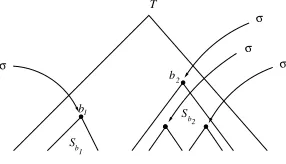
the relevant part of the kernel is bounded in size by a function in the parametersk, s. It turns out to be useful, first to take a more abstract view on the shadow structure of (F, σ) by only considering those shadows that are not subtrees of other shadows. Note that two shadows in a treeT either are disjoint subtrees ofT or one is a subtree of the other. Thus, in a treeT containing shadows there exists at least one shadow that is not subtree of any other shadow in T; we call such a shadow an envelope. An envelope usually contains several shadows as subtrees (cf. Fig. 2).
Let B ⊆I(σ) be the collection of all envelope roots in the input instance. Clearly, largest shadows in F are envelopes, hence sσ = maxb∈B|L(Sb)|. For envelope Sb,
b∈B, we consider itspreenvelope
H(b) := [
x∈I(σ)∩V(Sb)
σ−1(x)
collecting the leaves of all non-empty preimages of ver-tices inSb. A preenvelope H(b) is composed of its tree
fragments HT(b) := H(b)∩L(T), for each T ∈ F. For
convenience, letH(T) :={HT(b) :b∈B}denote the
col-lection of all different preenvelope fragments inT. Every leaf of a preenvelope fragmentHT(b) either is contained
in exactly one envelope ofT. Or it lies outside of all en-velopes contained inT, i.e., is contained in no shadow at all; we call the set of these leaves the 0-fragmentHT0(b) of HT(b). Let H0(W) := {HT0(b) : b ∈ B, T ∈ W} be
the collection of all 0-fragments in subforest W ⊆F (if
W = {T} we simply write H0(T)). A basic object
re-garding kernelization is an autonomous tree which, as will turn out, can be characterized by the number of its preenvelope fragments.
Definition 4 A tree T in(F, σ)is calledautonomousif for every transversalΛ in F− {T} there exists a leaf in
L(T) that is mutually shadow-independent of every leaf in Λ.
From the definition directly follows that an autonomous tree can be removed from a SIS input instance since it always can complete a shadow-independent transversal in the remaining forest. Therefore, a SIS search algorithm can be restricted to the remaining forest:
000000 000000 000000 000000 000000 000000 000000 000000 000000
111111 111111 111111 111111 111111 111111 111111 111111 111111
T T
σ
i j
l
[image:3.595.229.373.71.135.2](l)
Figure 1: LeafℓofTi generates the shadow rooted atσ(ℓ) in Tj.
0 0 1 1
00 00 00 11 11 11
00 00 00 11 11 11 00 00 00 11 11 11
00 00 00 11 11 11
T
S
S
b
b 1
1
2
2
σ σ σ
σ
b
b
Figure 2: A tree T containing two envelopes Sb1,Sb2; arrows correspond to assignments ofσ.
The key to specifying a problem kernel of SISκ is the
observation that there either exists an autonomous tree inF or all its trees have a bounded number of preenve-lope fragments. Basis for this observation is the following necessary condition for a tree to be autonomous.
Lemma 2 A tree T in(F, σ) is autonomous if
(∗) |H(T)| ≥1 + (|F| −1)(sσ+ 1)
Proof. LetT ∈F such that|H(T)| ≥1 + (|F| −1)(sσ+ 1), and let Λ be an arbitrary transversal inF− {T}. In worst case, each ℓ∈ Λ is mapped into V(T) generating shadow Sσ(ℓ) in T, and all these shadows are mutually
vertex-disjoint, i.e., envelopes. Because sσ is the
maxi-mum number of leaves in a shadow of (F, σ) we have
X
ℓ∈Λ
|L(Sσ(ℓ))| ≤(|F| −1)sσ
In worst case all preenvelope fragments ofT are single el-ement sets, implying that Λ rules out at most (|F| −1)sσ
preenvelope fragments inH(T). On the other hand, we have to assume that there is a set ˆΛ⊆D(σ)∩L(T) con-taining|F| −1 leaves lying outside ofS
ℓ∈ΛL(Sσ(ℓ)) such
that, for every ˆℓ∈Λ, there existsˆ ℓ∈Λ withℓ∈L(Sσ(ˆℓ)). Again supposing that each ˆℓ∈Λ delivers a single elementˆ preenvelope fragment another |F| −1 preenvelope frag-ments in H(T) are ruled out. In summary, there are
r:=|F| −1 + (|F| −1)sσpreenvelope fragments inH(T)
which under worst circumstances cannot provide a leaf shadow-independent of all leaves in Λ. But by assump-tion, for T we have|H(T)| −r ≥1, so there is at least one preenvelope fragment left inH(T) containing at least one element ˆℓ0. Although its shadowSσ(ˆℓ0)must be
con-tained in a tree of ˆF it does not contain a member of Λ because envelopes, by construction, are mutually disjoint subtrees. Observe that ˆℓ0 does not need to be the same
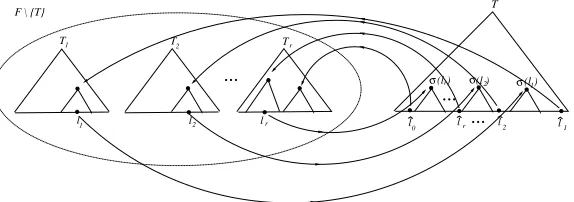
leaf for every transversal in F− {T}. The situation is illustrated in Fig. 3. 2
Hence, existence of autonomous trees in fact allows us to reduce the input instance: Recursively remove all au-tonomous trees. Then it is sufficient to decide SIS for the remaining input instance, called the kernel of the prob-lem.
Definition 5 The kernel ( ˆF ,ˆσ)of aSISinstance (F, σ) is defined as follows:
ˆ
F ⊆F is the largest subforest of F such that for every
T ∈Fˆ we have:
(i) there is no free leaf in T, (ii) T is not autonomous, and
ˆ
σ:=σ|Fˆ is the restriction ofσ toFˆ (meaning D(ˆσ) :=
D(σ)∩[L( ˆF)− {ℓ ∈ L( ˆF) : σ(ℓ) ∈ V( ˆF)}], i.e., the domain is restricted to L( ˆF), and additionally all leaves are removed from the domain that were previously mapped to vertices of F−Fˆ).
Proposition 1 (1) For every (F, σ), the kernel ( ˆF ,σˆ) exists and is unique.
(2)(F, σ)∈SISif and only if( ˆF ,σˆ)∈SIS.
(3) Let B denote the set of all envelope roots in Fˆ and
LB :=Sb∈BL(Sb), then
(α) X
T∈Fˆ
|H(T)| ≤ρ(|Fˆ|, sˆσ), (β) |LB| ≤sσˆ·ρ(|Fˆ|, sˆσ)
with ρ(x, y) :=x(x−1)(y+ 1).
Proof. For a constructive proof of (1) consider:
Procedure KERNEL:
For input (F, σ), initially assign ˆF ← F, ˆσ ← σ, and
F′←F.
[image:3.595.229.372.171.253.2]00 00 00 11 11 11
0 0 0 1 1 1
0 0 1 1 0
0 0 1 1 1 0 0 0 1 1 1
lr
0 0 0 1 1 1
l0
σ(l )1
l
2 l1
lr 0
0 0 1 1 1
0 0 1 1
0 0 1 1
00 00 00 11 11 11 0
0 0 1 1 1
0 0 0 1 1 1
00 00 00 11 11 11 0 0 1 1
T T T
l l
1 2 r
1 2
T
σ σ(l )r 2
F \ {T}
(l ) ... ...
[image:4.595.160.447.72.173.2]...
Figure 3: An autonomous tree T in the forest F ={T1, . . . , Tr, T}. Leaf ˆℓ0 is mutually shadow-independent of all
members of the transversal Λ ={ℓ1, . . . , ℓr}inF− {T}. Arrows correspond to assignments ofσ.
(B) Add toF′ each tree in ˆF containing a free leaf. (C) Add to F′ each tree in ˆF satisfying condition (∗) of Lemma 2.
(D) Assign ˆF ←Fˆ−F′ and ˆσ←σˆ|Fˆ,
finishing the loop body and also the procedure.
It is obvious that the procedure is purely deterministic and thus yields a unique result for each fixed input in-stance. We claim that the resulting object ( ˆF ,ˆσ) meets Definition 5: Indeed, suppose ( ˆF ,ˆσ) returned by Pro-cedure KERNEL contains an autonomous tree T (resp. a tree T containing a free leaf). Since the procedure stopped, containerF′ must be empty. Hence during the last iteration of the loop there was found neither an au-tonomous tree in Step (C) nor a tree containing a free leaf in Step (B) contradicting thatTis autonomous (resp. contains a free leaf). Finally, each tree T that has been removed from (F, σ) during Procedure KERNEL contains a free leaf or satisfies relation (∗) of Lemma 2, for ˆF∪{T}
and correspondingly extended ˆσ. Hence ( ˆF ,σˆ) cannot be enlarged to an instance that contains a greater subforest of F and has kernel properties completing the proof of (1).
(2) obviously holds true ifF =∅. ForF 6=∅, we claim
that each iteration of the loop in Procedure KERNEL preserves SIS-status meaning that the current instances at the beginning and at the end of each iteration either both belong to SIS or both do not, obviously implying (2). The claim is proven by induction on the numbern∈Nof
loop iterations: At the end of the first iterationn= 1 we either have (i) F′ =∅ meaning ˆF =F, and the
proce-dure stops, or (ii) ˆF=F−F′ whereF′=Ff∪Fa⊆F is
a subforest containing trees having a free leaf collected in
Ff, or autonomous trees inF collected inFa. In case (i)
there is nothing to prove. In case (ii) it is obvious that if
F admits a shadow-independent transversal, so does each subforest of F, especially ˆF. For the converse direction, assume that ˆF admits a shadow-independent transver-sal Λ but F does not. Let Λf denote any transversal
in Ff composed of free leaves, then clearly, Λ∪Λf is a
shadow independent transversal in ˆF ∪Ff. If there is
T ∈Fa then it satisfies|H(T)| ≥1 + (|F| −1)(sσ+ 1)≥
1 + (|Fˆ∪Ff| −1)(sσ|( ˆF∪Ff)+ 1). HenceT is autonomous
in ˆF ∪Ff according to Lemma 2. Therefore Λ∪Λf
can be enlarged to a shadow-independent transversal in ˆ
F∪Ff∪ {T}by Lemma 1. By analogous conclusion for
each remaining tree in Fa− {T}, we obtain a
shadow-independent transversal in ˆF ∪Ff∪Fa=F
contradict-ing the assumption and establishcontradict-ing the induction base. If the claim is true at the end of the ith iteration of the loop, for all i < n, n≥2, then it also holds true at the end of its nth iteration by means of an analogous argu-mentation.
To verify (3), first observe that (β) follows from (α): As-sume kernel ( ˆF ,σˆ) contains at most ρ(|Fˆ|, sσˆ) different
preenvelopes. Because the number of envelopes in the kernel equals the number of its preenvelopes, and each envelope contains at most sˆσ leaves, (β) holds true. So
it remains to prove (α). According to (1), ( ˆF ,ˆσ) con-tains no autonomous tree. Thus, for each T ∈ Fˆ, we have|H(T)| ≤(|Fˆ| −1)(sσˆ+ 1) according to Lemma 2.
Therefore ( ˆF ,σˆ) contains at most
X
T∈Fˆ
|H(T)| ≤ |Fˆ| ·(|Fˆ| −1)(sˆσ+ 1) =ρ(|Fˆ|, sσˆ)
different preenvelope fragments. Because any preenve-lope fragment belongs to exactly one preenvepreenve-lope, the number of preenvelopes in ( ˆF ,σˆ) is certainly upper bounded byρ(|Fˆ|, sσˆ).2
4
The main algorithm
In this section we provide an algorithm for SISκ that
works in two parts: After the kernel (F, σ, κ) of an input instance is computed, two dynamic programming steps are performed consecutively to decide whether (F, σ, κ)∈
SISκ. These dynamic programs are based on Algorithm
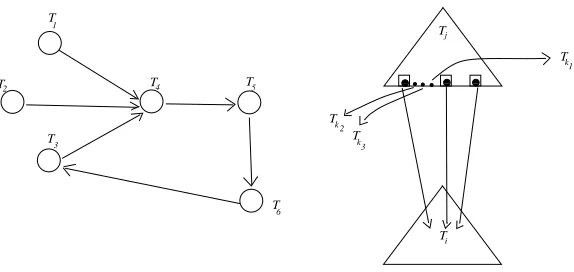
INITIAL (DP1) and Algorithm GLOBAL (DP2) in [4]. Whereas it turns out that we can use DP2 without modifi-cations, DP1 needs to be adapted for our purposes result-ing in DP1’. So we briefly recall the main ideas underly-ing DP1 to keep the presentation self-contained. Observe that a SIS input instance (F, σ) determines a digraphG, the shadow graph: Trees in F correspond to nodes and two nodesTj, Tiare joined by an arcTj →Tiif and only
if there is a leaf-vertex in Tj that is mapped byσ to a
00 00 11
1100110011001100001111 00001111
T
T
T
T T
T
3
4
6 5 1
2
1
T
T
T T
k 2
j
i
k
Tk
[image:5.595.158.445.69.205.2]3
Figure 4: A shadow pattern over the forestF ={T1, . . . , T6}(left part), and shadow graph construction (right part):
all mappings of leaf-vertices inTjto vertices inTidefined throughσare identified yielding arcTj→Tiin the shadow
graph.
vertices of the shadow graph nodes, so that the notion vertexis reserved for members inV(F) having no struc-ture. Similarly, we distinguish between the trees inFand directed trees as subgraphs of Gcalled G-trees.)
Basic objects in DP1 are specific subgraphs ofG, namely shadow patterns. A shadow pattern consists of all nodes inG, but selects exactly one outgoing arcof each node. Consequently, each connected component of a shadow pattern is a “cycle of G-trees”. Figure 4 (left part), e.g., depicts a shadow pattern over {T1, . . . , T6}, where
{T3, . . . , T6} are roots of G-trees in a (directed) cycle,
and only nodeT4is the root of a non-trivialG-tree with
node set{T1, T2, T4}. Observe that each transversal inF
composed of leaves inD(σ) determines a unique shadow pattern in G. It turns out to be useful that also the leaf-vertices inD(σ) can determine shadow patterns. To that end, we simply make σ a total map by assigning to eachℓ ∈D(σ) an arbitrary fixed vertex x of another tree, but define the shadow ofℓto be empty. Hencexis a “dummy” image ofℓ, and the SIS-status of the instance is preserved. Afterwards each transversal inF defines a unique shadow pattern. There are only two possibilities for dividing a connected shadow pattern into two parts. E.g., consider the connected shadow pattern depicted in Fig. 4: Either cut one arc of the G-tree rooted at T4
or cut two arcs of the cycle. Define a shadow pattern part (spp)to be an induced (not necessarily proper) con-nected subgraph of a connected shadow pattern. Hence a spp either is a cycle of G-trees called spp of tree-cycle type where each node has exactly one outgoing arc, or the spp is a root directed G-tree, where each node has at most one outgoing arc, and the root is the only node having no outgoing arc, called spp of tree type. Recur-sively, a connected induced subgraph of a spp is a spp, too. Thus, reversing the possible dividing operations we can combine two spp’s yielding a larger one in exactly two ways: Connect the root of the first one (which must be of tree type) by an arc to any node of the second one (which can be of tree type or of tree-cycle type) yielding a larger spp of tree type, resp. of tree-cycle type. Or two
spp’s of tree type are combined by connecting either root via an arc to a node of the other spp yielding a spp of tree-cycle type. Abstractly a triple (W, o, i) defines a spp of tree type: W ⊂ F is its node set, o ∈ L(W) defines its root node T(o) ∈ W, and i ∈ I(σ)∩V(W) is any selected image vertex. We call o an out-object because it can define the source of an arc combining (W, o, i) to another spp, and we call i an in-object because it can define the sink of an arc coming from another spp. i is also allowed to be the empty set, then (W, o,∅) can be
combined to another spp only in the first way as stated above. If o andi both are empty, then (W,∅,∅)
corre-sponds to a connected spp of tree-cycle type which can-not be enlarged by further combinations, since no source or sink vertices are reserved for combining arcs. Triples (W,∅, i) correspond to spp’s of tree-cycle type whereiis the sink of an arc coming from a spp of tree type. How-ever, such configurations do not need to be considered, see below. Now suppose there are shadow-independent transversals inducing spp’s of tree type in subforests W
resp. W′ with W ∩W′ =∅. For testing whether these spp’s can be combined to one overW ∪W′ without dis-turbing shadow-independency, we have to try whether there are leaf-verticeso ∈L(W) resp. o′ ∈L(W′) which yield arcs intoW′resp.W such that their shadows do not contain members of the transversals inW,W′. Starting with single tree subforests, in that way, it was possible in DP1 to test each subforest W of the input instance in-ductively whether it admits a spp induced by a shadow-independent transversal.
We now provide adaptation DP1’ of DP1 yielding a bound of kernel form for SISκ instances. Instead of
test-ing each stest-ingle leaf-vertex of the kernel as out-object and each single image vertexias in-object, we testonly leaves in LB as single out-objects, and only images of leaves in
LB as single in-objects. Leaves outside LB are treated
and a set I ofgeneralizedin-objects:
O:=LB∪ H0(F)∪ {eo} and I:=σ(LB)∪B∪ {ei}
whereeo is the empty out-object andei is the empty
in-object being instances of the empty set, andσis assumed to be total. For subforest W ⊆ F, we define OW :=
LB(W)∪ H0(W), andIW :=σ(LB(W))∪(B∩V(W)),
withLB(W) :=LB∩L(W).
Definition 6 We extend σ (assumed to be made total) to a mapping Σ :O → I by
Σ(O) :=
σ(ℓ), O=ℓ∈LB
b, O=HT0(b)∈ H0(F)
ei, O=eo
∈ I
If O ∈ LB, and I = Σ(O′), for O′ ∈ H0(F), then for
short we writeO6∈L(SI) if there existsℓ∈O′ such that
O 6∈ L(Sσ(ℓ)), and we write O ∈ L(SI) otherwise. For
O′ ∈ L
B, expression O 6∈ L(SI), resp. O ∈ L(SI), has
the usual meaning asI=σ(O′)is a unique image vertex then.
Definition 7 For SIS input instance (F, σ) and Σ as above, define Q: 2F× O × I → {0,1} byQ(W, O, I) = 1
iff the following conditions are satisfied simultaneously: (i) W 6= ∅, O ∈ OW ∪ {eo},Σ(O) ∈ IW ∪ {ei}, there
existsO′∈ OW ∪ {eo} such thatI= Σ(O′)∈ IW ∪ {ei},
(ii) there exists a shadow-independent transversal Λ in
W inducing a shadow pattern part over W such that
O∩Λ6=∅, (in caseOis a single leafℓ,O∩Λis identified
with {ℓ} ∩Λ)
(iii) for each ℓ∈Λit holds that ℓ6∈L(SI).
Algorithm DP1’:
Input: SIS-kernel (F, σ) with|F| ≥2,sσ≥1 .
Output: ValuesQ(U) :=Q(U, e0, ei), U ⊆F,|U| ≥2.
(A): Initial values: ∀T ∈F,∀(O, I)∈ O{T}× I{T} com-pute
Q(T , O, I) =
1, I=ei∨O∈ H0(T)∨(O∈LB({T}) :O6∈L(SI))
0,else
(B):∀U ⊆F :|U| ≥2,∀O∈ OU compute: Q(U, O, ei) =
_
W⊂U:
T(O)6∈W
_
O′∈OW:
Σ(O′)∈I{T(O)}
∧O /∈L(SΣ(O′) )
Q(W, O′, ei)∧Q(W , O, ei)
(C):∀U ⊆F :|U| ≥2 compute: ∀O ∈ OU,∀I∈ I{T(O)}:
Q(U, O, I) =
1, Q(U, O, ei) = 1∧O /∈L(SI)
0, else
∀O ∈ OU,∀I∈ IU, T(I)6=T(O) :
Q(U, O, I) = _
W⊂U:
T(O)6∈W ∧T(I)∈W
_
O′∈O{T(I)}
Q(W, O′, I)∧Q(W , O,Σ(O′))
(D): For eachU ⊆F :|U| ≥2 compute:
Q(U, eo, ei) =
_
W⊂U
_
O,O′∈OU
Q(W, O,Σ(O′))∧Q(W , O′,Σ(O))
=: Q(U)
Theorem 1 Let (F, σ) be the kernel of a SIS input in-stance, where σ has been made total. Assume that, for each pair (O, I) ∈ O × I, the information whether
O ∈L(SI) can be accessed inO(1) time. Via DP1’
fol-lowed by DP2, i.e. Algorithm GLOBAL in [4], can be decided inO([sσ·ρ(|F|, sσ)]33|F|)time whether(F, σ)
ad-mits a shadow-independent transversal, where ρ(x, y) :=
x(x−1)(y+ 1).
Proof. Observe that a kernel containing only one tree
cannot exist, because this tree is autonomous and thus is removed via Procedure KERNEL. So a kernel either is empty and therefore trivial or has size at least two which is assumed for the input of DP1’.
For proving correctness of DP1’, we have to show that in Step (D) value Q(U) := Q(U, e0, ei) is correctly
cal-culated for each U ⊆ F. That means Q(U) = 1 if there exists a shadow-independent transversal in U in-ducing a connected spp (U, eo, ei), and Q(U) = 0
oth-erwise. (U, eo, ei) corresponding to a spp of tree-cycle
type can be composed either via connecting two spp’s (W, O,Σ(O′)), (W , O′,Σ(O)) of tree type, for O ∈ O
W,
O′∈ O
W, andW ⊂Uas calculated in Step (D). Or it can
be combined via connecting a spp (W, O, ei) of tree type
and a spp (W , eo,Σ(O)) of tree-cycle type, forO∈ OW.
Observe that the latter combination type needs not to be considered because it is covered already by a combi-nation of the first kind: Indeed, replace W by W′ with
W ⊂W′ ⊆U containing the root of that G-tree in the cycle of (W , eo,Σ(O)) which contains the node Σ(O).
As long asO andO′ both are single leaves inLB(U)
cor-rectness of (D) is justified by the arguments above. If
O or O′ is a 0-fragment we have to verify that no con-flict can occur when simultaneously treating all leaves contained in O resp. O′. If both O, O′ ∈ H0(U) this is
obvious because no leaf inO resp. O′ is contained in the shadow of any leaf in O′ resp. O. If w.l.o.g.O∈ H0(U)
and O′ ∈ L
B(U), we only need to decide whether there
is a leaf ℓ ∈ O such that O′ 6∈ L(Sσ(ℓ) which
with-out conflict tells us the value Q(W , O′,Σ(O)), by def-inition. Therefore Q(W, O,Σ(O′))∧Q(W , O′,Σ(O)) is correctly computed. Observe that a conflict could oc-cur only if leaves of 0-fragments O, O′ lied in shadows:
Q(W, O,Σ(O′))∧Q(W , O′,Σ(O)) = 1 then would mean that there are ℓ1 ∈ O, ℓ′1 ∈ O′ such that ℓ1 6∈ L(Sσ(ℓ′
1))
and simultaneously that there are ℓ2 ∈ O, ℓ′2 ∈O′ such
that ℓ′2 6∈ L(Sσ(ℓ2)). But there was no guarantee that
ℓ1=ℓ2andℓ′1 =ℓ′2which could obviously yield a conflict
in case that e.g. ℓ1 is contained in the shadow of ℓ2. So
as classes.
To have made σ a total map without disturbing the shadow structure as described above guarantees that we touch each leaf inLB as an out-object and therefore no
possible candidate for a shadow-independent transversal is missed that might induce a connected spp. Clearly only leaves in LB need to be considered for makingσ a
total map because the kernel contains no free leaves. In Step (A), Step (B) and Step (C) all values necessary for Step (D) are provided. Correctness of Step (A) is ob-vious. Correctness of Steps (B) and (C) can be proven analogous to the argumentation above.
All calculations in (A) - (D) are of the same structure as those in DP1 for which the bound O(n3·3|F|) has been proven ([4], Proposition 4.2) under the assumption that all operations for calulating values ofQcan be per-formed in constant time. The only crucial part regard-ing these computations in DP1’ concerns the decision whether O ∈ L(SI) or O 6∈ L(SI), for O ∈ O, I ∈ I,
which has assumed to be managable in O(1) time. (In the proof of Theorem 2 below we will provide a preproce-dure making available these information appropriately.) Factorn in the bound stated above is the number of all vertices in F which is an upper bound for the number of all leaves in F, resp. the number of all image ver-tices w.r.t. the shadow map. Recall that leaves are the out-objects, and their images are the in-objects in DP1. Hence, to obtain the time complexity for calculating (A) - (D) we have to replace nby|O| ≤ |LB|+|H0(F)|+ 1
upper bounding the number of out- resp. in-objects in DP1’. According to Prop. 1 (3)(α), we have
|H0(F)|= X
T∈F
|H0(T)| ≤ X
T∈F
|H(T)| ≤ρ(|F|, sσ)
and according to Prop. 1 (3)(β) we have |LB| ≤ sσ ·
ρ(|F|, sσ). Therefore, and because sσ ≥ 1, we have
|O| ∈ O(sσ ·ρ(|F|, sσ)), hence DP1’ runs in O([sσ ·
ρ(|F|, sσ)]33|F|) worst case time.
If during DP1’ no shadow-independent transversal is found in F then there still can exist such a transver-sal inducing adisconnectedshadow pattern. That means (∗∗): for appropriate j ∈ N there can exist a partition
F =U1∪ · · · ∪Uj such thatQ(Ui) = 1 with|Ui| ≥2, for
each 1≤i≤j. Since the valuesQ(Ui) are independent
of out- and in-objects, we are allowed to use dynamic pro-gram DP2 (i.e. Algorithm GLOBAL in [4]) without pay-ing attention to 0-fragments as out-objects specifically. DP2 gets as input all valuesQ(U), U ⊂F, and outputs 1 if (∗∗) holds true, 0 otherwise. Correctness of DP2 as well as its worst case time complexity ofO(|F| ·3|F|) are stated in [4], Prop. 4.1. Thus the running time of DP2 is dominated by that of DP1’ completing the proof. 2
So far we only know how to treat the kernel, next we state the final result presenting a bound for a general input instance:
Theorem 2 Whether (F, σ, κ = (k, s)) ∈ SISκ can be
decided inO(k·n2+[s·ρ(k, s)]33k)time, wheren=|V(F)|
and ρ(x, y) :=x(x−1)(y+ 1).
Proof. Given input instance (F, σ, κ= (k, s)) we claim
that in time O(k·n2) we can compute its kernel, pro-vide all information that DP1’ needs to access in constant time, and moreover that we can decide whether |F| ≤k
and sσ ≤s. This claim implies the theorem using DP1’
and DP2 according to Theorem 1. We prove the claim via the preprocedure stated below. To that end, suppose thatσis represented, for each fixedT ∈F, by arrayσT of
length|L(T)|which for each leaf ofT in prescribed order contains its image vertex if existing and nil otherwise. We further assume that each vertex x∈V(F) “knows” the tree T(x)∈F it belongs to.
Preprocedure:
(1)For each fixedT ∈F, maintain array AT of Boolean
having length|V(T)|where vertices inV(T) are assumed to have a prescribed order. Running once through each
σT, T ∈ F, we fill all arrays AT simultaneously: if
σT(ℓ) = x we assign AT(x)(x) := 1. Afterwards
run-ning once through eachAT, we assign 0 to all entries still
having no value. Hence,AT,T ∈F, can be filled inO(n)
time. Observe that AT contains the information which
vertex ofT appears as image of the shadow map.
(2)For each fixed T ∈F, hold arrayBT of Boolean
hav-ing length|V(T)|, and arrayNT of Boolean having length
|L(T)|. These containers are filled via depth first search (DFS) as follows: For each ℓ ∈ L(T), start DFS in T, and for each vertexxon the path fromℓto the root ofT
check in constant time whether AT(x) = 1, i.e.ℓ lies in
the shadow ofx, and store for eachℓthe last current such vertex xinlast(ℓ). After all DFS rounds were finished, assign NT(ℓ) := 1 ifflast(ℓ) = ∅, i.e. ℓ is contained in
no shadow at all. Otherwise, assign BT(last(ℓ)) := 1,
meaning that vertex last(ℓ) is an envelope root in that case. All other entries ofBT, T ∈F,get value 0. Because
each DFS runs inO(n) time, Step (2) can be performed inO(n2) time.
(3)For each x∈V(F) :BT(x)(x) = 1, compute by DFS
setL(Sx) of all leaves in envelopeSxand store cardinality
|L(Sx)|. If there isx∈V(F) s.t.s <|L(Sx)|then reject
the instance and stop. Hold arrayU of length kand for each T ∈ F assign U(T) := max{|L(Sx)| : x ∈ V(T) :
BT(x) = 1}. Assign sσ := maxT∈FU(T); ifsσ = 0 then
accept the instance and stop. Step (3) can be performed inO(n2) time.
(4)Computation of the number of preenvelope fragments
cT := |H(T)| in T, for all trees T ∈ F simultaneously:
Initially set cT := 0, for each T ∈ F. For each fixed
x∈ V(F) :BT(x)(x) = 1 do: for each T ∈F − {T(x)}
do: if there is a first ℓ ∈ L(T) s.t. σT(ℓ) = xthen
in-crementcT :=cT+ 1 and continue with the next tree in
F− {T(x)}. Step (4) can be executed inO(n2) time.
Proce-dure KERNEL in proof of Prop. 1 (1): Since the values
sσ andcT,T ∈F, are already computed in Steps (3) and
(4) above, we can find all initially existing autonomous trees in the input instance in timeO(k). For finding all trees initially containing a free leaf, we simply check, for each T ∈ F, whether there is ℓ ∈ L(T) s.t. NT(ℓ) = 1
and σT(ℓ) = nil, needing O(n) time. Now assume that
during an iteration of KERNEL subforest W 6= ∅ is
detected to contain autonomous trees resp. free leaves w.r.t. the current instance ( ˆF ,σˆ). Then we first have to calculate the new shadow map ˆσ|( ˆF−W): For each
ℓ∈L( ˆF−W), assignσT(ℓ)(ℓ)←niliffσT(ℓ)(ℓ)∈V(W)
needing O(n) time. Now remove T, BT, NT, AT, σT for
each T ∈W. Finally, execute Steps (1) - (4) for updat-ingAT, BT, NT, U(T), andcT for eachT ∈Fˆ−W w.r.t.
ˆ
σ|( ˆF−W). If the forest of the kernel is empty then accept the input instance and stop. Since KERNEL performes at most|F| ≤krounds, and each iteration needs at most
O(n2) time, Step (5) can be executed within O(k·n2)
time.
(6)Let (F, σ) be the kernel of the input instance as com-puted previously. Maintain table R of Boolean having size|L(F)| · |V(F)|. For each leafℓ∈L(F), start DFS in
T(ℓ), and for each vertex on the path fromℓto the root of T(ℓ), assign R(ℓ, x) := 1 if AT(ℓ)(x) = 1, otherwise
assign 0. Step (6) can be performed inO(n2) time.
(7) For eachx∈V(F) :BT(x)(x) = 1, and each T ∈F
fill setH0
T(x) (initially assumed to be empty) as follows:
For each ℓ ∈ L(T) s.t. σT(ℓ) = x, add ℓ to HT0(x) iff
NT(ℓ) = 0 meaning thatℓis contained in no shadow and
thus is a member of the 0-fragmentH0
T(x). Step (7) can
be executed inO(n2) time.
(8) Maintain table Z of Boolean having size |L(F)| · |H0(F)|. For each x ∈ V(F) : B
T(x)(x) = 1, consider
each fixed pair (ℓ, H0
T(x)) whereℓ∈L(Sx) andHT0(x)∈
H0(F),T ∈F−{T(x)}. Then, for eachℓ′∈H0
T(x) check
whether R(ℓ, σT(ℓ′)) = 0, i.e., whether ℓ does not lie in
the shadow ofℓ′. If a first suchℓ′∈H0
T(x) can be found
forℓthen assign table entry Z(ℓ, HT0(x)) := 0, otherwise set it to 1. Finally, assign value 0 to all entries ofZ still having no value. Since|H0(F)| ∈O(k·n), Step (8) can
be performed inO(k·n2).
(9) Finally,σis modified to a total map as follows: Let
F = {T0, . . . , T|F|−1}. Run through each σT, T ∈ F:
if σT(ℓ) = nil, and ℓ ∈ Ti, then assign the root of
Ti+1 mod|F| to σT(ℓ). Observe that the information
about the shadow structure does not be affected since the tables R and Z have already been constructed be-fore. Step (9) can be executed inO(n) time.
As shown, the time complexity of each step of the pre-procedure is bounded byO(k·n2). It correctly computes the kernel of the input instance according to Prop. 1, and makesσa total map without modifying the shadow struc-ture. Moreover we observe that in the tablesRandZall information is collected that DP1’ needs to get access to in constant time completing the proof. 2
5
Concluding remarks and open
prob-lems
So far, problem SIS, parameterized by k only, did not reveal a kernelization, especially the FPT-bounds pro-vided in [2, 4] do not have kernel form. The reason might be that SIS input instances consist of two com-ponents, a forest and a shadow map, that essentially are independent of each other. In this paper we pro-vided a kernelization and a FPT algorithm for SIS run-ning in O(k·n2 + [s·ρ(k, s)]33k) time. The price to
pay was the introduction of an additional parameter s
bounding the shadow size. The new parameterization thus controls both components. An open question is, whether there is a completely different algorithmic ap-proach to SISk running faster and exhibiting a
kernel-ization based on parameter konly. A further feature of such an approach should be polynomial space amount, which cannot be achieved in the framework of dynamic programming. A distinct future work direction is to check whether the methods presented here can be extended to obtain also kernelizations for the generalized versions of the shadow problem as recently discussed in [5]. There the shadow map is replaced by a shadow relation and a fixed-parameter tractable algorithm w.r.t. standard pa-rameter kis presented.
References
[1] Downey, R.G., Fellows, M.R., Parameterized Com-plexity, Springer-Verlag, New York, 1999.
[2] Franco, J., Goldsmith, J., Schlipf, Speckenmeyer, E., Swaminathan, R.P., “An algorithm for the class of pure implicational formulas,”Discrete Appl. Math., V96, pp. 89-106, 1999.
[3] Golumbic, M.C., Algorithmic Graph Theory and Perfect Graphs, Academic Press, New York, 1980.
[4] Heusch, P., Porschen, S., Speckenmeyer, E., “Im-proving a fixed-parameter tractability time bound for the shadow problem,” J. Comp. Syst. Science, V67, pp. 772-788, 2003.