Proceedings of the 2019 Conference on Empirical Methods in Natural Language Processing 6045
Clause-Wise and Recursive Decoding for Complex and Cross-Domain
Text-to-SQL Generation
Dongjun Lee SAP Labs Korea
Abstract
Most deep learning approaches for text-to-SQL generation are limited to the Wikitext-to-SQL dataset, which only supports very simple queries over a single table. We focus on the Spider dataset, a complex and cross-domain text-to-SQL task, which includes com-plex queries over multiple tables. In this pa-per, we propose a SQL clause-wise decoding neural architecture with a self-attention based database schema encoder to address the Spi-dertask. Each of the clause-specific decoders consists of a set of sub-modules, which is de-fined by the syntax of each clause. Addition-ally, our model works recursively to support nested queries. When evaluated on theSpider dataset, our approach achieves 4.6% and 9.8% accuracy gain in the test and dev sets, respec-tively. In addition, we show that our model is significantly more effective at predicting com-plex and nested queries than previous work.
1 Introduction
Text-to-SQL generation is the task of translating a natural language question into the corresponding SQL. Recently, various deep learning approaches have been proposed based on the WikiSQL dataset (Zhong et al.,2017). However, because WikiSQL contains only very simple queries over just a sin-gle table, these approaches (Xu et al.,2017;Huang et al., 2018;Yu et al., 2018a; Dong and Lapata, 2018) cannot be applied directly to generate com-plex queries containing elements such as JOIN,
GROUP BY, and nested queries.
To overcome this limitation, Yu et al. (2018c) introduced Spider, a new complex and cross-domain text-to-SQL dataset. It contains a large number of complex queries over different databases with multiple tables. It also requires a model to generalize to unseen database schema as different databases are used for training and test-ing. Therefore, a model should understand not
only the natural language question but also the schema of the corresponding database to predict the correct SQL query.
In this paper, we propose a novel SQL-specific clause-wise decoding neural network model to ad-dress the Spider task. We first predict a sketch for each SQL clause (e.g.,SELECT,WHERE) with text classification modules. Then, clause-specific decoders find the columns and corresponding op-erators based on the sketches. Our contributions are summarized as follows.
• We decompose the clause-wise SQL decod-ing process. We also modularize each of the clause-specific decoders into sub-modules based on the syntax of each clause. Our ar-chitecture enables the model to learn clause-dependent context and also ensures the syn-tactic correctness of the predicted SQL.
• Our model works recursively so that it can predict nested queries.
• We also introduce a self-attention based database schema encoder that enables our model to generalize to unseen databases.
In the experiment on the Spider dataset, we achieve 24.3% and 28.8% exact SQL matching ac-curacy on the test and dev set respectively, which outperforms the previous state-of-the-art approach (Yu et al.,2018b) by 4.6% and 9.8%. In addition, we show that our approach is significantly more effective compared to previous work at predicting not only simple SQL queries, but also complex and nested queries.
2 Related Work
Iyer et al., 2018). While their approaches are fo-cused on general purpose code generation, we in-stead focus on SQL-specific grammar to address the text-to-SQL task. Our task differs from code generation in two aspects. First, it takes a database schema as an input in addition to natural language. To predict SQL correctly, a model should fully un-derstand the relationship between the question and the schema. Second, as SQL is a non-procedural language, predictions of SQL clauses do not need to be done sequentially.
For text-to-SQL generation, several SQL-specific approaches have been proposed (Zhong et al., 2017;Xu et al., 2017;Huang et al., 2018; Yu et al., 2018a; Dong and Lapata, 2018; Yavuz et al., 2018) based on WikiSQL dataset (Zhong et al., 2017). However, all of them are limited to the specific WikiSQL SQL sketch, which only supports very simple queries. It includes only the
SELECT and WHERE clauses, only a single ex-pression in the SELECT clause, and works only for a single table. To predict more complex SQL queries, sequence-to-sequence (Iyer et al., 2017; Finegan-Dollak et al., 2018) and template-based (Finegan-Dollak et al.,2018;Lee et al.,2019) ap-proaches have been proposed. However, they fo-cused only on specific databases such as ATIS (Price, 1990) and GeoQuery (Zelle and Mooney, 1996). Because they only considered question and SQL pairs without requiring an understanding of database schema, their approaches cannot gener-alize to unseen databases.
SyntaxSQLNet (Yu et al.,2018b) is the first and state-of-the-art model for the Spider (Yu et al., 2018c), a complex and cross-domain text-to-SQL task. They proposed an SQL specific syntax tree-based decoder with SQL generation history. Our approach differs from their model in the fol-lowing aspects. First, taking into account that SQL corresponds to non-procedural language, we develop a clause-specific decoder for each SQL clause, where SyntaxSQLNet predicts SQL to-kens sequentially. For example, in SyntaxSQL-Net, a single column prediction module works both in the SELECT and WHERE clauses, de-pending on the SQL decoding history. In con-trast, we define and train decoding modules sep-arately for each SQL clause to fully utilize clause-dependent context. Second, we apply sequence-to-sequence architecture to predict columns in-stead of using the sequence-to-set framework from
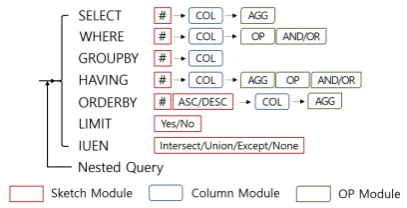
Figure 1: Clause-wise and recursive SQL generation process.
SyntaxSQLNet, because correct ordering is essen-tial for the GROUP BYand ORDER BYclauses. Finally, we introduce a self-attention mechanism (Lin et al., 2017) to efficiently encode database schema, which includes multiple tables.
3 Methodology
We predict complex SQL clause-wisely as de-scribed in Figure1. Each clause is predicted con-secutively by at most three different types of mod-ules (sketch, column, operator). The same ar-chitecture recursively predicts nested queries with temporal predicted SQL as an additional input.
3.1 Question and Schema Encoding
We encode a natural language question with a bi-directional LSTM. We denote HQ ∈ Rd×|X| as
the question encoding, wheredis the number of LSTM units and |X|is the number of tokens in the question.
To encode a database schema, we consider each column in its tables as a concatenated sequence of words from the table name and column name with a separation token. (e.g., [student, [SEP], first, name]). First, we apply bi-directional LSTM over this sequence for each column. Then, we apply the self-attention mechanism (Lin et al., 2017) over the LSTM outputs to form a summarized fixed-size vector for each column. For the ith column, its encodingh(i)col ∈Rdis computed by a weighted sum of the LSTM outputo(i)col ∈Rd×|L|as follows:
α=softmax(wTtanh(o(i)col)) (1)
h(i)col=o(i)colαT (2)
where|L|is the number of tokens in the column andw ∈ Rdis a trainable parameter. We denote
Hcol= [h(1)col, ...h(col|C|)]as columns encoding where
[image:2.595.318.522.60.164.2]3.2 Sketch Prediction
We predict the clause-wise sketch via 8 differ-ent text classification modules that include the number of SQL expressions in each clause, the presence of LIMIT clause, and the presence of
INTERSECT/UNION/EXCEPT as described in Figure1. All of them share the same model archi-tecture but are trained separately. For the classi-fication, we applied attention-based bi-directional LSTM followingZhou et al.(2016).
First, we compute sentence representationrs∈
Rdby a weighted sum of question encodingHQ∈
Rd×|X|. Then we apply the softmax classifier to
choose the sketch as follows:
αs=softmax(wTstanh(HQ)) (3)
rs =HQαTs (4)
Psketch=softmax(Wsrs+bs) (5)
wherews ∈Rd, Ws ∈Rns×d, bs∈Rns are
train-able parameters andnsis the number of possible sketches.
3.3 Columns and Operators Prediction
To predict columns and operators, we use the LSTM decoder with the attention mechanism ( Lu-ong et al.,2015) such thatthe number of decoding steps are decided by the sketch prediction module. We train 5 different column prediction modules separately for each SQL clause, but they share the same architecture.
In the column prediction module, the hidden state of the decoder at the t-th decoding step is computed asd(t)col(∈Rd) =LSTM(d(tcol−1), h(tcol−1)), whereh(tcol−1)∈Rdis an encoding of the predicted column in the previous decoding step. The con-text vectorr(t)is computed by a weighted sum of question encodingsHQ ∈Rd×|X|based on
atten-tion weight as follows:
α(t) =softmax(d(t)colTHQ) (6)
r(t) =HQα(t) T
(7)
Then, the attentional output of the t-th decoding step a(t)col is computed as a linear combination of
d(t)col ∈ Rdandr(t) ∈
Rdfollowed bytanh
acti-vation.
a(t)col =tanh(W1d(t)col+W2r(t)) (8)
whereW1, W2 ∈ Rd×dare trainable parameters.
Finally, the probability for each column at the t -th decoding step is computed as a dot product be-tweena(t)col∈Rdand the encoding of each column
inHcol ∈Rd×|C|followed by softmax.
Pcol(t)=softmax(a(t)colT Hcol) (9)
To predict corresponding operators for each pre-dicted column, we use a decoder of the same archi-tecture as in the column prediction module. The only difference is that a decoder input at thet-th decoding step is an encoding of thet-th predicted column from the column prediction module.
d(t)op =LSTM(d(top−1), h(t)col) (10)
Attentional outputa(t)op ∈ Rd is computed
identi-cally to Eq. (8). Then, the probability for opera-tors corresponding to thet-th predicted column is computed by the softmax classifier as follows:
Pop(t)=softmax(Woa(t)op +bo) (11)
where Wo ∈ Rno×d andbo ∈ Rno are trainable
parameters andnois the number of possible oper-ators.
3.4 From Clause Prediction
After the predictions of all the other clauses, we use a heuristic to generate the FROM clause. We first collect all the columns that appear in the pre-dicted SQL, and then weJOINtables that include these predicted columns.
3.5 Recursion for Nested Queries
To predict the presence of a sub-query, we train an-other module that has the same architecture as the operator prediction module. Instead of predicting corresponding operators for each column, it pre-dicts whether each column is compared to a vari-able (e.g.,WHEREage>3) or to a sub-query (e.g.,
WHEREage>(SELECT avg(age) ..)). In the lat-ter case, we add the temporal[SUB QUERY] to-ken to the corresponding location in the SQL out-put. Additionally, if the sketch prediction module predicts one of INTERSECT/UNION/EXCEPT
operators, we add a[SUB QUERY]token after the operator.
To predict a sub-query, our model takes the temporal generated SQL with a [SUB QUERY]
Dev Test Method Easy Medium Hard Extra Hard All All
SQLNet 23.2% 8.6% 9.8% 0% 10.9% 12.4% TypeSQL 18.8% 5.5% 4.6% 2.4% 8.0% 8.2% SyntaxSQLNet 38.4% 15.0% 16.1% 3.5% 19.0% 19.7%
Ours 53.2% 27.0% 20.1% 6.5% 28.8% 24.3%
-rec 53.2% 27.0% 14.4% 2.9% 27.4% --rec - col-att 46.4% 22.0% 12.1% 4.7% 23.4% --rec -col-att -sketch 33.2% 18.6% 11.5% 4.7% 18.7%
-Table 1: Accuracy of exact SQL matching with different hardness levels.
Method SELECT WHERE GROUP BY ORDER BY KEYWORDS
SQLNet 46.6% 20.6% 37.6% 49.2% 62.8% TypeSQL 43.7% 14.8% 16.9% 52.1% 67.0% SyntaxSQLNet 55.4% 22.2% 51.4% 50.6% 73.3%
Ours 68.7% 39.0% 63.1% 63.5% 76.5%
Table 2: F1 scores of SQL component matching on thedevset.
[image:4.595.136.463.64.170.2] [image:4.595.130.466.205.273.2]What is ... [SEP] SELECT ... INTERSECT [SUB QUERY]). This input is encoded in the same way as question encoding described in Sec-tion3.1. Then, the rest of the SQL generation pro-cess is identical to that described in Section 3.2– 3.4. After the sub-query is predicted, it replaces the[SUB QUERY]token to form the final query.
4 Experiments
4.1 Experimental Setup
We evaluate our model with Spider (Yu et al., 2018c), a large-scale, complex and cross-domain text-to-SQL dataset. We follow the same database split asYu et al. (2018c), which ensures that any database schema that appears in the training set does not appear in the dev or test set. Through this split, we examine how well our model can be gen-eralized to unseen databases. Because the test set is not opened to the public, we use thedevset for the ablation analysis. For the evaluation metrics, we use 1) accuracy of exact SQL matching and 2) F1 score of SQL component matching, proposed by (Yu et al.,2018c). We also follow their query hardness criteria to understand the model perfor-mance on different levels of queries. Our model and all the baseline models are trained based on only theSpiderdataset without data augmentation.
4.2 Model Configuration
We use the same hyperparameters for every mod-ule. For the word embedding, we apply deep con-textualized word representations (ELMO) from Peters et al.(2018) and allow them to be fine-tuned
during the training. For the question and column encoders, we use a 1-layer 512-unit bi-directional LSTM. For the decoders in the columns and oper-ators prediction modules, we use a 1-layer 1024-unit uni-directional LSTM. For the training, we use Adam optimizer (Kingma and Ba,2014) with a learning rate of 1e-4 and use early stopping with 50 epochs. Additionally, we use dropout (Hinton et al.,2012) with a rate of 0.2 for the regulariza-tion.
4.3 Result and Analysis
Table1 shows the exact SQL matching accuracy of our model and previous models. We achieve 24.3% and 28.8% on the test and dev sets respec-tively, which outperforms the previous best model SyntaxSQLNet (Yu et al., 2018b) by 4.6% and 9.8%. Moreover, our model outperforms previous models on all different query hardness levels.
encoder-decoder architecture without sketch generation for columns prediction, the accuracy drops by 4.7%.
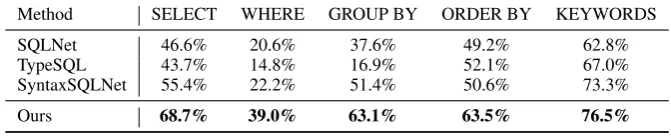
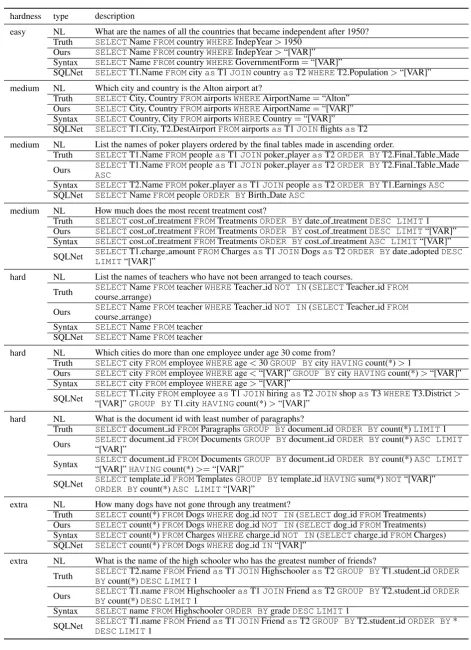
For the component matching result for each SQL clause, our model outperforms previous ap-proaches for all of the SQL components by a sig-nificant margin, as shown in Table2. Examples of predicted SQL from different models are shown in AppendixA.
5 Conclusion
In this paper, we propose a recursive and SQL clause-wise decoding neural architecture to ad-dress the complex and cross-domain text-to-SQL task. We evaluate our model with the Spider dataset, and the experimental result shows that our model significantly outperforms previous work for generating not only simple queries, but also com-plex and nested queries.
Acknowledgments
We thank Yongsik Lee, Jaesik Yoon, and Donghun Lee (SAP) for their reviews and support. We also thank professor Sungroh Yoon, Jongyun Song, and Taeuk Kim (Seoul National University) for their insightful feedback and three anonymous review-ers for their helpful comments.
References
Li Dong and Mirella Lapata. 2018. Coarse-to-fine de-coding for neural semantic parsing. In Proceed-ings of the 56th Annual Meeting of the Association for Computational Linguistics (Volume 1: Long Pa-pers), volume 1, pages 731–742.
Catherine Finegan-Dollak, Jonathan K Kummerfeld, Li Zhang, Karthik Ramanathan, Sesh Sadasivam, Rui Zhang, and Dragomir Radev. 2018. Improv-ing text-to-sql evaluation methodology. In Proceed-ings of the 56th Annual Meeting of the Association for Computational Linguistics (Volume 1: Long Pa-pers), volume 1, pages 351–360.
Geoffrey E Hinton, Nitish Srivastava, Alex Krizhevsky, Ilya Sutskever, and Ruslan R Salakhutdinov. 2012. Improving neural networks by preventing co-adaptation of feature detectors. arXiv preprint arXiv:1207.0580.
Po-Sen Huang, Chenglong Wang, Rishabh Singh, Wen-tau Yih, and Xiaodong He. 2018. Natural language to structured query generation via meta-learning. InProceedings of the 2018 Conference of the North American Chapter of the Association for Computational Linguistics: Human Language Tech-nologies, Volume 2 (Short Papers), volume 2, pages 732–738.
Srinivasan Iyer, Ioannis Konstas, Alvin Cheung, Jayant Krishnamurthy, and Luke Zettlemoyer. 2017. Learning a neural semantic parser from user feed-back. arXiv preprint arXiv:1704.08760.
Srinivasan Iyer, Ioannis Konstas, Alvin Cheung, and Luke Zettlemoyer. 2018. Mapping language to code in programmatic context. In Proceedings of the 2018 Conference on Empirical Methods in Natural Language Processing, pages 1643–1652.
Diederik P Kingma and Jimmy Ba. 2014. Adam: A method for stochastic optimization. arXiv preprint arXiv:1412.6980.
Dongjun Lee, Jaesik Yoon, Jongyun Song, Sang-gil Lee, and Sungroh Yoon. 2019. One-shot learning for text-to-sql generation. arXiv preprint arXiv:1905.11499.
Zhouhan Lin, Minwei Feng, Cicero Nogueira dos San-tos, Mo Yu, Bing Xiang, Bowen Zhou, and Yoshua Bengio. 2017. A structured self-attentive sentence embedding. arXiv preprint arXiv:1703.03130.
Thang Luong, Hieu Pham, and Christopher D Man-ning. 2015. Effective approaches to attention-based neural machine translation. In Proceedings of the 2015 Conference on Empirical Methods in Natural Language Processing, pages 1412–1421.
Matthew Peters, Mark Neumann, Mohit Iyyer, Matt Gardner, Christopher Clark, Kenton Lee, and Luke Zettlemoyer. 2018. Deep contextualized word repre-sentations. InProceedings of the 2018 Conference of the North American Chapter of the Association for Computational Linguistics: Human Language Technologies, Volume 1 (Long Papers), volume 1, pages 2227–2237.
Patti J Price. 1990. Evaluation of spoken language sys-tems: The atis domain. InSpeech and Natural Lan-guage: Proceedings of a Workshop Held at Hidden Valley, Pennsylvania, June 24-27, 1990.
Maxim Rabinovich, Mitchell Stern, and Dan Klein. 2017. Abstract syntax networks for code genera-tion and semantic parsing. In Proceedings of the 55th Annual Meeting of the Association for Compu-tational Linguistics (Volume 1: Long Papers), pages 1139–1149.
Xiaojun Xu, Chang Liu, and Dawn Song. 2017. Sqlnet: Generating structured queries from natural language without reinforcement learning. arXiv preprint arXiv:1711.04436.
Semih Yavuz, Izzeddin Gur, Yu Su, and Xifeng Yan. 2018. What it takes to achieve 100% condition ac-curacy on wikisql. InProceedings of the 2018 Con-ference on Empirical Methods in Natural Language Processing, pages 1702–1711.
Association for Computational Linguistics (Volume 1: Long Papers), pages 440–450.
Tao Yu, Zifan Li, Zilin Zhang, Rui Zhang, and Dragomir Radev. 2018a. Typesql: Knowledge-based type-aware neural text-to-sql generation. In Proceedings of the 2018 Conference of the North American Chapter of the Association for Computa-tional Linguistics: Human Language Technologies, Volume 2 (Short Papers), volume 2, pages 588–594.
Tao Yu, Michihiro Yasunaga, Kai Yang, Rui Zhang, Dongxu Wang, Zifan Li, and Dragomir Radev. 2018b. Syntaxsqlnet: Syntax tree networks for com-plex and cross-domain text-to-sql task. In Proceed-ings of the 2018 Conference on Empirical Methods in Natural Language Processing, pages 1653–1663.
Tao Yu, Rui Zhang, Kai Yang, Michihiro Yasunaga, Dongxu Wang, Zifan Li, James Ma, Irene Li, Qingn-ing Yao, Shanelle Roman, et al. 2018c. Spider: A large-scale human-labeled dataset for complex and cross-domain semantic parsing and text-to-sql task. In Proceedings of the 2018 Conference on Empiri-cal Methods in Natural Language Processing, pages 3911–3921.
John M Zelle and Raymond J Mooney. 1996. Learn-ing to parse database queries usLearn-ing inductive logic programming. In Proceedings of the national con-ference on artificial intelligence, pages 1050–1055.
Victor Zhong, Caiming Xiong, and Richard Socher. 2017. Seq2sql: Generating structured queries from natural language using reinforcement learning. CoRR, abs/1709.00103.
Peng Zhou, Wei Shi, Jun Tian, Zhenyu Qi, Bingchen Li, Hongwei Hao, and Bo Xu. 2016. Attention-based bidirectional long short-term memory net-works for relation classification. InProceedings of the 54th Annual Meeting of the Association for Com-putational Linguistics (Volume 2: Short Papers), volume 2, pages 207–212.
A Sample SQL Predictions
hardness type description
easy NL What are the names of all the countries that became independent after 1950? Truth SELECTNameFROMcountryWHEREIndepYear>1950
Ours SELECTNameFROMcountryWHEREIndepYear>“[VAR]” Syntax SELECTNameFROMcountryWHEREGovernmentForm=“[VAR]”
SQLNet SELECTT1.NameFROMcityasT1JOINcountryasT2WHERET2.Population>“[VAR]”
medium NL Which city and country is the Alton airport at?
Truth SELECTCity, CountryFROMairportsWHEREAirportName=“Alton” Ours SELECTCity, CountryFROMairportsWHEREAirportName=“[VAR]” Syntax SELECTCountry, CityFROMairportsWHERECountry=“[VAR]” SQLNet SELECTT1.City, T2.DestAirportFROMairportsasT1JOINflightsasT2
medium NL List the names of poker players ordered by the final tables made in ascending order.
Truth SELECTT1.NameFROMpeopleasT1JOINpoker playerasT2ORDER BYT2.Final Table Made
Ours SELECTT1.NameFROMpeopleasT1JOINpoker playerasT2ORDER BYT2.Final Table Made ASC
Syntax SELECTT2.NameFROMpoker playerasT1JOINpeopleasT2ORDER BYT1.EarningsASC SQLNet SELECTNameFROMpeopleORDER BYBirth DateASC
medium NL How much does the most recent treatment cost?
Truth SELECTcost of treatmentFROMTreatmentsORDER BYdate of treatmentDESC LIMIT1 Ours SELECTcost of treatmentFROMTreatmentsORDER BYcost of treatmentDESC LIMIT“[VAR]” Syntax SELECTcost of treatmentFROMTreatmentsORDER BYcost of treatmentASC LIMIT“[VAR]”
SQLNet SELECTT1.charge amountFROMChargesasT1JOINDogsasT2ORDER BYdate adoptedDESC LIMIT“[VAR]”
hard NL List the names of teachers who have not been arranged to teach courses.
Truth SELECTNameFROMteacherWHERETeacher idNOT IN(SELECTTeacher idFROM course arrange)
Ours SELECTNameFROMteacherWHERETeacher idNOT IN(SELECTTeacher idFROM course arrange)
Syntax SELECTNameFROMteacher SQLNet SELECTNameFROMteacher
hard NL Which cities do more than one employee under age 30 come from?
Truth SELECTcityFROMemployeeWHEREage<30GROUP BYcityHAVINGcount(*)>1
Ours SELECTcityFROMemployeeWHEREage<“[VAR]”GROUP BYcityHAVINGcount(*)>“[VAR]” Syntax SELECTcityFROMemployeeWHEREage>“[VAR]”
SQLNet SELECTT1.cityFROMemployeeasT1JOINhiringasT2JOINshopasT3WHERET3.District> “[VAR]”GROUP BYT1.cityHAVINGcount(*)>“[VAR]”
hard NL What is the document id with least number of paragraphs?
Truth SELECTdocument idFROMParagraphsGROUP BYdocument idORDER BYcount(*)LIMIT1
Ours SELECTdocument idFROMDocumentsGROUP BYdocument idORDER BYcount(*)ASC LIMIT “[VAR]”
Syntax SELECTdocument idFROMDocumentsGROUP BYdocument idORDER BYcount(*)ASC LIMIT “[VAR]”HAVINGcount(*)>=“[VAR]”
SQLNet SELECTtemplate idFROMTemplatesGROUP BYtemplate idHAVINGsum(*)NOT“[VAR]” ORDER BYcount(*)ASC LIMIT“[VAR]”
extra NL How many dogs have not gone through any treatment?
Truth SELECTcount(*)FROMDogsWHEREdog idNOT IN(SELECTdog idFROMTreatments) Ours SELECTcount(*)FROMDogsWHEREdog idNOT IN(SELECTdog idFROMTreatments) Syntax SELECTcount(*)FROMChargesWHEREcharge idNOT IN(SELECTcharge idFROMCharges) SQLNet SELECTcount(*)FROMDogsWHEREdog idIN“[VAR]”
extra NL What is the name of the high schooler who has the greatest number of friends?
Truth SELECTT2.nameFROMFriendasT1JOINHighschoolerasT2GROUP BYT1.student idORDER BYcount(*)DESC LIMIT1
Ours SELECTT1.nameFROMHighschoolerasT1JOINFriendasT2GROUP BYT2.student idORDER BYcount(*)DESC LIMIT1
Syntax SELECTnameFROMHighschoolerORDER BYgradeDESC LIMIT1
[image:7.595.68.540.55.706.2]SQLNet SELECTT1.nameFROMFriendasT1JOINFriendasT2GROUP BYT2.student idORDER BY* DESC LIMIT1
Table 3: Sample SQL predictions by our model and previous state-of-the-art models on the dev split.NLdenotes the natural language question andTruthdenotes the corresponding ground truth SQL query.Ours,Syntax, and