An Unsupervised Probability Model for Speech-to-Translation Alignment of
Low-Resource Languages
Antonios Anastasopoulos and David Chiang
University of Notre Dame
{aanastas,dchiang}@nd.edu
Long Duong
University of Melbourne
Abstract
For many low-resource languages, spoken lguage resources are more likely to be an-notated with translations than with transcrip-tions. Translated speech data is potentially valuable for documenting endangered lan-guages or for training speech translation sys-tems. A first step towards making use of such data would be to automatically align spoken words with their translations. We present a model that combines Dyer et al.’s
reparam-eterization of IBM Model 2 (fast_align)
andk-means clustering using Dynamic Time
Warping as a distance measure. The two com-ponents are trained jointly using expectation-maximization. In an extremely low-resource scenario, our model performs significantly better than both a neural model and a strong baseline.
1 Introduction
For many low-resource languages, speech data is easier to obtain than textual data. And because speech transcription is a costly and slow process, speech is more likely to be annotated with transla-tions than with transcriptransla-tions. This translated speech is a potentially valuable source of information – for example, for documenting endangered languages or for training speech translation systems.
In language documentation, data is usable only if it is interpretable. To make a collection of speech data usable for future studies of the language, some-thing resembling interlinear glossed text (transcrip-tion, morphological analysis, word glosses, free translation) would be needed at minimum. New
technologies are being developed to facilitate col-lection of translations (Bird et al., 2014), and there already exist recent examples of parallel speech collection efforts focused on endangered languages (Blachon et al., 2016; Adda et al., 2016). As for the other annotation layers, one might hope that a first pass could be done automatically. A first step to-wards this goal would be to automatically align spo-ken words with their translations, capturing informa-tion similar to that captured by word glosses.
In machine translation, statistical models have tra-ditionally required alignments between the source and target languages as the first step of training. Therefore, producing alignments between speech and text would be a natural first step towards MT systems operating directly on speech.
We present a model that, in order to learn such alignments, adapts and combines two components: Dyer et al.’s reparameterization of IBM Model 2 (Dyer et al., 2013), more commonly known as
fast_align, and k-means clustering using
Dy-namic Time Warping (Berndt and Clifford, 1994) as a distance measure. The two components are trained jointly using expectation-maximization.
We experiment on two language pairs. One is Spanish-English, using the CALLHOME and Fisher corpora. The other is Griko-Italian; Griko is an endangered language for which we created (and make freely available)1 gold-standard translations and word alignments (Lekakou et al., 2013). In all cases, our model outperforms both a naive but strong baseline and a neural model (Duong et al., 2016).
1https://www3.nd.edu/∼aanastas/griko/griko-data.tar.gz
2 Background
In this section, we briefly describe the existing mod-els that the two components of our model are based on. In the next section, we will describe how we adapt and combine them to the present task.
2.1 IBM Model 2 andfast_align
The IBM translation models (Brown et al., 1993) aim to model the distribution p(e | f) for an En-glish sentencee=e1· · ·el, given a French sentence
f = f1· · ·em. They all introduce a hidden variable
a = a1· · ·al that gives the position of the French word to which each English word is aligned.
The general form of IBM Models 1, 2 and
fast_alignis
p(e,a|f)= p(l) l
Y
i=1
t(ei | fai)δ(ai|i,l,m)
wheret(e| f) is the probability of translating French word f to English worde, andδ(ai = j | i,l,m) is the probability of aligning thei-th English word with the j-th French word.
In Model 1, δ is uniform; in Model 2, it is a categorical distribution. Dyer et al. (2013) pro-pose a reparameterization of Model 2, known as
fast_align:
h(i,j,l,m)=−i l−
j m
δ(ai|i,l,m)=
(1p0−p0)expZλλh(i(,il,,ami,)l,m) aaii =>00
where the null alignment probability p0 and preci-sion λ ≥ 0 are hyperparameters optimized by grid search. Asλ→0, the distribution gets closer to the distribution of IBM Model 1, and asλ gets larger, the model prefers monotone word alignments more strongly.
2.2 DTW and DBA
Dynamic Time Warping (DTW) (Berndt and Clif-ford, 1994) is a dynamic programming method for measuring distance between two temporal se-quences of variable length, as well as computing an alignment based on this distance. Given two se-quencesφ, φ0of lengthmandm0respectively, DTW
constructs anm×m0matrixw. The warping path can
be found by evaluating the following recurrence:
wi,j =d(φi, φ0j)+min{wi−1,j,wi−1,j−1,wi,j−1}
wheredis a distance measure. In this paper, we nor-malize the cost of the warping path:
DTW(φ, φ0)= wm,m0
m+m0 which lies between zero and one.
DTW Barycenter Averaging (DBA) (Petitjean et al., 2011) is an iterative approximate method that at-tempts to find a centroid of a set of sequences, min-imizing the sum of squared DTW distances.
In the original definition, given a set of sequences, DBA chooses one sequence randomly to be a “skele-ton.” Then, at each iteration, DBA computes the DTW between the skeleton and every sequence in the set, aligning each of the skeleton’s points with points in all the sequences. The skeleton is then re-fined using the found alignments, by updating each frame in the skeleton to the mean of all the frames aligned to it. In our implementation, in order to avoid picking a skeleton that is too short or too long, we randomly choose one of the sequences with median length.
3 Model
We use a generative model from a source-language speech segment consisting of feature frames φ = φ1· · ·φmto a target-language segment consisting of words e = e1. . .el. We chose to model p(e | φ) rather than p(φ| e) because it makes it easier to in-corporate DTW. The other direction is also possible, and we plan to explore it in future work.
In addition to the target-language sentence e, our model hypothesizes a sequence f = f1· · ·fl of language clusters (intuitively, source-language words), and spans (ai,bi) of the source sig-nal that each target wordei is aligned to. Thus, the clustersf = f1· · ·fland the spansa=a1, . . . ,aland
b=b1, . . . ,blare the hidden variables of the model:
p(e|φ)=X
a,b,f
p(e,a,b,f |φ).
1. Choosel, the number of target words, with uni-form probability. (Technically, this assumes a maximum target sentence length, which we can just set to be very high.)
2. For each target word positioni=1, . . . ,l: (a) Choose a cluster fi.
(b) Choose a span of source frames (ai,bi) for eito be aligned to.
(c) Generate a target wordeifrom fi.
Accordingly, we decomposep(e,a,b,f |φ) into sev-eral submodels:
p(e,a,b,f |φ)= p(l) l
Y
i=1 u(fi)×
s(ai,bi | fi,φ)× δ(ai,bi|i,l,|φ|)× t(ei | fi).
Note that submodels δ and s both generate spans (corresponding to step 2b), making the model de-ficient. We could make the model sum to one by replacing u(fi)s(ai,bi | fi,φ) with s(fi | ai,bi,φ), and this was in fact our original idea, but the model as defined above works much better, as discussed in Section 7.4. We describe bothδand s in detail be-low.
Clustering model The probability over clusters, u(f), is just a categorical distribution. The submodel s assumes that, for each cluster f, there is a “pro-totype” signal φf (cf. Ristad and Yianilos, 1998). Technically, theφf are parameters of the model, and will be recomputed during the M step. Then we can define:
s(a,b| f,φ)= exp(−DTW(φ f, φ
a· · ·φb)2)
Pm
a,b=1exp(−DTW(φf, φa· · ·φb)2)
where DTW is the distance between the prototype and the segment computed using Dynamic Time Warping. Thussassigns highest probability to spans ofφthat are most similar to the prototypeφf.
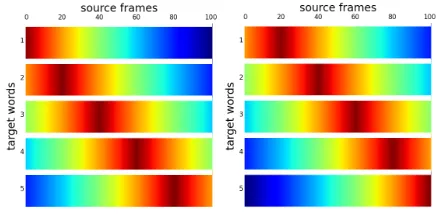
[image:3.612.316.535.57.164.2]Distortion model The submodelδcontrols the re-ordering of the target words relative to the source frames. It is an adaptation of fast_align to our
Figure 1: Sample distributions for the alignment variablesa andbform=100,l=5,p0=0,λ=0.5, andµ=20.
setting, where there is not a single source word po-sition ai, but a span (ai,bi). We want the model to prefer the middle of the word to be close to the di-agonal, so we need the variableato be somewhat to the left andbto be somewhat to the right. Therefore, we introduce an additional hyperparameterµwhich is intuitively the number of frames in a word. Then we define
ha(i,j,l,m, µ)=−il− m j
−µ
hb(i,j,l,m, µ)=−i l−
j−µ m−µ
δa(ai |i,l,m)=
(1p0−p0)expZλλh(ai(,li,,mai,)l,m) aaii =>00
δb(bi |i,l,m)=
(1p0−p0)expZλλh(bi(,li,,mbi,)l,m) bbii =>00 δ(ai,bi |i,l,m)=δa(ai |i,l,m)δb(bi |i,l,m)
where the Zλ(i,l,m) are set so that all distributions
sum to one. Figure 1 shows an example visualisation of the the resulting distributions for the two variables of our model.
We setµdifferently for each word. For eachi, we setµito be proportional to the number ofcharacters inei, such thatPiµi=m.
either zero or one, and does not need to be reesti-mated. In our experiments, we setk = 2, allowing each target word to have up to two source-language translations/pronunciations. (If a source word has more than one target translation, they are treated as distinct clusters with distinct prototypes.)
4 Training
We use the hard (Viterbi) version of the Expectation-Maximization (EM) algorithm to estimate the pa-rameters of our model, because calculating expected counts in full EM would be prohibitively expensive, requiring summations over all possible alignments.
Recall that the hidden variables of the model are the alignments (ai,bi) and the source words (fi). The parameters are the translation probabilitiest(ei | f) and the prototypes (φf). The (hard) E step uses the current model and prototypes to find, for each target word, the best source segment to align it to and the best source word. The M step reestimates the prob-abilitiest(e| f) and the prototypesφf. We describe each of these steps in more detail below.
Initialization Initialization is especially important since we are using hard EM.
To initialize the parameters, we initialize the hid-den variables and then perform an M step. We as-sociate each target word type e withk = 2 source clusters, and for each occurrence ofe, we randomly assign it one of theksource clusters.
The alignment variablesai,bi are initialized to
ai,bi =arg max
a,b δ(a,b|i,l,m).
M step The M step reestimates the probabilities t(e| f) using relative-frequency estimation.
The prototypes φf are more complicated. Theo-retically, the M step should recompute each φf so as to maximize that part of the log-likelihood that depends onφf:
Lφf =
X
φ
X
i|fi=f
logs(ai,bi | f,φ)
=X
φ
X
i|fi=f
logexp(−DTW(φf, φai· · ·φbi)2) Z(f,φ)
=X
φ
X
i|fi=f
−DTW(φf, φ
ai· · ·φbi)2−logZ(f,φ)
where the summation overφis over all source sig-nals in the training data. This is a hard problem, but note that the first term is just the sum-of-squares of the DTW distance between φf and all source seg-ments that are classified as f. This is what DBA is supposed to approximately minimize, so we simply setφf using DBA, ignoring the denominator.
E step The (hard) E step uses the current model and prototypes to find, for each target word, the best source segment to align it to and the best source clus-ter.
In order to reduce the search space for aand b, we use the unsupervised phonetic boundary detec-tion method of Khanagha et al. (2014). This method operates directly on the speech signal and provides us with candidate phone boundaries, on which we restrict the possible values for a andb, creating a list of candidate utterance spans.
Furthermore, we use a simple silence detection method. We pass the envelope of the signal through a low-pass filter, and then mark as “silence” time spans of 50ms or longer in which the magnitude is below a threshold of 5% relative to the maximum of the whole signal. This method is able to detect about 80% of the total pauses, with a 90% precision in a 50ms window around the correct silence bound-ary. We can then remove from the candidate list the utterance spans that include silence, on the assump-tion that a word should not include silences. Finally, in case one of the span’s boundaries happens to be within a silence span, we also move it so as to not include the silence.
Hyperparameter tuning The hyperparameters p0, λ, and µ are not learned. We simply set p0 to zero (disallowing unaligned target words) and setµ as described above.
Forλwe perform a grid search over candidate val-ues to maximize the alignment F-score on the devel-opment set. We obtain the best scores withλ=0.5.
5 Related Work
cross-lingual pronunciation lexicons. Pialign (Neu-big et al., 2012) aligns characters and can be ap-plied equally well to phones. Duong et al. (2016) use an extension of the neural attentional model of Bahdanau et al. (2015) for aligning phones to words and speech to words; we discuss this model below in Section 6.2.
There exist several supervised approaches that at-tempt to integrate speech recognition and machine translation. However, they rely heavily on the abun-dance of training data, pronunciation lexicons, or language models, and therefore cannot be applied in a low- or zero-resource setting.
A task somewhat similar to ours, which operates at a monolingual level, is the task of zero-resource spoken term discovery, which aims to discover re-peated words or phrases in continuous speech. Vari-ous approaches (Ten Bosch and Cranen, 2007; Park and Glass, 2008; Muscariello et al., 2009; Zhang and Glass, 2010; Jansen et al., 2010) have been tried, in order to spot keywords, using segmental DTW to identify repeated trajectories in the speech signal.
Kamper et al. (2016) try to discover word segmen-tation and a pronunciation lexicon in a zero-resource setting, combining DTW with acoustic embeddings; their methods operate in a very low-vocabulary set-ting. Bansal (2015) attempts to build a speech trans-lation system in a low-resource setting, by using as source input the simulated output of an unsupervised term discovery system.
6 Experiments
We evaluate our method on two language pairs, Spanish-English and Griko-Italian, against two baseline methods, a naive baseline, and the model of Duong et al. (2016).
6.1 Data
For each language pair, we require a sentence-aligned parallel corpus of source-language speech and target-language text. A subset of these sentences should be annotated with span-to-word alignments for use as a gold standard.
6.1.1 Spanish-English
For Spanish-English, we use the Spanish CALL-HOME corpus (LDC96S35) and the Fisher corpus
(LDC2010T04), which consist of telephone conver-sations between Spanish native speakers based in the US and their relatives abroad, together with English translations produced by Post et al. (2013). Span-ish is obviously not a low-resource language, but we pretend that it is low-resource by not making use of any Spanish ASR or resources like transcribed speech or pronunciation lexicons.
Since there do not exist gold standard alignments between the Spanish speech and English words, we use the “silver” standard alignments produced by Duong et al. (2016) for the CALLHOME corpus, and followed the same procedure for the Fisher cor-pus as well. In order to obtain them, they first used a forced aligner to align the speech to its transcription, and GIZA++with thegdfasymmetrization
heuris-tic to align the Spanish transcription to the English translation. They then combined the two alignments to produce “silver” standard alignments between the Spanish speech and the English words.
The CALLHOME dataset consists of 17532 Spanish utterances, based on the dialogue turns. We first use a sample of 2000 sentences, out of which we use 200 as a development set and the rest as a test set. We also run our experiments on the whole dataset, selecting 500 utterances for a development set, using the rest as a test set. The Fisher dataset consists of 143355 Spanish utterances. We use 1000 of them as a development set and the rest as a test set.
6.1.2 Griko-Italian
We also run our model on a corpus that consists of about 20 minutes of speech in Griko, an endangered minority dialect of Greek spoken in south Italy, along with text translations into Italian (Lekakou et al., 2013).2 The corpus consists of 330 mostly prompted utterances by nine native speakers. Al-though the corpus is very small, we use it to show-case the effectiveness of our method in a hard setting with extremely low resources.
All utterances were manually annotated and tran-scribed by a trained linguist and bilingual speaker of both languages, who produced the Griko tran-scriptions and Italian glosses. We created full trans-lations into Italian and manually aligned the transla-tions with the Griko transcriptransla-tions. We then
bined the two alignments (speech-to-transcription and transcription-to-translation) to produce speech-to-translation alignments. Therefore, our compar-ison is done against an accurate “gold” standard alignment. We split the data into a development set of just 30 instances, and a test set of the remain-ing 300 instances.
6.1.3 Preprocessing
In both data settings, we treat the speech data as a sequence of 39-dimensional Perceptual Linear Pre-diction (PLP) vectors encoding the power spectrum of the speech signal (Hermansky, 1990), computed at 10ms intervals. We also normalize the features at the utterance level, shifting and scaling them to have zero mean and unit variance.
6.2 Baselines
Our naive baseline assumes that there is no reorder-ing between the source and target language, and aligns each target word ei to a source span whose length in frames is proportional to the length ofeiin characters. This actually performs very well on lan-guage pairs that show minimal or no reordering, and language pairs that have shared or related vocabular-ies.
The other baseline that we compare against is the neural network attentional model of Duong et al. (2016), which extends the attentional model of Bahdanau et al. (2015) to be used for aligning and translating speech, and, along with several modifi-cations, achieve good results on the phone-to-word alignment task, and almost match the baseline per-formance on the speech-to-word alignment task.
7 Results
To evaluate an automatic alignment between the speech and its translation against the gold/silver standard alignment, we compute alignment preci-sion, recall, and F-score as usual, but on links be-tween source-language frames and target-language words.
7.1 Overview
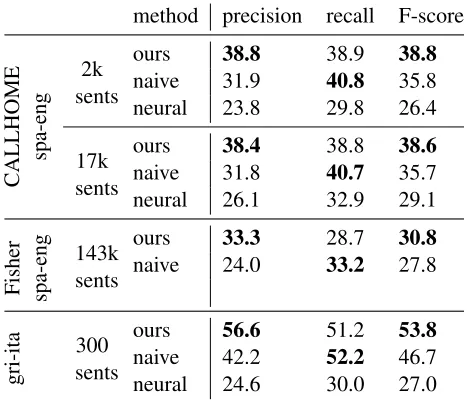
Table 1 shows the precision, recall, and balanced F-score of the three models on the Spanish-English CALLHOME corpus (both the 2000-sentence subset
method precision recall F-score
CALLHOME spa-eng 2k sents
ours 38.8 38.9 38.8
naive 31.9 40.8 35.8
neural 23.8 29.8 26.4
17k sents
ours 38.4 38.8 38.6
naive 31.8 40.7 35.7
neural 26.1 32.9 29.1
Fisher spa-eng
143k sents
ours 33.3 28.7 30.8
naive 24.0 33.2 27.8
gri-ita
300 sents
ours 56.6 51.2 53.8
naive 42.2 52.2 46.7
[image:6.612.311.545.61.261.2]neural 24.6 30.0 27.0
Table 1:Our model achieves higher precision and F-score than both the naive baseline and the neural model on all datasets.
and the full set), the Spanish-English Fisher corpus, and the Griko-Italian corpus.
In all cases, our model outperforms both the naive baseline and the neural attentional model. Our model, when compared to the baselines, improves greatly on precision, while slightly underperforming the naive baseline on recall. In certain applications, higher precision may be desirable: for example, in language documentation, it’s probably better to err on the side of precision; in phrase-based translation, higher-precision alignments lead to more extracted phrases.
The rest of the section provides a further anal-ysis of the results, focusing on the extremely low-resource Griko-Italian dataset.
7.2 Speaker robustness
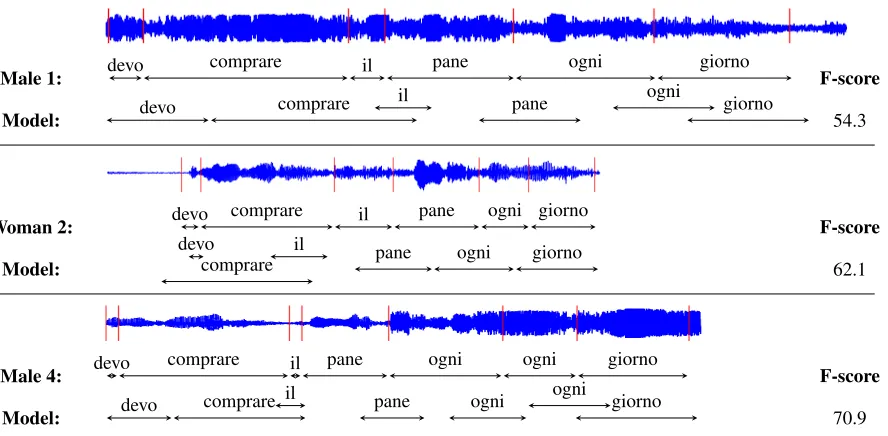
Figure 2 shows the alignments produced by our model for three utterances of the same sentence from the Griko-Italian dataset by three different speak-ers. Our model’s performance is roughly consistent across these utterances. In general, the model does not seem significantly affected by speaker-specific variations, as shown in Table 2.
Male 1: devo comprare il pane ogni giorno F-score
Model: devo comprare 54.3
il pane ogni giorno
Woman 2: devo comprare il pane ogni giorno F-score
Model: 62.1
devo
comprare il pane ogni giorno
Male 4: devo comprare il pane ogni ogni giorno F-score
Model: devo comprare il pane ogni 70.9
ogni
[image:7.612.83.527.57.275.2]giorno
Figure 2:Alignments produced for the Italian sentencedevo comprare il pane ogni giornoas uttered by three different Griko speakers.
speaker utt len F-score female 1 55 9.0 49.4 female 2 61 8.1 55.0 female 3 41 9.6 51.0 female 4 23 7.3 54.4 female 5 21 6.1 56.6
male 1 35 5.9 59.5
male 2 32 6.0 61.9
male 3 34 6.7 60.2
male 4 23 6.4 64.0
Table 2:Model performance (F-score) is generally consistent across speakers. The second column (utt) shows the number of utterances per speaker; the third (len), their average length in words.
7.3 Word level analysis
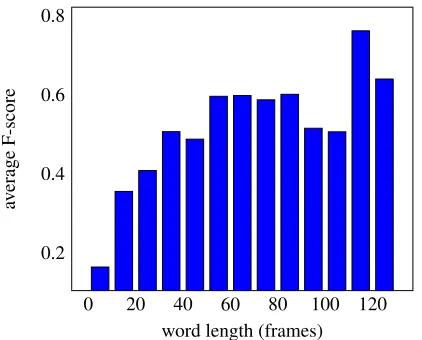
We also compute F-scores for each Italian word type. As shown in Figure 3, the longer the word’s utterance, the easier it is for our model to correctly align it. Longer utterances seem to carry enough in-formation for our DTW-based measure to function properly. On the other hand, shorter utterances are harder to align. The vast majority of Griko utter-ances that have less than 20 frames and are less ac-curately aligned correspond to monosyllabic deter-miners (o,i,a,to,ta) or conjunctions and
preposi-tions (ka,ce,en,na,an). For such short utterances,
there could be several parts of the signal that possi-bly match the prototype, leading the clustering com-ponent to prefer to align to wrong spans.
Furthermore, we note that rare word types tend to be correctly aligned. The average F-score for hapax legomena (on the Italian side) is 63.2, with 53% of them being aligned with an F-score higher than 70.0.
7.4 Comparison with proper model
[image:7.612.120.250.412.567.2]Griko-Griko: `ıcha na afor`aso to tsom`ı
Gold: dovevo comprare il pane F-score
Ours: dovevo comprare il pane 82.3
Proper: dovevo comprare il pane 61.7
[image:8.612.77.295.59.167.2]Attention: dovevo comprareil pane 38.3
Figure 4:The deficient model performs very well, whereas the proper and the attentional model prefer extreme alignment spans. For example, the proper model’s alignment for the words
dovevoandpaneare much too short.
Griko: `e Val`eria melet`a `o giorn`ali
Gold: Valeria legge il giornale F-score
Ours: Valeria legge il giornale 67.8
Proper: Valeria 75.2
legge
ilgiornale
[image:8.612.321.536.61.173.2]Attention: il legge il giornale Valeria giornale 6.0
Figure 5:One of the rare examples where the proper model performs better than the deficient one. The hapax legomena
Valeria andgiornali are not properly handled by the
at-tentional model.
0 20 40 60 80 100 120
0.2 0.4 0.6
0.8
word length (frames)
av
erage
F-score
Figure 3:There is a positive correlation between average word-level F-score and average word utterance length (in frames).
Italian dataset, it achieves an F-score of 44.3, which is better than the baselines, but still worse than our model.
In order to further examine why this happens, we performed three EM iterations on the Griko-Italian dataset with our model (in our experience, three it-erations are usually enough for convergence), and then computed one more E step with both our model and the proper model, so as to ensure that the two models would align the dataset using the exact same prototypes and that their outputs will be comparable. In this case, the proper model achieved an over-all F-score of 44.0, whereas our model achieved an F-score of 53.6. Figures 4 and 5 show the resulting alignments for two sentences. In both of these exam-ples, it is clear that the proper model prefers extreme spans: the selected spans are either much too short or
(less frequently) much too long. This is further ver-ified by examining the statistics of the alignments: the average span selected by the proper model has a length of about 30±39 frames whereas the aver-age span of the alignments produced by our deficient model is 37±24 frames. This means that the align-ments of the deficient model are much closer to the gold ones, whose average span is 42±26 frames.
We think that this is analogous to the “garbage collection” problem in word alignment. In the IBM word alignment models, if a source word f occurs in only one sentence, then EM can align many tar-get words to f and learn a very peaked distribution t(e| f). This can happen in our model and the proper model as well, of course, since IBM Model 2 is embedded in them. But in the proper model, some-thing similar can also happen with s(f | a,b): EM can make the span (a,b) large or small, and evi-dently making the span small allows it to learn a very peaked distributions(f |a,b). By contrast, our model hass(a,b | f), which seems less susceptible to this kind of effect.
8 Conclusion
Alignment of speech to text translations is a rela-tively new task, one with particular relevance for low-resource or endangered languages. The model we propose here, which combinesfast_alignand
k-means clustering using DTW and DBA, outper-forms both a very strong naive baseline and a neural attentional model, on three tasks of various sizes.
[image:8.612.82.293.246.416.2]pairs should prove more challenging. In that case, the naive baseline should be much less competitive. Similarly, the fast_align-based distortion model
may become less appopriate; we plan to try incorpo-rating IBM Model 3 or the HMM alignment model (Vogel et al., 1996) instead. Finally, we will in-vestigate downstream applications of our alignment methods, in the areas of both language documenta-tion and speech transladocumenta-tion.
Acknowledgements
We would like to thank Steven Bird, Eamonn Keogh, and the anonymous reviewers for their helpful feed-back. This research was supported in part by NSF Award 1464553.
References
Gilles Adda, Sebastian St¨uker, Martine Adda-Decker, Odette Ambouroue, Laurent Besacier, David Bla-chon, H´el`ene Bonneau-Maynard, Pierre Godard, Fa-tima Hamlaoui, Dmitry Idiatov, et al. 2016. Break-ing the unwritten language barrier: The BULB project.
Procedia Computer Science, 81:8–14.
Dzmitry Bahdanau, Kyunghyun Cho, and Yoshua Ben-gio. 2015. Neural machine translation by jointly learning to align and translate. InProc. ICLR. Sameer Bansal. 2015. Speech translation without speech
recognition. Master’s thesis, University of Edinburgh.
Donald J. Berndt and James Clifford. 1994. Using
dy-namic time warping to find patterns in time series. In
Proc. KDD, pages 359–370.
Steven Bird, Lauren Gawne, Katie Gelbart, and Isaac McAlister. 2014. Collecting bilingual audio in remote
indigenous communities. InProc. COLING.
David Blachon, Elodie Gauthier, Laurent Besacier, Guy-No¨el Kouarata, Martine Adda-Decker, and Annie Ri-alland. 2016. Parallel speech collection for under-resourced language studies using the Lig-Aikuma
mo-bile device app. Procedia Computer Science, 81:61–
66.
Peter F. Brown, Vincent J. Della Pietra, Stephen A. Della Pietra, and Robert L. Mercer. 1993. The mathemat-ics of statistical machine translation: Parameter
esti-mation. Computational Linguistics, 19(2):263–311.
Long Duong, Antonios Anastasopoulos, David Chiang, Steven Bird, and Trevor Cohn. 2016. An attentional model for speech translation without transcription. In
Proc. NAACL HLT, pages 949–959, June.
Chris Dyer, Victor Chahuneau, and Noah A. Smith. 2013. A simple, fast, and effective reparameterization
of IBM Model 2. InProc. NAACL HLT.
Hynek Hermansky. 1990. Perceptual linear predictive
(PLP) analysis of speech. J. Acoustical Society of
America, 87(4):1738–1752.
Aren Jansen, Kenneth Church, and Hynek Hermansky. 2010. Towards spoken term discovery at scale with
zero resources. InProc. INTERSPEECH, pages 1676–
1679.
Herman Kamper, Aren Jansen, and Sharon Goldwater. 2016. Unsupervised word segmentation and lexicon
discovery using acoustic word embeddings. IEEE
Trans. Audio, Speech, and Language Processing. Vahid Khanagha, Khalid Daoudi, Oriol Pont, and
Hus-sein Yahia. 2014. Phonetic segmentation of speech signal using local singularity analysis. Digital Signal Processing.
Marika Lekakou, Valeria Baldiserra, and Antonis Anasta-sopoulos. 2013. Documentation and analysis of an en-dangered language: aspects of the grammar of Griko. Armando Muscariello, Guillaume Gravier, and Fr´ed´eric
Bimbot. 2009. Audio keyword extraction by
unsuper-vised word discovery. InProc. INTERSPEECH.
Graham Neubig, Taro Watanabe, Shinsuke Mori, and Tat-suya Kawahara. 2012. Machine translation without words through substring alignment. InProc. ACL. Alex S. Park and James R. Glass. 2008.
Unsuper-vised pattern discovery in speech.IEEE Trans. Audio, Speech, and Language Processing, 16(1):186–197. Franc¸ois Petitjean, Alain Ketterlin, and Pierre Ganc¸arski.
2011. A global averaging method for dynamic time
warping, with applications to clustering. Pattern
Recognition, 44(3):678–693.
Matt Post, Gaurav Kumar, Adam Lopez, Damianos Karakos, Chris Callison-Burch, and Sanjeev Khu-danpur. 2013. Improved speech-to-text translation with the Fisher and Callhome Spanish–English speech translation corpus. InProc. IWSLT.
Eric Sven Ristad and Peter N Yianilos. 1998. Learn-ing strLearn-ing-edit distance. IEEE Transactions on Pattern Analysis and Machine Intelligence, 20(5):522–532. Felix Stahlberg, Tim Schlippe, Sue Vogel, and Tanja
Schultz. 2012. Word segmentation through
cross-lingual word-to-phoneme alignment. In Proc. IEEE
Spoken Language Technology Workshop (SLT). Louis Ten Bosch and Bert Cranen. 2007. A
compu-tational model for unsupervised word discovery. In
Proc. INTERSPEECH, pages 1481–1484.
Stephan Vogel, Hermann Ney, and Christoph Tillmann. 1996. HMM-based word alignment in statistical
trans-lation. InProc. COLING, pages 836–841.