Framework of Automatic Text Summarization
Using Reinforcement Learning
Seonggi Ryang
Graduate School of Information Science and Technology
University of Tokyo
Takeshi Abekawa National Institute of Informatics
Abstract
We present a new approach to the problem of automatic text summarization called Au-tomatic Summarization using Reinforcement Learning (ASRL) in this paper, which models the process of constructing a summary within the framework of reinforcement learning and attempts to optimize the given score function with the given feature representation of a sum-mary. We demonstrate that the method of re-inforcement learning can be adapted to auto-matic summarization problems naturally and simply, and other summarizing techniques, such as sentence compression, can be easily adapted as actions of the framework.
The experimental results indicated ASRL was superior to the best performing method in DUC2004 and comparable to the state of the art ILP-style method, in terms of ROUGE scores. The results also revealed ASRL can search for sub-optimal solutions efficiently under conditions for effectively selecting fea-tures and the score function.
1 Introduction
Automatic text summarization aims to automatically produce a short and well-organized summary of sin-gle or multiple documents (Mani, 2001). Automatic summarization, especially multi-document summa-rization, has been an increasingly important task in recent years, because of the exponential explosion of available information. The brief summary that the summarization system produces allows readers to quickly and easily understand the content of orig-inal documents without having to read each
individ-ual document, and it should be helpful for dealing with enormous amounts of information.
The extractive approach to automatic summariza-tion is a popular and well-known approach in this field, which creates a summary by directly selecting some textual units (e.g., words and sentences) from the original documents, because it is difficult to gen-uinely evaluate and guarantee the linguistic quality of the produced summary.
One of the most well-known extractive ap-proaches is maximal marginal relevance (MMR), which scores each textual unit and extracts the unit that has the highest score in terms of the MMR cri-teria (Goldstein et al., 2000). Greedy MMR-style algorithms are widely used; however, they cannot take into account the whole quality of the sum-mary due to their greediness, although a sumsum-mary should convey all the information in given docu-ments. Global inference algorithms for the extrac-tive approach have been researched widely in recent years (Filatova and Hatzivassiloglou, 2004; McDon-ald, 2007; Takamura and Okumura, 2009) to con-sider whether the summary is “good” as a whole. These algorithms formulate the problem as integer linear programming (ILP) to optimize the score: however, as ILP is non-deterministic polynomial-time hard (NP-hard), the polynomial-time complexity is very large. Consequently, we need some more efficient algorithm for calculations.
We present a new approach to the problem of au-tomatic text summarization called Auau-tomatic Sum-marization using Reinforcement Learning (ASRL), which models the process of construction of a sum-mary within the framework of reinforcement
ing and attempts to optimize the given score function with the given feature representation of a summary. We demonstrate that the method of reinforcement learning can be adapted to problems with automatic summarization naturally and simply, and other sum-marizing techniques, such as sentence compression, can be easily adapted as actions of the framework, which should be helpful to enhance the quality of the summary that is produced. This is the first paper utilizing reinforcement learning for problems with automatic summarization of text.
We evaluated ASRL with the DUC2004 summa-rization task 2, and the experimental results revealed ASRL is superior to the best method of performance in DUC2004 and comparable with the state of the art ILP-style method, based on maximum coverage with the knapsack constraint problem, in terms of ROUGE scores with experimental settings. We also evaluated ASRL in terms of optimality and execu-tion time. The experimental results indicated ASRL can search the state space efficiently for some sub-optimal solutions under the condition of effectively selecting features and the score function, and pro-duce a summary whose score denotes the expecta-tion of the score of the same features’ states. The evaluation of the quality of a produced summary only depends on the given score function, and there-fore it is easy to adapt the new method of evaluation without having to modify the structure of the frame-work.
2 Formulation of Extractive Approach
We first focus on the extractive approach, which is directly used to produce a summary by extracting some textual units, by avoiding the difficulty of hav-ing to consider the genuine lhav-inguistic quality of a summary.
The given document (or documents) in extractive summarization approaches is reduced to the set of textual units: D = {x1, x2,· · · , xn}, where n is
the size of the set, andxi denotes individual textual
units. Note that any textual unit is permitted, such as character, word, sentence, phrase, and concep-tual unit. If we determine asentenceis a textual unit to be extracted, the formulated problem is a problem of extracting sentences from the source document, which is one of the most popular settings for
sum-marization tasks.
Next, we define the score function,score(S), for any subset of the document:S ⊂D. SubsetSis one of the summaries of the given document. The aim of this summarization problem is to find the summary that maximizes this function when the score function is given. The score function is typically defined by taking into consideration the tradeoff between rele-vance and redundancy.
Then, we define length functionL(S), which in-dicates the length of summary S. The length is also arbitrary, which can be based on thecharacter,
word, and sentence. We assume the limitation of summary lengthKis given in summarization tasks. Finally, we define the extractive approach of the automatic summarization problem as:
S∗ = arg max
S⊂D
score(S) (1)
s.t. L(S)≤K.
3 Motivation
merely from the source documents. In fact, it is ideal that we can only directly utilize the score function, in the sense that we do not have to consider the de-composed form of the given score function.
We need to consider the problem with automatic summarization to be the same as that with reinforce-ment learning to handle these problems. Reinforce-ment learning is one of the solutions to three prob-lems.
• The learning of the agent only depends on the reward provided by the environment.
• Furthermore, the reward is delayed, in the sense that the agent cannot immediately know the ac-tual evaluation of the executed action.
• The agent only estimates the value of the state with the information on rewards, without knowledge of the actual form of the score func-tion, to maximize future rewards.
We suggest the formulation of the problem as we have just described will enable us to freely design the score function without limitations and expand the capabilities of automatic summarization.
4 Models of Extractive Approach for Reinforcement Learning
4.1 Reinforcement Learning
Reinforcement learning is a powerful method of solving planning problems, especially problems for-mulated as Markov decision processes (MDPs) (Sut-ton and Barto, 1998). The agent of reinforcement learning repeats three steps until terminated at each episode in the learning process.
1. The agent observes currentstatesfrom the en-vironment, contained in state spaceS.
2. Next, it determines and executes nextactiona
according to current policyπ. Actionais con-tained in the action space limited by the current state: A(s), which is a subset of whole action space A = ∪s∈SA(s). Policy π is the strat-egy for selecting action, represented as a con-ditional distribution of actions:p(a|s).
3. It then observes next states′ and receives re-wardrfrom the environment.
The aim of reinforcement learning is to find optimal policyπ∗only with information on sample trajecto-ries and to reward the experienced agent.
We describe how to adapt the extractive approach to the problem of reinforcement learning in the sec-tions that follow.
4.2 State
A state denotes a summary. We represent state s
as a tuple of summaryS (a set of textual units) and additional state variables:s= (S, A, f). We assume
shas the history of actionsAthat the agent executed to achieve this state. Additionally,shas the binary state variable,f ∈ {0,1}, which denotes whethers
is a terminal state or not. Initial states0is(∅,∅,0).
We assume thed-dimensional feature representa-tion of states: ϕ(s) ∈ Rd, which only depends on the feature of summaryϕ′(S)∈Rd−1. Givenϕ′(S), we define the features as:
ϕ(s) =
{
(ϕ′(S),0)T (L(S)≤K)
(0,1)T (K < L(S)) . (2)
This definition denotes that summaries that violate the length limitation are shrunk to a single feature, (0,1)T, which means it is not a summary.
Note the features of the state only depend on the features of the summary, not on the executed actions to achieve the state. Unlike naive search methods, this property has the potential for different states to be represented as the same vector, which has the same features. The agent, however, should search as many possible states as it can. Therefore, the gen-eralization function of the feature representation is of utmost importance. The accurate selection of fea-tures contributes to reducing the search space and provides efficient learning as will be discussed later.
4.3 Action
An action denotes a transition operation that pro-duces a new state from a current state. We assumed all actions were deterministic in this study. We de-fine inserti(1 ≤ i ≤ n) actions, each of which
inserts textual unitxi to the current state unless the
di-agram:
st at st+1
AStt
0
inserti
−−−−→
AtS∪ {t∪ {xinserti} i}
0
.(3)
In addition to insertion actions, we define finish that terminates the current episode in reinforcement learning:
st at st+1
AStt
0
finish
−−−−→
At∪ {Sfinisht }
1
(4)
Note thatft= 1means statestis a terminal state.
Then, the whole action set, A, is defined by insertiandfinish:
A={insert1,insert2,· · · ,insertn,finish}. (5)
We can calculate the available actions limited by statest:
A(st) =
{
A\At (L(St)≤K) {finish} (K < L(St))
. (6)
This definition means that the agent may execute one of the actions that have not yet been executed in this episode, and it has no choice but to finish if the sum-mary of the current state already violates length lim-itations.
4.4 Reward
The agent receives a reward from the environment as some kind of criterion of how good the action the agent executed was. If the current state is st, the
agent executes at, and the state makes a transition
intost+1; then, the agent receives the reward,rt+1:
rt+1=
score(St) (at=finish, L(St)≤K) −Rpenalty (at=finish, K < L(St))
0 (otherwise)
,(7)
whereRpenalty >0.
The agent can receive the score awarded by the given score function if and only if the executed ac-tion isfinishand the summary length is appropri-ate. If the summary length is inappropriate but the
executed action is finish, the environment awards a penalty to the agent. The most important point of this definition is that the agent receives nothing un-der the condition where the next state is not termi-nated. In this sense, the reward is delayed. Due to this definition, maximizing the expectation of future rewards is equivalent to maximizing the given score function, and we do not need to consider the decom-posed form of the score function, i.e., we only need to consider the final score of the whole summary.
4.5 Value Function Approximation
Our aim is to find the optimal policy. This is achieved by obtaining the optimalstate value func-tion, V∗(s), because if we obtain this, the greedy policy is optimal, which determines the action so as to maximize the state value after the transition oc-curred. Therefore, our aim is equivalent to finding
V∗(s). Let us try to estimate the state value func-tionwith parameterθ∈Rd:
V(s) =θTϕ(s). (8)
We can also represent and estimate theaction value function,Q(s, a), by usingV(s):
Q(s, a) =r+γV(s′), (9)
where the execution ofacauses the state transition from s to s′ and the agent receives reward r, and
γ(0 ≤ γ ≤ 1)is the discount rate. Note that all actions are deterministic in this study.
By using these value functions, we define the policy as the conditional distribution, p(a|s;θ, τ), which is parameterized byθand a temperature pa-rameterτ:
p(a|s;θ, τ) = e
Q(s,a)/τ
∑
a′eQ(s,a
′)/τ. (10)
Temperature τ decreases as learning progresses, which causes the policy to be greedier. This softmax selection strategy is called Boltzmann selection.
4.6 Learning Algorithm
Algorithm 1ASRL
Input: documentD={x1, x2,· · ·, xn},
score functionscore(S) 1: initializeθ=0
2: for k= 1toN do
3: s←(∅,∅,0) // initial state
4: e=0
5: whilesis not terminateddo
6: a∼p(a|s;θ, τk)
// selects action with current policy
7: (s′, r)←execute(s, a)
// observes next state and receive reward
8: δ←r+γθTϕ(s′)−θTϕ(s) // calculates TD-error
9: e←γλe+ϕ(s)
// updates the eligibility trace
10: θ←θ+αkδe
// learning with current learning rate
11: s←s′ 12: end while
13: end for
14: s←(∅,∅,0)
15: whilesis not terminateddo
16: a←maxaQ(s, a)
// selects action greedily with the learned policy
17: (s′, r)←execute(s, a) 18: s←s′
19: end while
20: return the summary ofs
in this paper. N is the number of learning episodes, ande(∈Rd)andλ(0≤λ≤1)correspond to the igibility trace and the trace decay parameter. The el-igibility trace,e, conveys all information on the fea-tures of states that the agent previously experienced, with previously decaying influences of features due to decay parameterλand discount rateγ (Line 9).
Line 1 initializes parameterθto start up its learn-ing. The following procedures from Lines 2 to 13 learnθ with the TD(λ) algorithm, by using infor-mation on actual interactions with the environment. Learning rateαk and temperature parameterτk
de-cay as the learning episode progresses. The best summary with the obtained policy is calculated in steps from Lines 14 to 19. If the agent can estimate
θproperly, greedy output is the optimal solution.
5 Models of Combined Approach for Reinforcement Learning
We formulated the extractive approach as a problem with reinforcement learning in the previous section. In fact, we can also formulate a more general model of summarization, since evaluation only depends on the final state and it is not actually very important to regard the given documents as a set of textual units contained in the original documents.
We explain how to take into account other meth-ods within the ASRL framework by modifying the models in this section, with an example of sentence compression. We assume that we have a method of sentence compression,comp(x), and that a textual unit to be extracted is a sentence. What we have to do is to only simply modify the definitions of the state and action. Note that this is just one example of the combined method. Even other summarization systems can be similarly adapted to ASRL.
5.1 State
We do not want to execute sentence compression twice, so we have to modify the state variables to convey the information: s = (S, A, c, f), where
c∈ {0,1}, andS, A,andf are the same definitions as previously described.
5.2 Action
We add deterministic actioncomptoA, which pro-duces the new summary constructed by compressing the last inserted sentence of the current summary:
st at st+1
St At
0 0
−−−−→comp
St\{xc} ∪ {comp(xc)} At∪ {comp}
1 0
,(11)
wherexcis the last sentence that is inserted intoSt.
Next, we modifyinsertiandfinish:
st at st+1
St At ct
0
−−−−→inserti
St∪ {xi} At∪ {inserti}
0 0
st at st+1
St At ct
0
−−−−→finish
St At∪ {finish}
ct
1
.(13)
Notecomp∈A(st)may be executed if and only if ct= 0. inserti resetscto 0.
6 Experiments
We conducted three experiments in this study. First, we evaluated our method with ROUGE metrics (Lin, 2004), in terms of ROUGE-1, ROUGE-2, and ROUGE-L. Second, we conducted an experiment on measuring the optimization capabilities of ASRL, with the scores we obtained and the execution time. Third, we evaluated ASRL taking into consideration sentence compression by using a very naive method, in terms of ROUGE-1, ROUGE-2, and ROUGE-3.
6.1 Experimental Settings
We used sentences as textual units for the extrac-tive approach in this research. Each sentence and document were represented as a bag-of-words vec-tor withtf*idfvalues, with stopwords removed. All tokens were stemmed by using Porter’s stemmer (Porter, 1980).
We experimented with our proposed method on the dataset of DUC2004 task2. This is a multi-document summarization task that contains 50 docu-ment clusters, each of which has 10 docudocu-ments. We set up the length limitation to 665 bytes, used in the evaluation of DUC2004.
We set up the parameters of ASRL where the number of episodes N = 300, the training rate
αk = 0.001·101/(100 +k1.1), and the
tempera-tureτk= 1.0·0.987k−1wherekwas the number of
episodes that decayed as learning progressed. Both discount rate γ and trace decay parameter λwere fixed to1for episodic tasks. The penalty,Rpenalty,
was fixed to1.
We used the following score function in this study:
score(S) = ∑
xi∈S
λsRel(xi)
− ∑
xi,xj∈S,i<j
(1−λs)Red(xi, xj), (14)
where
Rel(xi) = Sim(xi, D) +P os(xi)−1(15)
Red(xi, xj) = Sim(xi, xj). (16)
λs is the parameter for the trade-off between
relevance and redundancy, Sim(xi, D) and Sim(xi, xj) correspond to the cosine similarities
between sentence xi and the sentence set of the
given original documentsD, and between sentence
xi and sentence xj. P os(xi) is the position of
the occurrence of xi when we index sentences in
each document from top to bottom with one origin. This score function was determined by reference to McDonald (2007). We set λs = 0.9 in this
experiment.
We designedϕ′(S), i.e., the vector representation of a summary, to adapt it to the summarization prob-lem as follows.
• Coverage of important words: The elements are the top 100 words in terms of thetf*idfof the given document with binary representation.
• Coverage ratio: This is calculated by counting up the number of top 100 elements included in the summary.
• Redundancy ratio: This is calculated by counting up the number of elements that exces-sively cover the top 100 elements.
• Length ratio: This is the ratio between the length of the summary and length limitationK.
• Position: This feature takes into consideration the position of sentence occurrences. It is cal-culated with∑x∈SP os(x)−1.
Consequently,ϕ′(S)is a 104-dimensional vector. We executed ASRL 10 times with the settings pre-viously described and used all the results for evalu-ation.
We used the dataset of DUC2003, which is a simi-lar task that contains 30 document clusters and each cluster had 10 documents, to determineτk andλs.
ROUGE-1 ROUGE-2 ROUGE-L
ASRL 0.39013 0.09479 0.33769
MCKP 0.39033 0.09613 0.34225
PEER65 0.38279 0.09217 0.33099
ILP 0.34712 0.07528 0.31241
[image:7.612.316.537.57.211.2]GREEDY 0.30618 0.06400 0.27507
Table 1: Results of ROUGE evaluation compared with other peers in DUC2004. Scores for ILP and GREEDY have statistically significant differences from scores of ASRL.
6.2 Evaluation
We compared ASRL with four other conventional methods.
• GREEDY: This method is a simple greedy al-gorithm, which repeats the selection of the sen-tence with the highest score of the remaining sentences by using an MMR-like method of scoring as follows:
x = arg max
x∈D\S
[λsRel(x)
−(1−λs) max xi∈S
Red(x, xi)], (17)
whereSis the current summary.
• ILP: This indicates the method proposed by McDonald (2007) for maximizing the score function (14) with integer linear programming.
• PEER65: This is the best performing system in task 2 of the DUC2004 competition in terms of ROUGE-1 proposed by Conroy et al. (2004).
• MCKP: This method was proposed by Taka-mura and OkaTaka-mura (2009). MCKP defines an automatic summarization problem as a maxi-mum coverage problem with a knapsack con-straint, which uses conceptual units (Filatova and Hatzivassiloglou, 2004), and composes the meaning of sentences, as textual units and at-tempts to cover as many units as possible under the knapsack constraint.
7 Results
7.1 Evaluation with ROUGE
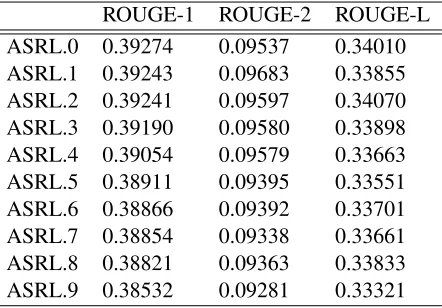
We evaluated our method of ASRL with ROUGE, in terms of ROUGE-1, ROUGE-2, and ROUGE-L.
ROUGE-1 ROUGE-2 ROUGE-L
ASRL.0 0.39274 0.09537 0.34010
ASRL.1 0.39243 0.09683 0.33855
ASRL.2 0.39241 0.09597 0.34070
ASRL.3 0.39190 0.09580 0.33898
ASRL.4 0.39054 0.09579 0.33663
ASRL.5 0.38911 0.09395 0.33551
ASRL.6 0.38866 0.09392 0.33701
ASRL.7 0.38854 0.09338 0.33661
ASRL.8 0.38821 0.09363 0.33833
[image:7.612.71.303.57.142.2]ASRL.9 0.38532 0.09281 0.33321
Table 2: Results of ROGUE evaluation for each ASRL peer of 10 results in DUC2004. ASRL did not converge with stable solution with these experimental settings be-cause of property of randomness.
The experimental results are summarized in Tables 1 and 2. Table 1 lists the results for the comparison and Table 2 lists all the results for ASRL peers.
The results imply ASRL is superior to PEER65, ILP, and GREEDY, and comparable to MCKP with these experimental settings in terms of ROUGE met-rics. Note that ASRL is a kind of approximate method, because actions are selected probabilisti-cally and the method of reinforcement learning oc-casionally converges with some sub-optimal solu-tion. This can be expected from Table 2, which in-dicates the results vary although each ASRL solu-tion converged with some solusolu-tion. However, in this experiment, ASRL achieved higher ROUGE scores than ILP, which achieved optimal solutions. This seems to have been caused by the properties of the features, which we will discuss later. It seems this feature representation is useful for efficiently search-ing the feature space. The method of mappsearch-ing a state to features is, however, approximate in the sense that some states will shrink to the same feature vector, and ASRL therefore has no tendency to converge with some stable solution.
7.2 Evaluation of Optimization Capabilities
0 50 100 150 200 250 300 Episode
−0.5 0.0 0.5 1.0 1.5 2.0 2.5 3.0
Av
er
ag
e
of
S
co
re
s
[image:8.612.82.294.70.235.2]ASRL GREEDY ILP
Figure 1: Average score for each episode in ASRL in DUC2004. Horizontal lines indicate scores of summaries obtained with ILP and GREEDY.
optimization capabilities.
The experimental results are plotted in Figures 1 and 2. Figure 1 plots the average for the re-wards (i.e., scores) that the agent obtained for each episode. The horizontal line for ILP is the average for the optimal scores of (14). The score in ASRL increases as the number of episodes increases, and overtakes the score of GREEDY at some episode. The agent attempts to come close to the optimal score line of ILP but seems to fail, and finally con-verges to some local optimal solution. We should increase the number of episodes, adjust parameters
α and τ, and select more appropriate features for the state to improve the optimization capabilities of ASRL.
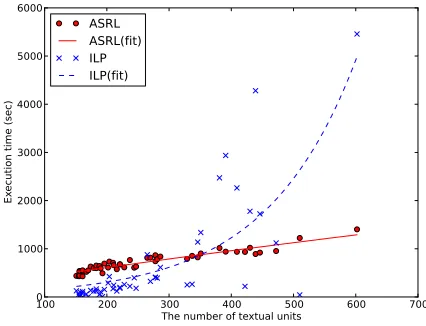
Figure 2 plots the execution time for each peer. The horizontal axis is the number of textual units, i.e., the number of sentences in this experiment. The vertical axis is the execution time taken by the task. The plots of ASRL and ILP fit a linear function for the former and an exponential function for the lat-ter. The experimental results indicate that while the execution time for ILP tends to increase exponen-tially, that for ASRL increases linearly. The time complexity of ASRL is linear with respect to the number of actions because the agent has to select the next action from the available actions for each episode, whose time complexity is naivelyO(|A|). As inserti actions are dominant in the extractive
100 200 300 400 500 600 700
The number of textual units 0
1000 2000 3000 4000 5000 6000
Ex
ec
uti
on
tim
e (
se
c)
ASRL ASRL(fit) ILP ILP(fit)
Figure 2: Execution time on number of textual units for each problem in DUC2004. Plot of ASRL is fitted to lin-ear function and that of ILP is fitted to exponential func-tion.
approach, the execution time increases linearly with respect to the number of textual units. However, ILP has to take into account the combinations of textual units, whose number increases exponentially.
In conclusion, both the experimental results in-dicate that ASRL efficiently calculated a summary that was sub-optimal, but that was of relatively high-quality in terms of ROUGE metrics, with the exper-imental settings we used.
7.3 Evaluation of Effects of Sentence Compression
We also evaluated the combined approach with sen-tence compression. We evaluated the method de-scribed in Section 5 called ASRLC in this experi-ment for the sake of convenience. We used a very naive method of sentence compression for this ex-periment, which compressed a sentence to only im-portant words, i.e., selecting word order by using the tf*idf score to compress the length to about half. This method of compression did not take into consideration either readability or linguistic quality. Note we wanted to confirm what effect the other methods would have, and we expected this to im-prove the ROUGE-1 score. We used the ROUGE-3 score in this evaluation instead of ROUGE-L, to con-firm whether naive sentence compression occurred.
[image:8.612.321.534.73.236.2]Ta-ROUGE-1 ROUGE-2 ROUGE-3
ASRL 0.39013 0.09479 0.03435
ASRLC 0.39141 0.09259 0.03239
Table 3: Evaluation of combined methods.
ble 3, which indicates ROUGE-1 increases but ROUGE-2 and ROUGE-3 decrease as expected. The variations, however, are small. This phenomenon was reported by Lin (2003) in that the effectiveness of sentence compression by local optimization at the sentence level was insufficient. Therefore, we would have to consider the range of applications with the combined method.
8 Discussion
8.1 Local Optimality of ASRL
We will discuss why ASRL seems to converge with some “good” local optimum with the described ex-perimental settings in this section.
Since our model of the state value function was simply linear and our parameter estimation was im-plemented by TD (λ), which is a simple method in RL, it seems simply employing more efficient or state-of-the-art reinforcement learning methods may improve the performance of ASRL, such as GTD and GTD2 (Sutton et al., 2009b; Sutton et al., 2009a). These methods basically only contribute to faster convergence, and the score that they will con-verge to might not differ significantly. As a result, it would not matter much which method was used for optimization.
The main point of this problem is modeling the feature representation of states, and this causes sub-optimality. The vector representation of states shrinks the different states to a single representation, i.e., the agent regards states whose features are simi-lar to be simisimi-lar states. Due to this property, the pol-icy of reinforcement learning is learned to maximize
the expected score of each feature vector, which includes many states. Such sub-optimality aver-agely balancedby the feature representation raises the possibility of achieving states that have a high-quality summary with a low score, since we do not have a genuine score function.
Thus, the most important thing in our method is to intentionally design the features of states and
the score function, so that the agent can generalize states, while taking into consideration truly-essential features for the required summarization. It would be useful if the forms of features and the score function could be arbitrarily designed by the user because there is the capability of obtaining a high-quality summaries.
8.2 Potential of Combined Method
Other useful methods, even other summarization systems, can easily be adapted to ASRL as was de-scribed in Section 5. The experimental results re-vealed that sentence compression has some effect. In fact, all operations that produce a new summary from an old summary can be used, i.e., even other summarizing methods can be employed for an ac-tion. We assumed a general combined method may have a great deal of potential to enhance the quality of summaries.
8.3 Can We Obtain “a Global Policy”?
We formulated each summarization task as a rein-forcement learning task in this paper, i.e., where each learned policy differs. As this may be a little unnatural, we wanted to obtain a single learned pol-icy, i.e., a global policy.
However, we assessed that we cannot achieve a global policy with these feature and score function settings because the best vector, which is the fea-ture representation of the summary that achieves an optimal score under the current settings, seems to vary for each cluster, even if the domain of the clus-ters is the same (e.g., a news domain). Having said that, we simultaneously surmised that we could ob-tain a global policy if we could obob-tain a highly gen-eral, crucial, and efficient feature representation of a summary. We also think a global policy is essential in terms of reinforcement learning and we intend to attempt to achieve this in future work.
9 Conclusion
The experimental results demonstrated ASRL tends to converge sub-optimally, and excessively de-pends on the formulation of features and the score function. Although it is difficult, we believe this for-mulation would enable us to improve the quality of summaries by designing them freely.
We intend to employ the ROUGE score as the score function in future work, and obtain the param-eters of the state value function. Using these results, we will attempt to obtain a single learned policy by employing the ROUGE score or human evaluations as rewards. We also intend to consider efficient fea-tures and a score to achieve stable convergence. In addition, we plan to use other methods of function approximation, such as RBF networks.
References
J.M. Conroy, J.D. Schlesinger, J. Goldstein, and D.P. O’ leary. 2004. Left-brain/right-brain multi-document summarization. InProceedings of the Document Un-derstanding Conference (DUC 2004).
E. Filatova and V. Hatzivassiloglou. 2004. A formal model for information selection in multi-sentence text extraction. In Proceedings of the 20th international conference on Computational Linguistics, page 397. Association for Computational Linguistics.
J. Goldstein, V. Mittal, J. Carbonell, and M. Kantrowitz. 2000. Multi-document summarization by sentence extraction. In Proceedings of the 2000 NAACL-ANLPWorkshop on Automatic summarization-Volume 4, pages 40–48. Association for Computational Lin-guistics.
C.Y. Lin. 2003. Improving summarization performance by sentence compression: a pilot study. In Proceed-ings of the sixth international workshop on Informa-tion retrieval with Asian languages-Volume 11, pages 1–8. Association for Computational Linguistics.
C.Y. Lin. 2004. Rouge: A package for automatic eval-uation of summaries. InProceedings of the workshop on text summarization branches out (WAS 2004), vol-ume 16.
I. Mani. 2001. Automatic summarization, volume 3. John Benjamins Pub Co.
R. McDonald. 2007. A study of global inference algo-rithms in multi-document summarization. Advances in Information Retrieval, pages 557–564.
MF Porter. 1980. An algorithm for suffix stripping.
Program: electronic library and information systems, 14(3):130–137.
R.S. Sutton and A.G. Barto. 1998. Reinforcement learn-ing: An introduction, volume 1. Cambridge Univ Press.
R.S. Sutton, H.R. Maei, D. Precup, S. Bhatnagar, D. Silver, C. Szepesv´ari, and E. Wiewiora. 2009a. Fast gradient-descent methods for temporal-difference learning with linear function approximation. In Pro-ceedings of the 26th Annual International Conference on Machine Learning, pages 993–1000. ACM. R.S. Sutton, C. Szepesv´ari, and H.R. Maei. 2009b. A
convergent o (n) algorithm for off-policy temporal-difference learning with linear function approxima-tion.