Grammatical Error Detection and Correction
using a Single Maximum Entropy Model
∗Peilu Wang, Zhongye Jia and Hai Zhao† Key Laboratory of Shanghai Education Commission for
Intelligent Interaction and Cognitive Engineering, Center for Brain-Like Computing and Machine Intelligence
Department of Computer Science and Engineering, Shanghai Jiao Tong University 800 Dongchuan Road, Shanghai 200240, China
{plwang1990,jia.zhongye}@gmail.com,[email protected]
Abstract
This paper describes the system of Shang-hai Jiao Tong Unvierity team in the CoNLL-2014 shared task. Error correc-tion operacorrec-tions are encoded as a group of predefined labels and therefore the task is formulized as a multi-label classifica-tion task. For training, labels are obtained through a strict rule-based approach. For decoding, errors are detected and correct-ed according to the classification results. A single maximum entropy model is used for the classification implementation in-corporated with an improved feature selec-tion algorithm. Our system achieved pre-cision of 29.83, recall of 5.16 and F 0.5 of 15.24 in the official evaluation.
1 Introduction
The task of CoNLL-2014 is grammatical error cor-rection which consists of detecting and correcting the grammatical errors in English essays written by non-native speakers (Ng et al., 2014). The re-search of grammatical error correction can poten-tially help millions of people in the world who are learning English as foreign language. Although there have been many works on grammatical error correction, the current approaches mainly focus on very limited error types and the result is far from satisfactory.
The CoNLL-2014 shared task, compared with the previous Help Our Own (HOO) tasks (Dale et al., 2012) considering only determiner and prepo-sition errors and the CoNLL-2013 shared task
fo-∗
This work was partially supported by the National Natu-ral Science Foundation of China (Grant No.60903119, Grant No.61170114, and Grant No.61272248), the National Ba-sic Research Program of China (Grant No.2013CB329401), the Science and Technology Commission of Shanghai Mu-nicipality (Grant No.13511500200), and the European Union Seventh Framework Program (Grant No.247619).
†Corresponding author
cusing on five major types of errors, requires to correct all 28 types of errors (Ng et al., 2014).
One traditional strategy is designing a system combined of a set of models, where each sub-model is specialized for a specific subtask, for ex-ample, correcting one type of errors. This strat-egy is computationally efficient and can adopt d-ifferent favorable features for each subtask. Top ranked systems in CoNLL-2013 (Rozovskaya et al., 2013; Kao et al., 2013; Xing et al., 2013; Yoshimoto et al., 2013; Xiang et al., 2013) are based on this strategy. However, the division of the model relies on prior-knowledges and the de-signing of different features for each sub-model requires a large amount of manual works. This shortage is especially notable in CoNLL-2014 shared task, since the number of error types is much larger and the composition of errors is more complicated than before.
In contrast, we follow the work in (Jia et al., 2013a; Zhao et al., 2009a), integrating everything into one model. This integrated system holds a merit that a one-way feature selection benefits the whole system and no additional process is needed to deal with the conflict or error propagation of ev-ery sub-models. Here is a glance of this method: A set of more detailed error types are generated auto-matically from the original 28 types of errors. The detailed error type can be regarded as the label of a word, thus the task of grammatical error detec-tion is transformed to a multi-label classificadetec-tion task using maximum entropy model (Berger et al., 1996; Zhao et al., 2013). A feature selection ap-proach is introduced to get effective features from large amounts of feature candidates. Once errors are detected through word label classification, a rule-based method is used to make corrections ac-cording to their labels.
The rest of the paper is organized as follows. Section 2 describes the system architecture. Sec-tion 3 introduces the feature selecSec-tion approach
and the features we used. Experiments and result-s are preresult-sented in result-section 5, followed by conclu-sion.
2 System Architecture
In our approach, the grammatical error detection is regarded as a multi-label classification task. At first, each token in training corpus is assigned a la-bel according to the golden annotation. The con-struction of labels is rule based using an extend-ed version of Levenshtein extend-edit distance algorith-m which will be discussed in the following sub-section. Each label maps an edit operation to do the correction, thus the generated labels are much more detailed than the originial 28 error types. Then, a maximum entropy (ME) model is adopted as the classifier. With the labeled data, the process of grammatical error correction is just applying the edit operation mapped by each label, which is ba-sically the reverse of the labeling phase.
2.1 Data Labeling
In CoNLL-2014 shared task, there are 28 error types but they can not be used directly as class la-bels, since these types are too general that they can hardly be corrected by applying one rule-based edit. For example, the correction of Vform (ver-b form) error type includes all ver(ver-b form inflec-tions such as converting a verb to its infinitive for-m, gerund forfor-m, past form and past participle and so on. Previous works (Dahlmeier et al., 2012; Rozovskaya et al., 2012; Kochmar et al., 2012) manually decompose each error types to more de-tailed subtypes. For example, in (Dahlmeier et al., 2012), the determinater errors are decomposed in-to:
• replacement determiner (RD):{a→the} • missing determiner (MD):{ϵ→a} • unwanted determiner (UD):{a→ϵ }
For a task with a few error types such as merely determinative and preposition error in HOO 2012, manually decomposition may be sufficient. How-ever, for CoNLL-2014, all 28 error types are re-quired to be corrected and some of these types such as Rloc- (Local redundancy) and Um (Un-clear meaning) are quite complex that the manu-al decomposition is time consuming and requires lots of grammatical knowledges. Therefore, an au-tomatica decomposition method is proposed. It is
extended from the Levenshtein edit distance algo-rithm and can divide error types into more detailed subtypes that each subtype can be corrected by ap-plying one simple rule. How to calculate the ex-tended Levenshtein edit distance is described in Algorithm 1.
Algorithm 1Extended Levenshtein Edit Distance
INPUT: tokssrc,toksdst
OUTPUT: E,P
lsrc, ldst←len(tokssrc),len(toksdst)
D[0. . . lsrc][0. . . ldst]←0
B[0. . . lsrc][0. . . ldst]←(0,0)
E[0. . . lsrc][0. . . ldst]←ϕ
fori←1. . . lsrcdo
D[i][0]←i B[i][0]←(i-1,0)
E[i][0]← D
end for
forj←1. . . ldstdo
D[0][j]←j B[0][j]←(0, j-1)
E[0][j]← A
end for
fori←1. . . lsrc;do
forj←1. . . ldstdo
iftokssrc[i-1] =toksdst[j-1]then
D[i][j]←D[i-1][j-1]
B[i][j]←(i-1, j-1)
E[i][j]← U
else
m= min(D[i-1][j-1], D[i-1][j], D[i][j-1])
ifm=D[i-1][j-1]then
D[i][j]←D[i-1][j-1] + 1
B[i][j]←(i-1, j-1)
if lemma(tokssrc[i-1])
=lemma(toksdst[j-1]) then
E[i][j]← S
else
E[i][j]← I
end if
else ifm=D[i-1][j]then
D[i][j]←D[i-1][j] + 1
B[i][j]←(i-1, j)
E[i][j]← D
else ifm=D[i][j-1]then
D[i][j]←D[i][j-1] + 1
B[i][j]←(i, j-1)
E[i][j]← A
end if end if end for end for
i, j←lsrc, ldst
whilei >0∨j >0 do
insertE[i][j]into head ofE
inserttoksdst[j−1]into head ofP (i, j)←B[i][j]
end while return(E,P)
In this algorithm, tokssrc represents the tokens
that are annotated with one grammatical error and
toksdstrepresents the corrected tokens oftokssrc.
E are initialized. For all i and j, D[i][j] holds the Levenshtein distance between the firstitokens oftokssrc and first jtokens of toksdst. B stores
the path of the Levenshtein distance andE stores the edit operations in this path. The original Lev-enshtein edit distance has 4 edit operations: un-change (U), addition (A), deletion (D) and substi-tution (S). We extend the “substitution” edit into two types of edits: inflection (I) and the original substitution (S). If two different words have the same lemma, the substitution operation isI, else is
S. lemma(x)returns the lemma of tokenx. This algorithm returns the edit operationsEand the pa-rameters of these operations P. Here is a simple sample illustrating this algorithm. For the golden edit{a red apple is→red apples are},tokssrcis
a red apple is,toksdstisred apples are, the output
editsEwill be{D,U,I,S}, and the parametersP
will be{-, red, apples, are}.
Then with the output of this extended Leven-shtein distance algorithm, labels can be generated by transforming these edit operations into readable symbols. For those tokens without errors, we di-rectly assign a special label “⊙” to them. A tricky part of the labeling process is the problem of the edit “addition”,A. A new token can only be added before or after an existing token. Thus for edit op-eration with addition, we must find an existing to-ken that the label can be assigned to, and this sort of token is defined aspivot. A pivot can be a token that is not changed in an edit operation, such as the “apple” in edit{apple→an apple}, or some oth-er types of edit such as the inflection of “look” to “looking” in edit{look→have been looking at}.
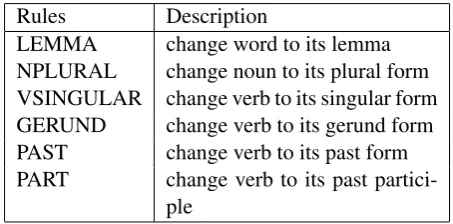
[image:3.595.305.532.451.563.2]The names of these labels are based on BNF syntax which is defined in Figure 1. The non-terminal ⟨word⟩ can be substituted by all words in the vocabulary. The non-terminal ⟨inflection-rules⟩can be substituted by terminals of inflection rules that are used for correcting the error types of noun number, verb form, and subject-verb agree-ment errors. All the inflection rules are listed in Table 1.
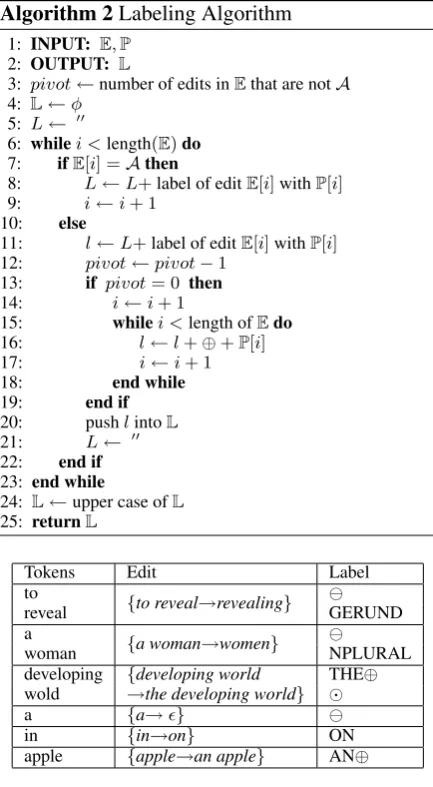
With the output of extended Levenshtein edits distance algorithm, Algorithm 2 gives the process to generate labels whose names are based on the syntax defined in Figure 1. It takes the outputE,P
of Algorithm 1 as inputs and returns the generat-ed set of labelsL. Each label inLcorresponds to one token intokssrcin order. For our previous
ex-ample of edit{a red apple is→ red apples are},
⟨label⟩::= ⟨simple-label⟩ | ⟨compound-label⟩
⟨simple-label⟩::= ⟨pivot⟩ | ⟨add-before⟩ | ⟨add-after⟩
⟨compound-label⟩::= ⟨add-before⟩ ⟨pivot⟩ | ⟨pivot⟩ ⟨add-after⟩
| ⟨add-before⟩ ⟨pivot⟩ ⟨add-after⟩
⟨pivot⟩::= ⟨unchange⟩ | ⟨substitution⟩ | ⟨inflection⟩
| ⟨deletion⟩
⟨add-before⟩::= ⟨word⟩⊕ | ⟨word⟩⊕⟨add-before⟩
⟨add-after⟩::= ⊕⟨word⟩ | ⊕⟨word⟩⟨add-after⟩
⟨substitution⟩::= ⟨word⟩
⟨inflection⟩::= ⟨inflection-rules⟩
⟨unchange⟩::= ⊙
⟨deletion⟩::= ⊖
Figure 1: BNF syntax of label
Rules Description
LEMMA change word to its lemma NPLURAL change noun to its plural form VSINGULAR change verb to its singular form GERUND change verb to its gerund form PAST change verb to its past form PART change verb to its past
partici-ple
Table 1: Inflection rules
theL returned by Algorithm 2 is{⊖, ⊙, NPLU-RAL, ARE} corresponding to the tokens{a,red,
apple,is}intokssrc. Some other examples of the
generated labels are presented in Table 2.
Algorithm 2Labeling Algorithm 1: INPUT: E,P
2: OUTPUT: L
3: pivot←number of edits inEthat are notA 4: L←ϕ
5: L← ′′
6: whilei <length(E)do
7: ifE[i] =Athen
8: L←L+label of editE[i]withP[i] 9: i←i+ 1
10: else
11: l←L+label of editE[i]withP[i] 12: pivot←pivot−1
13: if pivot= 0 then
14: i←i+ 1
15: whilei <length ofEdo
16: l←l+⊕+P[i]
17: i←i+ 1
18: end while
19: end if
20: pushlintoL
21: L← ′′
22: end if
23: end while
24: L←upper case ofL
25: returnL
Tokens Edit Label
to {to reveal→revealing} ⊖
reveal GERUND
a {a woman→women} ⊖
woman NPLURAL
developing {developing world THE⊕ wold →the developing world} ⊙
a {a→ϵ} ⊖
in {in→on} ON
[image:4.595.72.289.63.457.2]apple {apple→an apple} AN⊕ Table 2: Examples of labeling
2.2 Label Classification
Using the approach described above, the training corpus is converted to a sequence of words with labels. Maximum entropy model is used as the classifier. It allows a very rich set of features to be used in a model and has shown good performance in similiar tasks (Zhao et al., 2013). The features we used are discussed in the next section.
3 Feature Selection and Generation One key factor affecting the performance of maxi-mum entropy classifier is the features it used. A good feature that contains useful information to guide classification will significantly improve the performance of the classifier. One direct way to involve more good features is involving more fea-tures.
In our approach, large amounts of candidate features are collected at first. We carefully
exam-ine the factors involved in a wide range of fea-tures that have been or can be used to the word label classification task. Many features that are considered effective in various of previous work-s (Dahlmeier et al., 2012; Rozovwork-skaya et al., 2012; Han et al., 2006; Rozovskaya et al., 2011; Tetreault, Joel R and Chodorow, Martin, 2008) are included. Besides, features that are used in the similar spell checking tasks (Jia et al., 2013b; Yang et al., 2012) and some novel features show-ing effectiveness in other NLP tasks (Wang et al., 2013; Zhang and Zhao, 2013; Xu and Zhao, 2012; Ma and Zhao, 2012; Zhao, 2009; Zhao et al., 2009b) are also included. However, using too many features is time consuming. Besides, it in-creases the probability of overfitting and may lead to a poor solution of the maximum-likelihood pa-rameter estimate in the ME training.
Algorithm 3Greedy Feature Selection 1: INPUT:all feature candidatesF
2: OUTPUT:selected featuresS
3: S={f0, f1, . . . , fk}, a random subset ofF
4: while do
5: C=RECRUITMORE(S) 6: ifC={}then
7: returnS
8: end if
9: S′=SHAKEOFF(S+C) 10: ifscr(M(S))≥scr(M(S′))then
11: returnS
12: end if
13: S=S′ 14: end while
15: functionRECRUITMORE(S) 16: C={}, andp=scr(M(S)) 17: foreachf∈F−S do
18: ifp < scr(M(S+{f}))then
19: C=C+{f}
20: end if
21: end for
22: end function
23: functionSHAKEOFF(S)
24: while do
25: S′=S
0=S
26: foreachf∈Sdo
27: ifscr(M(S′))< scr(M(S′− {f}))then 28: S′=S′− {f}
29: end if
30: end for
31: S=S′ 32: ifS′=S
0then
33: returnS′
34: end if
35: end while
36: end function
effectiveness in (Zhao et al., 2013) and is present-ed in Algorithm 3.
In this algorithm, M(S) represents the model using feature set S andscr(M) represents the e-valuation score of modelM on a development da-ta set. It repeats two main steps until no further performance gain is achievable:
1. Include any features from the rest of F into the current set of candidate features if the in-clusion would lead to a performance gain.
2. Exclude any features from the current set of candidate templates if the exclusion would lead to no deterioration in performance.
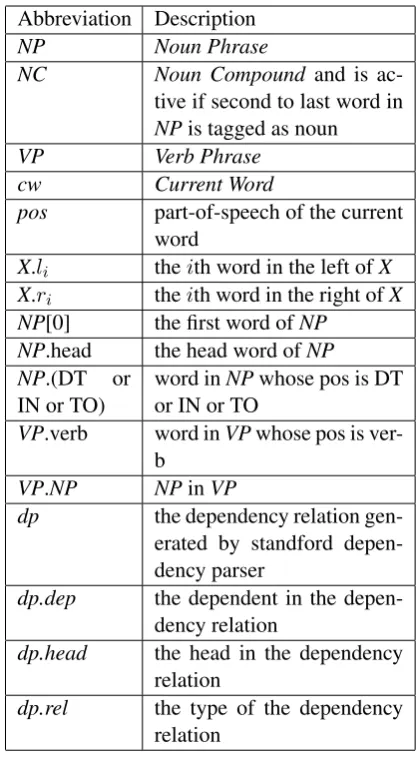
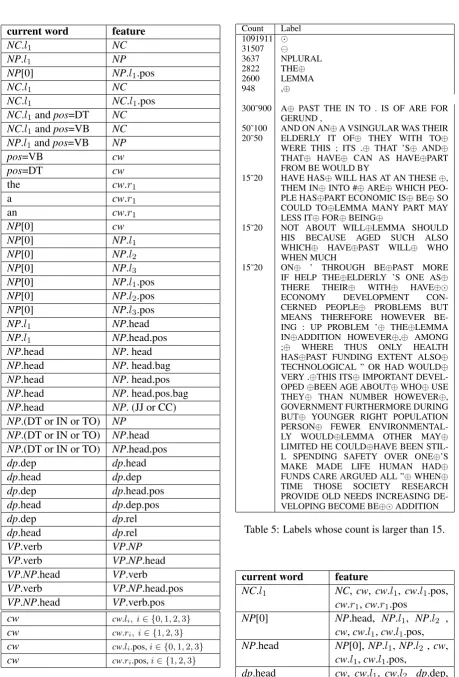
[image:5.595.311.520.60.442.2]By repeatedly adding the useful and removing the useless features, the algorithm aims to return a better and smaller set of features for next round. Only 55 of the 109 candidate features remain af-ter using this algorithm and they are presented in Table 4. Table 3 gives an interpretation of the ab-breviations used in Table 4. Each feature of a word is set to that listed infeaturecolumn if the word satisfies the condition listed incurrent word col-umn, else the feature is set to “NULL”. For ex-ample, if the current word satisfies the condition in the first row of Table 4 which is the first word in the left of aNC, feature 1 of this word is set to all words in theNC, otherwise, feature 1 is set to “NULL”.
4 Experiment
4.1 Data Sets
The CoNLL-2014 training data is a corpus of learner English provided by (Dahlmeier et al., 2013). This corpus consists of 1,397 articles, 12K sentences and 116K tokens. The official blind test data consists of 50 articles, 245 sentences and 30K tokens. More detailed information about this data is described in (Ng et al., 2014; Dahlmeier et al., 2013).
In development phase, the entire training corpus is splited by sentence. 80% sentences are picked up randomly and used for training and the rest 20% are used as the developing corpus. For the fi-nal submission, the entire corpus is used for train-ing.
Abbreviation Description
NP Noun Phrase
NC Noun Compound and is ac-tive if second to last word in
NPis tagged as noun
VP Verb Phrase
cw Current Word
pos part-of-speech of the current word
X.li theith word in the left ofX
X.ri theith word in the right ofX
NP[0] the first word ofNP NP.head the head word ofNP NP.(DT or
IN or TO) word inor IN or TONPwhose pos is DT
VP.verb word inVPwhose pos is ver-b
VP.NP NPinVP
dp the dependency relation gen-erated by standford depen-dency parser
dp.dep the dependent in the depen-dency relation
dp.head the head in the dependency relation
[image:5.595.311.521.71.437.2]dp.rel the type of the dependency relation
Table 3: The interpretation of the abbrevations in Table 4
4.2 Data Labeling
The labeling algorithm described in section 2.1 is firstly applied to the training corpus. Total 7047 labels are generated and those whose count is larg-er than 15 is presented in Table 5. Directly ap-plying these 7047 labels for correction receives an M2 score of precision=90.2%, recall=87.0% and
F 0.5=89.5%. However, the number of labels is too large that the training process is time con-suming and those labels appears only few times will hurt the generalization of the trained model. Therefore, labels with low frequency which ap-pear less than 30 times are cut out and 109 labels remain. The M2 score of the system using this
current word feature
NC.l1 NC
NP.l1 NP
NP[0] NP.l1.pos
NC.l1 NC
NC.l1 NC.l1.pos NC.l1andpos=DT NC NC.l1andpos=VB NC NP.l1andpos=VB NP
pos=VB cw
pos=DT cw
the cw.r1
a cw.r1
an cw.r1
NP[0] cw
NP[0] NP.l1
NP[0] NP.l2
NP[0] NP.l3
NP[0] NP.l1.pos NP[0] NP.l2.pos NP[0] NP.l3.pos NP.l1 NP.head NP.l1 NP.head.pos NP.head NP. head
NP.head NP. head.bag
NP.head NP. head.pos
NP.head NP. head.pos.bag
NP.head NP. (JJ or CC)
NP.(DT or IN or TO) NP NP.(DT or IN or TO) NP.head
NP.(DT or IN or TO) NP.head.pos
dp.dep dp.head
dp.head dp.dep
dp.dep dp.head.pos
dp.head dp.dep.pos
dp.dep dp.rel
dp.head dp.rel
VP.verb VP.NP VP.verb VP.NP.head
VP.NP.head VP.verb
VP.verb VP.NP.head.pos
VP.NP.head VP.verb.pos
cw cw.li, i∈ {0,1,2,3}
cw cw.ri, i∈ {1,2,3}
cw cw.li.pos,i∈ {0,1,2,3}
[image:6.595.71.531.39.717.2]cw cw.ri.pos,i∈ {1,2,3} Table 4: Remained features after the feature selec-tion.
Count Label 1091911 ⊙ 31507 ⊖
3637 NPLURAL
2822 THE⊕
2600 LEMMA
948 ,⊕
300˜900 A⊕ PAST THE IN TO . IS OF ARE FOR GERUND ,
50˜100 AND ON AN⊕A VSINGULAR WAS THEIR 20˜50 ELDERLY IT OF⊕ THEY WITH TO⊕ WERE THIS ; ITS .⊕ THAT ’S⊕ AND⊕ THAT⊕ HAVE⊕ CAN AS HAVE⊕PART FROM BE WOULD BY
15˜20 HAVE HAS⊕WILL HAS AT AN THESE⊕, THEM IN⊕INTO #⊕ARE⊕WHICH PEO-PLE HAS⊕PART ECONOMIC IS⊕BE⊕SO COULD TO⊕LEMMA MANY PART MAY LESS IT⊕FOR⊕BEING⊕
15˜20 NOT ABOUT WILL⊕LEMMA SHOULD HIS BECAUSE AGED SUCH ALSO WHICH⊕ HAVE⊕PAST WILL⊕ WHO WHEN MUCH
15˜20 ON⊕ ’ THROUGH BE⊕PAST MORE IF HELP THE⊕ELDERLY ’S ONE AS⊕ THERE THEIR⊕ WITH⊕ HAVE⊕⊙
ECONOMY DEVELOPMENT
CON-CERNED PEOPLE⊕ PROBLEMS BUT MEANS THEREFORE HOWEVER BE-ING : UP PROBLEM ’⊕ THE⊕LEMMA IN⊕ADDITION HOWEVER⊕,⊕ AMONG ;⊕ WHERE THUS ONLY HEALTH HAS⊕PAST FUNDING EXTENT ALSO⊕ TECHNOLOGICAL ” OR HAD WOULD⊕ VERY .⊕THIS ITS⊕IMPORTANT DEVEL-OPED⊕BEEN AGE ABOUT⊕WHO⊕USE THEY⊕ THAN NUMBER HOWEVER⊕, GOVERNMENT FURTHERMORE DURING BUT⊕ YOUNGER RIGHT POPULATION PERSON⊕ FEWER ENVIRONMENTAL-LY WOULD⊕LEMMA OTHER MAY⊕ LIMITED HE COULD⊕HAVE BEEN STIL-L SPENDING SAFETY OVER ONE⊕’S MAKE MADE LIFE HUMAN HAD⊕ FUNDS CARE ARGUED ALL ”⊕WHEN⊕ TIME THOSE SOCIETY RESEARCH PROVIDE OLD NEEDS INCREASING DE-VELOPING BECOME BE⊕⊙ADDITION Table 5: Labels whose count is larger than 15.
current word feature
NC.l1 NC, cw, cw.l1, cw.l1.pos, cw.r1,cw.r1.pos
NP[0] NP.head, NP.l1, NP.l2 , cw,cw.l1,cw.l1.pos, NP.head NP[0], NP.l1,NP.l2 ,cw,
cw.l1,cw.l1.pos,
dp.head cw, cw.l1, cw.l2 dp.dep, dp.dep.pos,dp.rel
[image:6.595.74.504.54.707.2]4.3 Data Refinement
The training corpus is refined before used that sen-tences which do not contain errors are filtered out. Only 38% of the total sentences remain. With less training corpus, it takes less time to train the ME model. Table 7 presents the performance of sys-tems using the unrefined training corpus and re-fined corpus.
[image:7.595.87.275.189.231.2]System Presicion Recall F 0.5 unrefined 26.99% 1.67% 6.71% refined 11.17% 3.1% 7.34%
Table 7: Comparison of systems with differen-t differen-training corpus.
All sets of these systems are kept the same ex-cept the training corpus they use. It can be seen that the refinement also improves the performance of the system.
[image:7.595.316.513.227.270.2]4.4 Feature Selection
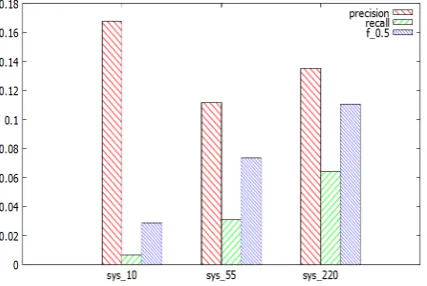
Figure 2 shows the results of systems with dif-ferent feature sets. sys 10 is the system with
Figure 2: Performance of systems with different features.
10 randomly chosen features which are used as the initial set of features in Algorithm 3, sys 55
is the system with the refined 55 features. With these refined features, various of new features are generated by combining different features. This combination is conducted empirically that features which are considered having relations are com-bined to generate new features. Using this method, 165 new features are generated and total 220 fea-tures are used in sys 220. Table 6 gives a few of examples showing the combined features. The performance is evaluated by the precision,
recal-l and F 0.5 score of the M2 scorer according
to (Dahlmeier and Ng, 2012). It can be seen that sys 220 with the most number of features achieves the best performance.
4.5 Evaluation Result
The final system we use is sys 220 with refined training data, the performance of our system on the developing corpus and the blind official test data is presented in Table 8. The score is calculated using M2 scorer.
Data Set Precision Recall F 0.5 DEV 13.52% 6.41% 11.07% OFFICIAL 29.83% 5.16% 15.24%
Table 8: Evaluation Results
5 Conclusion
In this paper, we describe the system of Shang-hai Jiao Tong Univerity team in the CoNLL-2014 shared task. The grammatical error detection is re-garded as a multi-label classification task and the correction is conducted by applying a rule-based approach based on these labels. A single max-imum entropy classifier is introduced to do the multi-label classification. Various features are in-volved and a feature selection algorithm is used to refine these features. Finally, large amounts of feature templates that are generated by the combi-nation of the refined features are used. This system achieved precision of 29.83%, recall of 5.16% and F 0.5 of 15.24% in the official evaluation.
References
Adam L Berger, Vincent J Della Pietra, and Stephen A Della Pietra. 1996. A maximum entropy ap-proach to natural language processing. Computa-tional linguistics, 22(1):39–71.
Daniel Dahlmeier and Hwee Tou Ng. 2012. Better evaluation for grammatical error correction. In Pro-ceedings of the 2012 Conference of the North Amer-ican Chapter of the Association for Computational Linguistics: Human Language Technologies (NAA-CL 2012), pages 568–572, Montreal, Canada.
Daniel Dahlmeier, Hwee Tou Ng, and Eric Jun Feng Ng. 2012. NUS at the HOO 2012 Shared Task. In
[image:7.595.75.289.406.549.2]Daniel Dahlmeier, Hwee Tou Ng, and Siew Mei Wu. 2013. Building a large annotated corpus of learner english: The nus corpus of learner english. In Pro-ceedings of the Eighth Workshop on Innovative Use of NLP for Building Educational Applications (BEA 2013), pages 22–31, Atlanta, Georgia, USA.
Robert Dale, Ilya Anisimoff, and George Narroway. 2012. Hoo 2012: A report on the preposition and determiner error correction shared task. In Proceed-ings of the Second Workshop on Building Education-al Applications Using NLP, pages 54–62, Montr´eal, Canada, June. Association for Computational Lin-guistics.
NA-RAE Han, Martin Chodorow, and Claudia Lea-cock. 2006. Detecting Errors in English Article Usage by Non-Native Speakers. Natural Language Engineering, 12:115–129, 5.
Zhongye Jia, Peilu Wang, and Hai Zhao. 2013a. Grammatical error correction as multiclass classi-fication with single model. In Proceedings of the Seventeenth Conference on Computational Natural Language Learning: Shared Task, pages 74–81, Sofia, Bulgaria, August. Association for Computa-tional Linguistics.
Zhongye Jia, Peilu Wang, and Hai Zhao. 2013b. Graph model for chinese spell checking. In Proceedings of the Seventh SIGHAN Workshop on Chinese Lan-guage Processing, pages 88–92, Nagoya, Japan, Oc-tober. Asian Federation of Natural Language Pro-cessing.
Ting-hui Kao, Yu-wei Chang, Hsun-wen Chiu, Tzu-Hsi Yen, Joanne Boisson, Jian-cheng Wu, and Jason S. Chang. 2013. Conll-2013 shared task: Grammati-cal error correction nthu system description. In Pro-ceedings of the Seventeenth Conference on Compu-tational Natural Language Learning: Shared Task, pages 20–25, Sofia, Bulgaria, August. Association for Computational Linguistics.
Ekaterina Kochmar, Øistein Andersen, and Ted Briscoe. 2012. HOO 2012 Error Recognition and Correction Shared Task: Cambridge University Sub-mission Report. In Proceedings of the Seventh Workshop on Building Educational Applications Us-ing NLP, pages 242–250, Montr´eal, Canada, June. Association for Computational Linguistics.
Xuezhe Ma and Hai Zhao. 2012. Fourth-order depen-dency parsing. In Proceedings of COLING 2012: Posters, pages 785–796, Mumbai, India, December. The COLING 2012 Organizing Committee.
Hwee Tou Ng, Siew Mei Wu, Ted Briscoe, Christian Hadiwinoto, Raymond Hendy Susanto, and Christo-pher Bryant. 2014. The conll-2014 shared task on grammatical error correction. InProceedings of the Eighteenth Conference on Computational Natu-ral Language Learning: Shared Task (CoNLL-2014 Shared Task), Baltimore, Maryland, USA.
Alla Rozovskaya, Mark Sammons, Joshua Gioja, and Dan Roth. 2011. University of Illinois System in HOO Text Correction Shared Task. InProceedings of the 13th European Workshop on Natural Lan-guage Generation, pages 263–266. Association for Computational Linguistics.
Alla Rozovskaya, Mark Sammons, and Dan Roth. 2012. The UI System in the HOO 2012 Shared Task on Error Correction. InProceedings of the Seventh Workshop on Building Educational Applications Us-ing NLP, pages 272–280, Montr´eal, Canada, June. Association for Computational Linguistics.
Alla Rozovskaya, Kai-Wei Chang, Mark Sammons, and Dan Roth. 2013. The university of illinois sys-tem in the conll-2013 shared task. InProceedings of the Seventeenth Conference on Computational Natu-ral Language Learning: Shared Task, pages 13–19, Sofia, Bulgaria, August. Association for Computa-tional Linguistics.
Tetreault, Joel R and Chodorow, Martin. 2008. The Ups and Downs of Preposition Error Detection in ESL Writing. In Proceedings of the 22nd Inter-national Conference on Computational Linguistics-Volume 1, pages 865–872. Association for Compu-tational Linguistics.
Rui Wang, Masao Utiyama, Isao Goto, Eiichro Sumi-ta, Hai Zhao, and Bao-Liang Lu. 2013. Convert-ing continuous-space language models into n-gram language models for statistical machine translation. In Proceedings of the 2013 Conference on Empiri-cal Methods in Natural Language Processing, pages 845–850, Seattle, Washington, USA, October. Asso-ciation for Computational Linguistics.
Yang Xiang, Bo Yuan, Yaoyun Zhang, Xiaolong Wang, Wen Zheng, and Chongqiang Wei. 2013. A hybrid model for grammatical error correction. In Proceed-ings of the Seventeenth Conference on Computation-al NaturComputation-al Language Learning: Shared Task, pages 115–122, Sofia, Bulgaria, August. Association for Computational Linguistics.
Junwen Xing, Longyue Wang, Derek F. Wong, Lidi-a S. ChLidi-ao, Lidi-and XiLidi-aodong Zeng. 2013. Um-checker: A hybrid system for english grammatical error cor-rection. InProceedings of the Seventeenth Confer-ence on Computational Natural Language Learn-ing: Shared Task, pages 34–42, Sofia, Bulgaria, Au-gust. Association for Computational Linguistics. Qiongkai Xu and Hai Zhao. 2012. Using deep
lin-guistic features for finding deceptive opinion spam. In Proceedings of COLING 2012: Posters, pages 1341–1350, Mumbai, India, December. The COL-ING 2012 Organizing Committee.
Stelios Piperidis, editors,Proceedings of the Eighth International Conference on Language Resources and Evaluation (LREC-2012), pages 730–736, Is-tanbul, Turkey, May. European Language Resources Association (ELRA). ACL Anthology Identifier: L12-1423.
Ippei Yoshimoto, Tomoya Kose, Kensuke Mitsuza-wa, Keisuke Sakaguchi, Tomoya Mizumoto, Yuta Hayashibe, Mamoru Komachi, and Yuji Matsumo-to. 2013. Naist at 2013 conll grammatical error correction shared task. InProceedings of the Seven-teenth Conference on Computational Natural Lan-guage Learning: Shared Task, pages 26–33, Sofi-a, BulgariSofi-a, August. Association for Computational Linguistics.
Jingyi Zhang and Hai Zhao. 2013. Improving function word alignment with frequency and syntactic infor-mation. In Proceedings of the Twenty-Third inter-national joint conference on Artificial Intelligence, pages 2211–2217. AAAI Press, August.
Hai Zhao, Wenliang Chen, and Chunyu Kit. 2009a. Semantic dependency parsing of nombank and prop-bank: An efficient integrated approach via a large-scale feature selection. In Proceedings of the 2009 Conference on Empirical Methods in Natural Lan-guage Processing, pages 30–39, Singapore, August. Association for Computational Linguistics.
Hai Zhao, Yan Song, Chunyu Kit, and Guodong Zhou. 2009b. Cross language dependency parsing using a bilingual lexicon. InProceedings of the Joint Con-ference of the 47th Annual Meeting of the ACL and the 4th International Joint Conference on Natural Language Processing of the AFNLP, pages 55–63, Suntec, Singapore, August. Association for Compu-tational Linguistics.
Hai Zhao, Xiaotian Zhang, and Chunyu Kit. 2013. In-tegrative semantic dependency parsing via efficien-t large-scale feaefficien-ture selecefficien-tion. Journal of Artificial Intelligence Research, 46:203–233.