Generalizing Sub-sentential Paraphrase Acquisition
across Original Signal Type of Text Pairs
Aur´elien Max Houda Bouamor
LIMSI-CNRS & Univ. Paris Sud Orsay, France
Anne Vilnat
Abstract
This paper describes a study on the impact of the original signal (text, speech, visual scene, event) of a text pair on the task of both man-ual and automatic sub-sentential paraphrase acquisition. A corpus of 2,500 annotated sen-tences in English and French is described, and performance on this corpus is reported for an efficient system combination exploiting a large set of features for paraphrase recogni-tion. A detailed quantified typology of sub-sentential paraphrases found in our corpus types is given.
1 Introduction
Sub-sentential paraphrases can be acquired from text pairs expressing the same meaning (Madnani and Dorr, 2010). If the semantic similarity of a text pair has a direct impact on the quality of the ac-quired paraphrases, it has, to our knowledge, never been shown what impact the type of original sig-nal has on paraphrase acquisition. In this work, we consider four types of corpora, which we think are representative of the main types of original semantic signals: text pairs (roughly, sentences) originating a) from independent translations of a text (TEXT), b) from independent translations of a speech (SPEECH),c) from independent descriptions of a visual scene (SCENE), andd) from independent descriptions of some event (EVENT). We will report the results of experiments on sub-sentential para-phrase acquisition on all these corpus types in two languages, English and French, and provide some answers to the following questions: What types of
paraphrases can be found by human annotators, with what confidence and in which quantities? How well can representative paraphrase acquisition systems perform on each corpus type, and how performance can be improved through combination? On what corpus types can performance be improved by using training material from other corpus types? Our ex-perimental results will provide several indications of the differences and complementarities of the corpus types under study, and will notably show that perfor-mance on the most readily available corpus type can be improved by using training data from the set of all other corpus types.
We will first describe the building procedures and characteristics of our corpora (section 2), and then describe our experimental settings for evalu-ating paraphrase acquisition (section 3.1). Our ex-periments will first consist of the description (sec-tion 3.2) and evalua(sec-tion (sec(sec-tion 3.3) of a system combination on each corpus type and then of our system provided with additional training data from the other corpus types (section 3.4). We will finally briefly review related work (section 4) and discuss our main findings and future work (section 5).
2 Collection of sentence pair corpora
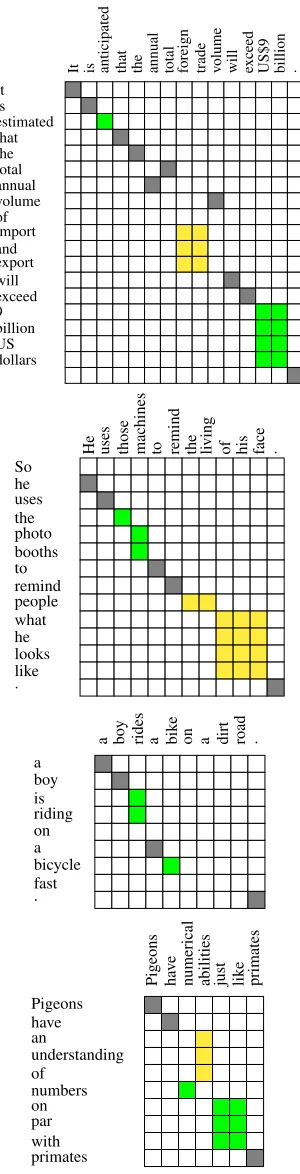
In this study, we will focus on paraphrase acquisition from related sentence pairs characteristic of 4 corpus types, which correspond to different original signal types of text pairs illustrated by the word alignment matrices on Figure 1. A corpus for each type has been collected for 2 languages, English and French, and comprises 625 sentence pairs per language. We now briefly describe how each corpus was built.
It is estimated that the total annual volume of import and export will exceed 9 billion US dollars .
It is anticipated that the annual total foreign trade volume will exceed US$9 billion .
So he uses the photo booths to remind people what he looks like .
He uses those machines to remind the living of his face .
a boy is riding on a bicycle fast .
a bo
y
rides a bik
e
on a dirt road .
Pigeons have an
understanding of
numbers on par with primates
Pigeons ha
v
e
numerical abilities just lik
e
primates
Figure 1: Example reference alignment matrices for (from top to bottom) TEXT, SPEECH, SCENE and EVENT.Surealignments appear in green or gray (identi-ties) andpossiblealignments in yellow.
TEXT For English, we used the MTC corpus1 (de-scribed in (Cohn et al., 2008)) consisting of sets of news article translations from Chinese, and for French the CESTA corpus2 consisting of sets of news article translations from English. For each sentence cluster, we selected sentence pairs with minimal edit distance above an empirically-selected threshold, covering all clusters first and then select-ing from already used clusters to reach the target number of sentence pairs.
e.g.It is estimated that the total annual volume of import and export will exceed 9 billion US dollars. ↔It is an-ticipated that the annual total foreign trade volume will exceed US$9 billion.
SPEECH For English, we used two freely
avail-able subtitle files3of the French moviesLe Fabuleux
Destin d’Am´elie PoulainandLes Choristes, and for
French we used two subtitle files from theDesperate
HousewivesTV series. We first aligned each
paral-lel corpus using the algorithm described in (Tiede-mann, 2007), based on time frames and developed for bilingual subtitles, we then filtered out sentence pairs below a minimal edit distance threshold, and manually removed obvious errors made by the algo-rithm.
e.g. So he uses the photo booths to remind people what he looks like. ↔He uses those machines to remind the living of his face.
SCENE We used the Multiple Video Description Corpus (Chen and Dolan, 2011) obtained from mul-tiple descriptions of short videos. Similarly to what we did for TEXT, we selected sentence pairs from clusters by minimal edit distance above a threshold. An important fact is that for English we were able to use what is described as “verified” descriptions. There were, however, far fewer descriptions avail-able for French, and none had the “verified” status. We decided to use this corpus nonetheless, but with the knowledge that this source for French is of a sub-stantially lower quality (this corpus type will there-fore appear as “(SCENE)” in all tables to reflect this).
e.g.a boy is riding on a bicycle fast.↔a boy rides a bike on a dirt road.
1http://www.ldc.upenn.edu/Catalog/
CatalogEntry.jsp?catalogId=LDC2002T01 2
[image:2.612.112.262.45.632.2]Corpus statistics Annotator agreements Tokens in paraphrase statistics
500 sentence pairs 50 sentence pairs not considering identity paraphrases sure para. possible para. # tokens # tokens per sent. sure para. possible para. % tokens # tokens % tokens # tokens
ENGLISH
TEXT 21,473 21.0 66.1 20.4 18.6 4004 12.3 2651
SPEECH 11,049 10.5 79.1 10.9 17.5 1942 31.6 3500
SCENE 7,783 7.5 80.5 35.2 10.9 851 14.0 1094
EVENT 8,609 8.0 65.3 20.5 17.5 1506 14.5 1251
FRENCH
TEXT 24,641 24.0 64.6 16.6 29.2 7218 6.2 1527
SPEECH 11,850 11.5 82.7 20.8 22.5 2667 16.7 1981
(SCENE) 7,012 6.5 42.8 9.3 3.9 275 9.4 664
[image:3.612.83.530.56.227.2]EVENT 9,121 9.1 67.8 3.8 19.6 1793 9.6 876
Table 1: Description of all corpora and paraphrase reference sets for English (top) and French (bottom). Note that SCENEfor French appears within parentheses as we do not consider it of the same quality as the other corpora.
EVENT We used titles of news article clusters from the Google News4 news aggregation service. We further refined the clustering algorithm by filter-ing out article pairs whose publication dates differed from more than one day. We repeated the same se-lection procedure as for TEXT and SCENE to have a maximal cluster coverage and select more similar pairs first.
e.g.Pigeons Have an Understanding of Numbers on Par With Primates↔Pigeons Have Numerical Abilities Just Like Primates
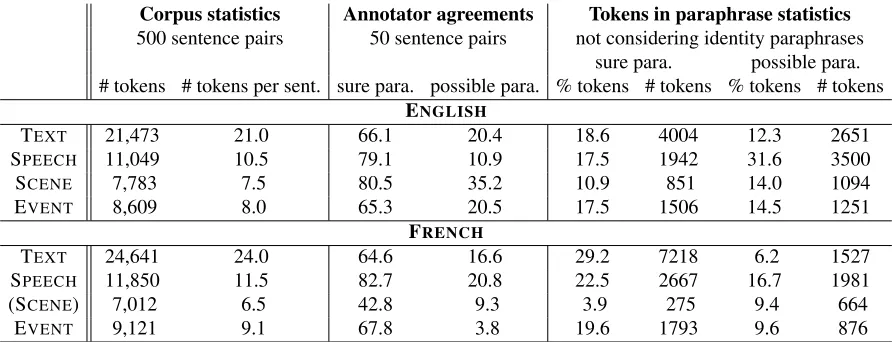
Table 1 provides various statistics for these cor-pora. The first observation is that TEXTcontains sig-nificantly larger sentences than the other types, more than twice as long as those of SPEECH. Annotation was performed following the guidelines proposed by
Cohnet al.(2008)5using the YAWATtool (Germann,
2008), except that alignments where not initially ob-tained automatically so as not to bias our annota-tors’ work (there were two annotators per language). The main guidelines that they had to follow were
that sure and possible paraphrases must be
distin-guished, smaller alignments were to be prefered but any-to-any alignments may be used, and sentences should be aligned as much as possible. Henceforth, we will only consider for all reported statistics and experiments those paraphrases that are not identity pairs (e.g. (a nice day↔a nice day)), as they are
4http://news.google.com
5See http://staffwww.dcs.shef.ac.uk/ people/T.Cohn/paraphrase_guidelines.pdf
considered trivial as far as acquisition is concerned. Table 1 also reports inter-annotator agreement6 values computed on sets of 50 sentence pairs. We find that acceptable values are obtained for sure paraphrases, but that low values are obtained for possible paraphrases. This was somehow expected, given the many possible interpretations of possible paraphrases, but was not a problem for our experi-ments: as we will describe in section 3.1, the evalua-tion metrics we use will not count them as expected solutions, but will simply not count them as false when proposed as candidates.
Table 1 finally shows proportions and absolute numbers of paraphrases of each type for all corpora. We find that there are approximately the same to-tal number of paraphrases for English (16,799) and French (17,001), but that English corpora collec-tively have an equivalent number of sure and pos-sible paraphrases (8,303 vs. 8,496) and French have more sure paraphrases (11,953 vs. 5,048). This may be explained by the fact that our annotators worked independently and that the corpora used have dif-ferences by nature, as our experiments will show. Other salient results include the fact that TEXT con-tains more sure paraphrases in number than the other corpora, that SPEECHcontains relatively more pos-sible paraphrases than the other corpora, and that SCENEhas significantly fewer paraphrases, both in proportion and number. In Figure 2 various
synonymy typography tense inclusion pragmatics syntax morphology number ENGLISH
TEXT 51.2 7.6 5.1 12.1 0.6 4.4 12.1 6.4
SPEECH 39.8 25.6 3.5 12.3 1.7 3.5 3.5 9.7
SCENE 50.0 1.3 13.5 21.6 0.0 1.3 5.4 6.7
EVENT 36.9 15.0 8.2 19.1 1.3 6.8 6.8 5.4
FRENCH
TEXT 46.9 9.0 8.7 2.1 3.6 6.6 3.0 19.8
SPEECH 45.5 14.2 8.0 8.0 2.6 11.6 3.5 6.2
(SCENE) 46.4 5.3 3.5 8.9 0.0 5.3 0.0 30.3
[image:4.612.87.524.56.192.2]EVENT 28.3 19.7 6.1 16.0 7.4 8.6 7.4 6.1
Table 2: Percentages of paraphrase classes in 50 randomly selected sentence pairs for reference paraphrases for English (top) and French (bottom). Classes are illustrated by the following examples: (mutual understanding↔consensus) (synonymy), (California↔CA) (typography), (letting↔having let) (tense), (Asian Development Bank↔Asian Bank) (inclusion), (police dispatcher↔woman) (pragmatics), (grief-stricken↔struck with grief) (syntactic), (Viet-name↔Vietnam) (morphology), (mortgage↔mortgages) (number).
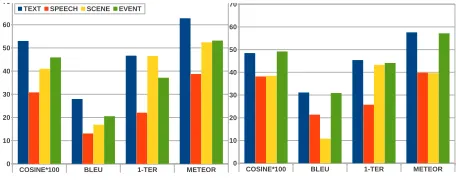
sures of sentence pair similarities are given. TEXT contains the most similar sentence pairs according to all metrics, with EVENTat a similar level on French. SCENEhas sentence pairs that are more similar than those in SPEECHfor English, but this is not the case for French. While the metrics used can only provide a crude account of semantic equivalence at the sen-tence level, these results clearly indicate that trans-lating from text yields more similar sentences than translating from speech.
Table 2 provides a typology of paraphrases found in all our corpora and two languages, where each class has been quantified with respect to the refer-ence alignments.7 The main observation here is that phrasal synonymy (e.g. mutual understanding ↔
consensus) is the most present phenomenon. It is
also interesting to note that the EVENTcorpus type, which is easy to collect on a daily basis, contains ref-erence paraphrases spread over all classes. Lastly, it is expected that paraphrases in thepragmaticsclass (e.g. police dispatcher ↔ woman) would be diffi-cult to acquire, as this would often rely on document context and costly world knowledge.8
7
Note that typologies of paraphrases have already been pro-posed in the literature (e.g. (Culicover, 1968; Vila et al., 2011)), but that the choice of our classes has been primarily moti-vated by potential subsequent uses of the acquired paraphrases (paraphrases could be annotated as belonging to more than one class). Note also that our experiments will also include results focused on thesynonymyclass only (cf. Table 5).
8Reusing such types of paraphrases into applications would however often be too strongly context-dependent.
COSINE*100 BLEU 1-TER METEOR 0
10 20 30 40 50 60 70
TEXT SPEECH SCENE EVENT
COSINE*100 BLEU 1-TER METEOR 0
10 20 30 40 50 60 70
Figure 2: Sentence pair average similarities for all cor-pora for English (left) and French (right) using the co-sine of token vectors, BLEU (Papineni et al., 2002), TER (Snover et al., 2006) and METEOR (Lavie and Agarwal, 2007).
3 Bilingual experiments across corpus types
3.1 Evaluation of paraphrase acquisition
[image:4.612.312.540.282.372.2]TEXT SPEECH SCENE EVENT
GIZA
FASTR
TERp
PIVOT
biphrases
biphrases
biphrases
biphrases
combination system
paraphrases
training and test instances
of sentence pairs
union of biphrases with features
[image:5.612.72.300.55.230.2]Original signal type of text pairs
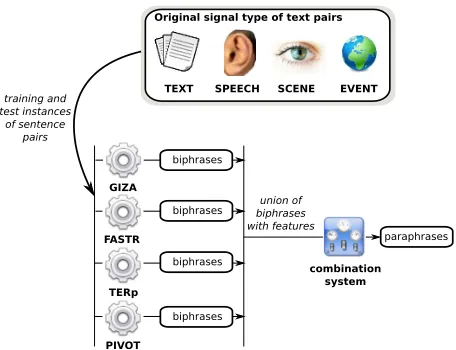
Figure 3: Architecture of our combination system for paraphrase identification.
denotedRsure, that are found by a system. We also computed an F-measure value (F1), which
consid-ers recall and precision as equally important. These values are thus given by the following formulae:
P = |H ∩ Rall|
|H| R=
|H ∩ Rsure| |Rsure| F1=
2P R P +R
Note that the way the setsRallandRsureof refer-ence paraphrase pairs are defined ensures that para-phrase pair candidates that include possible refer-ence paraphrases will not penalize precision while not increasing recall.
All performance values reported in the follow-ing sections will be obtained usfollow-ing 10-fold cross-validation and averaging the results on each sub-test. All data sets of cross-validation contain 500 sen-tence pairs per corpus type, and 125 pairs are kept for development.
3.2 A framework for sub-sentential paraphrase
identification
We now describe the systems that will be tested on the various corpora described in section 2 using the methodology described in section 3.1. Follow-ing (Bouamor et al., 2012), a combination system is used to automatically weight paraphrase pair can-didates produced by individual systems using a set of features aiming at recognizing paraphrases, as il-lustrated on Figure 3. Four individual systems have been used and are described below: the reasons for considering those systems include their free
avail-ability, the possibility of using comparable resources when relevant for our two languages, and the spe-cific characteristics of the techniques used.
Statistical learning of word alignments (GIZA)
The GIZA++ tool (Och and Ney, 2004) com-putes statistical word alignment models of increas-ing complexity from parallel corpora. It was run on each monolingual corpus of sentence pairs in both directions, symmetrized alignments were kept and classical phrase extraction heuristics were ap-plied (Koehn et al., 2003), without growing phrases with unaligned tokens.
Linguistic knowledge on term variation (FASTR)
The FASTRtool (Jacquemin, 1999) spots term vari-ants in large corpora, where varivari-ants are described through metarules expressing how the morphosyn-tactic structure of a term variant can be derived from a given term by means of regular expressions on morphosyntactic categories. Paradigmatic varia-tion can also be expressed with constraints between words, imposing that they be of the same morpho-logical or semantic family using existing resources available in our two languages. Variants for all phrases from one sentence of a pair are extracted from the other sentence, and the intersection of the sets for both directions is kept.
Edit rate on word sequences (TERp) The TERp
tool (Snover et al., 2010) can be used to compute an optimal set of word and phrase edits that can trans-form one sentence into another one.9 Edit types are parameterized by one or more weights which were optimized towards F-measure by hill climbing with 100 random restarts using the held-out data set con-sisting of 125 sentence pairs for each corpus type.
Translational equivalence (PIVOT) We exploited
the paraphrase probability defined by Bannard and Callison-Burch (2005) on bilingual parallel corpora. We used the Europarl corpus10of parliamentary de-bates in English and French, consisting of approx-imately 1.7 million parallel sentences, using each language as source and pivot in turn. GIZA++
9
Note that contrarily to what TERpallows, we did not used
the possibility of using word or phrase equivalents as those are only made available for English. This type of knowledge is however captured in part by the FASTRand PIVOTsystems.
Phrase pair features – edit distance between paraphrases, stem identity, bag-of-tokens similarity, phrase length ratio
Sentence pair features – sentence pair similarity (cosine, BLEU, TER, METEOR), relative position of paraphrases, presence of common tokens at paraphrase boundaries, presence of another paraphrase pair from each system at paraphrase boundaries, presence of a paraphrase at a different position in the other sentence
Distributional features – similarity of token context vectors for each phrase of a paraphrase (derived from counts in the large English-French parallel corpus from WMT’11 (http://www.statmt.org/ wmt11/translation-task.html) (approx. 30 million parallel sentences)
System features – combination of the individual systems that proposed the paraphrase pair
Table 3: Features used by our classifiers. Discretized intervals based on median values are used for real values, and binarized values are used for combinations.
was used for word alignment and phrase transla-tion probabilities were estimated from them by the MOSES system (Koehn et al., 2007). For each phrase of a sentence pair, we built its set of para-phrases, and extracted its paraphrase from the other sentence with highest probability. We repeated this process in both directions, and finally kept for each phrase its paraphrase pair from any direction with highest probability.
Automatic validation of candidate paraphrases
Taking the union of all paraphrase pair candidates from all the above systems for each sentence pair, we perform a Maximum Entropy two-class classifica-tion11, which allows us to include features that were not necessarily exploited or straightforward to ex-ploit by individual systems to determine the proba-bility that each candidate is a good paraphrase. More generally, this allows us to attempt to learn a more generic characterization of paraphrases, which could trivially accept any number of systems as inputs. Positive examples for the classifier are those from the union of candidates that are also in the reference setRsure, while negative examples are the remaining ones from the union. The features that we used are summarized in Table 3.
3.3 Experimental results
Results for individual systems, their union and our validation system trained on each corpus type are given on Table 4. First, we find that all individual systems fare better on TEXT, for which more train-ing data were available and where semantic
equiv-11Using the implementation at: http://homepages. inf.ed.ac.uk/lzhang10/maxent_toolkit.html
alence of sentence pairs is most likely. EVENT ap-pears to be the most difficult corpus type, whereas one could say that being the most readily data source this is a disapointing result: we will return to this in section 3.4. In terms of performance on F-measure per corpus type, GIZAperforms best for TEXTand SPEECH, containing long sentences with possible repetitions, while TERpperforms on par with GIZA for SCENEand best for EVENT, where equivalences that are rare at the corpus level are more present. FASTRachieves a very low recall, showing that the encoded definitions of term variants do not cover all types of paraphrases, and also possibly that the lex-ical resource that it uses has incomplete coverage. It nonetheless obtains high precision values, most notably on TEXT. One last comment regarding in-dividual systems is that PIVOT is by far the most precise of all the techniques used, but with a recall much lower than those of GIZA and TERp: as is the case for FASTR, which makes use of manually-encoded lexical resources, PIVOTencodes in some sense some kind of semantic knowledge.12
Individual systems Combination systems
GIZA FASTR TERp→F PIVOT union validation
P R F1 P R F1 P R F1 P R F1 P R F1 P R F1
ENGLISH
TEXT 48.2 58.9 53.0 63.1 5.9 10.7 41.2 66.4 50.9 73.4 25.8 38.2 20.8 80.8 33.1 68.4 62.8 65.5 SPEECH 39.7 44.2 41.8 27.1 3.5 6.3 25.0 50.3 33.4 79.2 15.3 25.7 25.5 71.4 37.6 51.0 56.3 53.5 SCENE 44.8 57.7 50.5 47.4 5.2 9.5 40.1 67.9 50.4 84.6 14.6 25.0 36.2 83.4 50.5 44.9 66.8 53.7 EVENT 19.0 33.9 24.3 62.9 3.1 6.0 28.8 68.7 40.6 97.4 11.2 20.1 20.8 75.5 32.7 35.0 67.1 46.0
FRENCH
[image:7.612.76.537.56.236.2]TEXT 52.5 58.9 55.5 56.9 4.9 9.1 46.4 61.4 52.8 64.5 30.3 41.2 41.5 77.9 54.1 74.7 61.0 67.1 SPEECH 44.0 54.9 48.9 30.7 4.3 7.6 34.8 60.2 44.1 75.5 19.0 30.4 31.4 76.2 44.5 60.2 59.7 60.0 (SCENE) 14.4 43.6 21.7 53.0 4.0 7.4 13.8 75.3 23.4 94.6 5.21 9.8 12.7 86.4 22.2 19.9 59.8 29.8 EVENT 28.7 44.2 34.8 34.4 2.3 4.3 29.9 58.9 39.7 79.5 15.0 25.2 25.2 72.5 37.4 40.0 56.3 46.8
Table 4: Evaluation results for individual systems (left) and combination systems (right) on all corpus types for English (top) and French (bottom). Values in bold are for highest values for a given metric for each corpus type and language.
and +6.1). Recall from Table 1 that TEXT and SPEECHwere the two corpus types with the highest number of sure paraphrase examples for both lan-guages: results show that our classifier was able to efficiently use them.
Recall values for the union are quite strong for all corpus types, ranging from 71.4 (SPEECHin En-glish) to 83.4 (SCENE in English). There is, how-ever, a substantial decrease between the unions and the results of our combination systems, although recall values for our systems are roughly between 56 and 67, which may be considered an acceptable range on such a task. Further study of false neg-atives should help with engineering new features to improve paraphrase recognition. Lastly, we note that precision is in general highest for a specific system (PIVOT), and reaches high values for our validation system on TEXT, where we have the most examples (resp. 68.4 and 74.7 for English and French).
As seen in Table 2, synonymy is the most present phenomenon in all our corpora; it is also proba-bly one of the most useful type of knowledge for many applications. We now therefore focus on this class, for which all the sure paraphrases in our cor-pora falling in this class have been annotated. Ta-ble 5 shows F-measure values for the individual techniques and our combination systems on all cor-pus types. We first observe that our combination sys-tem also always improves here over the best individ-ual system, albeit not by a large margin on EVENT.
GIZA FASTR TERp PIVOT validation
ENGLISH
TEXT 52.2 6.1 47.3 47.1 68.1 SPEECH 42.6 5.0 30.3 39.5 54.9 SCENE 51.8 6.0 48.0 26.0 56.3 EVENT 22.5 2.1 34.8 24.7 35.5
FRENCH
TEXT 55.3 3.9 50.7 50.5 70.3 SPEECH 49.8 1.6 40.9 36.2 57.2 (SCENE) 19.6 4.2 23.1 0.0 24.7 EVENT 36.8 3.5 35.3 25.6 39.9
Table 5: F-measure values for test instances in the syn-onymyclass (see Table 2) for all individual systems and our validation system for English (top) and French (bot-tom).
Also, we find that PIVOTperforms relatively closer to GIZAand TERp on TEXT and SPEECHthan for the full set of classes, confirming the intuition that translational equivalence may be appropriate to rec-ognize synonymy.
3.4 Experiments across corpus types
To test how different the corpora under study are as regards paraphrase identification, we now consider using as additional training data for our classifiers corpora of the other types, both individually and col-lectively. Results are given on Table 6.13
[image:7.612.315.539.291.426.2]+TEXT +SPEECH +SCENE +EVENT +All
ENGLISH
# ex+ 7,342 2,296 1,784 1,171 12,593
TEXT 65.5 66.2 65.1 66.2 65.1 SPEECH 56.0 53.5 52.8 54.8 56.6
SCENE 49.7 54.3 53.7 53.8 42.7 EVENT 51.1 45.3 42.5 46.0 56.2
FRENCH
# ex+ 12,961 3,340 966 2,160 19,427
[image:8.612.74.295.56.227.2]TEXT 67.1 67.2 66.7 67.0 66.6 SPEECH 57.6 60.0 56.4 59.6 57.9 (SCENE) 23.7 22.0 29.8 23.9 21.1 EVENT 45.2 45.6 44.3 46.8 49.3
Table 6: Evaluation results (F1 scores) for all corpus types for English (top) and French (bottom) when adding training material from other corpus types (values with gray background on the diagonal are when no additional training data are used). “#ex+” rows indicate numbers of positive paraphrase examples for each additional corpus type.
The most notable observation is that EVENT is substantially improved by using all available addi-tional training data for English (+10.2), and to a lesser extent for French (+2.5) . It should be noted that no individual corpus type, save TEXT, individu-ally improves results on EVENT, and that results are yet substantially improved over the use of training data from TEXT when using all available data, re-vealing a collective contribution of all corpus types. The second major observation is that all other cor-pus types seem to be quite specific in nature, as no addition of training data from other types yields any improvement (with the exception of SPEECHon En-glish), but they often in fact decrease performance. For instance, SCENEin English is substantially neg-atively impacted by the use of the numerous exam-ples of TEXT(-4 in F-measure) and even more when using all other training data (-9). This underlines the specific nature of this corpus type: independent descriptions of the same scene in a video may be worded with much variation that mostly differ from that present in other corpus types.
Our main conclusion here is therefore that all our corpora under study are quite specific in nature, but that EVENT can benefit from all training data from the other corpus types. We can further note that the
fact that TEXTis almost not impacted by additional data may also be explained by the fact that this cor-pus type contains more than half of the total number of examples for the two languages. Finally, there are substantially more positive paraphrase examples for French (19,427) than for English (12,593).
4 Related work
Over the years, paraphrase acquisition and genera-tion have attracted a wealth of research works that are too many to adequatly summarize here: (Mad-nani and Dorr, 2010) presents a complete and up-to-date review of the main approaches. Sentential paraphrase collection has been tackled from specific resources increasing the probability of sentences be-ing paraphrases (Dolan et al., 2004; Bernhard and Gurevych, 2008; Wubben et al., 2009), from com-parable monolingual corpora (Barzilay and Elhadad, 2003; Fung and Cheung, 2004; Nelken and Shieber, 2006), and even at web scale (Pasc¸a and Dienes, 2005; Bhagat and Ravichandran, 2008).
Various techniques have been proposed for para-phrase acquisition from related sentence pairs (Barzilay and McKeown, 2001; Pang et al., 2003) and from bilingual parallel corpora (Bannard and Callison-Burch, 2005; Kok and Brockett, 2010). The issue of corpus construction for developing and evaluating paraphrase acquisition techniques are ad-dressed in (Cohn et al., 2008; Callison-Burch et al., 2008). To the best of our knowledge, this is the first time that a study in paraphrase acquisition is con-ducted on several corpus types and for 2 languages. Faruqui and Pad´o (2011) study the acquisition of
en-tailment pairs (premise and hypothesis), with
(Schroeder et al., 2009; Resnik et al., 2010) and au-tomatically produced paraphrases (Madnani et al., 2008; Marton et al., 2009; Max, 2010; He et al., 2011) for improving translation performance.
5 Discussion and future work
This work has addressed the issue of sub-sentential paraphrase acquisition from text pairs. Analogu-ously to bilingual parallel corpora, which are still to date the most reliable resources for automatic ac-quisition of sub-sentential translations, monolingual parallel corpora are generally regarded as very ap-propriate for paraphrase acquisition. However, their low availability makes searching for less parallel
corpora a necessity. In this study, we have attempted to identify corpora of various degrees of semantic textual similarity by considering text pairs originat-ing from various signal types. These signal types allow various degrees of freedom as to how to for-mulate a text: a text is read and translated into a dif-ferent language (TEXT); some speech is listened to in the context of a visual story and translated into a different language (SPEECH); some action is looked at and described (SCENE); and some event that took place is concisely reported (EVENT).
The results presented in this paper have shown how these corpora differed in various aspects. First, they contain varying quantities of paraphrases that are differently distributed into paraphrase classes. Individual acquisition techniques, based on statis-tical learning of word alignments (GIZA), linguis-tic knowledge on term variation (FASTR), edit rate on word sequence (TERp), and translational equiv-alence (PIVOT), for which different performances were observed among them on the same corpus type, were shown to achieve different performances across corpus types. An efficient combination of candidate paraphrases from these individual tech-niques exploiting additional features to character-ize paraphrases has yielded substantial increases in performance on all corpus types; however, it is in-teresting to note that the highest amplitude in per-formance across corpus types was not so much on
recall (amplitude of 10.5 on English and 4.7 on
French) than onprecision(amplitude of 33.4 on En-glish and 34.714 on French). This, some other
fac-14
Not considering (SCENE) for French.
tors aside, emphasizes the fact that the correct idenfi-cation of paraphrases is facilitated when equivalence of semantic content is more probable. Many works have accordingly attempted to identify text units that
areas parallel as possiblefrom large corpora, and
the task of measuring semantic textual similarity, which can find many uses, has received some atten-tion lately (Agirre et al., 2012). However, it itself relies on some knowledge on paraphrasing.
Our avenues for future work lie in three main ar-eas. The first one is to continue our current line of work and study the impact of additional individual acquisition techniques and better characterizations of paraphrases in context, in tandem with working on identifying parallel text pairs in large corpora. Another avenue is to start from the output of high recall techniques and to attempt to characterize the contexts of possible substitution for candidate para-phrases from large corpora as a means to acquire precise paraphrases. As the examples from Table 7 show, some classes of paraphrases, and in particular in the continuum from oursynonymyto pragmat-icsclasses, require the joint acquisition of contextual information that license substitution. Lastly, we plan to apply such knowledge in text-to-text applications.
synonymy
TEXT take part in↔participate in great assistance↔enormous help SPEECH make a deal↔come to an agreement
I don’t care↔I don’t give a damn SCENE riding a bicycle↔cycling
lady↔woman EVENT jail escapee↔prison fugitive
apologizes↔expresses regret
pragmatics
TEXT flew in↔arrived in
flood-control materials↔needed supplies SPEECH face↔picture
want to sleep↔dream about sleeping
SCENE a man↔someone
bento↔food
EVENT violence↔bloodshed
[image:9.612.314.544.431.650.2]anger↔emotion
Table 7: Examples in English for the synonymy and
Acknowledgements
The authors would like to thank the reviewers for their comments and suggestions. This work was partly funded by ANR project Edylex (ANR-09-CORD-008).
References
Eneko Agirre, Daniel Cer, Mona Diab, and Aitor Gonzalez-Agirre. 2012. SemEval-2012 Task 6: A Pi-lot on Semantic Textual Similarity. InProceedings of SemEval, Montr´eal, Canada.
Colin Bannard and Chris Callison-Burch. 2005. Para-phrasing with Bilingual Parallel Corpora. In Proceed-ings of ACL, Ann Arbor, USA.
Regina Barzilay and Noemie Elhadad. 2003. Sentence alignment for monolingual comparable corpora. In Proceedings of EMNLP, Sapporo, Japan.
Regina Barzilay and Kathleen R. McKeown. 2001. Ex-tracting paraphrases from a parallel corpus. In Pro-ceedings of ACL, Toulouse, France.
Delphine Bernhard and Iryna Gurevych. 2008. Answer-ing Learners’ Questions by RetrievAnswer-ing Question Para-phrases from Social Q&A Sites. InProceedings of the Workshop on Innovative Use of NLP for Building Ed-ucational Applications, Columbus, USA.
Rahul Bhagat and Deepak Ravichandran. 2008. Large scale acquisition of paraphrases for learning surface patterns. In Proceedings of ACL-HLT, Columbus, USA.
Houda Bouamor, Aur´elien Max, and Anne Vilnat. 2012. Validation of sub-sentential paraphrases acquired from parallel monolingual corpora. In EACL, Avignon, France.
Chris Callison-Burch, Trevor Cohn, and Mirella Lapata. 2008. Parametric: An automatic evaluation metric for paraphrasing. In Proceedings of COLING, Manch-ester, UK.
David Chen and William Dolan. 2011. Collecting highly parallel data for paraphrase evaluation. InProceedings of ACL, Portland, USA.
Trevor Cohn, Chris Callison-Burch, and Mirella Lapata. 2008. Constructing corpora for the development and evaluation of paraphrase systems. Computational Lin-guistics, 34(4).
P. W. Culicover. 1968. Paraphrase Generation and Infor-mation Retrieval from Stored Text. Mechanical Trans-lation and Computational Linguistics, 11:78–88. Bill Dolan, Chris Quirk, and Chris Brockett. 2004.
Un-supervised construction of large paraphrase corpora: Exploiting massively parallel news sources. In Pro-ceedings of COLING, Geneva, Switzerland.
Manaal Faruqui and Sebastian Pad´o. 2011. Acquiring entailment pairs across languages and domains: A data analysis. In Proceedings of the International Con-ference on Computational Semantics (IWCS), Oxford, UK.
Pascale Fung and Percy Cheung. 2004. Multi-level bootstrapping for extracting parallel sentences from a quasi-comparable corpus. InProceedings of COLING, Geneva, Switzerland.
Ulrich Germann. 2008. Yawat : Yet Another Word Alignment Tool. In Proceedings of the ACL-HLT, demo session, Columbus, USA.
Wei He, Shiqi Zhao, Haifeng Wang, and Ting Liu. 2011. Enriching SMT Training Data via Paraphrasing. In Proceedings of IJCNLP, Chiang Mai, Thailand. Christian Jacquemin. 1999. Syntagmatic and
paradig-matic representations of term variation. In Proceed-ings of ACL, College Park, USA.
Philipp Koehn, Franz Josef Och, and Daniel Marcu. 2003. Statistical Phrase-Based Translation. In Pro-ceedings of NAACL-HLT, Edmonton, Canada. Philipp Koehn, Hieu Hoang, Alexandra Birch, Chris
Callison-Burch, Marcello Federico, Nicola Bertoldi, Brooke Cowan, Wade Shen, Christine Moran, Richard Zens, Chris Dyer, Ondrej Bojar, Alexandra Con-stantin, and Evan Herbst. 2007. Moses: Open Source Toolkit for Statistical Machine Translation. In Pro-ceedings of ACL, demo session, Prague, Czech Repub-lic.
Stanley Kok and Chris Brockett. 2010. Hitting the Right Paraphrases in Good Time. InProceedings of NAACL, Los Angeles, USA.
Alon Lavie and Abhaya Agarwal. 2007. METEOR: An automatic metric for MT evaluation with high levels of correlation with human judgments. InProceedings of the ACL Workshop on Statistical Machine Translation, Prague, Czech Republic.
Chang Liu, Daniel Dahlmeier, and Hwee Tou Ng. 2010. PEM: A paraphrase evaluation metric exploiting par-allel texts. In Proceedings of EMNLP, Cambridge, USA.
Nitin Madnani and Bonnie J. Dorr. 2010. Generating Phrasal and Sentential Paraphrases: A Survey of Data-Driven Methods . Computational Linguistics, 36(3). Nitin Madnani, Philip Resnik, Bonnie J. Dorr, and
Richard Schwartz. 2008. Are multiple reference translations necessary? investigating the value of paraphrased reference translations in parameter opti-mization. InProceedings of AMTA, Waikiki, USA. Yuval Marton, Chris Callison-Burch, and Philip Resnik.
Aur´elien Max. 2010. Example-Based Paraphrasing for Improved Phrase-Based Statistical Machine Transla-tion. InProceedings of EMNLP, Cambridge, USA. Donald Metzler, Eduard Hovy, and Chunliang Zhang.
2011. An empirical evaluation of data-driven para-phrase generation techniques. InProceedings of ACL-HLT, Portland, USA.
Rani Nelken and Stuart M. Shieber. 2006. Towards ro-bust context-sensitive sentence alignment for monolin-gual corpora. InProceedings of EACL, Trento, Italy. Franz Josef Och and Herman Ney. 2004. The
align-ment template approach to statistical machine trans-lation. Computational Linguistics, 30(4).
Bo Pang, Kevin Knight, and Daniel Marcu. 2003. Syntax-based alignement of multiple translations: Ex-tracting paraphrases and generating new sentences. In Proceedings of NAACL-HLT, Edmonton, Canada. Kishore Papineni, Salim Roukos, Todd Ward, and
Wei-Jing Zhu. 2002. Bleu: a method for automatic evalu-ation of machine translevalu-ation. InProceedings of ACL, Philadelphia, USA.
Marius Pasc¸a and Peter Dienes. 2005. Aligning Nee-dles in a Haystack: Paraphrase Acquisition Across the Web. InProceedings of IJCNLP, Jeju Island, South Korea.
Philip Resnik, Olivia Buzek, Chang Hu, Yakov Kronrod, Alex Quinn, and Benjamin B. Bederson. 2010. Im-proving translation via targeted paraphrasing. In Pro-ceedings of EMNLP, Cambridge, USA.
Josh Schroeder, Trevor Cohn, and Philipp Koehn. 2009. Word Lattices for Multi-Source Translation. In Pro-ceedings of EACL, Athens, Greece.
Matthew Snover, Bonnie J. Dorr, Richard Schwartz, Lin-nea Micciulla, and John Makhoul. 2006. A Study of Translation Edit Rate with Targeted Human Annota-tion. InProceedings of AMTA, Boston, USA.
Matthew Snover, Nitin Madnani, Bonnie J. Dorr, and Richard Schwartz. 2010. TER-Plus: paraphrase, se-mantic, and alignment enhancements to Translation Edit Rate. Machine Translation, 23(2-3).
J¨org Tiedemann. 2007. Building a Multilingual Paral-lel Subtitle Corpus. InProceedings of the Conference on Computational Linguistics in the Netherlands, Leu-ven, Belgium.
Marta Vila, M. Ant`onia Mart´ı, and Horacio Rodr´ıguez. 2011. Paraphrase Concept and Typology. A Linguisti-cally Based and Computationally Oriented Approach. Procesamiento del Lenguaje Natural, (462-3). Sander Wubben, Antal van den Bosch, Emiel Krahmer,
and Erwin Marsi. 2009. Clustering and maching headlines for automatic paraphrase acquisition. In Proceedings of the European Workshop on Natural Language Generation, Athens, Greece.