Reducing Parsing Complexity by Intra-Sentence Segmentation
based on M a x i m u m Entropy Model
S u n g D o n g K i m , B y o u n g o T a k Z h a n g , Y u n g T a e k K i m School of C o m p u t e r Science a n d Engineering,
Seoul N a t i o n a l University, K o r e a
{sdkim,btzhang}@scai. snu. ac. kr, ytkim@cse, snu. ac. kr
A b s t r a c t
Long sentence analysis has been a critical problem because of high complexity. This pa- per addresses the reduction of parsing com- plexity by intra-sentence segmentation, and presents m a x i m u m entropy model for deter- mining segmentation positions. The model features lexical contexts of segmentation posi- tions, giving a probability to each potential position. Segmentation coverage and accu- racy of the proposed method are 96% and 8 8 % respectively. The parsing efficiency is im- proved by 77% in time and 7 1 % in space. 1 Introduction
Long sentence analysis has been a critical problem in machine translation because of high complexity. In E B M T (example-based machine translation), the longer a sentence is, the less possible it is that the sentence has an exact match in the translation archive, and the less flexible an E B M T system will be (Cranias et al., 1994). In idiom-based ma- chine translation (Lee, 1993), long sentence parsing is difficult because more resources are spent during idiom recognition phase as sen- tence length increases. A parser is often un- able to analyze long sentences owing to their complexity, though they have no grammatical errors (Nasukawa, 1995).
In English-Korean machine translation, idiom-based approach is adopted to overcome the structural differences between two lan- guages and to get more accurate translation. T h e parser is a chart parser with a capabil- ity of idiom recognition and translation, which is adapted to English-Korean machine trana- lation. Idioms are recognized prior to syn- tactic analysis and the part of a sentence for an idiom takes an edge in a chart (Winograd, 1983). When parsing long sentences, an am- biguity of an idiom's range may cause more edges than the number of words included in
the idiom (Yoon, 1994), which increases pars- ing complexity much. A parser of practical machine translation system should be able to analyze long sentences in a reasonable time.
Most context-free parsing algorithms have O(n 3) parsing complexities in terms of time and space, where n is the length of a sen- tence (Tomita, 1986). Our work is moti- vated by the fact that parsing becomes more efficient, if n becomes shorter. This paper deals with the problem of parsing complex- ity by way of reducing the length of sentence to be analyzed. This reduction is achieved by i n t r a - s e n t e n c e s e g m e n t a t i o n , which is distinguished from i n t e r - - s e n t e n c e s e g m e n - t a t i o n that is used for text categorization (Beeferman et al., 1997) or sentence boundary identification (Palmer and Hearst, 1997) (Rey- nar and Ratnaparkhi, 1997). Intra-sentence segmentation plays a role as a preliminary step to a chart-based, context-free parser in English-Korean machine translation.
There have been several methods for reducing parsing complexities by intra- sentence segmentation. In (Lyon and Frank, 1995)(Lyon and Dickerson, 1997), they took advantage of the fact that the declarative sentences almost always consist of three seg- ments: [pre-subject : s u b j e c t : p r e d i c a t e ] . The complexity could be reduced by decom- posing a sentence into three sections. Pattern rules (Li et al., 1990) and sentence patterns (Kim and Khn, 1995) were used to segment long English sentences. They showed low seg- mentation coverage, which means that many of long sentences are not segmented by the pattern rules or sentence patterns. And they require much human efforts to construct pat- tern rules or collect sentence patterns. These factors may prevent them being applicable to practical machine translation sYstems.
in a sentence a n d determining appropriate segmentation positions. Given a corpus anno- tated with segmentation positions, our model automatically learns the contextual evidences about segmentation positions, which relieves h u m a n of b u r d e n to construct p a t t e r n rules or sentence patterns. These evidences are com- bined under the m a x i m u m entropy framework (Jaynes, 1957) to estimate the probability for each position. By intra-sentence segmenta- tion based on the proposed model, we achieve more improved parsing efficiency by 77% in time and 71% in space.
In Section 2 we introduce the m a x i m u m en- tropy model. Section 3 describes features in- corporated into t h e model and the process of identifying potential segmentation positions. The determination schemes of segmentation positions are described in Section 4. Segmen- tation performance of the model is presented with the degree of contribution to efficient parsing by the segmentation in Section 5. We also compare our approach with other i n t r a - sentence segmentation approaches. Section 6 draws conclusions and presents some further works.
2 M a x i m u m E n t r o p y M o d e l i n g
Sentence patterns or pattern ruels specify t h e sub-structures of the sentences. T h a t is, seg- mentation positions are determined in view of the global sentence structure. If there is no matched rules or patterns with a given sen- tence, the sentence could not be segmented. We assume t h a t whether a word is a segmenta- tion position depends on its surrounding con- text. We try to find factors t h a t affect the de- termination of segmentation positions. Maxi- m u m entropy is a technique for automatically acquiring knowledge from incomplete infor- mation, without making any unsubstantiated assumptions. It masters subtle effects so t h a t we may accurately model subtle dependencies. It does not make any unwarranted assump- tions, which means that m a x i m u m entropy learns exactly what the data says. Therefore it can perform well on unseen data.
The idea is to construct a model t h a t as- signs a probability to each potential segmen- tation position in a sentence. We build a prob- ability distribution
p(ylx),
where y • {0, 1} is a r a n d o m variable specifying the potential segmentation position in a context x. A fea- t u r e of a context is a binary-valued indicator function ] expressing the information a b o u t aspecific context.
Given a training sample of size N ,
(Xl,Yl),..-,
(XN,YN),
an e m p i r i c a l p r o b a - b i l i t y d i s t r i b u t i o n can be defined asy) =
y)
N
where # ( x , y) is the n u m b e r of occurrences of (x, y). T h e expected value of feature fi with respect to the empirical distribution i~(x, y) is expressed as
x , y
and the expected value of fi with respect to the probability distribution p(ylx) is
p(.fi) -~ ~ ( x ) p C y l x ) . h ( x , y),
x~y
where l~(x) is t h e empirical distribution of x in t h e corpus. We want to build probability distribution p(ylx) t h a t is required to accord to the feature
fi
useful in selecting segmenta- tion positions:P(fi) = IS(fi)
for all fi • .T, where Y is the set of candidate features. This makes the probability distribution be built on only training data.Given a feature set .T, let C be the subset of all distributions P t h a t satisfies t h e require- ment P(fi) = P(fi):
C ~- {p • ~
]
P(fi)
= P(fi), for all fi • .T}. (1) We choose a probability distribution consis- tent with all the facts, b u t otherwise as uni- form as possible. T h e uniformity of t h e prob- ability distribution p(ylx) is measured by the conditional entropy:H(p) = - ~ p ( x , y) logp(ylx)
x~y
=
(x)PCulx) logp(ylx)
x,y
Thus, t h e probability distribution with maxi- m u m entropy is the most uniform distribution. In building a model, we consider t h e linear exponential family Q given as
1
Q ( f ) = { p ( y l x ) = ~ e x p ( E ~ifi(x,y))}, $
where Ai are real-valued parameters and
ZA(x)
is a normalizing constant:=
exp(
y)).
y i
An intersection of the class Q of exponential models with the class of desired distribution (1) is nonempty, and the intersection contains the maximum entropy distribution and fur- thermore it is unique (Ratnaparkhi, 1994).
Finding p . E C that maximizes H(p) is a problem in constrained optimization, which cannot be explicitly written in general. There- fore, we take advantage of the fact that the models in Q that satisfy
p(fi)
= 15(fi) can be explained under the maximum likelihood framework (Ratnaparkhi, 1994). Maximum likelihood principle also gives the unique dis- tribution p., the intersection of the class Q with C.We assume each occurrence of
(x,y)
is sampled independently. Thus, log-likelihood L#(p) of the empirical distribution i5 as pre- dicted by a model p can be defined asL ~ ) _= log I I
p(ylx) ~(~'y) = ~ ] p ( x , y) logp(ylx ).
x , y x , y
That is, the model we want to build is p . = arg xc = a r g m a x
qE~
The parameters A~ of exponential model (2) are obtained by the
Generalized Iterative Scal-
ing
algorithm (Darroch and Ratcliff, 1972). 3 C o n s t r u c t i o n o f F e a t u r e sThis section describes the features. From a corpus, contextual evidences of segmentation positions are collected and combined, result- ing in features. The features are used in iden- tifying potential segmentation positions and included in the model.
3.1 S e g m e n t a b l e P o s i t i o n s a n d Safe
Segmentation
A sentence is constructed by the combina- tion of words, phrases, and clauses under the well-defined grammar. A sentence can be seg- mented into shorter segments that correspond to the constituents of the sentence. That is, segments correspond to the nonterminal sym- bols of the context-free grammar 1. The posi- 1Nonterminal symbols include the ones for phrases,
such as N P (noun phrase) and V P (verb phrase),
tion of a word is called s e g m e n t a b l e posi- t i o n that can be a starting position of a spe- cific segment.
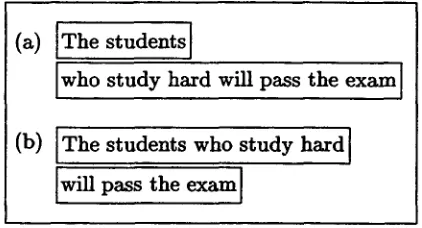
Though the analysis complexity can be re- duced by segmenting a sentence, there is a mis-segmentation risk that causes pars- ing failures. A segmentation can be called safe s e g m e n t a t i o n that results in a coherent blocks of words. In English-Korean transla- tion, safe segmentation is defined as the one which generates safe segments. A segment is safe, when there is a syntactic category sym- bol N P dominating the segment and the seg- ment can be combined with adjacent segments under a given grammar. In Figure 1, (a) is an unsafe segmentation because the second seg- ment cannot be analyzed into one syntactic category, resulting in parsing failure. By the safe segmentation (b), the first segment cor- responds to a noun phrase and the second to a verb phrase, so that we can get a correct analysis result.
(a) IThe students I
who study hard will pass the exam]
(b) I The students who study hard I I will pass the exam[
Figure h Examples of unsafe/safe segmenta- tion in English-Korean translation.
3.2 L e x i c a l C o n t e x t u a l C o n s t r a i n t s A l e x i c a l c o n t e x t of a
word
includes seven- word window: three to the left of aword and
three to the right of aword and a word
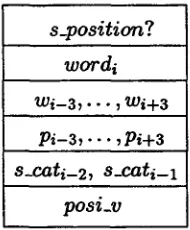
itself. It also includes the part-of-speeches of these words, subcategorization information for two words to the left, and position value. The position valueposi_v
of the ith word wi is cal- culated aspos _v = r × R ] ,
where n is the number of words and R 2 repre- sents the number of regions in the sentence. Region is the sequentially ordered block of and the ones for clauses like R L C L (relative clause), SUBCL (subordinate clause).
[image:3.596.348.559.350.464.2]words in a sentence, and posi_v represents the region in which a word lies. It is included to reflect the influence of the position of a word on being a segmentation position. Thus, the lexical context of a word is represented by 17 attributes as shown in Figure 2.
s_position? wordi
W i - 3 ~ • . . , W i + 3
Pi-3, " •, Pi+3 8.-Cgtti-2, S-carl- 1
posi_v
Figure 2: T h e structure of lexical context.
A n example of a training data and a re- sulting lexical context is shown in Figure 3. A symbol ' # ' represents a segmentation posi- tion marked by human annotators. Therefore, the lexical context of word w h e n includes the value 1 for attribute s_position? and follow- ings: three words to the left of w h e n (became, terribly, and worried) a n d part-of-speeches o f each word (VERB ADV ADJ), three words to the right (they, saw, and what) a n d p a r t - of-speeches (PRON VERB PRON), subcat- egorization information for two words to the left (0 1), a n d position value (2).
Of course his parents became terribly worried # w h e n they saw what was happening to Atzel.
( 1 w h e n became terribly worried they saw what VERB ADV ADJ P R O N VERB PRON 0 1 2 )
Figure 3: A n example of a training d a t a and a lexical context.
To get reliable statistics, much training data is required. To alleviate this prob- lem, we generate l e x i c a l c o n t e x t u a l c o n - s t r a l n t s by combining lexical contexts and collect statistics for them. To generate lex- ical contextual constraints and to identify segmentable positions, we define two oper- ations join (E9) and consistency (=). Let
( a l , . . . , a n ) and ( b l , . . . , b n ) be lexical con- texts and ( C 1 , . . . ,On) be lexical contextual
constraint. T h e operation join is defined as
( a l , . . . ,
an) •
(bl,.-.,
bn)
= (C1,..., Ca),
,.i if ai
#
bi Ci = ai if ai = bi 'where ' , ' is don't-care term accepting any value. A lexical contextual constraint is gen- erated as a result of j o i n operation. The
consistency is defined as
1 if ( C i = a i o r C i = ' * r ) f o r a l l l < i < n
k = 0 otherwise
The algorithm for generating lexical contex- tual constraints is shown in Figure 4.
• Input: a set of active lexical contexts
LCw = { l c l . . . lcn} for word w, where lcc/= ( a l , . . . , an).
• O u t p u t : a set of lexical contextual
constraints L C C w = {/ccl .../cck}, where l c c / = ( C 1 , . . . , Cn).
1. Initialize L C C w = 0
2. Do the followings for each l ~ E LCw
(a) For all lcj(j # i), Count(lcj) = # of matched attributes with Ic/
(b) max_cnt = arg maxlc¢ eLC. Count( Icj )
(c) For all lcj, where Count(lcj) = max..cnt, I c c = lc~ • lc~, L C C w e- L C C , U {/cc}
Figure 4: Algorithm for generating lexical contextual constraints.
A Icc plays t h e role of a feature. Following is an example of a feature.
f ( x , y ) =
1 i f X w a r d = "that" and xi-1 = "say" and y = 1
0
otherwiseWe collect t h e statistics for each Icc. The fre- quency of each lcc is counted as the number of lexical contexts t h a t satisfy the consistency
operation w i t h the lcc.
n
[image:4.596.69.558.60.776.2] [image:4.596.147.242.149.264.2]Identifying segmentable positions is per- formed with the consistency operation with the lexical context of word w and lcc E L C C w . The word whose lexical context is consistent with lcc is identified as a segmentable posi- tion.
4 D e t e r m i n a t i o n S c h e m e s o f S e g m e n t a t i o n P o s i t i o n s
Segmentation positions are determined through two steps: identifying segmentable positions and selecting the most appropriate position among them. Segmentable positions are identified using the consistency operation. Maximum entropy model in Section 2 gives a probability to each position.
Segmentation performance is measured in terms of coverage and accuracy. Coverage is the ratio of the number of actually segmented sentences to the number of segmentation tar- get sentences that are longer than ot words, where o~ is a fixed constant distinguishing long sentences from short ones. Accuracy is evalu- ated in terms of the safe segmentation ratio. They are defined as follows:
# of actually segmented Sent. coverage = ~ of Sent. to be segmented
(3)
# of Sent. with safe segmentation accuracy = ~ of actually segmented Sent.
(a)
4.1 B a s e l i n e S c h e m e
No contextual information is used in identify- ing segmentable positions. They are empiri- cally identified. A word that is tagged as a segmentation position more than 5 times is identified as a segmentable position. A set of segmentable positions, 9 , is as follows.
~D = {wi [ wi is tagged as segmentation position and #(tagged wi) >_ 5}
In order to select the most appropriate po- sition, the segmentation appropriateness of each position is evaluated by the probability of word wi:
# of tagged wi
p(Wi)
= # of wi in the corpusp(wi) represents the tendency that word wi will be used as a segmentation position. A
segmentation position w. is selected as the one that has highest p(wi) value:
w . = arg m a x p(wi).
wiE~
This scheme serves as a baseline for comparing the segmentation performance of the models. 4.2 A S c h e m e u s i n g L e x i c a l
C o n t e x t u a l C o n s t r a i n t s
Lexical contextual constraints are used in identifying segmentable positions. Compared with the baseline scheme, this scheme con- siders contextual information of a word. All consistent words with the defined lexical con- textual constraints form a set of segmentable positions 79.
The maximum likelihood principle gives a probability distribution for p(y I lcc~), where y E {0, 1}. Segmentation appropriateness is evaluated by p(1 I lcew,). A position with the highest p(1 I l c c ~ ) becomes a segmentation position:
w. = arg max p(1 I/CCwi).
wi E ~
4.3 A S c h e m e u s i n g L e x i c a l C o n t e x t u a l C o n s t r a i n t s w i t h
Word Sets
Due to insufficient training samples for con- structing lexical contextual constraints, some segmentable positions may not be identified. To alleviate this problem we introduce w o r d s e t s whose elements have linguistically similar features. We define four word sets: coordinate conjunction set, subordinate conjunction set, interogative set, auxiliary verb set. The cate- gories of word sets and the examples of their members are shown in Table 1.
Table 1: The word sets and examples.
Word Set Examples
Coordinate Conjunctions and, or, but Subordinate Conjunctions if, when, . . . Interogatives how, what, . . . Auxiliary Verbs can, should, . . .
members, interogatives 5 members, and aux- iliary verbs have 12 members now. T h e words belonging to each word set are treated equally. Lexical contextual constraints are constructed for words and word sets, so the statistics is collected for b o t h of them. T h e set of seg- mentable positions T~ is defined somewhat dif- ferently as:
:D = {wi, wsj I (Icc, v, -= lcc~,) = 1
or (Icws~ =-- IcC.ws~) = 1},
where wsj denotes a word set to which the j t h word in a sentence belongs.
In this scheme, p(1 I Iccc,,,) or p(1 ] lccws,)
expresses the segmentation appropriateness of the position. Therefore, a segmentation posi- tion is determined by
w, = arg
max
{p(1 I lcc ,), p(1 I lcc s )}.
{w,,ws~}~9
5 E x p e r i m e n t s
5.1 C o r p u s a n d C o n s t r u c t i o n o f t h e M a x i m u m E n t r o p y M o d e l
We construct the corpus from two different domains, where the sentences longer t h a n 15 -words are extracted 3. T h e training portion is used to generate lexical contextual constraints and to collect statistics for m a x i m u m entropy model construction. From high school English texts, 1500 sentences are tagged with segmen- tation positions by human. Two people who have some knowledge about English syntactic structures read sentences, and marked words as segmentation positions where they paused. After generating lexical contextual con- straints, we constructed t h e m a x i m u m en- tropy model p(ylx), where x is a lexical con- textual constraint and y E {0,1}. T h e m o d e l incorporates features that occur more t h a n 5 times in the training data. 3626 candidate fea- tures were generated without word sets a n d 3878 features with word sets. In Table 2, training time and the number of active fea- tures of the model are shown.
Segmentation performance is evaluated us- ing test portion that consists of 1800 sentences ffrom two domains: high school English texts and the Byte Magazine.
3The sentences with commas are excluded because comma is an explicit segmentation position. Segments
resulting from a segmentation at commas m a y be the
manageable-sized ones. Our work is to segment long sentences without explicit segmentation positions.
Table 2: Construction of models.
Training # of
T i m e Active Features W i t h o u t
10 rain 2720
Word Sets W i t h
12 m l n 2910 Word Sets
5.2 S e g m e n t a t i o n P e r f o r m a n c e
In addition to coverage a n d accuracy, SC
value is also defined to express the degree of contribution to efficient parsing by segmenta- tion. It is the ratio of t h e sentences that can benefit from intra-sentence segmentation. If a long sentence is not segmented or is segmented at unsafe segmentation positions, the sentence is called a s e g m e n t a t i o n e r r o r s e n t e n c e .
S C value is calculated as
# of segmentation error sentences
S G = I -
# of segmentation target sentences"
A
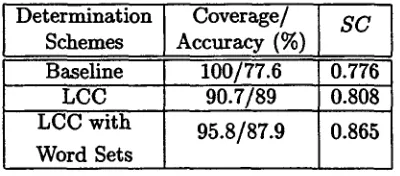
sentence longer t h a n vt words is con- sidered as the segmentation target sentence, where c~ is set to 12. Table 3 compares seg- mentation performance for each determina- tion scheme.Table 3: Segmentation performance of the de- termination schemes of segmentation position.
Determination Coverage/
Schemes Accuracy (%)
Baseline 100/77.6
LCC
90.7/89
LCC w i t h
95.8/87.9
Word Sets
S C
0.776 0.808
0 . 8 6 5
By the comparison of the baseline scheme with others, the accuracy is observed to de- p e n d on t h e context information. Word sets are helpful for increasing coverage with less degradation of accuracy. Each scheme has su- periority in terms of t h e different measures. B u t in terms of applicability to practical sys- tems, the third scheme is best for our purpose. Table 4 shows the segmentation performance of t h e scheme using L C C with word sets.
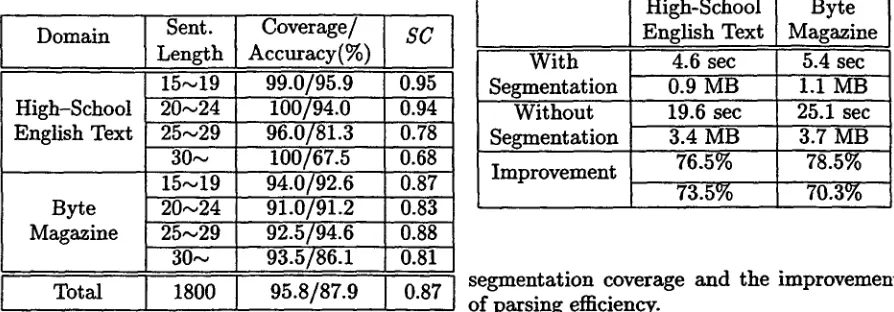
[image:6.596.331.533.91.177.2] [image:6.596.333.533.487.575.2]Table 4: Segmentation performance of LCC with word sets.
Domain Sent. Coverage/ I Length Accuracy(%)
I
15~19 High-School
English Text
Byte Magazine
Total
20~24 25~29 30~ 15,-,19 20,-~24 25,,~29 30,-~
99.0/95.9 100/94.0 96.0/81.3 100/67.5 94.0/92.6 91.0/91.2 92.5/94.6 93.5/86.1 1800 95.8/87.9 ]
8C
0.95 0.94
0.78
0.6g
0.87 0.83 0.88 0.81 0.87
about 0.85 for the sentenes from the Byte Magazine. Though they slightly differ be- tween test domains, about 87% of long sen- tences can be parsed with less complexity and without causing parsing failures. It suggests that the intra-sentence segmentation method can be utilized for efficient parsing of the long sentences.
5 . 3 P a r s i n g E f f i c i e n c y
Parsing efficiency is generally measured by the required time and memory for parsing. In most cases, parsing sentences longer than 30 words could not complete without intra- sentence segmentation. Therefore, the parsing is performed for the sentences longer than 15 and less than 30 words. Ultra-Sparc 30 ma- chine is used for experiments. The efficiency improvement was measured by
EItime = tunseg -- tseg ,,, x 100,
tunseg
EImemory = rnunseg --mseg X 100, ~T~unse9
where
$unseg
andrrbanseg
are time and memory during parsing without segmentation and tseg, rnseg are for the parsing with segmentation. Table 5 summarizes the results.By segmenting long sentences into several manageable-sized segments, we can parse long sentences with much less time and space.
5 . 4 C o m p a r i s o n w i t h R e l a t e d W o r k s The intra-sentence segmentation method based on the maximum entropy model is corn- - pared with other approaches in terms of the
Table 5: Comparison of parsing efficiency with/without segmentation.
With Segmentation
Without Segmentation Improvement
High-School Byte 1 English Text Magazine
4.6 sec 5.4 sec 1 0.9 MB
19.6 sec 3.4 MB 76.5% 73.5%
1.1 MB '25.1 sec 3.7 MB
78.5%
70.3%
segmentation coverage and the improvement of parsing efficiency.
In (Lyon and Frank, 1995)(Lyon and Dick- erson, 1997), a sentence is segmented into three segments. Though parsing efficiency can be improved by segmenting a sentence, this method may be applied to only simple sen- tences 4. Long sentences are generally coordi- nate sentences 5 or complex sentences 6. They have more than two subjects, so applying this method to such sentences seems to be inap- propriate.
In (Kim and Kim, 1995), sentence patterns are used to segment long sentences. This method improve parsing efficiency by 30% in time and 58% in space. However collecting sentence patterns requires much hnman efforts and segmentation coverage is only about 36%. Li's method (Li et al., 1990) for sentence segmentation also depends upon manual- intensive pattern rules. Segmentation cover- age seems to be unsatisfactory for practical machine translation system.
The proposed m e t h o d can be applied to co- ordinate and complex sentences as well as sim- ple sentences. It shows segmentation coverage of about 96%. In addition, it needs no o t h e r
human efforts except for constructing training data. Human ~.nnotators have only to read sentences and mark segmentation positions, which is more simple than collecting pattern rules or sentence patterns. We can also get much improved parsing efficiency: about 77% in time and about 71% in space.
4A simple sentence has one subject and one predi- cate.
5A coordinate sentence results ~ o m the combina- tion of several simple sentences by the coordinate con-
junctions. -
[image:7.596.110.557.110.266.2]6 C o n c l u s i o n a n d F u t u r e W o r k
Practical machine translation systems should be able to accommodate long sentences. Thus intra-sentence segmentation is required as a means for reducing parsing complexity. This paper presents a method for intra-sentence segmentation based on the m a x i m u m entropy model. The method builds statistical models automatically from a text corpus to provide the segmentation appropriateness for safe seg- mentation.
In the experiments with 1800 test sentences, about 87% of them were benefited from seg- mentation. The statistical intra-sentence seg- mentation method can also relieve human of the burden of constructing information, such as segmentation rules or sentence patterns. Experiments suggest that the proposed maxi- m u m entropy models can be incorporated into the parser for practical machine translation systems.
Further works can be done in two direc- tions. First, studies on recovery mecha- nisms for unsafe segmentation before parsing seem necessary since ungafe segmentation may cause parsing failures. Second, parsing control mechanisms should be studied that exploit the -characteristics of segmentation positions and the parallelism among segments. This will en- hance parsing efficiency further.
R e f e r e n c e s
D. Beeferman, A. Berger, and J. Lafferty. 1997. Text Segmentation using Exponential Models.
In Second Conference on Empirical Methods in Natural Language Processing. Providence, RI. Lambros Cranias, Harris Papageorgiou, and Ste-
lios Piperdis. 1994. A Matching Technique in Example-Based Machine Translati on. In Pro-
ceedings of 1995 COLING, pages 100--104. J.N. Darroch and D. Ratcliff. 1972. Generalized
Iterative Scaling for Log-linear Models. The Annals of Mathematical Statistics, 43(5):1470- 1480.
E.T. Jaynes. 1957. Information Theory and Sta- tistical Mechanics. Physical Review, 106:620- 630.
Sung Dong Kim and Yung Taek Kim. 1995. Sentence Analysis using Pattern Matching in English-Korean Machine Translation. In Pro-
ceedings of the 1995 ICCPOL, Oct. 25-28. Ho Suk Lee. 1993. Automatic Construction of
Transfer Dictionary based on the Corpus for English-Korean Machine Translation. Ph.D. thesis, Seoul National University. In Korean. Wei-Chuan Li, Tzusheng Pei, Bing-Huang Lee,
and Chuei-Feng Chiou. 1990. Parsing Long Ea-
ghsh Sentences with Pattern Rules. In Proceed- ings of 25th Conference of COLING, pages 410-- 412.
Caroline Lyon and Bob Dickerson. 1997. Reduc- ing the Complexity of Parsing by a Method of Decomposition. In International Workshop on Parsing Technology, September.
Caroline Lyon and Ray Frank. 1995. Neural Net- work Design for a Natural Language Parser.
In International Conference on Artificial Neural Networks.
Tetsura Nasukawa. 1995. Robust Parsing Based on Discourse Information. In 33rd Annual Meeting of the A CL, pages 33-46.
David D. Palmer and Marti A. Hearst. 1997. Adaptive Multilingual Sentence Boundary Disambiguation. Computational Linguistics,
23(2):241-265.
A. Ratnaparkhi. 1994. A Simple Introduction to Maximum Entropy Models for Natural Lano gnage Processing. Technical report, Institute for Research in Cognitive Science, University of Pennsylvania 3401 Walnut Street, Suite 400A Philadelphia, PA 19104-6228, May. IRCS Re- port 97-08.
J.C. Reynar and A. Ratnaparkhi. 1997. A Maxi- mum Entropy Approach to Identifying Sentence Boundaries. In Proceedings of the Fifth Confer- ence on Applied Natural Language Processing,
pages 16--19. Washington D.C.
Masaru Tomita. 1986. E~icient Parsing for Nat- ural Language. Kluwer Academic Publishers. T. Winograd. 1983. Language as a Cognitive Pro-
cess: Syntax, volume 1. Addison-Wesley. Sung Hee Yoon. 1994. Efficient Parser to Find