Error-driven HMM-based Chunk Tagger
with Context-dependent Lexicon
GuoDong ZHOU Kent Ridge Digital Labs 21 Heng Hui Keng Terrace
Singapore 119613 [email protected]
Jian SU
Kent Ridge Digital Labs 21 Heng Hui Keng Terrace
Singapore 119613 [email protected]
Abstract
This paper proposes a new error-driven HMM- based text chunk tagger with context-dependent lexicon. Compared with standard HMM-based tagger, this tagger uses a new Hidden Markov Modelling approach which incorporates more contextual information into a lexical entry. Moreover, an error-driven learning approach is adopted to decrease the memory requirement by keeping only positive lexical entries and makes it possible to further incorporate more context- dependent lexical entries. Experiments show that this technique achieves overall precision and recall rates of 93.40% and 93.95% for all chunk types, 93.60% and 94.64% for noun phrases, and 94.64% and 94.75% for verb phrases when trained on PENN WSJ TreeBank section 00-19 and tested on section 20-24, while 25-fold validation experiments of PENN WSJ TreeBank show overall precision and recall rates of 96.40% and 96.47% for all chunk types, 96.49% and 96.99% for noun phrases, and 97.13% and 97.36% for verb phrases.
Introduction
Text chunking is to divide sentences into non- overlapping segments on the basis of fairly superficial analysis. Abney(1991) proposed this as a useful and relatively tractable precursor to full parsing, since it provides a foundation for further levels of analysis, while still allowing more complex attachment decisions to be postponed to a later phase.
Text chunking typically relies on fairly simple and efficient processing algorithms. Recently, many researchers have looked at text chunking in two different ways: Some
researchers have applied rule-based methods, combining lexical data with finite state or other rule constraints, while others have worked on inducing statistical models either directly from the words and/or from automatically assigned part-of-speech classes. On the statistics-based approaches, Skut and Brants(1998) proposed a HMM-based approach to recognise the syntactic structures of limited length. Buchholz, Veenstra and Daelemans(1999), and Veenstra(1999) explored memory-based learning method to fred labelled chunks. Ratnaparkhi(1998) used maximum entropy to recognise arbitrary chunk as part of a tagging task. On the rule-based approaches, Bourigaut(1992) used some heuristics and a grammar to extract "terminology noun phrases" from French text. Voutilainen(1993) used similar method to detect English noun phrases. Kupiec(1993) applied. finite state transducer in his noun phrases recogniser for both English and French. Ramshaw and Marcus(1995) used transformation-based learning, an error-driven learning technique introduced by Eric Bn11(1993), to locate chunks in the tagged corpus. Grefenstette(1996) applied finite state transducers to fred noun phrases and verb phrases.
entries and make it possible to further improve the accuracy by merging different context- dependent lexicons into one after automatic analysis of the chunking errors. Finally, the conclusion is given.
The data used for all our experiments is extracted from the PENN" WSJ Treebank (Marcus et al. 1993) by the program provided by Sabine Buchholz from Tilbug University. We use sections 00-19 as the training data and 20-24 as test data. Therefore, the performance is on large scale task instead of small scale task on CoNLL-2000 with the same evaluation program.
For evaluation of our results, we use the precision and recall measures. Precision is the percentage of predicted chunks that are actually correct while the recall is the percentage of correct chunks that are actually found. For convenient comparisons of only one value, we also list the F~= I value(Rijsbergen 1979):
(/32 + 1). precision, recall
, with/3 = 1. /3 2. precision + recall
1
HMM-based Chunk Tagger
The idea of using statistics for chunking goes back to Church(1988), who used corpus frequencies to determine the boundaries of simple non-recursive noun phrases. Skut and Brants(1998) modified Church's approach in a way permitting efficient and reliable recognition of structures of limited depth and encoded the structure in such a way that it can be recognised by a Viterbi tagger. This makes the process run in time linear to the length of the input string.
Our approach follows Skut and Brants' way by employing HMM-based tagging method to model the chunking process.
Given a token sequence G~ = g~g2 " " g , , the goal is to fred a stochastic optimal tag sequence Tin = tlt2...t n which maximizes
log
P(T~"
I Of)
:e(:q",G?) log P(Ti n [ G? ) = log P(Ti n ) + log P(Ti n )" P ( G ? )
The second item in the above equation is the mutual information between the tag sequence
Tin and the given token sequence G~. By assuming that the mutual information between G~ and T1 ~ is equal to the summation of mutual
information between G~ and the individual tag ti(l_<i_<n ) :
n
log P(TI"' G?) = ~ log P(t,, G~) e(Tln ). P(G~) i=1 P(t,). P(G? )
o r
n n
MI(T~ ~ , G~ ) = ~ M I ( t , , G? ) ,
i = l
we have:
log P(T~
n
I G~)= log P(T1 n ) + ~ , log P(ti' G? )_ P(t i). P(G?)
rl n
= log P(T1 ~ ) - Z log P(t, ) + ~ log P(t, [ G? ) i = 1 i = 1
The first item of above equation can be solved by using chain rules. Normally, each tag is assumed to be probabilistic dependent on the N-1 previous tags. Here, backoff bigram(N=2) model is used. The second item is the summation of log probabilities of all the tags. Both the first item and second item correspond to the language model component of the tagger while the third item corresponds to the lexicon component of the tagger. Ideally the third item can be estimated by using the forward-backward algorithm(Rabiner 1989) recursively for the first-order(Rabiner 1989) or second-order HMMs(Watson and Chunk 1992). However, several approximations on it will be attempted later in this paper instead. The stochastic optimal tag sequence can be found by maxmizing the above equation over all the possible tag sequences. This is implemented by the Viterbi algorithm.
The main difference between our tagger and other standard taggers lies in our tagger has a context-dependent lexicon while others use a context-independent lexicon.
sequence. Here, we use structural tags to representing chunking(bracketing and labelling) structure. The basic idea of representing the structural tags is similar to Skut and Brants(1998) and the structural tag consists of three parts:
1) Structural relation. The basic idea is simple: structures of limited depth are encoded using a finite number of flags. Given a sequence of input tokens(here, the word and part-of-speech pairs), we consider the structural relation between the previous input token and the current one. For the recognition of chunks, it is sufficient to distinguish the following four different structural relations which uniquely identify the sub-structures of depth l(Skut and Brants used seven different structural relations to identify the sub-structures of depth 2).
00 the current input token and the previous one have the same parent
90 one ancestor of the current input token and the previous input token have the same parent 09 the current input token and one ancestor of the previous input token have the same parent 99 one ancestor of the current input token and one ancestor of the previous input token have the same parent
For example, in the following chunk tagged sentence(NULL represents the beginning and end of the sentence):
NULL [NP He/PRP] [VP reckons/VBZ] [ NP the/DT current/JJ account/NN deficit/NN] [VP will/MD narrow/VB] [PP to/TO] [NP only/RB #/# 1.8/CD billion/CD] [PP in/IN] [NP September/NNP] [O ./.] NULL
the corresponding structural relations between two adjacent input tokens are:
90(NULL He/PRP) 99(He/PRP reckons/VBZ) 99(reckons/VBZ the/DT) 00(the/DT current/JJ) 00(current/JJ account/NN) 00(account/NN deficit/NN) 99(deficit/NN will/MD) 00(will/MD narrow/VB) 99(narrow/VB to/TO) 99(to/TO only/RB) O0(only/RB #/#)
00(#/# 1.8/CD) 00(1.8/CD billion/CD) 99(billion/CD in/IN) 99(in/IN september/NNP) 99(september/NNP ./.) 09(./. NULL)
Compared with the B-Chunk and I-Chunk used in Ramshaw and Marcus(1995), structural relations 99 and 90 correspond to B-Chunk which represents the first word of the chunk, and structural relations 00 and 09 correspond to I-Chunk which represnts each other in the chunk while 90 also means the beginning of the sentence and 09 means the end of the sentence. 2)Phrase category. This is used to identify the phrase categories of input tokens.
3)Part-of-speech. Because of the limited number of structural relations and phrase categories, the part-of-speech is added into the structural tag to represent more accurate models. For the above chunk tagged sentence, the structural tags for all the corresponding input tokens are:
90 PRt~NP(He/PRP) 99_VB Z_VP(reckons/VBZ) 99 DT NP(the/DT)
O0 JJ NP(currentJJJ) 00_N/'~NP(account/NN) 00 N1NNP(deficiffNN) 99_MDSVP(will/MD) 00 VB_VP(narrow/VB) 99_TO PP(to/TO) 99_RB~,IP(only/RB)
oo_# NP(#/#)
00 CD_NP(1.8/CD) 0(~CD~qP(billion/CD) 99_IN PP(in/IN)99~lNP~,lP(september/NNP) 99_._0(./.)
2
The Baseline System
As the baseline system, we assume P(t i I G?)= P(t i I pi ). That is to say, only the current part-of-speech is used as a lexical entry to determine the current structural chunk tag. Here, we define:
• [ @ [ is the n u m b e r of lexical entries(the size of the chunking lexicon)
• C is the training data.
For the baseline system, we have :
• @={pi,p~3C}, where Pi is a part-of- speech existing in the tra]Lning data C • ]@ [=48 (the number of part-of-speech tags
in the training data).
Table 1 gives an overview of the results of the chunking experiments. For convenience, precision, recall and F#_ 1 values are given seperately for the chunk types NP, VP, ADJP, ADVP and PP.
Type Precision Recall Fa__~ Overall 87.01 89.68 88.32
NP 90.02 90.50 90.26
VP 89.86 93.14 91.47
ADJP 70.94 63.84 67.20
ADVP 57.98 80.33 I 67.35
PP 85.95 96.62 90.97
Table 1 : Results of chunking experiments with the lexical entry list : ~ = { pi, p~3C}
3
Context-dependent Lexicons
In the last section, we only use current part-of- speech as a lexical entry. In this section, we will attempt to add more contextual information to approximate P(t i/G~). This can be done by adding lexical entries with more contextual information into the lexicon ~ . In the following, we will discuss five context- dependent lexicons which consider different contextual information.
3.1 Context o f current part-of-speech and current word
Here, we assume:
e(t i I G~) = I P(ti I p~wi) [ P(tl I Pi)
where
piwi ~ dp PiWi ~ dp
~={piwi,piwi3C}+{pi,pi3C } and piwi is a part-of-speech and word pair existing in the training data C .
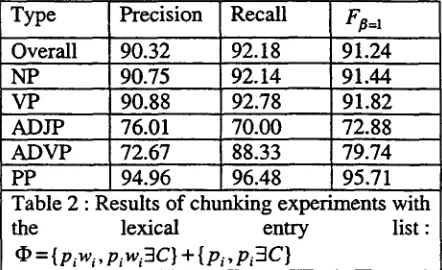
In this case, the current part-of-speech and word pair is also used as a lexical entry to determine the current structural chunk tag and we have a total of about 49563 lexical entries([ • ]=49563). Actually, the lexicon used here can be regarded as context-independent. The reason we discuss it in this section is to distinguish it from the context-independent lexicon used in the baseline system. Table 2 give an overview of the results of the chunking experiments on the test data.
Type [Precision Overall 90.32
NP 90.75
VP 90.88
ADJP 76.01 ADVP 72.67
PP 94.96
Table 2 : Results of chunking experiments
the lexical entry
= {piwi , Piwi3C} "1" {Pi" Pi 3C}
Recall Fa~.l 92.18 9i.24 92.14 91.44 92.78 91.82 70.00 72.88 88.33 79.74 96.48 95.71
with list :
Table 2 shows that incorporation of current word information improves the overall F~=~ value by 2.9%(especially for the ADJP, ADVP and PP chunks), compared with Table 1 of the baseline system which only uses current part-of- speech information. This result suggests that current word information plays a very important role in determining the current chunk tag.
3.2 Context of previous part-of-speech
andcurrent part-of-speech
Here, we assume : P(t i / G~)
I P(ti / pi-lPi ) Pi-lPi E = [ P(ti I Pi) Pi-! Pi ~ ~
where
= {Pi-l Pi, P~-1Pi 3C} + { Pi, pi3C} and Pi-lPi is a pair of previous part-of-speech and current part-of-speech existing in the training data C .
[image:4.596.347.568.204.339.2]Type Overall
Precision 88.63
NP 90.77
VP 92.46
ADJP 74.93 60.13 66.72
ADVP 71.65 73.21 72.42
PP 87.28 91.80 89.49
Table 3: Results of chunking experiments with the lexical entry list : • =
{Pi-lPi, Pi-lPi 3C} + {Pi, Pi 3C}
Recall F#= I 89.00 88.82 91.18 90.97 92.98 92.72
Compared with Table 1 of the baseline system, Table 3 shows that additional contextual information of previous part-of-speech improves the overall F/~_~ value by 0.5%. Especially, F/3_ ~ value for VP improves by 1.25%, which indicates that previous part-of-speech information has a important role in determining the chunk type VP. Table 3 also shows that the recall rate for chunk type ADJP decrease by 3.7%. It indicates that additional previous part- of-speech information makes ADJP chunks easier to merge with neibghbouring chunks. 3.3 Context of previous part-of-speech,
previous word and current part-of-speech
Here, we assume :
P(t, / G~)
IP(ti / pi_lwi_lpi) pi_lwi_lpl ~ dp I
[
P(ti
[ Pi ) Pi-lWi-I Pi ~ ~where
= { Pi-i wi-l Pi, Pi-l wi-I Pi3 C} + { Pi, Pi 3 C }, where pi_lwi_lp~ is a triple pattern existing in the training corpus.
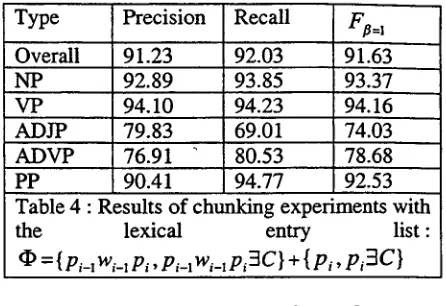
In this case, the previous part-of-speech, previous word and current part-of-speech triple is also used as a lexical entry to determine the current structural chunk tag and } • 1=136164.
Table 4 gives the results of the chunking experiments. Compared with Table 1 of the baseline system, Table 4 shows that additional 136116 new lexical entries of format Pi-lw~-lPi improves the overall F#= l value by 3.3%. Compared with Table 3 of the extended system 2.2 which uses previous part-of-speech and current part-of-speech as a lexical entry, Table 4 shows that additional contextual information of previous word improves the overall Fa= 1 value by 2.8%.
Type Precision Recall
F~=l
Overall 91.23 92.03 91.63NP 92.89 93.85 93.37
VP 94.10 94.23 94.16
ADJP 79.83 69.01 74.03
ADVP 76.91 80.53 78.68
PP 90.41 94.77 92.53
Table 4 : Results of chunking experiments with
the lexical entry list :
={p,_lw~_~ p,, p,_~ w,_ip,3C } + {Pi , p~3C}
3.4 Context o f previous part-of-speech, current part-of-speech and current word
Here, we assume : P(t i I G~ )
IP(tt I Pi-i PiWi) Pi-I piwi E dp
[ P(ti
/ Pi ) Pi-I Pi Wi ~ 1I)where
= {Pi-lPiWi, Pi-lP~W~ 3C} + {Pi, Pi3C}, where pi_lpiw~ is a triple pattern existing in the training and ] • [=131416.
Table 5 gives the results of the chunking experiments.
Type Precision Recall F/3= 1 Overall 92.67 93.43 93.05
NP 93.35 94.10 93.73
VP 93.05 94.30 93.67
ADJP 80.65 72.27 76.23
ADVP 78.92 84.48 81.60
PP 95.30 96.67 95.98
Table 5: Results of chunking experiments with
the lexical entry list :
={Pi-lPiWi,
P,-iP, w,3C} + {pi , Pi 3C}Compared with Table 2 of the extended system which uses current part-of-speech and current word as a lexical entry, Table 5 shows that additional contextual information of previous part-of-speech improves the overall
Fa= 1 value by 1.8%.
3.5 Context of previous part-of-speech, previous word, current part-of-speech and
current word
[image:5.596.70.358.56.669.2] [image:5.596.318.541.62.215.2]structural chunk tag and qb = {Pi-l wi-lPiWi, Pi-lwi-~piwi 36'} + {Pi, P i 3 C } , where p~_lWi_~P~W~ is a pattern existing in the training corpus. Due to memory limitation, only lexical entries which occurs :more than 1 times are kept. Out of 364365 possible lexical entries existing in the training data, 98489 are kept(
1~ 1=98489).
= I P(ti/Pi-]wi-,PiWli)
[ P(t, lp,) pi_lwi_lpiwi ~
Table 6 gives the results of the chunking experiments.
Type Overall NP VP ADJP ADVP PP
Precision 92.28 93.50 92.62 81.39 75.09 94.12
Recall 93.04 93.53 94.07 72.17 86.23 97.12
F~=l
92.66 93.52 93.35 76.50 80.27 95.59 Table 6: Results of chunking experiments with the lexical entry list : • ={Pi-l wi-]PiWi, Pi-lwi-lpiwi3C} + {Pi, p~3C}
Compared with Table 2 of the extended system which uses current part-of-speech and current word as a lexical entry, Table 6 shows that additional contextual information of previous part-of-speech improves the overall
Ft3=l value by 1.8%.
3.6 Conclusion
Above experiments shows that adding more contextual information into lexicon significantly improves the chunking accuracy. However, this improvement is gained at the expense of a very large lexicon and we fred it difficult to merge all the above context-dependent lexicons in a single lexicon to further improve the chunking accurracy because of memory limitation. In order to reduce the size of lexicon effectively, an error-driven learning approach is adopted to examine the effectiveness of lexical entries and make it possible to further improve the chunking accuracy by merging all the above context-dependent lexicons in a single lexicon. This will be discussed in the next section.
4 E r r o r - d r i v e n L e a r n i n g
In section 2, we implement a basefine system which only considers current part-of-speech as a lexical entry to d e t e , ufine the current chunk tag while in section 3, we implement several extended systems which take more contextual information into consideration.
Here, we will examine the effectiveness of lexical entries to reduce the size of lexicon and make it possible to further improve the chunking accuracy by merging several context- dependent lexicons in a single lexicon.
For a new lexical entry e i, the effectiveness F~ (e i) is measured by the reduction in error which results from adding the lexical entry to - - ~ E r r o r (e,). the lexicon : F~ (e i ) = F : rr°r ( e i ) -
o+Ao
Here, F,~ r~°r (el) is the chunking error number of the lexical entry e i for the old lexiconr ~ E r r o r / x
and r~,+~ te i) is the chunking error number of the lexical entry e i for the new lexicon + AO where e~ e A ~ ( A ~ is the list of new lexical entries added to the old lexicon ~ ). If F o (e i ) > 0, we define the lexical entry ei as positive for lexicon ~ . Otherwise, the lexical entry e i is negative for lexicon ~ .
Tables 7 and 8 give an overview of the effectiveness distributions for different lexicons applied in the extended systems, compared with the lexicon appfied in the baseline system, on the test data and the training data, respectively.
Tables 7 and 8 show that only a minority of lexical entries are positive. This indicates that discarding non-positive lexical entries will largely decrease the lexicon memory requirement while keeping the chunking accurracy.
Context Positive 1800
209
Negative 314 136
Total
4083 I 155 Table 7 : The effectiveness of lexical
the test data ...
49515 1363 2876 229 136116
2895 193 131368
98441
Context Positive i Negative 6724l
Type i Precision Recall Fa=l Overall 91.02 92.21 91.61
NP 92.36 93.69 93.02
VP 93.68 94.94 94.30
ADJP 78.28 71.46 74.71
ADVP 76.77 81.79 79.20
PP 90.67 95.37 92.96
Total
vos,w, 719 49515
eos,_,Pos, 357 196 1363
POS,.~w,.,eos,, 13205 582 136116
POS,_,eos,w, 14186 325 131368
[image:7.596.318.543.58.636.2]POS,.,w,_leos,,w, 15516 144 98441
Table 8 : The effectiveness of lexical entries on the training data
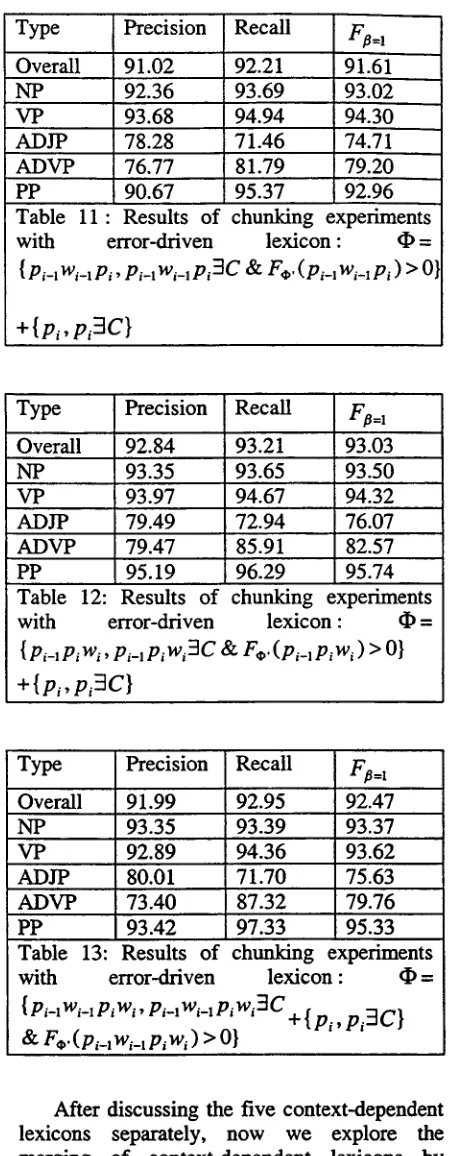
Tables 9-13 give the performances of the five error-driven systems which discard all the non-positive lexical enrties on the training data. Here, ~ ' is the lexicon used in the baseline system, dP'={pi,pi3C } and A ~ = ~ - ~ ' . It is found that Ffl_~ values of error driven systems for context of current part-of-speech and word pak and for context of previous part- of-speech and current part-of-speech increase by 1.2% and 0.6%. Although F~= 1 values for other three cases slightly decrease by 0.02%, 0.02% and 0.19%, the sizes of lexicons have been greatly reduced by 85% to 97%.
Type Precision Recall F#=l Overall 91.69 93.28 92.48
NP 92.64 93.48 93.06
VP 92.16 93.66 92.90
ADJP 78.39 71.69 74.89
ADVP 73.66 87.80 80.11
[image:7.596.86.309.63.166.2]PP 95.18 97.38 96.27
Table 9 : Results of chunking experiments with
error-driven lexicon : dp=
{ p~w~, p,w,3C & F~,. (p~w i ) > O} + { p~, p~3C}
Type Precision Recall F~=l Overall 88.68 90.28 89.47
NP 90.61 91.57 91.08
VP 91.80 94.08 92.90
ADJP 72.20 62.72 67.13
ADVP 70.53 78.90 74.48
PP 86.55 96.34 91.19
Table 10: Results of chunking experiments with error-driven lexicon : • =
{ P,-~
Pi, Pi-1 Pi ~C & F~.(p,_~ p,
) > 0}+ { Pi, Pi 3C}
Table 11: Results of chunking experiments with error-driven lexicon : • = { pi_l Wi_lPi , pi_l wi_lpi3C & V~,(Pi_l Wi_iPi ) > O}
+ { p i , P i ~ C }
Type
Overall 92.84 NP
VP
Precision
93.35 93.97 79.49
95.19
Recall 93.21 93.65 94.67 72.94
Ffl=l 93.03 93.50 94.32 76.07 ADJP
ADVP 79.47 85.91 82.57
PP 96.29 95.74
Table 12: Results of chunking experiments with error-driven lexicon : • =
{ Pi-I P~W~, p~_~ Piw,3C & F.. (pi_~ p,w i ) > 0} + { p i , P i 3 C }
Type Precision Recall F~_ 1 Overall 91.99 92.95 92.47
NP 93.35 93.39 93.37
VP 92.89 94.36 93.62
ADJP 80.01 71.70 75.63
ADVP 73.40 87.32 79.76
PP 93.42 97.33 95.33
Table 13: Results of chunking experiments with error-driven lexicon : • =
{Pi-l Wi-lPiWi' Pi-lWi-lpiWi3C+{pi ' Pi3C} & F®.(p~_~w~_~p~w~) > O}
After discussing the five context-dependent lexicons separately, now we explore the merging of context-dependent lexicons by assuming :
CI~ .~ { Pi-lWi-I PiWi, Pi-lWi-I PiwigC & Fa,. (pi-lwi-t piwi ) > 0}
+ { Pi-I PiW~, Pi-l piwi ~C & Fa" (Pi-l piwi ) > O}
+ { Pi-lWi-I Pi" Pi-lWi-1Pi 3C & F~. (pi_lWi_l Pi ) > 0} + { Pi-1 Pi, Pi-I Pii ~C & F~, (Pi-l Pi ) > O}
[image:7.596.70.308.355.712.2]and P ( t i /G~) is approximatl~ by the following order :
1. if Pi_lWi_iPiWi E fI~,
P(ti / G ~ ) = P ( t i / p i _ l w i _ l P i W i )
2. if p~_lp~wi E cb,
P(ti / G ~ ) = P ( t i / p i _ l w i _ l P i W i )
3. if Pi-twi-lPi E ~ ,
P(t i/G~) = P(t i / pi_l wi_l: pi )
4. if PiWi E ~ , P(t i / G~ ) = P(t i / piwi )
5. if Pi-I Pi E ~ , P(t i / G~ ) = P(t i / Pi-1Pi)
6. P(t i l G : ) = P ( t ilpi_lpi)
Table 14 gives an overview of the chunking experiments using the above assumption. It shows that the F:=i value for the merged
context-dependent lexicon inreases to 93.68%. For a comparison, the F/~=i value is 93.30% when all the possible lexical entries are included in ~ (Due to memory limitation, only the top 150000 mostly occurred lexical entries are included).
Type Precision Recall F#=i
Overall 93.40 93.95 93.68
NP 93.60 94.64 94.12
VP 94.64 94.75 94.70
ADJP 77.12 74.55 75.81
ADVP 82.39 83.80 83.09
PP 96.61 96.63 96.62
Table 14: Results of chunking experiments with the merged context-dependent lexicon
For the relationship between the training
corpus size and error driven learning
performance, Table 15 shows that the
performance of error-driven learning improves stably when the training corpus size increases.
Training Sections I ~ I Accuracy i FB 1
0-1 0-3 0-5 0-7 0-9 0-11 0-13 0-i5 0-17 0-19
14384 94.78% 91.95
24507 95.19% i 92.51
32316 95.28%1 92.77
38286 95.41% 93.00
39876 95.53% i 93.12
43372 95.65% 93.31
46029 95.62% 93.29
47901 95.66% 93.34
48813 95.74% i 93.41
49988 95.92% 93.68
Table 15: The performance of error-driven learning with different training corpus size
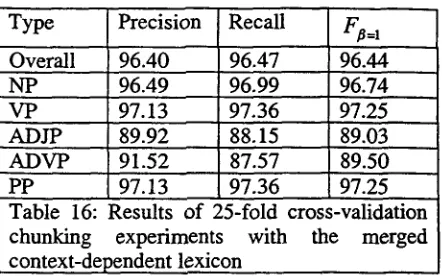
For comparison with other chunk taggers, we also evaluate our chunk tagger with the merged context-dependent lexicon by cross- validation on all 25 partitions of the PENN WSJ TreeBank. Table 16 gives an overview of such chunking experiments.
Type Precision Recall Fa=l
Overall 96.40 96.47 96.44
NP 96.49 96.99 96.74
VP 97.13 97.36 97.25
ADJP 89.92 88.15 89.03
ADVP 91.52 8 7 . 5 7 89.50
97.13 97.36
PP 97.25
Table 16: Results of 25-fold cross-validation chunking experiments with the merged context-dependent lexicon
Tables 14 and 16 shows that our new chunk tagger greatly outperforms other reported chunk taggers on the same training data and test data by 2%-3%.(Buchholz S., Veenstra J. and Daelmans W.(1999), Ramshaw L.A. and Marcus M.P.(1995), Daelemans W., Buchholz S. and Veenstra J.(1999), and Veenstra J.(1999)).
Conclusion
This paper proposes a new error-driven HMM- based chunk tagger with context-dependent lexicon. Compared with standard HMM-based tagger, this new tagger uses a new Hidden Markov Modelling approach which incorporates more contextual information into a lexical entry
n
by assuming MI(Tqn,G~)= 2 M l ( t , , G f ) .
i=1
Moreover, an error-driven learning approach is adopted to drease the memeory requirement and further improve the accuracy by including more context-dependent information into lexicon.
It is found that our new chunk tagger singnificantly outperforms other reported chunk taggers on the same training data and test data.
For future work, we will explore the effectivessness of considering even more contextual information on approximation of
[image:8.596.345.566.136.274.2] [image:8.596.83.333.142.744.2]Acknowledgement
We wish to thank Sabine Buchholz
from Tilbug University for kindly providing us
her program which is also used to
extact data for Conll-2000 share task.
References
Abney S. "Parsing by chunks ". Principle-Based
Parsing edited by Berwick, Abney and Tenny. Kluwer Academic Publishers.
Argamon S., Dagan I. and Krymolowski Y. "A memory-based approach to learning shallow
natural language patterns." COL1NG/ACL-
1998. Pp.67-73. Montreal, Canada. 1998. Bod R. "A computational model of language
performance: Data-oriented parsing."
COLING-1992. Pp.855-859. Nantes, France. 1992.
Boungault D. "Surface grammatical analysis for
the extraction of terminological noun
phrases". COLING-92. Pp.977-981. 1992.
Bdll Eric. "A corpus-based approach to
language learning". Ph.D thesis. Univ. of
Penn. 1993
Buchholz S., Veenstra J. and Daelmans W. "Cascaded grammatical relation assignment." Proceeding of EMNLP/VLC-99, at ACL'99.
1999
Cardie C. "A case-based approach to knowledge acquisition for domain-specific sentence
analysis." Proceeding of the 11 'h National
Conference on Artificial Intelligence. Pp.798- 803. Menlo Park, CA, USA. AAAI Press. 1993.
Church K.W. "A stochastic parts program and noun phrase parser for unrestricted Text." Proceeding of Second Conference on Applied Natural Language Processing. Pp.136-143. Austin, Texas, USA. 1988.
Daelemans W., Buchholz S. and Veenstra J.
"Memory-based shallow parsing." CoNLL-
1999. Pp.53-60. Bergen, Norway. 1999. Daelemans W., Zavrel J., Berck P. and Gillis S.
"MBT: A memory-based part-of-speech
tagger generator." Proceeding of the Fourth
Workshop on Large Scale Corpora. Pp. 14-27. ACL SIGDAT. 1996.
Grefenstette G. "Light parsing as finite-state
filtering". Workshop on Extended Finite State
Models of Language at ECAI'96. Budapest, Hungary. 1996.
Kupiec J. " An algorithm for finding noun phrase correspondences in bilingual corpora". ACL'93. Pp17-22. 1993.
Marcus M., Santodni B. and Marcinkiewicz • M.A. "Buliding a large annotated corpus of
English: The Penn Treebank". Computational
Linguistics. 19(2):313-330. 1993.
Rabiner L. "A tutorial on Hidden Markov Models and selected applications in speech
recognition". IEEE 77(2), pp.257-285. 1989.
Ramshaw L.A. and Marcus M.P.
"Transformation-based Learning".
Proceeding of 3th ACL Workshop on Very Large Corpora at ACL'95. 1995.
Rijsbergen C.J.van. Information Retrieval.
Buttersworth, London. 1979.
Skut W. and Brants T. "Chunk tagger: statistical
recognition of noun phrases." ESSLLI-1998
Workshop on Automated Acquisition of Syntax and Parsing. Saarbruucken, Germany. 1998. Veenstra J. "Memory-based text chunking".
Workshop on machine learning in human language technology at A CAI'99. 1999. Voutilainen A. "Nptool: a detector of English
phrases". Proceeding of the Workshop on
Very Large Corpora. Pp48-57. ACL' 93. 1993
Watson B. and Chunk Tsoi A. "Second order
Hidden Markov Models for speech
recognition". Proceeding of 4 ~ Australian