A Phrase-Based HMM Approach to Document/Abstract Alignment
Hal Daum´e III and Daniel MarcuInformation Sciences Institute University of Southern California
4676 Admiralty Way, Suite 1001 Marina del Rey, CA 90292
{hdaume,marcu}@isi.edu
Abstract
We describe a model for creating word-to-word and phrase-to-phrase alignments between documents and their human written abstracts. Such alignments are critical for the development of statistical sum-marization systems that can be trained on large cor-pora of document/abstract pairs. Our model, which is based on a novel Phrase-Based HMM, outper-forms both the Cut & Paste alignment model (Jing, 2002) and models developed in the context of ma-chine translation (Brown et al., 1993).
1 Introduction
There are a wealth of document/abstract pairs that statistical summarization systems could leverage to learn how to create novel abstracts. Detailed stud-ies of such pairs (Jing, 2002) show that human ab-stractors perform a range of very sophisticated op-erations when summarizing texts, which include re-ordering, fusion, and paraphrasing. Unfortunately, existing document/abstract alignment models are not powerful enough to capture these operations. To get around directly tackling this problem, re-searchers in text summarization have employed one of several techniques.
Some researchers (Banko et al., 2000) have de-veloped simple statistical models for aligning doc-uments and headlines. These models, which imple-ment IBM Model 1 (Brown et al., 1993), treat docu-ments and headlines as simple bags of words and learn probabilistic word-based mappings between the words in the documents and the words in the headlines. As our results show, these models are too weak for capturing the operations that are em-ployed by humans in summarizing texts beyond the headline level.
Other researchers have developed models that
make unreasonable assumptions about the data, which lead to the utilization of a very small per-cent of available data. For instance, the docu-ment and sentence compression models of Daum´e III, Knight, and Marcu (Knight and Marcu, 2002; Daum´e III and Marcu, 2002a) assume that sen-tences/documents can be summarized only through deletion of contiguous text segments. Knight and Marcu found that from a corpus of39,060 abstract sentences, only1067sentence extracts existed: a re-call of only2.7%.
An alternate techinque employed in a large vari-ety of systems is to treat the summarization prob-lem as a sentence extraction probprob-lem. Such sys-tems can be trained either on human constructed ex-tracts or exex-tracts generated automatically from doc-ument/abstract pairs (see (Marcu, 1999; Jing and McKeown, 1999) for two such approaches).
None of these techniques is adequate. Even for a relatively simple sentence from an abstract, we can see that none of the assumptions listed above holds. In Figure 1, we observe several phenomena:
• Alignments can occur at the granularity of words and at the granularity of phrases. • The ordering of phrases in an abstract can be
different from the ordering in the document. • Some abstract words do not have direct
cor-respondents in the document, and some doc-ument words are never used.
Connecting Point has become the single largest Mac retailer after tripling it ’s Macintosh sales since January 1989 .
[image:2.595.74.533.72.140.2]Connecting Point Systems tripled it ’s sales of Apple Macintosh systems since last January . It is now the single largest seller of Macintosh .
Figure 1: Example abstract/text alignment.
alignments. However, as we will show, the align-ments produced by such a system are inadequate for this task.
The solution that we propose to this problem is an alignment model based on a novel mathematical structure we call the Phrase-Based HMM.
2 Designing a Model
As observed in Figure 1, our model needs to be able to account for phrase-to-phrase alignments. It also needs to be able to align abstract phrases with arbi-trary parts of the document, and not require a mono-tonic, left-to-right alignment.1
2.1 The Generative Story
The model we propose calculates the probability of an alignment/abstract pair in a generative fashion, generating the summary S = hs1. . . smifrom the
documentD =hd1. . . dni.
In a document/abstract corpus that we have aligned by hand (see Section 3), we have observed that16% of abstract words are left unaligned. Our model assumes that these “null-generated” words and phrases are produced by a unique document word ∅, called the “null word.” The
parame-ters of our model are stored in two tables: a rewrite/paraphrase table and a jump table. The rewrite table stores probabilities of producing sum-mary words/phrases from document words/phrases and from the null word (namely, probabilities of the form rewrite s¯ d¯
and rewrite(¯s ∅)); the jump
ta-ble stores the probabilities of moving within a doc-ument from one position to another, and from and to∅.
The generation of a summary from a document is assumed to proceed as follows:
1
In the remainder of the paper, we will use the words “sum-mary” and “abstract” interchangeably. This is because we wish to use the lettersto refer to summaries. We could use the letter aas an abbreviation for “abstract”; however, in the definition
of the Phrase-Based HMM, we reuse common notation which ascribes a different interpretation toa.
1. Choose a starting index i and jump to po-sition di in the document with probability
jump(i). (If the first summary phrase is null-generated, jump to the null-word with proba-bility jump(∅).)
2. Choose a document phrase of lengthk ≥0and a summary phrase of length l ≥ 1. Generate summary wordssl1from document wordsdii+k
with probability rewritesl1 dii+k.2
3. Choose a new document index i0 and jump to position di0 with probability jump(i0−(i+k)) (or, if the new document position is the empty state, then jump(∅)).
4. Choose k0 and l0 as in step 2, and gener-ate the summary words s1+1+ll+l0 from the document words dii00+k0 with probability rewrites1+1+ll+l0 dii00+k0
.
5. Repeat from step 3 until the entire summary has been generated.
6. Jump to position dn+1 in the document with
probability jump(n+ 1−(i0+k0)).
Note that such a formulation allows the same document word/phrase to generate many summary words: unlike machine translation, where such be-havior is typically avoided, in summarization, we observe that such phenomena do occur. However, if one were to build a decoder based on this model, one would need to account for this issue to avoid degenerate summaries from being produced.
The formal mathematical model behind the align-ments is as follows: An alignmentℵ defines both a segmentation of the summary S and a mapping from the segments ofS to the segments of the doc-umentD. We writesito refer to theith segment of
S, and M to refer to the total number of segments 2
in S. We write dℵ(i) to refer to the words in the
document which correspond to segment si. Then,
the probability of a summary/alignment pair given a document (Pr (S,ℵ D)), becomes:
M+1
Y
i=1
jump(ℵ(i) ℵ(i−1))rewrite si dℵ(i)
Here, we implicitly definesm+1to be the
end-of-document token hωi and dℵ(m+1) to generate this
with probability 1. We also define the initial posi-tion in the document, ℵ(0) to be0, and assume a uniform prior on segmentations.
2.2 The Mathematical Model
Having decided to use this model, we must now find a way to efficiently train it. The model is very much like a Hidden Markov Model in which the summary is the observed sequence. However, us-ing a standard HMM would not allow us to account for phrases in the summary. We therefore extend a standard HMM to allow multiple observations to be emitted on one transition. We call this model a Phrase-Based HMM (PBHMM).
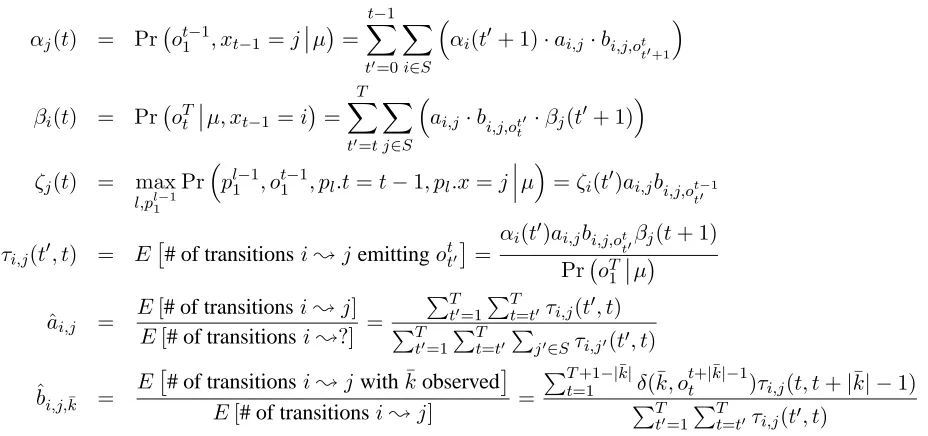
For this model, we have developed equiva-lents of the forward and backward algorithms, Viterbi search and forward-backward parameter re-estimation. Our notation is shown in Table 1.
Here,Sis the state space, and the observation se-quences come from the alphabetK. πj is the
prob-ability of beginning in statej. The transition prob-ability ai,j is the probability of transitioning from
stateito statej. bi,j,k¯is the probability of emitting
(the non-empty) observation sequencek¯while tran-sitioning from stateito statej. Finally,xtdenotes
the state after emittingtsymbols.
The full derivation of the model is too lengthy to include; the interested reader is directed to (Daum´e III and Marcu, 2002b) for the derivations and proofs of the formulae. To assist the reader in understand-ing the mathematics, we follow the same notation as (Manning and Schutze, 2000). The formulae for the calculations are summarized in Table 2.
2.2.1 Forward algorithm
The forward algorithm calculates the probability of an observation sequence. We define αj(t) as the
probability of being in statejafter emitting the first
t−1symbols (in whatever grouping we want).
2.2.2 Backward algorithm
Just as we can compute the probability of an obser-vation sequence by moving forward, so can we cal-culate it by going backward. We defineβi(t)as the
probability of emitting the sequence oT
t given that
we are starting out in statei. 2.2.3 Best path
We define a path as a sequenceP =hp1. . . pLisuch
thatpi is a tuple ht, xi wheret corresponds to the
last of the (possibly multiple) observations made, andxrefers to the state we were coming from when we output this observation (phrase). Thus, we want to find:
argmax
P
Pr P oT1, µ
= argmax
P
Pr P, oT1 µ
To do this, as in a traditional HMM, we estimate theζ table. When we calculateζj(t), we essentially
need to choose an appropriate i and t0, which we store in another table, so we can calculate the actual path at the end.
2.2.4 Parameter re-estimation
We want to find the model µ which best explains observations. There is no known analytic solution for standard HMMs, so we are fairly safe in assum-ing that we will not find an analytic solution for this more complex problem. Thus, we also revert to an iterative hill-climbing solution analogous to Baum-Welch re-estimation (i.e., the Forward Backward al-gorithm). The equations for the re-estimated values ˆ
aandˆbare shown in Table 2. 2.2.5 Dirichlet Priors
Using simple maximum likelihood estimation is in-adequate for this model: the maximum likelihood solution is simply to make phrases as long as pos-sible; unfortunately, doing so will first cut down on the number of probabilities that need to be multi-plied and second make nearly all observed summary phrase/document phrase alignments unique, thus re-sulting in rewrite probabilities of1after normaliza-tion. In order to account for this, instead of finding the maximum likelihood solution, we instead seek the maximum a posteriori solution.
The distributions we deal with in HMMs, and, in particular, PBHMMs, are all multinomial. The Dirichlet distribution is in the conjugate family to the multinomial distribution3. This makes Dirich-let priors very appealing to work with, so long as
3
S set of states
K output alphabet
Π={πj :j∈S} initial state probabilities
A={ai,j :i, j ∈S} transition probabilities
[image:4.595.76.540.176.394.2]B={bi,j,¯k:i, j ∈S,k¯∈K+} emission probabilities
Table 1: Notation used for the PBHMM
αj(t) = Pr ot1−1, xt−1 =j µ
=
t−1
X
t0=0
X
i∈S
αi(t0+ 1)·ai,j ·bi,j,ot t0+1
βi(t) = Pr oTt µ, xt−1 =i=
T
X
t0=t
X
j∈S
ai,j·bi,j,ot0
t ·βj(t 0+ 1)
ζj(t) = max l,pl−1 1
Prpl1−1, ot1−1, pl.t=t−1, pl.x=j µ
=ζi(t0)ai,jbi,j,ot−1
t0
τi,j(t0, t) = E
# of transitionsi; jemittingott0
= αi(t 0)a
i,jbi,j,ot
t0βj(t+ 1) Pr oT
1 µ
ˆ
ai,j =
E[# of transitionsi;j]
E[# of transitionsi;?] =
PT
t0=1
PT
t=t0τi,j(t0, t)
PT
t0=1
PT
t=t0
P
j0∈Sτi,j0(t0, t)
ˆb
i,j,¯k =
E# of transitionsi;jwithk¯observed
E[# of transitionsi;j] =
PT+1−|¯k|
t=1 δ(¯k, o
t+|¯k|−1
t )τi,j(t, t+|k¯| −1)
PT
t0=1
PT
t=t0τi,j(t0, t)
Table 2: Summary of equations for a PBHMM
we can adequately express our prior beliefs in their form. (See (Gauvain and Lee, 1994) for the appli-cation to standard HMMs.)
Applying a Dirichlet prior effectively allows us to add “fake counts” during parameter re-estimation, according to the prior. The prior we choose has a form such that fake counts are added as follows: word-to-word rewrites get an additional count of 2; identity rewrites get an additional count of 4; stem-identity rewrites get an additional count of 3.
2.3 Constructing the PBHMM
Given our generative story, we construct a PBHMM to calculate these probabilities efficiently. The structure of the PBHMM for a given document is conceptually simple. We provide values for each of the following: the set of possible statesS; the out-put alphabetK; the initial state probabilitiesΠ; the transition probabilities A; and the emission proba-bilitiesB.
2.3.1 State Space
The state set is large, but structured. There is a unique initial state p, a unique final state q, and a
state for each possible document phrase. That is, for all1≤i≤i0 ≤n, there is a state that corresponds to the document phrase beginning at position iand ending at position i0,dii0, which we will refer to as
ri,i0. There is also a null state for each document po-sitionr ,i, so that when jumping out of a null state,
we can remember what our previous position in the document was. Thus,S ={p, q} ∪ {ri,i0 : 1≤i≤
i0 ≤n} ∪ {r ,i : 1 ≤ i≤n}. Figure 2 shows the
schematic drawing of the PBHMM constructed for the document “a b”. K, the output alphabet, con-sists of each word found inS, plus the tokenω. 2.3.2 Initial State Probabilities
For initial state probabilities: since p is our initial state, we say thatπp = 1 and that πr = 0 for all
r6=p.
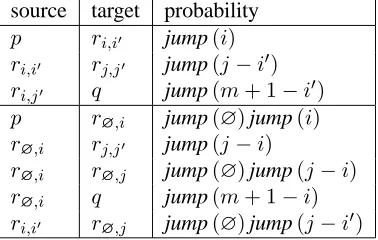
2.3.3 Transition Probabilities
jump(2)
jump(1) jump(1) jump(0)
jump(2)
jump(1) jump(2)
jump(0)
jump(1)
b a
ab
b
q p
jump(1) jump( )
[image:5.595.166.453.70.162.2]a
Figure 2: Schematic drawing of the PBHMM (with some transition probabilities) for the document “a b”
source target probability
p ri,i0 jump(i)
ri,i0 rj,j0 jump(j−i0)
ri,j0 q jump(m+ 1−i0)
p r ,i jump(∅)jump(i)
r ,i rj,j0 jump(j−i)
r ,i r ,j jump(∅)jump(j−i)
r ,i q jump(m+ 1−i)
[image:5.595.91.280.201.321.2]ri,i0 r ,j jump(∅)jump(j−i0)
Table 3: Jump probability decomposition
fromptori,i0, the valueap,ri,i0 = jump(i). Thus, if we begin at the first word in the document, we incur a transition probability of jump(1). There are no transitions intop.
2.3.4 Rewrite Probabilities
Just as the transition probabilities are governed by the jump table, the emission probabilities B are governed by the rewrite table. In general, we write
bx,y,¯kto mean the probability of generating¯kwhile
transitioning from state x to state y. However, in our case we do not need the x parameter, so we will refer to these asbj,k¯, the probability of
generat-ingk¯ when jumping into state j. When j = ri,i0,
this is rewrite
¯
k dii0. When j = r ,i, this is
rewrite ¯k ∅. Finally, any state transitioning into q generates the phrase hωi with probability 1 and any other phrase with probability0.
Consider again the document “a b” (the PBHMM for which is shown in Figure 2) in the case when the corresponding summary is “c d”. Suppose the correct alignment is that “c d” is aligned to “a” and “b” is left unaligned. Then, the path taken through the PBHMM is p → a → q. During the transi-tionp → a, “c d” is emitted. During the transition
a → q,ω is emitted. Thus, the probability for the alignment is: jump(1)rewrite(“cd” “a”)jump(2). The rewrite probabilities themselves are gov-erned by a mixture model with unknown mixing pa-rameters. There are three mixture component, each
of which is represented by a multinomial. The first is the standard word-for-word and phrase-for-phrase table seen commonly in machine translation, where rewrite s¯ d¯
is simply a normalized count of how many times we have seens¯aligned tod¯. The sec-ond is a stem-based table, in which suffixes (using Porter’s stemmer) of the words in¯sandd¯are thrown out before a comparison is made. The third is a simple identity function, which has a constant zero value whens¯and d¯are different (up to stem) and a constant non-zero value when they have the same stem. The mixing parameters are estimated simul-taneously during EM.
2.3.5 Parameter Initialization
Instead of initializing the jump and rewrite tables randomly or uniformly, as it typically done with HMMs, we initialize the tables according to the dis-tribution specified by the prior. This is not atypi-cal practice in problems in which a MAP solution is sought.
3 Evaluation and Results
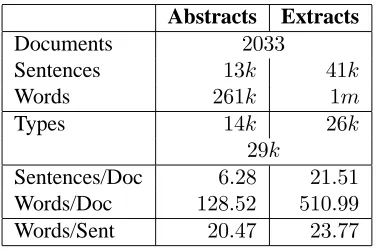
In this section, we describe an intrinsic evaluation of the PBHMM document/abstract alignment model. All experiments in this paper are done on the Ziff-Davis corpus (statistics are in Table 4). In order to judge the quality of the alignments produced by a system, we first need to create a set of “gold standard” alignments. Two human annotators man-ually constructed such alignments between docu-ments and their abstracts. Software for assisting this process was developed and is made freely available. An annotation guide, which explains in detail the document/abstract alignment process was also pre-pared and is freely available.4
4
Abstracts Extracts
Documents 2033
Sentences 13k 41k
Words 261k 1m
Types 14k 26k
29k
[image:6.595.91.279.70.195.2]Sentences/Doc 6.28 21.51 Words/Doc 128.52 510.99 Words/Sent 20.47 23.77 Table 4: Ziff-Davis extract corpus statistics
3.1 Human Annotation
From the Ziff-Davis corpus, we randomly selected 45 document/abstract pairs and had both annotators align them. The first five were annotated separately and then discussed; the last 40 were done indepen-dently.
Annotators were asked to perform phrase-to-phrase alignments between abstracts and documents and to classify each alignment as either possibleP
or sure S, where P ⊆ S. In order to calculate scores for phrase alignments, we convert all phrase alignments to word alignments. That is, if we have an alignment between phrases A and B, then this induces word alignments between a and b for all wordsa ∈ A and b ∈ B. Given an alignment A, we could calculate precision and recall as (see (Och and Ney, 2003)):
Precision= |A|A∩P|| Recall= |A|∩S|S|
One problem with these definitions is that phrase-based models are fond of making phrases. That is, when given an abstract containing “the man” and a document also containing “the man,” a human may prefer to align “the” to “the” and “man” to “man.” However, a phrase-based model will almost always prefer to align the entire phrase “the man” to “the man.” This is because it results in fewer probabili-ties being multiplied together.
To compensate for this, we define soft precision (SoftP in the tables) by counting alignments where “a b” is aligned to “a b” the same as ones in which “a” is aligned to “a” and “b” is aligned to “b.” Note, however, that this is not the same as “a” aligned to “a b” and “b” aligned to “b”. This latter alignment will, of course, incur a precision error. The soft pre-cision metric induces a new, soft F-Score, labeled SoftF.
Often, even humans find it difficult to align
func-tion words and punctuafunc-tion. A list of 58 function words and punctuation marks which appeared in the corpus (henceforth called the ignore-list) was as-sembled. Agreement and precision/recall have been calculated both on all words and on all words that do not appear in the ignore-list.
Annotator agreement was strong for Sure align-ments and fairly weak for Possible alignalign-ments (con-sidering only the40independently annotated pairs). When considering only Sure alignments, the kappa statistic (over7.2million items,2annotators and2 categories) for agreement was0.63. When words from the ignore-list were thrown out, this rose to 0.68. Carletta (1995) suggests that kappa values over 0.80 reflect very strong agreement and that kappa values between 0.60 and 0.80 reflect good agreement.
3.2 Machine Translation Experiments
In order to establish a baseline alignment model, we used the IBM Model 4 (Brown et al., 1993) and the HMM model (Stephan Vogel and Tillmann, 1996) as implemented in the GIZA++ package (Och and Ney, 2003). We modified this slightly to allow longer inputs and higher fertilities.
Such translation models require that input be in sentence-aligned form. In the summarization task, however, one abstract sentence often corresponds to multiple document sentences. In order to over-come this problem, each sentence in an abstract was paired with three sentences from the corresponding document, selected using the techniques described by Marcu (1999). In an informal evaluation,20such pairs were randomly extracted and evaluated by a human. Each pair was ranked as0(document sen-tences contain little-to-none of the information in the abstract sentence),1 (document sentences con-tain some of the information in the abstract sen-tence) or2 (document sentences contain all of the information). Of the twenty random examples, none were labeled as0; five were labeled as 1; and 15 were labeled as2, giving a mean rating of1.75.
lan-guage.
In all MT cases, the corpus was appended with one-word sentence pairs for each word where that word is translated as itself. In the two basic mod-els, HMM and Model 4, the abstract sentence is the source language and the document sentences are the target language. To alleviate the fertility problem, we also ran experiments with the translation going in the opposite direction. These are called HMM-flipped and Model 4-HMM-flipped, respectively. These tend to out-perform the original translation direc-tion. In all of these setups, 5 iterations of Model 1 were run, followed by 5 iterations of the HMM model. In the Model 4 cases, 5 iterations of Model 4 were run, following the HMM.
3.3 Cut and Paste Experiments
We also tested alignments using the Cut and Paste summary decomposition method (Jing, 2002), based on a non-trainable HMM. Briefly, the Cut and Paste HMM searches for long contiguous blocks of words in the document and abstract that are iden-tical (up to stem). The longest such sequences are aligned. By fixing a length cutoff ofnand ignoring sequences of length less thann, one can arbitrarily increase the precision of this method. We found that
n= 2yields the best balance between precision and recall (and the highest F-measure). The results of these experiments are shown under the header “Cut & Paste.” It clearly outperforms all of the MT-based models.
3.4 PBHMM Experiments
While the PBHMM is based on a dynamic program-ming algorithm, the effective search space in this model is enormous, even for moderately sized doc-ument/abstract pairs. We selected the 2000 shortest document/abstract pairs from the Ziff-Davis corpus for training; however, only12of the hand-annotated documents were included in this set, so we addition-ally added the other33hand-annotate documents to this set, yielding2033document/abstract pairs. We then performed sentence extraction on this corpus exactly as in the MT case, using the technique of (Marcu, 1999). The relevant data for this corpus is in Table 4. We also restrict the state-space with a beam, sized at50%of the unrestricted state-space.
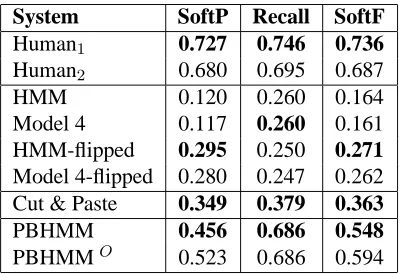
The PBHMM system was then trained on this ab-stract/extract corpus. The precision/recall results are shown in Table 5. Under the methodology for combining the two human annotations by taking the union, either of the human scores would achieve a
System SoftP Recall SoftF Human1 0.727 0.746 0.736
Human2 0.680 0.695 0.687
HMM 0.120 0.260 0.164
[image:7.595.328.528.70.207.2]Model 4 0.117 0.260 0.161 HMM-flipped 0.295 0.250 0.271 Model 4-flipped 0.280 0.247 0.262 Cut & Paste 0.349 0.379 0.363 PBHMM 0.456 0.686 0.548 PBHMMO 0.523 0.686 0.594 Table 5: Results on the Ziff-Davis corpus
precision and recall of1.0. To give a sense of how well humans actually perform on this task (in addi-tion to the kappa scores reported earlier), we com-pare each human against the other.
One common precision mistake made by the PBHMM system is to accidentally align words on the summary side to words on the document side, when the summary word should be null-aligned. The PBHMMOsystem is an oracle system in which system-produced alignments are removed for sum-mary words that should be null-aligned (according to the hand-annotated data). Doing this results in a rather significant gain in SoftP score.
As we can see from Table 5, none of the ma-chine translation models is well suited to this task, achieving, at best, an F-score of0.298. The Cut & Paste method performs significantly better, which is to be expected, since it is designed specifically for summarization. As one would expect, this method achieves higher precision than recall, though not by very much. Our method significantly outperforms both the IBM models and the Cut & Paste method, achieving a precision of0.456and a recall nearing 0.7, yielding an overall F-score of0.548.
4 Conclusions and Future Work
Despite the success of our model, it’s performance still falls short of human performance (we achieve an F-score of 0.548 while humans achieve 0.736). Moreover, this number for human performance is a lower-bound, since it is calculated with only one reference, rather than two.
or a summary word should be aligned to a differ-ent, non-identical document word. We can see the PBHMMO model as giving us an upper bound on performance if we were to fix this first problem. The second problem has to do either with synonyms that do not appear frequently enough for the system to learn reliable rewrite probabilities, or with corefer-ence issues, in which the system chooses to align, for instance, “Microsoft” to “Microsoft,” rather than “Microsoft” to “the company,” as might be correct in context. Clearly more work needs to be done to fix these problems; we are investigating solving the first problem by automatically building a list of synonyms from larger corpora and using this in the mixture model, and the second problem by inves-tigating the possibility of including some (perhaps weak) coreference knowledge into the model.
Finally, we are looking to incorporate the results of this model into a real system. This can be done ei-ther by using the word-for-word alignments to auto-matically build sentence-to-sentence alignments for training a sentence extraction system (in which case the precision/recall numbers over full sentences are likely to be much higher), or by building a system that exploits the word-for-word alignments explic-itly.
5 Acknowledgments
This work was partially supported by DARPA-ITO grant N66001-00-1-9814, NSF grant IIS-0097846, and a USC Dean Fellowship to Hal Daum´e III. Thanks to Franz Josef Och and Dave Blei for dis-cussions related to the project.
References
Michele Banko, Vibhu Mittal, and Michael Wit-brock. 2000. Headline generation based on sta-tistical translation. In Proceedings of the 38th Annual Meeting of the Association for Compu-tational Linguistics (ACL–2000), pages 318–325, Hong Kong, October 1–8.
Peter F. Brown, Stephen A. Della Pietra, Vincent J. Della Pietra, and Robert L. Mercer. 1993. The mathematics of statistical machine transla-tion: Parameter estimation. Computational Lin-guistics, 19(2):263–311.
Jean Carletta. 1995. Assessing agreement on clas-sification tasks: the kappa statistic. Computa-tional Linguistics, 22(2):249–254.
Hal Daum´e III and Daniel Marcu. 2002a. A noisy-channel model for document compression. In
Proceedings of the Conference of the Association of Computational Linguistics (ACL 2002). Hal Daum´e III and Daniel Marcu. 2002b.
A phrase-based HMM. Unpublished; avail-able at http://www.isi.edu/˜hdaume/
docs/daume02pbhmm.ps, December.
J. Gauvain and C. Lee. 1994. Maximum a-posteriori estimation for multivariate gaussian mixture observations of markov chains. IEEE Transactions SAP, 2:291–298.
Hongyan Jing and Kathleen R. McKeown. 1999. The decomposition of human-written summary sentences. In Proceedings of the 22nd Confer-ence on Research and Development in Informa-tion Retrieval (SIGIR–99), Berkeley, CA, August 15–19.
Hongyan Jing. 2002. Using hidden markov mod-eling to decompose human-written summaries. Computational Linguistics, 28(4):527 – 544, De-cember.
Kevin Knight and Daniel Marcu. 2002. Summa-rization beyond sentence extraction: A proba-bilistic approach to sentence compression. Arti-ficial Intelligence, 139(1).
Christopher Manning and Hinrich Schutze. 2000. Foundations of Statistical Natural Language Pro-cessing. The MIT Press.
Daniel Marcu. 1999. The automatic construction of large-scale corpora for summarization research. In Proceedings of the 22nd Conference on Re-search and Development in Information Retrieval (SIGIR–99), pages 137–144, Berkeley, CA, Au-gust 15–19.
Franz Josef Och and Hermann Ney. 2003. A systematic comparison of various statistical alignment models. Computational Linguistics, 29(1):19–51.