DeepPath: A Reinforcement Learning Method for
Knowledge Graph Reasoning
Wenhan Xiong and Thien Hoang and William Yang Wang Department of Computer Science
University of California, Santa Barbara Santa Barbara, CA 93106 USA
{xwhan,william}@cs.ucsb.edu, [email protected]
Abstract
We study the problem of learning to reason in large scale knowledge graphs (KGs). More specifically, we describe a novel re-inforcement learning framework for learn-ing multi-hop relational paths: we use a policy-based agent with continuous states based on knowledge graph embeddings, which reasons in a KG vector space by sampling the most promising relation to extend its path. In contrast to prior work, our approach includes a reward function that takes theaccuracy,diversity, and ef-ficiency into consideration. Experimen-tally, we show that our proposed method outperforms a path-ranking based algo-rithm and knowledge graph embedding methods on Freebase and Never-Ending Language Learning datasets.1
1 Introduction
In recent years, deep learning techniques have ob-tained many state-of-the-art results in various clas-sification and recognition problems (Krizhevsky et al.,2012;Hinton et al.,2012;Kim,2014). How-ever, complex natural language processing prob-lems often require multiple inter-related decisions, and empowering deep learning models with the ability of learning to reason is still a challenging issue. To handle complex queries where there are no obvious answers, intelligent machines must be able to reason with existing resources, and learn to infer an unknown answer.
More specifically, we situate our study in the context of multi-hop reasoning, which is the task of learning explicit inference formulas, given a large KG. For example, if the KG includes the
1Code and the NELL dataset are available athttps://
github.com/xwhan/DeepPath.
beliefs such as Neymar plays for Barcelona, and
Barcelona are in the La Liga league, then ma-chines should be able to learn the following for-mula: playerPlaysForTeam(P,T) ∧ teamPlaysIn-League(T,L)⇒ playerPlaysInLeague(P,L). In the testing time, by plugging in the learned formulas, the system should be able to automatically infer the missing link between a pair of entities. This kind of reasoning machine will potentially serve as an essential components of complex QA sys-tems.
In recent years, the Path-Ranking Algorithm (PRA) (Lao et al., 2010, 2011a) emerges as a promising method for learning inference paths in large KGs. PRA uses a random-walk with restarts based inference mechanism to perform multiple bounded depth-first search processes to find rela-tional paths. Coupled with elastic-net based learn-ing, PRA then picks more plausible paths using supervised learning. However, PRA operates in a fully discrete space, which makes it difficult to evaluate and compare similar entities and relations in a KG.
In this work, we propose a novel approach for controllable multi-hop reasoning: we frame the path learning process as reinforcement learn-ing (RL). In contrast to PRA, we use translation-based knowledge translation-based embedding method ( Bor-des et al.,2013) to encode the continuous state of our RL agent, which reasons in the vector space environment of the knowledge graph. The agent takes incremental steps by sampling a relation to extend its path. To better guide the RL agent for learning relational paths, we use policy gradient training (Mnih et al., 2015) with a novel reward function that jointly encourages accuracy, diver-sity, and efficiency. Empirically, we show that our method outperforms PRA and embedding based methods on a Freebase and a Never-Ending Lan-guage Learning (Carlson et al., 2010a) dataset.
Our contributions are three-fold:
• We are the first to consider reinforcement learning (RL) methods for learning relational paths in knowledge graphs;
• Our learning method uses a complex reward function that considers accuracy, efficiency, and path diversity simultaneously, offering better control and more flexibility in the path-finding process;
• We show that our method can scale up to large scale knowledge graphs, outperform-ing PRA and KG embeddoutperform-ing methods in two tasks.
In the next section, we outline related work in path-finding and embedding methods in KGs. We describe the proposed method in Section 3. We show experimental results in Section 4. Finally, we conclude in Section5.
2 Related Work
The Path-Ranking Algorithm (PRA) method (Lao et al., 2011b) is a primary path-finding approach that uses random walk with restart strategies for multi-hop reasoning. Gardner et al. (2013;2014) propose a modification to PRA that computes fea-ture similarity in the vector space. Wang and Cohen (2015) introduce a recursive random walk approach for integrating the background KG and text—the method performs structure learning of logic programs and information extraction from text at the same time. A potential bottleneck for random walk inference is that supernodes connect-ing to large amount of formulas will create huge fan-out areas that significantly slow down the in-ference and affect the accuracy.
Toutanova et al. (2015) provide a convolutional neural network solution to multi-hop reasoning. They build a CNN model based on lexicalized de-pendency paths, which suffers from the error prop-agation issue due to parse errors. Guu et al. (2015) uses KG embeddings to answer path queries. Zeng et al. (2014) described a CNN model for rela-tional extraction, but it does not explicitly model the relational paths. Neelakantan et al. (2015) pro-pose a recurrent neural networks model for model-ing relational paths in knowledge base completion (KBC), but it trains too many separate models, and therefore it does not scale. Note that many of the recent KG reasoning methods (Neelakantan et al.,
2015;Das et al.,2017) still rely on first learning the PRA paths, which only operates in a discrete space. Comparing to PRA, our method reasons in a continuous space, and by incorporating vari-ous criteria in the reward function, our reinforce-ment learning (RL) framework has better control and more flexibility over the path-finding process. Neural symbolic machine (Liang et al., 2016) is a more recent work on KG reasoning, which also applies reinforcement learning but has a dif-ferent flavor from our work. NSM learns to com-pose programs that can find answers to natural lan-guage questions, while our RL model tries to add new facts to knowledge graph (KG) by reasoning on existing KG triples. In order to get answers, NSM learns to generate a sequence of actions that can be combined as a executable program. The ac-tion space in NSM is a set of predefined tokens. In our framework, the goal is to find reasoning paths, thus the action space is relation space in the KG. A similar framework (Johnson et al.,2017) has also been applied to visual reasoning tasks.
3 Methodology
In this section, we describe in detail our RL-based framework for multi-hop relation reasoning. The specific task of relation reasoning is to find re-liable predictive paths between entity pairs. We formulate the path finding problem as a sequen-tial decision making problem which can be solved with a RL agent. We first describe the environ-ment and the policy-based RL agent. By interact-ing with the environment designed around the KG, the agent learns to pick the promising reasoning paths. Then we describe the training procedure of our RL model. After that, we describe an efficient path-constrained search algorithm for relation rea-soning with the paths found by the RL agent.
3.1 Reinforcement Learning for Relation Reasoning
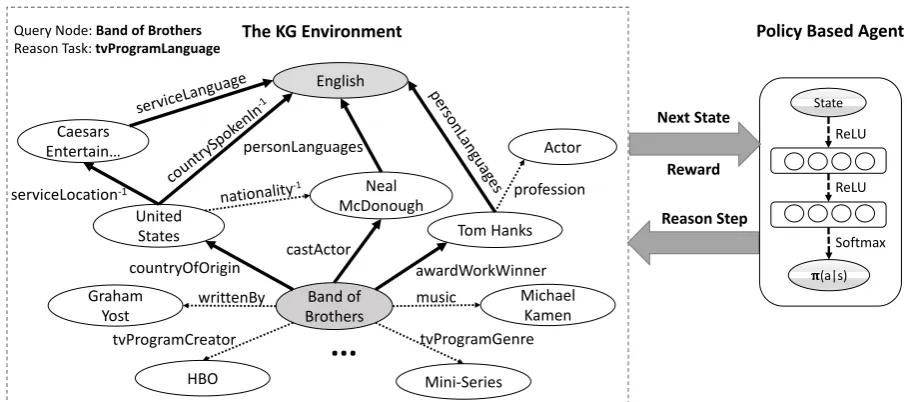
The RL system consists of two parts (see Fig-ure1). The first part is the external environment
E which specifies the dynamics of the interaction between the agent and the KG. This environment is modeled as a Markov decision process (MDP). A tuple < S,A,P,R > is defined to represent the MDP, where S is the continuous state space,
Band of Brothers
Mini-Series HBO
tvProgramCreator tvProgramGenre
Graham
Yost writtenBy music Michael Kamen
United States countryOfOrigin
Neal McDonough English
Tom Hanks
awardWorkWinner castActor
Actor
...
profession personLanguages
Caesars Entertain…
serviceLocation-1
The KG Environment
State
𝛑(a|s)
ReLU
ReLU
Softmax
Next State
Reward
Reason Step
Policy Based Agent
Query Node: Band of Brothers
[image:3.595.72.526.82.283.2]Reason Task: tvProgramLanguage
Figure 1: Overview of our RL model.Left:The KG environmentEmodeled by a MDP. The dotted arrows (partially) show the existing relation links in the KG and the bold arrows show the reasoning paths found by the RL agent.−1denotes the inverse
of an relation.Right:The structure of the policy network agent. At each step, by interacting with the environment, the agent learns to pick a relation link to extend the reasoning paths.
function of every(s, a)pairs.
The second part of the system, the RL agent, is represented as a policy network πθ(s, a) = p(a|s;θ) which maps the state vec-tor to a stochastic policy. The neural network parameters θ are updated using stochastic gra-dient descent. Compared to Deep Q Network (DQN) (Mnih et al., 2013), policy-based RL methods turn out to be more appropriate for our knowledge graph scenario. One reason is that for the path finding problem in KG, the action space can be very large due to complexity of the relation graph. This can lead to poor convergence properties for DQN. Besides, instead of learning a greedy policy which is common in value-based methods like DQN, the policy network is able to learn a stochastic policy which prevent the agent from getting stuck at an intermediate state. Before we describe the structure of our policy network, we first describe the components (actions, states, rewards) of the RL environment.
Actions Given the entity pairs (es, et) with relation r, we want the agent to find the most informative paths linking these entity pairs. Beginning with the source entityes, the agent use the policy network to pick the most promising
relation to extend its path at each step until it reaches the target entity et. To keep the output dimension of the policy network consistent, the action space is defined as all the relations in the KG.
States The entities and relations in a KG are naturally discrete atomic symbols. Since exist-ing practical KGs like Freebase (Bollacker et al.,
2008) and NELL (Carlson et al.,2010b) often have huge amounts of triples. It is impossible to di-rectly model all the symbolic atoms in states. To capture the semantic information of these sym-bols, we use translation-based embeddings such as TransE (Bordes et al., 2013) and TransH (Wang et al.,2014) to represent the entities and relations. These embeddings map all the symbols to a low-dimensional vector space. In our framework, each state captures the agent’s position in the KG. After taking an action, the agent will move from one en-tity to another. These two are linked by the action (relation) just taken by the agent. The state vector at steptis given as follows:
st= (et,etarget−et)
the target entity. At the initial state,et =esource. We do not incorporate the reasoning relation in the state, because the embedding of the reasoning relation remain constant during path finding, which is not helpful in training. However, we find out that by training the RL agent using a set of positive samples for one particular relation, the agent can successfully discover the relation semantics.
RewardsThere are a few factors that contribute to the quality of the paths found by the RL agent. To encourage the agent to find predictive paths, our reward functions include the following scoring cri-teria:
Global accuracy: For our environment settings, the number of actions that can be taken by the agent can be very large. In other words, there are much more incorrect sequential decisions than the correct ones. The number of these incorrect de-cision sequences can increase exponentially with the length of the path. In view of this challenge, the first reward function we add to the RL model is defined as follows:
rGLOBAL =
(
+1, if the path reachesetarget
−1, otherwise
the agent is given an offline positive reward+1if it reaches the target after a sequence of actions.
Path efficiency: For the relation reasoning task, we observe that short paths tend to provide more reliable reasoning evidence than longer paths. Shorter chains of relations can also improve the efficiency of the reasoning by limiting the length of the RL’s interactions with the environment. The efficiency reward is defined as follows:
rEFFICIENCY = length1 (p)
where pathpis defined as a sequence of relations r1 →r2 →...→rn.
Path diversity:We train the agent to find paths us-ing positive samples for each relation. These train-ing sample(esource, etarget)have similar state rep-resentations in the vector space. The agent tends to find paths with similar syntax and semantics. These paths often contains redundant information since some of them may be correlated. To encour-age the encour-agent to find diverse paths, we define a di-versity reward function using the cosine similarity
between the current path and the existing ones:
rDIVERSITY =−|F1|
|F| X
i=1
cos(p,pi)
where p = Pni=1ri represents the path embed-ding for the relation chainr1 →r2 →...→rn. Policy Network We use a fully-connected neu-ral network to parameterize the policy function π(s;θ) that maps the state vector s to a proba-bility distribution over all possible actions. The neural network consists of two hidden layers, each followed by a rectifier nonlinearity layer (ReLU). The output layer is normalized using a softmax function (see Figure1).
3.2 Training Pipeline
In practice, one big challenge of KG reasoning is that the relation set can be quite large. For a typ-ical KG, the RL agent is often faced with hun-dreds (thousands) of possible actions. In other words, the output layer of the policy network of-ten has a large dimension. Due to the complexity of the relation graph and the large action space, if we directly train the RL model by trial and er-rors, which is typical for RL algorithms, the RL model will show very poor convergence proper-ties. After a long-time training, the agents fails to find any valuable path. To tackle this prob-lem, we start our training with a supervised policy which is inspired by the imitation learning pipeline used byAlphaGo(Silver et al., 2016). In the Go game, the player is facing nearly 250 possible le-gal moves at each step. Directly training the agent to pick actions from the original action space can be a difficult task.AlphaGofirst train a supervised policy network using experts moves. In our case, the supervised policy is trained with a randomized breadth-first search (BFS).
(RE-INFORCE) (Williams,1992): J(θ) =Ea∼π(a|s;θ)(
X
t
Rst,at)
=X
t
X
a∈A
π(a|st;θ)Rst,at (1)
whereJ(θ) is the expected total rewards for one episode. For supervised learning, we give a re-ward of+1for each step of a successful episode. By plugging in the paths found by the BFS, the approximated gradient used to update the policy network is shown below:
∇θJ(θ) =
X
t
X
a∈A
π(a|st;θ)∇θlogπ(a|st;θ)
≈ ∇θ
X
t
logπ(a=rt|st;θ) (2)
wherertbelongs to the pathp.
However, the vanilla BFS is a biased search al-gorithm which prefers short paths. When plug-ging in these biased paths, it becomes difficult for the agent to find longer paths which may po-tentially be useful. We want the paths to be controlled only by the defined reward functions. To prevent the biased search, we adopt a sim-ple trick to add some random mechanisms to the BFS. Instead of directly searching the path be-tweenesource andetarget, we randomly pick a in-termediate nodeeinter and then conduct two BFS between(esource, einter)and(einter, etarget). The concatenated paths are used to train the agent. The supervised learning saves the agent great efforts learning from failed actions. With the learned ex-perience, we then train the agent to find desirable paths.
Retraining with Rewards To find the reasoning paths controlled by the reward functions, we use reward functions to retrain the supervised policy network. For each relation, the reasoning with one entity pair is treated as one episode. Starting with the source nodeesource, the agent picks a relation according to the stochastic policyπ(a|s), which is a probability distribution over all relations, to ex-tend its reasoning path. This relation link may lead to a new entity, or it may lead to nothing. These failed steps will cause the agent to receive negative rewards. The agent will stay at the same state af-ter these failed steps. Since the agent is following a stochastic policy, the agent will not get stuck by repeating a wrong step. To improve the training ef-ficiency, we limit the episode length with an upper
Algorithm 1: Retraining Procedure with re-ward functions
1 Restore parametersθfrom supervised policy; 2 forepisode←1toNdo
3 Initialize state vectorst←s0 4 Initialize episode lengthsteps←0 5 whilenum steps < max lengthdo 6 Randomly sample actiona∼π(a|st) 7 Observe rewardRt, next statest+1
// if the step fails
8 ifRt=−1then
9 Save< st, a >toMneg 10 ifsuccess orsteps=max length
then
11 break
12 Incrementnum steps
// penalize failed steps 13 Updateθusing
g∝ ∇θPMneglogπ(a=rt|st;θ)(−1) ifsuccessthen
14 Rtotal←λ1rGLOBAL+λ2rEFFICIENCY+ λ3rDIVERSITY
15 Updateθusing
g∝ ∇θPtlogπ(a=rt|st;θ)Rtotal
boundmax length. The episode ends if the agent fails to reach the target entity withinmax length steps. After each episode, the policy network is updated using the following gradient:
∇θJ(θ) =∇θ
X
t
logπ(a=rt|st;θ)Rtotal (3)
whereRtotal is the linear combination of the de-fined reward functions. The detail of the retrain process is shown in Algorithm1. In practice,θis updated using the Adam Optimizer (Kingma and Ba,2014) with L2regularization.
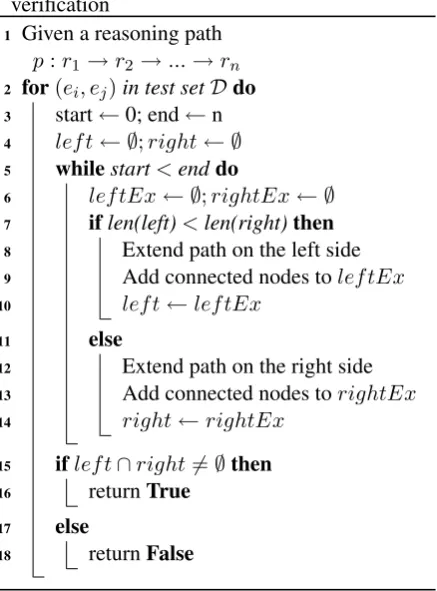
3.3 Bi-directional Path-constrained Search Given an entity pair, the reasoning paths learned by the RL agent can be used as logical formulas to predict the relation link. Each formula is veri-fied using a bi-directional search. In a typical KG, one entity node can be linked to a large number of neighbors with the same relation link. A sim-ple examsim-ple is the relation personNationality−1,
for-Algorithm 2: Bi-directional search for path verification
1 Given a reasoning path
p:r1→r2→...→rn
2 for(ei, ej)in test setDdo 3 start←0; end←n 4 left← ∅;right← ∅ 5 whilestart<enddo
6 leftEx← ∅;rightEx← ∅ 7 iflen(left)<len(right)then 8 Extend path on the left side
9 Add connected nodes toleftEx
10 left←leftEx
11 else
12 Extend path on the right side
13 Add connected nodes torightEx
14 right←rightEx
15 ifleft∩right6=∅then
16 returnTrue
17 else
18 returnFalse
mula consists of such links, the number of inter-mediate entities can exponentially increase as we follow the reasoning formula. However, we ob-serve that for these formulas, if we verify the for-mula from the inverse direction. The number of in-termediate nodes can be tremendously decreased. Algorithm 2 shows a detailed description of the proposed bi-directional search.
4 Experiments
To evaluate the reasoning formulas found by our RL agent, we explore two standard KG reason-ing tasks: link prediction (predictreason-ing target en-tities) and fact prediction (predicting whether an unknown fact holds or not). We compare our method with both path-based methods and embed-ding based methods. After that, we further analyze the reasoning paths found by our RL agent. These highly predictive paths validate the effectiveness of the reward functions. Finally, we conduct a ex-periment to investigate the effect of the supervised learning procedure.
4.1 Dataset and Settings
Table 1 shows the statistics of the two datasets we conduct our experiments on. Both of them
Dataset # Ent. # R. # Triples # Tasks FB15K-237 14,505 237 310,116 20
[image:6.595.310.520.61.96.2]NELL-995 75,492 200 154.213 12 Table 1: Statistics of the Datasets. # Ent. denotes the number of unique entities and # R. denotes the number of relations
are subsets of larger datasets. The triples in FB15K-237 (Toutanova et al.,2015) are sampled from FB15K (Bordes et al., 2013) with redun-dant relations removed. We perform the reasoning tasks on 20 relations which have enough reason-ing paths. These tasks consists of relations from different domains like Sports, People, Locations,
Film, etc. Besides, we present a new NELL sub-set that is suitable for multi-hop reasoning from the 995th iteration of the NELL system. We first remove the triples with relationgeneralizationsor
haswikipediaurl. These two relations appear more than 2M times in the NELL dataset, but they have no reasoning values. After this step, we only se-lect the triples with Top-200 relations. To facilitate path finding, we also add the inverse triples. For each triple (h, r, t), we append (t, r−1, h) to the
datasets. With these inverse triples, the agent is able to step backward in the KG.
For each reasoning task ri, we remove all the triples withriorri−1from the KG. These removed triples are split into train and test samples. For the link prediction task, each h in the test triples
{(h, r, t)} is considered as one query. A set of candidate target entities are ranked using different methods. For fact prediction, the true test triples are ranked with some generated false triples.
4.2 Baselines and Implementation Details Most KG reasoning methods are based on either path formulas or KG embeddings. we explore methods from both of these two classes in our ex-periments. For path based methods, we compare our RL model with the PRA (Lao et al., 2011a) algorithm, which has been used in a couple of rea-soning methods (Gardner et al.,2013; Neelakan-tan et al., 2015). PRA is a data-driven algorithm using random walks (RW) to find paths and obtain path features. For embedding based methods, we evaluate several state-of-the-art embeddings de-signed for knowledge base completion, such as TransE (Bordes et al.,2013), TransH (Wang et al.,
2014), TransR (Lin et al., 2015) and TransD (Ji et al.,2015) .
[image:6.595.72.291.84.380.2]FB15K-237 NELL-995
Tasks PRA RL TransE TransR Tasks PRA RL TransE TransR
teamSports 0.987 0.955 0.896 0.784 athletePlaysForTeam 0.547 0.750 0.627 0.673 birthPlace 0.441 0.531 0.403 0.417 athletePlaysInLeague 0.841 0.960 0.773 0.912 personNationality 0.846 0.823 0.641 0.720 athleteHomeStadium 0.859 0.890 0.718 0.722 filmDirector 0.349 0.441 0.386 0.399 athletePlaysSport 0.474 0.957 0.876 0.963 filmWrittenBy 0.601 0.457 0.563 0.605 teamPlaySports 0.791 0.738 0.761 0.814 filmLanguage 0.663 0.670 0.642 0.641 orgHeadquaterCity 0.811 0.790 0.620 0.657 tvLanguage 0.960 0.969 0.804 0.906 worksFor 0.681 0.711 0.677 0.692 capitalOf 0.829 0.783 0.554 0.493 bornLocation 0.668 0.757 0.712 0.812 organizationFounded 0.281 0.309 0.390 0.339 personLeadsOrg 0.700 0.795 0.751 0.772 musicianOrigin 0.426 0.514 0.361 0.379 orgHiredPerson 0.599 0.742 0.719 0.737
... ...
[image:7.595.329.505.265.376.2]Overall 0.541 0.572 0.532 0.540 0.675 0.796 0.737 0.789
Table 2: Link prediction results (MAP) on two datasets.
code released by (Lao et al.,2011a). We use the TopK negative mode to generate negative samples for both train and test samples. For each pos-itive samples, there are approximately 10 corre-sponding negative samples. Each negative sample is generated by replacing the true target entity t with a faked onet0 in each triple(h, r, t). These positive and negative test pairs generated by PRA make up the test set for all methods evaluated in this paper. For TransE,R,H,D, we learn a separate embedding matrix for each reasoning task using the positive training entity pairs. All these embed-dings are trained for 1,000 epochs.2
Our RL model make use of TransE to get the continuous representation of the entities and rela-tions. We use the same dimension as TransE, R to embed the entities. Specifically, the state vec-tor we use has a dimension of 200, which is also the input size of the policy network. To reason using the path formulas, we adopt a similar lin-ear regression approach as in PRA to re-rank the paths. However, instead of using the random walk probabilities as path features, which can be com-putationally expensive, we simply use binary path features obtained by the bi-directional search. We observe that with only a few mined path formulas, our method can achieve better results than PRA’s data-driven approach.
4.3 Results
4.3.1 Quantitative Results
Link PredictionThis task is to rank the target en-tities given a query entity. Table2shows the mean average precision (MAP) results on two datasets.
2The implementation we used can be found athttps:
//github.com/thunlp/Fast-TransX
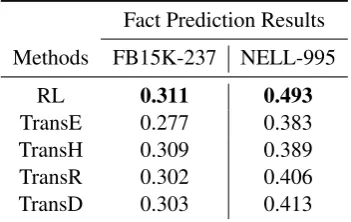
Fact Prediction Results Methods FB15K-237 NELL-995
RL 0.311 0.493
TransE 0.277 0.383
TransH 0.309 0.389
TransR 0.302 0.406
[image:7.595.306.533.413.552.2]TransD 0.303 0.413
Table 3: Fact prediction results (MAP) on two datasets.
# of Reasoning Paths
Tasks PRA RL
worksFor 247 25
teamPlaySports 113 27
teamPlaysInLeague 69 21
athletehomestadium 37 11
organizationHiredPerson 244 9
...
Average # 137.2 20.3
Table 4: Number of reasoning paths used by PRA and our RL model. RL achieved better MAP with a more compact set of learned paths.
Since path-based methods generally work better than embedding methods for this task, we do not include the other two embedding baselines in this table. Instead, we spare the room to show the de-tailed results on each relation reasoning task.
infor-0 5 10 15 20 25
distribution of reasoning paths
0 20 40 60 80 100 120
number of paths
[image:8.595.310.504.67.209.2]NELL-995 FB15K-237
Figure 2: The distribution of paths lengths on two datasets
mation in the KG, they generally perform worse than our RL model or PRA. However, when there are not enough paths between entities, our model and PRA can give poor results. For example, for the relationfilmWrittenBy, our RL model only finds 4 unique reasoning paths, which means there is actually not enough reasoning evidence existing in the KG. Another observation is that we always get better performance on the NELL dataset. By analyzing the paths found from the KGs, we be-lieve the potential reason is that the NELL dataset has more short paths than FB15K-237 and some of them are simply synonyms of the reasoning re-lations.
Fact PredictionInstead of ranking the target en-tities, this task directly ranks all the positive and negative samples for a particular relation. The PRA is not included as a baseline here, since the PRA code only gives a target entity ranking for each query node instead of a ranking of all triples. Table3 shows the overall results of all the meth-ods. Our RL model gets even better results on this task. We also observe that the RL model beats all the embedding baselines on most reasoning tasks. 4.3.2 Qualitative Analysis of Reasoning Paths To analyze the properties of reasoning paths, we show a few reasoning paths found by the agent in Table 5. To illustrate the effect of the effi-ciency reward function, we show the path length distributions in Figure2. To interpret these paths, take the personNationality relation for example, the first reasoning path indicates that if we know factsplaceOfBirth(x,y) andlocationContains(z,y)
then it is highly possible that personxhas nation-ality z. These short but predictive paths indicate the effectiveness of the RL model. Another im-portant observation is that our model use much
0 50 100 150 200
training episodes
0.00 0.05 0.10 0.15 0.20
[image:8.595.91.263.73.210.2]success ratio within 10 steps
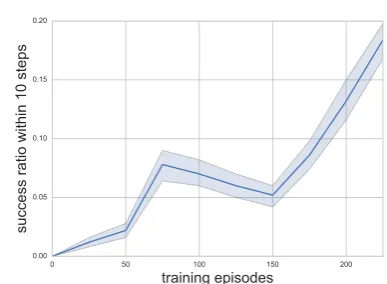
Figure 3: The success ratio (succ10) during training. Task:
athletePlaysForTeam.3
fewer reasoning paths than PRA, which indicates that our model can actually extract the most reli-able reasoning evidence from KG. Treli-able4shows some comparisons about the number of reasoning paths. We can see that, with the pdefined re-ward functions, the RL agent is capable of picking the strong ones and filter out similar or irrelevant ones.
4.3.3 Effect of Supervised Learning
As mentioned in Section3.2, one major challenge for applying RL to KG reasoning is the large ac-tion space. We address this issue by applying supervised learning before the reward retraining step. To show the effect of the supervised train-ing, we evaluate the agent’s success ratio of reach-ing the target within 10 steps (succ10) after
differ-ent number of training episodes. For each train-ing episode, one pair of entities(esource, etarget) in the train set is used to find paths. All the cor-rect paths linking the entities will get a+1global reward. We then plug in some true paths for train-ing. Thesucc10is calculated on a held-out test set
that consists of 100 entity pairs. For the NELL-995 dataset, since we have 200 unique relations, the dimension of the action space will be 400 af-ter we add the backward actions. This means that random walks will get very lowsucc10since there
may be nearly40010invalid paths. Figure3shows
thesucc10 during training. We see that even the
agent has not seen the entity before, it can actually pick the promising relation to extend its path. This also validates the effectiveness of our state repre-sentations.
Relation Reasoning Path
filmCountry filmReleaseRegionfeatureFilmLocation→locationContains−1
actorFilm−1→personNationality
personNationality placeOfBirth→locationContains
−1
peoplePlaceLived→locationContains−1
peopleMarriage→locationOfCeremony→locationContains−1
tvProgramLanguage tvCountryOfOrigintvCountryOfOrigin→→countryOfficialLanguagefilmReleaseRegion−1 →filmLanguage
tvCastActor→filmLanguage
personBornInLocation personBornInCitygraduatedUniversity→graduatedSchool−1 →personBornInCity
personBornInCity→atLocation−1→atLocation
athletePlaysForTeam athleteHomeStadium→teamHomeStadium
−1
athletePlaysSport→teamPlaysSport−1
athleteLedSportsTeam
personLeadsOrganization worksFororganizationTerminatedPerson−1
[image:9.595.79.519.64.357.2]mutualProxyFor−1
Table 5: Example reasoning paths found by our RL model. The first three relations come from the FB15K-237 dataset. The others are from NELL-995. Inverses of existing relations are denoted by−1.
5 Conclusion and Future Work
In this paper, we propose a reinforcement learn-ing framework to improve the performance of re-lation reasoning in KGs. Specifically, we train a RL agent to find reasoning paths in the knowledge base. Unlike previous path finding models that are based on random walks, the RL model allows us to control the properties of the found paths. These effective paths can also be used as an alternative to PRA in many path-based reasoning methods. For two standard reasoning tasks, using the RL paths as reasoning formulas, our approach generally out-performs two classes of baselines.
For future studies, we plan to investigate the possibility of incorporating adversarial learn-ing (Goodfellow et al., 2014) to give better re-wards than the human-defined reward functions used in this work. Instead of designing rewards according to path characteristics, a discriminative model can be trained to give rewards. Also, to ad-dress the problematic scenario when the KG does not have enough reasoning paths, we are interested in applying our RL framework to joint reasoning with KG triples and text mentions.
References
Kurt Bollacker, Colin Evans, Praveen Paritosh, Tim Sturge, and Jamie Taylor. 2008. Freebase: a collab-oratively created graph database for structuring hu-man knowledge. In Proceedings of the 2008 ACM SIGMOD international conference on Management of data, pages 1247–1250. ACM.
Antoine Bordes, Nicolas Usunier, Alberto Garcia-Duran, Jason Weston, and Oksana Yakhnenko. 2013. Translating embeddings for modeling multi-relational data. In Advances in neural information processing systems, pages 2787–2795.
Andrew Carlson, Justin Betteridge, Bryan Kisiel, Burr Settles, Estevam R. Hruschka Jr., and Tom M. Mitchell. 2010a. Toward an architecture for never-ending language learning. InAAAI.
Andrew Carlson, Justin Betteridge, Bryan Kisiel, Burr Settles, Estevam R. Hruschka Jr., and Tom M. Mitchell. 2010b. Toward an architecture for never-ending language learning. In Proceedings of the Twenty-Fourth Conference on Artificial Intelligence (AAAI 2010).
Rajarshi Das, Arvind Neelakantan, David Belanger, and Andrew McCallum. 2017. Chains of reasoning over entities, relations, and text using recurrent neu-ral networks. EACL.
and inference in a large knowledge-base using latent syntactic cues. InEMNLP, pages 833–838.
Matt Gardner, Partha Pratim Talukdar, Jayant Krishna-murthy, and Tom Mitchell. 2014. Incorporating vec-tor space similarity in random walk inference over knowledge bases.
Ian Goodfellow, Jean Pouget-Abadie, Mehdi Mirza, Bing Xu, David Warde-Farley, Sherjil Ozair, Aaron Courville, and Yoshua Bengio. 2014. Generative ad-versarial nets. In Advances in Neural Information Processing Systems, pages 2672–2680.
Kelvin Guu, John Miller, and Percy Liang. 2015. Traversing knowledge graphs in vector space. In
EMNLP.
Geoffrey Hinton, Li Deng, Dong Yu, George E Dahl, Abdel-rahman Mohamed, Navdeep Jaitly, Andrew Senior, Vincent Vanhoucke, Patrick Nguyen, Tara N Sainath, et al. 2012. Deep neural networks for acoustic modeling in speech recognition: The shared views of four research groups.IEEE Signal Process-ing Magazine, 29(6):82–97.
Guoliang Ji, Shizhu He, Liheng Xu, Kang Liu, and Jun Zhao. 2015. Knowledge graph embedding via dy-namic mapping matrix. InACL (1), pages 687–696. Justin Johnson, Bharath Hariharan, Laurens van der Maaten, Judy Hoffman, Li Fei-Fei, C Lawrence Zit-nick, and Ross Girshick. 2017. Inferring and exe-cuting programs for visual reasoning. arXiv preprint arXiv:1705.03633.
Yoon Kim. 2014. Convolutional neural net-works for sentence classification. arXiv preprint arXiv:1408.5882.
Diederik Kingma and Jimmy Ba. 2014. Adam: A method for stochastic optimization. arXiv preprint arXiv:1412.6980.
Alex Krizhevsky, Ilya Sutskever, and Geoffrey E Hin-ton. 2012. Imagenet classification with deep con-volutional neural networks. In Advances in neural information processing systems, pages 1097–1105.
Ni Lao, Tom Mitchell, and William W Cohen. 2011a. Random walk inference and learning in a large scale knowledge base. InProceedings of the Conference on Empirical Methods in Natural Language Pro-cessing, pages 529–539. Association for Computa-tional Linguistics.
Ni Lao, Tom M. Mitchell, and William W. Cohen. 2011b. Random walk inference and learning in a large scale knowledge base. InEMNLP, pages 529– 539. ACL.
Ni Lao, Jun Zhu, Xinwang Liu, Yandong Liu, and William W Cohen. 2010. Efficient relational learn-ing with hidden variable detection. InNIPS, pages 1234–1242.
Chen Liang, Jonathan Berant, Quoc Le, Kenneth D Forbus, and Ni Lao. 2016. Neural symbolic machines: Learning semantic parsers on free-base with weak supervision. arXiv preprint arXiv:1611.00020.
Yankai Lin, Zhiyuan Liu, Maosong Sun, Yang Liu, and Xuan Zhu. 2015. Learning entity and relation em-beddings for knowledge graph completion. InAAAI, pages 2181–2187.
Volodymyr Mnih, Koray Kavukcuoglu, David Sil-ver, Alex Graves, Ioannis Antonoglou, Daan Wier-stra, and Martin Riedmiller. 2013. Playing atari with deep reinforcement learning. arXiv preprint arXiv:1312.5602.
Volodymyr Mnih, Koray Kavukcuoglu, David Silver, Andrei A Rusu, Joel Veness, Marc G Bellemare, Alex Graves, Martin Riedmiller, Andreas K Fidje-land, Georg Ostrovski, et al. 2015. Human-level control through deep reinforcement learning. Na-ture, 518(7540):529–533.
Arvind Neelakantan, Benjamin Roth, and Andrew Mc-Callum. 2015. Compositional vector space mod-els for knowledge base completion. arXiv preprint arXiv:1504.06662.
David Silver, Aja Huang, Chris J Maddison, Arthur Guez, Laurent Sifre, George Van Den Driessche, Ju-lian Schrittwieser, Ioannis Antonoglou, Veda Pan-neershelvam, Marc Lanctot, et al. 2016. Mastering the game of go with deep neural networks and tree search. Nature, 529(7587):484–489.
Kristina Toutanova, Danqi Chen, Patrick Pantel, Hoi-fung Poon, Pallavi Choudhury, and Michael Gamon. 2015. Representing text for joint embedding of text and knowledge bases. InEMNLP, volume 15, pages 1499–1509. Citeseer.
William Yang Wang and William W Cohen. 2015. Joint information extraction and reasoning: A scal-able statistical relational learning approach. InACL. Zhen Wang, Jianwen Zhang, Jianlin Feng, and Zheng Chen. 2014. Knowledge graph embedding by trans-lating on hyperplanes. InAAAI, pages 1112–1119. Citeseer.
Ronald J Williams. 1992. Simple statistical gradient-following algorithms for connectionist reinforce-ment learning. Machine learning, 8(3-4):229–256. Daojian Zeng, Kang Liu, Siwei Lai, Guangyou Zhou,