Word Embeddings based on Fixed-Size Ordinally Forgetting Encoding
Joseph Sanu†, Mingbin Xu†, Hui Jiang† and Quan Liu‡ †Department of Electrical Engineering and Computer Science,
York University, 4700 Keele Street, Toronto, Ontario, M3J 1P3, Canada
‡Department of EEIS, University of Science and Technology of China, Hefei, China
[email protected], [email protected], [email protected], [email protected]
Abstract
In this paper, we propose to learn word embeddings based on the recent fixed-size ordinally forgetting encoding (FOFE) method, which can almost uniquely en-code any variable-length sequence into a fixed-size representation. We use FOFE to fully encode the left and right text of each word in a corpus to con-struct a novel word-context matrix, which is further weighted and factorized using truncated SVD to generate low-dimension word embedding vectors. We have eval-uated this alternative method in encoding word-context statistics and show the new FOFE method has a notable effect on the resulting word embeddings. Experimen-tal results on several popular word similar-ity tasks have demonstrated that the pro-posed method outperforms many recently popular neural prediction methods as well as the conventional SVD models that use canonical count based techniques to gen-erate word context matrices.
1 Introduction
Low dimensional vectors as word representations are very popular in NLP tasks such as inferring semantic similarity and relatedness. Most of these representations are based on either matrix factor-ization or context sampling described by (Baroni et al.,2014) as count or predict models. The ba-sis for both models is the distributional hypoth-esis (Harris, 1954), which states that words that appear in similar contexts have similar meaning. Traditional context representations have been ob-tained by capturing co-occurrences of words from a fixed-size window relative to the focus word. This representation however does not encompass
the entirety of the context surrounding the focus word. Therefore, the distributional hypothesis is not being taken advantage of to the fullest extent. In this work, we seek to capture these contexts through the fixed-size ordinally forgetting encod-ing (FOFE) method, recently proposed in (Zhang et al.,2015b). In addition to just capturing word co-occurrences, we attempt to use the FOFE to encode the full contexts of each focus word, in-cluding the order information of the context se-quences. We believe the full encoding of con-texts can enhance the resulting word embedding vectors, derived by factoring the corresponding word-context matrix. As argued in (Zhang et al.,
2015b), the FOFE method can almost uniquely en-code discrete sequences of varying lengths into a fixed-size code, and this encoding method was used to address the challenges of a limited size window when using deep neural networks for lan-guage modeling. The resulting algorithm fulfills the needs of keeping long term dependency while being fast. The word order in a sequence is mod-eled by FOFE using an ordinally-forgetting mech-anism which encodes each position of every word in the sequence.
In this paper, we elaborate how to use the FOFE to fully encode context information of each focus word in text corpora, and present a new method to construct the word-context matrix for word em-bedding, which may be weighted and factorized as in traditional vector space models (Turney and Pantel,2010). Next, we report our experimental results on several popular word similarity tasks, which demonstrate that the proposed FOFE-based approach leads to significantly better performance in these tasks, comparing with the conventional vector space models as well as the popular neu-ral prediction methods, such asword2vec, GloVe and more recent Swivel. Finally, this paper will conclude with the analysis and prospects of
bining this approach with other methods.
2 Related Work
There has been some debate as to what the opti-mal length of a text should be for measuring word similarity. Word occurrences from a fixed con-text window of words can be used to represent a context (Lund and Burgess, 1996). The word co-occurrence frequencies are based on fixed win-dows spanning in both directions from the focus word. This is then used to create a word-context matrix from which row vectors can be used to measure word similarity. A weighting step is usu-ally applied to highlight words with close associa-tion in the co-occurrence matrix, and the truncated SVD is used to factorize the weighted matrix to generate low-dimension word vectors. Recently, (Mikolov et al.,2013a) has introduced an alterna-tive way to generate word embeddings using the skipgram model trained with stochastic gradient descent and negative sampling, named as SGNS. SGNS tries to maximize the dot product between w ·c where both a word w and a context c are obtained from observed word-context pairs, and meanwhile it also tries to minimize the dot product betweenw·c0wherec0is a negative sample repre-senting some contexts that are not observed in the corpus. More recently, (Levy and Goldberg,2014) has showed that the objective function of SGNS is essentially seeking to minimize the difference between the models estimate and the log of co-occurrence count. Their finding has shown that the optimal solution is a weighted factorization of a pointwise mutual information matrix shifted by the log of the number of negative samples.
SGNS and GloVe (Pennington et al.,2014) se-lect a fixed window of usually 5 words or less around a focus word to encode its context and the word order information within the window is com-pletely ignored. Other attempts to fully capture the contexts have been successful with the use of re-current neural networks (RNNs) but these methods are much more expensive to run over large corpora when comparing with the proposed FOFE method in this paper. Some previous approaches to en-code order information, such as such as BEAGLE (Jones and Mewhort, 2007) and Random Permu-tations (Sahlgren et al., 2008), typically require the use of expensive operations such as convolu-tion and permutaconvolu-tion to process all n-grams within a context window to memorize order information
for a given word. On the contrary, the FOFE meth-ods only use a simple recursion to process a sen-tence once to memorize both context and order in-formation for all words in the sentence.
3 FOFE based Embedding
To capture the full essence of the distributional hy-pothesis, we need to fully encode the left and right context of each focus word in the text, and fur-ther take into accounts that words closer to the fo-cus word should play a bigger role in representing the context relevant to the focus word than other words locating much farther away. Traditional co-occurrence word-context matrixes fail to address these concerns of context representation.
In this work, we propose to make use of the fixed-size ordinally-forgetting encoding (FOFE) method, proposed in (Zhang et al., 2015b) as a unique encoding method for any variable-length sequence of discrete words.
Given a vocabulary of sizeK, FOFE uses 1-of-K one-hot representation to represent each word. To encode any variable-length sequence of words, FOFE generates the code using a simple recursive formula from the first word (w1) to the last one
(wT) of the sequence: (assumez0 = 0)
zt=α·zt−1+et(1≤t≤T) (1)
where zt denotes the FOFE code for the partial
sequence up to word wt, α is a constant
forget-ting factor, andetdenotes the one-hot vector
rep-resentation of word wt. In this case, the code zT may be viewed as a fixed-size representation
of any sequence of {w1, w2,· · · , wT}. For
ex-ample, assume we have three symbols in vocabu-lary, e.g.,A,B,C, whose 1-of-K codes are[1,0,0], [0,1,0]and [0,0,1]respectively. When calculat-ing from left to right, the FOFE code for the se-quence{ABC}is[α2, α,1], and that of{ABCBC}
is[α4, α+α3,1 +α2].
The uniqueness of the FOFE code is made evi-dent if the original sequence can be unequivocally recovered from the given FOFE code. According to (Zhang et al.,2015b), FOFE codes have some nice theoretical properties to ensure the unique-ness, as exemplified by the following two theo-rems1:
Theorem 1 If the forgetting factorαsatisfies0< α≤0.5,FOFEis unique for anyKandT.
Theorem 2 For 0.5 < α < 1, given any finite values ofKandT,FOFEis almost unique every-where forα∈(0.5,1.0), except only a finite set of countable choices ofα.
Finally, for alpha values less than or equal to 0.5 and greater than 0, the FOFE is unique for any sequence. For alpha values greater than 0.5, the chance of collision is extremely low and the FOFE is unique in almost all cases. Too find more about the theoretical correctness of FOFE, please refer to (Zhang et al.,2015b). In other words, the FOFE codes can almost uniquely encode any se-quences, serving as a fixed-size but theoretically lossless representation for any variable-length se-quences.
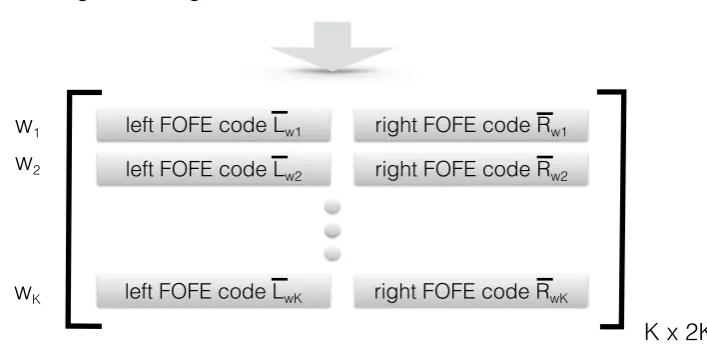
In this work, we propose to use FOFE to encode the full context where each focus word appears in text. As shown in Figure1, the left context of a fo-cus word, i.e.,bank, may be viewed as a sequence and encoded as a FOFE code L from the left to right while its right context is encoded as another FOFE code R from right to left. When a proper forgetter factorα is chosen, the two FOFE codes can almost fully represent the context of the focus word. If the focus word appears multiple times in text, a pair of FOFE codes[L, R]is generated for each occurrence. Next, a mean vector is calcu-lated for each word from all of its occurrences in text. Finally, as shown in Figure1, we may line up these mean vectors (one word per row) to form a new word-context matrix, called the FOFE matrix here.
4 PMI-based Weighting and SVD-based Matrix Factorization
We further weight the above FOFE matrix using the standard positive pointwise mutual informa-tion (PMI) (Church and Hanks,1990) which has been shown to be of benefit for regular word-context matrices (Pantel and Lin, 2002). PMI is used as a measure of association between a word and a context. PMI tries to compute the asso-ciation probabilities based on co-occurrence fre-quencies. Positive pointwise mutual information is a commonly adopted approach where all neg-ative values in the PMI matrix are replaced with zero. The PMI-based weighting function is critical here since it helps to highlight the more surprising events in original word-context matrix.
There are significant benefits in working with low-dimensional dense vectors, as noted by (
Deer-wester et al.,1990) with the use of truncated sin-gular value decomposition (SVD). Here, we also use truncated SVD to factorize the above weighted FOFE matrix as the product of three dense matri-cesU,Σ, VT, whereU andVT have orthonormal
columns andΣis a diagonal matrix consisting of singular values. If we selectΣto be of rankd, its diagonal values represent the top dsingular val-ues, andUdcan be used to represent all word
em-beddings withddimensions where each row rep-resents a word vector.
5 Experiments
We conducted experiments on several popular word similarity data sets and compare our FOFE method with other existing word embedding mod-els in these tasks. In this work, we opt to use five data sets: WordSim353 (Finkelstein et al.,
2001),MEN(Bruni et al.,2012),Mechanical Turk (Radinsky et al.,2011),Rare Words(Luong et al.,
2013) and SimLex-999 (Hill et al., 2015). The word similarity performance is evaluated based on the Spearman rank correlation coefficient obtained by comparing cosine distance between word vec-tors and human assigned similarity scores.
For our training data, we use the standard en-wiki9 corpus which contains 130 million words. The pre-processing stage includes discarding ex-tremely long sentences, tokenizing, lowercasing and splitting each sentence as a context. Our vo-cabulary size is chosen to be 80,000 for the most frequent words in the corpus. All words not in the vocabulary are replaced with the token<unk>. In this work, we use a python-based library, called scipy2, to perform truncated SVD to factorize all
word-context matrices.
5.1 Experimental Setup
Our first baseline is the conventional vector space model (VSM) (Turney and Pantel,2010), relying on the PMI-weighted co-occurrence matrix with dimensionality reduction performed using trun-cated SVD. The dimension of word vectors is cho-sen to be 300 and this number is kept the same for all models examined in this paper. Our main goal is to outperform VSM as the model proposed in this paper also uses SVD based matrix factor-ization. This allows for appropriate comparisons between the different word encoding methods.
left FOFE code Lw1 right FOFE code Rw1
left FOFE code Lw2 right FOFE code Rw2
left FOFE code LwK right FOFE code RwK
w1
w2
wK
K x 2K
Back in the day, we had an entire bank of computers devoted to this problem.
left FOFE code L right FOFE code R
i) encoding left and right context for one occurrence of the focus word, i.e. bank
ii) forming the FOFE word-context matrix for all words
Figure 1: i) encoding left and right contexts of each focus word with FOFE and ii) forming the FOFE word-context matrix.
For the purpose of completeness, the other non-SVD based embedding models, mainly the more recent neural prediction methods, are also com-pared in our experiments. As a result, we build the second baseline using the skip-gram model pro-vided by theword2vecsoftware package (Mikolov et al., 2013a), denoted as SGNS. The word em-beddings are generated using the recommended hyper-parameters from (Levy et al.,2015). Their findings show a larger number of negative sam-ples is preferable and increments on the window size have minimal improvements on word similar-ity tasks. In our experiments the number of nega-tive samples is set to 5 and the window size is set to 5. In addition, we set the subsampling rate to 10−4and run 3 iterations for training. In adition to
SGNS, we also obtained results for CBOW, GloVe (Pennington et al., 2014) and Swivel (Shazeer et al., 2016) models using similar recommended settings. While the window size has a fixed limit in the baseline models, our model does not have a window size parameter as the entire sentence
is fully captured as well as distinctions between left and right contexts when generating the FOFE codes. The impact of closer context words is fur-ther highlighted by the use of the forgetting factor which is unique to the FOFE based word embed-ding.
Finally, we use the FOFE codes to construct the word-context matrix and generate word embed-ding as described in sections3and4. Throughout our experiments, we have chosen to use a constant forgetting factorα = 0.7. There is no significant difference in word similarity scores after experi-menting with differentαvalues between[0.6,0.9] when generating FOFE codes.
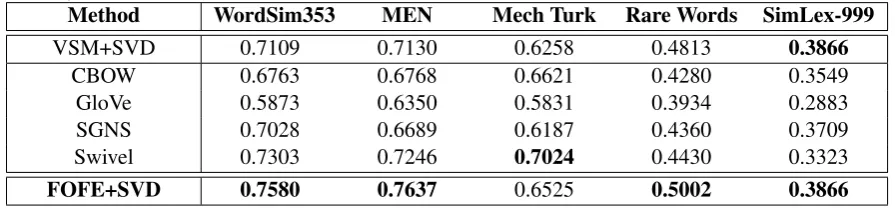
[image:4.595.119.473.201.378.2]Table 1: The best achieved performance of various word embedding models on all five examined word similarity tasks.
Method WordSim353 MEN Mech Turk Rare Words SimLex-999
VSM+SVD 0.7109 0.7130 0.6258 0.4813 0.3866
CBOW 0.6763 0.6768 0.6621 0.4280 0.3549
GloVe 0.5873 0.6350 0.5831 0.3934 0.2883
SGNS 0.7028 0.6689 0.6187 0.4360 0.3709
Swivel 0.7303 0.7246 0.7024 0.4430 0.3323
FOFE+SVD 0.7580 0.7637 0.6525 0.5002 0.3866
weighting parameter tuning (Caron,2001) proved to be incredibly effective for some datasets but in-effectual in others. The net benefit however is pal-pable and we include it for both VSM and FOFE methods.
5.2 Results and Discussion
The best results of all word embedding models are summarized in Table1for all five examined data sets, which include the the traditional count based VSM with SVD alongside SGNS usingword2vec and our proposed FOFE word embeddings. The most discernible piece of information from the ta-ble is that the FOFE method significantly outper-forms the traditional count based VSM method on most of these word similarity tasks. The results in Table1show that substantial gains are obtained by FOFE inWordSim353, MENand Rare Words data sets. The MENdataset shows a 7% relative improvement over the conventional VSM.
Among all of these five data sets, the proposed FOFE word embedding significantly outperforms VSM in four tasks while yielding similar perfor-mance as VSM in the last data set, i.e. SimLex-999. FOFE also outperforms all the other models except Swivel in theMech Turkdataset. It is im-portant to note that this paper does not state that SVD is obligatory to obtain the best model. The FOFE method can be complemented with other models such as Swivel in place of count based en-coding methods. It is also theoretically guaranteed that the original sentence is perfectly recoverable from this FOFE code. This theoretical guarantee is clearly missing in previous methods to encode word order information, such as both BEAGLE and Random Permutations. It is evident that over-all the FOFE encoding method does achieve sig-nificant gains in performance in these word sim-ilarity tests over the traditional VSM method that applies the same factorization method. This is
sub-stantial as (Levy et al., 2015) demonstrates that larger window sizes when using SVD does not payoff and the optimal context window is 2. We establish that we can indeed encode more infor-mation into our embedding with the FOFE codes. In summary, our experimental results show great promise in using the FOFE encoding to rep-resent word contexts for traditional matrix factor-ization methods. As for future work, the FOFE en-coding method may be combined with other pop-ular algorithms, such as Swivel, to replace the co-occurrence statistics based on a fixed window size. 6 Conclusion
The ability to capture the full context without restriction can play a crucial factor in generat-ing superior word embeddgenerat-ings that excel in NLP tasks. The fixed-size ordinally forgetting encod-ing (FOFE) has the ability to seize large contexts while discriminating contexts that are farther away as being less significant. Conventional embed-dings are derived from ambiguous co-occurrence statistics that fail to adequately discriminate con-texts words even within the fixed-size window. The FOFE encoding technique trumps other ap-proaches in its ability to procure the state of the art results in several word similarity tasks when combined with prominent factorization practices.
Acknowledgments
This work is partially supported by a Discovery Grant from Natural Sciences and Engineering Re-search Council (NSERC) of Canada, and a re-search donation from iFLYTEK Co., Hefei, China.
References
Marco Baroni, Georgiana Dinu, and Germ´an
Kruszewski. 2014. Don’t count, predict! a
context-predicting semantic vectors. In ACL (1), pages 238–247.
Elia Bruni, Gemma Boleda, Marco Baroni, and Nam-Khanh Tran. 2012. Distributional semantics in
tech-nicolor. In Proceedings of the 50th Annual
Meet-ing of the Association for Computational LMeet-inguis- Linguis-tics, pages 136–145. Association for Computational Linguistics.
John Caron. 2001. Experiments with lsa scoring:
Optimal rank and basis. In Proceedings of the
SIAM Computational Information Retrieval Work-shop, pages 157–169.
Kenneth W. Church and Patrick Hanks. 1990. Word association norms, mutual information, and lexicog-raphy.Computational linguistics, 16(1):22–29.
Scott Deerwester, Susan T Dumais, George W Fur-nas, Thomas K Landauer, and Richard Harshman.
1990. Indexing by latent semantic analysis.
Jour-nal of the American society for information science, 41(6):391.
Lev Finkelstein, Evgeniy Gabrilovich, Yossi Matias, Ehud Rivlin, Zach Solan, Gadi Wolfman, and Ey-tan Ruppin. 2001. Placing search in context: The concept revisited. InProceedings of the 10th inter-national conference on World Wide Web, pages 406– 414. ACM.
Zellig S Harris. 1954. Distributional structure. Word, 10(2-3):146–162.
Felix Hill, Roi Reichart, and Anna Korhonen. 2015. Simlex-999: Evaluating semantic models with (gen-uine) similarity estimation. Computational Linguis-tics.
M.N Jones and D.J.K Mewhort. 2007. Represent-ing word meanRepresent-ing and order information in a
com-posite holographic lexicon. Psychological Review,
114(1):1–37.
Omer Levy and Yoav Goldberg. 2014. Neural word
embedding as implicit matrix factorization. In
Ad-vances in Neural Information Processing Systems, pages 2177–2185.
Omer Levy, Yoav Goldberg, and Ido Dagan. 2015. Im-proving distributional similarity with lessons learned
from word embeddings. Transactions of the
Associ-ation for ComputAssoci-ational Linguistics, 3:211–225.
Kevin Lund and Curt Burgess. 1996. Producing
high-dimensional semantic spaces from lexical
co-occurrence. Behavior Research Methods,
Instru-ments, and Computers, 28(2):203–208.
Thang Luong, Richard Socher, and Christopher D Manning. 2013. Better word representations with
recursive neural networks for morphology. In
CoNLL, pages 104–113. Citeseer.
Tomas Mikolov, Kai Chen, Greg Corrado, and Jef-frey Dean. 2013a. Efficient estimation of word
representations in vector space. arXiv preprint
arXiv:1301.3781.
Tomas Mikolov, Ilya Sutskever, Kai Chen, Greg S Cor-rado, and Jeff Dean. 2013b. Distributed representa-tions of words and phrases and their
compositional-ity. InAdvances in neural information processing
systems, pages 3111–3119.
Patrick Pantel and Dekang Lin. 2002. Discovering word senses from text. InProceedings of the eighth ACM SIGKDD international conference on Knowl-edge discovery and data mining, pages 613–619. Jeffrey Pennington, Richard Socher, and Christopher
Manning. 2014. Glove: Global vectors for word
representation. In Proceedings of the 2014 Con-ference on Empirical Methods in Natural Language Processing (EMNLP), pages 1532–1543, Doha, Qatar. Association for Computational Linguistics.
Kira Radinsky, Eugene Agichtein, Evgeniy
Gabrilovich, and Shaul Markovitch. 2011. A
word at a time: computing word relatedness using
temporal semantic analysis. In Proceedings of the
20th international conference on World wide web, pages 337–346. ACM.
Magnus Sahlgren, Anders Holst, and Kanerva Pentti. 2008. Permutations as a means to encode order in
word space. InIn Proceedings of the 30th Annual
Conference of the Cognitive Science Society, pages 1300–1305.
Noam Shazeer, Ryan Doherty, Colin Evans, and Chris Waterson. 2016. Swivel: Improving
embed-dings by noticing whats missing. arXiv preprint
arXiv:1602.02215.
Peter D. Turney and Patrick Pantel. 2010. From fre-quency to meaning: Vector space models of se-mantics. Journal of Artificial Intelligence Research, 37:141–188.
Shiliang Zhang, Hui Jiang, Mingbin Xu, Junfeng Hou,
and Lirong Dai. 2015a. A fixed-size encoding
method for variable-length sequences with its ap-plication to neural network language models. arXiv preprint arXiv:1505.01504.
Shiliang Zhang, Hui Jiang, Mingbin Xu, Junfeng Hou,
and Lirong Dai. 2015b. The fixed-size