Inducing Semantic Micro-Clusters from Deep Multi-View
Representations of Novels
Lea Frermann University of Edinburgh∗ [email protected]
Gy¨orgy Szarvas
Amazon Development Center Germany GmbH [email protected]
Abstract
Automatically understanding the plot of novels is important both for informing lit-erary scholarship and applications such as summarization or recommendation. Vari-ous models have addressed this task, but their evaluation has remained largely in-trinsic and qualitative. Here, we pro-pose a principled and scalable framework leveraging expert-provided semantic tags (e.g.,mystery,pirates) to evaluate plot rep-resentations in an extrinsic fashion, assess-ing their ability to produce locally coher-ent groupings of novels (micro-clusters) in model space. We present a deep recur-rent autoencoder model that learns richly
structuredmulti-viewplot representations,
and show that they i) yield better micro-clusters than less structured representa-tions; and ii) are interpretable, and thus useful for further literary analysis or la-belling of the emerging micro-clusters.
1 Introduction
For the literature aficionado, the quest for the next novel to read can be daunting: the sheer number of novels of different styles, topics and genres is dif-ficult to navigate. It is intuitively clear that readers select novels based on specific but potentially di-verse and structured preferences (e.g., they might
prefer novels of a particular theme (small-town
ro-mance), mood (dark) or based on character types (grumpy boss), character relations (love, enmity) and their development). These preferences also manifest in the organization of online book stores
or recommendation platforms.1 For example, the
∗ Work done while the first author was an intern at Ama-zon (ADC Germany GmbH, Berlin).
1E.g.,www.amazon.comorwww.goodreads.com
Amazon book catalog contains semantic tags pro-vided by experts (publishers), including labels of character types (pirates) or theme (secret baby ro-mance) to aid focused search for novels of interest. Although these tags are already fairly granular, many cover large sets of novels (e.g., the tagsecret baby romancecovers almost4,000novels), limit-ing their utility for exhaustive exploration and call for even finer grained micro-groupings. Can we
instead automatically induce fine-grained novel
clusters in an unsupervised, data-driven way? We propose a framework to learn structured, in-terpretable book representations that capture dif-ferent aspects of the plot, and verify that such representations are rich enough to support down-stream tasks like generating interpretable book groupings. A real-world application of this work is content-based book recommendation based on diverse and interpretable book characteristics. Content-based recommendation has been criti-cized by the limited complexity of typically
em-ployed features (limited content analysis; Lops
et al. (2011);Adomavicius and Tuzhilin (2005)). This work addresses this problem by inducing complex, structured and interpretable representa-tions. Our contributions are two-fold.
First, assuming that richlystructuredbook tags
call for rich content representations (which expert taggers arguably possess), we describe a deep
un-supervised model for learning multi-view
repre-sentations of novel plots. We use the term view
to refer to specific types of plot characteristics (e.g., pertaining to events, characters or mood), and multi-view to refer to combinations of these views. We use multi-view book representations to construct meaningful and locally coherent neigh-bourhoods in model space, which we will refer to asmicro-clusters. To this end, we extend a recent
autoencoder model (Iyyer et al., 2016) to learn
multi-view representations of books. Our model
encodes properties of characters (view v1),
rela-tions between characters (view v2), and their
re-spective trajectories over the plot.2 View-specific
encodings are learnt in an unsupervised way from raw text as separate sets of word clusters which
are jointly optimized to encode relevant and
distinct information. These properties are crucial for applications such as book recommen-dation, because they allow to i) explain why par-ticular books are similar based on the inferred la-tent structure and ii) find similarities based on im-portant and distinct aspects of a novel (character types or interactions). Our framework of unsu-pervised multi-view learning is very flexible and can straightforwardly be applied to learn arbitrary kinds and numbers of views from raw text.
Secondly, we propose an empirical evaluation
framework. Before we can use models toextend
existing categories as discussed above, it must be
shown that the representations captureexisting
as-sociations. To this end, we investigate whether micro-clusters derived from induced representa-tions resemble reference clusters defined as groups of novels sharing tags in the Amazon catalog. While automatic induction of plot representations
has attracted considerable attention (see Jockers
(2013)), evaluation has remained largely
qualita-tive and intrinsic. To the best of our knowledge, we are the first to investigate the utility of auto-matically induced plot representations on an ex-trinsic task at scale. We evaluate micro-clusters as local neighbourhoods in model space containing
10,000novels under50reference tags.
We show that rich multi-view representations produce better micro-clusters compared to com-petitive but simpler models, and that interpretabil-ity of the learnt representations is not compro-mised despite the more complex objective. We also qualitatively demonstrate that high-quality micro-clusters emerge from a smaller, more
ho-mogeneous data set of Gutenberg3novels.
2 Related Work
Automatically learning representations of book plots, as structured summaries of their content,
has attracted much attention (cf, Jockers (2013)
for a review). Unsupervised models have been
2We argue that both characters, and their relations evolve throughout the plot: Heroes pick up new attitudes or skills, and utilize those to different extents; relations change and de-velop over time (hate to love, friendship to enmity and back).
3https://www.gutenberg.org/
proposed which, given raw text, extract
prototyp-ical event structure (McIntyre and Lapata, 2010;
Chambers and Jurafsky,2009), prototypical char-acters (Bamman et al.,2013,2014;Elsner,2012) and their social networks (Elson et al.,2010).
Other work focused on the dynamicsof a plot,
learning trajectories of relations between two char-acters (Iyyer et al.,2016;Chaturvedi et al.,2017).
Iyyer et al. (2016) combine dictionary
learn-ing (Olshausen and Field,1997) with deep
recur-rent autoencoders to learn interpretable character relationship descriptors. They show that their deep model learns better representations than
concep-tually similar topic models (Gruber et al., 2007;
Chang et al., 2009). Here, we extend the model of Iyyer et al. (2016) to simultaneously induce multiple views on the plot.
Methodologically, our work falls into the class of multi-view learning, and we propose a novel formulation of the model objective which
encour-ages encoding ofdistinctinformation in the views.
Our objective function is inspired by prior work in multi-task learning and deep domain adaptation
for classification (Ganin and Lempitsky, 2015;
Ganin et al., 2016). They train neural networks to simultaneously learn classifiers which are ac-curate on their target task and are agnostic about feature fluctuation pertaining to domain shift. We adapt this idea to unsupervised models with a re-construction objective and learn multi-view repre-sentations which efficiently encode the input data
and, at the same time, learn toonlyencode
infor-mation relevant for the particular view.
Evaluating induced plot representations is no-toriously difficult. Most evaluation has resorted to manual inspection, or crowd-sourced human judgments of the coherence and interpretability of the representations (Iyyer et al.,2016;Chaturvedi et al.,2017). While such evaluations demonstrated that the induced representations are qualitatively valuable, it is not clear whether they are rich and general enough to be used for downstream tasks and applications. Others have used automatically created gold-standards of re-occurring character
names across scripts (‘gang member’) (Bamman
et al., 2013), prototypical plot templates (tropes, e.g., ‘corrupt corporate executive’) or manually
created gold-standards of character types (Vala
et al.,2016) or their relations (Massey et al.,2015;
we investigate how these results extend to
extrin-sic tasks, and use structured plot representations
for the task of inducing micro-clusters of novels.
Elsner (2012) depart from the above pattern, suggesting an extrinsic, albeit artificial, evaluation paradigm. Approaching plot understanding from the angle of its utility for summarization, they use kernel methods to learn character-centric plot rep-resentations. They evaluate their trained models on their ability to differentiate between real and ar-tificially distorted novels (e.g., with shuffled chap-ters). While this evaluation is extrinsic and quanti-tative, it leverages artificial data and it is not clear how the results extend to real-world summaries.
Language features were previously used in content-based book recommendation e.g., as
bags-of-words (Mooney and Roy, 1999) or semantic
frames (Clercq et al.,2014). Both works use struc-tured databases and plot summaries rather than the raw book text. Other work used topic mod-els to augment a recommender system of
scien-tific articles (Wang and Blei, 2011). Similar to
our work, these works emphasize the added value ofinterpretablerepresentations and recommenda-tions, however, they do not leverage the raw con-tent of entire novels and the richness of informa-tion encoded in those.
3 Multi-View Novel Representations
We first provide an intuitive description of
Rela-tionship Modeling Networks (RMN; Iyyer et al.
2016), and our extension (henceforth MVPlot),
whichjointlyinduces temporally awaremulti-view
representations of novel plots. Afterwards we de-scribe the MVPlot model in technical detail.
3.1 Intuition
Iyyer et al. (2016) introduce the RMN, an un-supervised model which learns interpretable plot representations in terms of types of relations be-tween pairs of book characters, and their devel-opment over time. Given a book and a charac-ter pair, the model learns relation types as word
clusters (not unlike topics in a topic model (Blei
et al.,2003)) from local contexts mentioning both characters. In addition the RMN learns for each character pair how these relations vary over time as a trajectory of relations. Methodologically, the RMN combines a deep recurrent autoencoder with dictionary learning, where terms in the dictionary are relationship descriptors. The RMN learns to
View Descriptor
v1 laugh scream laughing yell joke cringe disgraceembarrassment hate cursing
v1 snug fleece warm comfortable wet blanket flan-nel cozy comfort roomy
v1 excellency mademoiselle monsieur majestyduchess empress madame countess madam
v2 love loving lovely dear sweetest dearest thankdarling congratulation hello
[image:3.595.308.522.66.179.2]v2 associate assistant senior chairman executiveleadership vice director liaison vice-president
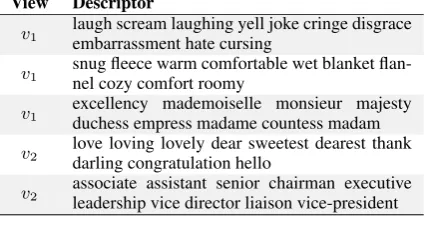
Table 1: Example property (v1) and relation (v2)
descriptors induced by MVPlot on the Gutenberg corpus, as their nearest neighbours in GloVe space.
efficiently encode local text spans as a linear com-bination of these relation descriptors.
We extend RMNs to induce temporally aware multi-view representations of novel plots. Multi-ple interpretable views are induced jointly within one process in an unsupervised way. The core of our model closely corresponds to the structure of
the RMN (as technically described in Section3.2).
However, we provide the model with distinct types of informative input for each view, and, reformu-late the objective in a way that jointly optimizes
parameterizations of all views to encode distinct
information (cf., Section3.3).
Our MVPlot model learns two views:
prop-erties associated with individual characters (v1),
relations between character pairs (v2, as in the
RMN) and their respective development over the course of the plot (examples of descriptors learnt
by MVPlot for both views are shown in Table1).
Our modeling framework, however, is very gen-eral in the sense that any number and type of views can be learnt jointly as long as input with relevant signals can be provided for each view. For exam-ple, we could naturally extend the model described here with a ‘plot’ view to capture properties of the story which are not related to any character.
3.2 The MVPlot Model
We now formally describe the MVPlot model for learning multi-view plot representations encoding individual character properties (v1), character pair
relationships (v2), and their respective trajectories.
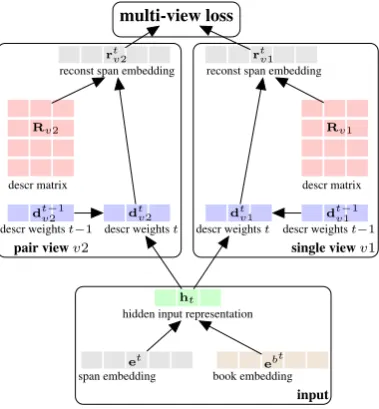
The full model is shown in Figure1.
Input to our model are two corpora of text
spans, one for each view,Sv1 and Sv2. The
cor-pora consist of different sets of relevant
view-specific local contexts as described in Section 5.
et ebt span embedding book embedding
ht hidden input representation
dtv−21 dtv2 dtv1 dtv−11 descr weightst−1 descr weightst descr weightst descr weightst−1
Rv2 Rv1
descr matrix descr matrix
rt
v2 rtv1 reconst span embedding reconst span embedding
multi-view loss
pair viewv2
[image:4.595.87.277.62.267.2]input single viewv1
Figure 1: Visualization of the MVPlot model.
linearly ordered4sequences of text spansstat time
t={1...T} in which charactercis mentioned, but
no other character,
Svc,b1={s1, s2, ..., sT}s.th.∀t:c∈st
Similarly, Sc1,c2,b
v2 , given a book b and a pair of
charactersc1andc2, contains linearly ordered text
spans which mention bothc1andc2, but no other
character,
Sc1,c2,b
2 ={s1, s2, ..., sT}s.th.∀t: c1∈st, c2∈st.
The rest of the input preparation follows Iyyer
et al. (2016) as follows. We map text spans into
word embedding space, by mapping each wordw
to its 300-dimensional GloVe embeddingew(
Pen-nington et al., 2014) pre-trained on Common-Crawl, and averaging the word embeddings,
et= 1|st| X w∈st
ew. (1)
We provide MVPlot with a trainable matrix B
of dimensions b × n, where b is the
num-ber of books in our data set, and each row eb
is an n-dimensional book embedding, encoding
background information (e.g, about its general set-ting or style) which is relevant to neither view
of MVPlot.5 Finally the span embedding and the
corresponding book embedding are concatenated,
4with respect to their occurrence in the novel
5The RMN learns background encodings for characters in addition to the book embeddings. We omit this for MVPlot as this information is explicitly learned in the views.
and passed through a ReLu non-linearity (cf., Fig-ure1, bottom),
ht=ReLu(Wh[et;ebt]). (2)
Model architecture MVPlot uses the architec-ture of the RMN autoencoder, but replicates it for
each input view,v1 andv2 (cf., Figure1, center).
Each part will induce an encoding of view-specific information. The feed-forward pass, described be-low, is identical for both parts, however, the loss
and backpropagation will differ (cf., Section3.3).
We describe the feed-forward pass forv2,
not-ing that it works analogously for v1. The latent
input representationht(eqn (2)) is passed through
a softmax layer which returns a weight vector over descriptors,dt
v2 =softmax(Wdv2[ht]).
Descrip-tors are rows in the k ×d-dimensional
descrip-tor matrix Rv2, with each row k corresponding
to oned-dimensional descriptor (similar to a topic
in a topic model). The inputet is reconstructed
through the dot product ofdt
v2 and the descriptor
matrixRv2,
rt=dtv2Rv2. (3)
Like in the original RMN, we want to capture thetemporaldevelopment of character relations or properties. Intuitively, we assume that the rela-tions between (or properties of) characters at time
tdepend on their relations (or properties) at time
t−1. As in the RMN, we factor the descriptor weights of theprevioustime stepdt−1into the
rep-resentation at timet, such that dt
v2=α softmax Wdv2[ht;dt−1v2 ]+(1−α)dt−1v2 (4)
Output First, the model induces property
de-scriptors (rows in Rv1) and the relationship
de-scriptors (rows inRv2). Both sets of descriptors
are optimized to reconstruct model input in GloVe
embedding space (cf., Section 3.3 for details).
They consequently themselves live in GloVe word embedding space, and can be visualized through their nearest neighbours in this space. In
addi-tion, for each bookb, character cb and character
pair{c1, c2}, sequences of weight vectors over re-lations
Tc1,c2,b
v2 =d1v2...dTv2,
and over properties
Tc,b
v1 =d1v1...dTv1
3.3 The Multi-View Loss
We formulate our loss as a Hinge loss within the contrastive max-margin framework. Our objective
is to learn parameters for each view ∈ {v1, v2}
which efficiently encode view-specific input in a low-dimensional space from which the original in-put can be re-constructed with high accuracy. In addition, we want to learn view-specific
parame-ters which encode distinct information such that
when utilized together, they provide an improved embedding of the data. Intuitively, we achieve this by discouraging parameters of view v1 from
ac-curately reconstructing input spans from viewv2,
and vice versa.
Our loss combines these two objectives as
fol-lows. The first part of the loss corresponds
to the loss of the RMN. We use negative sam-pling to induce parameters for each view which reconstruct their respective view-specific input
well. Formally, assuming model input from
view v1, et
v1, we construct a set of 10 ‘negative
inputs’{en1
v1, ...env1I}which are sampled at random
from the v1 input corpus. We want to learn
pa-rameters encoding viewv1to reconstruct the input
such that the inner product between the true in-put et
v1 and its reconstruction rtv1 is higher than
the inner product betweenrt
v1and any of the
neg-ative sampleseni
v1by a margin of at least1,
J(θ) =X t
X
i
max(0,1−rt
v1etv1+rtv1env1i), (5)
whereθrefers to the set of all model parameters.
We add an orthogonality-encouraging regulariz-ing term to this objective in order to obtain view-specific descriptors which are distant from each other (Hyv¨arinen and Oja,2000),
J(θ) =X t
X
i
max(0,1−rtv1etv1+rtv1env1i)
+λ||Rv1RTv1−I||.
(6)
The loss is defined analogously for input of
view v2. Note that so far, the loss is defined in
an entirely view-specific way, independent of the
v2parameters (e.g., thev1loss in equation (6) is
independent of thev2parameters).
We break this independence by adding a sec-ond term to our loss function, which ensures that
view-specific parameters encodeonly relevant
in-formation. That is, we wantv2-specific parameters
to only encode v2-specific information, and vice
versa. Assuming model input from viewv1, etv1,
Genre Example Tags
Mystery British Detectives; FBI Agents; Female Pro-tagonists; Private Investigators Romance Cowboys; Criminals & Outlaws; Doctors;Royalty & Aristocrats; Spies; Wealthy SciFi AIs; Aliens; Clones; Corporations; Mutants;Pirates; Psychics; Robots & Androids
Table 2: Example tags from the Amazon book
cat-alog for the refinementcharacter type.
we learn parameters for to viewv2that reconstruct
the input poorly. Again, we use the max-margin framework, maximizing the margin between the
(high) quality reconstruction of et
v1 from v1
pa-rameters,rt
v1, and the (poor) quality of the
recon-struction fromv2parameters,rtv2,
K(θ) =max(0,1−et
v1rtv1+etv1rtv2). (7)
The update is defined analogously, swapping v1
andv2subscripts, when the true input stems from
v2. The full loss is defined as a weighted linear combination of its terms (eqns (6) and (7)),
L(θ) =βJ(θ) + (1−β)K(θ). (8) 4 Semantic Micro-Cluster Evaluation
MVPlot induces structured representations of a
novel b as relation trajectories between
charac-ters pairs in b, and property trajectories of
indi-vidual characters in b. Are those representations
rich and informative enough to produce mean-ingful and interpretable micro-clusters of novels?
In Section 6.1 we evaluate the quality of such
micro-clusters, i.e., local novel neighbourhoods in model space. We propose an objective and empir-ical evaluation employing expert-provided seman-tic novel tags in the Amazon catalog.
Novels listed in the Amazon catalog are tagged
with respect to their genre (e.g., mystery,
ro-mance). They are further labelled with re-finements pertaining to diverse information like
character types or mood, which take dif-ferent sets of values, depending on the genre, and are as such predestined as an objective reference for evaluating the diverse information captured by
our model. Table2 lists example tags for the
re-finementcharacter type.
# novels #v1sequences #v2sequences
Gutenberg 3,500 45,182 60,493
Amazon 10,000 91,511 70,156
Table 3: The number of novels and property (v1)
relation (v2) input sequences for the Gutenberg
and the Amazon corpus.
We selected a set of 50 representative tags from
the Amazon catalog and did not tune this set for our evaluation. The full tag set is included in the supplementary material.
Note that while this scheme provides an em-pirical way of evaluating plot representations, it may not capture their full potential: our models are not explicitly tuned towards producing micro-clusters which are coherent with respect to our gold-standard tags, and may encode additional structure which is not probed in this evaluation. That said, we consider this evaluation as a good
procedure to evaluate therelativequality of
differ-ent models in the sense that a better model should produce micro-clusters that better correspond to reference clusters derived from gold-standard tags.
5 Data
We evaluate our model on two data sets. First, we create a diverse data set by sampling 10,000
digital novels under our 50 gold-standard tags
(cf., Section 4) of the Amazon catalog
(Ama-zon). Our second data set consists of 3,500 nov-els from Project Gutenberg, a large digital collec-tion of freely available novels consisting primar-ily of classic literature (Gutenberg). The Ama-zon novels are already labelled with genre and re-finement tags, such that evaluation using our gold-standard is straightforward. While Gutenberg nov-els come with the advantage of being freely avail-able, they are unlabelled, and not fully covered by
our 50 gold-standard tags. We therefore restrict
our quantitative analysis to the Amazon data set. However, we also report qualitative results on the Gutenberg corpus, demonstrating that our model induces meaningful novel representations for cor-pora of varying size and diversity.
Both data sets were pre-processed with the
BookNLP pipeline (Bamman et al., 2014) for
coreference resolution of character mentions. We filtered stop-words and low-frequency words by
discarding the500most frequent words and those
which occur in less than100novels, and discarded
novels less than100sentences long or containing
fewer than5characters from our data set.
We created view-specific input corpora as fol-lows: (1) a relation corpus of chronologically
or-dered sequences of text spans of20words for
char-acter pairs {c1, c2} in a book b, Sc1,c2,b
v2 , which
mentiononlyc1andc2with a margin of10words
for the Amazon corpus (1 word for the smaller
Gutenberg corpus) but no other character; and (2) a property corpus of chronologically ordered
sequences of 20 word text spans for individual
characters c in book b, Sc1,c2,b
v2 , which mention
onlyc, using the same margins as above.
We keep only sequences of lengthntime steps
s.th.,5≤n≤250. We only keep pair sequences
if we also obtain sequences for each individual
character confirming to the above criteria. Table3
summarizes statistics on our input corpora.
6 Evaluation
Section 6.1 quantitatively evaluates the quality
of local neighbourhoods in model space induced from the Amazon corpus against our proposed
gold-standard. Section 6.2 evaluates the quality
of the induced descriptors from both the Amazon and Gutenberg corpus both through crowd sourc-ing and illustrative examples.
Models We set the MVPlot performance into
perspective comparing it against the RMN.6
MV-Plot induces both character properties and rela-tions, and is trained on both the relation-view and property-view input, while the RMN only induces pair relationships and can only utilize relation-view input. In addition, we report a frequency baseline, which is trained on both property and relation-view input. We concatenate all input spans of a given view for a particular novel; con-struct its term frequency vector and use cosine similarity to compute the nearest neighbours to each novel.
Parameter settings Across all experiments and
corpus-specific models, we set β=0.99 for
MV-Plot, and for both MVPlot and RMN we
set α=0.5, λ=10−5, k=50.7 We train both
RMN and MVPlot for15 epochs using SGD and
ADAM (Kingma and Ba,2014).8
6We do not compare against topic model baselines be-cause they were outperformed by RMN (Iyyer et al.,2016).
7Parameters were tuned on a small subset of books used in the nearest neighbourhood evaluation (Section6.1).
8Our implementation builds on the available RMN code
6.1 Nearest Neighbours Evaluation
We evaluate local neighbourhoods in model space
using the500most popular novels by their
num-ber of Amazon reviews as reference novels from the Amazon corpus. For each reference novel we
compute the 10 nearest neighbours as described
below. We measure neighbourhood quality
us-ing the gold-standard tags from Section4,
regard-ing neighbours as relevant if at least one tag is
shared with the reference novel. We report
pre-cision at rank 10 (P@10) and mean average
preci-sion (MAP).
Method MVPlot represents a book b in terms of trajectories of weight vectors over relation de-scriptorsTb
v2 and property descriptorsTvb1. RMN
only learns relation descriptors and their tra-jectories. For both models, we map each
in-duced trajectory for book b to a fixed-sized k
-dimensional vector representation by averaging the time-specific weight vectors, for example for av2trajectory,
Tc1,c2,b
v2 =
1
Tc1,c2,b
v2
X
t∈Tc1,c2,b v2
dt
v2, (9)
and equivalently forv1trajectories,Tvc,b1 .
We compute the similarity between two
books {br, bc} as follows. We align the v2
tra-jectory for each character pair {c1, c2} in br,
Tc1,c2,br, to its closest neighbouring character pair
vector inbc,Tc01,c02,bc, by Euclidean distance, and
compute the overall book similarity in terms of
character relations between br and bc as the
av-erage over all distances.
simbr,bc
v2 = 1|Tbr
v2| X
T ∈Tvbr2
arg min T0∈Tvbc
2
dist(T,T0). (10)
We obtainsimbr,bc
v1 in an analogous process. For
cosineand MVPlot we obtain a final, multi-view
similarity by averaging similarity scores obtained in each view’s space,
simbr,bc
both = 12 simbv1r,bc+simbv2r,bc
. (11)
For RMN we compute similarity only in character relation space.
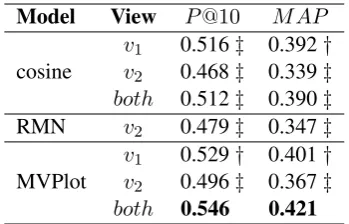
Results Table 4 presents micro-cluster quality
in terms of precision@10 and MAP. The full
MVPlot model statistically significantly
outper-foms all other models.9The same pattern emerges
9Also, intra-view comparisons except for MVPlotv
1and cosinev1are statistically significant.
Model View P@10 MAP
cosine vv21 0.5160.468‡‡ 0.3920.339†‡
both 0.512‡ 0.390‡
RMN v2 0.479‡ 0.347‡
MVPlot vv12 0.5290.496†‡ 0.4010.367†‡ both 0.546 0.421
Table 4: Micro-cluster quality results (Amazon
corpus). Differences of cosine and RMN
com-pared to the best MVPlot result are significant with
p <0.05(†) orp <0.01(‡) (paired t-test).
when comparing models with the same
underly-ing views: MVPlot v2 outperforms both cosine
v2 and RMN v2 (similarly for MVPlot v1 and
cosine v1), indicating that the MVPlot character
relation representations are most informative for micro-cluster induction.
In order to shed light on the contribution of in-dividual model components, we compare the full
MVPlot model (both) to model versions with
ac-cess to onlyv1orv2(Table4bottom). Combining
information from both views boosts performance compared to the single-view versions. This con-firms that MVPlot indeed encodes distinct and rel-evant information in the respective views.
While cosine is a strong baseline, its representa-tions are not structured or interpretable. It conse-quently does not provide sufficient information for applications like book tagging or recommendation with respect to specific aspects or criteria. Simi-larly, RMN cannot learn representations of multi-ple, distinct views of the plot.
Advancing our understanding of the informa-tion encoded in the individual views of MVPlot, we took a closer look at the refinement tags for
which the single view MVPlot model (v1) has
the clearest advantage over the pair view MVPlot
model (v2), and vice-versa. We computed
tag-wise F1-scores for the two MVPlot variants. Ta-ble5lists the book tags for which the scores of the two views diverge the most.
In terms of types of refinements, viewv2suffers
most for predicting book categories, or topical tags
(‘sports’, ‘second changes’), while viewv1is
[image:7.595.329.504.61.173.2]char-F1v2>> F1v1 F1v1>> F1v2
Tag RefType Tag RefType
Robots & Androids Character Hard SciFi Category Corporations Character Sports Category International Theme Horror Theme
[image:8.595.72.294.61.135.2]Aliens Character Second Chances Theme Cowboys Character Crime Category
Table 5: The tags (Tag) and their refinement types
(RefType) for which MVPlotv1most clearly
out-performs MVPlot v2(left) and vice versa (right)
in terms of tag-specific F1-measure.
acters. Topical information, however, is encoded robustly in the properties of individual characters.
6.2 Evaluating Induced Descriptors
This evaluation investigates whether induced re-lation descriptors indeed capture rere-lational infor-mation. We evaluate the interpretability of the
in-duced descriptors, comparing thev2(relation)
de-scriptors induced by RMN and MVPlot. We apply both models to both the Amazon and the Guten-berg corpus, and report results on both data sets.
Method We collect crowdsourced judgments on Amazon Mechanical Turkto qualitatively evaluate
the learnt descriptors, followingChaturvedi et al.
(2017). In each task a worker is shown one
in-duced descriptor as a set of its 10 closest words
in GloVe space (like in Table 1), and is asked to
indicate whether ”the words in the group describe a relation, event or interaction between people”. We compare the proportion of positive answers, i.e., the number of descriptors consideredrelevant, for RMN descriptors and MVPlot pair descriptors.
We collect 30 judgments for each of k=50
de-scriptors induced by the respective models.
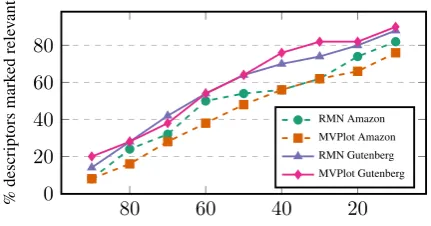
Results Figure 2 displays our results. We ob-serve a similar pattern of ratings across models and corpora, e.g., around 50% of the descriptors are labelled as relevant by at least 50% of the annota-tors. None of the differences are statistically sig-nificant which lets us conclude that interpretability of induced descriptors is comparable for the RMN and MVPlot. This is encouraging because we con-firm that representation interpretability is not com-promised by MVPlot’s more complex objective.
Table 1 displays examples of property and
re-lation descriptors induced by MVPlot from the Gutenberg corpus. We can see that the different views indeed capture differing information (e.g., a
v1 descriptor refers to individuals’titles, while a
20 40
60 80
0 20 40 60 80
% of annotators who marked descriptor relevant
%
descriptors
mark
ed
rele
vant
RMN Amazon MVPlot Amazon RMN Gutenberg MVPlot Gutenberg
Figure 2: Results of descriptor interpretability. (% of descriptors marked as ‘relevant descriptors of relations’ by various proportions of annotators).
v2 descriptor refers to a love relation). Despite
its smaller size and more homogeneous nature, we show that MVPlot learns meaningful representa-tions from the Gutenberg corpus, demonstrating the flexibility of our model.
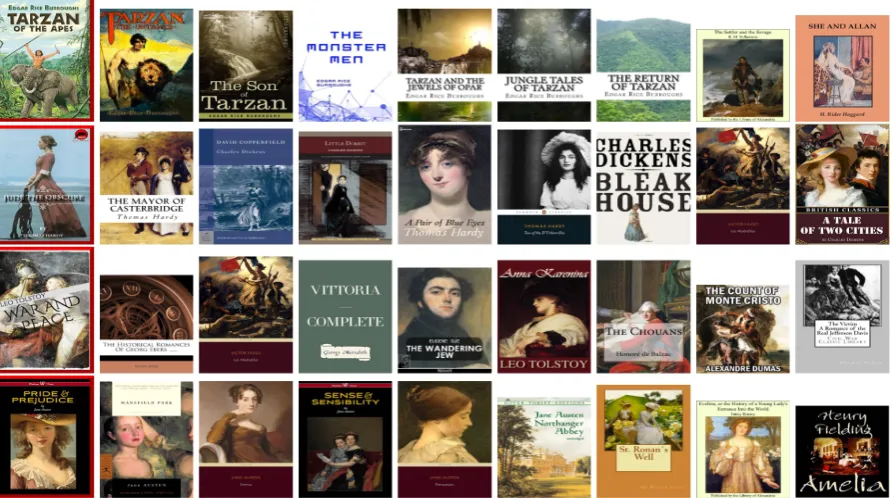
Figure 3 further illustrates this, displaying
ex-ample local neighbourhoods of four reference nov-els (left) with their eight nearest neighbours or-dered by proximity (left to right). The neighbour-hoods are intuitively meaningful, and particularly impressive bearing in mind that the full model
space contains 3,500novels. While most
neigh-bourhoods are dominated by novels of the same author, some exceptions emerge. Row two, for example, contains novels by Thomas Hardy and Charles Dickens who both are known for bio-graphical 17th century novels focusing on class and social changes.
7 Conclusions
Content-based micro-clustering of novels is a complex but interesting task. In order to even-tually augment the diverse associations humans have, models must be able to pick up rich and structured signals from raw text. This paper pre-sented a deep recurrent autoencoder which learns multi-view representations of plots, and intro-duced a principled evaluation framework using clusters based on expert-provided book tags.
[image:8.595.309.525.66.179.2]Figure 3: Nearest neighbours for four classic stories from the Gutenberg Corpus. Target novels on the left (with red border), and NNs are presented in the same row, ordered by their distance to the target novel.
micro-clusters, and might reveal previously unno-ticed parallels between novels and may be useful for literary analysis or content-based recommen-dation. This is an exciting avenue for future work. Our method is general and scalable both in terms of its input, utilizing raw text with only au-tomatic pre-processing, and in terms of the num-ber of distinct views it can learn. We described an objective function which triggers views to encode
distinctinformation. In future work we plan to ex-plore joint learning of more and different views.
Our approach relies strongly on the assumption that text spans mentioning two characters contain information about character relations, and that text spans mentioning one character contain informa-tion about the character’s properties. While our re-sults suggest that these assumptions are valid, they are arguably crude. In the future we plan to define more targeted input, e.g., by using semantic and syntactic information from dependency parses.
In this work we induced dual-view representa-tions of book content, however, we emphasize that the proposed method is very general. The number and kinds of views, as well as underlying data are in no way constrained, as long as relevant view-specific input can be defined. In the context of novel representation it would be interesting to
in-duce additional views, for example one that cap-tures the mood of a novel. Another interesting av-enue for future work would be to apply the frame-work to questions arising in the digital humanities, e.g., to extract different views from news articles.
The presented model and evaluation are de-signed with the objective to detect a different kinds of similarity between novels, with the ultimate
goal to enrich human-provided genres and tags.
We described a first step in this direction, verifying that the learnt information is meaningful and can
reproducehuman-created semantic book tags. Ex-pert book tags exist for a wide variety of informa-tion (mood, theme, characters), and provide a rich evaluation environment for learnt representations. We invite the community to join us in exploring the full space of opportunities and evaluating
in-duced representationsholisticallyin the future.
Acknowledgements
References
Gediminas Adomavicius and Alexander Tuzhilin. 2005. Toward the next generation of recommender systems: A survey of the state-of-the-art and pos-sible extensions. IEEE Trans. on Knowl. and Data Eng., 17(6):734–749.
David Bamman, Brendan O’Connor, and Noah A. Smith. 2013. Learning latent personas of film char-acters. InProceedings of the 51st Annual Meeting of the Association for Computational Linguistics (Vol-ume 1: Long Papers), pages 352–361, Sofia, Bul-garia. Association for Computational Linguistics.
David Bamman, Ted Underwood, and Noah A. Smith. 2014. A bayesian mixed effects model of literary character. InProceedings of the 52nd Annual Meet-ing of the Association for Computational LMeet-inguis- Linguis-tics (Volume 1: Long Papers), pages 370–379, Bal-timore, Maryland. Association for Computational Linguistics.
David M. Blei, Andrew Y. Ng, and Michael I. Jordan. 2003. Latent dirichlet allocation. J. Mach. Learn. Res., 3:993–1022.
Nathanael Chambers and Dan Jurafsky. 2009. Unsu-pervised learning of narrative schemas and their par-ticipants. InProceedings of the Joint Conference of the 47th Annual Meeting of the ACL and the 4th In-ternational Joint Conference on Natural Language Processing of the AFNLP, pages 602–610, Suntec, Singapore. Association for Computational Linguis-tics.
Jonathan Chang, Jordan L. Boyd-Graber, and David M. Blei. 2009. Connections between the lines: aug-menting social networks with text. InKDD, pages 169–178. ACM.
Snigdha Chaturvedi, Mohit Iyyer, and Hal Daum´e III. 2017. Unsupervised learning of evolving relation-ships between literary characters. InAssociation for the Advancement of Artificial Intelligence.
Orph´ee De Clercq, Michael Schuhmacher, Si-mone Paolo Ponzetto, and V´eronique Hoste. 2014. Exploiting framenet for content-based book recom-mendation. InProceedings of the 1st Workshop on New Trends in Content-based Recommender Sys-tems co-located with the 8th ACM Conference on Recommender Systems, CBRecSys@RecSys 2014, Foster City, Silicon Valley, California, USA, Octo-ber 6, 2014., pages 14–21.
Micha Elsner. 2012. Character-based kernels for nov-elistic plot structure. In Proceedings of the 13th Conference of the European Chapter of the Asso-ciation for Computational Linguistics, pages 634– 644, Avignon, France. Association for Computa-tional Linguistics.
David Elson, Nicholas Dames, and Kathleen McKe-own. 2010. Extracting social networks from literary
fiction. In Proceedings of the 48th Annual Meet-ing of the Association for Computational LMeet-inguis- Linguis-tics, pages 138–147, Uppsala, Sweden. Association for Computational Linguistics.
Yaroslav Ganin and Victor Lempitsky. 2015. Unsu-pervised domain adaptation by backpropagation. In
Proceedings of the 32nd International Conference on Machine Learning (ICML-15), pages 1180–1189. JMLR Workshop and Conference Proceedings. Yaroslav Ganin, Evgeniya Ustinova, Hana Ajakan,
Pascal Germain, Hugo Larochelle, Franc¸ois Lavio-lette, Mario Marchand, and Victor Lempitsky. 2016. Domain-adversarial training of neural networks. J. Mach. Learn. Res., 17(1):2096–2030.
Amit Gruber, Yair Weiss, and Michal Rosen-Zvi. 2007. Hidden topic markov models. InAISTATS, volume 2 ofJMLR Proceedings, pages 163–170. JMLR.org. A. Hyv¨arinen and E. Oja. 2000. Independent
compo-nent analysis: Algorithms and applications. Neural Netw., (4-5):411–430.
Mohit Iyyer, Anupam Guha, Snigdha Chaturvedi, Jor-dan Boyd-Graber, and Hal Daum´e III. 2016. Feud-ing families and former friends: Unsupervised learn-ing for dynamic fictional relationships. In North American Association for Computational Linguis-tics.
Matthew L. Jockers. 2013. Macroanalysis: Digital Methods and Literary History. University of Illinois Press.
Diederik P. Kingma and Jimmy Ba. 2014. Adam: A method for stochastic optimization. In Proceed-ings of the 3rd International Conference on Learn-ing Representations (ICLR).
Pasquale Lops, Marco de Gemmis, and Giovanni Se-meraro. 2011. Content-based Recommender Sys-tems: State of the Art and Trends. Springer US, Boston, MA.
Philip Massey, Patrick Xia, David Bamman, and Noah A. Smith. 2015. Annotating character rela-tionships in literary texts.CoRR, abs/1512.00728. Neil McIntyre and Mirella Lapata. 2010. Plot
induc-tion and evoluinduc-tionary search for story generainduc-tion. In
Proceedings of the 48th Annual Meeting of the Asso-ciation for Computational Linguistics, pages 1562– 1572, Uppsala, Sweden. Association for Computa-tional Linguistics.
Raymond J. Mooney and Loriene Roy. 1999. Content-based book recommending using learning for text categorization. In Proceedings of the SIGIR-99 Workshop on Recommender Systems: Algorithms and Evaluation, Berkeley, CA.
Jeffrey Pennington, Richard Socher, and Christo-pher D. Manning. 2014. Glove: Global vectors for word representation. InEmpirical Methods in Nat-ural Language Processing (EMNLP), pages 1532– 1543.
Hardik Vala, Stefan Dimitrov, David Jurgens, An-drew Piper, and Derek Ruths. 2016. Annotating Characters in Literary Corpora: A Scheme, the CHARLES Tool, and an Annotated Novel. In Pro-ceedings of the Tenth International Conference on Language Resources and Evaluation (LREC 2016), Paris, France. European Language Resources Asso-ciation (ELRA).