Accuracy-Based Scoring for DOT: Towards Direct Error Minimization for
Data-Oriented Translation
Daniel Galron
CIMS
New York University [email protected]
Sergio Penkale, Andy Way
CNGL
Dublin City University {spenkale,away} @computing.dcu.ie
I. Dan Melamed
AT&T Shannon Laboratory {lastname} @research.att.com
Abstract
In this work we present a novel technique to rescore fragments in the Data-Oriented Translation model based on their contri-bution to translation accuracy. We de-scribe three new rescoring methods, and present the initial results of a pilot experi-ment on a small subset of the Europarl cor-pus. This work is a proof-of-concept, and is the first step in directly optimizing trans-lation decisions solely on the hypothesized accuracy of potential translations resulting from those decisions.
1 Introduction
The Data-Oriented Translation (DOT) (Poutsma, 2000) model is a tree-structured translation model, in which linked subtree fragments extracted from a parsed bitext are composed to cover a source-language sentence to be translated. Each linked fragment pair consists of a source-language side and a target-language side, similar to (Wu, 1997). Translating a new sentence involves composing the linked fragments into derivations so that a new source-language sentence is covered by the source tree fragments of the linked pairs, where the yields of the target-side derivations are the can-didate translations. Derivations are scored accord-ing to their likelihood, and the translation is se-lected from the derivation pair with the highest score. However, we have no reason to believe that maximizing likelihood is the best way to maxi-mize translation accuracy – likelihood and accu-racy do not necessarily correlate well.
We can frame the problem as a search problem, where we are searching a space of derivations for the one that yields the highest scoring translation. By putting weights on the derivations in the search space, we wish to point the decoder in the direc-tion of the optimal transladirec-tion. Since we want
the decoder to find the translation with the high-est evaluation score, we would want to score the derivations with weights that correlate well with the particular evaluation measure in mind.
Much of the work in the MT literature has focused on the scoring of translation decisions made. (Yamada and Knight, 2001) follow (Brown et al., 1993) in using the noisy channel model, by decomposing the translation decisions mod-eled by the translation model into different types, and inducing probability distributions via max-imum likelihood estimation over each decision type. This model is then decoded as described in (Yamada and Knight, 2002). This type of ap-proach is also followed in (Galley et al., 2006).
There has been some previous work on accuracy-driven training techniques for SMT, such as MERT (Och, 2003) and the Simplex Armijo Downhill method (Zhao and Chen, 2009), which tune the parameters in a linear combination of var-ious phrase scores according to a held-out tun-ing set. While this does tune the relative weights of the scores to maximize the accuracy of candi-dates in the tuning set, the scores themselves in the linear combination are not necessarily correlated with the accuracy of the translation. Tillmann and Zhang (2006) present a procedure to directly opti-mize the global scoring function used by a phrase-based decoder on the accuracy of the translations. Similarly to MERT, Tillmann and Zhang estimate the parameters of a weight vector on a linear com-bination of (binary) features using a global objec-tive function correlated with BLEU (Papineni et al., 2002).
In this work, we prototype some methods for moving directly towards incorporating a measure of the translation quality of each fragment used, bringing DOT more into the mainstream of cur-rent SMT research. In Section 2 we describe probability-based DOT fragment scoring. In Sec-tion 3 we describe our rescoring setup and the
(a) S
NP VP
V
likes NP
S
NP VP
V
plaˆıt PP
P
`a NP
(b) NP
John NP
John
(c) S
NP
John
VP
V
likes NP
S
NP VP
V
plaˆıt PP
P
`a NP
John (d)
NP
Mary NP
[image:2.595.77.285.64.242.2]Mary
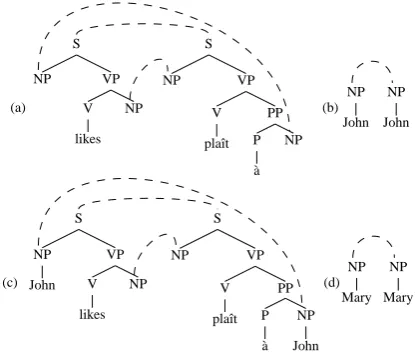
Figure 1: Example DOT Fragments.
three rescoring methods. In Section 4, we describe our experiments. In Section 5 we compare the results of rescoring the fragments with the three methods. In Section 6 we discuss some of the decisions that are affected by our rescoring meth-ods. Finally, we discuss the next steps in training the DOT system by optimizing over a translation accuracy-based objective function in Section 7.
2 DOT Scoring
As described in previous work (Poutsma, 2000; Hearne and Way, 2003), DOT scores translations according to the probabilities of the derivations, which are in turn computed from the relative fre-quencies of linked tree fragments in a parallel tree-bank. Linked fragment pairs are conditionally in-dependent, so the score of a derivation is the prod-uct of the probabilities of all the linked fragments used. To find the probability of a translation, DOT marginalizes over the scores of all deriva-tions yielding the translation.
From a parallel treebank aligned at the sub-sentential level, we extract all possible linked frag-ment pairs by first selecting all linked pairs of nodes in the treebank to be the roots of a new sub-tree pair, and then selecting a (possibly empty) set of linked node pairs that are descendants of the newly selected fragment roots and deleting all sub-tree pairs dominated by these nodes. Leaves of fragments can either be terminals, or non-terminal frontier nodes where we can compose other frag-ments (c.f. (Eisner, 2003)). We give example DOT fragment pairs in Figure 1.
Given two subtree pairs hs1, t1i and hs2, t2i, we can compose them using the DOT composi-tion operator ◦ if the leftmost non-terminal
fron-tier node of s1 is equal to the root node of s2, and the leftmost non-terminal frontier node ofs1’s linked counterpart int1 is equal to the root node of t2. The resulting tree pair consists of a copy of s1 where s2 has been inserted at the leftmost frontier node, and a copy oft1 wheret2 has been inserted at the node linked tos1’s leftmost frontier node (Hearne and Way, 2003).
In Figure 1, fragment pair (a) is a fragment with two open substitution sites. If we compose this fragment pair with fragment pair (b), the source side composition must take place on the leftmost non-terminal frontier node (the leftmost NP). On the target side we compose on the frontier linked to the leftmost source side non-terminal frontier. The result is fragment pair (c). If we now com-pose the resulting fragment pair with fragment pair (d), we obtain a fragment pair with no open sub-stitution sites whose source-side yield is John likes Mary and whose target-side yield is Mary plaˆıt `a John. Note that there are two different derivations using the fragment pairs in Figure 1 that result in the same fragment pair, namely (a)◦(b)◦(d), and (c)◦(d).
For a given linked fragment pair hds, dti, the probability assigned to it is
P(hds, dti) = P |hds, dti|
r(us)=r(ds)∧r(ut)=r(dt)|hus, uti|
(1) where |hds, dti| is the number of times the frag-ment pairhds, dtiis found in the bitext, andr(d) is the root nonterminal ofd. Essentially, the prob-ability assigned to the fragment pair is the relative frequency of the fragment pair to the pair of non-terminals that root the fragments.
Then, with the assumption that DOT fragments are conditionally independent, the probability of a derivation is
P(d) = P(hds, dti1◦. . .◦ hds, dtiN)
= Y
i
P(hds, dtii) (2)
given by (3):
P(ws, wt) =
X
d∈D
P(dhws,wti) (3)
and the translation is chosen so as to maximize (4):
ˆ
wt= argmax
wt P(ws, wt) (4)
Hearne and Way (2006) examined alternative dis-ambiguation strategies. They found that rather than disambiguating on the translation probability, the translation quality would improve by disam-biguating on the derivation probability, as in (5):
ˆ
wt= argmax
d P(d) (5)
Our analysis suggest that this is because many derivations with very low probabilities generate the same, poor translation. When applying Equa-tion (3) to marginalize over those derivaEqua-tions, the resulting score is higher for the poor translation than a better translation with fewer derivations but where the derivations had higher likelihood.
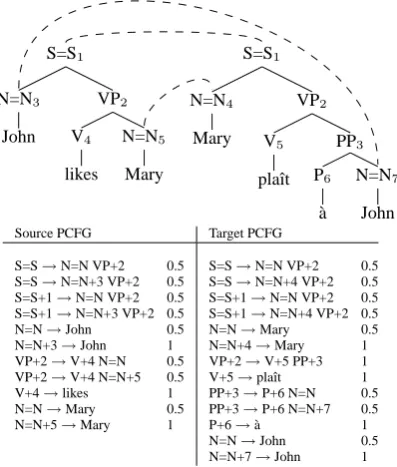
Using the DOT model directly is difficult – the number of fragments extracted from a paral-lel treebank is exponential in the size of the tree-bank. Therefore we use the Goodman reduction of DOT (Hearne, 2005) to create an isomorphic PCFG representation of the DOT model that is lin-ear in the size of the treebank. The idea behind the Goodman reduction is that rather than storing frag-ments in the grammar and translating via compo-sition, we simultaneously build up the fragments using the PCFG reduction and compose them to-gether. To perform the reduction, we first relabel the two linked nodes (X, Y) with the new label X=Y. We then label each node in the parallel tree-bank with a unique Goodman index. Each binary-branching node and its two children can be inter-nal or root/frontier. We add rules to the grammar reflecting the role that each node can take, keeping unaligned nodes as fragment-internal nodes. So in the case where a node and both of its children are aligned, we commit 8 rules into the grammar, as follows:
LHS→RHS1 RHS2 LHS+a→RHS1 RHS2 LHS→RHS1+b RHS2 LHS+a→RHS1+b RHS2 LHS→RHS1 RHS2+c LHS+a→RHS1 RHS2+c LHS→RHS1+b RHS+c LHS+a→RHS1+b RHS2+c
A category label which ends in a ‘+’ symbol fol-lowed by a Goodman index is fragment-internal and all other nodes are either fragment roots or
S=S1
N=N3
John
VP2
V4
likes N=N5
Mary
S=S1
N=N4
Mary
VP2
V5
plaˆıt
PP3
P6
`a
N=N7
John
Source PCFG Target PCFG
S=S→N=N VP+2 0.5 S=S→N=N VP+2 0.5 S=S→N=N+3 VP+2 0.5 S=S→N=N+4 VP+2 0.5 S=S+1→N=N VP+2 0.5 S=S+1→N=N VP+2 0.5 S=S+1→N=N+3 VP+2 0.5 S=S+1→N=N+4 VP+2 0.5
N=N→John 0.5 N=N→Mary 0.5
N=N+3→John 1 N=N+4→Mary 1
VP+2→V+4 N=N 0.5 VP+2→V+5 PP+3 1 VP+2→V+4 N=N+5 0.5 V+5→plaˆıt 1 V+4→likes 1 PP+3→P+6 N=N 0.5 N=N→Mary 0.5 PP+3→P+6 N=N+7 0.5
N=N+5→Mary 1 P+6→`a 1
N=N→John 0.5
[image:3.595.321.520.60.294.2]N=N+7→John 1
Figure 2: A parallel tree and its corresponding Goodman re-duction.
frontier nodes. A fragment pair, then, is a pair of subtrees in which the root does not have an index, all internal nodes have indices, and all the leaves are either terminals or un-indexed nodes. We give an example Goodman reduction in Figure 2.
While we store the source grammar and the tar-get grammar separately, we also keep track of the correspondence between source and target Good-man indices and can easily identify the alignments according to the Goodman indices. Probabilities for the PCFG rules are computed monolingually as in the standard Goodman reduction for DOP (Goodman, 1996). In decoding with the Goodman reduction, we first find the n-best parses on the source side, and for each source fragment, we con-struct the k-best fragments on the target side. We finally compute the bilingual derivation probabil-ities by multiplying the source and target deriva-tion probabilities by the target fragment relative frequencies conditioned on the source fragment.
(and by extension, DOT) is known to be biased and inconsistent.
3 Accuracy-Based Fragment Scoring
In our work, we wish to incorporate a measure of fragment accuracy into the scoring. To do so, we reformulate the scoring of DOT as log-linear rather than probabilistic, in order to incorporate non-likelihood features into the derivation scores. For all tree fragment pairshds, dti, let
l(hds, dti) = log(p(hds, dti)) (6)
The general form of a rescored tree fragment will be
s(hds, dti) =α0l(hds, dti) + k
X
i=1
αifi(hds, dti)
(7) where eachαi is the weight of that term in the fi-nal score, and eachfi(d)is a feature. In this work, we only considerf1(d), an accuracy-based score, although in future work we will consider a wide variety of features in the scoring function, includ-ing combinations of the different scorinclud-ing schemes described below, binary lexical features, binary source-side syntactic features, and local target side features. The score of a derivation is now given by (8):
s(d) = s(hds, dti1◦. . .◦ hds, dtiN)
= X
i
s(hds, dtii) (8)
In order to disambiguate between candidate translations, we follow (Hearne and Way, 2006) by using Equation (5).
3.1 Structured Fragment Rescoring
In all our approaches, we rescore fragments ac-cording to their contribution to the accuracy of a translation. We would like to give fragments that contribute to good translations relatively high scores, and give fragments that contribute to bad translations relatively low scores, so that during decoding fragments that are known to contribute to good translations would be chosen over those that are known to contribute to bad translations. Fur-thermore, we would like to score each fragment in a derivation independently, since bad translations may contain good fragments, and vice-versa.
In practice, it is infeasible to rescore only those fragments seen during the rescoring process, due
to the Goodman reduction for DOT. If we were to properly rescore each fragment, a new rule would need to be added to the grammar for each rule ap-pearing in the fragment. Since the number of frag-ments is exponential, this would lead to a substan-tial increase in grammar size. Instead, we rescore the individual rules in the fragments, by evenly di-viding the total amount of scoring mass among the rules of the particular fragment, and then assigning them the average of the rule scores over all frag-ments in which they appear. That is for each rule r in a fragment f consisting of cf(r) rules with scoreδ(f), the score of the rule is given as:
s(r) =
P
f:r∈fδ(f)/cf(r)
|f| (11)
This has the further advantage that we are al-lowing fragments that were unseen during tuning to be rescored according to previously seen frag-ment substructures.
To implement this scheme, we select a set of or-acle translations for each sentence in the tuning data by evaluating all the candidate translations against the gold standard translation using the F-score (Turian et al., 2003), and selecting those with the highest F1-measure, with exponent 1. We use GTM, rather than BLEU, because BLEU is not known to work well on a per-sentence level (Lavie et al., 2004) as needed for oracle selection. We then compare all the target-side fragments in-ferred in the translation process for each candidate translation against the fragments that yielded the oracles. There are two relevant parts of the frag-ments – the internal yields (i.e. the terminal leaves of the fragment) and the substitution sites (i.e. the frontiers where other fragments attach). We score the fragments rooted at the substitution sites sepa-rately from the parent fragment. We can uniquely identify the set of fragments that can be rooted at substitution sites by determining the span of the linked source-side derivation.
To compare two fragments, we define an edit distance between them. For a given fragment d, let r(d) be the root of the fragment, let r(d) → rhs1 be the left subtree of r(d), and letr(d) → rhs2be the right subtree. The difference between a candidate fragment dc and an oracle fragment dgsis given by the equations in Table 1.
δ(dc, dgs) =
(
0 ifdc=dgs
1 ifdc6=dgsBase case:dcanddgsare unary subtrees or substitution sites (9)
δ(dc, dgs) = min
8 > > > > > > > < > > > > > > > :
δ(dc→rhs1, dgs→rhs1) +δ(dc→rhs2, dgs→rhs2), δ(dc→rhs2, dgs→rhs1) +δ(dc→rhs1, dgs→rhs2) + 1, δ(dc, dgs→rhs1) +|y(dgs→rhs2)|,
δ(dc, dgs→rhs2) +|y(dgs→rhs1)|, δ(dc→rhs1, dgs) +|y(dc→rhs2)|, δ(dc→rhs2, dgs) +|y(dc→rhs1)|
[image:5.595.121.486.75.178.2](10)
Table 1: The recursive relation defining the fragment difference between two fragments.
(a) A
B
b C
c
(b) A
C
c B
b
(c) D
A
B
b F
f E
e
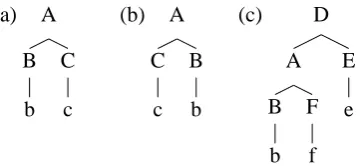
Figure 3: Comparing trees (a) and (b) with our distance met-ric yields a value of 1. The difference between trees (a) and (c) is 2, and for trees (b) and (c) the distance is 3.
as edit operations. For example, the only dif-ference between trees (a) and (b) in Figure 3 is that their children have been inverted. To com-pare these trees using our distance metric, we first compute the first argument of theminfunction in Equation (10), directly comparing the structure of each immediate subtree. We then compute the sec-ond argument, obtaining the cost of performing an inversion, and finally compute the remaining argu-ments, assessing the cost of allowing each tree to be a direct subtree of the other. The result of this computation is1, representing the inversion oper-ation required to transform tree (a) into tree (b). If we compare trees (a) and (c) in Figure 3, we obtain a value of2, given that the minimum opera-tions required to transform tree (a) into tree (c) are inserting an additional subtree at the top level and then substituting the subtree rooted by C for the subtree rooted by F. If we compare tree (b) with tree (c) then the distance is 3, since we are now required to also replace the subtree rooted by C by the one rooted by B.
Since it is not efficient to compute the differ-ences directly, we utilize common substructures and derive a dynamic programming implementa-tion of the recursion. We compare each fragment against the set of oracle fragments for the same source span, and select the lowest cost as the score, assigning the candidate the negative difference
be-tween it and the oracle fragment it is most similar to, as in (12):
f(hds, dti) = max
hdos,do
ti∈Do:dos=ds
−δ(dt, dot) (12)
In practice, given the Goodman reduction for DOT, we divide the fragment score by the number of rules in the fragment, and assign the average of those scores for each rule instance across all frag-ments rescored.
3.2 Normalized Structured Fragment
Rescoring
In the structured fragment rescoring scheme, the scores that the fragments are assigned are the un-normalized edit distances between the two frag-ments. It may be better to normalize the fragment scores, rather than using the minimum number of tree transformations to convert one fragment into the other. We would expect that when compar-ing larger fragments, on average there would be more transformations needed to change one into the other than when comparing small fragments. However in the previous scheme, small fragments would have higher scores than large fragments, since fewer differences would be observed. The normalized score is given in (13):
f(hds, dti) = max
hdo
s,doti∈Do:dos=ds
log(1−δ(dt, dot)/
max(|dt|,|dot|))
(13)
Essentially, we are normalizing the edit distance by the maximum edit distance possible, namely the size of the largest fragment of the two being compared.
3.3 Fragment Surface Rescoring
[image:5.595.94.275.228.311.2]syntactic structure of the fragment into account. In comparing two fragments, they may have the same (or very similar) surface yields, but differ-ent internal structures. The previous approach would penalize the candidate fragment, even if its yield is quite close to the oracle. In this rescor-ing method, we extract the leaves of the candi-date and oracle fragments, representing the substi-tution sites by the source span which their frag-ments cover. We then compare them using the Damerau-Levenshtein distanceδdl(dc, dgs) (Dam-erau, 1964) between the two fragment yields, and score them as in (14):
f(hds, dti) = max
hdos,do
ti∈Do:dos=ds
−δdl(dt, dot) (14)
In Equation (14) we are selecting the maximal score for hds, dti from its comparison to all the possible corresponding oracle fragments. In this way, we are choosing to scorehds, dtiagainst the oracle fragment it is closest to.
4 Experiments
For our pilot experiments, we tested all the rescor-ing methods in the previous section on Spanish-to-English translation against the relative-frequency baseline. We randomly selected 10,000 sentences from the Europarl corpus (Koehn, 2005), and parsed and aligned the bitext as described in (Tins-ley et al., 2009). From the parallel treebank, we extracted a Goodman reduction DOT grammar, as described in (Hearne, 2005), although on an order of magnitude greater amount of training data. Un-like (Bod, 2007), we did not use the unsupervised version of DOT, and did not attempt to scale up our amount of training data to his levels, although in ongoing work we are optimizing our system to be able to handle that amount of training data. To perform the rescoring, we randomly chose an ad-ditional 30K sentence pairs from the Spanish-to-English bitext. We rescored the grammar by trans-lating the source side of the 10K training sentence pairs and 10K of the additional sentences, and us-ing the methods in Section 3 to score the frag-ments derived in the translation process. We then performed the same experiment translating the full 40K-sentence set. Rules in the grammar that were not used during tuning were rescored using a de-fault score defined to be the median of all scores observed.
Our system performs translation by first obtain-ing then-best parses for the source sentences and
BLEU NIST F-SCORE
Baseline 8.78 3.582 38.21 2-8 4-6 5-5 6-4 8-2
BLEU SFR 10.30 10.31 10.32 10.27 10.08 NSFR 8.31 9.37 9.53 9.66 9.90
FSR 10.19 10.25 10.18 10.19 9.93
NIST SFR 3.792 3.805 3.808 3.800 3.781 NSFR 3.431 3.638 3.661 3.693 3.722 FSR 3.784 3.799 3.792 3.795 3.764
F-SCORE SFR 40.92 40.82 40.86 40.84 40.78
[image:6.595.307.527.61.187.2]NSFR 37.53 39.50 39.93 40.38 40.78 FSR 40.83 40.85 40.87 40.91 40.67
Table 2: Results on test set. Rescoring on 20K sentences.
SFR stands for Structured Fragment Rescoring, NSFR for
Normalized SFR and FSR for Fragment Surface Rescoring.
system-i-jrepresents the corresponding system withα0=i
andα1 =j. Underlined results are statistically significantly better than the baseline atp= 0.01.
BLEU NIST F-SCORE
Baseline 8.78 3.582 38.21 2-8 4-6 5-5 6-4 8-2
BLEU SFR 10.59 10.58 10.41 10.38 10.08
NSFR 8.61 9.71 9.90 9.96 9.93 FSR 10.49 10.48 10.35 10.38 10.06
NIST SFR 3.841 3.835 3.810 3.807 3.785
NSFR 3.515 3.694 3.713 3.734 3.727 FSR 3.834 3.833 3.820 3.816 3.784
F-SCORE SFR 41.12 40.99 40.86 40.88 40.75
NSFR 38.16 40.39 40.69 40.90 40.75 FSR 41.03 41.02 41.01 40.98 40.72
Table 3: Results on test set. Rescoring on 40K sentences. Un-derlined are statistically significantly better than the baseline atp= 0.01.
then computing thek-best bilingual derivations for each source parse. In our experiments we used beams of n = 10,000andk = 5. We also ex-perimented with different values ofα0 andα1 in Equation (7). We set these parameters manually, although in future work we will automatically tune them, perhaps using a MERT-like algorithm.
We tested our rescored grammars on a set of 2,000 randomly chosen Europarl sentences, and used a set of 200 randomly chosen sentences as a development test set. 1
5 Results
Translation quality results can be found in Tables 2 and 3. In these tables, columns labeled i-j in-dicate that the corresponding system was trained using parameters α0 = i and α1 = j in Equa-tion 7. Statistical significance tests for NIST and BLEU were performed using Bootstrap Resam-pling (Koehn, 2004).
1All sentences, including the ones used for training, were
[image:6.595.307.526.275.401.2]BLEU NIST F-SCORE
Baseline 10.82 3.493 42.31 2-8 4-6 5-5 6-4 8-2
BLEU SFR 11.34 12.12 11.94 11.97 11.78 NSFR 9.68 10.99 11.38 11.63 11.30 FSR 11.40 11.49 11.72 11.91 11.72
NIST SFR 3.653 3.727 3.723 3.708 3.694 NSFR 3.376 3.530 3.554 3.616 3.572 FSR 3.655 3.675 3.698 3.701 3.675
[image:7.595.72.291.61.188.2]F-SCORE SFR 44.84 45.47 45.36 45.33 45.08 NSFR 41.44 43.38 44.18 44.79 44.26 FSR 44.68 44.91 45.15 45.19 44.82
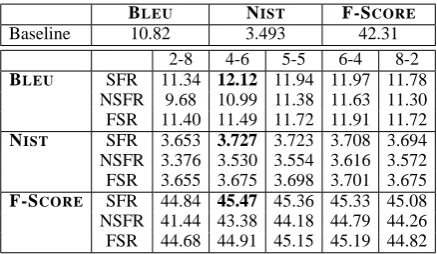
Table 4: Results on development test set. Rescoring on 40K sentences.
As Table 2 indicates, all three rescoring meth-ods significantly outperform the relative frequency baseline. The unnormalized structured fragment rescoring method performed the best, with the largest improvement of 1.5 BLEU points, a 17.5% relative improvement. We note that the BLEU scores for both the baseline and the experiments are low. This is to be expected, because the gram-mar is extracted from a very small bitext espe-cially when the heterogeneity of the Europarl cor-pus is considered. In our analysis, only 32.5 per-cent of the test sentences had a complete source-side parse, meaning that a lot of structural infor-mation is lost contributing to arbitrary target-side ordering. In these experiments we did not use an additional language model. DOT (and many other syntax-based SMT systems) essentially have the target language model encoded within the trans-lation model, since the inferences derived dur-ing translations link source structures to target structures, so in principle, no additional language model should be necessary. Furthermore, we only evaluate against a single reference, which also contributes to the lowering of absolute scores. To provide a sanity check against a state-of-the-art system, we trained the Moses phrase-based MT system (Koehn et al., 2007) using our training corpus, using no language model and using uni-form feature weights, to provide a fair comparison against our baseline. We used this system to de-code our development test set, and as a result we obtained a BLEU score of 10.72, which is compa-rable to the score obtained by our baseline on the same set.
When we scale up to tuning on 40,000 sen-tences we see an improvement in BLEU scores as well, as shown in Table 3. When tuning on 40K sentences, we observe an increase of 1.81 BLEU points on the best-performing system, which is a
20.6% improvement over the baseline. We note that rescoring on 20K sentences rescores approxi-mately 275,000 rules out of 655,000 in the gram-mar, whereas rescoring on 40K sentences rescores approximately 280,000.
To analyze the benefits of the rescored gram-mar, we set aside a separate development set that we decoded with the grammar trained on 40K sen-tences. The results are presented in Table 4. The analysis is presented in Section 6.
Interestingly, there is a large difference between the normalized and unnormalized versions of the SFR scoring scheme. Our analysis suggests that the differences are mostly due to numerical issues, namely the difference in magnitude between the NSFR scores and the likelihood scores in the linear combination, and the default value assigned when the NSFR score was zero. In ongoing work, we are working to address these issues.
For most configurations the difference between SFR and FSR was not statistically significant at p = 0.05. Our analysis indicated that surface dif-ferences tended to co-occur with structural differ-ences. We hypothesize that as we scale up to larger and more ambiguous grammars, the system will infer more derivations with the same yields, ren-dering a larger difference between the quality of the two scoring mechanisms.
6 Discussion
To analyze the advantages and disadvantages of our approach over the baseline, we closely ex-amined and compared the derivations made on the devset translation by the SFR-scored gram-mar and the likelihood-scored gramgram-mar. Although the BLEU scores are rather low, there were sev-eral sentences in which the SFR-scored grammar showed a marked improvement over the baseline. We observed two types of improvements.
sn=NP+67600−1.97/−5.66
NP+67608
the rapporteur
sp=PP+67601
s=IN−0.48/−0.37
in
sn=SBAR+165198 −1.39/−1.90
nc=TO+165203
to
dn=VP0/−0.49
make
sn=NP+36950−5.89/−5.09
NP+36952
the rapporteur
sp=PP+36951−4.28/−3.81
s=IN−0.48/−0.37
in
sn=NP+36953
dn=DT0/−0.58
both
nc=NNS−1.03/−0.81
[image:8.595.77.523.79.206.2]questions
Figure 4: Target side of the highest-scoring translations for a sentence, according to the baseline system (left) and the SFR system (right). Boxed nodes are substitution sites. Scores in superscripts denote the score of the sub-derivation according to the baseline and to the SFR system.
and the rescored grammar outputs the translation “to there in the third place , I are the problem of the implementation standardised is the Commu-nity law .”, with an F-Score of 0.5. While many of the fragments in the derivations that yielded these two translations differ, the ones we would like to focus on are the fragments that yield the transla-tion of “comunitario”. The grammar contains sev-eral competing unary fragment pairs for “comuni-taro”. In the baseline grammar, the pair (aq=NNP
→ comunitario, aq=NNP→EU) has a score of −0.693147, whereas the pair (aq=NNP → comunitario,aq=NNP→Community) has a score of−1.38629. In the rescored grammar how-ever, (aq=NNP → comunitario, aq=NNP→ EU) has a score of -0.762973, whereas (aq=NNP
→ comunitario, aq=NNP → Community) has a score of -0.74399. In effect, the rescoring scheme rescored the word alignment itself. This suggests that in future work, it may be possible to integrate a word aligner or fragment aligner di-rectly into the MT training method.
The other improvement was where the baseline and the SFR-scored grammar output translations of roughly the same quality according to the eval-uation measure, yet in terms of human evaleval-uation, the SFR translation was much better than the base-line translation. For instance, our devset contained the Spanish sentence “Estoy de acuerdo con el po-nente en dos cuestiones .” The baseline transla-tion given is “I agree with the rapporteur in to make .”, and the SFR-scored translation given is “I agree with the rapporteur in both questions .”. While both translations have the same GTM score against the gold standard “I agree with the rap-porteur on two issues .”, clearly, the second one
is of far higher quality than the first. As we can see in Figure 4, the derivation over the substring “in both questions” gets a higher score than “in to make” when translated with the rescored gram-mar. In the baseline, “en dos cuestiones” is not translated as a whole unit – rather, the derivation of “el ponente en dos cuestiones” is decomposed into four subderivations, yielding “el” “ponente” “en” “dos cuestiones”, where each of those is translated separately, into “∅” “the rapporteur” “in” and “to make”. The SFR-scored grammar, however, out-puts a different bilingual derivation. The source is decomposed into five sub-derivations, one for each word, and each word is translated separately. Then, the rescored target fragments set the proper target-side word order and select the target-side words that maximize the score of the subderiva-tion covering the source span. We note that in this example, the score of translating “dos” to “make” was higher than the score of translating “dos” to “both”. However, the higher level target frag-ment that composed the translation of “dos” to-gether with the translation of “cuestiones” yielded a higher score when composing “both questions” rather than “to make”.
7 Conclusions and Future Work
transla-tion’s accuracy.
Now that we have demonstrated that translation quality can be improved by incorporating a mea-sure of fragment quality into the scoring scheme, our immediate next step is to optimize our sys-tem so that we can scale up to significantly larger training and tuning sets, and determine whether the improvements we have noted carry over when the likelihood is computed from more data. Af-terwards, we will implement a training scheme to maximize an accuracy-based objective func-tion, for instance, by minimizing the difference between the scores of the highest-scoring deriva-tion and the oracle derivaderiva-tions, in effect maximiz-ing the score of the highest-scormaximiz-ing translation.
The rescoring method presented in this paper need not be limited to DOT. Fragments can be thought of as analogous to phrases in Phrase-Based SMT systems – we could implement a sim-ilar rescoring system for phrase-based systems, where we generate several candidate translations for source sentences in a tuning set, and score each phrase used against the phrases used in a set of or-acles. More broadly, we could potentially take any statistical MT system, and compare the features of all candidates generated against those of oracle translations, and score those that are closer to the oracle higher than those further away.
Finally, by explicitly framing the translation problem as a search problem, where we are di-vorcing the inferences in the search space (i.e. the model) from the path we take to find the op-timal inference according to some criterion (i.e. the scoring scheme), we can remove some of the variability when comparing two models or scoring mechanisms (Lopez, 2009).
Acknowledgements
This work is supported by Science Foundation Ire-land (Grant No. 07/CE/I1142). We would like to thank the anonymous reviewers for their helpful comments and suggestions.
References
R. Bod. 2007. Unsupervised syntax-based ma-chine translation: The contribution of discontiguous phrases. In Proceedings of the 11th Machine
Trans-lation Summit, pages 51–57, Copenhagen,
Den-mark.
P. F. Brown, S. Della Pietra, V. Della Pietra, and R. Mercer. 1993. The mathematics of statistical ma-chine translation: Parameter estimation.
Computa-tional Linguistics, 19(2):263–311.
F. J. Damerau. 1964. A technique for computer de-tection and correction of spelling errors. Commun.
ACM, 7(3):171–176.
J. Eisner. 2003. Learning non-isomorphic tree map-pings for machine translation. In Proceedings of the
41st Annual Meeting of the Association for Com-putational Linguistics (ACL), Companion Volume,
pages 205–208, Sapporo.
M. Galley, J. Graehl, K. Knight, D. Marcu, S. De-Neefe, W. Wang, and I. Thayer. 2006. Scalable in-ference and training of context-rich syntactic trans-lation models. In Proceedings of the 21st
Interna-tional Conference on ComputaInterna-tional Linguistics and 44th Annual Meeting of the Association for Compu-tational Linguistics, pages 961–968, Sydney,
Aus-tralia.
J. Goodman. 1996. Efficient algorithms for parsing the DOP model. In Proceedings of the Conference on
Empirical Methods in Natural Language Process-ing, pages 143–152, Philadelphia, PA.
M. Hearne and A. Way. 2003. Seeing the wood for the trees: Data-oriented translation. In Proceedings of
the Ninth Machine Translation Summit, pages 165–
172, New Orleans, LA.
M. Hearne and A. Way. 2006. Disambiguation strate-gies for data-oriented translation. In Proceedings of
the 11th Conference of the European Association for Machine Translation, pages 59–68, Oslo, Norway.
M. Hearne. 2005. Data-Oriented Models of Parsing
and Translation. Ph.D. thesis, Dublin City
Univer-sity, Dublin, Ireland.
M. Johnson. 2002. The DOP estimation method is biased and inconsistent. Computational Linguistics, 28(1):71–76, March.
P. Koehn, H. Hoang, A. Birch, C. Callison-Burch, M. Federico, N. Bertoldi, B. Cowan, W. Shen, C. Moran, R. Zens, C. Dyer, O. Bojar, A. Constantin, and E. Herbst. 2007. Moses: Open source toolkit for statistical machine translation. In Proceedings
of the Annual Meeting of the Association for Com-putational Linguistics, demonstation session, pages
177–180, Prague, Czech Republic.
the Conference on Empirical Methods in Natural Language Processing, pages 388–395, Barcelona,
Spain.
P. Koehn. 2005. Europarl: A Parallel Corpus for Sta-tistical Machine Translation. In Machine
Transla-tion Summit X, pages 79–86, Phuket, Thailand.
A. Lavie, K. Sagae, and S. Jayaraman. 2004. The sig-nificance of recall in automatic metrics for MT eval-uation. In Proceedings of the 6th Conference of the
Association for Machine Translation in the Ameri-cas, pages 134–143, Washington, DC.
A. Lopez. 2009. Translation as weighted deduction. In
Proceedings of the 12th Conference of the European Chapter of the ACL (EACL 2009), pages 532–540,
Athens, Greece.
F. J. Och. 2003. Minimum error rate training in statis-tical machine translation. In Proceedings of the 41st
Annual Meeting of the Association for Computa-tional Linguistics, pages 160–167, Sapporo, Japan.
K. Papineni, S. Roukos, T. Ward, and W. Zhu. 2002. Bleu: a method for automatic evaluation of machine translation. In Proceedings of 40th Annual
Meet-ing of the Association for Computational LMeet-inguis- Linguis-tics, pages 311–318, Philadelphia, PA.
A. Poutsma. 2000. Data-oriented translation. In The
18th International Conference on Computational Linguistics, pages 635–641, Saarbr¨ucken, Germany.
C. Tillmann and T. Zhang. 2006. A discrimina-tive global training algorithm for statistical MT. In
Proceedings of the 21st International Conference on Computational Linguistics and the 44th annual meeting of the Association for Computational Lin-guistics, pages 721–728, Sydney, Australia.
J. Tinsley, M. Hearne, and A. Way. 2009. Parallel tree-banks in phrase-based statistical machine transla-tion. In Proceedings of the Tenth International
Con-ference on Intelligent Text Processing and Computa-tional Linguistics (CICLing), pages 318–331,
Mex-ico City, MexMex-ico.
J. Turian, L. Shen, and I. D. Melamed. 2003. Eval-uation of machine translation and its evalEval-uation. In
Proceedings of the Ninth Machine Translation Sum-mit, pages 386–393, New Orleans, LA.
D. Wu. 1997. Stochastic inversion transduction gram-mars and bilingual parsing of parallel corpora.
Com-putational Linguistics, 23(3):377–404.
K. Yamada and K. Knight. 2001. A syntax-based statistical translation model. In Proceedings of
39th Annual Meeting of the Association for Com-putational Linguistics, pages 523–530, Toulouse,
France.
K. Yamada and K. Knight. 2002. A decoder for syntax-based statistical MT. In Proceedings of 40th
Annual Meeting of the Association for Computa-tional Linguistics, pages 303–310, Philadelphia, PA.
B. Zhao and S. Chen. 2009. A simplex armijo downhill algorithm for optimizing statistical ma-chine translation decoding parameters. In
Proceed-ings of Human Language Technologies: The 2009 Annual Conference of the North American Chap-ter of the Association for Computational Linguis-tics, Companion Volume: Short Papers, pages 21–