Corpus-Based Learning for N o u n Phrase Coreference R e s o l u t i o n
W e e M e n g S o o n H w e e T o u N g C h u n g Y o n g L i m DSO National Laboratories
20 Science P a r k Drive, Singapore 118230
{sweemeng ,nhweetou, ichungyo}©dso, org. sg
A b s t r a c t
In this paper, we present a learning approach for coreference resolution of noun phrases in unrestricted text. The approach learns from a small, annotated corpus and the task in- cludes resolving not just pronouns but rather general noun phrases. In contrast to previous work, we attempt to evaluate our approach on a common data set, the MUC-6 coreference cor- pus. We obtained encouraging results, indicat- ing that on the general noun phrase coreference task, the learning approach holds promise and achieves accuracy comparable to non-learning approaches.
1 I n t r o d u c t i o n
Coreference resolution refers to the process of determining if two expressions in natural lan- guage refer to the same entity in the world. It is an important subtask in natural language processing systems. In particular, informa- tion extraction (IE) systems like those built in the DAI:tPA Message Understanding Confer- ences (Chinchor, 1998; Sundheim, 1995) have revealed that coreference resolution is such a critical component of IE systems that a sepa- rate coreference subtask has been defined and evaluated since MUC-6 (Committee, 1995).
In this paper, we focus on the task of deter- mining coreference relations as defined in MUC- 6 (Committee, 1995). Specifically, a coreference relation denotes an identity of reference and holds between two textual elements known as
markables,
which are nouns, noun phrases, or pronouns. Thus, our coreference task resolves general noun phrases and not just pronouns, unlike in some previous work on anaphora res- olution. The ability to link co-referring noun phrases both within and across sentences is crit- ical to discourse analysis and language under-standing in general.
2 A L e a r n i n g A p p r o a c h f o r C o r e f e r e n c e R e s o l u t i o n
We adopt a corpus-based, learning approach for noun phrase coreference resolution. In this ap- proach, we need a relatively small corpus of training documents that have been annotated with coreference chains of noun phrases. All possible markables in a training document are determined by a pipeline of language process- ing modules, and training examples in the form of feature vectors are generated for appropri- ate pairs of markables. These training exam- ples are then given to a learning algorithm to build a classifier. To determine the coreference chains in a new document, all markables are determined and potential pairs of co-referring markables are presented to the classifier which will decide whether the two markables actually co-refer. We give the details of these steps in the following subsections.
2.1 D e t e r m i n a t i o n o f M a r k a b l e s
A pre-requisite for coreference resolution is to obtain most, if not all, of the possible mark- ables in a raw input text. To determine the markables, a pipeline of natural language pro- cessing (NLP) modules is used. They consist of sentence segmentation, tokenization, morpho- logical analysis, part-of-speech tagging, noun phrase identification, named entity recognition, and semantic class determination. As far as coreference resolution is concerned, the goal of these NLP modules is to determine the bound- ary of the markables, and to provide the neces- sary in.formation about each markable for sub- sequent generation of features in the training examples.
tistical bigram tagger based on the Hidden Markov Model (HMM) (Church, 1988). Sim- ilarly, we built a statistical HMM-based noun phrase identification module where the noun phrase boundaries are determined solely based on the part-of-speech tags assigned to the words in a sentence. We also implemented a mod- ule that recognizes MUC-style named entities, i.e., organization, person, location, date, time, money, and percent. Our named entity recogni- tion module uses the HMM approach of (Bikel et al., 1999; Bikel et al., 1997), which learns from a tagged corpus of n a m e d entities. T h a t is, our part-of-speech tagger, n o u n phrase iden- tification module, and the n a m e d entity recog- nition module are all based on HMM and learn from corpora tagged with parts-of-speech, noun phrases, and n a m e d entities, respectively. The markables needed for coreference resolution is the union of the n o u n phrases and named enti- ties found.
To achieve high accuracy in coreference reso- lution, it is most critical that the eligible candi- dates for coreference are identified correctly in the first place. In order to test the effective- ness of our system in determining the mark- ables, we a t t e m p t e d to m a t c h the markables generated by our system against those appear- ing in the coreference chains a n n o t a t e d in 100 SGML documents, a subset of the documents available in MUC-6. We found t h a t our system is able to correctly identify about 85% of the noun phrases appearing in coreference chains in the 100 annotated SGML documents. Most of the u n m a t c h e d n o u n phrases are of the following types: (1) Our system generated a head noun which is a subset of the n o u n phrase in the anno- tated corpus. For example, "Saudi Arabia, the cartel's biggest producer," was annotated as a markable b u t our system generated only "Saudi Arabia". (2) Our system extracted a sequence of words that cannot be considered as a mark- able. (3) Unclear notion of what constitutes a markable. For example, "wage reductions" was annotated, b u t "selective wage reductions" was identified by our system instead.
2.2 D e t e r m i n a t i o n o f Feature Vectors
Feature vectors are required for training and testing the coreference engine. A feature vec- tor consists of 10 features described below, and is derived based on two extracted markables, i
and j , where i is the antecedent and j is the anaphor. In.formation needed to derive the fea- ture vectors is provided by the pipeline of lan- guage modules prior to the coreference engine.
1. D i s t a n c e Feature Its possible values are 0, 1, 2, 3, . . . . This feature captures the distance between i and j . If i and j are in the same sentence, the value is 0; if they are 1 sentence apart, the value is 1; and so
o n .
2. P r o n o u n Feature Its possible values are true or false. If j is a pronoun, return true; else r e t u r n false. P r o n o u n s include reflexive pronouns (himself, herself), personal pro- nouns (he, him, you), and possessive pro- nouns (hers, her).
3. String M a t c h Feature Its possible values are true or false. If the string of i matches the string of j , r e t u r n true; else return false.
4. D e f i n i t e N o u n P h r a s e Feature Its pos- sible values are true or false. In our def- inition, a definite n o u n phrase is a n o u n phrase that starts with the word "the". For example, "the car" is a definite n o u n phrase. If j is a definite noun phrase, re- t u r n true; else r e t u r n false.
5. D e m o n s t r a t i v e N o u n P h r a s e Feature
Its possible values are true or false. A demonstrative n o u n phrase is one that starts with the word "this", "that", "these" or "those". If j is a demonstrative n o u n phrase, then r e t u r n true; else return false.
6. N u m b e r A g r e e m e n t Feature Its possi- ble values are true or false. If i and j agree in number, i.e., they are b o t h singular or b o t h plural, the value is true; otherwise false. Pronouns such as "they", "them", etc., are plural, while "it", "him", etc., are singular. The morphological root of a noun is used to determine whether it is singular or plural if the n o u n is not a pronoun.
7. S e m a n t i c Class A g r e e m e n t Feature
Its possible values are true, false, or
unknown. In our system, we defined
arranged in a simple ISA hierarchy. Each of the "female" and "male" semantic classes is a subclass of the semantic class "per- son", while each of the semantic classes "organization", "location", "date", "time", "money", and "percent" is a subclass of the semantic class "object". Each of these de- fined semantic classes is then mapped to a WORDNET synset (Miller, 1990). For ex- ample, "male" is mapped to sense 2 of the noun "male" in
WORDNET,
"location" is mapped to sense 1 of the noun "location", etc.The semantic class determination module assumes that the semantic class for every markable extracted is the first sense of the head noun of the markable. Since WORD- NET orders the senses of a noun by their frequency, this is equivalent to choosing the most frequent sense as the semantic class for each noun. If the selected semantic class of a markable is a subclass of one of our de- fined semantic class C, then the semantic class of the markable is C, else its semantic class is "unknown".
The semantic classes of markables i and j are in agreement if one is the parent of the other (e.g., "chairman" with semantic class "person" and "Mr. Lim" with semantic class "male"), or both of them are the same (e.g., "Mr. Lira" and "he" both of semantic class "male"). The value returned for such cases is true. If the semantic classes of i and j are not the same (e.g. "IBM" with se- mantic class "organization" and "Mr. Lim" with semantic class "male"), return false. If either semantic class is "unknown", then the head nouns of both markables are com- pared. If they are the same, return true, else return unknown.
8. G e n d e r A g r e e m e n t F e a t u r e Its possi- ble values are true, false, or unknown. The gender of a markable is determined in sev- erai ways. Designators and pronouns such as "Mr.", "Mrs.", "she", "he", etc., can de- termine the gender. For a markable that is a person's name such as "Peter H. Diller', the gender cannot be determined by the above method. In our system, the gender of such a markable can only be determined if there are markables found later in the doc-
.
10.
ument that refer to "Peter H. DiUer" by us- ing the designator-form of the name, such as "Mr. Diller". The gender of a mark- able will be unknown for noun phrases such as "the president", "chief executive officer", etc. If the gender of either markable i or j is unknown, then the gender agreement feature value is unknown; else if i and j agree in gender, then the feature value is true; otherwise its value is false.
P r o p e r N a m e F e a t u r e Its possible val- ues are true or false. A proper name is de- termined based on capitalization. Preposi- tions appearing in the name such as "off, "and", etc., need not be in upper case. If i and j are both proper names, return true; else return false.
Alias F e a t u r e Its possible values are true or false. If i is an alias of j or vice versa, return true; else return false. That is, this feature value is true if i and j are proper names that refer to the same entity. For ex- ample, the pairs "Mr. Simpson" and "Bent Simpson", "IBM" and "International Busi- ness Machines Corp.", "SEC" and "the Se- curities and Exchange Commission", "Mr. Dingell" and "Chairman John DingeU", are aliases. However, the pairs "Mrs. Washing- ton" and "her", "the talk" and "the meet- ing", are not aliases.
2 . 3 G e n e r a t i n g T r a i n i n g E x a m p l e s
Consider a coreference chain A1 - A2 - A3 - A4 found in an annotated training document. Only pairs of noun phrases in the chain that are im- mediately adjacent (i.e., A1 - A2, A2 - A3, and A3 - A4) are used to generate the positive train- ing examples. The first noun phrase in a pair is always considered the antecedent while the sec- ond is the anaphor. On the other hand, nega- tive training examples are extracted as follows. For each antecedent-anaphor pair, first obtain all markables between the antecedent and the anaphor. These markables are either not found in any coreference chain or they appear in other chains. Each of them is then paired with the anaphor to form a negative example. For ex- ample, if markables a, b, B1 appear between A1 and A2, then the negative examples are a
do not appear in any coreference chain while B1 appears in another coreference chain.
For an annotated n o u n phrase in a coreference chain in a training document, the same noun phrase must be identified as a markable by our pipeline of language processing modules before this noun phrase can be used to form a feature vector for use as a training example. This is because the information necessary to derive a feature vector, such as semantic class and gen- der, is computed by the language modules. If an annotated n o u n phrase is not identified as a markable, it will not contribute any training ex- ample. Note that the language modules are also needed to identify markables not already anno- tated in the training document so that they can used for generating the negative examples.
2.4 B u i l d i n g a Classifier
T h e next step is to use a machine learning algo- r i t h m to learn a classifier based on the feature vectors generated from the training documents. The learning algorithm used in our coreference engine is C4.5 (Quinlan, 1993). C4.5 is a com- monly used machine learning algorithm and thus it may be considered as a baseline m e t h o d against which other learning algorithms can be compared.
2.5 G e n e r a t i n g Coreference Chains for Test D o c u m e n t s
Before determining the coreference chains for a test document, all possible markables need to be extracted from the document. Every mark- able is a possible anaphor, and every mark- able before the anaphor in document order is a possible antecedent of the anaphor, except when the anaphor is nested. If the anaphor is a child or nested markable, then its possi- ble antecedents must not be any markable with the same root markable as the current anaphor. However, the possible antecedents can be other root markables and their children t h a t are be- fore the anaphor in document order. For exam- ple, consider the 2 root markables, "Mr. Tom's daughter" and "His daughter's eyes", appearing in that order in a test document. The possi- ble antecedents of "His" cannot be "His daugh- ter", nor "His daughter's eyes", but can be "Mr. Tom" or "Mr. Tom's daughter".
T h e coreference resolution algorithm consid- ers every markable j starting from the second
markable in the document to be a potential can- didate as an anaphor. For each j , the algorithm considers every markable before j as a potential antecedent. For each pair i and j , a feature vec- tor is generated and given to the decision tree classifier. A co-referring antecedent is found if the classifier returns true. T h e algorithm starts from the immediately preceding markable and proceeds backwards in the reverse order of the markables in the document until there is no more markable to test or an antecedent is found.
3 E v a l u a t i o n
In order to evaluate the performance of our learning approach to coreference resolution on a c o m m o n data set, we utilized the annotated corpus and scoring program from MUC-6, which assembled a set of newswire documents anno- tated with coreference chains. Although we did not participate in MUC-6, we were able to ob- tain the MUC-6 training and test corpus from the MUC organizers for research purpose. 1 30 dry-run documents a n n o t a t e d with coreference information were used as the training docu- ments for our coreference engine. After train- ing the engine, we tested its accuracy on the 30 formal test documents in MUC-6. These 30 test documents are exactly those used to evalu- ate the systems that participated in the MUC-6 evaluation.
Our implemented system runs on a P e n t i u m II 400MHz PC. T h e total size of the 30 train- ing documents is close to 13,000 words. It took less t h a n five minutes to generate the training examples from these training documents. T h e training time for the C4.5 algorithm to generate a decision tree from all the training examples was about 30 seconds. T h e decision tree classi- fier learned (using a pruning confidence level of 25%) is shown in Figure 1.
One advantage of using a decision tree learn- ing algorithm is that the resulting decision tree classifier built can be interpreted by human. T h e decision tree in Figure 1 seems to encap- sulate a reasonable rule-of-thumb that matches our intuitive linguistic notion of when two noun phrases can co-refer. It is also interesting to note that only five out of the ten available fea- tures in the training examples are actually used in the final decision tree built.
s t r i n g matching?
+ pronoun anaphor ?
gender matching? a l i a s ?
distance? - - +
+
O. 100
[image:5.612.132.535.66.229.2] [image:5.612.311.541.307.476.2]90 80 70 60 50 40 30 20
... i. ...
. . . i x . . . * i . . . []
. . . ~ Y . . . , . . ~ . . .
x
10 ...
0
10 20 30 40 50 60 70 80 90 1 O0
Recall
Figure 1: T h e decision tree classifier learned
When given new test documents, the o u t p u t of the coreference engine is in the form of SGML files with the coreference chains properly anno- tated according to the MUC-6 guidelines. The time taken to generate the coreference chains for 30 test documents of close to 14,000 words was less t h a n three minutes. We then used the scorer program of MUC-6 to generate the recall and precision score for our coreference engine.
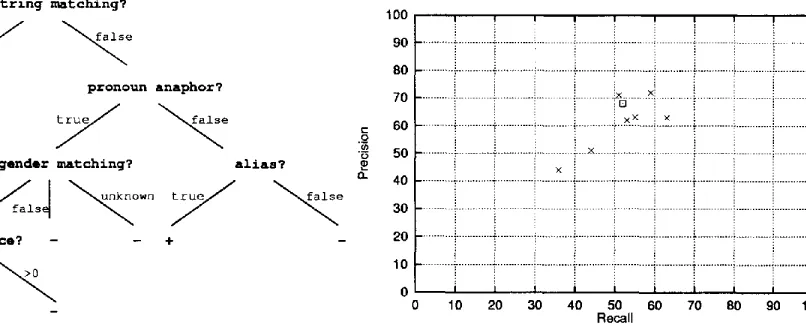
Our coreference engine achieves a recall of 52% and a precision of 68%, yielding a balanced F-measure of 58.9%. We plotted the score of our coreference engine (square-shaped) against the other official test scores of MUC-6 systems (cross-shaped) in Figure 2. We also plotted the learning curve of our coreference engine in Fig- ure 3, showing its accuracy averaged over five random trials when trained on 5, 10, . . . , 30 training documents.
Our score is in the upper region of the MUC- 6 systems. We performed a simple two-tailed, paired t-test at p = 0.05 to determine whether the difference between our system's F-measure scores and each of the other MUC-6 systems' F-measure scores on the 30 formal test docu- ments is statistically significant. We found that at the 95% significance level, our system per- formed worse than one, better than two, and as well as the rest of the MUC-6 systems. Our re- sult is encouraging as it indicates that a learning approach using relatively shallow features and a small number of training documents can lead to scores that are comparable to systems built us-
Figure 2: Coreference scores of MUC-6 systems and our system
62
60
58
56
54
52
50
48
J
/
I I I I I
5 10 15 20 25 30 Number of Documents Trained On
Figure 3: Learning curve of coreference resolu- tion accuracy
ing non-learning approaches.
not identify the two named entities "USAir" and "Piedmont" in the expression "USAir and Pied- mont" but instead treat it as one single named entity. Also, some of the features such as num- ber agreement, gender agreement and seman- tic class agreement are difficult to determine at times. For example, "they" is sometimes used to refer to "the government" even though su- perficially both do not seem to agree in number. All these problems hurt the performance of the coreference engine.
4 R e l a t e d W o r k
There is a long tradition of work on coreference resolution within computational linguistics, but most of them are not subjected to empirical evaluation until recently. Among the work that reported quantitative evaluation results, most are not based on learning from an annotated corpus (Baldwin, 1997; Kameyama, 1997; Lap- pin and Leass, 1994; Mitkov, 1997).
To our knowledge, the work of (Aone and Bennett, 1995; Ge et al., 1998; McCarthy and Lehnert, 1995) are the only ones that are based on learning from an annotated corpus. Ge et al. (Ge et al., 1998) used a statistical model for resolving pronouns. In contrast, we used a decision tree learning algorithm and resolved general noun phrases, not just pronouns. Both the work of (Aone and Bennett, 1995; Mc- Carthy and Lehnert, 1995) employed decision tree learning. However, the features they used include domain-specific ones like DNP-F (def- inite NP whose referent is a facility) (Aone and Bennett, 1995), JV-CHILD-i (does i re- fer to a joint venture formed as the result of a tie-up) (McCarthy and Lehnert, 1995), etc. In contrast, all our 10 features are domain- independent, which makes our coreference en- gine a domain-independent module. Moreover, both (Aone and Bennett, 1995) and (McCarthy and Lehnert, 1995) made simplifying assump- tions in their experimental evaluations. Since the accuracy of coreference resolution relies on the correct identification of the candidate noun phrases, both (Aone and Bennett, 1995) and (McCarthy and Lehnert, 1995) only evaluated their systems on noun phrases that have been correctly identified. In contrast, we evaluated our coreference resolution engine as part of a to- tal system which has to first identify all the can-
didate noun phrases and has to deal with the in- evitable noisy data when mistakes occur in noun phrase identification. Also, the evaluation of (Aone and Bennett, 1995) and (McCarthy and Lehnert, 1995) only focused on specific types of noun phrases (organizations and business enti- ties), and (Aone and Bennett, 1995) dealt only with Japanese texts. Our evaluation was done on all types of English noun phrases instead.
None of the systems in MUC-7 adopted a learning approach to coreference resolution (Chinchor, 1998). Among the MUC-6 systems, the only one that we can directly compare to is the UMass system, which also used C4.5 for coreference resolution. The other MUC-6 sys- tems were not based on a learning approach. The score of the UMass system is not high com- pared to the rest of the MUC-6 systems. In particular, the system's recall is relatively low. As explained in (Fisher et al., 1995), the reason for this is that it only concentrated on coref- erence relationships among references to peo- ple and organizations. Our system, as opposed to the UMass system, considered all types of markables. The score of our system is higher than that of the UMass system, and the dif- ference is statistically significant at p = 0.05. Thus, the contribution of our work is in show- ing that a learning approach, when evaluated on a common coreference data set, is able to achieve accuracy competitive with state-of-the- art systems using non-learning approaches. 5 C o n c l u s i o n
In this paper, we presented a learning approach for coreference resolution of noun phrases in un- restricted text. The approach learns from a small, annotated corpus and the task includes resolving not just pronouns but rather general noun phrases. In contrast to previous work, we evaluated our approach on a common data set, the MUC-6 coreference corpus. We obtained encouraging results, indicating that on the gen- eral noun phrase coreference task, the learning approach holds promise and achieves accuracy comparable to non-learning approaches.
6 A c k n o w l e d g e m e n t s
possible. We would also like to thank Hai Leong Chieu who implemented the HMM-based named entity learning module.
R e f e r e n c e s
Chinatsu Aone and Scott William Bennett. 1995. Evaluating automated and manual ac- quisition of anaphora resolution strategies. In
Proceedings of the 33rd Annual Meeting of the
Association for Computational Linguistics.
Breck Baldwin. 1997. CogNIAC: High precision coreference with limited knowledge and lin- guistic resources. In
Proceedings of the A CL
Workshop on Operational Factors in Practi-
cal, Robust Anaphora Resolution for Unre-
stricted Texts,
pages 38-45.Daniel M. Bikel, Scott Miller, Richard Schwartz, and Ralph Weischedel. 1997. Nymble: A high-performance learning name- finder. In
Proceedings of the Fifth Confer-
ence on Applied Natural Language Process-
ing,
pages 194-201.Daniel M. Bikel, Richard Schwartz, and Ralph M. Weischedel. 1999. An algorithm that learns what's in a name.
Machine Learn-
ing,
34(1-3), February.Nancy A. Chinchor. 1998. Overview of MUC- 7/MET-2. In
Proceedings of the Seventh
Message Understanding Conference (MUC-
7)
http://www, muc. saic. corn/proceedings/
muc_7_toc.html.
Kenneth Church. 1988. A stochastic parts pro- gram and noun phrase parser for unrestricted text. In
Proceedings of the Second Confer-
ence on Applied Natural Language Process-
ing,
pages 136-143.MUC-6 Program Committee. 1995. Corefer- ence task definition (v2.3, 8 Sep 95). In
Pro-
ceedings of the Sixth Message Understanding
Conference (MUC-6),
pages 335-344.David Fisher, Stephen Soderland, Joseph Mc- Carthy, Faugfang Feug, and Wendy Lehnert. 1995. Description of the UMass system as used for MUC-6. In
Proceedings of the Sixth
Message Understanding Conference (MUC-
6),
pages 127-140.Niyu Ge, John Hale, and Eugene Charniak. 1998. A statistical approach to anaphora res- olution. In
Proceedings of the Sixth Workshop
on Very Large Corpora,
pages 161-170. Megumi Kameyama. 1997. Recognizing refer-ential links: An information extraction per- spective. In
Proceedings of the A CL Work-
shop on Operational Factors in Practical, Ro-
bust Anaphora Resolution for Unrestricted
Texts,
pages 46-53.Shalom Lappin and Herbert J. Leass. 1994. An algorithm for pronominal anaphora resolu- tion.
Computational Linguistics,
20(4):535- 561, December.Joseph F. McCarthy and Wendy Lehnert. 1995. Using decision trees for coreference resolu- tion. In
Proceedings of the Fourteenth Inter-
national Joint Conference on Artificial Intel-
ligence,
pages 1050-1055.George A. Miller. 1990. WordNet: an on- line lexical database.
International Journal
of Lexicography,
3(4):235-312.Ruslan Mitkov. 1997. Factors in anaphora res- olution: They are not the only things that matter, a case study based on two differ- ent approaches. In
Proceedings of the ACL
Workshop on Operational Factors in Prac-
tical, Robust Anaphora Resolution for Unre-
stricted Texts,
pages 14-21.John Ross Quinlan. 1993.
C~.5: Programs for
Machine Learning.
Morgan Kanfmann, SanFrancisco, CA.