D e t e c t i n g Text Similarity over Short Passages: Exploring
Linguistic Feature Combinations via Machine Learning
V a s i l e i o s
Hatzivassiloglou*, Judith
L. K l a v a n s *t, a n d E l e a z a r E s k i n ** D e p a r t m e n t of C o m p u t e r Science Columbia University 1214 A m s t e r d a m Avenue
New York, N.Y. 10027
tCenter for Research o n Information Access C o l u m b i a University
535 W e s t ll4th Street N e w York, N.Y. 1 0 0 2 7
{vh, klavans, eeskin}@cs, columbia, edu
A b s t r a c t
We present a new composite similarity metric that combines information from multiple lin- guistic indicators to measure semantic distance between pairs of small textual units. Several potential features are investigated and an opti- real combination is selected via machine learn- ing. We discuss a more restrictive definition of similarity than traditional, document-level and information retrieval-oriented, notions of similarity, and motivate it by showing its rel- evance to the multi-document text summariza- tion problem. Results from our system are eval- u a t e d against standard information retrieval techniques, establishing that the n e w m e t h o d is m o r e effective in identifying closely related textual units.
1 R e s e a r c h G o a l s
In this paper, we focus on the problem of detect- ing whether two small textual units (paragraph- or sentence-sized) contain common information, as a necessary step towards extracting such common information and constructing thematic groups of text units across multiple documents. Identifying similar pieces of text has many ap- plications (e.g., summarization, information re- trieval, text clustering). Most research in this area has centered on detecting similarity be- tween documents [Willet 1988], similarity be- tween a query and a document [Salton 1989] or between a query and a segment of a document [Callan 1994]. While effective techniques have been developed for document clustering and classification which depend on inter-document similarity measures, these techniques mostly rely on shared words, or occasionally colloca-
tions of words [Smeaton 1992]. When larger units of text are compared, overlap may be suf- ficient to detect similarity; but when the units of text are small, simple surface matching of words and phrases is less likely to succeed since the number of potential matches is smaller.
Our task differs from typical text matching applications not only in the smaller size of the text units compared, but also in its overall goal. Our notion of similarity is more restrictive than topical similarity--we provide a detailed defi- nition in the next section. We aim to recover sets of small textual units from a collection of documents so that each text unit within a given set describes the same action. Our sys- tem, which is fully implemented, is further mo- tivated by the need for determining similarity between small pieces of text across documents that potentially span different topics during multi-document summarization. It serves as the first component of a domain-independent multi- document summarization system [McKeown et al. 1999] which generates a summary through text reformulation [Barzilay et al. 1999] by com- bining information from these similar text pas- sages.
on a m a n u a l l y a n n o t a t e d corpus of 10,345 pairs of c o m p a r e d paragraphs. Our new features, and especially t h e composite ones, are shown to o u t p e r f o r m traditional techniques such as T F * I D F [Buckley 1985; Salton 1989] for deter- mining similarity over small text units.
2
D e f i n i t i o n of Similarity
Similarity is a complex concept which has been widely discussed in the linguistic, philosophi- cal, and information t h e o r y communities. For example, Frawley [1992] discusses all semantic typing in t e r m s of two mechanisms: the de- tection of similarity and difference. Jackendoff [1983] argues t h a t s t a n d a r d semantic relations such as synonymy, paraphrase, redundancy, and entailment all result from j u d g m e n t s of like- ness whereas antonymy, contradiction, and in- consistency derive from j u d g m e n t s of differ- ence. Losee [1998] reviews notions of similarity and their impact on information retrieval tech- niques.
For our task, we define two text units as sim- ilar if t h e y share t h e same focus on a c o m m o n concept, actor, object, or action. In addition, the c o m m o n actor or object must perform or be subjected to the same action, or be the sub- ject of t h e same description. For example, Fig- ure 1 shows three input text fragments (para- graphs) taken from the T D T pilot corpus (see Section 5.1)', all from the same topic on the forced landing of a U.S. helicopter in North Ko- rea.
We consider units (a) and (b) in Figure 1 to be similar, because t h e y b o t h focus on the same event (loss of contact) with the same p r i m a r y participant (the helicopter). On the other hand, unit (c) in Figure 1 is not similar to either (a) or (b). A l t h o u g h all three refer to a helicopter, the p r i m a r y focus in (c) is on t h e emergency landing r a t h e r t h a n t h e loss of contact.
We discuss an experimental validation of our similarity definition in Section 5.2, after we in- t r o d u c e t h e corpus we use in our experiments.
3 R e l a t e d W o r k
Although: there is related empirical research on determining text similarity, primarily in the in- formation retrieval community, there are two m a j o r differences between the goals of this ear- lier work and t h e problem we address in this
(a) An OH-58 helicopter, carrying a crew of two, was on a routine training orien- tation when contact was lost at about 11:30 a.m. S a t u r d a y (9:30 p.m. E S T Fri- day).
(b) "There were two people on board," said Bacon. "We lost r a d a r contact with t h e helicopter a b o u t 9:15 E S T (0215 GMT)."
(c) An OH-58 U.S. military scout helicopter m a d e an emergency landing in N o r t h Korea at about 9.15 p.m. E S T Friday (0215 G M T Saturday), t h e Defense De- p a r t m e n t said.
Figure 1: I n p u t text units (from t h e T D T pilot corpus, topic 11).
paper. First, the notion of similarity as de- fined in the previous section is more restric- tive t h a n the traditional definition of similar- ity [Anderberg 1973; Willet 1988]. S t a n d a r d notions of similarity generally involve t h e cre- ation of a vector or profile of characteristics of a text fragment, and t h e n c o m p u t i n g on t h e basis of frequencies t h e distance between vec- tors to determine conceptual distance [Salton and Buckley 1988; Salton 1989]. Features typ- ically include s t e m m e d words although some- times multi-word units and collocations have been used [Smeaton 1992], as well as typolog- ical characteristics, such as thesaural features. T h e distance between vectors for one text (usu- ally a query) and another (usually a d o c u m e n t ) t h e n determines closeness or similarity [van Ri- jsbergen 1979]. In some cases, the texts are rep- resented as vectors of sparse n-grams of word occurrences and learning is applied over those vectors [Schapire and Singer 1999]. B u t since our definition of similarity is oriented to t h e small-segment goal, we make more fine-grained distinctions. Thus, a set of passages t h a t would probably go into the same class by s t a n d a r d IR criteria would be further separated by our m e t h - ods.
or q u e r y - t o - d o c u m e n t comparison. A closely re- lated problem is t h a t of matching a query to the relevant segment from a longer document [Callan 1994; Kaszkiel and Zobel 1998], which primarily involves determining which segment of a longer d o c u m e n t is relevant to a query, whereas our focus is on which segments are sim- ilar to each other. In b o t h cases, we have less d a t a to compare, and thus have to explore ad- ditional or more informative indicators of simi- larity.
4 M e t h o d o l o g y
We c o m p u t e a feature vector over a pair of tex- tual units, where features are either primitive,
consisting of one characteristic, or composite,
consisting of pairs of primitive features. 4.1 P r i m i t i v e F e a t u r e s
Our features draw on a number of linguistic ap- proaches to text analysis, and are based on b o t h single words and simplex noun phrases (head nouns preceded by optional premodifiers b u t with no e m b e d d e d recursion). Each of these morphological, syntactic, and semantic features has several variations. We thus consider the fol- lowing potential matches between text units:
• W o r d c o - o c c u r r e n c e , i.e., sharing of a sin- gle word between text units. Variations of this feature restrict matching to cases where the parts of speech of the words also match, or relax it to cases where just the stems of the two words are identical.
• M a t c h i n g n o u n p h r a s e s . We use the LINKIT tool [Wacholder 1998] to identify sim- plex noun phrases and match those that share the same head.
• W o r d N e t s y n o n y m s . W o r d N e t [Miller et al. 1990] provides sense information, placing words in sets of synonyms (synsets). We m a t c h words t h a t appear in the same synset. Variations on this feature restrict the words considered to a specific part-of-speech class. • C o m m o n s e m a n t i c c l a s s e s f o r v e r b s .
Levin's [1993] semantic classes for verbs have been found to be useful for determining doc- u m e n t t y p e and text similarity [Klavans and K a n 1998]. We m a t c h two verbs that share the same semantic class.
• S h a r e d p r o p e r n o u n s . P r o p e r nouns are identified using the A L E M B I C tool set [Ab- erdeen et al. 1995]. Variations on proper noun matching include restricting the proper noun t y p e to a person, place, or an organization (these subcategories are also e x t r a c t e d with ALEMBIC's named entity finder).
In order to normalize for text length and fre- quency effects, we experimented with two t y p e s of optional normalization of feature values. The first is for text length (measured in words), where each feature value is normalized by the size of the textual units in the pair. Thus, for a pair of textual units A and B, the feature values are divided by:
v/length(A) × length(B) (1) This operation removes potential bias in favor of longer text units.
The second t y p e of normalization we exam- ined was based on the relative frequency of oc- currence of each primitive. This is motivated by the fact t h a t infrequently matching primi- tive elements are likely to have a higher impact on similarity t h a n primitives which m a t c h more frequently. We perform this normalization in a manner similar to the I D F p a r t of T F * I D F [Salton 1989]. Every primitive element is asso- ciated with a value which is the n u m b e r of tex- tual units in which the primitive a p p e a r e d in the corpus. For a primitive element which compares single words, this is the n u m b e r of textual units which contain t h a t word in the corpus; for a noun phrase, this is the n u m b e r of textual units that contain noun phrases t h a t share the same head; and similarly for other primitive types. We multiply each feature's value by:
Total n u m b e r of textual units
log N u m b e r of textual units (2) containing this primitive
Since each normalization is optional, there are four variations for each primitive feature. 4.2 C o m p o s i t e F e a t u r e s
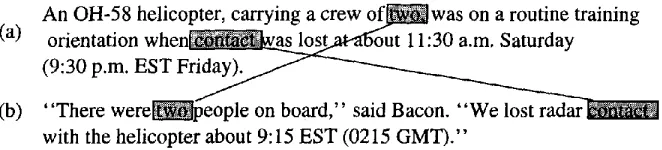
An OH-58 helicopter, carrying a crew o f ~ l w a s on a routine training (a) orientation when a s ~ s t out 11:30 a.m. Saturday
(9:30 p.m. EST F r ~ y ~ ~ - _ ~
- ~ _ _ _ ~ _ (b) "There w e r e t ~ e o p l e on board," said Bacon. "We lost r a d a r ~
with the helicopter about 9:15 EST (0215 GMT)."
Figure 2: A composite feature over word primitives with a restriction on order would count t h e pair "two" and "contact" as a m a t c h because t h e y occur with the same relative order in b o t h textual units.
An OH-58 helicopter, carrying a crew of two, was on a routine training orientation w h e n i 4 ~ . ~ _ . ~ , a b o u t 11:30 a.m. Saturday (a) (9:30 p.m. EST Friday).
(b) "There were two ~
with the helicopter about 9:15 EST (0215 GMT)."
Figure 3: A composite feature over word primitives with a restriction on distance would m a t c h on the pair "lost" and "contact" because t h e y occur within two words of each other in b o t h textual units.
arrying a crew of two, was on a routine training ~orientation when contact w a s ~ a t about 11:30 a.m. Saturday (a) ( ~ 0 p'm" EST Friday)"
(b) " T ere w e ~ e o p l e on board," said Bacon. i l W e ~ r a d a r contact ~ ~ ~ b o u t 9:15 EST (0215 GMT).
Figure 4: A composite feature with restrictions on the primitives' type. One primitive must be a m a t c h i n g simplex n o u n phrase (in this case, a helicopter), while t h e other primitive must be a m a t c h i n g verb (in this case, "lost" .) T h e example shows a pair of textual units where this composite feature detects a valid match.
• O r d e r i n g . Two pairs of primitive elements are required to have t h e same relative order in b o t h textual units (see Figure 2).
• D i s t a n c e . Two pairs of primitive elements are required to occur within a certain dis- tance in b o t h textual units (see Figure 3). T h e m a x i m u m distance between the primi- t i r e elements can vary as an additional pa- rameter. A distance of one matches rigid col- locations whereas a distance of five captures related primitives within a region of the text unit [Smeaton 1992; S m a d j a 1993].
• P r i m i t i v e . Each element of the pair of prim- itive elements can be restricted to a specific primitive, allowing more expressiveness in the
composite features. For example, we can re- strict one of the primitive features to be a sim- plex noun phrase and t h e other to be a verb; then, two n o u n phrases, one from each text unit, must m a t c h according to t h e rule for matching simplex n o u n phrases (i.e., sharing the same head), and two verbs must m a t c h according to the rule for verbs (i.e., shar- ing the same semantic class); see Figure 4.1 This particular combination loosely approx- imates grammatical relations, e.g., m a t c h i n g subject-verb pairs.
[image:4.612.135.466.71.146.2]Since these restrictions can be combined, m a n y different composite features can be de- fined, although our empirical results indicate that the most successful tend to include a dis- tance constraint. As we p u t more restrictions on a composite feature, the fewer times it occurs in the corpus; however, some of the more restric- tive features are most effective in determining similarity. Hence, there is a balance between the discriminatory power of these features and their applicability to a large number of cases. Composite features are normalized as primitive features are (i.e., for text unit length and for frequency of occurrence). This t y p e of normal- ization also uses equation (2) b u t averages the normalization values of each primitive in the composite feature.
4.3 L e a r n i n g a Classifier
For each pair of text units, we c o m p u t e a vec- tor of primitive and composite feature values. To determine whether the units match overall, we employ a machine learning algorithm, RIP- P E R [Cohen 1996], a widely used and effective rule induction system. R I P P E R is trained over a corpus of manually marked pairs of units; we discuss the specifics of our corpus and of the an- notation process in the next session. We exper- iment with varying R I P P E R ' s loss ratio, which measures the cost of a false positive relative to t h a t of a false negative ( w h e r e we view "simi- lar" as the positive class), and thus controls the relative weight of precision versus recall. This is an i m p o r t a n t step in dealing with the sparse d a t a problem; most text units are not similar, given our restrictive definition, and thus posi- tive instances are rare.
5 R e s u l t s
5.1 T h e E v a l u a t i o n C o r p u s
For evaluation, we use a set of articles already classified into topical subsets which we obtained from the Reuters part of the 1997 pilot Topic Detection and Tracking ( T D T ) corpus. T h e T D T corpus, developed by NIST and D A R P A , is a collection of 16,000 news articles from R e u t e r s and C N N where m a n y of the articles and transcripts have been manually grouped into 25 categories each of which corresponds to a single event (see h t t p : / / m o r p h . l d c .
uperm, edu/Cat alog/LDC98T25, html).
Usingthe Reuters part of the corpus, we selected five of the larger categories and e x t r a c t e d all articles assigned to t h e m from severM r a n d o m l y chosen days, for a total of 30 articles.
Since paragraphs in news stories tend to be s h o r t - - t y p i c a l l y one or two s e n t e n c e s - - i n this s t u d y we use paragraphs as our small text units, although sentences would also b e a possibility. In total, we have 264 text units and 10,345 com- parisons between units. As comparisons are made between all pairs of paragraphs from the same topic, the total n u m b e r of comparisons is equal to
E
i = 1where Ni is the n u m b e r of paragraphs in all se- lected articles from topical category i.
Training of our machine learning c o m p o n e n t was done by three-fold cross-validation, ran- domly splitting the 10,345 pairs of paragraphs into three (almost) equally-sized subsets. In each of the three runs, two of these subsets were used for training and one for testing.
To create a reference standard, the entire col- lection of 10,345 p a r a g r a p h pairs was marked for similarity by two reviewers who were given our definition and detailed instructions. Each re-- viewer independently marked each pair of para- graphs as similar or not similar. Subsequently, the two reviewers jointly examined eases where there was disagreement, discussed reasons, and reconciled the differences.
5.2 E x p e r i m e n t a l V a l i d a t i o n o f t h e S i m i l a r i t y D e f i n i t i o n
judges agreed with the manually marked and standardized corpus on 97.6% of the compar- isons.
Unfortunately, approximately 97% (depend- ing on the specific experiment) of the compar- isons in both our model and the subsequent val- idation experiment receive the value "not sim- ilar". This large percentage is due to our fine- grained notion of similarity, and is parallel to what happens in randomly sampled IR collec- tions, since in that case most documents will not be relevant to any given query. Neverthe- less, we can account for the high probability of inter-reviewer agreement expected by chance, 0.97.0.97+ ( 1 - 0 . 9 7 ) - ( 1 - 0 . 9 7 ) -- 0.9418, by re- ferring to the kappa statistic [Cohen 1960; Car- letta 1996]. The kappa statistic is defined as
P A -- Po g - ~ - -
-l - P 0
where PA is the probability that two reviewers agree in practice, and P0 is the probability that they would agree solely by chance. In our case,
PA = 0.976, P0 = 0.9418, and K = 0.5876, indicating that the observed agreement by the reviewers is indeed significant. 2 If P0 is esti- mated from the particular sample used in this experiment rather than from our entire corpus, it would be only 0.9, producing a value of 0.76 for K.
In addition to this validation experiment that used r a n d o m l y s a m p l e d pairs of paragraphs (and reflected the disproportionate rate of oc- currence of dissimilar pairs), w e performed a balanced experiment by r a n d o m l y selecting 50 of the dissimilar pairs a n d 50 of the similar pairs, in a m a n n e r that guaranteed generation of an independent sample. 3 Pairs in this sub- set were rated for similarity by two additional independent reviewers, w h o agreed on their de- cisions 9 1 % of the time, versus 5 0 % expected b y chance; in this case, K --- 0.82. Thus, w e feel confident in the reliability of our annotation
2 K is always between 0 and I, with 0 indicating no better agreement than expected by chance and 1 indi- cating perfect agreement.
3To guarantee independence, pairs of paragraphs were randomly selected for inclusion in the sample b u t a pair (A, B) was immediately rejected if there were paragraphs X 1 , . . . , X , ~ for n > 0 such that all pairs (A, X1), (X1, X2), • • •, (Xn, B) had already been in- cluded in the sample.
process, and can use the annotated corpus to as- sess the performance of our similarity measure and compare it to measures proposed earlier in the information retrieval literature.
5.3 P e r f o r m a n c e C o m p a r i s o n s
We compare the performance of our system to three other methods. First, we use stan- dard TF*IDF, a method that with various alter- ations, remains at the core of many information retrieval and text matching systems [Salton and Buckley 1988; Salton 1989]. We compute the to- tal frequency (TF) of words in each text unit. We also compute the number of units each word appears in in our training set (DF, or document frequency). Then each text unit is represented as a vector of TF*IDF scores calculated as
Total number of units
T F (word/) • log
DF(wordi)
Similarity between text units is measured by the cosine of the angle between the corresponding two vectors (i.e., the normalized inner product of the two vectors). A further cutoff point is selected to convert similarities to hard decisions of "similar" or "not similar"; different cutoffs result in different tradeoffs between recall and precision.
Second, we compare our method against a standard, widely available information re- trieval system developed at Cornell University, SMART [Buckley 1985]. 4 SMART utilizes a modified TF*IDF measure (ATC) plus stem- ming and a fairly sizable stopword list.
Third, we use as a baseline method the de- fault selection of the most frequent category, i.e., "not similar". While this last method can- not be effectively used to identify similar para- graphs, it offers a baseline for the overall ac- curacy of any more sophisticated technique for this task.
5.4 E x p e r i m e n t a l R e s u l t s
Recall Precision Accuracy Machine
learning over linguistic indicators T F * I D F SMART Default choice (baseline)
36.6%
30.0% 29.1%
0%
60.5% 98.8%
47.4% 97.2% 48.3% 97.1%
undefined 97.5%
Table I: Experimental results for different sim- ilarity metrics. For comparison purposes, w e list the average recall, precision, a n d accuracy obtained by T F * I D F a n d S M A R T at the two points in the precision-recall curve identified for each m e t h o d in the text (i.e., the point where the method's precision is most similar to ours, and the point where its recall is most similar to ours).
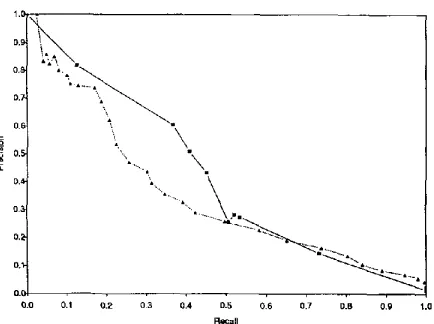
precision. SMART (in its default configura- tion) offered only a small improvement over the base T F * I D F implementation, and significantly underperformed our method, obtaining 34.1% precision at recall of 36.7%, and 21.5% recall at 62.4% precision. T h e default m e t h o d of al- ways marking a pair as dissimilar obtains of course 0% recall and undefined precision. Fig- ure 5 illustrates the difference between our sys- tern and straight T F * I D F at different points of the precision-recall spectrum.
When overall accuracy (total percentage of correct answers over both categories of similar and non-similar pairs) is considered, the num- bers are much closer together: 98.8% for our approach; 96.6% and 97.8% for T F * I D F on the two P - R points mentioned for that m e t h o d above; 96.5% and 97.6% for SMART, again at the two P - R points mentioned for SMART earlier; and 97.5% for the default baseline. 5 Nevertheless, since the challenge of identifying sparsely occurring similar small text units is our goal, the accuracy measure and the base- line technique of classifying everything as not similar are included only for reference but do
5Statistical tests of significance cannot be performed for comparing these values, since paragraphs appear in multiple comparisons and consequently the comparisons are not independent.
I.G
0.8-
0.7-
0.6
0 . 5
0.~
0 . 9
0.2-
O.O O.0
"\
0.1 0.2 0.3 0.4 0.5 0,6 0.7 O.B 0.9 1.0
Recall
Figure 5: Precision-recall graph comparing our m e t h o d using R I P P E R (solid line with squares) versus T F * I D F (dotted line with triangles).
not reflect our task.
6 A n a l y s i s a n d D i s c u s s i o n o f F e a t u r e P e r f o r m a n c e
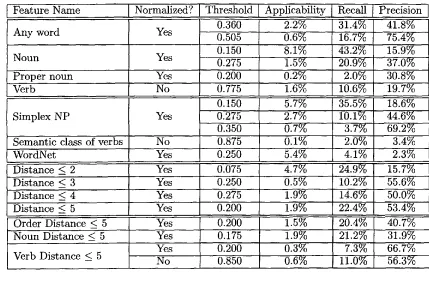
We computed statistics on how much each fea- ture helps in identifying similarity, summarized in Table 2. Primitive features are n a m e d ac- cording to the type of the feature (e.g., Verb for the feature that counts the number of matching verbs according to exact matches). Composite feature names indicate the restrictions applied to primitives. For example, the composite fea- ture Distance < ~ restricts a pair of matching primitives to occur within a relative distance of four words. If the composite feature also re- stricts the types of the primitives in the pair, the name of the restricting primitive feature is added to the composite feature name. For ex- ample the feature named Verb Distance < 5 re-
quires one member of the pair to be a verb and the relative distance between the primitives to be at most five.
The second column in Table 2 shows whether the feature value has been normalized accord- ing to its overall rarity 6, while the third column indicates the actual threshold used in decisions assuming t h a t only this feature is used for clas- sification. The fourth column shows the applica- bility of that feature, that is, the percentage of
[image:7.612.317.534.56.218.2] [image:7.612.77.295.60.195.2]Feature N a m e
Any word
Noun
Proper noun Verb
Simplex NP
Semantic class of verbs WordNet
Distance < 2
Distance _< 3 Distance < 4
Distance < 5 Order Distance < 5
Normalized? Yes Yes Yes No Yes No Yes Yes Yes Yes Yes Yes Threshold 0.360 0.505 0.150 0.275 0.200 0.775 0.150 0.350 0.875 0.250 0.075 0.250 0.275 0.200 0.200 Noun Distance < 5 Yes 0.175
Yes 0.200
No
Verb Distance < 5 !l,~II
Applicability[Recall 2.2% 0.6% 8.1% 1.5% 0.2% 1.6% 5.7% 2.7% 0.7% 0.1% 5.4% 4.7% 0.5% 1.9% 1.9% 1.5% 1.9% 0.3% 0.6% 31.4% 16.7% 43.2% 20.9%
2.0%
10.6% 35.5% 10.1% 3.7% 2.0% 4.1% 24.9% 10.2% 14.6% 22.4% 20.4% 21.2% 7.3% 11.0% [ Precision 41.8% 75.4% 15.9% 37.0% 30.8% 19.7% 18.6% 44.6% 69.2% 3.4% 2.3% 15.7% 55.6% 5O.O% 53.4% 40.7% 31.9% 66.7% 56.3%Table 2: Statistics for a selected subset of features. Performance measures are occasionally given multiple times for the same feature and normalization option, highlighting the effect of different decision thresholds.
paragraph pairs for which this feature would ap- ply (i.e., have a value over the specified thresh- old). Finally, the fifth and sixth columns show the recall and precision on identifying similar paragraphs for each independent feature. Note that some features have low applicability over the entire corpus, but target the hard-to-find similar pairs, resulting in significant gains in re- call and precision.
Table 2 presents a selected subset of primitive and composite features in order to demonstrate our results. For example, it was not surprising to observe that the most effective primitive fea- tures in determining similarity are
Any word,
Simplex NPi
andNoun
while other primitives such asVerb
were not as effective independently. This is to be expected since nouns name ob- jects, entities, and concepts, and frequently ex- hibit more sense constancy. In contrast, verbs are functions and tend to shift senses in a more fluid fashion depending on context. Further- more, our technique does not label phrasal verbs (e.g. look up, look out, look over, look for, etc.), which are a major source of verbal ambiguity inEnglish.
Whereas primitive features viewed indepen- dently might not have a directly visible effect on identifying similarity, when used in compos- ite features they lead to some novel results. The most pronounced case of this is for
Verb,
which, in the composite featureVerb Distance _< 5,
can help identify similarity effectively, as seen in Table 2. This composite feature approxi- mates verb-argument and verb-collocation rela- tions, which are strong indicators of similarity. At the same time, the more restrictive a feature is, the fewer occurrences of that feature appear in the training set. This suggests that we could consider adding additional features suggested by current results in order to further refine and improve our similarity identification algorithm.7 C o n c l u s i o n a n d F u t u r e W o r k
[image:8.612.89.518.65.346.2]our method to a substantial number of para- graph pairs from news articles, and compared results to baseline and standard information re- trieval techniques. Our results indicate that our method outperforms the standard techniques for detecting similarity, and the system has been successfully integrated into a larger multiple- document summarization system [McKeown et
al. 1999].
We are currently working on incorporating a clustering algorithm in order to give as output a set of textual units which are mutually sim- ilar rather than just pairwise similar. Future work includes testing on textual units of differ- ent size, comparing with additional techniques proposed for document similarity in the infor- mation retrieval and computational linguistics literature, and extending the feature set to in- corporate other types of linguistic information in the statistical learning method.
A c k n o w l e d g m e n t s
We are grateful to Regina Barzilay, Hongyan Jing, Kathy McKeown, Shimei Pan, and Yoram Singer for numerous discussions of earlier ver- sions of this paper and for their help with setting up and running R I P P E R and SMART. This re- search has been supported in part by an NSF STIMULATE grant, IRI-96-1879. Any opin- ions, findings, and conclusions or recommenda- tions expressed in this paper are those of the authors and do not necessarily reflect the views of the National Science Foundation.
R e f e r e n c e s
[Aberdeen et al. 1995] John Aberdeen, John Burger, David Day, Lynette Hirschman, Pa- tricia Robinson, and Marc Vilain. MITRE: Description of the Alembic System as Used for MUC-6. In Proceedings of the Sixth Message Understanding Conference (MUC- 6), 1995.
[Anderberg 1973] Michael R. Anderberg. Clus- ter Analysis fo r Applications. Academic Press, New York, 1973. Revised version of the author's thesis, University of Texas at Austin, 1971.
[Barzilay et al. 1999] Regina Barzilay, Kath- leen R. McKeown, and Michael Elhadad. In-
formation Fusion in the Context of Multi- Document Summarization. In Proceedings of the 37th Annual Meeting of the A CL, Col- lege Park, Maryland, June 1999 (to appear). Association for Computational Linguistics.
[Buckley 1985] Christopher Buckley. Imple- mentation of the SMART Information Ree- treival System. Technical Report 85-686, Cornell University, 1985.
[Callan 1994] Jaime P. Callan. Passage-Level Evidence in Document Retrieval. In Pro- ceedings of the 17th A CM SIGIR Interna- tional Conference on Research and Develop- ment in Information Retrieval, pages 302- 309, Dublin, Ireland, 1994.
[Carletta 1996] Jean Carletta. Assessing Agreement on Classification Tasks: The Kappa Statistic. Computational Linguistics, 22(2):249-254, June 1996.
[Cohen 1960] Jacob Cohen. A Coefficient of Agreement for Nominal Scales. Educational and Psychological Measurement, 20:37-46, 1960.
[Cohen 1996] William Cohen. Learning Trees and Rules with Set-Valued Features. In Pro- ceedings of the Fourteenth National Confer- ence on Artificial Intelligence (AAAI-96). American Association for Artificial Intelli- gence, 1996.
[Frawley 1992] William Frawley. Linguistic Se- mantics. Lawrence Erlbaum Associates, Hillsdale, New Jersey, 1992.
[Jackendoff 1983] Ray Jackendoff. Semantics and Cognition. MIT Press, Cambridge, Massachusetts, 1983.
[Kaszkiel and Zobel 1998] Marcin Kaszkiel and Justin Zobel. Passage Retrieval Revisited. In Proceedings of the 21st Annual Interna- -tional A CM SIGIR Conference on Research and Development in Information Retrieval, Melbourne, Australia, August 1998.