Automatic Reference-Based Evaluation of Pronoun Translation
Misses the Point
Liane Guillou* University of Edinburgh
School of Informatics Scotland, United Kingdom
Christian Hardmeier* Uppsala University Dept. of Linguistics & Philology
Uppsala, Sweden
Abstract
We compare the performance of the APT and AutoPRF metrics for pronoun translation against a manually annotated dataset com-prising human judgements as to the correct-ness of translations of the PROTEST test suite. Although there is some correlation with the human judgements, a range of issues limit the performance of the automated met-rics. Instead, we recommend the use of semi-automatic metrics and test suites in place of fully automatic metrics.
1 Introduction
As the general quality of machine translation (MT) increases, there is a growing interest in improv-ing the translation of specific limprov-inguistic phenomena. A case in point that has been studied in the con-text of both statistical (Hardmeier,2014;Guillou, 2016; Lo´aiciga, 2017) and neural MT (Bawden et al.,2017;Voita et al.,2018) is that of pronom-inal anaphora. In the simplest case, translating anaphoric pronouns requires the generation of cor-responding word forms respecting the grammatical constraints on agreement in the target language, as in the following English-French example, where the correct form of the pronoun in the second sen-tence varies depending on which of the (equally correct) translations of the wordbicyclewas used in the first:
(1) a. I have a bicycle.Itis red. b. J’ai un v´elo.Ilest rouge. [ref]
c. J’ai une bicyclette.Elleest rouge. [MT]
However, the problem is more complex in prac-tice because there is often no 1 : 1 correspon-dence between pronouns in two languages. This is easily demonstrated at the corpus level by ob-serving that the number of pronouns varies signif-icantly across languages in parallel texts (Mitkov
*Both authors contributed equally.
and Barbu, 2003), but it tends to be difficult to predict in individual cases.
In general MT research, significant progress was enabled by the invention of automatic evaluation metrics based on reference translations, such as BLEU (Papineni et al.,2002). Attempting to cate a similar framework for efficient research, re-searchers have proposed automatic reference-based evaluation metrics specifically targeting pronoun translation: AutoPRF (Hardmeier and Federico, 2010) and APT (Miculicich Werlen and Popescu-Belis,2017). We study the performance of these metrics on a dataset of English-French translations and investigate to what extent automatic evaluation based on reference translations provides insights into how well an MT system handles pronouns. Our analysis clarifies the conceptual differences be-tween AutoPRF and APT, uncovering weaknesses in both metrics, and investigates the effects of the alignment correction heuristics used in APT. By using the fine-grained PROTEST categories of pro-noun function, we find that the accuracy of the automatic metrics varies across pronouns of dif-ferent functions, suggesting that certain linguistic patterns are captured better in the automatic eval-uation than others. We argue that fully automatic wide-coverage evaluation of this phenomenon is unlikely to drive research forward, as it misses es-sential parts of the problem despite achieving some correlation with human judgements. Instead, semi-automatic evaluation involving semi-automatic identifi-cation of correct translations with high precision and low recall appears to be a more achievable goal. Another more realistic option is a test suite evaluation with a very limited scope.
2 Pronoun Evaluation Metrics for MT
The first (Hardmeier and Federico,2010) is a vari-ant of precision, recall and F-score that measures the overlap of pronouns in the MT output with a reference translation. It lacks an official name, so we refer to it asAutoPRFfollowing the terminol-ogy of the DiscoMT 2015 shared task (Hardmeier et al.,2015). The scoring process relies on a word alignment between the source and the MT output, and between the source and the reference transla-tion. For each input pronoun, it computes aclipped count(Papineni et al.,2002) of the overlap between the aligned tokens in the reference and the MT out-put. The clipped count of a given word is defined as the number of times it occurs in the MT output, limited by the number of times it occurs in the refer-ence translation. The final metric is then calculated as the precision, recall and F-score based on these clipped counts.
Miculicich Werlen and Popescu-Belis (2017) propose a metric calledAccuracy of Pronoun Trans-lation (APT)that introduces several innovations over the previous work. It is a variant of accu-racy, so it counts, for each source pronoun, whether its translation can be considered correct, without considering multiple alignments. Since word align-ment is problematic for pronouns, the authors pro-pose an heuristic procedure to improve alignment quality. Finally, it introduces the notion of pronoun equivalence, assigning partial credit to pronoun translations that differ from the reference transla-tion in specific ways deemed to be acceptable. In particular, it considers six possible cases when com-paring the translation of a pronoun in MT output and the reference. The pronouns may be: (1) iden-tical, (2)equivalent, (3)different/incompatible, or there may be no translation in: (4) the MT output, (5) the reference, (6) either the MT output or the reference. Each of these cases may be assigned a weight between 0 and 1 to determine the level of correctness.
3 The PROTEST Dataset
We study the behaviour of the two automatic met-rics using the PROTEST test suite (Guillou and Hardmeier, 2016). The test suite comprises 250 hand-selected personal pronoun tokens taken from the DiscoMT2015.test dataset of TED talk tran-scriptions and translations (Hardmeier et al.,2016) and annotated according to the ParCor guidelines (Guillou et al.,2014). It is structured according to a linguistic typology motivated by work on
func-tional grammar byDik(1978) andHalliday(2004). Pronouns are first categorised according to their function:
anaphoric: I have a bicycle.Itis red. event: He lost his job.Itwas a shock. pleonastic:Itis raining.
addressee reference:You’re welcome.
They are then subcategorised according to mor-phosyntactic criteria, whether the antecedent is a group noun, whether the ancedent is in the same or a different sentence, and whether an addressee reference pronoun refers to one or more specific people (deictic) or to people in general (generic).
Our dataset contains human judgements on the performance of nine MT systems on the transla-tion of the 250 pronouns in the PROTEST test suite. The systems include five submissions to the DiscoMT 2015 shared task on pronoun transla-tion (Hardmeier et al.,2015) – four phrase-based SMT systemsAUTO-POSTEDIT(Guillou,2015),
UU-HARDMEIER(Hardmeier et al.,2015),IDIAP
(Luong et al.,2015),UU-TIEDEMANN(Tiedemann, 2015), a rule-based system ITS2 (Lo´aiciga and Wehrli,2015), and the shared task baseline (also phrase-based SMT). Three NMT systems are in-cluded for comparison: LIMSI (Bawden et al., 2017),NYU(Jean et al.,2014), andYANDEX(Voita et al.,2018).
the candidate translation, but it occasionally caused valid translations to be rejected because they were missed by the annotator.
4 Accuracy versus Precision/Recall
There are three ways in which APT differs from Au-toPRF: the scoring statistic, the alignment heuristic in APT, and the definition of pronoun equivalence.
APT is a measure of accuracy: It reflects the pro-portion of source pronouns for which an acceptable translation was produced in the target. AutoPRF, by contrast, is a precision/recall metric on the basis of clipped counts.Hardmeier and Federico(2010) motivate the use of precision and recall by pointing out that word alignments are not 1 : 1, so each pronoun can be linked to multiple elements in the target language, both in the reference translation and in the MT output. Their metric is designed to account for all linked words in such cases.
To test the validity of this argument, we exam-ined the subset of examples of 8 systems in our English-French dataset1 giving rise to a clipped count greater than one2and found that these exam-ples follow very specific patterns. All 143 cases included exactly one personal pronoun. In 99 cases, the additional matched word was the complemen-tiserque‘that’. In 31 and 4 cases, respectively, it was a form of the auxiliary verbsavoir ‘to have’ and ˆetre‘to be’. One example matched bothque and a form of ˆetre. Two had reflexive pronouns, and one an imperative verb form. With the possible exception of the two reflexive pronouns, none of this seems to be relevant to pronoun correctness. We conclude that it is more reasonable to restrict the counts to a single pronominal item per example. With this additional restriction, however, the recall score of AutoPRF becomes equivalent to a version of APT without equivalent pronouns and alignment correction. We therefore limit the remainder of our study to APT.
5 Effects of Word Alignment
APT includes an heuristic alignment correction pro-cedure to mitigate errors in the word alignment between a source-language text and its translation (reference or MT output). We ran experiments to
1Excluding the
YANDEXsystem, which was added later.
2A clipped count greater than one for a given pronoun
translation indicates that the MT output and the reference translation aligned to this pronoun overlap in more than one token.
Score APT-A APT-B
PRO-Alig. corr. + – + – TEST
Reference 1.000 1.000 1.000 1.000 0.920
BASELINE 0.544 0.536 0.574 0.566 0.660
IDIAP 0.496 0.496 0.528 0.528 0.660
UU-TIED. 0.532 0.532 0.562 0.562 0.680
UU-HARD. 0.528 0.520 0.556 0.548 0.636
POSTEDIT 0.492 0.492 0.532 0.532 0.668
ITS2 0.436 0.428 0.462 0.454 0.472
LIMSI 0.364 0.364 0.388 0.388 0.576
NYU 0.424 0.420 0.456 0.452 0.616
YANDEX 0.544 0.536 0.570 0.562 0.796
Table 1: Comparison of APT scores with human judge-ments over the PROTEST test suite
assess the correlation of APT with human judge-ments, with and without the alignment correction heuristics.
Table 1 displays the APT results in both con-ditions and the proportion of pronouns in the PROTEST test suite marked as correctly translated. For better comparison with the PROTEST test suite results, we restricted APT to the pronouns in the test suite. We used two different weight settings:3
APT-Auses weight 1 foridenticalmatches and 0 for all other cases.APT-Buses weight 1 for iden-ticalmatches, 0.5 for equivalentmatches and 0 otherwise.
There is little difference in the APT scores when we consider the use of alignment heuristics. This is due to the small number of pronouns for which alignment improvements are applied for most sys-tems (typically 0–12 per system). The exception is theITS2 system output for which 18 alignment improvements are made. For the following systems we observe a very small increase in APT score for each of the two weight settings we consider, when alignment heuristics are applied: UU-HARDMEIER
(+0.8), ITS2 (+0.8), BASELINE (+0.8), YANDEX
(+0.8), andNYU(+0.4). However, these small im-provements are not sufficient to affect the system rankings. It seems, therefore, that the alignment heuristic has only a small impact on the validity of the score.
To assess differences in correlation with hu-man judgment for pairs of APT settings, we run Williams’s significance test (Williams,1959; Gra-ham and Baldwin, 2014). The test reveals that differences in correlation between the various con-figurations of APT and human judgements are not statistically significant (p >0.2in all cases).
c1 c2 Pearson Spearman
With alignment 1 0 0.848 0.820 heuristics 1 0.5 0.853 0.815
Without alignment 1 0 0.850 0.820 heuristics 1 0.5 0.855 0.811
Table 2: Correlation of APT and human judgements
APT Human Disagreement
Category Cases Assess.
1 2 3 3 7 Dis. Ex. %
Anaphoric
intra sbjit 130 13 73 156 60 47 / 216 21.8 intra nsbjit 59 1 31 77 14 19 / 91 20.9 inter sbjit 104 21 111 142 94 63 / 236 26.7 inter nsbjit 21 0 7 8 20 13 / 28 46.4
intrathey 131 0 95 154 72 37 / 226 16.4 interthey 126 0 108 129 105 47 / 234 20.1 sgthey 57 0 66 83 40 58 / 12347.2
groupit/they 47 0 41 64 24 31 / 88 35.2 Eventit 145 42 94 185 96 60 / 281 21.4 Pleonasticit 171 54 52 243 34 46 / 277 16.6 Genericyou 117 0 70 186 1 69 / 18736.9
Deictic sgyou 95 0 47 140 2 45 / 142 31.7 Deictic plyou 91 0 7 97 1 6 / 98 6.1
[image:4.595.96.270.63.130.2]Total 1,294 131 802 1,664 563 541 / 2,227 24.3
Table 3: Number of pronouns marked as cor-rect/incorrect in the PROTEST human judgements, as identical (1), equivalent (2), and incompatible (3) by APT, and the percentage of disagreements, per category (Disagree [Dis.] / Examples [Ex.])
6 Metric Accuracy per Category
LikeMiculicich Werlen and Popescu-Belis(2017), we use Pearson’s and Spearman’s correlation coef-ficients to assess the correlation between APT and our human judgements (Table2). Although APT does correlate with the human judgements over the PROTEST test suite, the correlation is weaker than that with the DiscoMT gap-filling evaluations reported inMiculicich Werlen and Popescu-Belis (2017). A Williams significance test reveals that the difference in correlation (for those systems com-mon to both studies) is not statistically significant
(p > 0.3). Table1 also shows that the rankings
induced from the PROTEST and APT scores are rather different. The differences are due to the different ways in which the two metrics define pro-noun correctness, and the different sources against which correctness is measured (reference transla-tion vs. human judgement).
We also study how the results of APT (with alignment correction) interact with the categories in PROTEST. We consider a pronoun to be mea-sured as correctby APT if it is assigned case 1
(identical) or 2 (equivalent). Likewise, a pronoun is consideredincorrectif it is assigned case 3 (in-compatible). We compare the number of pronouns marked as correct/incorrect by APT and by the hu-man judges, ignoring APT cases in which no judge-ment can be made: no translation of the pronoun in the MT output, reference or both, and pronouns for which the human judges were unable to make a judgement due to factors such as poor overall MT quality, incorrect word alignments, etc. The results of this comparison are displayed in Table3.
At first glance, we can see that APT disagrees with the human judgements for almost a quarter (24.3%) of the assessed translations. The distribu-tion of the disagreements over APT cases is very skewed and ranges from 8% for case 1 to 32% for case 2 and 49% for case 3. In other words, APT identifies correct pronoun translations with good precision, but relatively low recall. We can also see that APT rarely marks pronouns as equivalent (case 2).
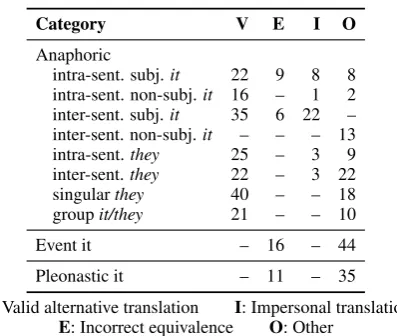
Performance for anaphoric pronouns is mixed. In general, there are three main problems affecting anaphoric pronouns (Table4). 1) APT, which does not incorporate knowledge of anaphoric pronoun antecedents, does not consider pronoun-antecedent head agreement so manyvalid alternative transla-tions involving personal pronounsare marked as incompatible (i.e. incorrect, case 3), but as correct by the human judges. Consider the following exam-ple, in which the pronountheyis deemed correctly translated by theYANDEXsystem (according to the human judges) as it agrees in number and grammat-ical gender with the translation of the antecedent extraits (clips). However, the pronoun translation ilsis marked as incorrect by APT as it does not match the translation in the reference (elles).
SOURCE: so what these twoclipsshow is not just the devastating consequence of the disease, but
theyalso tell us something about the shocking pace of the disease. . .
YANDEX: donc ce que ces deux ex-traits[masc.,pl.] montrent n’est pas seulement la cons´equence d´evastatrice de la maladie, mais
ils[masc. pl.] nous disent aussi quelque chose sur le rythme choquant de la maladie. . .
REFERENCE: ce que ces deuxvid´eos[fem.,pl.] montrent, ce ne sont pas seulement les cons´equences dramatiques de cette maladie,
2) Substitutions between pronouns are governed by much more complex rules than the simple pro-noun equivalence mechanism in APT. For example, the dictionary of pronouns used in APT lists il andceas equivalent. However, whileilcan often replace ce as a pleonastic pronoun in French, it has a much stronger tendency to be interpreted as anaphoric, rendering pleonastic use unacceptable if there is a salient masculine antecedent in the context. 3) APT does not consider the use of imper-sonal pronounssuch asc’in place of the feminine personal pronounelleor the plural formsilsand elles.
Category V E I O
Anaphoric
intra-sent. subj.it 22 9 8 8 intra-sent. non-subj.it 16 – 1 2 inter-sent. subj.it 35 6 22 – inter-sent. non-subj.it – – – 13 intra-sent.they 25 – 3 9 inter-sent.they 22 – 3 22 singularthey 40 – – 18 groupit/they 21 – – 10
Event it – 16 – 44
Pleonastic it – 11 – 35
V: Valid alternative translation I: Impersonal translation
[image:5.595.83.282.247.415.2]E: Incorrect equivalence O: Other
Table 4: Common cases of disagreement for anaphoric, pleonastic, and event reference pronouns
As with anaphoric pronouns, APT incorrectly marks some pleonasticandevent translations as equivalent, in disagreement with the human judges. Other common errors arise from 1) the use of al-ternative translations marked as incompatible (i.e. incorrect) by APT but correct by the human judges, for exampleil(personal) in the MT output when the reference contained the impersonal pronoun celaor c¸a(30 cases for pleonastic, 7 for event), or 2) the presence ofilin both the MT output and reference marked by APT as identical but by the human judges as incorrect (3 cases for pleonastic, 15 event).
Some of these issues could be addressed by in-corporating knowledge of pronoun function in the source language, of pronoun antecedents, and of the wider context of the translation surrounding the pronoun. However, whilst we might be able to derive language-specific rules for some scenarios, it would be difficult to come up with more general or language-independent rules. For example,iland cecan be anaphoric or pleonastic pronouns, but
il has a morereferential character. Therefore in certain constructions that are strongly pleonastic (e.g. clefts) onlyceis acceptable. This rule would be specific to French, and would not cover other scenarios for the translation of pleonasticit. Other issues include the use of pronouns in impersonal constructions such asil faut[one must/it takes] in which evaluation of the pronoun requires consider-ation of the whole expression, or transformconsider-ations between active and passive voice, where the per-spective of the pronouns changes.
7 Conclusions
Our analyses reveal that despite some correlation between APT and the human judgements, fully au-tomatic wide-coverage evaluation of pronoun trans-lation misses essential parts of the problem. Com-parison with human judgements shows that APT identifies good translations with relatively high pre-cision, but fails to reward important patterns that pronoun-specific systems must strive to generate. Instead of relying on fully automatic evaluation, our recommendation is to emphasise high preci-sion in the automatic metrics and implement semi-automatic evaluation procedures that refer negative cases to a human evaluator, using available tools and methods (Hardmeier and Guillou,2016). Fully automatic evaluation of a very restricted scope may still be feasible using test suites designed for spe-cific problems (Bawden et al.,2017).
Acknowledgements
References
Rachel Bawden, Rico Sennrich, Alexandra Birch, and Barry Haddow. 2017. Evaluating discourse phe-nomena in neural machine translation. CoRR, abs/1711.00513.
Simon C. Dik. 1978. Functional Grammar. Amster-dam, North-Holland.
Yvette Graham and Timothy Baldwin. 2014. Testing for significance of increased correlation with human judgment. InProceedings of the 2014 Conference on Empirical Methods in Natural Language Process-ing (EMNLP), pages 172–176, Doha, Qatar. Associ-ation for ComputAssoci-ational Linguistics.
Liane Guillou. 2015. Automatic post-editing for the DiscoMT pronoun translation task. InProceedings of the Second Workshop on Discourse in Machine Translation, pages 65–71, Lisbon, Portugal. Associ-ation for ComputAssoci-ational Linguistics.
Liane Guillou. 2016.Incorporating Pronoun Function into Statistical Machine Translation. Ph.D. thesis, Edinburgh University, Department of Informatics.
Liane Guillou and Christian Hardmeier. 2016. PROTEST: A test suite for evaluating pronouns in machine translation. InProceedings of the Eleventh Language Resources and Evaluation Conference, LREC 2016, pages 636–643, Portoroˇz, Slovenia.
Liane Guillou, Christian Hardmeier, Aaron Smith, J¨org Tiedemann, and Bonnie Webber. 2014. ParCor 1.0: A parallel pronoun-coreference corpus to support statistical MT. In Proceedings of the 9th Interna-tional Conference on Language Resources and Eval-uation, LREC 2014, pages 3191–3198, Reykjavik, Iceland. European Language Resources Association (ELRA).
Michael A. K. Halliday. 2004.An introduction to func-tional grammar, 3rd edition. Hodder Arnold Lon-don.
Christian Hardmeier. 2014. Discourse in Statistical Machine Translation. Ph.D. thesis, Uppsala Univer-sity, Department of Linguistics and Philology.
Christian Hardmeier and Marcello Federico. 2010. Modelling pronominal anaphora in statistical ma-chine translation. InProceedings of the 7th Interna-tional Workshop on Spoken Language Translation, IWSLT 2010, pages 283–289, Paris, France.
Christian Hardmeier and Liane Guillou. 2016. A graph-ical pronoun analysis tool for the protest pronoun evaluation test suite. Baltic Journal of Modern Com-puting, (2):318–330.
Christian Hardmeier, Preslav Nakov, Sara Stymne, J¨org Tiedemann, Yannick Versley, and Mauro Cettolo. 2015. Pronoun-focused MT and cross-lingual pro-noun prediction: Findings of the 2015 DiscoMT shared task on pronoun translation. InProceedings
of the Second Workshop on Discourse in Machine Translation, DiscoMT 2015, pages 1–16, Lisbon, Portugal.
Christian Hardmeier, J¨org Tiedemann, Preslav Nakov, Sara Stymne, and Yannick Versely. 2016. Dis-coMT 2015 Shared Task on Pronoun Translation. LINDAT/CLARIN digital library at Institute of For-mal and Applied Linguistics, Charles University in Prague.
S´ebastien Jean, Kyunghyun Cho, Roland Memisevic, and Yoshua Bengio. 2014. On using very large tar-get vocabulary for neural machine translation.ArXiv e-prints, 1412.2007.
Sharid Lo´aiciga and Eric Wehrli. 2015. Rule-based pronominal anaphora treatment for machine trans-lation. InProceedings of the Second Workshop on Discourse in Machine Translation, pages 86–93, Lis-bon, Portugal. Association for Computational Lin-guistics.
Sharid Lo´aiciga. 2017. Pronominal anaphora and ver-bal tenses in machine translation. Ph.D. thesis, Uni-versit´e de Gen`eve.
Ngoc Quang Luong, Lesly Miculicich Werlen, and An-drei Popescu-Belis. 2015. Pronoun translation and prediction with or without coreference links. In Pro-ceedings of the Second Workshop on Discourse in Machine Translation, pages 94–100, Lisbon, Portu-gal. Association for Computational Linguistics.
Lesly Miculicich Werlen and Andrei Popescu-Belis. 2017. Validation of an automatic metric for the ac-curacy of pronoun translation (APT). In Proceed-ings of the Third Workshop on Discourse in Ma-chine Translation (DiscoMT). Association for Com-putational Linguistics (ACL).
Ruslan Mitkov and Catalina Barbu. 2003. Using bilin-gual corpora to improve pronoun resolution. Lan-guages in Contrast, 4(2):201–211.
Kishore Papineni, Salim Roukos, Todd Ward, and Wei-Jing Zhu. 2002. BLEU: A method for automatic evaluation of machine translation. InProceedings of the 40th Annual Meeting of the Association for Com-putational Linguistics, pages 311–318, Philadelphia (Pennsylvania, USA). ACL.
J¨org Tiedemann. 2015. Baseline models for pronoun prediction and pronoun-aware translation. In Pro-ceedings of the Second Workshop on Discourse in Machine Translation, pages 108–114, Lisbon, Portu-gal. Association for Computational Linguistics.
Elena Voita, Pavel Serdyukov, Rico Sennrich, and Ivan Titov. 2018. Context-aware neural machine trans-lation learns anaphora resolution. In Proceedings of the 56th Annual Meeting of the Association for Computational Linguistics. Association for Compu-tational Linguistics.
![Table 3:Number of pronouns marked as cor-APT, and the percentage of disagreements, per categoryrect/incorrect in the PROTEST human judgements, asidentical (1), equivalent (2), and incompatible (3) by(Disagree [Dis.] / Examples [Ex.])](https://thumb-us.123doks.com/thumbv2/123dok_us/1346468.666540/4.595.96.270.63.130/percentage-disagreements-categoryrect-judgements-asidentical-equivalent-incompatible-examples.webp)