Analyzing Stemming Approaches for Turkish Multi-Document
Summarization
Muhammed Yavuz Nuzumlalı Arzucan ¨Ozg¨ur
Department of Computer Engineering
Bo˘gazic¸i University
TR-34342, Bebek, ˙Istanbul, Turkey
{
yavuz.nuzumlali,arzucan.ozgur
}
@boun.edu.tr
Abstract
In this study, we analyzed the effects of ap-plying different levels of stemming approaches such as fixed-length word truncation and mor-phological analysis for multi-document sum-marization (MDS) on Turkish, which is an ag-glutinative and morphologically rich language. We constructed a manually annotated MDS data set, and to our best knowledge, reported the first results on Turkish MDS. Our results show that a simple fixed-length word trun-cation approach performs slightly better than no stemming, whereas applying complex mor-phological analysis does not improve Turkish MDS.
1 Introduction
Automatic text summarization has gained more impor-tance with the enormous growth and easy availability of the Internet. It is now possible to reach extensive and continuously growing amount of resources. However, this situation brings its own challenges such as finding the relevant documents, and absorbing a large quan-tity of relevant information (Gupta and Lehal, 2010). The goal of multi-document summarization (MDS) is to automatically create a summary of a set of docu-ments about the same topic without losing the impor-tant information. Several approaches for MDS have been proposed in the last decade. However, most of them have only been applied to a relatively small set of languages, mostly English, and recently also to lan-guages like Chinese, Romanian, Arabic, and Spanish (Giannakopoulos, 2013).
Previous studies have shown that methods proposed for languages like English do not generally work well for morphologically rich languages like Finnish, Turk-ish, and Czech, and additional methods considering the morphological structures of these languages are needed (Eryi˘git et al., 2008). For instance, Turkish is an ag-glutinative language where root words can take many derivational and inflectional affixes. This feature re-sults in a very high number of different word surface forms, and eventually leads to the data sparseness prob-lem. Hakkani-T¨ur et al. (2000) analyzed the number of unique terms for Turkish and English and showed that
the term count for Turkish is three times more than En-glish for a corpus of 1M words.
There are only a few studies for text summariza-tion on Turkish, all of which are about single-document summarization (Altan, 2004; C¸ı˘gır et al., 2009; ¨Ozsoy et al., 2010; G¨uran et al., 2010; G¨uran et al., 2011). Some of these studies applied morphological analysis methods, but none of them analyzed their effects in de-tail.
To our best knowledge, this paper reports the first multi-document summarization study for Turkish. We used LexRank as the main summarization algorithm (Erkan and Radev, 2004), applied and analyzed differ-ent levels of stemming methods such as complex mor-phological analysis and fixed-length word truncation. We also created the first manually annotated MDS data set for Turkish, which has been made publicly available for future studies.
The rest of the paper is organized as follows. Sec-tion 2 presents the related work on MDS, as well as on the applications of morphological analysis on Turk-ish for different Natural Language Processing (NLP) and Information Retrieval (IR) problems. In Section 3, we provide a very brief introduction to the Turkish morphology and present the stemming methods that we evaluated. The details about the created data set and our experimental setup are presented in Section 4. We present and discuss the results in Section 5, and con-clude in Section 6.
2 Related Work
A large number of methods have been proposed for multi-document summarization in the last 10-15 years (e.g. (Erkan and Radev, 2004; Shen and Li, 2010; Christensen et al., 2013)). While most of these ap-proaches have only been applied to English, summa-rization data sets and systems for other languages like Chinese, Romanian, and Arabic have also been pro-posed in the recent years (Giannakopoulos, 2013).
Previous studies on automatic summarization for Turkish only tackled the problem of single-document summarization (SDS). Altan (2004) and C¸ı˘gır et al. (2009) proposed feature-based approaches for Turk-ish SDS, whereas ¨Ozsoy et al. (2010) and G¨uran et al. (2010) used Latent Semantic Analysis (LSA) based methods. G¨uran et al. (2011) applied non-negative
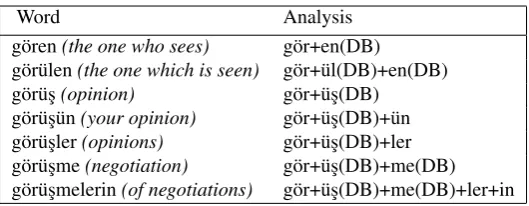
Word Analysis g¨oren(the one who sees) g¨or+en(DB)
g¨or¨ulen(the one which is seen) g¨or+¨ul(DB)+en(DB) g¨or¨us¸(opinion) g¨or+¨us¸(DB)
[image:2.595.167.432.60.163.2]g¨or¨us¸¨un(your opinion) g¨or+¨us¸(DB)+¨un g¨or¨us¸ler(opinions) g¨or+¨us¸(DB)+ler g¨or¨us¸me(negotiation) g¨or+¨us¸(DB)+me(DB) g¨or¨us¸melerin(of negotiations) g¨or+¨us¸(DB)+me(DB)+ler+in
Table 1: Different word forms and their morphological analysis for the stem “g¨or” (to see). The derivational boundaries are marked with (DB).
trix factorization (NMF) and used consecutive words detection as a preprocessing step.
The effect of morphological analysis for Turkish was analyzed in detail for Information Retrieval (Can et al., 2008) and Text Categorization (Akkus¸ and C¸akıcı, 2013). Can et al. (2008) showed that us-ing fixed-length truncation methods perform similarly to lemmatization-based stemming for information re-trieval. Akkus¸ and C¸akıcı (2013) obtained better results for text categorization with fixed-length word trunca-tion rather than complex morphological analysis, but the difference was not significant. For other morpho-logically rich languages, there is a case study on Greek by Galiotou et al. (2013). They applied different stem-ming algorithms and showed that stemstem-ming on Greek texts improves the summarization performance.
3 Methodology
This section contains detailed information about the ap-plication of different levels of morphological features during the summarization process. Before diving into the details, we provide a very brief description of the morphological structure of the Turkish language.
3.1 Turkish Morphology
Turkish is an agglutinative language with a productive morphology. Root words can take one or more deriva-tional and inflecderiva-tional affixes; therefore, a root can be seen in a large number of different word forms. An-other issue is the morphological ambiguity, where a word can have more than one morphological parse.
Table 1 shows an example list of different word forms for the stem “g¨or” (to see). All the words in the table have the same root, but the different suffixes lead to different surface forms which may have similar or different meanings. When the surface forms of these words are used in a summarization system, they will be regarded as totally different words. However, if a mor-phological analysis method is applied to the sentences before giving them to the summarization system, words with similar meanings can match during the sentence similarity calculations.
3.2 Stemming Policies
In this section, we explain the different stemming meth-ods that we investigated.
Raw: In this method, we take the surface forms of words, without applying any stemming.
Root: This method takes the most simple unit of a
word, namely the root form. For example, in Table 1, the words “g¨oren”, “g¨or¨us¸¨un”, and “g¨or¨us¸melerin” have the same root (g¨or), so they will match during sen-tence similarity calculations.
Deriv: Using the Root method may oversimplify
words because some words that are derived from the same root may have irrelevant meanings. In the above example, “g¨or¨us¸ler” and “g¨oren” have different mean-ings, but they have the same root (g¨or). In order to solve this oversimplification issue, we propose to preserve derivational affixes, and only remove the inflectional affixes from the words. In this method, “g¨or¨us¸ler” and “g¨oren” will not match because when we remove only the inflectional affixes, they become “g¨or¨us¸” and “g¨oren”. On the other hand, the words “g¨or¨us¸ler” and “g¨or¨us¸¨un” will match because their Deriv forms are the same, which is “g¨or¨us¸”.
Prefix: In Turkish, affixes almost always occur as
suffixes, not prefixes. Additionally, applying morpho-logical analysis methods is a time consuming process, and may become an overhead for online applications. Therefore, a fixed-length simplification method is also tried, since it is both a fast method and can help match similar words by taking the firstncharacters of words which have lengths larger thann.
As the summarization algorithm, we used LexRank (Erkan and Radev, 2004), which is a salient graph-based method that achieves promising results for MDS. In LexRank, first a sentence connectivity graph is con-structed based on the cosine similarities between sen-tences, and then the PageRank (Page et al., 1999) algo-rithm is used to find the most important sentences.
4 Experimental Setup
4.1 Data Set
annotated a Turkish MDS data set, which is publicly available for future studies1.
In order to match the standards for MDS data sets, we tried to follow the specifications of the DUC 2004 data set. Our data set consists of 21 clusters, each con-sisting of around 10 documents. We selected21 differ-ent topics from differdiffer-ent domains (e.g., politics, eco-nomics, sports, social, daily, and technology), and se-lected10 documents on average for each topic. The documents were obtained from the websites of various news sources. The average number of words per doc-ument is337, and the average number of letters in a word is6.84.
For manual annotation, we divided the 21 clusters into three groups and sent them to three annotators dif-ferent from the authors. We required the human sum-maries not to exceed120 words for the summary of each cluster.
4.2 Tools
4.2.1 Turkish Morphological Analysis
In order to perform different levels of morphological analysis on documents, we used a two-level morpho-logical analyzer (Oflazer, 1994) and a perceptron-based morphological disambiguator (Sak et al., 2007), which is trained with a corpus of about750,000tokens from news articles. The accuracy of the disambiguator has been reported as96%(Sak et al., 2007). The Root and Deriv forms of words were generated from the disam-biguator output.
4.2.2 MEAD Summarization Toolkit
We used MEAD (Radev et al., 2004), which is an open-source toolkit created for extractive MDS, in our exper-iments. MEAD handles all the necessary processes to generate a summary document (e.g., sentence ranking, selection, re-ordering, and etc.).
We used the LexRank implementation that comes with MEAD as a feature, together with the Cen-troid and Position features (each feature is equally weighted). We forced the generated summaries not to exceed120words. However, we define the following exception in order to preserve the readability and the grammaticality of the generated summary. For a can-didate sentenceS havingnwords, if the absolute dif-ference between the threshold (which is120) and the summary length including sentenceS(sayNw) is less than the absolute difference between the threshold and the summary length excluding sentenceS (sayNwo), and ifNwis less than132(which is120∗1.1), we allow the summary to exceed the threshold and add sentence Sas the last summary sentence.
We used term frequency (tf) based cosine similarity as the similarity measure during the sentence selection step. We also required sentence length to be between
1The data set can be retrieved from the following github
repository: https://github.com/manuyavuz/ TurkishMDSDataSet_alpha
6 and50 words (which we found empirically) in or-der to increase the readability of the summaries. The reason behind applying this filtering is that very short sentences generally do not contain much information to become a summary sentence, whereas very long sen-tences decrease the readability and fill a significant per-centage of the summary limit.
4.2.3 ROUGE
For evaluation, we used ROUGE, which is a standard metric for automated evaluation of summaries based on n-gram co-occurrence. We used ROUGE-1 (based on uni-grams), ROUGE-2 (based on bi-grams), and ROUGE-W (based on longest common sub-sequence weighted by length) in our experiments. Among these, ROUGE-1 has been shown to agree with human judges the most (Lin and Hovy, 2003), so we give importance to it while interpreting the results.
5 Evaluation and Results
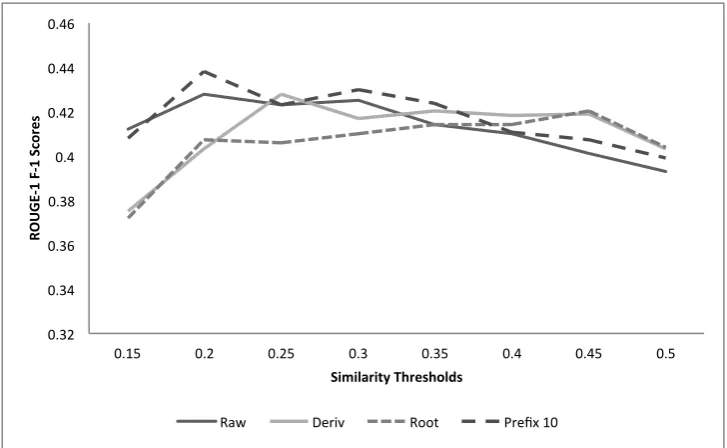
We ran MEAD with the proposed stemming policies using different levels of cosine similarity threshold val-ues to analyze the effect of the similarity threshold on the summarization performance. After the sentences are ranked using the LexRank method, the similarity threshold is used to decide whether to include a sen-tence to the summary. A sensen-tence is not included to the summary, if its similarity to a previously picked sen-tence is larger than the similarity threshold.
In our preliminary experiments, we used the default similarity threshold0.7, which was found empirically by the MEAD developers for English. However, it pro-duced poor results on the Turkish data set.
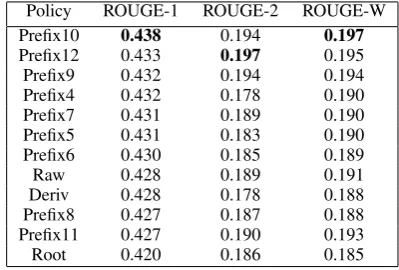
Policy ROUGE-1 ROUGE-2 ROUGE-W Prefix10 0.438 0.194 0.197
Prefix12 0.433 0.197 0.195
Prefix9 0.432 0.194 0.194
Prefix4 0.432 0.178 0.190
Prefix7 0.431 0.189 0.190
Prefix5 0.431 0.183 0.190
Prefix6 0.430 0.185 0.189
Raw 0.428 0.189 0.191
Deriv 0.428 0.178 0.188
Prefix8 0.427 0.187 0.188
Prefix11 0.427 0.190 0.193
[image:3.595.315.515.473.608.2]Root 0.420 0.186 0.185
Table 2: Best scores for different policies
0.32 0.34 0.36 0.38 0.4 0.42 0.44 0.46
0.15 0.2 0.25 0.3 0.35 0.4 0.45 0.5
RO
U
G
E-‐
1
F-‐
1
Sc
or
es
Similarity Thresholds
[image:4.595.117.481.62.286.2]Raw Deriv Root Prefix 10
Figure 1: F-1 scores for different similarity threshold values
text with different surface forms due to their inflec-tions. Such words can not be matched during similar-ity computation if morphological analysis is not per-formed. Therefore, using higher similarity threshold values cause very similar sentences to occur together in the summaries, and eventually, result in poor scores. Table 2 shows the best scores obtained by each pol-icy. The Prefix policy generally outperforms the Raw policy. The Prefix10 policy achieves the best ROUGE-1 score. On the other hand, the policies that apply com-plex morphological analysis (i.e. Root and Deriv) are not able to outperform the simple Prefix and Raw poli-cies. The Deriv policy performs similarly to the Raw and Prefix policies, whereas the Root policy obtains the lowest ROUGE-1 score.
5.1 Discussion
The results show that using a simple fixed-length pre-fix policy outperforms all other methods, and apply-ing complex morphological analysis does not improve Turkish MDS. The poor performance of the Root pol-icy is somewhat expected due to the fact that, if we pre-serve only the roots of the words, we lose the semantic differences among the surface forms provided by the derivational affixes. On the other hand, the reason be-hind the observation that Deriv and Raw obtain similar performances is not obvious.
In order to further analyze this observation, we used an entropy based measure, which is calculated as shown below, to quantify the homogeneity of the clus-ters in the data set in terms of the variety of the surface forms corresponding to the Deriv forms of each word in the cluster. We first compute the entropy for each Deriv form in a cluster. The entropy of a Deriv form is lower, if it occurs with fewer different surface forms in the cluster. The entropy of a cluster is computed by
summing the entropies of the Deriv forms in the clus-ter and dividing the sum by the number of words in the cluster (i.e. N).
DDerivi={t|t inflected from Deriv i}
H(Derivi) =
X
t∈DDerivi
p(t) logp(t)
H(C) =X
i
H(Derivi)
N
To compare with the data set clusters, we generated random document clusters by randomly selecting 10 different clusters and then randomly selecting one doc-ument from each selected cluster. The average entropy value for the data set clusters and the random clusters were4.99and7.58, respectively. Due to this signifi-cant difference, we can hypothesize that the documents about the same topic show a more homogeneous struc-ture. In other words, a Deriv form is usually seen in the same surface form in a cluster of documents which are about the same topic. Therefore, the Deriv policy and the Raw policy achieve similar results for summarizing documents about the same topic.
During evaluation, we ran ROUGE with the Deriv versions of the human summaries and the system sum-maries in order to match semantically similar words having different surface forms. We also experimented with ROUGE using the Raw versions, but the results followed very similar patterns, so those results were not reported.
6 Conclusion
articles, and made publicly available for future stud-ies. We utilized the LexRank summarization algorithm, and analyzed the effects of different stemming poli-cies for Turkish MDS. Our results show that simple fixed-length truncation methods with high limits (such as taking the first 10 letters) improves summarization scores. In contrast to our expectation, using morpho-logical analysis does not enhance Turkish MDS, possi-bly due to the homogeneousness of the documents in a cluster to be summarized. As future work, we plan to extend the data set with more clusters and more refer-ence summaries, as well as to develop sentrefer-ence com-pression methods for Turkish MDS.
Acknowledgments
We would like to thank Ferhat Aydın for his contri-butions during the data set corpus collection and an-notation process. We would also like to thank Burak Sivrikaya and Serkan Bugur for their help in generat-ing the human summaries for the data set.
References
Burak Kerim Akkus¸ and Ruket C¸akıcı. 2013. Catego-rization of turkish news documents with morpholog-ical analysis. InACL (Student Research Workshop), pages 1–8. The Association for Computer Linguis-tics.
Zeynep Altan. 2004. A turkish automatic text sum-marization system. In Proceedings of the IASTED International Conference Artificial Intelligence and Applications, pages 74–83.
Fazlı Can, Seyit Koc¸berber, Erman Balc¸ık, Cihan Kay-nak, H Ca˘gdas¸ ¨Ocalan, and Onur M Vursavas¸. 2008. Information retrieval on turkish texts.Journal of the American Society for Information Science and Tech-nology, 59(3):407–421.
Janara Christensen, Stephen Soderland Mausam, and Oren Etzioni. 2013. Towards coherent multi-document summarization. In Proceedings of NAACL-HLT, pages 1163–1173.
G¨unes¸ Erkan and Dragomir R. Radev. 2004. Lex-pagerank: Prestige in multi-document text summa-rization. InEMNLP, pages 365–371. ACL.
G¨uls¸en Eryi˘git, Joakim Nivre, and Kemal Oflazer. 2008. Dependency parsing of turkish. Computa-tional Linguistics, 34(3):357–389.
Eleni Galiotou, Nikitas Karanikolas, and Christodou-los Tsoulloftas. 2013. On the effect of stemming al-gorithms on extractive summarization: a case study. In Panayiotis H. Ketikidis, Konstantinos G. Margari-tis, Ioannis P. Vlahavas, Alexander Chatzigeorgiou, George Eleftherakis, and Ioannis Stamelos, editors, Panhellenic Conference on Informatics, pages 300– 304. ACM.
George Giannakopoulos. 2013. Multi-document mul-tilingual summarization and evaluation tracks in acl 2013 multiling workshop.MultiLing 2013, page 20. Vishal Gupta and Gurpreet Singh Lehal. 2010. A survey of text summarization extractive techniques. Journal of Emerging Technologies in Web Intelli-gence, 2(3).
Aysun G¨uran, Eren Bekar, and S Akyokus¸. 2010. A comparison of feature and semantic-based sum-marization algorithms for turkish. InInternational Symposium on Innovations in Intelligent Systems and Applications. Citeseer.
A G¨uran, NG Bayazıt, and E Bekar. 2011. Au-tomatic summarization of turkish documents using non-negative matrix factorization. InInnovations in Intelligent Systems and Applications (INISTA), 2011 International Symposium on, pages 480–484. IEEE. Dilek Z. Hakkani-T¨ur, Kemal Oflazer, and G¨okhan T¨ur. 2000. Statistical morphological disambiguation for agglutinative languages. In COLING, pages 285– 291. Morgan Kaufmann.
Chin-Yew Lin and Eduard H. Hovy. 2003. Au-tomatic evaluation of summaries using n-gram co-occurrence statistics. InHLT-NAACL.
Kemal Oflazer. 1994. Two-level description of turk-ish morphology. Literary and linguistic computing, 9(2):137–148.
Lawrence Page, Sergey Brin, Rajeev Motwani, and Terry Winograd. 1999. The pagerank citation rank-ing: Bringing order to the web. Stanford InfoLab. Dragomir Radev, Timothy Allison, Sasha
Blair-Goldensohn, John Blitzer, Arda Celebi, Stanko Dim-itrov, Elliott Drabek, Ali Hakim, Wai Lam, Danyu Liu, et al. 2004. Mead-a platform for multidocu-ment multilingual text summarization. Proceedings of the 4th International Conference on Language Re-sources and Evaluation (LREC 2004).
Has¸im Sak, Tunga G¨ung¨or, and Murat Sarac¸lar. 2007. Morphological disambiguation of turkish text with perceptron algorithm. In Alexander F. Gelbukh, edi-tor,CICLing, volume 4394 ofLecture Notes in Com-puter Science, pages 107–118. Springer.
Chao Shen and Tao Li. 2010. Multi-document sum-marization via the minimum dominating set. In Pro-ceedings of the 23rd International Conference on Computational Linguistics, pages 984–992. Associ-ation for ComputAssoci-ational Linguistics.
Celal C¸ı˘gır, M¨ucahid Kutlu, and ˙Ilyas C¸ic¸ekli. 2009. Generic text summarization for turkish. In ISCIS, pages 224–229. IEEE.