Adjective Intensity and Sentiment Analysis
Raksha Sharma, Mohit Gupta, Astha Agarwal, Pushpak Bhattacharyya
Dept. of Computer Science and Engineering IIT Bombay, Mumbai, India
{raksha,mohitgupta,astha11,pb}@cse.iitb.ac.in
Abstract
For fine-grained sentiment analysis, we need to go beyond zero-one polarity and find a way to compare adjectives that share a common semantic property. In this paper, we present a semi-supervised ap-proach to assign intensity levels to adjec-tives, viz. high, medium and low, where adjectives are compared when they belong to the same semantic category. For exam-ple, in the semantic category of EXPER-TISE,expert, experiencedandfamiliarare respectively of level high, medium and
low. We obtain an overall accuracy of77% for intensity assignment. We show the sig-nificance of considering intensity informa-tion of adjectives in predicting star-rating of reviews. Our intensity based prediction system results in an accuracy of59%for a 5-star rated movie review corpus.
1 Introduction
Sentence intensity becomes crucial when we need to compare sentences having the same polarity ori-entation. In such scenarios, we can use inten-sity of words to judge the inteninten-sity of a sentence. Words that bear the same semantic property can be used interchangeably to upgrade or downgrade the intensity of the expression. For example,good
andoutstandingboth are positive words from the QUALITY category, but the latter can be used to intensify positive expression in a sentence.
There are several manually or automatically created lexical resources (Liu, 2010; Wilson et al., 2005b; Wilson et al., 2005a; Taboada and Grieve, 2004) that assign a fixed positive (+1) or nega-tive (−1) polarity to words, making no distinction among them in terms of their intensity. This pa-per presents a semi-supa-pervised approach to assign intensity levels to adjectives, viz. high, medium
andlow, which share the same semantic property. We have used the semantic frames of FrameNet-1.5 (Baker et al., 1998) to obtain these semantic categories. Our approach is based on the idea that the most intense word has higher contextual simi-larity withhighintensity words than withmedium
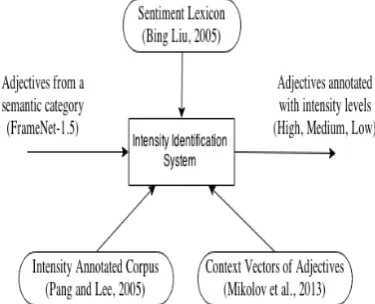
[image:1.595.324.512.413.565.2]orlow intensity words. We use the intensity an-notated movie review corpus to obtain the most intense word for a semantic category. Then, co-sine similarity between word vectors of the most intense word and other words of the category is used to assign intensity levels to those words. Our approach with the used resources is shown in fig-ure 1.
Figure 1: Intensity Analysis System
Our Contribution:Corpus based approaches suf-fer from the data sparsity problem. Our approach tackles this problem by using word vectors for in-tensity assignment (Section 2.3). It also provides a better overall accuracy (77%) than current state of the art when compared with gold-standard in-tensity levels (Section 6.2). In addition to this, we show that accuracy of the star rating prediction task improves when we incorporate our intensity levels as features in addition to standard features such as unigrams (Section 6.3).
2 Idea Used for Deriving Adjectival Scale In this paper, we dealt with 52 semantic (polar) categories of the FrameNet data and derived the polarity-intensity ordering among adjectives for each category. Examples of these semantic cate-gories with a few words that belong to the category are as follows.
• INTELLIGENCE:Brainy, brainless, intelli-gent, smart, dim etc.
• CANDIDNESS: Honest, dishonest, trust-worthy, reliable, gullible etc.
• EMOTION:Sad, upset, appalled, tormented, gleeful, happy, pleased etc.
Our algorithm to assign intensity levels to adjec-tives is based on the following ideas:
2.1 What Does Intensity Annotated Corpus Tell About The Intensity of Words?
Rill et al. (2012) showed that an intensity anno-tated polar corpus can be used to derive the in-tensity of the adjectives. A high inin-tensity word will occur more frequently in high intensity re-views. For example, the wordexcellent is found 118times, whileaverageis found only16times in 5-star rated movie reviews (Section 3). Based on this distribution, we use a weighted mean formula to find intensity of the words from the corpus. We call it Weighted Normalized Polarity Intensity (WNPI)formula. For a 5-star intensity rating cor-pus, theW NP Iformula is as follows:
W NP I(word) =
P5
i=1i∗Ci
5∗P5i=1Ci (1) whereCiis the count of thewordini-star reviews.
2.2 Need Significant Occurrence of A Word
TheW NP I formula gives a corpus based result, hence can give biased scores for words which oc-cur less frequently in the corpus. For example, in our movie review data-set, the word substan-dardoccurs only3times in the corpus, and these occurrences happen to be in 1-star and 2-star re-views only. Hence, theW NP Iformula assigns a higher score tosubstandard. To avoid such a bias, we integrate W NP I formula with Chi-Square test. Sharma and Bhattacharyya (2013) used Chi-Square test to find significant polar words in a do-main. We use the same categorical Chi-Square test in our work.
2.3 How to Get Intensity Clue for All Words?
A combination of W NP I formula and Chi-Square test cannot assign intensity scores to ad-jectives, which are not present in the corpus. To overcome this data sparsity problem, we restrict the use of W NP I formula to identify the most intense word in each category. We explore pre-computed context vectors of words, presented by Mikolov et al. (2011) (Section 3), to assign in-tensity levels to remaining words of the semantic category:
Case-1 Words which have less number of senses: These words will have a limited set of con-text words. Hence, their concon-text vectors will also be based on these limited words. Example: excel-lent, extraordinary, amazing, superb, great etc.
Case-2Words which have many senses: These words will have a large set of context words. Hence their context vectors will be based on a set of large number of words. Example: good, fair, fine, average etc.
Inferences:
1. Two words expressing similar meaning, and satisfying case-1 will have similar context. Hence, their word vectors will exhibit high cosine similar-ity. Whereas a word satisfying case-2 will be less similar to a word satisfying case-1.
2. The classical semantic bleaching theory1 states that a word which has less number of senses (possibly one) tends to have higher intensity in comparison to a word having more senses. Con-sidering semantic bleaching phenomenon as a base, we deduce that words which satisfy case-1 tend to behighintensity words while words satis-fying case-2 arelowintensity words.
Hence, we conclude that high intensity words (case-1) have higher cosine similarity with each other than with low or medium intensity words (case-2). Therefore, cosine similarity with ahigh
intensity word can be used to obtain intensity or-dering for remaining words of the category. 3 Data and Resources
This section gives an overview of the corpus and lexical resources used in our approach.
Rating Definition Size 0 Totally painful, unbearable
picture 179
1 Poor Show ( dont waste your
money) 1057
2 Average Movie 888
[image:3.595.72.291.62.177.2]3 Excellent show, look for it 1977 4 A must see film 905
Table 1: Review ratings with their definitions and number of reviews.
represents a semantic property and contains words bearing the property. We explored the FrameNet data manually and found52frames (semantic cat-egories) with polar semantic properties.
Intensity Annotated Corpus: To identify a
high intensity word for a semantic category, we use a movie review corpus2(Pang and Lee, 2005) of5006files. Each review is rated on a scale of0 to4, where0 indicatesan unbearable movie and 4representsa must see film. Table 1 describes the meanings of the rating scores with the count of re-views in each rating. We can infer that increase in rating corresponds to increase in positive intensity and decrease in negative intensity.
Sentiment Lexicon: To identify the polarity orientation of words, we use a list of positive (2006) and negative (4783) words3 (Liu, 2010). We manually assign polarities to universally po-lar words likeenduring, creditableand nonsensi-cal, which are missing in this lexicon, using other standard lexicons. We found a total of218such missing words.
Context Vectors: We use the precomputed context vectors of words generated using Recur-rent Neural Network Language Model (RNNLM) (Mikolov et al., 2013). The RNN is trained with 320Mwords from the broadcast news data. 4 Gold Standard Data Preparation We asked five annotators to assign words to differ-ent intensity levels: high, medium, and low. An-notators were given positive and negative words of each category separately. The level chosen by a majority of annotators is selected as the gold 2Written and rated by four authorized movie crit-ics. Available at: http://www.cs.cornell.edu/ people/pabo/movie-review-data/
3Available at: http://www.cs.uic.edu/˜liub/
FBS/sentiment-analysis.html\#datasets
[image:3.595.311.532.113.357.2]standard intensity level for the word. To compute agreement among five annotators, we usedfleiss’ kappa, and obtained a score of0.61.
Figure 2: Intensity scale for QUALITY category, where extraordinarywas found as Pos-pivot and
awfulasNeg-pivot.
5 Identification of Intensity of Adjectives In this section, we give a step-by-step description of our approach.
Step 1: Find Intensity of Words
We calculate polarity-intensity of each word of a semantic category usingW NP I formula (eq. 1). Based on the polarity orientation of a word, the W NP I formula uses intensity interpretation of star-rating as shown in table 2. The variableiof theW NP Iformula refers to these star ratings (in-tensity levels). The polarity orientation of an ob-served word is obtained using Bing Liu’s lexicon.
aaa aaa
aaaa
Word-Orientation Star-Rating
0 1 2 3 4
Positive 1 2 3 4 5 Negative 5 4 3 2 1
Table 2: Interpretation of star rating as intensity scores of reviews for positive and negative words.
Step 2: Find Pivot Using Chi-Square Test
[image:3.595.321.510.616.688.2]score with the highest intensity score as per W NP I is set aspivot(Pos-pivotandNeg-pivot). The Chi-Square test helps us to exclude the biased words, which are getting high intensity scores by theW NP Iformula, just by chance (Section 2.2).
Step 3: Obtain Similarity Scores with Pivot
Further, we compute thecosine similaritybetween the context vectors of the pivot and the other words of the category. We usePos-pivot, if the observed word is positive and Neg-pivot, if the observed word is negative.
Step 4: Assign Intensity Level to Words
[image:4.595.316.515.154.328.2]Finally, we arrange similarity scores obtained above in decreasing order, and place 2 break points in the sequence where consecutive similar-ity scores differ the most. We set these break-points as the thresholds for intensity levels.
Figure 2 shows the intensity scale obtained by our approach for the QUALITY category, where
extraordinarywas found asPos-pivotandawfulas
Neg-pivot.
6 Experiments And Results
To evaluate the performance of our approach, we consider three measures: accuracy with the gold-standard data, comparison with state of the art and accuracy for thestar rating prediction task.
6.1 Evaluation Using Gold Standard Data
We compute accuracy as the fraction of adjectives for which the predicted intensity level is the same as the gold standard level. We obtained an overall accuracy of77%across52polar categories, con-taining a total of697adjectives.
6.2 Comparison with State of The Art
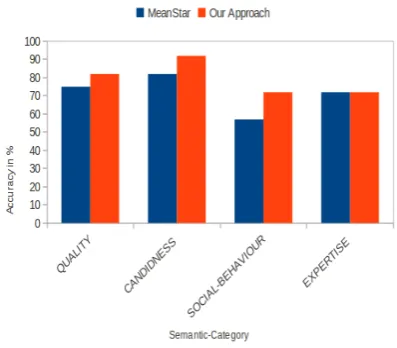
Ruppenhofer et al. (2014) showed that a cor-pus based method called MeanStar approach per-forms the best for intensity ordering task among existing approaches (De Melo and Bansal, 2013; Kim and de Marneffe, 2013; Fahrni and Klen-ner, 2008; Dragut et al., 2010) for polar seman-tic categories. Figure 3 shows the comparison be-tween MeanStar and our approach for four seman-tic categories4. For first three categories, our ap-proach performs better than MeanStar and for EX-PERTISE we obtain the same level of accuracy. MeanStar approach gives an overall accuracy of 4We have used the same semantic categories and inten-sity annotated movie review corpus in our work as used by Ruppenhofer et al. (2014).
73%across 52 polar categories, which is signifi-cantly lesser than the accuracy obtained with our approach. MeanStar approach does not assign in-tensity score to words missing from the corpus. While,88 out of122missing words are assigned correct intensity levels by our approach.
Figure 3: Accuracy obtained with MeanStar and our approach
6.3 Evaluation Using Star Rating Prediction
There have been several successful attempts at sentiment polarity detection in the past (Turney, 2002; Pang et al., 2002; Pang and Lee, 2004; Mo-hammad et al., 2013; Svetlana Kiritchenko and Mohammad, 2014). However, prediction of star ratings still considered as a challenging task (Qu et al., 2010; Gupta et al., 2010; Boteanu and Cher-nova, 2013). We implemented three systems to evaluate the significance of intensity annotated ad-jectives in star rating prediction task.
System 1: A rule based system based on the concept thatnegatively high intensewords will oc-cur more frequently in the low star reviews and
positively high intensewords will occur more fre-quently in thehigh star reviews. This system uses the following functionI to assign intensity score to a reviewr:
I(r) =
P3
i=1i∗CiP −P3i=1i∗CiN 3∗(P3i=1CP
i +P3i=1CiN) (2)
whereCP
i andCiN respectively represent sum of the term-frequencies of positive and negative ad-jectives with intensityi.
into 5-star ratings. We learn these breakpoints by maximizing accuracy for the training data5over all possible breakpoints.
System 2:In this system, we consider intensity of each adjective as +1or−1 as per its polarity, and then uses eq. 2 to find review intensity.
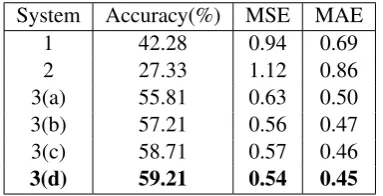
System 3:This is an SVM based system which uses four different types of features: (a) unigrams, (b) unigrams with the modification that if adjec-tive belongs to our intensity annotated adjecadjec-tive list, then feature value is intensity of the adjective, (c) and (d) use the scores coming from eq. 2 as an additional feature over those in (a) and (b) respec-tively.
System Accuracy(%) MSE MAE 1 42.28 0.94 0.69 2 27.33 1.12 0.86 3(a) 55.81 0.63 0.50 3(b) 57.21 0.56 0.47 3(c) 58.71 0.57 0.46
[image:5.595.86.278.267.365.2]3(d) 59.21 0.54 0.45
Table 3: Comparison of rating prediction systems, where MSE is the Mean Squared Error and MAE is the Mean Absolute Error
Table 3 shows the results obtained with the above systems. System 3(d) achieves the maxi-mum accuracy depicting that inclusion of intensity information with the standard features improves the star rating prediction significantly.
7 Related Work
Sentiment analysis on adjectives has been exten-sively explored in NLP literature. However, most of the works addressed the problem of finding po-larity orientation of adjectives (Hatzivassiloglou and McKeown, 1997; Wiebe, 2000; Fahrni and Klenner, 2008; Dragut et al., 2010). The first work in the direction of adjectival scale was done by Hatzivassiloglou and McKeown (1993). They ex-ploited linguistic knowledge available in the cor-pora to compute similarity between adjectives. However, their approach did not consider polarity orientation of adjectives, they provided ordering among non-polar adjectives like, cold, lukewarm, warm, hot.
5We use80% of the star-rated movie review corpus as training data and20%as test data. The results reported in table 3 are based on the 20% test data.
The task of ordering adjectives according to their polarity-intensity has recently received much attention due to the vital role of intensity analy-sis in several real world tasks. Kim et al. (2013) interpreted the continuous space word representa-tion by demonstrating that vector off-set can be used to derive scalar relationship amongst adjec-tives. Their approach provided relationship among all the adjectives independent of their semantic property. De Melo and Bansal (2013) used a pat-tern based approach to identify intensity relation among adjectives, but their approach had a severe coverage problem. They also did not consider the semantic property of adjectives, assuming one sin-gle intensity-scale for all adjectives.
Ruppenhofer et al. (2014) provided ordering among polar adjectives that bear the same seman-tic property. Their approach was completely cor-pus dependent, it was not able to derive intensity of those adjectives which were not found in the corpus. We have used the same star-rated movie review corpus in our work as used by Ruppenhofer et al. (2014) and found122polar adjectives which are absent from the corpus. Our system is able to identify intensity levels for these missing adjec-tives. Moreover, we obtained an improvement of 4% in overall accuracy.
8 Conclusion
In this paper, we have proposed an approach that assigns intensity levels to domain independent ad-jectives, viz. high, mediumand low. The impor-tant feature of our approach is that it is not fully corpus dependent, hence is able to assign inten-sity to adjectives that are absent in the corpus. We have reported that the overall results are better than the recently reported corpus based approach and fairly close to human agreement on this challeng-ing task.
The use of adjectives with their intensity infor-mation can enrich existing sentiment analysis sys-tems. We have shown the significance of consider-ing intensity information of adjectives in predict-ing the intensity of movie reviews.
9 Acknowledgment
References
Collin F Baker, Charles J Fillmore, and John B Lowe. 1998. The berkeley framenet project. In Proceed-ings of the 17th international conference on Compu-tational linguistics-Volume 1. Association for Com-putational Linguistics.
Adrian Boteanu and Sonia Chernova. 2013. Unsuper-vised rating prediction based on local and global se-mantic models. In2013 AAAI Fall Symposium Se-ries.
Gerard De Melo and Mohit Bansal. 2013. Good, great, excellent: Global inference of semantic intensities.
Transactions of the Association for Computational Linguistics, 1.
Eduard C Dragut, Clement Yu, Prasad Sistla, and Weiyi Meng. 2010. Construction of a sentimental word dictionary. InProceedings of the 19th ACM inter-national conference on Information and knowledge management. ACM.
Angela Fahrni and Manfred Klenner. 2008. Old wine or warm beer: Target-specific sentiment analysis of adjectives. InProc. of the Symposium on Affective Language in Human and Machine, AISB.
Narendra Gupta, Giuseppe Di Fabbrizio, and Patrick Haffner. 2010. Capturing the stars: predicting rat-ings for service and product reviews. In Proceed-ings of the NAACL HLT 2010 Workshop on Semantic Search. Association for Computational Linguistics. Vasileios Hatzivassiloglou and Kathleen R McKeown.
1993. Towards the automatic identification of ad-jectival scales: Clustering adjectives according to meaning. InProceedings of the 31st annual meeting on Association for Computational Linguistics. Asso-ciation for Computational Linguistics.
Vasileios Hatzivassiloglou and Kathleen R McKeown. 1997. Predicting the semantic orientation of adjec-tives. In Proceedings of the 35th annual meeting of the association for computational linguistics and eighth conference of the european chapter of the as-sociation for computational linguistics. Association for Computational Linguistics.
Joo-Kyung Kim and Marie-Catherine de Marneffe. 2013. Deriving adjectival scales from continuous space word representations. InEMNLP.
Bing Liu. 2010. Sentiment analysis and subjectivity.
Handbook of natural language processing, 2. Tomas Mikolov, Anoop Deoras, Daniel Povey, Lukas
Burget, and Jan Cernocky. 2011. Strategies for training large scale neural network language mod-els. In Automatic Speech Recognition and Under-standing (ASRU), 2011 IEEE Workshop on. IEEE. Tomas Mikolov, Kai Chen, Greg Corrado, and
Jef-frey Dean. 2013. Efficient estimation of word representations in vector space. arXiv preprint arXiv:1301.3781.
Saif M. Mohammad, Svetlana Kiritchenko, and Xiao-dan Zhu. 2013. Nrc-canada: Building the state-of-the-art in sentiment analysis of tweets. In Pro-ceedings of the seventh international workshop on Semantic Evaluation Exercises.
Bo Pang and Lillian Lee. 2004. A sentimental educa-tion: Sentiment analysis using subjectivity summa-rization based on minimum cuts. InProceedings of the 42nd annual meeting on Association for Compu-tational Linguistics, page 271. Association for Com-putational Linguistics.
Bo Pang and Lillian Lee. 2005. Seeing stars: Ex-ploiting class relationships for sentiment categoriza-tion with respect to rating scales. InProceedings of the 43rd Annual Meeting on Association for Compu-tational Linguistics. Association for Computational Linguistics.
Bo Pang, Lillian Lee, and Shivakumar Vaithyanathan. 2002. Thumbs up?: sentiment classification using machine learning techniques. InProceedings of the ACL-02 conference on Empirical methods in natu-ral language processing-Volume 10. Association for Computational Linguistics.
Lizhen Qu, Georgiana Ifrim, and Gerhard Weikum. 2010. The bag-of-opinions method for review rat-ing prediction from sparse text patterns. In Pro-ceedings of the 23rd International Conference on Computational Linguistics. Association for Compu-tational Linguistics.
Sven Rill, J¨org Scheidt, Johannes Drescher, Oliver Sch¨utz, Dirk Reinel, and Florian Wogenstein. 2012. A generic approach to generate opinion lists of phrases for opinion mining applications. In Pro-ceedings of the First International Workshop on Is-sues of Sentiment Discovery and Opinion Mining. ACM.
Josef Ruppenhofer, Michael Wiegand, and Jasper Brandes. 2014. Comparing methods for deriving intensity scores for adjectives. EACL 2014, 117. Raksha Sharma and Pushpak Bhattacharyya. 2013.
Detecting domain dedicated polar words. IJCNP 2013, pages 661–666.
Xiaodan Zhu Svetlana Kiritchenko and Saif M. Mo-hammad. 2014. Sentiment analysis of short infor-mal texts. 50.
Maite Taboada and Jack Grieve. 2004. Analyzing appraisal automatically. In Proceedings of AAAI Spring Symposium on Exploring Attitude and Affect in Text (AAAI Technical Re# port SS# 04# 07), Stan-ford University, CA, pp. 158q161. AAAI Press. Peter D Turney. 2002. Thumbs up or thumbs down?:
Janyce Wiebe. 2000. Learning subjective adjectives from corpora. InAAAI/IAAI.
Theresa Wilson, Paul Hoffmann, Swapna Somasun-daran, Jason Kessler, Janyce Wiebe, Yejin Choi, Claire Cardie, Ellen Riloff, and Siddharth Patward-han. 2005a. Opinionfinder: A system for subjectiv-ity analysis. InProceedings of hlt/emnlp on interac-tive demonstrations. Association for Computational Linguistics.