Reordering with Source Language Collocations
Zhanyi Liu
1,2, Haifeng Wang
2, Hua Wu
2, Ting Liu
1, Sheng Li
11
Harbin Institute of Technology, Harbin, China
2
Baidu Inc., Beijing, China
{liuzhanyi, wanghaifeng, wu_hua}@baidu.com
{tliu, lisheng}@hit.edu.cn
Abstract
This paper proposes a novel reordering model for statistical machine translation (SMT) by means of modeling the translation orders of the source language collocations. The model is learned from a word-aligned bilingual cor-pus where the collocated words in source sen-tences are automatically detected. During decoding, the model is employed to softly constrain the translation orders of the source language collocations, so as to constrain the translation orders of those source phrases con-taining these collocated words. The experi-mental results show that the proposed method significantly improves the translation quality, achieving the absolute improvements of 1.1~1.4 BLEU score over the baseline me-thods.
1
Introduction
Reordering for SMT is first proposed in IBM mod-els (Brown et al., 1993), usually called IBM con-straint model, where the movement of words during translation is modeled. Soon after, Wu (1997) proposed an ITG (Inversion Transduction Grammar) model for SMT, called ITG constraint
model, where the reordering of words or phrases is constrained to two kinds: straight and inverted. In order to further improve the reordering perfor-mance, many structure-based methods are pro-posed, including the reordering model in hierarchical phrase-based SMT systems (Chiang, 2005) and syntax-based SMT systems (Zhang et al.,
2007; Marton and Resnik, 2008; Ge, 2010; Vis-weswariah et al., 2010). Although the sentence structure has been taken into consideration, these methods don‟t explicitly make use of the strong correlations between words, such as collocations, which can effectively indicate reordering in the target language.
In this paper, we propose a novel method to im-prove the reordering for SMT by estimating the reordering score of the source-language colloca-tions (source collocacolloca-tions for short in this paper). Given a bilingual corpus, the collocations in the source sentence are first detected automatically using a monolingual word alignment (MWA) me-thod without employing additional resources (Liu et al., 2009), and then the reordering model based on the detected collocations is learned from the word-aligned bilingual corpus. The source colloca-tion based reordering model is integrated into SMT systems as an additional feature to softly constrain the translation orders of the source collocations in the sentence to be translated, so as to constrain the translation orders of those source phrases contain-ing these collocated words.
This method has two advantages: (1) it can au-tomatically detect and leverage collocated words in a sentence, including long-distance collocated words; (2) such a reordering model can be inte-grated into any SMT systems without resorting to any additional resources.
We implemented the proposed reordering mod-el in a phrase-based SMT system, and the evalua-tion results show that our method significantly improves translation quality. As compared to the baseline systems, an absolute improvement of 1.1~1.4 BLEU score is achieved.
The paper is organized as follows: In section 2, we describe the motivation to use source colloca-tions for reordering, and briefly introduces the col-location extraction method. In section 3, we present our reordering model. And then we de-scribe the experimental results in section 4 and 5. In section 6, we describe the related work. Lastly, we conclude in section 7.
2
Collocation
A collocation is generally composed of a group of words that occur together more often than by chance. Collocations effectively reveal the strong association among words in a sentence and are widely employed in a variety of NLP tasks (Mckeown and Radey, 2000).
Given two words in a collocation, they can be translated in the same order as in the source lan-guage, or in the inverted order. We name the first case as straight, and the second inverted. Based on the observation that some collocations tend to have fixed translation orders such as “金融 jin-rong „fi-nancial‟ 危 机 wei-ji „crisis‟” (financial crisis) whose English translation order is usually straight, and “法 律 fa-lv „law‟ 范 围 fan-wei „scope‟” (scope of law) whose English translation order is generally inverted, some methods have been pro-posed to improve the reordering model for SMT based on the collocated words crossing the neigh-boring components (Xiong et al., 2006). We fur-ther notice that some words are translated in different orders when they are collocated with dif-ferent words. For instance, when “潮流 chao-liu „trend‟” is collocated with “时代 shi-dai „times‟”, they are often translated into the “trend of times”; when collocated with “历史 li-shi „history‟”, the translation usually becomes the “historical trend”. Thus, if we can automatically detect the colloca-tions in the sentence to be translated and their or-ders in the target language, the reordering information of the collocations could be used to constrain the reordering of phrases during decod-ing. Therefore, in this paper, we propose to im-prove the reordering model for SMT by estimating the reordering score based on the translation orders of the source collocations.
In general, the collocations can be automatically identified based on syntactic information such as dependency trees (Lin, 1998). However these
me-thods may suffer from parsing errors. Moreover, for many languages, no valid dependency parser exists. Liu et al. (2009) proposed to automatically detect the collocated words in a sentence with the MWA method. The advantage of this method lies in that it can identify the collocated words in a sen-tence without additional resources. In this paper, we employ MWA Model l~3 described in Liu et al. (2009) to detect collocations in sentences, which are shown in Eq. (1)~(3).
lj j cj
w w t S A p
1 1
Model
MWA ( | ) ( | ) (1)
l
j j c j
l c j d w w t S A p
j
1 2
Model
MWA ( | ) ( | ) ( | , ) (2)
l
j j c j
l
i i i
l c j d w w t
w n S A p
j
1 1 3
Model MWA
) , | ( ) | (
) | ( ) | (
(3)
Where S wl 1
is a monolingual sentence; i de-notes the number of words collocating with wi;
} & ] , 1 [ | ) ,
{(i c i l c i
A i i denotes the potentially collocated words in S.
The MWA models measure the collocated words under different constraints. MWA Model 1 only models word collocation probabilities
) | (wj wcj
t . MWA Model 2 additionally employs position collocation probabilities d(j|cj,l) .
Be-sides the features in MWA Model 2, MWA Model 3 also considers fertility probabilities n(i|wi).
Given a sentence, the optimal collocated words can be obtained according to Eq. (4).
) | ( max
arg
* pMWA Model A S
A i
A
(4)
Given a monolingual word aligned corpus, the collocation probabilities can be estimated as fol-lows.
2
) | ( ) | ( ) ,
(wi wj pwi wj p wj wi
r
(5)
Where,
w
j j i j
i
w w count
w w count w
w p
) , (
) , ( )
|
( ; (wi,wj)
denotes the collocated words in the corpus and
) , (wi wj
3
Reordering Model with Source
Lan-guage Collocations
In this section, we first describe how to estimate the orientation probabilities for a given collocation, and then describe the estimation of the reordering score during translation. Finally, we describe the integration of the reordering model into the SMT system.
3.1
Reordering probability estimationGiven a source collocation (fi,fj) and its corres-ponding translations (eai,eaj) in a bilingual sen-tence pair, the reordering orientation of the collocation can be defined as in Eq. (6).
j i j i j i j i a a j
i i j a a i j a a
a a j i a a j i
o i j
& or & if inverted & or & if straight , , , (6)
In our method, only those collocated words in source language that are aligned to different target words, are taken into consideration, and those be-ing aligned to the same target word are ignored.
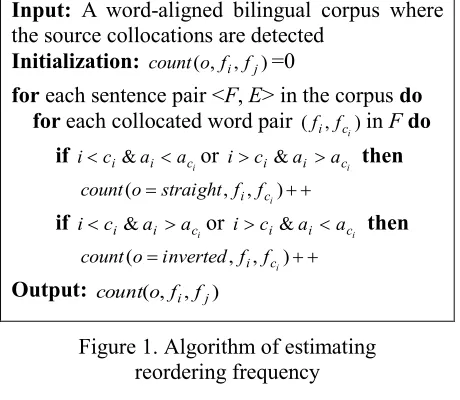
Given a word-aligned bilingual corpus where the collocations in source sentences are detected, the probabilities of the translation orientation of collocations in the source language can be esti-mated, as follows:
o i j
j i j
i counto f f
f f o count f f o p ) , , ( ) , , straight ( ) , | straight
( (7)
o i j
j i j
i counto f f
f f o count f f o p ) , , ( ) , , inverted ( ) , | inverted ( (8)
Here, count(o,fi,fj) is collected according to
the algorithm in Figure 1.
3.2
Reordering modelGiven a sentence F fl 1
to be translated, the
col-locations are first detected using the algorithm de-scribed in Eq. (4). Then the reordering score is estimated according to the reordering probability weighted by the collocation probability of the col-located words. Formally, for a generated transla-tion candidate T , the reordering score is calculated as follows. ) , | ( log ) , ( ) , ( , , , ) ,
( i i i ci i
i ic a a i c
c i
c i
O F T r f f po f f
P
(9)Input: A word-aligned bilingual corpus where the source collocations are detected
Initialization: count(o,fi,fj)=0
for each sentence pair <F, E> in the corpus do for each collocated word pair ( , )
i c
i f
f in F do
if
i c i
i a a
c
i & or
i c i
i a a
c
i & then
count(ostraight,fi,fci)
if
i c i
i a a
c
i & or ici&aiaci then ( , , ) i c i f f inverted o count
[image:3.612.313.543.74.274.2]Output: count(o,fi,fj)
Figure 1. Algorithm of estimating reordering frequency
Here, ( , ) i c i f f
r denotes the collocation probabil-ity of fi and fci as shown in Eq. (5).
In addition to the detected collocated words in the sentence, we also consider other possible word pairs whose collocation probabilities are higher than a given threshold. Thus, the reordering score is further improved according to Eq. (10).
) , ( &, ) {(, )}( , , , , , , ) , ( )} , | ( log ) , ( ) , | ( log ) , ( ) , ( j i i j i i i c i i i i f f rj ic
i i j i ja a i j
c i a a c i c
i i c
O f f o p f f r f f o p f f r T F P (10)
Where and are two interpolation weights. is the threshold of collocation probability. The weights and the threshold can be tuned using a de-velopment set.
3.3
Integrated into SMT systemThe SMT systems generally employ the log-linear model to integrate various features (Chiang, 2005; Koehn et al., 2007). Given an input sentence F, the final translation E* with the highest score is chosen from candidates, as in Eq. (11).
} ) , ( { max arg * 1
M m m m E F E hE (11)
Where hm(E, F) (m=1,...,M) denotes
fea-tures.
m is a feature weight.Figure 2. An example for reordering
4
Evaluation of Our Method
4.1
ImplementationWe implemented our method in a phrase-based SMT system (Koehn et al., 2007). Based on the GIZA++ package (Och and Ney, 2003), we im-plemented a MWA tool for collocation detection. Thus, given a sentence to be translated, we first identify the collocations in the sentence, and then estimate the reordering score according to the translation hypothesis. For a translation option to be expanded, the reordering score inside this source phrase is calculated according to their trans-lation orders of the collocations in the correspond-ing target phrase. The reordercorrespond-ing score crosscorrespond-ing the current translation option and the covered parts can be calculated according to the relative position of the collocated words. If the source phrase matched by the current translation option is behind the cov-ered parts in the source sentence, then
...) | staight (
logpo is used, otherwise
...) | inverted (
logpo . For example, in Figure 2, the current translation option is ( f2 f3e3e4). The collocations related to this translation option are
) ,
(f1 f3 , (f2,f3), (f3,f5). The reordering scores can be estimated as follows:
) , | straight (
log ) ,
(f1 f3 po f1 f3
r
) , | inverted (
log ) ,
(f2 f3 po f2 f3
r
) , | inverted (
log ) ,
(f3 f5 po f3 f5
r
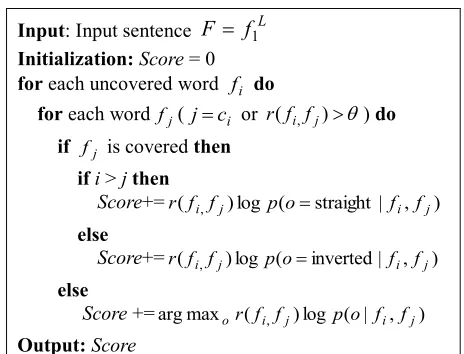
In order to improve the performance of the de-coder, we design a heuristic function to estimate the future score, as shown in Figure 3. For any un-covered word and its collocates in the input sen-tence, if the collocate is uncovered, then the higher reordering probability is used. If the collocate has been covered, then the reordering orientation can
Input: Input sentence F f1L
Initialization: Score = 0
for each uncovered word fi do
for each word fj( jci or r(fi,fj)) do if fj is covered then
if i > j then
Score+=r(fi,fj)log p(ostraight |fi,fj)
else
Score+=r(fi,fj)logp(oinverted| fi,fj)
else
Score +=argmaxor(fi,fj)logp(o|fi,fj)
[image:4.612.124.233.73.174.2]Output: Score
Figure 3. Heuristic function for estimating future score
be determined according to the relative positions of the words and the corresponding reordering proba-bility is employed.
4.2
SettingsWe use the FBIS corpus (LDC2003E14) to train a Chinese-to-English phrase-based translation model. And the SRI language modeling toolkit (Stolcke, 2002) is used to train a 5-gram language model on the English sentences of FBIS corpus.
We used the NIST evaluation set of 2002 as the development set to tune the feature weights of the SMT system and the interpolation parameters, based on the minimum error rate training method (Och, 2003), and the NIST evaluation sets of 2004 and 2008 (MT04 and MT08) as the test sets.
We use BLEU (Papineni et al., 2002) as evalua-tion metrics. We also calculate the statistical signi-ficance differences between our methods and the baseline method by using the paired bootstrap re-sample method (Koehn, 2004).
4.3
Translation resultsWe compare the proposed method with various reordering methods in previous work.
Monotone model: no reordering model is used.
Distortion based reordering (DBR) model: a distortion based reordering method (Al-Onaizan & Papineni, 2006). In this method, the distortion cost is defined in terms of words, ra-ther than phrases. This method considers out-bound, inbound, and pairwise distortions that
f1 f2 f3 f4 f5
e4
e3
e2
Reorder models MT04 MT08
Monotone model 26.99 18.30
DBR model 26.64 17.83
MSDR model (Baseline) 28.77 18.42
MSDR+
DBR model 28.91 18.58
SCBR Model 1 29.21 19.28
SCBR Model 2 29.44 19.36
SCBR Model 3 29.50 19.44
[image:5.612.184.432.71.205.2]SCBR models (1+2) 29.65 19.57 SCBR models (1+2+3) 29.75 19.61 Table 1. Translation results on various reordering models
T1: The two sides are also the basic stand of not relaxed.
T2: The basic stance of the two sides have not relaxed.
Reference: The basic stances of both sides did not move. Figure 4. Translation example. (*/*) denotes (pstraight / pinverted)
are directly estimated by simple counting over alignments in the word-aligned bilingual cor-pus. This method is similar to our proposed method. But our method considers the transla-tion order of the collocated words.
msd-bidirectional-fe reordering (MSDR or
Baseline) model: it is one of the reordering models in Moses. It considers three different orientation types (monotone, swap, and discon-tinuous) on both source phrases and target phrases. And the translation orders of both the next phrase and the previous phrase in respect to the current phrase are modeled.
Source collocation based reordering (SCBR) model: our proposed method. We investigate three reordering models based on the corres-ponding MWA models and their combinations. In SCBR Model i (i=1~3), we use MWA Mod-el i as described in section 2 to obtain the col-located words and estimate the reordering probabilities according to section 3.
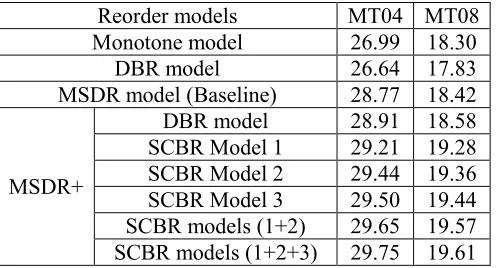
The experiential results are shown in Table 1. The DBR model suffers from serious data sparse-ness. For example, the reordering cases in the trained pairwise distortion model only covered
32~38% of those in the test sets. So its perfor-mance is worse than that of the monotone model. The MSDR model achieves higher BLEU scores than the monotone model and the DBR model. Our models further improve the translation quality, achieving better performance than the combination of MSDR model and DBR model. The results in Table 1 show that “MSDR + SCBR Model 3” per-forms the best among the SCBR models. This is because, as compared to MWA Model 1 and 2, MWA Model 3 takes more information into con-sideration, including not only the co-occurrence information of lexical tokens and the position of words, but also the fertility of words in a sentence. And when the three SCBR models are combined, the performance of the SMT system is further im-proved. As compared to other reordering models, our models achieve an absolute improvement of 0.98~1.19 BLEU score on the test sets, which are statistically significant (p < 0.05).
Figure 4 shows an example: T1 is generated by the baseline system and T2 is generated by the sys-tem where the SCBR models (1+2+3)1 are used.
1 In the remainder of this paper, “SCBR models” means the
combination of the SCBR models (1+2+3) unless it is explicit-ly explained.
Input: 双方 的 基本 立场 也 都 没有 松动 。 shuang-fang DE ji-ben li-chang ye dou mei-you song-dong .
(0.99/0.01)
both-side DE basic stance also both not loose . (0.21/0.79)
Reordering models MT04 MT08
MSDR model 28.77 18.42
MSDR+
DBR model 28.91 18.58
CBR model 28.96 18.77
WCBR model 29.15 19.10
WCBR+SCBR
[image:6.612.69.301.73.164.2]models 29.87 19.83
Table 2. Translation results of co-occurrence based reordering models
CBR model SCBR
Model3
Consecutive words 77.9% 73.5%
Interrupted words 74.1% 87.8%
[image:6.612.71.300.207.278.2]Total 74.3% 84.9%
Table 3. Precisions of the reordering models on the development set
The input sentence contains three collocations. The collocation (基本, 立场) is included in the same phrase and translated together as a whole. Thus its translation is correct in both translations. For the other two long-distance collocations (双方, 立场) and (立场, 松动), their translation orders are not correctly handled by the reordering model in the baseline system. For the collocation (双方, 立场), since the SCBR models indicate p(o=straight|双方, 立场) < p(o=inverted|双方, 立场), the system fi-nally generates the translation T2 by constraining their translation order with the proposed model.
5
Collocations vs. Co-occurring Words
We compared our method with the method that models the reordering orientations based on co-occurring words in the source sentences, rather than the collocations.
5.1
Co-occurrence based reordering modelWe use the similar algorithm described in section 3 to train the co-occurrence based reordering (CBR) model, except that the probability of the reordering orientation is estimated on the co-occurring words and the relative distance. Given an input sentence and a translation candidate, the reordering score is estimated as shown in Eq. (12).
) ,
( , , ,
) , , | (
log )
, (
j
i ija a i j i j
O F T po f f
P i j (12)
Here, ij is the relative distance of two words in the source sentence.
We also construct the weighted co-occurrence based reordering (WCBR) model. In this model, the probability of the reordering orientation is ad-ditionally weighted by the pointwise mutual infor-mation2 score of the two words (Manning and
Schütze, 1999), which is estimated as shown in Eq. (13).
) ,
( MI ,, ,
) , , | (
log ) , ( ) , (
j
i i j ija a i j i j
O
f f o
p f f s T F P
j i
(13)
5.2
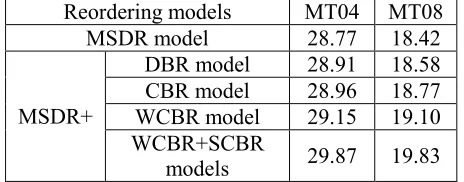
Translation resultsTable 2 shows the translation results. It can be seen that the performance of the SMT system is im-proved by integrating the CBR model. The perfor-mance of the CBR model is also better than that of the DBR model. It is because the former is trained based on all co-occurring aligned words, while the latter only considers the adjacent aligned words. When the WCBR model is used, the translation quality is further improved. However, its perfor-mance is still inferior to that of the SCBR models, indicating that our method (SCBR models) of modeling the translation orders of source colloca-tions is more effective. Furthermore, we combine the weighted co-occurrence based model and our method, which outperform all the other models.
5.3
Result analysisPrecision of prediction
First of all, we investigate the performance of the reordering models by calculating precisions of the translation orders predicted by the reordering models. Based on the source sentences and refer-ence translations of the development set, where the source words and target words are automatically aligned by the bilingual word alignment method, we construct the reference translation orders for two words. Against the references, we calculate three kinds of precisions as follows:
| } 1 | || { |
| } &
1 {
|
,
, , , , CW
j i o
o o j| |i P
j i
a a j i j
i i j
(14)
2 For occurring words extraction, the window size is set to [-6,
| } 1 | || { |
| } &
1 { |
,
, , , , IW
j i o
o o j| |i P
j i
a a j i j
i i j
(15)
| } { |
| } {
|
, , , , , total
j i
a a j i j i
o o o
P i j
(16)
Here, oi,j denotes the translation order of (fi,fj)
predicted by the reordering models. If )
| straight
(o fi,fj
p > p(oinverted|fi,fj) , then
straight
,j i
o , else if p(ostraight|fi,fj) <
) , inverted
(o |fi fj
p , then oi,j inverted .
j ia a j i
o
,, , denotes the translation order derived from the word alignments. If oi,j oi,j,ai,aj , then the predicted translation order is correct, otherwise wrong. PCWand PIW denote the precisions calculated on the consecutive words and the interrupted words in the source sentences, respectively. Ptotal denotes the precision on both cases. Here, the CBR model and SCBR Model 3 are compared. The results are shown in Table 3.
From the results in Table 3, it can be seen that the CBR model has a higher precision on the con-secutive words than the SCBR model, but lower precisions on the interrupted words. It is mainly because the CBR model introduces more noise when the relative distance of words is set to a large number, while the MWA method can effectively detect the long-distance collocations in sentences (Liu et al., 2009). This explains why the combina-tion of the two models can obtain the highest BLEU score as shown in Table 2. On the whole, the SCBR Model 3 achieves higher precision than the CBR model.
Effect of the reordering model
Then we evaluate the reordering results of the generated translations in the test sets. Using the above method, we construct the reference transla-tion orders of collocatransla-tions in the test sets. For a given word pair in a source sentence, if the transla-tion order in the generated translatransla-tion is the same as that in the reference translations, then it is cor-rect, otherwise wrong.
We compare the translations of the baseline thod, the co-occurrence based method, and our me-thod (SCBR models). The precisions calculated on both kinds of words are shown in Table 4. From
Test sets Baseline (MSDR)
MSDR+ WCBR
MSDR+ SCBR
MT04 78.9% 80.8% 82.5%
[image:7.612.308.543.72.127.2]MT08 80.7% 83.8% 85.0%
Table 4. Precisions (total) of the reordering models on the test sets
the results, it can be seen that our method achieves higher precisions than both the baseline and the method modeling the translation orders of the co-occurring words. It indicates that the proposed me-thod effectively constrains the reordering of source words during decoding and improves the transla-tion quality.
6
Related Work
Reordering was first proposed in the IBM models (Brown et al., 1993), later was named IBM con-straint by Berger et al. (1996). This model treats the source word sequence as a coverage set that is processed sequentially and a source token is cov-ered when it is translated into a new target token. In 1997, another model called ITG constraint was presented, in which the reordering order can be hierarchically modeled as straight or inverted for two nodes in a binary branching structure (Wu, 1997). Although the ITG constraint allows more flexible reordering during decoding, Zens and Ney (2003) showed that the IBM constraint results in higher BLEU scores. Our method models the reor-dering of collocated words in sentences instead of all words in IBM models or two neighboring blocks in ITG models.
their translation orders in the target languages, which are used to constrain the ordering models with the estimated reordering (straight or inverted) score. Moreover, our method allows flexible reor-dering by consireor-dering both consecutive words and interrupted words.
In order to further improve translation results, many researchers employed syntax-based reorder-ing methods (Zhang et al., 2007; Marton and Res-nik, 2008; Ge, 2010; Visweswariah et al., 2010). However these methods are subject to parsing er-rors to a large extent. Our method directly obtains collocation information without resorting to any linguistic knowledge or tools, therefore is suitable for any language pairs.
In addition, a few models employed the collo-cation information to improve the performance of the ITG constraints (Xiong et al., 2006). Xiong et al. used the consecutive co-occurring words as col-location information to constrain the reordering, which did not lead to higher translation quality in their experiments. In our method, we first detect both consecutive and interrupted collocated words in the source sentence, and then estimated the reordering score of these collocated words, which are used to softly constrain the reordering of source phrases.
7
Conclusions
We presented a novel model to improve SMT by means of modeling the translation orders of source collocations. The model was learned from a word-aligned bilingual corpus where the potentially col-located words in source sentences were automati-cally detected by the MWA method. During decoding, the model is employed to softly con-strain the translation orders of the source language collocations. Since we only model the reordering of collocated words, our methods can partially al-leviate the data sparseness encountered by other methods directly modeling the reordering based on source phrases or target phrases. In addition, this kind of reordering information can be integrated into any SMT systems without resorting to any additional resources.
The experimental results show that the pro-posed method significantly improves the transla-tion quality of a phrase based SMT system, achieving an absolute improvement of 1.1~1.4 BLEU score over the baseline methods.
References
Yaser Al-Onaizan and Kishore Papineni. 2006. Distor-tion Models for Statistical Machine TranslaDistor-tion. In Proceedings of the 21st International Conference on Computational Linguistics and 44th Annual Meeting of the ACL, pp. 529-536.
Adam L. Berger, Peter F. Brown, Stephen A. Della Pie-tra, Vincent J. Della PiePie-tra, Andrew S. Kehler, and Robert L. Mercer. 1996. Language Translation Appa-ratus and Method of Using Context-Based
Transla-tion Models. United States Patent, Patent Number
5510981, April.
Peter F. Brown, Stephen A. Della Pietra, Vincent J. Del-la Pietra, and Robert. L. Mercer. 1993. The Mathe-matics of Statistical Machine Translation: Parameter
estimation. Computational Linguistics, 19(2):
263-311.
David Chiang. 2005. A Hierarchical Phrase-based Mod-el for Statistical Machine Translation. In Proceedings of the 43rd Annual Meeting of the Association for Computational Linguistics, pp. 263-270.
Niyu Ge. 2010. A Direct Syntax-Driven Reordering Model for Phrase-Based Machine Translation. In Proceedings of Human Language Technologies: The 2010 Annual Conference of the North American Chapter of the ACL, pp. 849-857.
Philipp Koehn. 2004. Statistical Significance Tests for
Machine Translation Evaluation. In Proceedings of
the 2004 Conference on Empirical Methods in Natu-ral Language Processing, pp. 388-395.
Philipp Koehn, Franz Joseph Och, and Daniel Marcu.
2003. Statistical Phrase-Based Translation. In
Pro-ceedings of the Joint Conference on Human Lan-guage Technologies and the Annual Meeting of the North American Chapter of the Association of Com-putational Linguistics, pp. 127-133.
Philipp Koehn, Hieu Hoang, Alexandra Birch, Chris Callison-Burch, Marcello Federico, Nicola Bertoldi, Brooke Cowan, Wade Shen, Christine Moran Ri-chard Zens, Chris Dyer, Ondrej Bojar, Alexandra Constantin, and Evan Herbst. 2007. Moses: Open Source Toolkit for Statistical Machine Translation. In Proceedings of the 45th Annual Meeting of the ACL, Poster and Demonstration Sessions, pp. 177-180. Philipp Koehn, Amittai Axelrod, Alexandra Birch
Dekang Lin. 1998. Extracting Collocations from Text
Corpora. In Proceedings of the 1st Workshop on
Computational Terminology, pp. 57-63.
Zhanyi Liu, Haifeng Wang, Hua Wu, and Sheng Li. 2009. Collocation Extraction Using Monolingual Word Alignment Method. In Proceedings of the 2009 Conference on Empirical Methods in Natural Lan-guage Processing, pp. 487-495.
Christopher D. Manning and Hinrich Schütze. 1999. Foundations of Statistical Natural Language Processing, Cambridge, MA; London, U.K.: Brad-ford Book & MIT Press.
Yuval Marton and Philip Resnik. 2008. Soft Syntactic Constraints for Hierarchical Phrased-based
Transla-tion. In Proceedings of the 46st Annual Meeting of
the Association for Computational Linguistics: Hu-man Language Technologies, pp. 1003-1011. Kathleen R. McKeown and Dragomir R. Radev. 2000.
Collocations. In Robert Dale, Hermann Moisl, and
Harold Somers (Ed.), A Handbook of Natural
Lan-guage Processing, pp. 507-523.
Franz Josef Och. 2003. Minimum Error Rate Training in
Statistical Machine Translation. In Proceedings of
the 41st Annual Meeting of the Association for Com-putational Linguistics, pp. 160-167.
Franz Josef Och and Hermann Ney. 2003. A Systematic Comparison of Various Statistical Alignment Models. Computational Linguistics, 29(1) : 19-51.
Kishore Papineni, Salim Roukos, Todd Ward, and Weij-ing Zhu. 2002. BLEU: A Method for Automatic
Evaluation of Machine Translation. In Proceedings
of 40th Annual Meeting of the Association for Com-putational Linguistics, pp. 311-318.
Andreas Stolcke. 2002. SRILM - An Extensible
Lan-guage Modeling Toolkit. In Proceedings for the
In-ternational Conference on Spoken Language Processing, pp. 901-904.
Christoph Tillmann. 2004. A Unigram Orientation
Model for Statistical Machine Translation. In
Pro-ceedings of the Joint Conference on Human Lan-guage Technologies and the Annual Meeting of the North American Chapter of the Association of Com-putational Linguistics, pp. 101-104.
Christoph Tillmann and Tong Zhang. 2005. A Localized Prediction Model for Statistical Machine Translation. In Proceedings of the 43rd Annual Meeting of the As-sociation for Computational Linguistics, pp. 557-564. Karthik Visweswariah, Jiri Navratil, Jeffrey Sorensen,
Vijil Chenthamarakshan, and Nanda Kambhatla. 2010. Syntax Based Reordering with Automatically
Derived Rules for Improved Statistical Machine Translation. In Proceedings of the 23rd International Conference on Computational Linguistics, pp. 1119-1127.
Dekai Wu. 1997. Stochastic Inversion Transduction Grammars and Bilingual Parsing of Parallel Corpora. Computational Linguistics, 23(3):377-403.
Deyi Xiong, Qun Liu, and Shouxun Lin. 2006. Maxi-mum Entropy Based Phrase Reordering Model for
Statistical Machine Translation. In Proceedings of
the 21st International Conference on Computational Linguistics and 44th Annual Meeting of the Associa-tion for ComputaAssocia-tional Linguistics, pp. 521-528. Richard Zens and Herman Ney. 2003. A Comparative
Study on Reordering Constraints in Statistical Ma-chine Translation. In Proceedings of the 41st Annual Meeting of the Association for Computational Lin-guistics, pp. 192-202.
Richard Zens and Herman Ney. 2006. Discriminative Reordering Models for Statistical Machine
Transla-tion. In Proceedings of the Workshop on Statistical
Machine Translation, pp. 55-63.
Dongdong Zhang, Mu Li, Chi-Ho Li, and Ming Zhou. 2007. Phrase Reordering Model Integrating Syntactic
Knowledge for SMT. In Proceedings of the 2007