Chunk-based Statistical Translation
Taro Watanabe†, Eiichiro Sumita† and Hiroshi G. Okuno‡
{taro.watanabe, eiichiro.sumita}@atr.co.jp
†ATR Spoken Language Translation ‡Department of Intelligence Science
Research Laboratories and Technology
2-2-2 Hikaridai, Keihanna Science City Graduate School of Informatics, Kyoto Uniersity
Kyoto 619-0288 JAPAN Kyoto 606-8501 JAPAN
Abstract
This paper describes an alternative trans-lation model based on a text chunk un-der the framework of statistical machine translation. The translation model sug-gested here first performs chunking. Then, each word in a chunk is translated. Fi-nally, translated chunks are reordered. Under this scenario of translation model-ing, we have experimented on a broad-coverage Japanese-English traveling cor-pus and achieved improved performance.
1 Introduction
The framework of statistical machine translation for-mulates the problem of translating a source sentence in a language J into a target language E as the maximization problem of the conditional probability
ˆ
E = argmaxEP(E|J). The application of the Bayes Rule resulted in ˆE=argmaxEP(E)P(J|E). The for-mer term P(E) is called a language model, repre-senting the likelihood of E. The latter term P(J|E) is called a translation model, representing the gener-ation probability from E into J.
As an implementation of P(J|E), the word align-ment based statistical translation (Brown et al., 1993) has been successfully applied to similar lan-guage pairs, such as French–English and German– English, but not to drastically different ones, such as Japanese–English. This failure has been due to the limited representation by word alignment and the weak model structure for handling complicated word correspondence.
This paper provides a chunk-based statistical translation as an alternative to the word alignment based statistical translation. The translation process inside the translation model is structured as follows. A source sentence is first chunked, and then each chunk is translated into target language with local word alignments. Next, translated chunks are re-ordered to match the target language constraints.
Based on this scenario, the chunk-based statis-tical translation model is structured with several components and trained by a variation of the EM-algorithm. A translation experiment was carried out with a decoder based on the left-to-right beam search. It was observed that the translation quality improved from 46.5% to 52.1% in BLEU score and from 59.2% to 65.1% in subjective evaluation.
The next section briefly reviews the word align-ment based statistical machine translation (Brown et al., 1993). Section 3 discusses an alternative ap-proach, a chunk-based translation model, ranging from its structure to training procedure and decod-ing algorithm. Then, Section 4 provides experimen-tal results on Japanese-to-English translation in the traveling domain, followed by discussion.
2 Word Alignment Based Statistical Translation
E= NULL0 show1 me2 the3 one4 in5 the6 window7
J= uindo1 no2 shinamono3 o4 mise5 tekudasai6
[image:2.612.320.534.70.164.2]A=( 7 0 4 0 1 1 )
Figure 1: Example of word alignment
Under this word alignment assumption, the transla-tion model P(J|E) can be further decomposed with-out approximation.
P(J|E)=
A
P(J,A|E)
2.1 IBM Model
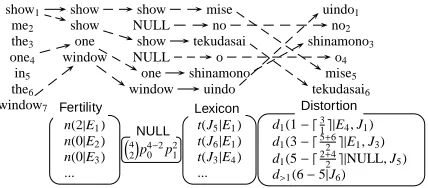
During the generation process from E to J, P(J,A|E) is assumed to be structured with a couple of pro-cesses, such as insertion, deletion and reorder. A scenario for the word alignment based translation model defined by Brown et al. (1993), for instance IBM Model 4, goes as follows (refer to Figure 2).
1. Choose the number of words to generate for each source word according to the Fertility Model. For example, “show” was increased to 2 words, while “me” was deleted.
2. Insert NULLs at appropriate positions by the NULL Generation Model. Two NULLs were inserted after each “show” in Figure 2.
3. Translate word-by-word for each generated word by looking up the Lexicon Model. One of the two “show” words was translated to “mise.”
4. Reorder the translated words by referring to the Distortion Model. The word “mise” was re-ordered to the 5th position, and “uindo” was reordered to the 1st position. Positioning is de-termined by the previous word’s alignment to capture phrasal constraints.
For the meanings of each symbol in each model, re-fer to Brown et al. (1993).
2.2 Problems of Word Alignment Based Translation Model
The strategy for the word alignment based transla-tion model is to translate each word by generating multiple single words (a bag of words) and to deter-mine the position of each translated word. Although
show1 show show mise uindo1
me2 show NULL no no2
the3 one show tekudasai shinamono3
one4 window NULL o o4
in5 one shinamono mise5
the6 window uindo tekudasai6
window7
n(2|E1)
n(0|E2)
n(0|E3)
... Fertility
4 2
p4−20 p2 1
NULL t(J5|E1)
t(J6|E1)
t(J3|E4)
... Lexicon
d1(1− 31|E4,J1)
d1(3− 5+26|E1,J3)
d1(5− 2+24|NULL,J5)
d>1(6−5|J6)
[image:2.612.77.291.70.113.2]Distortion
Figure 2: Word alignment based translation model P(J,A|E) (IBM Model 4)
this procedure is sufficient to capture the bilingual correspondence for similar language pairs, some is-sues remain for drastically different pairs:
Insertion/Deletion Modeling Although deletion was modeled in the Fertility Model, it merely as-signs zero to each deleted word without considering context. Similarly, inserted words are selected by the Lexical Model parameter and inserted at the po-sitions determined by a binomial distribution.
This insertion/deletion scheme contributed to the simplicity of this representation of the translation processes, allowing a sophisticated application to run on an enormous bilingual sentence collection. However, it is apparent that the weak modeling of those phenomena will lead to inferior performance for language pairs such as Japanese and English.
Local Alignment Modeling The IBM Model 4 (and 5) simulates phrasal constraints, although there were implicitly implemented as its Distortion Model parameters. In addition, the entire reordering is determined by a collection of local reorderings in-sufficient to capture the long-distance phrasal con-straints.
The next section introduces an alternative model-ing, chunk-based statistical translation, which was intended to resolve the above two issues.
3 Chunk-based Statistical Translation
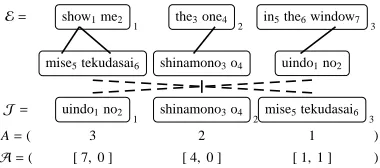
Chunk-based statistical translation models the pro-cess of chunking for both the source and target sen-tences, E and J,
P(J|E)=
J
E
P(J,J,E|E)
ar-E= show1me2
1 the3one4 2 in5the6window7 3
mise5tekudasai6 shinamono3o4 uindo1no2
J= uindo1no2
1 shinamono3o4 2mise5tekudasai6 3
A=( 3 2 1 )
[image:3.612.91.281.70.154.2]A=( [ 7,0 ] [ 4,0 ] [ 1,1 ] )
Figure 3: Example of chunk-based alignment
rays. For instance, Ji,j represents the jth word of
the ith chunk. The number of chunks for source and target is assumed to be equal, |J| = |E|, so that each chunk can convey a unit of meaning without added/subtracted information. The term P(J,J,E|E) is further decomposed by chunk align-ment A and word alignalign-ment for each chunk transla-tionA.
P(J,J,E|E)=
A
A
P(J,J,A,A,E|E)
The notion of alignment A is the same as those found in the word alignment based translation model, which assigns a source chunk index for each target chunk. Ais a two-dimensional array which assigns a source word index for each target word per chunk. For example, Figure 3 shows two-level alignments taken from the example in Figure 1. The target chunk at position 3,J3, “mise tekudasai” is aligned to the first position (A3 = 1), and both the words “mise” and “tekudasai” are aligned to the first posi-tion of the source sentence (A3,1 =1,A3,2=1).
3.1 Translation Model Structure
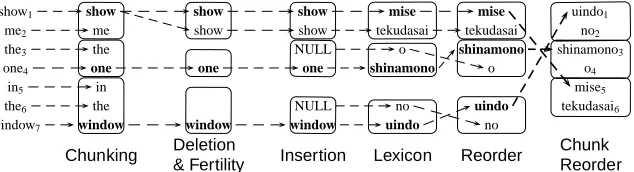
The term P(J,J,A,A,E|E) is further decomposed with approximation according to the scenario de-scribed below (refer to Figure 4).
1. Perform chunking for source sentence E by P(E|E). For instance, chunks of “show me” and “the one” were derived. The process is mod-eled by two steps:
(a) Selection of chunk size (Head Model). For each word Ei, assign the chunk size
ϕi using the head model(ϕi|Ei). A word
with chunk size more than 0 (ϕi > 0) is
treated as a head word, otherwise a non-head (refer to the words in bold in Figure 4).
(b) Associate each non-head word to a head word (Chunk Model). Each non-head word Eiis associated to a head word Ehby
the probabilityη(c(Eh)|h−i,c(Ei)), where
h is the position of a head word and c(E) is a function to map a word E to its word class (i.e. POS). For instance, “the3” is associated with the head word “one4” lo-cated at 4−3= +1.
2. Select words to be translated with Deletion and Fertility Model.
(a) Select the number of head words. For each head word Eh(ϕh>0), choose fertilityφh
according to the Fertility Model ν(φh|Eh).
We assume that the head word must be translated, therefore φh > 0. In addition,
one of them is selected as a head word at target position using a uniform distribu-tion 1/φh.
(b) Delete some non-head words. For each non-head word Ei (ϕi = 0),
delete it according to the Deletion Model
δ(di|c(Ei),c(Eh)), where Eh is the head
word in the same chunk and di is 1 if Ei
is deleted, otherwise 0.
3. Insert some words. In Figure 4, NULLs were inserted for two chunks. For each chunk Ei,
select the number of spurious wordsφi by In-sertion Modelι(φi|c(Eh)), where Ehis the head
word ofEi.
4. Translate word-by-word. Each source word Ei,
including spurious words, is translated to Jj
ac-cording to the Lexicon Model,τ(Jj|Ei).
5. Reorder words. Each word in a chunk is reordered according to the Reorder Model P(Aj|EAj,Jj). The chunk reordering is taken
after the Distortion Model of IBM Model 4, where the position is determined by the relative position from the head word,
P(Aj|EAj,Jj)= |Aj|
k=1
ρ(k−h|c(EAA j,k),c(Jj,k))
where h is the position of a head word for the chunkJj. For example, “no” is positioned−1
show1 show show show mise mise uindo1
me2 me show show tekudasai tekudasai no2
the3 the NULL o shinamono shinamono3
one4 one one one shinamono o o4
in5 in mise5
the6 the NULL no uindo tekudasai6
window7 window window window uindo no
Chunking Deletion
& Fertility Insertion Lexicon Reorder
[image:4.612.150.467.69.155.2]Chunk Reorder
Figure 4: Chunk-based translation model. The words in bold are head words.
6. Reorder chunks. All of the chunks are reordered according to the Chunk Reorder Model, P(A|E,J). The chunk reordering is also similar to the Distortion Model, where the positioning is determined by the relative posi-tion from the previous alignment
P(A|E,J) =
|J|
j=1
( j− j|c(EAj−1,h),c(Jj,h))
where jis the chunk alignment of the the pre-vious chunk aEAj−1. h and hare the head word indices for Jj and EAj−1, respectively. Note that the reordering is dependent on head words.
To summarize, the chunk-based translation model can be formulated as
P(J|E) =
E,J,A,A
i
(ϕi|Ei)
×
i:ϕi=0
η(c(Ehi)|hi−i,c(Ei))
×
i:ϕi>0
ν(φi|Ei)/φi
×
i:ϕi=0
δ(di|c(Ei),c(Ehi))
×
i:ϕi>0
ι(φi|c(Ei))×
j
k
τ(Jj,k|EAj,k)
×
j
P(Aj|EAj,Jj)×P(A|E,J)
.
3.2 Characteristics of chunk-based Translation Model
The main difference to the word alignment based translation model is the treatment of the bag of word translations. The word alignment based trans-lation model generates a bag of words for each
source word, while the chunk-based model con-structs a set of target words from a set of source words. The behavior is modeled as a chunking pro-cedure by first associating words to the head word of its chunk and then performing chunk-wise trans-lation/insertion/deletion.
The complicated word alignment is handled by the determination of word positions in two stages: translation of chunk and chunk reordering. The for-mer structures local orderings while the latter con-stitutes global orderings. In addition, the concept of head associated with each chunk plays the central role in constraining different levels of the reordering by the relative positions from heads.
3.3 Parameter Estimation
The parameter estimation for the chunk-based trans-lation model relies on the EM-algorithm (Dempster et al., 1977). Given a large bilingual corpus the conditional probability of P(J,A,A,E|J,E) = P(J,J,A,A,E|E)/J,A,A,EP(J,J,A,A,E|E) is first estimated for each pair of J and E (E-step), then each model parameters is computed based on the estimated conditional probability (M-step). The above procedure is iterated until the set of parameters converge.
However, this naive algorithm will suffer from se-vere computational problems. The enumeration of all possible chunkingsJ andEtogether with word alignmentAand chunk alignment A requires a sig-nificant amount of computation. Therefore, we have introduced a variation of the Inside-Outside algo-rithm as seen in (Yamada and Knight, 2001) for E-step computation. The details of the procedure are described in Appendix A.
does not guarantee finding the global maximum. In order to solve this problem and to make the pa-rameters converge quickly, IBM Model 4 parame-ters were used as the initial parameparame-ters for training. We directly applied the Lexicon Model and Fertility Model to the chunk-based translation model but set other parameters as uniform.
3.4 Decoding
The decoding algorithm employed for this chunk-based statistical translation is chunk-based on the beam search algorithm for word alignment statistical translation presented in (Tillmann and Ney, 2000), which generates outputs in left-to-right order by consuming input in an arbitrary order.
The decoder consists of two stages:
1. Generate possible output chunks for all possi-ble input chunks.
2. Generate hypothesized output by consuming input chunks in arbitrary order and combining possible output chunks in left-to-right order.
The generation of possible output chunks is es-timated through an inverted lexicon model and sequences of inserted strings (Tillmann and Ney, 2000). In addition, an example-based method is also introduced, which generates candidate chunks by looking up the viterbi chunking and alignment from a training corpus.
Since the combination of all possible chunks is computationally very expensive, we have introduced the following pruning and scoring strategies.
beam pruning: Since the search space is
enor-mous, we have set up a size threshold to main-tain partial hypotheses for both of the above two stages. We also incorporated a threshold for scoring, which allows partial hypotheses with a certain score to be processed.
example-based scoring: Input/output chunk pairs that appeared in a training corpus are “re-warded” so that they are more likely kept in the beam. During the decoding process, when a pair of chunks appeared in the first stage, the score is boosted by using this formula in the log domain,
log Ptm(J|E) + log Plm(E)
Table 1: Basic Travel Expression Corpus
Japanese English # of sentences 171,894 # of words 1,181,188 1,009,065 vocabulary size 20472 16232 # of singletons 82,06 5,854 3-gram perplexity 23.7 35.8
+ weight×
j
f req(EAj,Jj)
in which Ptm(J|E) and Plm(E) are translation
model and language model probability, respec-tively1, f req(E
Aj,Jj) is the frequency for the
pair EAj andJj appearing in the training
cor-pus, and weight is a tuning parameter.
4 Experiments
The corpus for this experiment was extracted from the Basic Travel Expression Corpus (BTEC), a col-lection of conversational travel phrases for Japanese and English (Takezawa et al., 2002) as seen in Ta-ble 1. The entire corpus was split into three parts: 152,169 sentences for training, 4,846 sentences for testing, and the remaining 10,148 sentences for pa-rameter tuning, such as the termination criteria for the training iteration and the parameter tuning for decoders.
Three translation systems were tested for compar-ison:
model4: Word alignment based translation model,
IBM Model 4 with a beam search decoder.
chunk3: Chunk-based translation model, limiting
the maximum allowed chunk size to 3.
model3+: chunk3 with example-based chunk
can-didate generation.
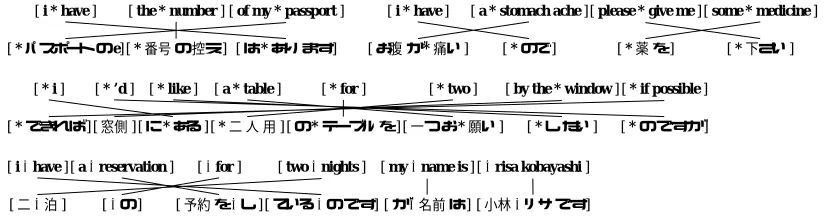
Figure 5 shows some examples of viterbi chunking and chunk alignment for chunk3.
Translations were carried out on 510 sentences se-lected randomly from the test set and evaluated ac-cording to the following criteria with 16 reference sets.
WER: Word-error-rate, which penalizes the edit distance
against reference translations.
1For simplicity of notation, dependence on other variables
[ i * have ] [ the * number ] [ of my * passport ]
[ *パスポート のe] [ *番号 の 控え] [は*あり ます]
[ i * have ] [ a * stomach ache ] [ please * give me ] [ some * medicine ]
[お腹 が*痛い] [ *ので] [ *薬 を] [ *下さい]
[ * i ] [ * ’d ] [ * like ] [ a * table ] [ * for ] [ * two ] [ by the * window ] [ * if possible ]
[ *できれ ば] [窓側] [に*ある] [ *二 人 用] [の*テーブル を] [一つ お*願い] [ *し たい] [ *の です が]
[ i∗have ] [ a∗reservation ] [∗for ] [ two∗nights ] [ my∗name is ] [∗risa kobayashi ]
[二∗泊] [∗の] [予約 を∗し] [ている∗の です] [が∗名前 は] [小林∗リサ です]
Figure 5: Examples of viterbi chunking and chunk alignment for English-to-Japanese translation model. Chunks are bracketed and the words with∗to the left are head words.
Table 2: Experimental results for Japanese–English translation
Model WER PER BLEU SE [%] [%] [%] [%] A A+B A+B+C model4 43.3 37.2 46.5 59.2 74.1 80.2 chunk3 40.9 36.1 48.4 59.8 73.5 78.8 chunk3+ 38.5 33.7 52.1 65.1 76.3 80.6
PER: Position independent WER, which penalizes without
considering positional disfluencies.
BLEU: BLEU score, which computes the ratio of n-gram for
the translation results found in reference translations (Pa-pineni et al., 2002).
SE: Subjective evaluation ranks ranging from A to D
(A:Perfect, B:Fair, C:Acceptable and D:Nonsense), judged by native speakers.
Table 2 summarizes the evaluation of Japanese-to-English translations, and Figure 6 presents some of the results by model4 and chunk3+.
As Table 2 indicates, chunk3 performs better than model4 in terms of the non-subjective evaluations, although it scores almost equally in subjective eval-uations. With the help of example-based decoding, chunk3+was evaluated as the best among the three systems.
5 Discussion
The chunk-based translation model was originally inspired by transfer-based machine translation but modeled by chunks in order to capture syntax-based correspondence. However, the structures evolved into complicated modeling: The translation model involves many stages, notably chunking and two kinds of reordering, word-based and chunk-based alignments. This is directly reflected in parameter
input: 一 五 二 便 の 荷物 は これ で 全部 です か reference: is this all the baggage from flight one five two model4: is this all you baggage for flight one five two chunk3: is this all the baggage from flight one five two
input: 朝食 を ルームサービス で お 願い し ます reference: may i have room service for breakfast please
model4: please give me some room service please chunk3: i ’d like room service for breakfast
input: もしもし 三 月 十 九 日 の 予約 を 変更 し たい の です が reference: hello i ’d like to change my reservation for march nineteenth
model4: i ’d like to change my reservation for ninety days be march hello chunk3: hello i ’d like to change my reservation on march nineteenth
input: 二 三 分 待っ て下さい 今 電話 中 な ん です reference: wait a couple of minutes i ’m telephoning now
model4: is this the line is busy now a few minutes
chunk3: i ’m on another phone now please wait a couple of minutes
Figure 6: Translation examples by word alignment based model and chunk-based model
estimation, where chunk3 took 20 days for 40 iter-ations, which is roughly the same amount of time required for training IBM Model 5 with pegging.
de-viation from a training corpus, while the latter ap-proach will be able to perform well on unseen word sequences, although chunk-based examples are also useful for decoding to overcome the limited context of a n-gram based language model.
Wang (1998) presented a different chunk-based method by treating the translation model as a phrase-to-string process. Yamada and Knight (2001) fur-ther extended the model to a syntax-to-string trans-lation modeling. Both assume that the source part of a translation model is structured either with a se-quence of chunks or with a parse tree, while our method directly models a string-to-string procedure. It is clear that the string-to-string modeling with hi-den chunk-layers is computationally more expensive than those structure-to-string models. However, the structure-to-string approaches are already biased by a monolingual chunking or parsing, which, in turn, might not be able to uncover the bilingual phrasal or syntactical constraints often observed in a corpus.
Alshawi et al. (2000) also presented a two-level arranged word ordering and chunk ordering by a hi-erarchically organized collection of finite state trans-ducers. The main difference from our work is that their approach is basically deterministic, while the chunk-based translation model is non-deterministic. The former method, of course, performs more ef-ficient decoding but requires stronger heuristics to generate a set of transducers. Although the latter approach demands a large amount of decoding time and hypothesis space, it can operate on a very broad-coverage corpus with appropriate translation model-ing.
Acknowledgments
The research reported here was supported in part by a contract with the Telecommunications Advance-ment Organization of Japan entitled “A study of speech dialogue translation technology based on a large corpus”.
References
Hiyan Alshawi, Srinivas Bangalore, and Shona Douglas. 2000. Learning dependency translation models as col-lections of finite state head transducers. Computa-tional Linguistics, 26(1):45–60.
Peter F. Brown, Stephen A. Della Pietra, Vincent J. Della
Pietra, and Robert L. Mercer. 1993. The mathematics of statistical machine translation: Parameter estima-tion. Computational Linguistics, 19(2):263–311.
A. P. Dempster, N.M. Laird, and D.B.Rubin. 1977. Maximum likelihood from incomplete data via the em algorithm. Journal of the Royal Statistical Society, B(39):1–38.
Daniel Marcu and William Wong. 2002. A phrase-based, joint probability model for statistical machine transla-tion. In Proc. of EMNLP-2002, Philadelphia, PA, July.
Franz Josef Och, Christoph Tillmann, and Hermann Ney. 1999. Improved alignment models for statistical ma-chine translation. In Proc. of EMNLP/WVLC, Univer-sity of Maryland, College Park, MD, June.
Kishore Papineni, Salim Roukos, Todd Ward, and Wei-Jing Zhu. 2002. Bleu: a method for automatic eval-uation of machine translation. In Proc. of ACL 2002, pages 311–318.
Toshiyuki Takezawa, Eiichiro Sumita, Fumiaki Sugaya, Hirofumi Yamamoto, and Seiichi Yamamoto. 2002. Toward a broad-coverage bilingual corpus for speech translation of travel conversations in the real world. In Proc. of LREC 2002, pages 147–152, Las Palmas, Ca-nary Islands, Spain, May.
Christoph Tillmann and Hermann Ney. 2000. Word re-ordering and dp-based search in statistical machine translation. In Proc. of the COLING 2000, July-August.
Ye-Yi Wang. 1998. Grammar Inference and Statis-tical Machine Translation. Ph.D. thesis, School of Computer Science, Language Technologies Institute, Carnegie Mellon University.
Taro Watanabe, Kenji Imamura, and Eiichiro Sumita. 2002. Statistical machine translation based on hierar-chical phrase alignment. In Proc. of TMI 2002, pages 188–198, Keihanna, Japan, March.
Kenji Yamada and Kevin Knight. 2001. A syntax-based statistical translation model. In Proc. of ACL 2001, Toulouse, France.
Appendix A Inside-Outside Algorithm for Chunk-based Translation Model
can be derived, which represent the probability of source/target paring of chunks and sentences. The outside (forward or alpha) probabilities can be de-fined as the probability of a particular source and target pair appearing at a particular chunking and re-ordering.
Inside Probability First, given E and J, compute chunk translation inside probabilities for all the pos-sible source and target chunks pairing Eii and Jjj in which Eiiis the chunk ranging from index i to i,
β(Eii,Jjj) =
A
P(A,Jjj|Eii)
=
A
θ
Pθ(A,Jjj,Eii)
where Pθ is the probability of a model with asso-ciated values for corresponding random variables, such as(ϕi|Ei) orτ(Jj|Ei), except for the chunk
re-order model. Ais a word alignment for the chunks Eii and Jjj.
Second, compute the inside probability for sen-tence pairs E and J by considering all possible chunkings and chunk alignments.
β(E,J) =
E,J:|E|=|J|
A
P(A,E,J,J|E)
=
E,J:|E|=|J|
A
P(A|E,J)
j
β(EAj,Jj)
Outside Probability The outside probability for sentence pairing is always 1.
α(E,J)=1.0
The outside probabilities for each chunk pair is
α(Eii,Jjj) = α(E,J)
E,J:|E|=|J|
A
P(A|E,J)
×
EAkEii,JkJ j j
β(EAk,Jk)
.
Inside-Outside Computation The combination of the above inside-outside probabilities yields the following formulas for the accumulated counts of pair occurrences.
First, the counts for each model parameterθwith associated random variables countθ(Θ) is
countθ(Θ) =
<E,J>
Θ(A,Ei i,J
j j )
α(Eii,Jjj)/β(E,J)
×
θ
Pθ(A,Jjj,Eii)
.
Second, the count for chunk reordering with asso-ciated random variables count(Θ) is
count(Θ) =
<E,J>
α(E,J)/β(E,J)
Θ(A,E,J)
P(A|E,J)
k
β(EAk,Jk)
.
Approximation Even with the introduction of the inside-outside parameter estimation paradigm, the enumeration of all possible chunk pairing and word alignment requires O(lmk4(k + 1)k) computations, where l and m are sentence length for E and J, re-spectively, and k is the maximum allowed number of words per chunk. In addition, the enumeration of all possible alignments for all possible chunked sentences is O(2l2mn!), where n=|J|=|E|.
In order to handle the massive amount of compu-tational demand, we have applied an approximation to the inside-outside estimation procedure. First, the enumeration of word alignment computation for chunk translations was approximated by a set of alignments, the viterbi alignment and neighboring alignment through move/swap operations of partic-ular word alignments.
Second, the chunk alignment enumeration was also approximated by a set of chunking and chunk alignments as follows.
1. Determines the number of chunks per sentence
2. Determine initial chunking and alignment
3. Compute viterbi chunking-alignment via hill-climbing using the following operators
• Move boundary of chunk
• Swap chunk alignment
• Move head position