A Novel Graph-based Compact Representation of Word Alignment
Qun Liu†‡ Zhaopeng Tu‡ Shouxun Lin‡
†Centre for Next Generation Locolisation ‡Key Lab. of Intelligent Info. Processing
Dublin City University Institute of Computing Technology, CAS [email protected] {tuzhaopeng,sxlin}@ict.ac.cn
Abstract
In this paper, we propose a novel compact representation called weighted bipartite hypergraph to exploit the fertility model, which plays a critical role in word align-ment. However, estimating the probabili-ties of rules extracted from hypergraphs is an NP-complete problem, which is com-putationally infeasible. Therefore, we pro-pose a diviand-conquer strategy by de-composing a hypergraph into a set of inde-pendent subhypergraphs. The experiments show that our approach outperforms both 1-best andn-best alignments.
1 Introduction
Word alignment is the task of identifying trans-lational relations between words in parallel cor-pora, in which a word at one language is usually translated into several words at the other language (fertility model) (Brown et al., 1993). Given that many-to-many links are common in natural lan-guages (Moore, 2005), it is necessary to pay atten-tion to the relaatten-tions among alignment links.
In this paper, we have proposed a novel graph-based compact representation of word alignment, which takes into account the joint distribution of alignment links. We first transform each align-ment to a bigraph that can be decomposed into a set of subgraphs, where all interrelated links are in the same subgraph (§ 2.1). Then we employ a weighted partite hypergraph to encode multiple bigraphs (§2.2).
[image:1.595.326.507.209.307.2]The main challenge of this research is to effi-ciently calculate the fractional counts for rules ex-tracted from hypergraphs. This is equivalent to the decision version of set covering problem, which is NP-complete. Observing that most alignments are not connected, we propose a divide-and-conquer strategy by decomposing a hypergraph into a set
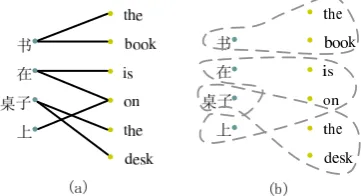
Figure 1: A bigraph constructed from an align-ment (a), and its disjoint MCSs (b).
of independent subhypergraphs, which is compu-tationally feasible in practice (§3.2). Experimen-tal results show that our approach significantly im-proves translation performance by up to 1.3 BLEU points over 1-best alignments (§4.3).
2 Graph-based Compact Representation
2.1 Word Alignment as a Bigraph
Each alignment of a sentence pair can be trans-formed to a bigraph, in which the two disjoint ver-tex setsSandTare the source and target words re-spectively, and the edges are word-by-word links. For example, Figure 1(a) shows the corresponding bigraph of an alignment.
The bigraph usually is not connected. A graph is called connected if there is a path between every pair of distinct vertices. In an alignment, words in a specific portion at the source side (i.e. a verb phrase) usually align to those in the corresponding portion (i.e. the verb phrase at the target side), and would never align to other words; and vice versa. Therefore, there is no edge that connects the words in the portion to those outside the portion.
Therefore, a bigraph can be decomposed into a unique set of minimum connected subgraphs (MCSs), where each subgraph is connected and does not contain any other MCSs. For example, the bigraph in Figure 1(a) can be decomposed into
the
book
is
on
the
desk
Җ
൘
Ṽᆀ
к
D
the
book
is
on
the
desk
Җ
൘
Ṽᆀ
к
e1
F
the
book
is
on
the
desk
Җ
൘
Ṽᆀ
к
E
e2 e3 e4
e5
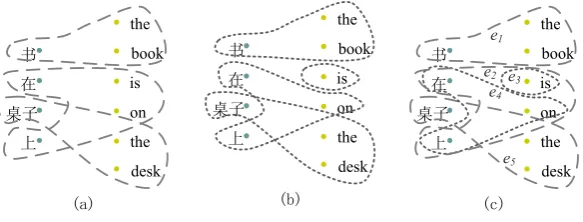
Figure 2: (a) One alignment of a sentence pair; (b) another alignment of the same sentence pair; (c) the resulting hypergraph that takes the two alignments as samples.
the MCSs in Figure 1(b). We can see that all in-terrelated links are in the same MCS. These MCSs work as fundamental units in our approach to take advantage of the relations among the links. Here-inafter, we use bigraph to denote the alignment of a sentence pair.
2.2 Weighted Bipartite Hypergraph
We believe that offering more alternatives to ex-tracting translation rules could help improve trans-lation quality. We propose a new structure called weighted bipartite hypergraph that compactly en-codes multiple alignments.
We use an example to illustrate our idea. Fig-ures 2(a) and 2(b) show two bigraphs of the same sentence pair. Intuitively, we can encode the union set of subgraphs in a bipartite hypergraph, in which each MCS serves as a hyperedge, as in Figure 2(c). Accordingly, we can calculate how well a hyperedge is by calculating its relative fre-quency, which is the probability sum of bigraphs in which the corresponding MCS occurs divided by the probability sum of all possible bigraphs. Suppose that the probabilities of the two bigraphs in Figures 2(a) and 2(b) are 0.7 and 0.3, respec-tively. Then the weight of e1 is 1.0 and e2 is 0.7. Therefore, each hyperedge is associated with a weight to indicate how well it is.
Formally, a weighted bipartite hypergraphHis a triple hS, T, Ei whereS and T are two sets of vertices on the source and target sides, andE are hyperedges associated with weights. Currently, we estimate the weights of hyperedges from ann -best list by calculating relative frequencies:
w(ei) =
P
BG∈Np(BG)×δ(BG, gi)
P
BG∈Np(BG)
HereN is ann-best bigraph (i.e., alignment) list,
p(BG)is the probability of a bigraphBGin then -best list,giis the MCS that corresponds toei, and δ(BG, gi)is an indicator function which equals 1 whengi occurs inBG, and 0 otherwise.
It is worthy mentioning that a hypergraph en-codes much more alignments than the inputn-best list. For example, we can construct a new align-ment by using hyperedges from different bigraphs that cover all vertices.
3 Graph-based Rule Extraction
In this section we describe how to extract transla-tion rules from a hypergraph (§ 3.1) and how to estimate their probabilities (§3.2).
3.1 Extraction Algorithm
We extract translation rules from a hypergraph for the hierarchical phrase-based system (Chiang, 2007). Chiang (2007) describes a rule extrac-tion algorithm that involves two steps: (1) extract phrases from 1-best alignments; (2) obtain vari-able rules by replacing sub-phrase pairs with non-terminals. Our extraction algorithm differs at the first step, in which we extract phrases from hyper-graphs instead of 1-best alignments. Rather than restricting ourselves by the alignment consistency in the traditional algorithm, we extract all possible candidate target phrases for each source phrase. To maintain a reasonable rule table size, we fil-ter out less promising candidates that have a frac-tional count lower than a threshold.
3.2 Calculating Fractional Counts
[image:2.595.154.446.73.184.2]Intuitively, our approach faces two challenges:
1. How to calculate the probability sum of all alignments encoded in a hypergraph (§3.2.1)?
2. How to efficiently calculate the probability sum of all consistent alignments for each phrase pair (§3.2.2)?
3.2.1 Enumerating All Alignments
In theory, a hypergraph can encode all possible alignments if there are enough hyperedges. How-ever, since a hypergraph is constructed from ann -best list, it can only represent partial space of all alignments (p(A|H) <1) because of the limiting size of hyperedges learned from the list. There-fore, we need to enumerate all possible align-ments in a hypergraph to obtain the probability sump(A|H).
Specifically, generating an alignment from a hy-pergraph can be modelled as finding a complete hyperedge matching, which is a set of hyperedges without common vertices that matches all vertices. The probability of the alignment is the product of hyperedge weights. Thus, enumerating all possi-ble alignments in a hypergraph is reformulated as finding all complete hypergraph matchings, which is an NP-complete problem (Valiant, 1979).
Similar to the bigraph, a hypergraph is also usu-ally not connected. To make the enumeration prac-tically tractable, we propose a divide-and-conquer strategy by decomposing a hypergraphHinto a set of independent subhypergraphs {h1, h2, . . . , hn}. Intuitively, the probability of an alignment is the product of hyperedge weights. According to the divide-and-conquer strategy, the probability sum of all alignmentsAencoded in a hypergraphHis:
p(A|H) = Y
hi∈H
p(Ai|hi)
Here p(Ai|hi) is the probability sum of all sub-alignmentsAi encoded in the subhypergraphhi.
3.2.2 Enumerating Consistent Alignments
Since a hypergraph encodes many alignments, it is unrealistic to enumerate all consistent alignments explicitly for each phrase pair.
Recall that a hypergraph can be decomposed to a list of independent subhypergraphs, and an alignment is a combination of the sub-alignments from the decompositions. We observe that a phrase pair is absolutely consistent with the sub-alignments from some subhypergraphs, while pos-sibly consistent with the others. As an example,
E the
book
is
on
the
desk
Җ
൘ Ṽᆀ
к
e1
D
e2 e3
e4
e5
the
book
is
on the
desk
Җ
൘ Ṽᆀ
к
e1
e2 e3
e4 e5
h1
[image:3.595.326.507.78.207.2]h3 h2
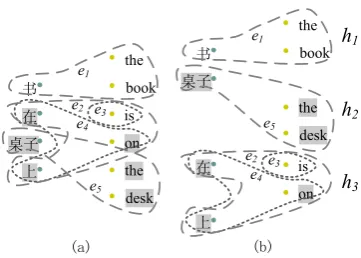
Figure 3: A hypergraph with a candidate phrase in the grey shadow (a), and its independent subhy-pergraphs{h1, h2, h3}.
consider the phrase pair in the grey shadow in Fig-ure 3(a), it is consistent with all sub-alignments from bothh1 andh2 because they are outside and inside the phrase pair respectively, while not con-sistent with the sub-alignment that contains hyper-edgee2 fromh3because it contains an alignment link that crosses the phrase pair.
Therefore, to calculate the probability sum of all consistent alignments, we only need to consider the overlap subhypergraphs, which have at least one hyperedge that crosses the phrase pair. Given a overlap subhypergraph, the probability sum of consistent alignments is calculated by sub-tracting the probability sum of the sub-alignments that contain crossed hyperedges, from the proba-bility sum of all sub-alignments encoded in a hy-pergraph.
Given a phrase pair P, let OS and N S de-notes the sets of overlap and non-overlap subhy-pergraphs respectively (N S =H−OS). Then
p(A|H, P) = Y hi∈OS
p(Ai|hi, P)
Y
hj∈N S
p(Aj|hj)
Here the phrase pair is absolutely consistent with the sub-alignments from non-overlap subhyper-graphs (NS), and we have p(A|h, P) = p(A|h). Then the fractional count of a phrase pair is:
c(P|H) = p(A|H, P) p(A|H) =
Q
hi∈OSp(A|hi, P)
Q
hi∈OSp(A|hi)
After we get the fractional counts of transla-tion rules, we can estimate their relative frequen-cies (Och and Ney, 2004). We follow (Liu et al., 2009; Tu et al., 2011) to learn lexical tables from
Rules from. . . Rules MT03 MT04 MT05 Avg.
1-best 257M 33.45 35.25 33.63 34.11
10-best 427M 34.10 35.71 34.04 34.62
[image:4.595.164.435.62.119.2]Hypergraph 426M 34.71 36.24 34.41 35.12
Table 1: Evaluation of translation quality.
4 Experiments
4.1 Setup
We carry out our experiments on Chinese-English translation tasks using a reimplementation of the hierarchical phrase-based system (Chiang, 2007). Our training data contains 1.5 million sentence pairs from LDC dataset.1 We train a 4-gram language model on the Xinhua portion of the GIGAWORD corpus using the SRI Language Toolkit (Stolcke, 2002) with modified Kneser-Ney Smoothing (Kneser and Ney, 1995). We use min-imum error rate training (Och, 2003) to optimize the feature weights on the MT02 testset, and test on the MT03/04/05 testsets. For evaluation, case-insensitive NIST BLEU (Papineni et al., 2002) is used to measure translation performance.
We first follow Venugopal et al. (2008) to pro-duce n-best lists via GIZA++. We propro-duce 10-best lists in two translation directions, and use “grow-diag-final-and” strategy (Koehn et al., 2003) to generate the final n-best lists by selecting the top nalignments. We re-estimated the probabil-ity of each alignment in the n-best list using re-normalization (Venugopal et al., 2008). Finally we construct weighted alignment hypergraphs from thesen-best lists.2When extracting rules from hy-pergraphs, we set the pruning thresholdt= 0.5.
4.2 Tractability of Divide-and-Conquer Strategy
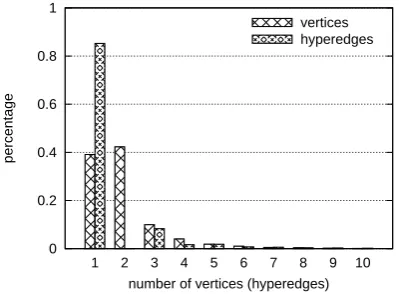
Figure 4 shows the distribution of vertices (hy-peredges) number of the subhypergraphs. We can see that most of the subhypergraphs have just less than two vertices and hyperedges.3 Specifically, each subhypergraph has 2.0 vertices and 1.4
hy-1
The corpus includes LDC2002E18, LDC2003E07, LDC2003E14, Hansards portion of LDC2004T07, LDC2004T08 and LDC2005T06.
2Here we only use 10-best lists, because the alignments
beyond top 10 have very small probabilities, thus have negli-gible influence on the hypergraphs.
3It’s interesting that there are few subhypergraphs that
have exactly 2 hyperedges. In this case, the only two hy-peredges fully cover the vertices and they differ at the word-by-word links, which is uncommon inn-best lists.
0 0.2 0.4 0.6 0.8 1
1 2 3 4 5 6 7 8 9 10
percentage
number of vertices (hyperedges) vertices hyperedges
Figure 4: The distribution of vertices (hyperedges) number of the subhypergraphs.
peredges on average. This suggests that the divide-and-conquer strategy makes the extraction compu-tationally tractable, because it greatly reduces the number of vertices and hyperedges. For computa-tional tractability, we only allow a subhypergraph has at most 5 hyperedges. 4
4.3 Translation Performance
Table 1 shows the rule table size and transla-tion quality. Using n-best lists slightly improves the BLEU score over 1-best alignments, but at the cost of a larger rule table. This is in ac-cord with intuition, because all possible transla-tion rules would be extracted from different align-ments inn-best lists without pruning. This larger rule table indeed leads to a high rule coverage, but in the meanwhile, introduces translation errors be-cause of the low-quality rules (i.e., rules extracted only from low-quality alignments inn-best lists). By contrast, our approach not only significantly improves the translation performance over 1-best alignments, but also outperformsn-best lists with a similar-scale rule table. The absolute improve-ments of 1.0 BLEU points on average over 1-best alignments are statistically significant atp <0.01 using sign-test (Collins et al., 2005).
4If a subhypergraph has more than 5 hyperedges, we
[image:4.595.320.520.163.310.2]Rules from. . . Shared Non-shared All
Rules BLEU Rules BLEU Rules BLEU
10-best 1.83M 32.75 2.81M 30.71 4.64M 34.62
[image:5.595.144.458.63.120.2]Hypergraph 1.83M 33.24 2.89M 31.12 4.72M 35.12
Table 2: Comparison of rule tables learned fromn-best lists and hypergraphs. “All” denotes the full rule table, “Shared” denotes the intersection of two tables, and “Non-shared” denotes the complement. Note that the probabilities of “Shared” rules are different for the two approaches.
Why our approach outperformsn-best lists? In theory, the rule table extracted from n-best lists is a subset of that from hypergraphs. In prac-tice, however, this is not true because we pruned the rules that have fractional counts lower than a threshold. Therefore, the question arises as to how many rules are shared by n-best and hypergraph-based extractions. We try to answer this ques-tion by comparing the different rule tables (filtered on the test sets) learned fromn-best lists and hy-pergraphs. Table 2 gives some statistics. “All” denotes the full rule table, “Shared” denotes the intersection of two tables, and “Non-shared” de-notes the complement. Note that the probabil-ities of “Shared” rules are different for the two approaches. We can see that both the “Shared” and “Non-shared” rules learned from hypergraphs outperform n-best lists, indicating: (1) our ap-proach has a better estimation of rule probabili-ties because we estimate the probabiliprobabili-ties from a much larger alignment space that can not be rep-resented byn-best lists, (2) our approach can ex-tract good rules that cannot be exex-tracted from any single alignments in then-best lists.
5 Related Work
Our research builds on previous work in the field of graph models and compact representations. Graph models have been used before in word alignment: the search space of word alignment can be structured as a graph and the search problem can be reformulated as finding the optimal path though this graph (e.g., (Och and Ney, 2004; Liu et al., 2010)). In addition, Kumar and Byrne (2002) define a graph distance as a loss function for minimum Bayes-risk word alignment, Riesa and Marcu (2010) open up the word alignment task to advances in hypergraph algorithms currently used in parsing. As opposed to the search problem, we propose a graph-based compact representation that encodes multiple alignments for machine transla-tion.
Previous research has demonstrated that com-pact representations can produce improved re-sults by offering more alternatives, e.g., using forests over 1-best trees (Mi and Huang, 2008; Tu et al., 2010; Tu et al., 2012a), word lattices over 1-best segmentations (Dyer et al., 2008), and weighted alignment matrices over 1-best word alignments (Liu et al., 2009; Tu et al., 2011; Tu et al., 2012b). Liu et al., (2009) estimate the link probabilities from n-best lists, while Gispert et al., (2010) learn the alignment posterior probabil-ities directly from IBM models. However, both of them ignore the relations among alignment links. By contrast, our approach takes into account the joint distribution of alignment links and explores the fertility model past the link level.
6 Conclusion
We have presented a novel compact representa-tion of word alignment, named weighted bipar-tite hypergraph, to exploit the relations among alignment links. Since estimating the probabil-ities of rules extracted from hypergraphs is an NP-complete problem, we propose a computation-ally tractable diviand-conquer strategy by de-composing a hypergraph into a set of independent subhypergraphs. Experimental results show that our approach outperforms both 1-best and n-best alignments.
Acknowledgement
References
Peter E. Brown, Stephen A. Della Pietra, Vincent J. Della Pietra, and Robert L. Mercer. 1993. The mathematics of statistical machine translation: Parameter estimation. Computational linguistics, 19(2):263–311.
David Chiang. 2007. Hierarchical phrase-based trans-lation. Computational Linguistics, 33(2):201–228.
M. Collins, P. Koehn, and I. Kuˇcerov´a. 2005. Clause restructuring for statistical machine translation. In Proceedings of the 43rd Annual Meeting on Associa-tion for ComputaAssocia-tional Linguistics, pages 531–540.
Adri`a de Gispert, Juan Pino, and William Byrne. 2010. Hierarchical phrase-based translation grammars ex-tracted from alignment posterior probabilities. In Proceedings of the 2010 Conference on Empirical Methods in Natural Language Processing, pages 545–554.
Christopher Dyer, Smaranda Muresan, and Philip Resnik. 2008. Generalizing word lattice translation. In Proceedings of ACL-08: HLT, pages 1012–1020.
Reinhard Kneser and Hermann Ney. 1995. Improved backing-off for m-gram language modeling. In Pro-ceedings of the International Conference on Acous-tics, Speech, and Signal Processing, volume 1, pages 181–184.
Philipp Koehn, Franz Joseph Och, and Daniel Marcu. 2003. Statistical phrase-based translation. In Pro-ceedings of the 2003 Conference of the North Amer-ican Chapter of the Association for Computational Linguistics, pages 48–54.
Shankar Kumar and William Byrne. 2002. Mini-mum Bayes-risk word alignments of bilingual texts. In Proceedings of the 2002 Conference on Empiri-cal Methods in Natural Language Processing, pages 140–147.
Yang Liu, Tian Xia, Xinyan Xiao, and Qun Liu. 2009. Weighted alignment matrices for statistical machine translation. In Proceedings of the 2009 Conference on Empirical Methods in Natural Language Pro-cessing, pages 1017–1026.
Yang Liu, Qun Liu, and Shouxun Lin. 2010. Discrim-inative word alignment by linear modeling. Compu-tational Linguistics, 36(3):303–339.
Haitao Mi and Liang Huang. 2008. Forest-based trans-lation rule extraction. In Proceedings of the 2008 Conference on Empirical Methods in Natural Lan-guage Processing, pages 206–214.
Robert C. Moore. 2005. A discriminative framework for bilingual word alignment. In Proceedings of the Conference on Empirical Methods in Natural Lan-guage Processing, pages 81–88, October.
Franz J. Och and Hermann Ney. 2004. The alignment template approach to statistical machine translation. Computational Linguistics, 30(4):417–449.
Franz Josef Och. 2003. Minimum error rate training in statistical machine translation. In Proceedings of the 41st Annual Meeting of the Association for Com-putational Linguistics, pages 160–167.
Kishore Papineni, Salim Roukos, Todd Ward, and Wei-Jing Zhu. 2002. Bleu: a method for automatic evaluation of machine translation. In Proceedings of 40th Annual Meeting of the Association for Com-putational Linguistics, pages 311–318.
Jason Riesa and Daniel Marcu. 2010. Hierarchical search for word alignment. In Proceedings of the 48th Annual Meeting of the Association for Compu-tational Linguistics, pages 157–166.
Andreas Stolcke. 2002. Srilm - an extensible language modeling toolkit. In Proceedings of Seventh Inter-national Conference on Spoken Language Process-ing, volume 3, pages 901–904. Citeseer.
Zhaopeng Tu, Yang Liu, Young-Sook Hwang, Qun Liu, and Shouxun Lin. 2010. Dependency forest for statistical machine translation. In Proceedings of the 23rd International Conference on Computa-tional Linguistics, pages 1092–1100.
Zhaopeng Tu, Yang Liu, Qun Liu, and Shouxun Lin. 2011. Extracting hierarchical rules from a weighted alignment matrix. In Proceedings of 5th Interna-tional Joint Conference on Natural Language Pro-cessing, pages 1294–1303.
Zhaopeng Tu, Wenbin Jiang, Qun Liu, and Shouxun Lin. 2012a. Dependency forest for sentiment anal-ysis. In Springer-Verlag Berlin Heidelberg, pages 69–77.
Zhaopeng Tu, Yang Liu, Yifan He, Josef van Genabith, Qun Liu, and Shouxun Lin. 2012b. Combining mul-tiple alignments to improve machine translation. In Proceedings of the 24th International Conference on Computational Linguistics, pages 1249–1260.
Leslie G Valiant. 1979. The complexity of comput-ing the permanent. Theoretical Computer Science, 8(2):189–201.