A Lattice-based Framework for Joint Chinese Word Segmentation,
POS Tagging and Parsing
Zhiguo Wang
1,
Chengqing Zong
1and
Nianwen Xue
21
National Laboratory of Pattern Recognition,
Institute of Automation, Chinese Academy of Sciences, Beijing, China, 100190
2Computer Science Department, Brandeis University, Waltham, MA 02452
{zgwang, cqzong}@nlpr.ia.ac.cn [email protected]
Abstract
For the cascaded task of Chinese word seg-mentation, POS tagging and parsing, the pipe-line approach suffers from error propagation while the joint learning approach suffers from inefficient decoding due to the large combined search space. In this paper, we present a novel lattice-based framework in which a Chinese sentence is first segmented into a word lattice, and then a lattice-based POS tagger and a lat-tice-based parser are used to process the lattice from two different viewpoints: sequential POS tagging and hierarchical tree building. A strat-egy is designed to exploit the complementary strengths of the tagger and parser, and encour-age them to predict agreed structures. Experi-mental results on Chinese Treebank show that our lattice-based framework significantly im-proves the accuracy of the three sub-tasks.
1
Introduction
Previous work on syntactic parsing generally assumes a processing pipeline where an input sentence is first tokenized, POS-tagged and then parsed (Collins, 1999; Charniak, 2000; Petrov and Klein, 2007). This approach works well for languages like English where automatic tokeni-zation and POS tagging can be performed with high accuracy without the guidance of the high-level syntactic structure. Such an approach, how-ever, is not optimal for languages like Chinese where there are no natural delimiters for word boundaries, and word segmentation (or tokeniza-tion) is a non-trivial research problem by itself. Errors in word segmentation would propagate to later processing stages such as POS tagging and syntactic parsing. More importantly, Chinese is a language that lacks the morphological clues that help determine the POS tag of a word. For ex-ample, 调 查 (“investigate/investigation”) can either be a verb (“investigate”) or a noun (“ inves-tigation”), and there is no morphological varia-tion between its verbal form and nominal form.
This contributes to the relatively low accuracy (95% or below) in Chinese POS tagging when evaluated as a stand-alone task (Sun and Uszko-reit, 2012), and the noun/verb ambiguity is a ma-jor source of error.
More recently, joint inference approaches have been proposed to address the shortcomings of the pipeline approach. Qian and Liu (2012) proposed a joint inference approach where syn-tactic parsing can provide feedback to word segmentation and POS tagging and showed that the joint inference approach leads to improve-ments in all three sub-tasks. However, a major challenge for joint inference approach is that the large combined search space makes efficient de-coding and parameter estimation very hard.
In this paper, we present a novel lattice-based framework for Chinese. An input Chinese sen-tence is first segmented into a word lattice, which is a compact representation of a small set of high-quality word segmentations. Then, a lat-tice-based POS tagger and a latlat-tice-based parser are used to process the word lattice from two different viewpoints. We next employ the dual decomposition method to exploit the comple-mentary strengths of the tagger and parser, and encourage them to predict agreed structures. Ex-perimental results show that our lattice-based framework significantly improves the accuracies of the three sub-tasks
2
The Lattice-based Framework
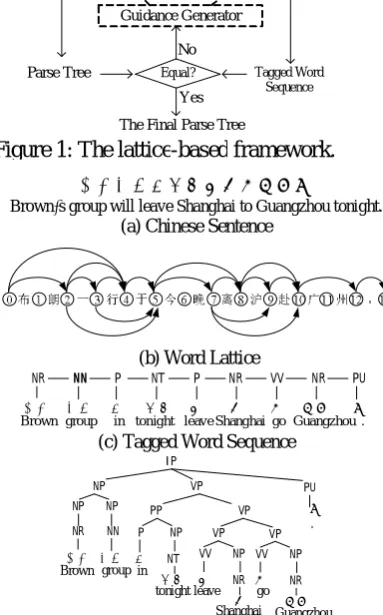
Figure 1 gives the organization of the framework. There are four types of linguistic structures: a Chinese sentence, the word lattice, tagged word sequence and parse tree of the Chinese sentence. An example for each structure is provided in Figure 2. We can see that the terminals and pre-terminals of a parse tree constitute a tagged word sequence. Therefore, we define a comparator between a tagged word sequence and a parse tree: if they contain the same word sequence and POS tags, they are equal, otherwise unequal.
Figure 1 also shows the workflow of the framework. First, the Chinese sentence is mented into a word lattice using the word seg-mentation system. Then the word lattice is fed into the lattice-based POS tagger to produce a tagged word sequence and into the lattice-based parser to separately produce a parse tree . We then compare with to see whether they are equal. If they are equal, we output as the final result. Otherwise, the guidance generator generates some guidance orders based on the difference between and , and guides the tag-ger and the parser to process the lattice again. This procedure may iterate many times until the tagger and parser predict equal structures.
The motivation to design such a framework is as follows. First, state-of-the-art word segmenta-tion systems can now perform with high accura-cy. We can easily get an F1 score greater than 96%, and an oracle (upper bound) F1 score greater than 99% for the word lattice (Jiang et
al., 2008). Therefore, a word lattice provides us a good enough search space to allow sufficient interaction among word segmentation, POS tag-ging and parsing systems. Second, both the lat-tice-based POS tagger and the latlat-tice-based pars-er can select word segmentation from the word lattice and predict POS tags, but they do so from two different perspectives. The lattice-based POS tagger looks at a path in a word lattice as a se-quence and performs sese-quence labeling based on linear local context, while the lattice-based pars-er builds the parse trees in a hipars-erarchical mannpars-er. They have different strengths with regard to word segmentation and POS tagging. We hypo-thesize that exploring the complementary strengths of the tagger and parser would improve each of the sub-tasks.
We build a character-based model (Xue, 2003) for the word segmentation system, and treat segmentation as a sequence labeling task, where each Chinese character is labeled with a tag. We use the tag set provided in Wang et al. (2011) and use the same feature templates. We use the Maximum Entropy (ME) model to estimate the feature weights. To get a word lattice, we first generate N-best word segmentation results, and then compact the N-best lists into a word lattice by collapsing all the identical words into one edge. We also assign a probability to each edge, which is calculated by multiplying the tagging probabilities of each character in the word. The goal of the lattice-based POS tagger is to predict a tagged word sequence for an input word lattice :
= argmax
∈ ( ) ∙ ( )
where ( ) represents the set of all possible tagged word sequences derived from the word lattice . ( ) is used to map onto a global fea-ture vector, and is the corresponding weight vector. We use the same non-local feature tem-plates used in Jiang et al. (2008) and a similar decoding algorithm. We use the perceptron algo-rithm (Collins, 2002) for parameter estimation.
Goldberg and Elhadad (2011) proposed a lat-tice-based parser for Heberw based on the PCFG-LA model (Matsuzaki et al., 2005). We adopted their approach, but found the un-weighted word lattice their parser takes as input to be ineffective for our Chinese experiments. Instead, we use a weighted lattice as input and weigh each edge in the lattice with the word probability. In our model, each syntactic catego-ry is split into multiple subcategories [ ] by labeling a latent annotation . Then, a parse tree
布朗一行于今晚离沪赴广州。
Brown’s group will leave Shanghai to Guangzhou tonight. (a) Chinese Sentence
(b) Word Lattice
布朗 于 今晚 离 沪 赴 广州 。
NR P NT P NR VV NR PU
一行 NN
Brown group in tonight leaveShanghaigo Guangzhou. (c) Tagged Word Sequence
Brown
.
Guangzhou go
Shanghai leave tonight in group
布朗 于
今晚 赴
广州 。
NR P
NT NP PP
VV
NR NP VP
PU NP
IP
VP
一行
NN NP NP
离
沪
VV
NR NP VP
VP
[image:2.595.89.254.266.418.2](d) Parse Tree
Figure 2: Linguistic structure examples. Chinese Sentence
Word Segmentation
Word Lattice
Lattice-based Parser Lattice-based POS Tagger
Guidance Generator
Parse Tree Tagged Word
Sequence
The Final Parse Tree No
Yes
[image:2.595.82.274.350.658.2]Equal?
is refined into [ ], where X is the latent an-notation vector for all non-terminals in . The probability of [ ] is calculated as:
( [ ]) = ( [ ]→ [ ] [ ])× ( [ ]→ ) × ( )
where the three terms are products of all syntac-tic rule probabilities, lexical rule probabilities and word probabilities in [ ] respectively.
3
Combined Optimization Between The
Lattice-based POS Tagger and The
Lattice-based Parser
We first define some variables to make it easier to compare a tagged word sequence with a parse tree . We define as the set of all POS tags. For , we define ( , , )=1 if contains a POS tag ∈ spanning from the i-th character to the j-th character, otherwise ( , , ) = 0. We also define (, , #) = 1 if contains the word spanning from the i-th character to the j-th cha-racter, otherwise ( , , #) = 0. Similarly, for , we define ( , , )=1 if contains a POS tag
∈ spanning from the i-th character to the j-th character, otherwise ( , , ) = 0. We also define
( , , #) = 1 if contains the word spanning from the i-th character to the j-th character, oth-erwise ( , , #) = 0. Therefore, and are equal, only if ( , , )= ( , , ) for all ∈[0, ],
∈[ + 1, ] and ∈ ∪#, otherwise unequal. Our framework expects the tagger and the parser to predict equal structures and we formu-late it as a constraint optimization problem:
, = argmax
, ( ) + ( )
Such that for all ∈[0, ], ∈[ + 1, ] and
∈ ∪#:
(, , ) = (, , )
where ( ) = ∙ ( ) is a scoring function from the viewpoint of the lattice-based POS tag-ger, and ( ) = log ( ) is a scoring function from the viewpoint of the lattice-based parser.
The dual decomposition (a special case of La-grangian relaxation) method introduced in Ko-modakis et al. (2007) is suitable for this problem. Using this method, we solve the primal con-straint optimization problem by optimizing the
dual problem. First, we introduce a vector of La-grange multipliers (, , ) for each equality constraint. Then, the Lagrangian is formulated as:
( , , ) = ( ) + ( )
+ (, , )( (, , )− (, , )) ,,
By grouping the terms that depend on and , we rewrite the Lagrangian as
( , , ) = ( ) + (, , ) (, , ) ,,
+ ( )− (, , )(, , ) ,,
Then, the dual objective is
( ) = max, ( , , )
= max ( ) + (, , ) (, , ) ,,
+
max ( )− (, , )(, , ) ,,
The dual problem is to find min ( ).
We use the subgradient method (Boyd et al., 2003) to minimize the dual. Following Rush et al. (2010), we define the subgradient of ( ) as:
(, , ) = (, , )− ( , , ) for all ( , , ) Then, adjust (, , ) as follows:
( , , ) = (, , )− ( (, , )− (, , ))
where >0 is a step size.
Algorithm 1 presents the subgradient method to solve the dual problem. The algorithm initia-lizes the Lagrange multiplier values with 0 (line 1) and then iterates many times. In each iteration, the algorithm finds the best ( ) and ( ) by running the lattice-based POS tagger (line 3) and the lattice-based parser (line 4). If ( ) and ( ) share the same tagged word sequence (line 5), then the algorithm returns the solution (line 6). Otherwise, the algorithm adjusts the Lagrange multiplier values based on the differences be-tween ( ) and ( ) (line 8). A crucial point is that theargmax problems in line 3 and line 4 can be solved efficiently using the original decoding algorithms, because the Lagrange multiplier can be regarded as adjustments for lexical rule prob-abilities and word probprob-abilities.
4
Experiments
We conduct experiments on the Chinese Tree-bank Version 5.0 and use the standard data split
Algorithm 1: Combined Optimization 1: Set ()(, , )=0, for all (, , )
2: Fork=1 toK
3: ( )←argmax ( ) +∑,, ( )(, , ) (, , ) 4: ( )←argmax ( )−∑,, ( )( , , ) ( , , ) 5: If ( )( , , ) = ( )( , , ) for all ( , , )
6: Return ( ( ), ( )) 7: Else
8: ( )( , , ) =
(Petrov and Klein, 2007). The traditional evalua-tion metrics for POS tagging and parsing are not suitable for the joint task. Following with Qian and Liu (2012), we redefine precision and recall
by computing the span of a constituent based on character offsets rather than word offsets.
4.1 Performance of the Basic Sub-systems
We train the word segmentation system with 100 iterations of the Maximum Entropy model using the OpenNLP toolkit. Table 1 shows the perfor-mance. It shows that our word segmentation tem is comparable with the state-of-the-art sys-tems and the upper bound F1 score of the word lattice exceeds 99.6%. This indicates that our word segmentation system can provide a good search space for the lattice-based POS tagger and the lattice-based parser.
To train the lattice-based POS tagger, we gen-erate the word lattice for each sentence in the training set using cross validation approach. We divide the entire training set into 18 folds on av-erage (each fold contains 1,000 sentences). For each fold, we segment each sentence in the fold into a word lattice by compacting 20-best seg-mentation list produced with a model trained on the other 17 folds. Then, we train the lattice-based POS tagger with 20 iterations of the aver-age perceptron algorithm. Table 2 presents the joint word segmentation and POS tagging per-formance and shows that our lattice-based POS tagger obtains results that are comparable with state-of-the-art systems.
We implement the lattice-based parser by modifying the Berkeley Parser, and train it with 5 iterations of the split-merge-smooth strategy (Petrov et al., 2006). Table 3 shows the perfor-mance, where the “Pipeline Parser” represents the system taking one-best segmentation result
from our word segmentation system as input and
“Lattice-based Parser” represents the system tak-ing the compacted word lattice as input. We find the lattice-based parser gets better performance than the pipeline system among all three sub-tasks.
4.2 Performance of the Framework
For the lattice-based framework, we set the max-imum iteration in Algorithm 1 as K = 20. The step size is tuned on the development set and empirically set to be 0.8. Table 4 shows the pars-ing performance on the test set. It shows that the lattice-based framework achieves improvement over the lattice-based parser alone among all three sub-tasks: 0.16 points for word segmenta-tion, 1.19 points for POS tagging and 1.65 points for parsing. It also outperforms the lattice-based POS tagger by 0.65 points on POS tagging accu-racy. Our lattice-based framework also improves over the best joint inference parsing system (Qian and Liu, 2012) by 0.57 points.
5
Conclusion
In this paper, we present a novel lattice-based framework for the cascaded task of Chinese word segmentation, POS tagging and parsing. We first segment a Chinese sentence into a word lattice, then process the lattice using a lattice-based POS tagger and a lattice-lattice-based parser. We also design a strategy to exploit the complemen-tary strengths of the tagger and the parser and encourage them to predict agreed structures. Ex-perimental results show that the lattice-based framework significantly improves the accuracies of the three tasks. The parsing accuracy of the framework also outperforms the best joint pars-ing system reported in the literature.
P R F
(Qian and Liu, 2012)
Seg. 97.56 98.36 97.96 POS 93.43 94.2 93.81 Parse 83.03 82.66 82.85
Lattice-based Framework
Seg. 97.82 97.9 97.86 POS 94.36 94.44 94.40
Parse 83.34 83.5 83.42
Table 4: Lattice-based framework evaluation.
P R F
Pipeline Parser
Seg. 96.97 98.06 97.52 POS 92.01 93.04 92.52 Parse 80.86 81.47 81.17
Lattice-based Parser
Seg. 97.73 97.66 97.70 POS 93.24 93.18 93.21 Parse 81.83 81.71 81.77 Table 3: Parsing evaluation.
P R F
(Kruengkrai et al., 2009) 93.28 94.07 93.67 (Zhang and Clark, 2010) - - 93.67 (Qian and Liu, 2012) 93.1 93.96 93.53
(Sun, 2011) - - 94.02
Lattice-based POS tagger 93.64 93.87 93.75 Table 2: POS tagging evaluation.
P R F
(Kruengkrai et al., 2009) 97.46 98.29 97.87 (Zhang and Clark, 2010) - - 97.78 (Qian and Liu, 2012) 97.45 98.24 97.85
(Sun, 2011) - - 98.17
Acknowledgments
The research work has been funded by the Hi-Tech Research and Development Program ("863" Program) of China under Grant No.
2011AA01A207, 2012AA011101, and
2012AA011102 and also supported by the Key Project of Knowledge Innovation Program of Chinese Academy of Sciences under Grant No.KGZD-EW-501. This work is also supported in part by the DAPRA via contract HR0011-11-C-0145 entitled "Linguistic Resources for Multi-lingual Processing".
References
S. Boyd, L. Xiao and A. Mutapcic. 2003. Subgradient methods. Lecture notes of EE392o, Stanford Uni-versity.
E. Charniak. 2000. A maximum–entropy–inspired parser. In NAACL ’00, page 132–139.
Michael Collins. 1999. Head-Driven Statistical Mod-els for Natural Language Parsing. Ph.D. thesis, University of Pennsylvania.
Michael Collins. 2002. Discriminative training me-thods for hidden markov models: Theory and expe-riments with perceptron algorithms. In Proc. of EMNLP2002, pages 1-8.
Yoav Goldberg and Michael Elhadad. 2011. Joint Hebrew segmentation and parsing using a PCFG-LA lattice parser. In Proc. of ACL2011.
Wenbin Jiang, Haitao Mi and Qun Liu. 2008. Word lattice reranking for Chinese word segmentation and part-of-speech tagging. In Proc. of Coling 2008, pages 385-392.
Komodakis, N., Paragios, N., and Tziritas, G. 2007. MRF optimization via dual decomposition: Mes-sage-passing revisited. In ICCV 2007.
C. Kruengkrai, K. Uchimoto, J. Kazama, Y. Wang, K. Torisawa and H. Isahara. 2009. An error-driven word-character hybrid model for joint Chinese word segmentation and POS tagging. In Proc. of ACL2009, pages 513-521.
Takuya Matsuzaki, Yusuke Miyao and Jun'ichi Tsujii. 2005. Probabilistic CFG with latent annotations. In Proc. of ACL2005, pages 75-82.
Slav Petrov, Leon Barrett, Romain Thibaux and Dan Klein. 2006. Learning accurate, compact, and in-terpretable tree annotation. In Proc. of ACL2006, pages 433-440.
Slav Petrov and Dan Klein. 2007. Improved inference for unlexicalized parsing. In Proc. of NAACL2007, pages 404-411.
Xian Qian and Yang Liu. 2012. Joint Chinese Word segmentation, POS Tagging Parsing. In Proc. of EMNLP 2012, pages 501-511.
Alexander M. Rush, David Sontag, Michael Collins and Tommi Jaakkola. 2010. On dual decomposi-tion and linear programming relaxadecomposi-tions for natural language processing. In Proc. of EMNLP2010, pages 1-11.
Weiwei Sun. 2011. A stacked sub-word model for joint Chinese word segmentation and part-of-speech tagging. In Proc. of ACL2011, pages 1385-1394.
Weiwei Sun and Hans Uszkoreit. Capturing paradig-matic and syntagparadig-matic lexical relations: Towards accurate Chinese part-of-speech tagging. In Proc. of ACL2012.
Yiou Wang, Jun'ichi Kazama, Yoshimasa Tsuruoka, Wenliang Chen, Yujie Zhang and Kentaro Torisa-wa. 2011. Improving Chinese word segmentation and POS tagging with semi-supervised methods us-ing large auto-analyzed data. In Proc. of IJCNLP2011, pages 309-317.
Nianwen Xue. 2003. Chinese word segmentation as character tagging. Computational Linguistics and Chinese Language Processing, 8 (1). pages 29-48.