Towards Developing Generation Algorithms for Text-to-Text Applications
Radu Soricut and Daniel Marcu Information Sciences Institute University of Southern California
4676 Admiralty Way, Suite 1001 Marina del Rey, CA 90292
radu, marcu @isi.edu
Abstract
We describe a new sentence realization framework for text-to-text applications. This framework uses IDL-expressions as a representation formalism, and a gener-ation mechanism based on algorithms for intersecting IDL-expressions with proba-bilistic language models. We present both theoretical and empirical results concern-ing the correctness and efficiency of these algorithms.
1 Introduction
Many of today’s most popular natural language ap-plications – Machine Translation, Summarization, Question Answering – are text-to-text applications. That is, they produce textual outputs from inputs that are also textual. Because these applications need to produce well-formed text, it would appear nat-ural that they are the favorite testbed for generic generation components developed within the Natu-ral Language Generation (NLG) community. Over the years, several proposals of generic NLG systems have been made: Penman (Matthiessen and Bate-man, 1991), FUF (Elhadad, 1991), Nitrogen (Knight and Hatzivassiloglou, 1995), Fergus (Bangalore and Rambow, 2000), HALogen (Langkilde-Geary, 2002), Amalgam (Corston-Oliver et al., 2002), etc. Instead of relying on such generic NLG systems, however, most of the current text-to-text applica-tions use other means to address the generation need. In Machine Translation, for example, sentences are
produced using application-specific “decoders”, in-spired by work on speech recognition (Brown et al., 1993), whereas in Summarization, summaries are produced as either extracts or using task-specific strategies (Barzilay, 2003). The main reason for which text-to-text applications do not usually in-volve generic NLG systems is that such applica-tions do not have access to the kind of informa-tion that the input representainforma-tion formalisms of cur-rent NLG systems require. A machine translation or summarization system does not usually have access to deep subject-verb or verb-object relations (such as ACTOR, AGENT, PATIENT, POSSESSOR, etc.) as needed by Penman or FUF, or even shallower syntactic relations (such assubject, object, premod, etc.) as needed by HALogen.
In this paper, following the recent proposal made by Nederhof and Satta (2004), we argue for the use of IDL-expressions as an application-independent, information-slim representation lan-guage for text-to-text natural lanlan-guage generation. IDL-expressions are created from strings using four operators: concatenation (), interleave ( ), disjunc-tion ( ), and lock ( ). We claim that the IDL formalism is appropriate for text-to-text generation, as it encodes meaning only via words and phrases, combined using a set of formally defined operators. Appropriate words and phrases can be, and usually are, produced by the applications mentioned above. The IDL operators have been specifically designed to handle natural constraints such as word choice and precedence, constructions such as phrasal com-bination, and underspecifications such as free word order.
CFGs via intersection with Deterministic
Non−deterministic via intersection with probabilistic LMs Word/Phrase
based Fergus, Amalgam Nitrogen, HALogen FUF, PENMAN NLG System
(Nederhof&Satta 2004) IDL
Representation (formalism) Semantic, few meanings
Syntactically/ Semantically grounded
Syntactic dependencies
Representation (computational)
Linear Exponential
Linear
Deterministic Generation (mechanism)
Non−deterministic via intersection with probabilistic LMs
Non−deterministic via intersection with probabilistic LMs
(this paper) IDL
Linear
Generation (computational)
Optimal Solution Efficient Run−time Efficient Run−time Optimal Solution
Efficient Run−time All Solutions
Efficient Run−time Optimal Solution
Linear Linear
[image:2.612.72.299.54.184.2]based Word/Phrase
Table 1: Comparison of the present proposal with current NLG systems.
In Table 1, we present a summary of the repre-sentation and generation characteristics of current NLG systems. We mark by characteristics that are needed/desirable in a generation component for text-to-text applications, and by characteristics that make the proposal inapplicable or problematic. For instance, as already argued, the representation for-malism of all previous proposals except for IDL is problematic ( ) for text-to-text applications. The IDL formalism, while applicable to text-to-text ap-plications, has the additional desirable property that it is a compact representation, while formalisms such as word-lattices and non-recursive CFGs can have exponential size in the number of words avail-able for generation (Nederhof and Satta, 2004).
While the IDL representational properties are all desirable, the generation mechanism proposed for IDL by Nederhof and Satta (2004) is problematic ( ), because it does not allow for scoring and ranking of candidate realizations. Their genera-tion mechanism, while computagenera-tionally efficient, in-volves intersection with context free grammars, and therefore works by excluding all realizations that are not accepted by a CFG and including (without rank-ing) all realizations that are accepted.
The approach to generation taken in this paper is presented in the last row in Table 1, and can be summarized as a tiling of generation character-istics of previous proposals (see the shaded area in Table 1). Our goal is to provide an optimal gen-eration framework for text-to-text applications, in which the representation formalism, the generation mechanism, and the computational properties are all needed and desirable ( ). Toward this goal, we
present a new generation mechanism that intersects IDL-expressions with probabilistic language mod-els. The generation mechanism implements new al-gorithms, which cover a wide spectrum of run-time behaviors (from linear to exponential), depending on the complexity of the input. We also present theoret-ical results concerning the correctness and the effi-ciency input IDL-expression) of our algorithms.
We evaluate these algorithms by performing ex-periments on a challenging word-ordering task. These experiments are carried out under a high-complexity generation scenario: find the most prob-able sentence realization under an n-gram language model for IDL-expressions encoding bags-of-words of size up to 25 (up to 10
possible realizations!). Our evaluation shows that the proposed algorithms are able to cope well with such orders of complex-ity, while maintaining high levels of accuracy.
2 The IDL Language for NLG
2.1 IDL-expressions
IDL-expressions have been proposed by Nederhof & Satta (2004) (henceforth N&S) as a representa-tion for finite languages, and are created from strings using four operators: concatenation (), interleave ( ), disjunction ( ), and lock ( ). The semantics of IDL-expressions is given in terms of sets of strings.
The concatenation () operator takes two ments, and uses the strings encoded by its argu-ment expressions to obtain concatenated strings that respect the order of the arguments; e.g., en-codes the singleton set . The nterleave ( ) operator interleaves the strings encoded by its argu-ment expressions; e.g., encodes the set . The isjunction ( ) operator al-lows a choice among the strings encoded by its ar-gument expressions; e.g., encodes the set . The ock ( ) operator takes only one ar-gument, and “locks-in” the strings encoded by its argument expression, such that no additional mate-rial can be interleaved; e.g., ! " encodes
the set .
Consider the following IDL-expression:
$#&%(')*)$+, !.-0/1 *2(354768%13"6" 9.-0/1 :"'"2-40;16
<
131 =31)>1?'61?@ .A
the appears before the noun it determines. The lock
( ) operator enforces phrase-encoding constraints, such as the fact that the captives is a phrase which should be used as a whole. The disjunction ( ) op-erator allows for multiple word/phrase choice (e.g.,
the prisoners versus the captives), and the
inter-leave ( ) operator allows for word-order freedom, i.e., word order underspecification at meaning repre-sentation level. Among the strings encoded by IDL-expression 1 are the following:
finally the prisoners were released the captives finally were released the prisoners were finally released
The following strings, however, are not part of the language defined by IDL-expression 1:
the finally captives were released the prisoners were released finally the captives released were
The first string is disallowed because the oper-ator locks the phrase the captives. The second string is not allowed because the operator requires all its arguments to be represented. The last string violates the order imposed by the precedence operator be-tween were and released.
2.2 IDL-graphs
IDL-expressions are a convenient way to com-pactly represent finite languages. However, IDL-expressions do not directly allow formulations of algorithms to process them. For this purpose, an equivalent representation is introduced by N&S, called IDL-graphs. We refer the interested reader to the formal definition provided by N&S, and provide here only an intuitive description of IDL-graphs.
We illustrate in Figure 1 the IDL-graph corre-sponding to IDL-expression 1. In this graph, ver-tices and are called initial and final, respec-tively. Vertices ,
with in-going
-labeled edges, and ,
with out-going -labeled edges, for ex-ample, result from the expansion of the operator, while vertices , with in-going -labeled edges, and , with out-going -labeled edges result from the expansion of the operator. Vertices
to and to result from the expansion of the two operators, respectively. These latter ver-tices are also shown to have rank 1, as opposed to rank 0 (not shown) assigned to all other vertices.
The ranking of vertices in an IDL-graph is needed to enforce a higher priority on the processing of the higher-ranked vertices, such that the desired seman-tics for the lock operator is preserved.
With each IDL-graph we can associate a fi-nite language: the set of strings that can be generated by an IDL-specific traversal of , starting from
and ending in . An IDL-expression and its corresponding IDL-graph are said to be equiv-alent because they generate the same finite language, denoted .
2.3 IDL-graphs and Finite-State Acceptors
To make the connection with the formulation of our algorithms, in this section we link the IDL formal-ism with the more classical formalformal-ism of finite-state acceptors (FSA) (Hopcroft and Ullman, 1979). The FSA representation can naturally encode precedence and multiple choice, but it lacks primitives corre-sponding to the interleave ( ) and lock ( ) opera-tors. As such, an FSA representation must explic-itly enumerate all possible interleavings, which are implicitly captured in an IDL representation. This correspondence between implicit and explicit inter-leavings is naturally handled by the notion of a cut of an IDL-graph .
Intuitively, a cut through is a set of vertices that can be reached simultaneously when traversing
from the initial node to the final node, follow-ing the branches as prescribed by the encoded , , and operators, in an attempt to produce a string in
9. More precisely, the initial vertex is consid-ered a cut (Figure 2 (a)). For each vertex in a given cut, we create a new cut by replacing the start ver-tex of some edge with the end verver-tex of that edge, observing the following rules:
the vertex that is the start of several edges la-beled using the special symbol
is replaced by a sequence of all the end vertices of these edges (for example,
is a cut derived from
(Figure 2 (b))); a mirror rule handles the spe-cial symbol ;
the vertex that is the start of an edge labeled us-ing vocabulary items or is replaced by the end vertex of that edge (for example,
, ,
, are cuts derived from
,
v1 v0 ve vs finally ε ε ε ε ε ε ε ε ε ε ε ε ε released were captives prisoners the the
v2 1 1 1 1
[image:4.612.72.300.53.115.2]1 1 1 1 v20 v19 v18 v17 v16 v15 v14 v13 v12 v11 v10 v9 v8 v7 v6 v5 v4 v3
Figure 1: The graph corresponding to the IDL-expression $#&%(')0)$+ !.-0/1 2(354768%13"6" !.-0/1
:?'52-4*;156
<
131 31)>1?'61?@.
(a) vs (c) v1 finally v2 v0 vs (b) v2 v0 vs rank 1 rank 0 finally
ε v5 the
(e) v3 ε v2 v0 vs the ε v2 v0
vs ε v6
v1
(d)
[image:4.612.315.570.55.129.2]v6 v5 v3
Figure 2: Cuts of the IDL-graph in Figure 1 (a-d). A non-cut is presented in (e).
, and
, respectively, see Figure 2 (c-d)), only if the end vertex is not lower ranked than any of the vertices already present in the cut (for example, is not a cut that can be derived from , see Figure 2 (e)).
Note the last part of the second rule, which restricts the set of cuts by using the ranking mechanism. If one would allow to be a cut, one would imply that finally may appear inserted between the words of the locked phrase the prisoners.
We now link the IDL formalism with the FSA for-malism by providing a mapping from an IDL-graph
to an acyclic finite-state acceptor
. Be-cause both formalisms are used for representing fi-nite languages, they have equivalent representational power. The IDL representation is much more com-pact, however, as one can observe by comparing the IDL-graph in Figure 1 with the equivalent finite-state acceptor
in Figure 3. The set of states of
is the set of cuts of . The initial state of the finite-state acceptor is the state corresponding to cut , and the final states of the finite-state acceptor are the state corresponding to cuts that contain . In what follows, we denote a state of
by the name of the cut to which it corresponds. A
transi-v0 v2 vs ε v1 v2 v0 v4 v0 v10 the
v0 v5 the v0 v0
v0v11v0v12 v6 v7 v0
v0 v8 v13 prisoners captives ε ε ε ε v10 v1 ε ε the the v6 v11 prisoners captives v5 v1 v1 v1 v1
v1 v7 v12 ε ε v1 v8 v13 v1
v0 v3 v1v4
finally finally finally v3 v1 ε ε ε ε v14 v0 v1 v9 v0 v9 v1 v14 finally finally finally finally ve ε v1 v15 v0 v15 were were ε ε ε ε released released v16 v16 v17 v17 v18 v18 v19 v19 ε v20 v1 v1 v1 v1
v0 v0 v0 v0 v0
finally finally finally finally
v20 v1 ε ε ε εε ε ε ε ε
Figure 3: The finite-state acceptor corresponding to the IDL-graph in Figure 1.
tion labeled in
between state and state
occurs if there is an edge
in . For the example in Figure 3, the transition labeled were between states
and
occurs because of the edge labeled were between nodes and (Figure 1), whereas the transition labeled finally between states
and
occurs because of the edge labeled finally be-tween nodes and (Figure 1). The two represen-tations and
are equivalent in the sense that the language generated by IDL-graph is the same as the language accepted by FSA
. It is not hard to see that the conversion from the IDL representation to the FSA representation de-stroys the compactness property of the IDL formal-ism, because of the explicit enumeration of all possi-ble interleavings, which causes certain labels to ap-pear repeatedly in transitions. For example, a tran-sition labeled finally appears 11 times in the finite-state acceptor in Figure 3, whereas an edge labeled
finally appears only once in the IDL-graph in
Fig-ure 1.
3 Computational Properties of IDL-expressions
3.1 IDL-graphs and Weighted Finite-State
Acceptors
As mentioned in Section 1, the generation mecha-nism we propose performs an intersection of IDL-expressions with n-gram language models. Follow-ing (Mohri et al., 2002; Knight and Graehl, 1998), we implement language models using weighted finite-state acceptors (wFSA). In Section 2.3, we presented a mapping from an IDL-graph to a finite-state acceptor
. From such a finite-state acceptor
, we arrive at a weighted finite-state acceptor , by splitting the states of
[image:4.612.84.287.179.291.2]
ac-cording to the information needed by the language model to assign weights to transitions. For ex-ample, under a bigram language model , state
in Figure 3 must be split into three differ-ent states, 23"4*68%,13"6
,
>:?'52-4*;156 , and #&%(')*)$+(
, according to which (non-epsilon) transition was last used to reach this state. The transitions leaving these states have the same la-bels as those leaving state
, and are now weighted using the language model probability dis-tributions 2(3"4*68%13"6, :?'"2-40;16 , and
#&%(')0)+ , respectively.
Note that, at this point, we already have a na¨ıve algorithm for intersecting IDL-expressions with n-gram language models. From an IDL-expression , following the mapping
, we arrive at a weighted finite-state accep-tor, on which we can use a single-source shortest-path algorithm for directed acyclic graphs (Cormen et al., 2001) to extract the realization corresponding to the most probable path. The problem with this al-gorithm, however, is that the premature unfolding of the IDL-graph into a finite-state acceptor destroys the representation compactness of the IDL repre-sentation. For this reason, we devise algorithms that, although similar in spirit with the single-source shortest-path algorithm for directed acyclic graphs, perform on-the-fly unfolding of the IDL-graph, with a mechanism to control the unfolding based on the scores of the paths already unfolded. Such an ap-proach has the advantage that prefixes that are ex-tremely unlikely under the language model may be regarded as not so promising, and parts of the IDL-expression that contain them may not be unfolded, leading to significant savings.
3.2 Generation via Intersection of
IDL-expressions with Language Models
Algorithm IDL-NGLM-BFS The first algorithm
that we propose is algorithm IDL-NGLM-BFS in Figure 4. The algorithm builds a weighted finite-state acceptor corresponding to an IDL-graph
incrementally, by keeping track of a set of ac-tive states, called ' : -4*;1 . The incrementality comes from creating new transitions and states in orig-inating in these active states, by unfolding the IDL-graph ; the set of newly unfolded states is called
%8)@ . The new transitions in are weighted
ac-IDL-NGLM-BFS
1 ' : -4*;1
2 ' A
3 while '
4 do
%8)@ UNFOLDIDLG' : -40;1 =
5 EVALUATENGLM
%8)>@
6 ifFINALIDLG
%8)>@
7 then'
8 ' : -4*;1
%8)@
9 return ' : -4*;1
Figure 4: Pseudo-code for intersecting an IDL-graph
with an n-gram language model using incre-mental unfolding and breadth-first search.
cording to the language model. If a final state of
is not yet reached, the while loop is closed by making the
%8)@ set of states to be the next set of ' : -4*;1 states. Note that this is actually a breadth-first search (BFS) with incremental unfolding. This algorithm still unfolds the IDL-graph completely, and therefore suffers from the same drawback as the na¨ıve algorithm.
The interesting contribution of algorithm IDL-NGLM-BFS, however, is the incremental unfolding. If, instead of line 8 in Figure 4, we introduce mechanisms to control which
%8)@ states become part of the ' : -40;1 state set for the next unfolding iteration, we obtain a series of more effective algorithms.
Algorithm IDL-NGLM-A We arrive at
algo-rithm IDL-NGLM-A by modifying line 8 in Fig-ure 4, thus obtaining the algorithm in FigFig-ure 5. We use as control mechanism a priority queue, '6-'3 , in which the states from
% 8)>@ arePUSH-ed, sorted according to an admissible heuristic function (Rus-sell and Norvig, 1995). In the next iteration, ' : -40;1 is a singleton set containing the state POP-ed out from the top of the priority queue.
Algorithm IDL-NGLM-BEAM We arrive at
IDL-NGLM-A
1 ' : -4*;1
2 ' A
3 while '
4 do
%8)@ UNFOLDIDLG' : -40;1 =
5 EVALUATENGLM
%8)>@
6 ifFINALIDLG
%8)>@
7 then'
8 for each65- '- 1 in
%8)>@
doPUSH'6- '3# 65-'- 1
' : -40;1 POP'65-'3#
[image:6.612.73.290.67.224.2]9 return ' : -4*;1
Figure 5: Pseudo-code for intersecting an IDL-graph
with an n-gram language model using incre-mental unfolding and A search.
IDL-NGLM-BEAM !"1'#"
1 ' : -4*;1
2 ' A
3 while '
4 do
%8)@ UNFOLDIDLG' : -40;1 =
5 EVALUATENGLM
%8)>@
6 ifFINALIDLG
%8)>@
7 then'
8 ' : -4*;1 BEAMSTATES
%8)@ !?1?'#"
9 return ' : -4*;1
Figure 6: Pseudo-code for intersecting an IDL-graph
with an n-gram language model using incre-mental unfolding and probabilistic beam search.
%8)@ reachable with a probability higher or equal to the current maximum probability times the prob-ability beam !?1?'#" .
3.3 Computing Admissible Heuristics for
IDL-expressions
The IDL representation is ideally suited for com-puting accurate admissible heuristics under lan-guage models. These heuristics are needed by the IDL-NGLM-A algorithm, and are also employed for pruning by the IDL-NGLM-BEAMalgorithm.
For each state
in a weighted finite-state accep-tor corresponding to an IDL-graph , one can efficiently extract from – without further
unfold-ing – the set1 of all edge labels that can be used to reach the final states of . This set of labels, de-noted , is an overestimation of the set of fu-ture events reachable from
, because the labels un-der the operators are all considered. From
and the -1 labels (when using an -gram language model) recorded in state
we obtain the set of label sequences of length -1. This set, denoted
, is an (over)estimated set of possible future condition-ing events for state
, guaranteed to contain the most cost-efficient future conditioning events for state
. Using
, one needs to extract from the set of most cost-efficient future events from under each operator. We use this set, denoted
, to arrive at an admissible heuristic for state
under a language model , using Equation 2:
! #"%$'& )( +*
,
.-+
0/ 12/ (2)
If
is the true future cost for state
, we guar-antee that
43
from the way
and
are constructed. Note that, as it usually hap-pens with admissible heuristics, we can make
come arbitrarily close to
, by computing in-creasingly better approximations
of . Such approximations, however, require increasingly advanced unfoldings of the IDL-graph (a com-plete unfolding of for state
gives
, and consequently
5
). It fol-lows that arbitrarily accurate admissible heuristics exist for IDL-expressions, but computing them on-the-fly requires finding a balance between the time and space requirements for computing better heuris-tics and the speed-up obtained by using them in the search algorithms.
3.4 Formal Properties of IDL-NGLM
algorithms
The following theorem states the correctness of our algorithms, in the sense that they find the maximum probability path encoded by an IDL-graph under an n-gram language model.
Theorem 1 Let be an IDL-expression, G( )
its IDL-graph, and W( ) its wFSA under
an n-gram language model LM. Algorithms
IDL-NGLM-BFS and IDL-NGLM-A find the
1Actually, these are multisets, as we treat multiply-occurring
[image:6.612.72.295.312.441.2]path of maximum probability under LM. Algorithm
IDL-NGLM-BEAM finds the path of maximum
probability under LM, if all states in W( ) along
this path are selected by itsBEAMSTATESfunction.
The proof of the theorem follows directly from the correctness of the BFS and A search, and from the condition imposed on the beam search.
The next theorem characterizes the run-time com-plexity of these algorithms, in terms of an input IDL-expression and its corresponding IDL-graph complexity. There are three factors that linearly in-fluence the run-time complexity of our algorithms: is the maximum number of nodes in needed to represent a state in
– depends solely on ;
is the maximum number of nodes in needed to represent a state in –
depends on and
, the length of the context used by the -gram lan-guage model; and
is the number of states of –
also depends on and . Of these three factors,
is by far the predominant one, and we simply call
the complexity of an IDL-expression.
Theorem 2 Let be an IDL-expression, its
IDL-graph,
its FSA, and its wFSA
under an n-gram language model. Let
be the set of states of
, and
the set of states of . Let also
( +*
,
1 ,
( +*
,
1 , and
. Algorithms IDL-NGLM-BFS
and IDL-NGLM-BEAM have run-time complexity
. Algorithm IDL-NGLM-A has run-time
complexity
"$'&
.
We omit the proof here due to space constraints. The fact that the run-time behavior of our algorithms is linear in the complexity of the input IDL-expression (with an additional log factor in the case of A search due to priority queue management) allows us to say that our algorithms are efficient with respect to the task they accomplish.
We note here, however, that depending on the input IDL-expression, the task addressed can vary in complexity from linear to exponential. That is, for the intersection of an IDL-expression
(bag of words) with a trigram lan-guage model, we have ,
,
1
1 A , and therefore a
1
com-plexity. This exponential complexity comes as no surprise given that the problem of intersecting an
n-gram language model with a bag of words is known to be NP-complete (Knight, 1999). On the other hand, for intersecting an IDL-expression
(sequence of words) with a trigram lan-guage model, we have A ,
, and
, and therefore an
generation algorithm. In general, for IDL-expressions for which is bounded, which we expect to be the case for most practical problems, our algorithms perform in
poly-nomial time in the number of words available for generation.
4 Evaluation of IDL-NGLM Algorithms
In this section, we present results concerning the performance of our algorithms on a word-ordering task. This task can be easily defined as follows: from a bag of words originating from some sentence, reconstruct the original sentence as faithfully as possible. In our case, from an original sentence such as “the gifts are donated by
amer-ican companies”, we create the IDL-expression! "
.-0/1 4-06 @ 8%('-1?@ :?8#"92' % 4156!+( '3?1 ' " 1354:"'%
!$##" , from which some algorithm realizes a sen-tence such as “donated by the american companies
are gifts”. Note the natural way we represent in
an IDL-expression beginning and end of sentence constraints, using the operator. Since this is generation from bag-of-words, the task is known to be at the high-complexity extreme of the run-time behavior of our algorithms. As such, we consider it a good test for the ability of our algorithms to scale up to increasingly complex inputs.
We use a state-of-the-art, publicly available toolkit2 to train a trigram language model using Kneser-Ney smoothing, on 10 million sentences (170 million words) from the Wall Street Journal (WSJ), lower case and no final punctuation. The test data is also lower case (such that upper-case words cannot be hypothesized as first words), with final punctuation removed (such that periods cannot be hypothesized as final words), and consists of 2000 unseen WSJ sentences of length 3-7, and 2000 un-seen WSJ sentences of length 10-25.
The algorithms we tested in this experiments were the ones presented in Section 3.2, plus two baseline algorithms. The first baseline algorithm, L, uses an
inverse-lexicographic order for the bag items as its output, in order to get the word the on sentence ini-tial position. The second baseline algorithm, G, is a greedy algorithm that realizes sentences by maxi-mizing the probability of joining any two word se-quences until only one sequence is left.
For the A algorithm, an admissible cost is com-puted for each state
in a weighted finite-state au-tomaton, as the sum (over all unused words) of the minimum language model cost (i.e., maximum prob-ability) of each unused word when conditioning over all sequences of two words available at that particu-lar state for future conditioning (see Equation 2, with
). These estimates are also used by the beam algorithm for deciding which IDL-graph nodes are not unfolded. We also test a greedy ver-sion of the A algorithm, denoted A
, which con-siders for unfolding only the nodes extracted from the priority queue which already unfolded a path of length greater than or equal to the maximum length already unfolded minus (in this notation, the A algorithm would be denoted A ). For the beam al-gorithms, we use the notation B to specify a proba-bilistic beam of size , i.e., an algorithm that beams out the states reachable with probability less than the current maximum probability times .
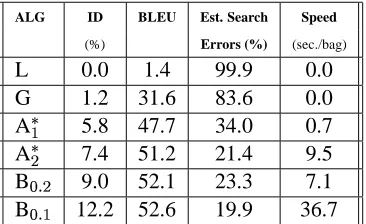
Our first batch of experiments concerns bags-of-words of size 3-7, for which exhaustive search is possible. In Table 2, we present the results on the word-ordering task achieved by various algorithms. We evaluate accuracy performance using two auto-matic metrics: an identity metric, ID, which mea-sures the percent of sentences recreated exactly, and BLEU (Papineni et al., 2002), which gives the ge-ometric average of the number of uni-, bi-, tri-, and four-grams recreated exactly. We evaluate the search performance by the percent of Search Errors made by our algorithms, as well as a percent figure of Es-timated Search Errors, computed as the percent of searches that result in a string with a lower proba-bility than the probaproba-bility of the original sentence. To measure the impact of using IDL-expressions for this task, we also measure the percent of unfolding of an IDL graph with respect to a full unfolding. We report speed results as the average number of sec-onds per bag-of-words, when using a 3.0GHz CPU machine under a Linux OS.
The first notable result in Table 2 is the savings
ALG ID BLEU Search Unfold Speed
(%) Errors (%) (%) (sec./bag)
L 2.5 9.5 97.2(95.8) N/A .000
G 30.9 51.0 67.5(57.6) N/A .000
BFS 67.1 79.2 0.0(0.0) 100.0 .072
A 67.1 79.2 0.0(0.0) 12.0 .010
A
60.5 74.8 21.1(11.9) 3.2 .004
A
64.3 77.2 8.5
(4.0) 5.3 .005
B
65.0 78.0 9.2(5.0) 7.2 .006
[image:8.612.314.539.55.193.2]B 66.6 78.8 3.2(1.7) 13.2 .011
Table 2: Bags-of-words of size 3-7: accuracy (ID, BLEU), Search Errors (and Estimated Search Errors), space
savings (Unfold), and speed results.
achieved by the A algorithm under the IDL repre-sentation. At no cost in accuracy, it unfolds only 12% of the edges, and achieves a 7 times speed-up, compared to the BFS algorithm. The savings achieved by not unfolding are especially important, since the exponential complexity of the problem is hidden by the IDL representation via the folding mechanism of the operator. The algorithms that find sub-optimal solutions also perform well. While maintaining high accuracy, the A
and B
algo-rithms unfold only about 5-7% of the edges, at 12-14 times speed-up.
Our second batch of experiments concerns bag-of-words of size 10-25, for which exhaustive search is no longer possible (Table 3). Not only exhaustive search, but also full A search is too expensive in terms of memory (we were limited to 2GiB of RAM for our experiments) and speed. Only the greedy versions A
and A
, and the beam search using tight probability beams (0.2-0.1) scale up to these bag sizes. Because we no longer have access to the string of maximum probability, we report only the per-cent of Estimated Search Errors. Note that, in terms of accuracy, we get around 20% Estimated Search Errors for the best performing algorithms (A
and B ), which means that 80% of the time the algo-rithms are able to find sentences of equal or better probability than the original sentences.
5 Conclusions
develop-ALG ID BLEU Est. Search Speed
(%) Errors (%) (sec./bag)
L 0.0 1.4 99.9 0.0
G 1.2 31.6 83.6 0.0
A
5.8 47.7 34.0 0.7
A
7.4 51.2 21.4 9.5
B
[image:9.612.95.278.54.166.2]
9.0 52.1 23.3 7.1 B 12.2 52.6 19.9 36.7
Table 3: Bags-of-words of size 10-25: accuracy (ID, BLEU), Estimated Search Errors, and speed results.
ing text-to-text generation capabilities. Our contri-bution concerns a new generation mechanism that implements intersection between an IDL expression and a probabilistic language model. The IDL for-malism is ideally suited for our approach, due to its efficient representation and, as we show in this paper, efficient algorithms for intersecting, scoring, and ranking sentence realizations using probabilistic language models.
We present theoretical results concerning the cor-rectness and efficiency of the proposed algorithms, and also present empirical results that show that our algorithms scale up to handling IDL-expressions of high complexity. Real-world text-to-text genera-tion tasks, such as headline generagenera-tion and machine translation, are likely to be handled graciously in this framework, as the complexity of IDL-expressions for these tasks tends to be lower than the complex-ity of the IDL-expressions we worked with in our experiments.
Acknowledgment
This work was supported by DARPA-ITO grant NN66001-00-1-9814.
References
Srinivas Bangalore and Owen Rambow. 2000. Using TAG, a tree model, and a language model for genera-tion. In Proceedings of the 1st International Natural
Language Generation Conference.
Regina Barzilay. 2003. Information Fusion for
Multi-document Summarization: Paraphrasing and Genera-tion. Ph.D. thesis, Columbia University.
Peter F. Brown, Stephen A. Della Pietra, Vincent J. Della
Pietra, and Robert L. Mercer. 1993. The mathematics of statistical machine translation: Parameter estima-tion. Computational Linguistics, 19(2):263–311.
Thomas H. Cormen, Charles E. Leiserson, Ronald L. Rivest, and Clifford Stein. 2001. Introduction to
Al-gorithms. The MIT Press and McGraw-Hill. Second
Edition.
Simon Corston-Oliver, Michael Gamon, Eric K. Ringger, and Robert Moore. 2002. An overview of Amalgam: A machine-learned generation module. In
Proceed-ings of the International Natural Language Genera-tion Conference.
Michael Elhadad. 1991. FUF User manual — version 5.0. Technical Report CUCS-038-91, Department of Computer Science, Columbia University.
John E. Hopcroft and Jeffrey D. Ullman. 1979.
Introduc-tion to automata theory, languages, and computaIntroduc-tion.
Addison-Wesley.
Kevin Knight and Jonathan Graehl. 1998. Machine transliteration. Computational Linguistics, 24(4):599– 612.
Kevin Knight and Vasileios Hatzivassiloglou. 1995. Two level, many-path generation. In Proceedings of the
As-sociation of Computational Linguistics.
Kevin Knight. 1999. Decoding complexity in word-replacement translation models. Computational
Lin-guistics, 25(4):607–615.
Irene Langkilde-Geary. 2002. A foundation for
general-purpose natural language generation: sentence real-ization using probabilistic models of language. Ph.D.
thesis, University of Southern California.
Christian Matthiessen and John Bateman. 1991. Text
Generation and Systemic-Functional Linguistic.
Pin-ter Publishers, London.
Mehryar Mohri, Fernando Pereira, and Michael Ri-ley. 2002. Weighted finite-state transducers in speech recognition. Computer Speech and Language, 16(1):69–88.
Mark-Jan Nederhof and Giorgio Satta. 2004. IDL-expressions: a formalism for representing and parsing finite languages in natural language processing.
Jour-nal of Artificial Intelligence Research, 21:287–317.
Kishore Papineni, Salim Roukos, Todd Ward, and Wei-Jing Zhu. 2002. BLEU: a method for automatic evalu-ation of machine translevalu-ation. In Proceedings of the
As-sociation for Computational Linguistics (ACL-2002),
pages 311–318, Philadelphia, PA, July 7-12.
Stuart Russell and Peter Norvig. 1995. Artificial
Intelli-gence. A Modern Approach. Prentice Hall, Englewood