Splitting Complex Temporal Questions for Question Answering systems
E. Saquete, P. Mart´ınez-Barco, R. Mu ˜noz, J.L. VicedoGrupo de investigaci´on del Procesamiento del Lenguaje y Sistemas de Informaci´on. Departamento de Lenguajes y Sistemas Inform´aticos. Universidad de Alicante.
Alicante, Spain
stela,patricio,rafael,vicedo @dlsi.ua.es
Abstract
This paper presents a multi-layered Question An-swering (Q.A.) architecture suitable for enhanc-ing current Q.A. capabilities with the possibility of processing complex questions. That is, questions whose answer needs to be gathered from pieces of factual information scattered in different docu-ments. Specifically, we have designed a layer ori-ented to process the different types of temporal questions. Complex temporal questions are first de-composed into simpler ones, according to the tem-poral relationships expressed in the original ques-tion.
In the same way, the answers of each simple ques-tion are re-composed, fulfilling the temporal restric-tions of the original complex question.
Using this architecture, a Temporal Q.A. system has been developed.
In this paper, we focus on explaining the first part of the process: the decomposition of the complex questions. Furthermore, it has been evaluated with the TERQAS question corpus of 112 temporal ques-tions. For the task of question splitting our system has performed, in terms of precision and recall, 85% and 71%, respectively.
1 Introduction
Question Answering could be defined as the pro-cess of computer-answering to precise or arbitrary questions formulated by users. Q.A. systems are es-pecially useful to obtain a specific piece of informa-tion without the need of manually going through all the available documentation related to the topic.
Research in Question Answering mainly focuses on the treatment of factual questions. These require as an answer very specific items of data, such as dates, names of entities or quantities, e.g., “What is the capital of Brazil?”.
This paper has been supported by the Spanish government, projects FIT-150500-2002-244, FIT-150500-2002-416, TIC-2003-07158-C04-01 and TIC2000-0664-C02-02.
Temporal Q.A. is not a trivial task due to the com-plexity temporal questions may reach. Current op-erational Q.A. systems can deal with simple factual temporal questions. That is, questions requiring to be answered with a date, e.g. “When did Bob Mar-ley die?”. or questions that include simple temporal expressions in their formulation, e.g., “Who won the U.S. Open in 1999?”. Processing this sort of ques-tions is usually performed by identifying explicit temporal expressions in questions and relevant doc-uments, in order to gather the necessary information to answer the queries.
Even though, it seems necessary to emphasize that the system described in (Breck et al., 2000) is the only one also using implicit temporal expression recognition for Q.A. purposes. It does so by apply-ing the temporal tagger developed by Mani and Wil-son (2000).
However, issues like addressing the temporal properties or the ordering of events in questions, re-main beyond the scope of current Q.A. systems:
“Who was spokesman of the Soviet Embassy in Baghdad during the invasion of Kuwait?”
“Is Bill Clinton currently the President of the United States?”
This work presents a Question Answering system capable of answering complex temporal questions. This approach tries to imitate human behavior when responding this type of questions. For example, a human that wants to answer the question: “Who was spokesman of the Soviet Embassy in Baghdad during the invasion of Kuwait?” would follow this process:
1. First, he would decompose this question into two simpler ones: “Who was spokesman of the Soviet Embassy in Baghdad?” and “When did the invasion of Kuwait occur?”.
spokesman of the Soviet Embassy in Bagh-dad?”.
3. After that, he would look for the answer to the second simple question: “When did the inva-sion of Kuwait occur?”
4. Finally, he would give as a final answer one of the answers to the first question (if there is any), whose associated date stays within the period of dates implied by the answer to the second question. That is, he would obtain the final answer by discarding all answers to the simple questions which do not accomplish the restrictions imposed by the temporal signal provided by the original question (during).
Therefore, the treatment of complex question is based on the decomposition of these questions into simpler ones, to be resolved using conventional Question Answering systems. Answers to simple questions are used to build the answer to the origi-nal question.
This paper has been structured in the following fashion: first of all, section 2 presents our proposal of a taxonomy for temporal questions. Section 3 describes the general architecture of our temporal Q.A. system. Section 4 deepens into the first part of the system: the decomposition unit. Finally, the evaluation of the decomposition unit and some con-clusions are shown.
2 Proposal of a Temporal Questions Taxonomy
Before explaining how to answer temporal ques-tions, it is necessary to classify them, since the way to solve them will be different in each case. Our classification distinguishes first between simple questions and complex questions. We will consider as simple those questions that can be solved directly by a current General Purpose Question Answering system, since they are formed by a single event. On the other hand, we will consider as complex those questions that are formed by more than one event related by a temporal signal which establishes an order relation between these events.
Simple Temporal Questions:
Type 1: Single event temporal questions without temporal expression (TE). This kind of questions are formed by a single event and can be directly resolved by a Q.A. System, without pre- or post-processing them. There are not temporal expres-sions in the question. Example: “When did Jordan close the port of Aqaba to Kuwait?”
Type 2: Single event temporal questions with tem-poral expression. There is a single event in the
ques-tion, but there are one or more temporal expressions that need to be recognized, resolved and annotated. Each piece of temporal information could help to search for an answer. Example: “Who won the 1988 New Hampshire republican primary?”. TE: 1988
Complex Temporal Questions:
Type 3: Multiple events temporal questions with temporal expression. Questions that contain two or more events, related by a temporal signal. This sig-nal establishes the order between the events in the question. Moreover, there are one or more tempo-ral expressions in the question. These tempotempo-ral ex-pressions need to be recognized, resolved and an-notated, and they introduce temporal constraints to the answers of the question. Example: “What did George Bush do after the U.N. Security Council or-dered a global embargo on trade with Iraq in August 90?” In this example, the temporal signal is after and the temporal constraint is “between 8/1/1990 and 8/31/1990”. This question can be divided into the following ones:
Q1: What did George Bush do?
Q2: When the U.N. Security Council ordered a global embargo on trade with Iraq?
Type 4: Multiple events temporal questions with-out temporal expression. Questions that consist of two or more events, related by a temporal sig-nal. This signal establishes the order between the events in the question. Example: “What happened to world oil prices after the Iraqi annexation of Kuwait?”. In this example, the temporal signal is after and the question would be decomposed into:
Q1: What happened to world oil prices?
Q2: When did the Iraqi “annexation” of Kuwait occur?
How to process each type will be explained in de-tail in the following sections.
3 Multi-layered Question-Answering System Architecture
cope with questions that need complex processing and are not temporal oriented.
Some examples of complex questions are:
Temporal questions like “Where did Michael Milken study before going to the University of Pennsylvania?”. This kind of questions needs to use temporal information and event ordering to obtain the right answer.
Script questions like “How do I assemble a bi-cycle?”. In these questions, the final answer is a set of ordered answers.
Template-based questions like “Which are the main biographical data of Nelson Mandela?”. This question should be divided in a number of factual questions asking for different aspects of Nelson Mandela’s biography. Gathering their respective answers will make it possible to an-swer the original question.
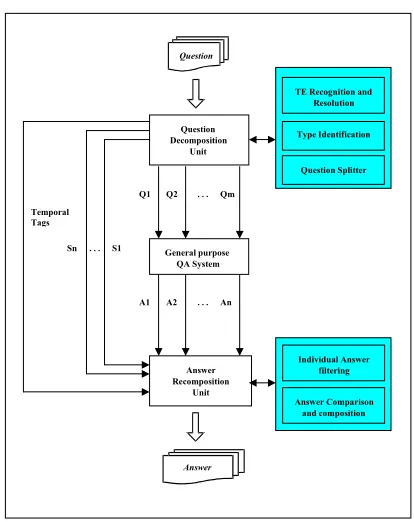
These three types of question have in common the necessity of an additional processing in order to be solved. Our proposal to deal with them is to superpose an additional processing layer, one by each type, to a current General Purpose Question Answering system, as it is shown in Figure 1. This layer will perform the following steps:
Decomposition of the question into simple events to generate simple questions (questions) and the ordering of the sub-questions.
Sending simple questions to a current General Purpose Question Answering system.
Receiving the answers to the simple questions from the current General Purpose Question Answering system.
Filtering and comparison between sub-answers to build the final complex answer.
[image:3.595.324.531.412.673.2]!
Figure 1: Multi-layered Architecture of a Q.A.
The main advantages of performing this multi-layered system are:
It allows you to use any existing general Q.A. system, with the only effort of adapting the output of the processing layer to the type of input that the Q.A. system uses.
Due to the fact that the process of complex questions is performed at an upper layer, it is not necessary to modify the Q.A. system when you want to deal with more complex questions.
Each additional processing layer is indepen-dent from each other and only processes those questions within the type accepted by that layer.
Next, we present a layer oriented to process tem-poral questions according to the taxonomy shown in section 2.
3.1 Architecture of a Question Answering System applied to Temporality
The main components of the Temporal Question Answering System are (c.f. figure 2) top-down: Question Decomposition Unit, General purpose Q.A. system and Answer, Recomposition Unit.
!
! """
"""
"""
Figure 2: Temporal Question Answering System
[image:3.595.100.269.605.728.2]which process the temporal questions, before and after using a General Purpose Q.A. system.
The Question Decomposition Unit is a prepro-cessing unit which performs three main tasks. First of all, the recognition and resolution of temporal expressions in the question. Sec-ondly, there are different types of questions, according to the taxonomy shown in section 2. Each type of them needs to be treated in a dif-ferent manner. For this reason, type identifica-tion must be done. After that, complex ques-tions of types 3 and 4 only, are split into sim-ple ones, which are used as the input of a Gen-eral Purpose Question-Answering system. For example, the question “Where did Bill Clinton study before going to Oxford University?”, is divided into two sub-questions related through the temporal signal before:
– Q1: Where did Bill Clinton study?
– Q2: When did Bill Clinton go to Oxford
University?
A General Purpose Question Answering sys-tem. Simple factual questions generated are processed by a General Purpose Question An-swering system. Any Question AnAn-swering sys-tem could be used here. In this case, the SEMQA system (Vicedo and Ferr´andez, 2000) has been used. The only condition is to know the output format of the Q.A. system to accord-ingly adapt the layer interface. For the exam-ple above, a current Q.A. system returns the following answers:
– Q1 Answers: Georgetown University (1964-68) // Oxford University (1968-70) // Yale Law School (1970-73)
– Q2 Answer: 1968
The Answer Recomposition Unit is the last stage in the process. This unit builds the an-swer to the original question from the anan-swers to the sub-questions and the temporal infor-mation extracted from the questions (temporal signals or temporal expressions). As a result, the correct answer to the original question is returned.
Apart from proposing a taxonomy of tem-poral questions, we have presented a multi-layered Q.A. architecture suitable for enhanc-ing current Q.A. capabilities with the possibil-ity of adding new layers for processing differ-ent kinds of complex questions. Moreover, we
have proposed a specific layer oriented to pro-cess each type of temporal questions.
The final goal of this paper is to introduce and evaluate the first part of the temporal question processing layer: the Question Decomposition Unit.
Next section shows the different parts of the unit together with some examples of their behavior.
4 Question Decomposition Unit
The main task of this unit is the decomposition of the question, which is divided in three main tasks or modules:
Type Identification (according to the taxonomy proposed in section 2)
Temporal Expression Recognition and Resolu-tion
Question Splitter
These modules are fully explained below. Once the decomposition of the question has been made, the output of this unit is:
A set of sub-questions, that are the input of the General Purpose Question-Answering system.
Temporal tags, containing concrete dates re-turned by TERSEO system (Saquete et al., 2003), that are part of the input of the Answer Recomposition Unit and are used by this unit as temporal constraints in order to filter the in-dividual answers.
A set of temporal signals that are part of the in-put of the Answer Recomposition Unit as well, because this information is necessary in order to compose the final answer.
Once the decomposition has been made, the General Purpose Question-Answering system is used to treat with simple questions. The temporal information goes directly to the Answer Recomposition unit.
4.1 Type Identification
a non-temporal question, which are considered sim-ple questions.
[image:5.595.87.283.136.303.2]The question type is established according to the rules in figure 3:
Figure 3: Decision tree for Type Identification
4.2 Temporal Expression Recognition and Resolution
This module uses TERSEO system (Saquete et al., 2003) to recognize, annotate and resolve temporal expressions in the question. The tags this module returns exhibit the following structure:
Explicit dates:
<DATE_TIME ID="value" TYPE="value" VALDATE1="value"VALTIME1="value"
VALDATE2="value" VALTIME2="value"> expression </DATE_TIME>
Implicit dates:
<DATE_TIME_REF ID="value" TYPE="value" VALDATE1="value"VALTIME1="value"
VALDATE2="value" VALTIME2="value"> expression </DATE_TIME_REF>
Every expression is identified by a numeric ID. VALDATE# and VALTIME# store the range of dates and times obtained from the system, where VALDATE2 and VALTIME2 are only used to es-tablish ranges. Furthermore, VALTIME1 could be omitted if a single date is specified. VALDATE2, VALTIME1 and VALTIME2 are optional attributes. These temporal tags are the output of this mod-ule and they are used in the Answer Recomposi-tion Unit in order to filter the individual answers ob-tained by the General Purpose Question-Answering system. The tags are working as temporal con-straints.
Following, a working example is introduced. Given the next question “Which U.S. ship was at-tacked by Israeli forces during the Six Day war in the sixties?”:
1. Firstly, the unit recognizes the temporal ex-pression in the question, resolves and tags it, resulting in:
<DATETIMEREF valdate1="01/01/1960" valdate2="31/12/1969"> in the sixties </DATETIMEREF>
2. The temporal constraint is that the date of the answers should be between the values valdate1 and valdate2.
4.3 Question Splitter
This task is only necessary when the type of the question, obtained by the Type Identification Mod-ule, is 3 or 4. These questions are considered com-plex questions and need to be divided into simple ones (Type 1, Type 2). The decomposition of a complex question is based on the identification of temporal signals, which relate simple events in the question and establish an order between the answers of the sub-questions. Finally, these signals are the output of this module and are described in next sub-section.
4.3.1 Temporal Signals
Temporal signals denote the relationship between the dates of the related events. Assuming that F1 is the date related to the first event in the question and F2 is the date related to the second event, the signal will establish an order between them. This we have named the ordering key. An example of some ordering keys is introduced in table 1.
SIGNAL ORDERING KEY
After F1 > F2
When F1 = F2
Before F1 < F2
During F2i <= F1 <=
F2f
From F2 to F3 F2 <= F1 <= F3
About F2 -- F3 F2 <= F1 <= F3
On / in F1 = F2
While F2i <= F1 <=
F2f
For F2i <= F1 <=
F2f
At the time of F1 = F2
Since F1 > F2
4.3.2 Implementation
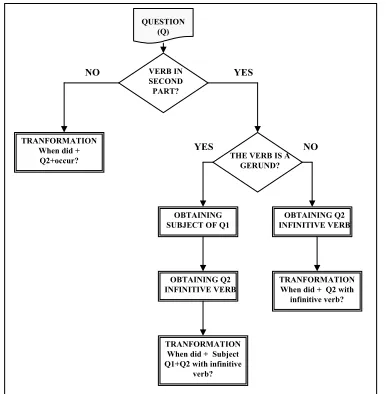
One have divided each complex question into two parts, based on the temporal signal. The former is a simple question, therefore, no transformation is required. However, the latter (the bit after the temporal signal) needs transformation into a correct question pattern, always corresponding to a “When” type-question. Moreover, three different kinds of question structures have been determined, being the transformation different for each of them. The im-plementation of this module is shown in figure 4.
!!"#
$ %
&
&
"'(!) % * ) + ),
, #'
[image:6.595.90.283.224.421.2]* ) + ), , #'
Figure 4: Decision tree for the Question Splitter
The three possible cases are:
The question that follows the temporal sig-nal does not contain any verb, for example: “What happened to the world oil prices af-ter the Iraqi annexation of Kuwait?” In this case, our system returns the following trans-formation: “When did the Iraqi annexation of Kuwait occur?” This case is the simplest, since the only transformation needed is adding the words “When did... occur?” to the second sentence.
The question that follows the temporal signal contains a verb, but this verb is a gerund tense, for example: “Where did Bill Clinton study before going to Oxford University?” In this case two previous steps to the transformation are necessary:
1. Extracting the subject of the previous question.
2. Converting the verb of the second sen-tence to infinitive tense.
The final question returned by the system is: “When did Bill Clinton go to Oxford Univer-sity?”.
In the last type of transformation the second sentence in the question contains a tensed verb and its own subject, e.g., “What did George Bush do after the U.N. Security Council or-dered a global embargo on trade with Iraq?” In this case, the infinitive and the tense of the sentence are obtained. Hence, the question re-sults in the following form: “When did the U.N. Security Council order a global embargo on trade with Iraq?”.
4.3.3 Example
In the following example a part of the returned file of our Decomposition Unit is shown.
1.Where did Bill Clinton study before going to Oxford University?
Temporal Signal: before
Q1: Where did Bill Clinton study? Q2: When did Bill Clinton go to
Oxford University?
2.What did George Bush do after the U.N. Security Council ordered a global embargo on trade with Iraq in August 90?
Temporal Signal: after
Temporal Expression: in August 90 Q1: What did George Bush do? Q2: When did the U.N. Security
Council order a global embargo on trade with Iraq in August 90?
DateQ2:[01/08/1990--31/08/1990] 3.When did Iraq invade Kuwait?
Temporal Signal: Temporal Expression:
-Q1: When did Iraq invade Kuwait? 4.Who became governor of New Hampshire
in 1949?
Temporal Signal:
-Temporal Expression: in 1949 Q1: Who became governor of New
Hampshire in 1949?
DateQ1:[01/01/1949--31/12/1949]
4.4 Decomposition Unit Evaluation
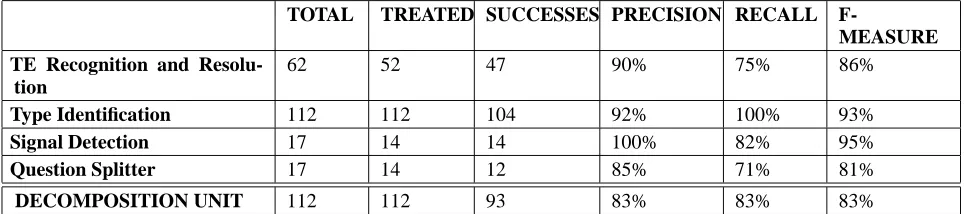
TOTAL TREATED SUCCESSES PRECISION RECALL
F-MEASURE TE Recognition and
Resolu-tion
62 52 47 90% 75% 86%
Type Identification 112 112 104 92% 100% 93%
Signal Detection 17 14 14 100% 82% 95%
Question Splitter 17 14 12 85% 71% 81%
[image:7.595.71.553.73.180.2]DECOMPOSITION UNIT 112 112 93 83% 83% 83%
Table 2: Evaluation of the system
From these, 11 were discarded due to requiring the need of a treatment beyond the capabilities of the system introduced hereby. Questions of the type: “Who was the second man on the moon” can not be answered by applying the question decomposi-tion. They need a special treatment. For the afore-mentioned phrase, this would consist of obtaining the names of all the men having been on the moon, ordering the dates and picking the second in the or-dered list of names.
Therefore, for this evaluation, we have just been focusing on trying to resolve the 112 left. The eval-uation has been made manually by three annotators. Four different aspects of the unit have been consid-ered:
Recognition and resolution of Temporal Ex-pressions: In this corpus, there were 62 tem-poral expressions and our system was able to recognize 52, from which 47 were properly re-solved by this module.
Type Identification: There were 112 temporal questions in the corpus. Each of them was pro-cessed by the module, resulting in 104 properly identified according to the taxonomy proposed in section 2.
Signal Detection: In the corpus, there were 17 questions that were considered complex (Type 3 and Type 4). Our system was able to treat and recognize correctly the temporal signal of 14 of these questions.
Question Splitter: From this set of 17 complex questions, the system was able to process 14 questions and divided properly 12 of them.
The results, in terms of precision and recall are shown in Table 2. In the evaluation, only 19 ques-tions are wrongly pre-processed. Errors provoking a wrong pre-processing have been analyzed thor-oughly:
There were 8 errors in the identification of the type of the question and they were due to:
– Not treated TE or wrong TE recognition:
6 questions.
– Wrong Temporal Signal detection: 2 questions.
There were 5 errors in the Question Splitter module:
– Wrong Temporal Signal detection: 3 questions.
– Syntactic parser problems: 2 questions.
There were 15 errors not affecting the treat-ment of the question by the General Purpose Question Answering system. Nevertheless, they do affect the recomposition of the final an-swer. They are due to:
– Not treated TE or wrong TE recognition:
6 questions.
– Wrong temporal expression resolution: 9
questions.
Some of these questions provoke more than one problem, causing that both, type identification and division turn to be wrong.
5 Conclusions
Moreover, this work proposes a new multi-layered architecture that enables to solve complex questions by enhancing current Q.A. capabilities.
The multi-layered approach can be applied to any kind of complex questions that allow question de-composition such as script questions, e.g., “How do I assemble a bicycle?”, or template-like questions, e.g., “Which are the main biographical data of Nel-son Mandela?”.
This paper has specifically focused on a process of decomposition of complex temporal questions and on its evaluation on a temporal question corpus. In the future, our work is directed to fine tune this system and increase its capabilities towards process-ing questions of higher complexity.
References
E. Breck, J. Burger, L. Ferro, W. Greiff, M. Light, I. Mani, and J. Rennie. 2000. Another sys called quanda. In Ninth Text REtrieval Conference, vol-ume 500-249 of NIST Special Publication, pages 369–378, Gaithersburg, USA, nov. National In-stitute of Standards and Technology.
CLEF. Cross-language evaluation forum.
http://clef.iei.pi.cnr.it/.
I. Mani and G. Wilson. 2000. Robust temporal pro-cessing of news. In ACL, editor, Proceedings of the 38th Meeting of the Association of Computa-tional Linguistics (ACL 2000), Hong Kong, Oc-tober.
J. Pustejovsky. 2002. Terqas:time and event recognition for question answering systems.
http://time2002.org/.
D. Radev and B. Sundheim. 2002. Us-ing timeml in question answering.
http://www.cs.brandeis.edu/ ˜
jamesp/ arda/ time/ documentation/
TimeML-use-in-qa-v1.0.pdf.
E. Saquete, R. Mu¯noz, and P. Mart´ınez-Barco. 2003. Terseo: Temporal expression resolution system applied to event ordering. In TSD, ed-itor, Proceedings of the 6th International Con-ference ,TSD 2003, Text, Speech and Dialogue, pages 220–228, Ceske Budejovice,Czech Repub-lic, September.
TREC. Text retrieval conference.
http://trec.nist.gov/.