Proceedings of the 43rd Annual Meeting of the ACL, pages 549–556,
Context-dependent SMT Model using Bilingual Verb-Noun Collocation
Young-Sook Hwang ATR SLT Research Labs 2-2-2 Hikaridai Seika-cho Soraku-gun Kyoto, 619-0288, JAPAN
Yutaka Sasaki ATR SLT Research Labs 2-2-2 Hikaridai Seika-cho Soraku-gun Kyoto, 619-0288, JAPAN
Abstract
In this paper, we propose a new context-dependent SMT model that is tightly cou-pled with a language model. It is de-signed to decrease the translation ambi-guities and efficiently search for an opti-mal hypothesis by reducing the hypothe-sis search space. It works through recipro-cal incorporation between source and tar-get context: a source word is determined by the context of previous and correspond-ing target words and the next target word is predicted by the pair consisting of the previous target word and its correspond-ing source word. In order to alleviate the data sparseness in chunk-based lation, we take a stepwise back-off trans-lation strategy. Moreover, in order to ob-tain more semantically plausible transla-tion results, we use bilingual verb-noun collocations; these are automatically ex-tracted by using chunk alignment and a monolingual dependency parser. As a case study, we experimented on the language pair of Japanese and Korean. As a result, we could not only reduce the search space but also improve the performance.
1 Introduction
For decades, many research efforts have contributed to the advance of statistical machine translation. Recently, various works have improved the quality
of statistical machine translation systems by using phrase translation (Koehn et al., 2003; Marcu et al., 2002; Och et al., 1999; Och and Ney, 2000; Zens et al., 2004). Most of the phrase-based translation models have adopted the noisy-channel based IBM style models (Brown et al., 1993):
½
(1)
In these model, we have two types of knowledge: translation model,
and language model,
. The translation model links the source
lan-guage sentence to the target lanlan-guage sentence. The language model describes the well-formedness of the target language sentence and might play a role in restricting hypothesis expansion during decoding. To recover the word order difference between two languages, it also allows modeling the reordering by introducing a relative distortion probability distribu-tion. However, in spite of using such a language model and a distortion model, the translation outputs may not be fluent or in fact may produce nonsense.
To make things worse, the huge hypothesis search space is much too large for an exhaustive search. If arbitrary reorderings are allowed, the search prob-lem is NP-complete (Knight, 1999). According to a previous analysis (Koehn et al., 2004) of how many hypotheses are generated during an exhaustive search using the IBM models, the upper bound for the number of states is estimated by
,
where is the number of source words and
is
the size of the target vocabulary. Even though the number of possible translations of the last two words is much smaller than
, we still need to make further improvement. The main concern is the
ponential explosion from the possible configurations of source words covered by a hypothesis. In order to reduce the number of possible configurations of source words, decoding algorithms based on
as well as the beam search algorithm have been pro-posed (Koehn et al., 2004; Och et al., 2001). (Koehn et al., 2004; Och et al., 2001) used heuristics for pruning implausible hypotheses.
Our approach to this problem examines the pos-sibility of utilizing context information in a given language pair. Under a given target context, the cor-responding source word of a given target word is al-most deterministic. Conversely, if a translation pair is given, then the related target or source context is predictable. This implies that if we considered bilin-gual context information in a given language pair during decoding, we can reduce the computational complexity of the hypothesis search; specifically, we could reduce the possible configurations of source words as well as the number of possible target trans-lations.
In this study, we present a statistical machine translation model as an alternative to the classical IBM-style model. This model is tightly coupled with target language model and utilizes bilingual context information. It is designed to not only re-duce the hypothesis search space by decreasing the translation ambiguities but also improve translation performance. It works through reciprocal incorpo-ration between source and target context: source words are determined by the context of previous and corresponding target words, and the next target words are predicted by the current translation pair. Accordingly, we do not need to consider any dis-tortion model or language model as is the case with IBM-style models.
Under this framework, we propose a chunk-based translation model for more grammatical, fluent and accurate output. In order to alleviate the data sparse-ness problem in chunk-based translation, we use a stepwise back-off method in the order of a chunk, sub-parts of the chunk, and word level. Moreover, we utilize verb-noun collocations in dealing with long-distance dependency which are automatically extracted by using chunk alignment and a monolin-gual dependency parser.
As a case study, we developed a Japanese-to-Korean translation model and performed some
ex-periments on the BTEC corpus.
2 Overview of Translation Model
The goal of machine translation is to transfer the meaning of a source language sentence,
, into a target language sentence,
. In most types of statistical machine
trans-lation, conditional probability
is used to
describe the correspondence between two sentences. This model is used directly for translation by solving the following maximization problem:
½
(2)
½
½
½
½
(3)
½
(4)
Since a source language sentence is given and the
probability is applied to all possible
corre-sponding target sentences, we can ignore the denom-inator in equation (3). As a result, the joint proba-bility model can be used to describe the correspon-dence between two sentences. We apply Markov chain rules to the joint probability model and obtain the following decomposed model:
½
(5) where
is the index of the source word that is
aligned to the word
under the assumption of the
fixed one-to-one alignment. In this model, we have two probabilities:
source word prediction probability under a
given target language context,
target word prediction probability under the
preceding translation pair,
½
Since a target and a source word are predicted through reciprocal incorporation between source and target context from the beginning of a target sentence, the word order in the target sentence is automatically determined and the number of pos-sible configurations of source words is decreased. Thus, we do not need to perform any computation for word re-ordering. Moreover, since correspon-dences are provided based on bilingual contextual evidence, translation ambiguities can be decreased. As a result, the proposed model is expected to re-duce computational complexity during the decoding as well as improve performance.
Furthermore, since a word-based translation ap-proach is often incapable of handling complicated expressions such as an idiomatic expressions or complicated verb phrases, it often outputs nonsense translations. To avoid nonsense translations and to increase explanatory power, we incorporate struc-tural aspects of the language into the chunk-based translation model. In our model, one source chunk is translated by exactly one target chunk, i.e., one-to-one chunk alignment. Thus we obtain:
½
(6)
½
(7) whereis the number of chunks in a source and a
target sentence.
3 Chunk-based J/K Translation Model with Back-Off
With the translation framework described above, we built a chunk-based J/K translation model as a case study. Since a chunk-based translation model causes severe data sparseness, it is often impossible to ob-tain any translation of a given source chunk. In order to alleviate this problem, we apply back-off trans-lation models while giving the consideration to lin-guistic characteristics.
Japanese and Korean is a very close language pair. Both are agglutinative and inflected languages in the word formation of a bunsetsu and an eojeol. A bun-setsu/eojeol consists of two sub parts: the head part composed of content words and the tail part com-posed of functional words agglutinated at the end of
the head part. The head part is related to the mean-ing of a given segment, while the tail part indicates a grammatical role of the head in a given sentence.
By putting this linguistic knowledge to practical use, we build a head-tail based translation model as a back-off version of the chunk-based translation model. We place several constraints on this head-tail based translation model as follows:
The head of a given source chunk corresponds
to the head of a target chunk. The tail of the source chunk corresponds to the tail of a target chunk. If a chunk does not have a tail part, we assign NUL to the tail of the chunk.
The head of a given chunk follows the tail of the
preceding chunk and the tail follows the head of the given chunk.
The constraints are designed to maintain the struc-tural consistency of a chunk. Under these con-straints, the head-tail based translation can be for-mulated as the following equation:
½
(8)
½
where
denotes the head of the
chunk and
means the tail of the chunk.
In the worst case, even the head-tail based model may fail to obtain translations. In this case, we back it off into a word-based translation model. In the word-based translation model, the constraints on the head-tail based translation model are not ap-plied. The concept of the chunk-based J/K transla-tion framework with back-off scheme can be sum-marized as follows:
1. Input a dependency-parsed sentence at the chunk level,
2. Apply the chunk-based translation model to the given sentence,
3. If one of chunks does not have any correspond-ing translation:
divide the failed chunk into a head and a
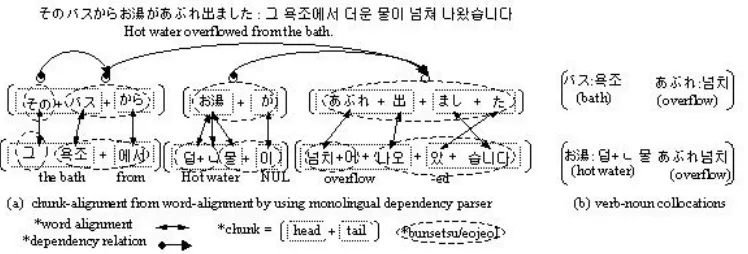
Figure 1: An example of (a) chunk alignment for chunk-based, head-tail based translation and (b) bilingual verb-noun collocation by using the chunk alignment and a monolingual dependency parser
back-off the translation into the head-tail
based translation model,
if the head or tail does not have any
corre-sponding translation, apply a word-based translation model to the chunk.
Here, the back-off model is applied only to the part that failed to get translation candidates.
3.1 Learning Chunk-based Translation
We learn chunk alignments from a corpus that has been aligned by a training toolkit for word-based translation models: the Giza++ (Och and Ney, 2000) toolkit for the IBM models (Brown et al., 1993). For aligning chunk pairs, we con-sider word(bunsetsu/eojeol) sequences to be chunks if they are in an immediate dependency relationship in a dependency tree. To identify chunks, we use a word-aligned corpus, in which source language sentences are annotated with dependency parse trees by a dependency parser (Kudo et al., 2002) and tar-get language sentences are annotated with POS tags by a part-of-speech tagger (Rim, 2003). If a se-quence of target words is aligned with the words in a single source chunk, the target word sequence is regarded as one chunk corresponding to the given source chunk. By applying this method to the cor-pus, we obtain a word- and chunk-aligned corpus (see Figure 1).
From the aligned corpus, we directly estimate the phrase translation probabilities,
,
and the model parameters,
,
½
. These estimation are made
based on relative frequencies.
3.2 Decoding
For efficient decoding, we implement a multi-stack decoder and a beam search with
algorithm. At each search level, the beam search moves through at most-best translation candidates, and a multi-stack
is used for partial translations according to the trans-lation cardinality. The output sentence is generated from left to right in the form of partial translations.
Initially, we gettranslation candidates for each
source chunk with the beam size. Every possible
translation is sorted according to its translation prob-ability. We start the decoding with the initialized beams and initial stack
, the top of which has the
information of the initial hypothesis,
. The decoding algorithm is described in Table 1.
In the decoding algorithm, estimating the back-ward score is so complicated that the computational complexity becomes too high because of the context consideration. Thus, in order to simplify this prob-lem, we assume the context-independence of only the backward score estimation. The backward score is estimated by the translation probability and lan-guage model score of the uncovered segments. For each uncovered segment, we select the best transla-tion with the highest score by multiplying the trans-lation probability of the segment by its language model score. The translation probability and lan-guage model score are computed without giving consideration to context.
After estimating the forward and backward score of each partial translation on stack
1. Push the initial hypothesis¼
¼on the initial stack¼
2. for i=1 to K
Pop the previous state information of ½
½
from stack
½
Get next target and corresponding source
for all pairs of
– Check the head-tail consistency
– Mark the source segment as a covered one – Estimate forward and backward score – Push the state of pair
onto stack Sort all translations on stackby the scores Prune the hypotheses
3. while (stack
is not empty) Pop the state of the pair
Compose translation output,
½
4. Output the besttranslations
Table 1:
multi-stack decoding algorithm
prune the hypotheses. In pruning, we first sort the partial translations on stack
according to their
scores. If the gradient of scores steeply decreases over the given threshold at the
translation, we prune the translations of lower scores than the
one. Moreover, if the number of filtered translations is larger than , we only take the top transla-tions. As a final translation, we output the single best translation.
4 Resolving Long-distance Dependency
Since most of the current translation models take only the local context into account, they cannot account for long-distance dependency. This often causes syntactically or semantically incorrect trans-lation to be output. In this section, we describe how this problem can be solved. For handling the long-distance dependency problem, we utilize bilin-gual verb-noun collocations that are automatically acquired from the chunk-aligned bilingual corpora.
4.1 Automatic Extraction of Bilingual Verb-Noun Collocation(BiVN)
To automatically extract the bilingual verb-noun collocations, we utilize a monolingual dependency parser and the chunk alignment result. The basic
concept is the same as that used in (Hwang et al., 2004): bilingual dependency parses are obtained by sharing the dependency relations of a monolingual dependency parser among the aligned chunks. Then bilingual verb sub-categorization patterns are ac-quired by navigating the bilingual dependency trees. A verb sub-categorization is the collocation of a verb and all of its argument/adjunct nouns, i.e. verb-noun collocation(see Figure 1).
To acquire more reliable and general knowledge, we apply the following filtering method with statis-tical
test and unification operation:
step 1. Filter out the reliable translation
corre-spondences from all of the alignment pairs by
test at a probability level of
step 2. Filter out reliable bilingual verb-noun
collocations BiVN by a unification and
test at a probability level of
: Here, we assume
that two bilingual pairs,
and
are unifiable into a frame
iff
both of them are reliable pairs filtered in step 1. and they share the same verb pair
.
4.2 Application of BiVN
The acquired BiVN is used to evaluate the bilingual correspondence of a verb-noun pair dependent on each other and to select the correct translation. It can be applied to any verb-noun pair regardless of the distance between them in a sentence. Moreover, since the verb-noun relation in BiVN is bilingual knowledge, the sense of each corresponding verb and noun can be almost completely disambiguated by each other.
In our translation system, we apply this BiVN during decoding as follows:
1. Pivot verbs and their dependents in a given dependency-parsed source sentence
2. When extending a hypothesis, if one of the piv-oted verb and noun pairs is covered and its cor-responding translation pair is in BiVN, we give positive weight to the hypothesis.
if
where
and
is a function that indicates whether the bilingual translation pair is in BiVN. By adding the weight
of the
function, we refine our model as
follows:
(10)
½
where
is a function indicating whether the
pair of a verb and its argument
is covered
with
or
and
is a bilingual translation pair in the
hy-pothesis.
5 Experiments
5.1 Corpus
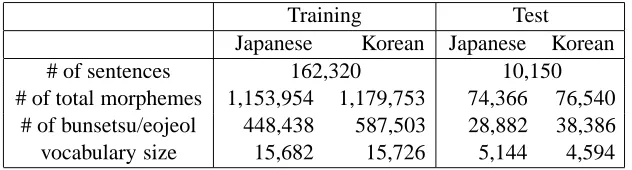
The corpus for the experiment was extracted from the Basic Travel Expression Corpus (BTEC), a col-lection of conversational travel phrases for Japanese and Korean (see Table 2). The entire corpus was split into two parts: 162,320 sentences in parallel for training and 10,150 sentences for test. The Japanese sentences were automatically dependency-parsed by CaboCha (Kudo et al., 2002) and the Korean sen-tences were automatically POS tagged by KUTag-ger (Rim, 2003)
5.2 Translation Systems
Four translation systems were implemented for evaluation: 1) Word based IBM-style SMT tem(WBIBM), 2) Chunk based IBM-style SMT Sys-tem(CBIBM), 3) Word based LM tightly Coupled SMT System(WBLMC), and 4) Chunk based LM tightly Coupled SMT System(CBLMC). To exam-ine the effect of BiVN, BiVN was optionally used for each system.
The word-based IBM-style (WBIBM) system1 consisted of a word translation model and a bi-gram language model. The bi-gram language model was generated by using CMU LM toolkit (Clarkson et al., 1997). Instead of using a fer-tility model, we allowed a multi-word target of a given source word if it aligned with more than one word. We didn’t use any distortion model for word re-ordering. And we used a log-linear model
1
In this experiment, a word denotes a morpheme
for weighting the
language model and the translation model. For de-coding, we used a multi-stack decoder based on the
algorithm, which is almost the same as that de-scribed in Section 3. The difference is the use of the language model for controlling the generation of target translations.
The chunk-based IBM-style (CBIBM) system consisted of a chunk translation model and a bi-gram language model. To alleviate the data sparse-ness problem of the chunk translation model, we ap-plied the back-off method at the head-tail or mor-pheme level. The remaining conditions are the same as those for WBIBM.
The word-based LM tightly coupled (WBLMC) system was implemented for comparison with the chunk-based systems. Except for setting the transla-tion unit as a morpheme, the other conditransla-tions are the same as those for the proposed chunk-based transla-tion system.
The chunk-based LM tightly coupled (CBLMC) system is the proposed translation system. A bi-gram language model was used for estimating the backward score.
5.3 Evaluation
Translation evaluations were carried out on 510 sen-tences selected randomly from the test set. The met-rics for the evaluations are as follows:
PER(Position independent WER), which pe-nalizes without considering positional dis-fluencies(Niesen et al., 2000).
mWER(multi-reference Word Error Rate), which is based on the minimum edit distance between the target sentence and the sentences in the ref-erence set (Niesen et al., 2000).
BLEU, which is the ratio of the n-gram for the translation results found in the reference translations with a penalty for too short sen-tences (Papineni et al., 2001).
NIST which is a weighted n-gram precision in combination with a penalty for too short sen-tences.
Training Test
Japanese Korean Japanese Korean
# of sentences 162,320 10,150
# of total morphemes 1,153,954 1,179,753 74,366 76,540
# of bunsetsu/eojeol 448,438 587,503 28,882 38,386
[image:7.612.149.465.55.140.2]vocabulary size 15,682 15,726 5,144 4,594
Table 2: Statistics of Basic Travel Expression Corpus
PER mWER BLEU NIST
[image:7.612.118.501.175.248.2]WBIBM 0.3415 / 0.3318 0.3668 / 0.3591 0.5747 / 0.5837 6.9075 / 7.1110 WBLMC 0.2667 / 0.2666 0.2998 / 0.2994 0.5681 / 0.5690 9.0149 / 9.0360 CBIBM 0.2677 / 0.2383 0.2992 / 0.2700 0.6347 / 0.6741 8.0900 / 8.6981 CBLMC 0.1954 / 0.1896 0.2176 / 0.2129 0.7060 / 0.7166 9.9167 / 10.027
Table 3: Evaluation Results of Translation Systems: without BiVN/with BiVN
WBIBM WBLMC CBIBM CBLMC
0.8110 / 0.8330 2.5585 / 2.5547 0.3345 / 0.3399 0.9039 / 0.9052
Table 4: Translation Speed of Each Translation Systems(sec./sentence): without BiVN/with BiVN
5.4 Analysis and Discussion
Table 3 shows the performance evaluation of each system. CBLMC outperformed CBIBM in overall evaluation criteria. WBLMC showed much better performance than WBIBM in most of the evalua-tion criteria except for BLEU score. The interesting point is that the performance of WBLMC is close to that of CBIBM in PER and mWER. The BLEU score of WBLMC is lower than that of CBIBM, but the NIST score of WBLMC is much better than that of CBIBM.
The reason the proposed model provided better performance than the IBM-style models is because the use of contextual information in CBLMC and WBLMC enabled the system to reduce the transla-tion ambiguities, which not only reduced the compu-tational complexity during decoding, but also made the translation accurate and deterministic. In addi-tion, chunk-based translation systems outperformed word-based systems. This is also strong evidence of the advantage of contextual information.
To evaluate the effectiveness of bilingual verb-noun collocations, we used the BiVN filtered with
, where coverage is
on the test set and average ambiguity is . We
suffered a slight loss in the speed by using the BiVN(see Table 4), but we could improve perfor-mance in all of the translation systems(see Table 3). In particular, the performance improvement in CBIBM with BiVN was remarkable. This is a pos-itive sign that the BiVN is useful for handling the problem of long-distance dependency. From this re-sult, we believe that if we increased the coverage of BiVN and its accuracy, we could improve the per-formance much more.
sorting and pruning algorithm for partial translations provides shorter search times in all system. Since the number of parameters for the proposed model is much more than for the IBM-style models, it took a longer time to retrieve parameters. To decrease the processing time, we need to construct a more effi-cient DB system.
6 Conclusion
In this paper, we proposed a new chunk-based statis-tical machine translation model that is tightly cou-pled with a language model. In order to alleviate the data sparseness in chunk-based translation, we applied the back-off translation method at the head-tail and morpheme levels. Moreover, in order to get more semantically plausible translation results by considering long-distance dependency, we uti-lized verb-noun collocations which were automat-ically extracted by using chunk alignment and a monolingual dependency parser. As a case study, we experimented on the language pair of Japanese and Korean. Experimental results showed that the proposed translation model is very effective in im-proving performance. The use of bilingual verb-noun collocations is also useful for improving the performance.
However, we still have some problems of the data sparseness and the low coverage of bilingual verb-noun collocation. In the near future, we will try to solve the data sparseness problem and to increase the coverage and accuracy of verb-noun collocations.
References
Peter F. Brown, Stephen A. Della Pietra, Vincent J. Della Pietra, and R. L. Mercer. 1993. The mathematics of
statistical machine translation: Parameter estimation, Computational Linguistics, 19(2):263-311.
P.R. Clarkson and R. Rosenfeld. 1997. Statistical
Lan-guage Modeling Using the CMU-Cambridge Toolkit,
Proc. of ESCA Eurospeech.
Young-Sook Hwang, Kyonghee Paik, and Yutaka Sasaki. 2004. Bilingual Knowledge Extraction Using Chunk
Alignment, Proc. of the 18th Pacific Asia Con-ference on Language, Information and Computation (PACLIC-18), pp. 127-137, Tokyo.
Kevin Knight. 1999. Decoding Complexity in
Word-Replacement Translation Models, Computational Lin-guistics, Squibs Discussion, 25(4).
Philipp Koehn, Franz Josef Och, and Daniel Marcu. 2003 Statistical Phrase-Based Translation, Proc.
of the Human Language Technology
Confer-ence(HLT/NAACL)
Philipp Koehn. 2004 Pharaoh: a Beam Search
De-coder for Phrase-Based Statistical Machine Transla-tion Models, Proc. of AMTA’04
Taku Kudo, Yuji Matsumoto. 2002. Japanese
Depen-dency Analyisis using Cascaded Chunking, Proc. of CoNLL-2002
Daniel Marcu and William Wong. 2002. A phrase-based,
joint probability model for statistical machine transla-tion , Proc. of EMNLP.
Sonja Niesen, Franz Josef Och, Gregor Leusch, Hermann Ney. 2000. An Evaluation Tool for Machine
Transla-tion: Fast Evaluation for MT Research, Proc. of the
2nd International Conference on Language Resources and Evaluation, pp. 39-45, Athens, Greece.
Franz Josef Och, Christoph Tillmann, Hermann Ney. 1999. Improved alignment models for statistical
ma-chine translation, Proc. of EMNLP/WVLC.
Franz Josef Och and Hermann Ney. 2000. Improved
Sta-tistical Alignment Models , Proc. of the 38th Annual
Meeting of the Association for Computational Lin-guistics, pp. 440-447, Hongkong, China.
Franz Josef Och, Nicola Ueffing, Hermann Ney. 2001.
An Efficient A* Search Algorithm for Statistical Ma-chine Translation , Data-Driven MaMa-chine Translation
Workshop, pp. 55-62, Toulouse, France.
Kishore Papineni, Salim Roukos, Todd Ward, and Wei-Jing Zhu. 2001. Bleu: a method for automatic
evalu-ation of machine translevalu-ation , IBM Research Report,
RC22176.
Toshiyuki Takezawa, Eiichiro Sumita, Fumiaki Sugaya, Hirofumi Yamamoto, and Seiichi Yamamoto. 2002.
Toward a broad-coverage bilingual corpus for speech translation of travel conversations in the real world, Proc. of LREC 2002, pp. 147-152, Spain.
Richard Zens and Hermann Ney. 2004.
Improve-ments in Phrase-Based Statistical Machine Transla-tion, Proc. of the Human Language Technology
Con-ference (HLT-NAACL) , Boston, MA, pp. 257-264.
Hae-Chang Rim. 2003. Korean Morphological Analyzer
and Part-of-Speech Tagger, Technical Report, NLP