STRUCTURAL DISAMBIGUATION WITH
CONSTRAINT PROPAGATION
H i r o s h i M a r u y a m a
I B M R e s e a r c h , T o k y o R e s e a r c h L a b o r a t o r y 5 - 1 9 S a n b a n c h o , C h i y o d a - k u ,
T o k y o 102 J a p a n m a r u y a m a @ j p n t s c v m . b i t n e t
A b s t r a c t
We present a new grammatical formalism called Con- straint D e p e n d e n c y G r a m m a r (CDG) in which every grammatical rule is given as a constraint on word- to-word modifications. CDG parsing is formalized as a constraint satisfaction problem over a finite do- main so t h a t efficient constraint-propagation algo- rithms can be employed to reduce structural am- biguity without generating individual parse trees. T h e weak generative capacity and the computational complexity of CDG parsing are also discussed.
1 I N T R O D U C T I O N
We are interested in an efficient treatment of struc- tural ambiguity in natural language analysis. It is known that "every-way" ambiguous constructs, such as prepositional a t t a c h m e n t in English, have a Cata- lan number of ambiguous parses (Church and Patil 1982), which grows at a faster than exponential rate (Knuth 1975). A parser should be provided with a disambiguation mechanism that does not involve generating such a combinatorial number of parse trees explicitly.
We have developed a parsing method in which an intermediate parsing result is represented as a d a t a structure called a constraint network. E v e r y solution that satisfies all the constraints simultaneously corre- sponds to an individual parse tree. No explicit parse trees are generated until ultimately necessary. Pars- ing and successive disambiguation are performed by adding new constraints to the constraint network. Newly added constraints are efficiently propagated over the network by Constraint Propagation (Waltz
1975, Montanari 1976) to remove inconsistent values.
In this paper, we present the basic ideas of a formal grammatical theory called Constraint Depen- dency G r a m m a r (CDG for short) that makes this parsing technique possible. CDG has a reasonable time bound in its parsing, while its weak generative capacity is strictly greater than that of C o n t e x t Free
G r a m m a r (CFG).
We give the definition of CDG in the next section. Then, in Section 3, we describe the parsing method based on constraint propagation, using a step-by- step example. Formal properties of CDG are dis- cussed in Section 4.
31
2 C D G : D E F I N I T I O N
Let a sentence s = w l w 2 . . . w,, be a finite string on a finite alphabet E. Let R -- { r l , r 2 , . . . , r k } be a finite set of role-iris. Suppose that each word i in a sentence s has k-different roles r l ( i ) , r2(i) . . . . , rk(i). Roles are like variables, and each role can have a pair <a, d> as its value, where the label a is a member of a finite set L = { a l , a 2 , . . . , a t } and the modifiee d is either 1 < d < n or a special symbol n i l . An analysis of the sentence s is obtained by assigning appropriate values to the n x k roles (we can regard this situation as one in which each word has a frame with k slots, as shown in Figure 1).
rt-role
r=-role
W~ W= W.
I
I
[ - - - ]
I I l- I
r.-ro,e I I 1" t I I
Figure 1: Words and their roles.
• p o s ( x ) ~ f the position i • r i d ( x ) ~ r the role id r j • lab(x)d-~ f the label of x
• mod(x)d-~ f the modifiee of x
We also define word(i) as the terminal symbol occurring at the position i. 1
An individual g r a m m a r G = < ~, R, L, C > in the C D G theory determines a set of possible assignments of a given sentence, where
• ~ is a finite set of terminal symbols. • R is a finite set of role-ids.
• L is a finite set of labels.
• C is a constraint t h a t an assignment A should satisfy.
A constraint C is a logical formula in a form
Vxlx2...xp : role; PI&P2&...&P,~
where the w H a b l e s Xl, x2, ..., xp range over the set of roles in an assignment A and each subformula P~ consists only of the following vocabulary:
• Variables: x l , x2, ..., xp
• Constants: elements and subsets of
E U L U R U { n i l , l , 2 , . . . }
• Function symbols: word(), posO, rid(), lab(),
and modO
l I n t h i s paper, w h e n referring to a word, we p u r p o s e l y use the position (1,2,...,n) of t h e w o r d r a t h e r t h a n the word itself (Wl,W2, ,--,Wn), because the s a m e w o r d can occur in m a n y different p o s i t i o n s in a sentence. For readability, however, we s o m e t i m e s use the n o t a t i o n word~os~tion.
• Predicate symbols: =, <, >, and E
• Logical connectors: &, l, "~, and
Specifically, we call a subformula P i a unary con- straint when P.i contains only one variable, and a
binary constraint when Pi contains exactly two vari- ables.
T h e semantics of the functions have been defined above. T h e semantics of the predicates and the logi- cal connectors are defined as usual, except t h a t com- paring an expression containing n i l with a n o t h e r value by the inequality predicates always yields the t r u t h value false.
These conditions guarantee that, given an assign- ment A, it is possible to compute whether the values of x l , x2 . . . . , xp satisfy C in a constant time, regard- less of the sentence length n.
D e f i n i t i o n
• T h e degree of a g r a m m a r G is the size k of the role-id set R.
• T h e arity of a g r a m m a r G is the n u m b e r of vari- ables p in the constraint C.
Unless otherwise stated, we deal with only ar- i t y - 2 cases.
• A nonnull string s over the alphabet ~ is gener- ated iff there exits an assignment A t h a t satisfies the constraint C.
• L(G) is a language generated by the g r a m m a r G iff L(G) is the set of all sentences generated by a g r a m m a r G.
E x a m p l e
Let us consider G1 = < E 1 , R 1 , L 1 , C 1 > where • =
• R1 = {governor}
• n l = {DET,SUBJ,ROOT}
• C1 = Vxy : role; P1.
T h e formula P 1 of the constraint C1 is the con- junction of the following four subformulas (an infor-
mal description is attached to each constraint):
G I - 1 ) word(pos(x))=D ~ ( lab(x)=DgT, word(mod(x))=N, pos(x) < rood(x) )
"A determiner (D) modifies a noun (N) on the right with the label DET."
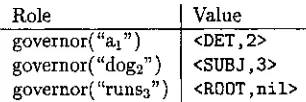
Role Value governor( "al" )
governor("dog2") governor( "runs3" )
<DET,2> <SUBJ,3> <R00T,nil>
Figure 2: Assignment Satisfying (GI-1) to (G1-4)
~SUB3
(G1-2)
word(pos(x))=N ~ ( lab(x)=SUBJ,
word(mod(x))=V, pos(x) < mod(x) )
"A noun modifies a verb (V) on the right with the label SUBJ."
(G1-3)
word(pos(x))=V ~ ( lab(x)=ROOT,
mod(x)=nil )
"A verb modifies nothing and its label should be ROOT."
(G1-4) (mod(x)=mod(y),
lab(x)=lab(y) ) ~ x=y
"No two words can modify the same word with the same label."
Analyzing a sentence with G1 means assigning a label-modifiee pair to the only role "governor" of each word so that the assignment satisfies (GI-1) to (G1-4) simultaneously. For example, sentence (1) is analyzed as shown in Figure 2 provided that the words "a," "dog," and "runs" are given parts-of- speech D, N, and V, respectively (the subscript at- tached to the words indicates the position of the word in the sentence).
(1) A1 dog2 runs3.
Thus, sentence (1) is generated by the grammar G1. On the other hand, sentences (2) and (3) are not generated since there are no proper assignments for such sentences.
(2) A runs.
(3) Dog dog runs.
We can graphically represent the parsing result of sentence (1) as shown in Figure 3 if we interpret the
governor
role of a word as a pointer to the syntacticgovernor of the word. Thus, the syntactic structure produced by a CDG is usually a
dependency structure
(Hays 1964) rather than a
phrase structure.
Figure 3: Dependency tree
3 P A R S I N G W I T H
C O N S T R A I N T P R O P A G A T I O N
CDG parsing is done by assigning values to n × k roles, whose values are selected from a finite set L x { 1 , 2 , . . . , n , n i l } . Therefore, CDG parsing can be viewed as a constraint satisfaction problem over a finite domain. Many interesting artificial intelli- gence problems, including graph coloring and scene labeling, are classified in this group of problems, and much effort has been spent on the development of efficient techniques to solve these problems.
Con-
straint propagation
(Waltz 1975, Montanari 1976),sometimes called
filtering,
is one such technique. One advantage of the filtering algorithm is that it allows new constraints to be added easily so that a better solution can be obtained when many candidates re- main. Usually, CDG parsing is done in the following three steps:1. Form an initial constraint network using a "core" grammar.
2. Remove local inconsistencies by filtering.
3. If any ambiguity remains, add new constraints and go to Step 2.
In this section, we will show, through a step-by-step example, that the filtering algorithms can be effec- tively used to narrow down the structural ambigui- ties of CDG parsing.
T h e E x a m p l e
We use a PP-attachment example. Consider sen- tence (4). Because of the three consecutive preposi- tional phrases (PPs), this sentence has many struc- tural ambiguities.
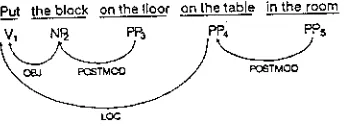
(4) Put the block on the floor on the table in the room.
[image:3.612.115.268.80.131.2]Pu._t the block on the floor on the table in the room
V, NI~ PP3 PP4 PPs
~'rMO0
Figure 4: Possible dependency structure
One of the possible syntactic structures is shown in Figure 42 .
To simplify tile following discussion, we treat the grammatical symbols V, NP, and PP as terminal sym- bols (words), since the analysis of the internal struc- tures of such phrases is irrelevant to the point be- ing made. T h e correspondence between such simpli- fied dependency structures and the equivalent phrase structures should be clear. Formally, the input sen- tence that we will parse with CDG is (5).
(5) V1 NP2 PP3 PP4 PP5
First, we consider a "core" grammar that con- tains purely syntactic rules only. We define a CDG
G2a
= < E2, R2, L2, C2 > as follows:• E 2 = { V , N P , P P }
• R2 = {governor}
• L 2 = {ROOT, 0B J, LOC,POSTMOD}
• C2 = Vxy : role; P2,
L1 P2P3 L1 P2P3P4
1 1 1 Rnil 1 1 1 1 Rnil
{Rn,I}/-A--~ 1 / ( ' ~ {L1P2 p3 p4}
' ' ' , . , . 2 . 3 . .
/,
L1 0 1 1 P 2 1 1 1 1
Figure 5: Initial constraint network (the values Rnil,
L1, P2, ... should be read as <ROOT,nil>, <LOC,I>, <POSTMOD,2>, ..., and so on.)
(G2a-4)
word(pos(x))=NP =~ ( word(mod(x))=V,
lab(x)=OBJ, mod(x) < pos(x) )
"An NP modifies a V on the left with the label OBJ."
(G2a-5)
word(pos(x))=V ~ ( mod(x)=nil,
lab(x)=KOOT )
"A Y modifies nothing with the label ROOT."
(G2a-6)
mod(x) < pos(y) < pos(x) =~
mod(x) < mod(y) < pos(x)
"Modification links do not cross each other."
where the formula P 2 is the conjunction of the following unary and binary constraints :
(G2a-1)
word(pos(x))=PP ~ (word(mod(x)) 6
{PP,NP,V},
rood(x) < pos(x) )
"A
PP modifies a PP, an NP, or a V on the left."(G2a-2)
word(pos(x))=PP, word(rood(x))
6 {PP,NP}lab(x)=POSTMOD
"If a PP modifies a PP or an NP, its label should be POSTMOD."
(G2a-3)
word(pos(x) )=PP, word(mod(x) )=V
lab(x)
=LOC"If a PP modifies a V, its label should be L0¢."
2In linguistics, a r r o w s are usually d r a w n in the o p p o s i t e direction in a d e p e n d e n c y diagram: f r o m a governor (modifiee) to its d e p e n d e n t (modifier). In this paper, however, we d r a w an a r r o w f r o m a modifier to its modifiee in o r d e r to e m p h a s i z e t h a t t h i s i n f o r m a t i o n is contained in a modifier's role.
According to the g r a m m a r
G2a ,
sentence (5) has14
(= Catalan(4))
different syntactic structures. Wedo not generate these syntactic structures one by one, since the number of the structures may grow more rapidly than exponentially when the sentence becomes long. Instead, we build a packed d a t a struc- ture, called a
constraint network,
that contains all the syntactic structures implicitly. Explicit parse trees can be generated whenever necessary, but it may take a more than exponential computation time.F o r m a t i o n o f i n i t i a l n e t w o r k
Figure 5 shows the initial constraint network for sen- tence (5). A node in a constraint network corre- sponds to a role. Since each word has only one role
governor
in the grammarG2,
the constraint network [image:4.612.279.535.90.269.2] [image:4.612.66.238.107.170.2]sentence. In the figure, the node labeled Vl repre- sents the governor role of the word Vl, and so on. A node is associated with a set of possible values that the role can take as its value, called a domain. T h e domains of the initial constraint network are com- puted by examining unary constraints ((G2a-1) to (G2a-5) in our example). For example, the modifiee of the role of the word Vl must be ROOT and its label must be n i l according to the unary constraint (G2a- 5), and therefore the domain of the corresponding node is a singleton set {<R00T,nil>). In the figure, values are abbreviated by concatenating the initial letter of the label and the modifiee, such as R n i l for <R00T,nil>, 01 for <0BJ,I>, and so on.
An arc in a constraint network represents a bi- nary constraint imposed on two roles. Each arc is associated with a two-dimensional matrix called
a constraint matlqx, whose xy-elements are either 1 or 0. T h e rows and the columns correspond to the possible values of each of the two roles. T h e value 0 indicates t h a t this particular combination of role values violates the binary constraints. A constraint matrix is calculated by generating every possible pair of values and by checking its validity according to the binary constraints. For example, the case in which governor(PP3) = <LOC,I> and
governor(PP4) -- <POSTMOD,2> violates the binary constraint (G2a-6), so the L1-P2 element of the con- straint m a t r i x between PPs and PPa is set to zero.
The reader should not confuse the undirected arcs in a constraint network with the directed modifica- tion links in a dependency diagram. An arc in a constraint network represents the existence of a bi- nary constraint between two nodes, and has nothing to do with the modifier-modifiee relationships. T h e possible modification relationships are represented as the modifiee part of the domain values in a constraint network.
A constraint network contains all the information needed to produce the parsing results. No grammati- cal knowledge is necessary to recover parse trees from a constraint network. A simple backtrack search can generate the 14 parse trees of sentence (5) from the constraint network shown in Figure 5 at any time. Therefore, we regard a constraint network as a packed representation of parsing results.
F i l t e r i n g
A constraint network is said to be arc consistent if, for any constraint matrix, there are no rows and no columns that contain only zeros. A node value cor- responding to such a row or a column cannot partici- pate in any solution, so it can be abandoned without further checking. The filtering algorithm identifies such inconsistent values and removes them from the domains. Removing a value from one domain may make another value in another domain inconsistent, so the process is propagated over the network until the network becomes arc consistent.
Filtering does not generate solutions, but may sig- nificantly reduce the search space. In our example, the constraint network shown in Figure 5 is already arc consistent, so nothing can be done by filtering at this point.
A d d i n g N e w C o n s t r a i n t s
To illustrate how we can add new constraints to nar- row down the ambiguity, let us introduce additional constraints (G2b-1) and (G2b-2), assuming that ap- propriate syntactic a n d / o r semantic features are at- tached to each word and that the function /e(i) is provided to access these features.
(G2b-1) word(pos(x))=PP, on_table E ]e(pos(x))
~(:floor e /e(mM(x)) )
"A floor is not on a table."
(G2b-2) lab(x)=LOC, lab(y)=LOC, mod(x)=mod(y), ward(mod(x) )--V ~ x=y
"No verb can take two locatives."
Note that these constraints are not purely syntac- tic. Any kind of knowledge, syntactic, semantic, or even pragmatic, can be applied in CDG parsing as long as it is expressed as a u n a r y or binary constraint on word-to-word modifications.
I L1 P2 P3 P4
~ i l i l 1 1 1
{FInIIi{"UT'D_ 1 / / " T t~ {L1 p2 p3 p4} ' '
I \
, , o . o o ,
/ \
/,.=")':~-
/W
P2tl 1 0 1I L1P2P3P_4 . ~ / ,,.~. ! L1 i"Z ~/~,. \
011'i, 1 ' J_. ~ \/Ftni, l , 1 / ~ . _ _ ~ _ . .
S
/ {L1,P2} x
ILl P2 P3 P4
~ 2 L1 0"0 1 1 P2 1 1 11
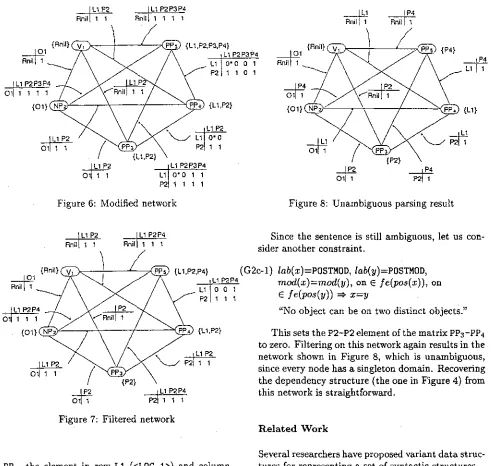
Figure 6: Modified network
! L1 I P4
Rnill 1 Rnill 1
{ O l } ( . ~ / ".~ S ~ {L1}
!p2 ~
011 1
Figure 8: Unambiguous parsing result
Flnil L1P2P4
Rnill 1 1 1 1 1
/
o,,,,
/
\
1 P2 1 I
Figure 7: Filtered network
Since the sentence is still ambiguous, let us con- sider another constraint.
(G2c-1)
Iab(x)=POSTMOD, lab(y)=POSTMOD,
mod(x)=mod(y),
on efe(po~(x)),
one fe(pos(y)) ~ x=y
"No object can be on two distinct objects."
This sets the P2-P2 element of the matrix PP3-PP4
to zero. Filtering on this network again results in the network shown in Figure 8, which is unambiguous, since every node has a singleton domain. Recovering the dependency structure (the one in Figure 4) from this network is straightforward.
R e l a t e d W o r k
PP4, the element in row L1 (<LOC,I>) and column L1 (<LOC, 1>) is set to zero, since both are modifica- tions to Vl with the label LOC. Similarly, the L1-L1 elements of the matrices PP3-PP5 and PP4-PP5 are set to zero. T h e modified network is shown in Fig- ure 6, where the updated elements are indicated by asterisks.
Note that the network in Figure 6 is not arc consistent. For example, the L1 row of the matrix PP3-PP4 consists of all zero elements. The filtering algorithm identifies such locally inconsistent values and eliminates them until there are no more incon- sistent values left. T h e resultant network is shown in Figure 7. This network implicitly represents the remaining four parses of sentence (5).
Several researchers have proposed variant d a t a struc- tures for representing a set of syntactic structures.
Chart
(Kaplan 1973) andshared, packed for-
[image:6.612.41.272.93.528.2] [image:6.612.39.535.94.560.2]the same nonterminal symbol have to be represented by separate edges, and this may cause a combinato- rial explosion.
Seo and Simmons (1988) propose a data structure called a syntactic graph as a packed representation of context-free parsing. A syntactic graph is similar to a constraint network in the sense that it is dependency- oriented (nodes are words) and that an exclusion ma- trix is used to represent the co-occurrence conditions between modification links. A syntactic graph is, however, built after context-free parsing and is there- fore used to represent only context-free parse trees. The formal descriptive power of syntactic graphs is not known. As will be discussed in Section 4, the formal descriptive power of CDG is strictly greater than that of CFG and hence, a constraint network can represent non-context-free parse trees as well.
Sugimura et al. (1988) propose the use of a con- straint logic program for analyzing modifier-modifiee relationships of Japanese. An arbitrary logical for- mula can be a constraint, and a constraint solver called CIL (Mukai 1985) is responsible for solving the constraints. The generative capacity and the compu- tational complexity of this formalism are not clear.
The above-mentioned works seem to have concen- trated on the efficient representation of the output of a parsing process, and lacked the formalization of a structural disambiguation process, that is, they did not specify what kind of knowledge can be used in what way for structural disambiguation. In CDG parsing, any knowledge is applicable to a constraint network as long as it can be expressed as a constraint between two modifications, and an efficient filtering algorithm effectively uses it to reduce structural am- biguities.
4 F O R M A L P R O P E R T I E S
W e a k G e n e r a t i v e C a p a c i t y o f C D G
Consider the language L w w = {wwlw E (a+b)*}, the language of strings that are obtained by con- catenating the same arbitrary string over an alpha- bet {a,b}. L w w is known to be non-context-free (Hopcroft and Ullman 1979), and is frequently men- tioned when discussing the non-context-freeness of the "respectively" construct (e.g. "A, B, and C do D, E, and F, respectively") of various natural lan- guages (e.g., Savitch et al. 1987). Although there
37
= (a, b}
L = ( l }
R = (partner}
C = conjunction of the following subformulas:
• (word(pos(x))=a ~ word(mod(x))=a) & (word(pos(x))=b ~ word(mod(x))=b) • mod(x) = pos(y) ~ rood(y) = pos(x) • rood(x) ¢ pos(x) & rood(x) • n i l
• pos(x) < pos(y) < mod(y) pos(x) < mod(x) < mod(y) • rood(y) < pos(y) < pos(x)
mod(y) < mod(x) < pos(x)
Figure 9: Definition of Gww
~
a
a
a b
Figure 10: Assignment for a sentence of L w w
is no context-free grammar that generates Lww, the grammar Gww = < E , L , R , C > shown in Figure 9 generates it (Maruyama 1990). An assignment given to a sentence "aabaab" is shown in Figure 10.
On the other hand, any context-free language can be generated by a degree=2 CDG. This can be proved by constructing a constraint dependency grammar GCDG from an arbitrary context-free gram- mar GCFG in Greibach Normal Form, and by show- ing that the two grammars generate exactly the same language. Since G c F c is in Greibach Normal Form, it is easy to make one-to-one correspondence between a word in a sentence and a rule application in a phrase-structure tree. The details of the proof are given in Maruyama (1990). This, combined with the fact that Gww generates Lww, means that the weak generative capacity of CDG with degree=2 is strictly greater than that of CFG.
C o m p u t a t i o n a l c o m p l e x i t y of C D G p a r s i n g
CDG parsing, every word has k roles, so there are n × k nodes in total. A role can have n x l possible values, where l is the size of L, so the maximum domain size is n x l. Binary constraints may be imposed on arbitrary pairs of roles, and therefore the number of constraint matrices is at most proportional to (nk) 2. Since the size of a constraint matrix is (nl) 2, the total space complexity of the constraint network is
O(12k~n4).
Since k and l are grammatical constants,it is O(n 4) for the sentence length n.
As the initial formation of a constraint network takes a computation time proportional to the size of the constraint network, the time complexity of the initial formation of a constraint network is
O(n4).
The complexity of adding new constraints to a con- straint network never exceeds the complexity of the initial formation of a constraint network, so it is also bounded by O(n4).
The most efficient filtering algorithm developed so far runs in
O(ea 2,)
time, where e is the number of arcs and a is the size of the domains in a con- straint network (Mohr and Henderson 1986). Since the number of arcs is at mostO((nk)2),
filtering can be performed inO((nk)2(nl)2),
which is O(n 4) with- out grammatical constants.Thus, in CDG parsing with arity 2, both the ini- tial formation of a constraint network and filtering are bounded in
O(n 4)
time.5 C O N C L U S I O N
We have proposed a formal grammar that allows effi- cient structural disambiguation. Grammar rules are constraints on word-to-word modifications, and pars- ing is done by adding the constraints to a data struc- ture called a constraint network. The initial forma- tion of a constraint network and the filtering have a polynomial time bound whereas the weak generative capacity of CDG is strictly greater than that of CFG.
CDG is actually being used for an interac- tive Japanese parser of a Japanese-to-English ma- chine translation system for a newspaper domain (Maruyama et. al. 1990). A parser for such a wide domain should make use of any kind of information available to the system, including user-supplied in- formation. The parser treats this information as an- other set of unary constraints and applies it to the constraint network.
38
R e f e r e n c e s
1. Church, K. and Patil, R. 1982, "Coping with syntactic ambiguity, or how to put the block in the box on the table,"
American Journal of
Computational Linguistics,
Vol. 8, No. 3-4.2. Hays, D.E. 1964, "Dependency theory: a for- malism and some observations,"
Language,
Vol. 40.3. Hopcroft, J.E. and Ullman, J.D., 1979,
Intro-
duction to Automata Theory, Languages, and
Computation,
Addison-Wesley.4. Kaplan, R.M. 1973, "A general syntactic pro- cessor," in: Rustin, R. (ed.)
Natural Language
Processing,
Algorithmics Press.5. Maruyama, H. 1990, "Constraint Dependency Grammar,"
TRL Research Report
RT0044, IBM Research, Tokyo Research Laboratory.6. Maruyama, H., Watanabe, H., and Ogino, S, 1990, "An interactive Japanese parser for ma- chine translation,"
COLING 'gO,
to appear. 7. Mohr, R. and Henderson, T. 1986, "Arc andpath consistency revisited,"
Artificial Intelli-
gence,
Vol. 28.8. Montanari, U. 1976, "Networks of constraints: Fundamental properties and applications to pic- ture processing,"
Information Science,
Vol. 7. 9. Mukai, K. 1985, "Unification over complex inde-terminates in Prolog," ICOT Technical Report TR-113.
10. Savitch, W.J. et al. (eds.) 1987,
The Formal
Complexity of Natural Language,
Reidel.11. Seo, J. and Simmons, R. 1988, "Syntactic graphs: a representation for the union of all ambiguous parse trees,"
Computational Linguis.
tics,
Vol. 15, No. 7.12. Sugimura, R., Miyoshi, H., and Mukai, K. 1988, "Constraint analysis on Japanese modification," in: Dahl, V. and Saint-Dizier, P. (eds.)
Natu-
ral Language Understanding and Logic Program-
ming, II,
Elsevier.13. Tomita, M. 1987, "An efficient augmented- context-free parsing algorithm,"
Computational
Linguistics,
Vol. 13.14. Waltz, D.L. 1975, "Understanding line draw- ings of scenes with shadows," in: Winston, P.H. (ed.):
The Psychology of Computer Vision,