A Theoretical Study on Atomic Motion during Twinning for Magnesium
Jiejun He
1,*and Lushu Wu
21School of Materials and Metallurgical Engineering, Guizhou Institute of Technology, Guiyang, Guizhou 550003, PR China
2College of Mechanical Engineering, Guizhou Institute of Technology, Guiyang, Guizhou 550003, PR China
A theoretical analysis based on the calculation on atomic displacement vectors during twinning was performed to investigate twinning mechanism for magnesium and its alloys. After that, a new mode on the atomic motion during twinning was proposed for magnesium and its alloys. During twinning, it was suggested that atomic motion can be accomplished by two steps from a geometrical view: a pre-rotation of quadrangular prism-shaped atomic group units and a subsequent shear. Through this model, atomic motion during twinning in magnesium can be describe using uniform law. It provide a new view for us to explore the twinning mechanism for HCP metals. But it should be pointed out that the two-step motion law in this paper is just an artificial division. In realistic deformation twinning in magnesium, it is possible the rotation and shear happen simultaneously. [doi:10.2320/matertrans.M2016433]
(Received December 6, 2016; Accepted December 27, 2016; Published February 25, 2017)
Keywords: magnesium, twinning, atomic displacement vectors
1. Introduction
Magnesium and its alloys are the current interest because of their low density and potential applications1–3). It has been found that twinning plays an important role in magnesium alloys especially in magnesium alloys with sharp texture be-cause these alloys have insufficient slip systems to accommo-date plastic deformation4,5). Among all the possible twinning modes in magnesium and its alloys, {10-12} type twinning is the easiest activated twinning. {10-12} type twinning, which with a low critical resolved shear stress (CRSS), has obvious effect on processing and material service procedure6). Twin-ning mechanism in HCP alloy, namely atomic motion during twinning in HCP alloy, has been investigated for many years, but it is still not fully understood or maybe controversial up to now. Being different from alloys with cubic structure, atomic motion in magnesium alloys cannot be described uniformly using shear movement except {11¯21}<11¯2¯6>7). In magnesium alloys, some atoms known as shearing atoms shift on the twinning direction during twinning but atoms known as shuf-fling atoms do not move on a given direction. Up to present, at least four modes were proposed to describe the twinning mechanism in magnesium alloys. The first and the original twinning mechanism in magnesium alloy is the shearing- shuffling mode8). As referred above, for this twinning mech-anism, atoms are divided into two categories. Atoms moving on the twinning direction have been described as shearing atoms but the other atoms moving without a fixed direction were described as shuffling atoms. This twinning mechanism was accepted by many researchers. However, movement of the shuffling atoms in this mechanism cannot be described using uniform law, i.e., how these atoms move is still un-known. In this twinning mechanism, the shuffling atoms are surmised to be stressed by the shearing atoms, and this is re-sponsible for the movement of the shuffling atoms. But how the shuffling atoms move is indistinct. The second twinning mechanism, which is often known as twinning dislocation mechanism, is also accepted by many researchers9). To be similar to the shearing-shuffling mode, atoms also are
di-vided into two categories in the twinning dislocation mecha-nism, but it indicated that the movement of shearing atoms was the results of twinning dislocation slip. Li et. al.10) un-covered a new twinning mechanism for magnesium in 2009. In that twinning mechanism, they proposed that twin nucle-ation could be established by local atomic shuffling, directly constructing the twin lattice from the parent lattice. In 2010, a rotation mode of quadrangular prism-shaped atomic group (QPAG) unit was proposed by Jiang et. al.11). It indicated that the rotation of QPAG unit led to twin nucleation and growth. For this twinning mechanism, the movement of the shuffling atoms can be regulated. However, it was found that the twin-ning cannot be completed by pure rotation and for a three-di-mensional crystal, the original rotation of the QPAG unit is unknown. For investigation on atomic motion for twinning in HCP metals, the first-principles methods provide a new
view12,13). Recently, Ishii et al.14) performed a first-principles
based investigation to research atomic motions for magne-sium deformation twinning. Besides the strain-controlled mechanism, a shuffling-controlled twin nucleation mecha-nism was also found at the smallest lengthscale of the irreduc-ible lattice correspondence pattern. Although so much work has been done to reveal the law of atomic motion during twin-ning in magnesium and its alloys, it is still not fully clarified. Therefore, it is necessary to study on atomic motion during twinning in magnesium and its alloys.
2. Research Method
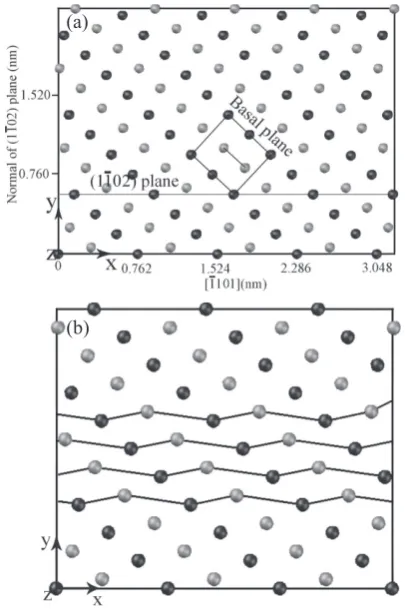
To investigate atomic motion during twinning, a new rect-angular coordinate system was adopted in magnesium crystal lattice, as shown in Fig. 1. In this new coordinate, x-axis is along direction [¯1101], y-axis normal to the twin plane (1¯102)
and z-axis along [11¯20]. The black balls in the lattices stand for the A-type atoms in the well-known stacking sequence ...ABAB... in hcp structure and the gray balls stand for the B-type atoms. Afterwards magnesium crystal lattices were projected from z-axis. Figure 2(a) shows the lattice projection along z-axis. In the projecting drawing, the (1¯102) plane is parallel to waterline. In fact, atomic arrangement in {10¯12} plane is wrinkled, as indicated in Fig. 2(b). As shown in *
Fig. 3(a), wrinkled atom layers above the twinning boundary were labeled as 1, 2, 3, 4..., respectively. In order to investi-gate atomic motion law, atoms in every wrinkled layer were classified into two types: A-layer atoms which were marked using capital letters A, B, C, D, E, F... and B-layer atoms marked using small letters a, b, c, d, e, f....
Atomic displacement vectors during twinning were calcu-lated from the symmetric relationship between twin and its matrix lattice, and from the minimum magnitude required for a displacement8). After calculating, law of atomic motion was summarized.
3. Results and Discussion
According to the symmetric relationship between twin and its matrix lattice, we can calculate the atomic displacement vectors during twinning. As shown in Fig. 3(a), arrows indi-cate atomic displacement vectors during twinning. The black balls at the end of the arrows stand for the new sites of atoms after twinning. For the twinning plane, atoms keep in place in theory. However, the {10¯12} plane is actually wrinkled, i.e., not all atoms are on the same plane, therefore, the B-type at-oms which are near the twinning plane will move to this plane during twinning, as illustrated by arrows in Fig. 3(a). Here, →−vt is used to represent the displacement vector of these atoms. It can be described as:
−
→vt = ∆xti+ ∆ytj+ ∆ztk
= √
3 6 a cos
arctan
√ 3 3 γ
i+
√ 3 6 a sin
arctan
√ 3 3 γ
j+0k ≈0.211ai−0.197aj+0k
(1)
−
→vt = ∆xt2+ ∆y
t2+ ∆zt2 ≈0.289a (1′) Fig. 1 A new rectangular coordinate system in magnesium crystal lattice.
Fig. 2 (a) a projection of the magnesium matrix from the z axis and (b) wrinkled {10¯12} plane in magnesium.
[image:2.595.329.525.68.399.2] [image:2.595.76.261.71.246.2] [image:2.595.67.270.296.601.2]In the twinning region, as illustrated in Fig. 3(a), atoms in the same plane shear a same displacement vector. For atoms in plane A, displacement vector can be obtained as follow:
− →
vA= ∆xAi+ ∆yAj+ ∆zAk
= √3
3 acos arc √ 3 3 γ −c2sin
arctan √ 3 3 γ i
+ √3
3 asin arctan √ 3 3 γ −2ccos
arctan √ 3 3 γ j+ok ≈(0.421a−0.342c)i+(0.395a−0.365c) j+0k
In magnesiun, c = 1.623a, therefore, the above formula can be translated into the following form:
− →
vA ≈ −0.134ai−0.197a j+0k (2a)
− →
vA = ∆xA2+ ∆yA2+ ∆zA2 ≈0.24a (2a′)
For atoms in the plane a, as shown in Fig. 3(a), atomic dis-placement vector during twinning can be expressed by:
−
→va= ∆xai+ ∆yaj+ ∆zak
= √3
6 acos
arctan √ 3 3 γ + √ 3
2 acos
arctan √ 3 3 γ
−c2sin
arctan √ 3 3 γ i
− √
3 6 asin
arctan √ 3 3 γ j+0k ≈(0.842a−0.342c)i−0.197a j+0k ≈0.287ai−0.197a j+0k
(2b)
−
→va = ∆xa2+ ∆ya2+ ∆za2≈0.349a (2b′)
In plane B, all atoms move along the direction [¯1011] during twinning, i.e., all atoms move along x-axis, as shown in Fig. 3(a). The displacement vector can be described as:
− →
vB= ∆xBi+ ∆yBj+ ∆zBk
= √3a cos
arctan √ 3 3 γ −csin
arctan √ 3 3 γ i +0 j+0k
≈(1.264a−0.684c)i+0 j+0k
=0.154ai+0 j+0k (2c)
− →
vB = ∆xB2+ ∆yB2+ ∆zB2≈0.154a (2c′)
For atoms in plane b, the displacement vector can be ob-tained as follow:
−
→vb= ∆xbi+ ∆ybj+ ∆zbk
=
7√3 6 acos
arctan √ 3 3 γ − √ 3 6 acos
arctan √ 3 3 γ + √ 3 2 a cos arctan √ 3 3 − √ 3a cos arctan √ 3 3 γ −csin
arctan √ 3 3 γ 2 i − √ 3 3 asin
arctan √ 3 3 γ j+0k ≈(1.26a−0.684c)i−0.395a j+0k ≈0.15ai−0.395a j+0k
(2d)
−
→vb = ∆xb2+ ∆y
b2+ ∆zb2≈0.424a (2d′)
In a similar way, displacement vector of atoms in plane C can be described as:
−→
vC= ∆xCi+ ∆yCj+ ∆zCk
= √ 3 3 a cos arctan √ 3 3 γ + √ 3 3 acos
arctan √ 3 3 γ + √ 3 6 a cos arctan √ 3 3 γ
− (√3a)2+c2
− √
3 2 acos
arctan √ 3 3 γ
−√3a cos arctan √ 3 3 γ
+csin arctan √ 3 3 γ i− √ 3 6 asin
arctan √ 3 3 γ j+0k
≈(3.504a− (√3a)2+c2−0.684c)i−0.197a j+0k ≈0.02ai−0.197a j+0k
(2e)
−→
vC = ∆xC2+ ∆yC2+ ∆zC2≈0.199a (2e′)
law for these atomic units, we can peer atomic motion law during twinning in magnesium. The displacement vectors abtained above also can be translate as the following from formula 2b, 2c, 2d and 2e respectively:
−
→va≈0.287ai−0.197a j+0k=(0.133ai−0.197a j+0k)+0.154ai (3a)
− →
vB≈0.154ai+0 j+0k=(0i+0 j+0k)+0.154ai (3b)
−
→vb≈0.15ai−0.395a j+0k=(0.004ai−0.395a j+0k)+0.154ai (3c)
−
→vc≈0.02ai−0.197a j+0k=(−0.134ai−0.197a j+0k)+0.154ai (3d)
For magnesium, the elementary twinning dislocation −→btw = 0.154ai, therefore, the above formula also can be expressed as following:
−
→va≈0.287ai−0.197aj+0k=(0.133ai−0.197aj+0k)+−→btw
(3a′)
−
→vB≈0.154ai+0 j+0k=(0i+0 j+0k)+−→btw (3b′)
−
→vb≈0.15ai−0.395aj+0k=(0.004ai−0.395aj+0k)+−→btw
(3c′)
−
→vc≈0.02ai−0.197a j+0k=(−0.134ai−0.197a j+0k)+−→btw
(3d′)
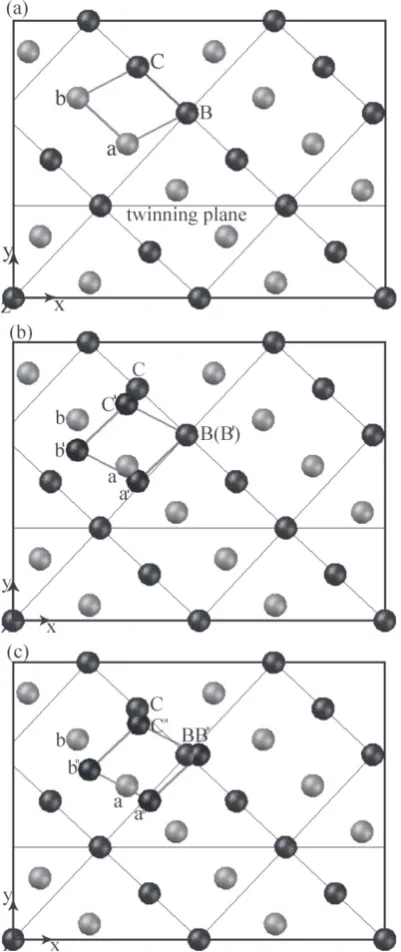
Through the four formulas above, atomic motion in plane a, B, b and C can be divided into two steps: atomic unit com-plete a pre-motion and then move a displacement of 0.154a along [¯1011] direction, as shown in Fig. 4(b) and (c). In Fig. 4(a), a, B, b, c stand for the sites of atoms before twin-ning. During the pre-motion, one can see that the ball B keeps in the original site, a pre-rotation was completed in the atom-ic group unit, and the new atom sites are shown as B , C , b , a in Fig. 4(b). After that, the atomic unit move along twin-ning direction, as shown in Fig. 4(c). It should be pointed out that in the projecting drawing, a ball actually stands for a row of atoms in three-dimensional magnesium lattice. Therefore, the atomic units shown in Fig. 4 are actually quadrangular prism-shaped atomic group units in three-dimensional mag-nesium lattice.
Similarly, displacement vectors of atoms in plane c, D, d and E can be abtained as follwing:
−
→vc=(0.133ai−0.197aj+0k)+2×0.154ai (4a)
−→
vD=(0i+0 j+0k)+2×0.154ai (4b)
−
→vd =(0.004ai−0.395a j+0k)+2×0.154ai (4c)
−→
vE=(−0.134ai−0.197a j+0k)+2×0.154ai (4d) The four formulars above can be also expressed as follow-ing:
−
→vc=(0.133ai−0.197a j+0k)+2−→btw (4a′)
−→
vD=(0i+0 j+0k)+2−→btw (4b′)
−
→vd =(0.004ai−0.395a j+0k)+2−→btw (4c′)
−→
vE =(−0.134ai−0.197a j+0k)+2−→btw (4d′)
From the calculation above, one can see that the second group of atomic unit from the twinning plane to the outer which was made up of atoms in plane c, D, d and E, shears a double motion vector comparing with atomic units made up of atoms in plane a, B, b and C. If the twin thickness is large enough, there will be many groups of atomic unit from the twinning plane to the outer. According to the naming rule shown in Fig. 3(a), atoms in every wrinkled {10¯12} layer was classfied into two layers. If we use nx
X to express the layers
shown in Fig. 3(a), here n standing for the number of wrin-kled {10¯12} layer above twinning plane, X standing for the Fig. 4 Schematic drawings showing step-by-step motion of the atomic
[image:4.595.69.270.71.548.2]atomic layers labled using capital letters and x standing for the atomic layers labled using small letters, the displacement vctors of atoms during twinning will be expressed as follow-ing:
When n is an even number,
−→
vX =(0i+0 j+0k)+n2−→btw (5a)
−
→vx=(0.004ai−0.395a j+0k)+n
2
−→
btw (5b)
When n is an odd number,
−→
vX =(−0.134ai−0.197a j+0k)+n−1
2 −→btw (5c)
−
→vx=(0.133ai−0.197a j+0k)+n+1 2
−→
btw (5d)
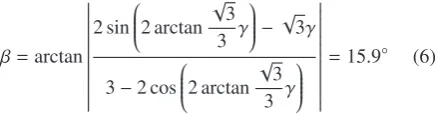
According to the calculation results and analysis above, atomic mtion during twinning in magnesium can be summa-rized geometrically as a pre-rotation of atomic units and a subsequent shearing, as shown in Fig. 5. During twinning, quadrangular prism-shaped atomic group units realized a pre-rotation. The rotation angle can be obtained as 15.9 by the following formular. After that, the quadrangular prism-shaped atomic group units suffered a shearing along twinning direction. One can see in Fig. 5(c) that the atoms in the twin and the atoms in matrix are symmetrical about the twinning plane after the pre-rotation and shearing.
β=arctan 2 sin
2 arctan
√ 3 3 γ
−√3γ
3−2 cos 2 arctan
√ 3 3 γ
=15.9 ◦ (6)
It is should be pointed out that here we just understand the atomic motion law from a geometrical view, and the two-step motion law indicated in this paper is just a artificial division. In realistic deformation twinning, rotation and shear may happen simultaneously. And also, more energy conditions should be considered in realistic deformation.
4. Conclusions
Atomic motion displacement vectors during twinning in magnesium were calculated in this work. Law of atomic mo-tion was summarized from the geometrical view and a new model was proposed for twinning in magnesium and its alloy. During twinning in magnesium and its alloys, atomic motion can be unitized by movement of quadrangular prism-shaped atomic group units geometrically. It was suggested that twin-ning in magnesium and its alloys can be realized by pre-rota-tion and shearing of quadrangular prism-shaped atomic group units. We also pointed out that the motion law indicated in this paper is just an artificial division, more energy conditions should be considered in realistic deformation.
Acknowledgements
This work was supported by National Natural Science
Foundation of China (51501045), Natural Science tion of Guizhou Province (J[2015]2067), Research Founda-tion for Advanced Talents in Guizhou Intsitute of Technology (XJGC20141102) and Foundation of Talent Team (Guizhou(2015)4008).
REFERENCES
1) H. Fan, S. Aubry, A. Arsenlis and J.A. EI-Awady: Scr. Mater. 112 (2016) 50–53.
2) J. Cheng and S. Ghosh: Int. J. Plast. 67 (2015) 148–170.
3) F. Zhang, M. Hao, F.C. Wang, C.W. Tan, X.D. Yu, H.L. Ma and H.N. Cai: Scr. Mater. 67 (2012) 951–954.
4) J.J. He, T.M. Liu, S. Xu and Y. Zhang: Mater. Sci. Eng. A 579 (2013) 1–8.
[image:5.595.72.291.425.482.2]5) D.W. Hou, T.M. Liu, H.C. Chen, D.F. Shi, C.H. Ran and F.S. Pan: Ma-ter. Sci. Eng. A 60 (2016) 102–107.
6) B.S. Wang, R.L. Xin, G.J. Huang and Q. Liu: Mater. Sci. Eng. A 534 (2012) 588–593.
7) X.Y. Zhang, B. Li, X.L. Wu, Y.T. Zhu, Q. Ma and Q. Liu: Scr. Mater. 67 (2012) 862–865.
8) J.W. Christian and S. Mahajan: Prog. Mater. Sci. 39 (1995) 1–157.
9) J. Wang, J.P. Hirth and C.N. Tomé: Acta Mater. 47 (2009) 5521–5530. 10) B. Li and E. Ma: Phys. Rev. Lett. 035503 (2009) 1–4.
11) S. Jiang, T.M. Liu, L.W. Lu, W. Zeng and Z.C. Wang: Scr. Mater. 62 (2010) 556–559.