Munich Personal RePEc Archive
State Control and the Effects of Foreign
Relations on Bilateral Trade
Davis, Christina L. and Fuchs, Andreas and Johnson,
Kristina
Princeton University, Heidelberg University, University of
Massachusetts Boston
16 October 2016
Online at
https://mpra.ub.uni-muenchen.de/74597/
State Control and the Effects of Foreign Relations on
Bilateral Trade
∗
Christina L. Davis, Andreas Fuchs, and Kristina Johnson
October 16, 2016
∗Christina Davis is Professor of Politics and International Affairs, Department of Politics and
Abstract
Powerful states have a long tradition of economic statecraft. Trade relations form a means of
in-fluence (Hirschman, [1945] 1980; Lake, 2009; Flores-Mac´ıas and Kreps, 2013), and alliances support
favorable economic agreements (Mansfield and Bronson, 1997; Long and Leeds, 2006). During the Cold
War, trade patterns closely reflected political relations (e.g. Pollins, 1989; Gowa, 1994; Mansfield and
Bronson, 1997; Keshk, Reuveny and Pollins, 2004; Kastner, 2007; Berger et al., 2013). Governments
today, however, have less leeway for using trade as carrot and stick in foreign policy. Global trade rules
restrict the ability of governments to discriminate among trading partners, and transnational production
further complicates efforts to link trade to foreign policy (Gowa and Mansfield, 2004; Brooks, 2007;
Davis and Meunier, 2011; Carnegie, 2014). What are the channels by which governments induce trade
patterns to follow foreign policy interests in today’s global economy? This paper revisits the question of
whether trade follows the flag and highlights state ownership of firms as a key means for politicization
of trade. Where previous studies examine aggregate trade at cross-national level, we bring new data on
trade flows based on firm ownership.
Anecdotal evidence suggests that governments continue to manipulate trade in response to political
disputes. In 2014, for example, the United States and the EU announced a range of economic penalties
to punish Russian intervention in Ukraine, and Russia retaliated with its own boycotts of agricultural
products from Europe. Politically-motivated trade disruptions, however, are not limited to formal
sanc-tions. In 2012, Telam, Argentina’s official news outlet, reported that ministry officials had asked some
20 companies to cease importing materials from the UK in response to diplomatic tensions over the
Falkland (Malvinas) Islands.1 In Vietnam, the government encouraged manufacturing firms to diversify
their imports away from China partly in response to tensions in the South China Sea.2
1“Falklands dispute: Argentina ‘urges UK import ban,”’BBC News, February 28, 2012.
We argue that government influence over firms makes trade flows more responsive to foreign
rela-tions. State-owned firms align their behavior with state interests because of dependence at the level of
personnel and finances. Where private firms trade on the basis of business interests, state-owned firms
also pursue government interests. As a result, we expect the impact of political relations on trade to be
a function of state control. To test this argument, we compare the responsiveness to political tensions
of bilateral import flows through state-owned enterprises (SOEs) and private firms. By examining how
imports between the same pair of countries are impacted by political tensions conditional on ownership
type of the importing firms, our research design allows a direct test of state control as the mechanism
by which governments influence trade patterns. This is the first study to analyze the impact of state
ownership on bilateral patterns of trade.
Our paper challenges the view that market expectations and business lobbying alone shape
com-mercial relations. Liberal theories emphasize the constraints that arise from the economic interests of
social actors within the state. A large body of research has argued that interdependence encourages
co-operative relations between states under commercial liberalism because governments respond to private
economic interests (Polachek, 1980; Russett and Oneal, 2001; Li and Sacko, 2002; Gartzke, 2007; Lee
and Mitchell, 2012). Instead, we demonstrate the ongoing role of the state in trade discrimination.
Eco-nomic patriotism has been shown to motivate selective liberalization as well as protection (Levy, 2006;
Clift and Woll, 2012; Rickard and Kono, 2014). Berger et al. (2013) find that the positive impact of CIA
interventions on US imports by a country is conditional on the government’s share of the economy. These
studies have begun to highlight the role of the state in politicizing trade, but do not specify the channel
through which governments generate this effect. Our paper finds that states manipulate imports as a tool
of foreign policy through their influence over state-owned firms. State ownership of firms explains how
state-craft. This represents a starkly different logic about economic interdependence in which governments
shape rather than respond to economic interests.
The distinction between SOEs and non-SOEs is increasingly significant to the study of trade politics.
After the widespread privatizations of the 1980s and 1990s, the governments of a number of emerging
countries—China, Brazil, Indonesia, Russia, South Africa, and Venezuela among them—have reversed
course and taken steps to preserve or expand the presence of state-owned enterprises in key sectors
(World Bank, 2014). SOEs now occupy the ranks of the largest firms. The world’s thirteen largest
oil companies, largest bank, and largest natural gas company are all state-owned or state-supported.3
Over ten percent of the Forbes Global 2000 list of the largest publicly-traded companies are
majority-owned SOEs, the combined sales of which, at US$3.6 trillion, amount to more than the Gross National
Income (GNI) of Germany and total almost six percent of world GDP (Kowalski et al., 2013, p.20).4 As
governments in a number of emerging countries have actively supported the expansion of SOEs abroad
in recent years and taken steps to foster national “champions,” concerns about financial and political
advantages to state-owned and state-supported firms have featured prominently in trade and investment
dialogues—recently as a major obstacle in negotiations over the Trans-Pacific Partnership Agreement.
We focus our analysis on two important cases: China and India. Both are global players with active
foreign policy agendas whose economies rank among the largest in the world.5 The potential for China
3See “The Visible Hand,”The Economist, January 21, 2012.
4Figures are from 2010/2011 and count only majority government-owned enterprises as SOEs.
5In 2013, China was the world’s second largest economy and India the tenth, as determined by GDP.
Together, these countries accounted for 13.0 percent of world exports and 12.7 percent of world imports
in 2012, see http://www.wto.org/english/res_e/statis_e/its2013_e/its2013_
to wield its growing economic power as tool of foreign policy is readily apparent (Flores-Mac´ıas and
Kreps, 2013; Kastner, forthcoming). China made waves in 2010 when it cut off exports of rare earths
minerals to Japan in response to a territorial dispute over the Diaoyu/Senkaku Islands,6and again when it
halted fresh salmon imports from Norway after the Nobel Committee awarded its Peace Prize to Chinese
human rights activist Liu Xiaobo. Fuchs and Klann (2013) find that countries whose leadership receives
the Dalai Lama suffer a temporary reduction of exports to China. India offers a useful comparison with
China to test the argument within a different context of domestic institutions and geopolitical relations.
Critical for our study is the fact that both retain high levels of state ownership in some sectors alongside
other sectors with little state involvement. Chinese and Indian firms comprised the largest numbers of
SOEs on the Forbes Global 2000 list in 2013, and they also have vibrant private-sector economies and
leading private firms.7 We leverage this variation within each country to conduct parallel analysis for
China and India that compares the responsiveness of imports to political relations between SOEs and
privately-owned firms.
Whereas much of the literature on conflict and interdependence focuses on militarized disputes
(Pollins, 1989; Morrow, Siverson and Tabares, 1998; Morrow, 1999; Long, 2008; Gowa and Hicks,
2016), we also examine lower-level frictions such as threats, complaints, and diplomatic spats. Issues
that fall well short of war and even appear minor in isolation may have a larger cumulative effect on
6 In line with our argument, Fisman, Hamao and Wang (2014) find that at the time of the incident,
Chinese sectors with high SOE intensity reduced their trade with Japanese firms more than sectors
dom-inated by private firms.
7 SOEs comprise the majority of firms on the list for both China (90 of 136 firms) and India (31
of 56 firms). Included in the SOE count for China are subsidiaries with SOE parents. See http:
//www.forbes.com/global2000/list/ and Naazneen Karmali, “India faces reality check in
interstate relations. We measure political relations by negative political events and voting alignment in
the United Nations General Assembly (UNGA). Across these different measures of relations, we expect
more negative political relations to correspond with lower imports, with the most pronounced effect in
import flows through SOEs.
Our statistical analysis of annual imports by China and India from the early 1990s through 2012
demonstrates that negative bilateral events correspond with a reduction in imports. The relationship is
stronger for imports by firms in the state-owned sector of the economy relative to privately-owned firms.
The strength and statistical significance of the findings varies across the different measures of political
relations, but is generally robust to alternative specifications.
Our analysis of economic statecraft in emerging markets and our use of new trade data disaggregated
by firm ownership make an original contribution to the literature. Our research indicates that economic
statecraft remains relevant in the current era of globalization, and examines state ownership as a
mecha-nism that has not been previously studied in the literature on economic interdependence. Trade patterns
respond to political relations in areas where governments maintain the capacity to manipulate trade.
1
State Control and Non-commercial Interests in Trade
The exercise of economic statecraft has distributional consequences both at home and abroad. The
objective is to punish or reward another state for its policy position. Denying key resources or market
opportunities harms the target state, while preferential access offers benefits. Using economic policy
to achieve foreign policy goals, however, can produce negative externalities for the domestic market as
firms are forced to move away from the market equilibrium. Indeed, the domestic costs of intervention
interdependence as a tool for states to signal resolve in conflict bargaining (Martin, 1992; Gartzke, Li
and Boehmer, 2001; Reed, 2003). Despite possible foreign policy gains, economic decisions dictated by
geopolitical interests may not coincide with the best economic outcomes.
Several studies find that harm to economic actors at home limits the use of economic statecraft
(Skalnes, 2000; Davis, 2008/9). Even when retaliation occurs in the context of WTO-authorized
en-forcement against a violation by a trade partner, the decision to raise tariffs encounters opposition from
home industries that would suffer from the actions. As the United States and European governments
de-bated sanctions against Russia for its actions in Ukraine in 2014, the harm to business interests loomed
as a major concern.8 State ownership of enterprises addresses this problem by lowering domestic
oppo-sition to letting foreign policy influence business decisions. Close integration with the state in terms of
personnel, funding and goals hard-wires business actors to follow government interests. Market
compe-tition pushes for decisions on a commercial basis, but state intervention introduces additional decision
criteria that call on economic actors to incorporate non-commercial goals.9
8Alison Smale and Danny Hakim, “European Firms Seek to Minimize Russia Sanctions,”New York
Times, April 26, 2014.
9WTO rules reflect this tendency, admonishing that state-trading enterprises must make purchases
“solely in accordance with commercial considerations” (Article XVII of the General Agreement,
avail-able at http://www.wto.org/english/docs_e/legal_e/gatt47_e.pdf). While the
manipulation of economic policies to serve political interests clearly challenges the non-discrimination
rules of the WTO, the explicit statement highlights that state-controlled enterprises are most subject to
1.1
State Ownership as Mechanism for Politicization of Trade
How does state ownership facilitate the politicization of trade? We highlight three pathways by which
state ownership influences firm behavior: firm mission, personnel, and financing. First and most
funda-mentally, the purpose of state-owned enterprises is to advance the goals of the state. While SOEs can
and increasingly do operate with commercial considerations, they serve primarily as conduits through
which the government may intervene in the economy to serve particular social, industrial, or political
objectives in the national (or narrow government) interest. SOEs were historically established to fulfill
socioeconomic policy objectives, such as infrastructure building, energy and food provision, and health
care, and they remain tasked today with providing public services. SOEs also may serve as tools to
pro-mote industrial policies when governments support SOEs in sectors the government deems “strategic”
for infant industry development. Given that fulfilling political imperatives is one of the primary raisons
d’ˆetre of these firms, we should expect them to pose less resistance to political demands than private
firms.
Second, close ties between the state and state-owned enterprises are clearly visible in corporate
gov-ernance structures. Unlike in private firms, where managers generally report to an independent board of
directors, in the case of SOEs, directors are regularly determined by political appointment (Vagliasindi,
2008). Blurring the lines between business and politics further, top SOE managers are often themselves
political insiders; their performance as corporate leaders impacts not only their position with the firm
but also their position in the political hierarchy. Business managers in state-owned enterprises thus often
view their responsibilities as two-fold—to advance the interests of the firm and the state—and may suffer
consequences for failing to do so.
Third, financial support also provides leverage over SOEs. These firms do not, and in many cases
stag-gering. For example, subsidy payments to just three SOEs in Malaysia averaged four percent of GDP
between 2003 and 2006 (World Bank, 2014, p.11). Much scholarly and policy research has documented
the inefficiencies of state-backed firms, especially relative to private firms (e.g. Boardman and Vining,
1989; World Bank, 1995) but also the range of advantages they enjoy over private firms, including
favor-able taxation, subsidies, and preferential access to financing (DeWenter and Malatesta, 2001; Capobianco
and Christiansen, 2011). Government bailouts of financially under-performing SOEs are commonplace
in many countries. Even where state-owned firms achieve competitiveness, they owe much of their
success to privileged access to capital and other regulatory benefits.
The interactions between SOEs and policymakers represent mutual dependence. Just as the
bu-reaucratic channels linking SOEs directly to the state enhance government oversight, they also provide
avenues for managers to bargain for compensation when state policy adversely impacts firm profits or
operations. Indeed, SOEs enjoy higher levels of policy influence than private firms (Aisbett and
McAus-land, 2013; Baccini, Impullitti and Malesky, 2013). But the political influence of SOEs that may win
them special deals is unlikely to be used in opposition to government directives. Given their subsidized
operations and ability to negotiate for compensation, SOEs are less sensitive than non-SOEs to
distribu-tional costs arising from the manipulation of economic policies. They have less need to object to state
influence that injects non-commercial criteria for business. Instead, dependence on the state requires
responsiveness to government requests.
The cooperation of firms is important for two means of politicizing trade. Most directly, the firms
can act as the agent of the state to shift import sourcing or cancel export contracts in response to bilateral
tensions. Indirect support is also important—often governments may intervene through the actions of
customs agents to delay or block import and export shipments. Such actions would normally provoke
extent that SOEs tolerate such inconveniences, they support the politicization of trade policy.
1.2
State-Owned Enterprises in China and India
Turning to our countries of focus—China and India—we see ample evidence of the three primary
mecha-nisms posited to link state ownership of firms with the politicization of trade: service to policy objectives,
government influence over personnel decisions, and access to state-sponsored subsidies.
In both China and India, most SOEs derive their origins from state-sponsored efforts to manage
the economy and enhance social welfare. In China, SOEs were tasked with rebuilding the country’s
infrastructure following the Civil War and served to a large extent as the sole providers of goods, services,
and jobs for the next three decades. In support of the government’s effort to mitigate social unrest,
SOEs were forced to maintain burdensome employment levels and offer social welfare services like
schools and hospitals—requirements that persist to a more limited degree even today (Steinfeld, 2000).
In India, the state-owned Food Corporation of India (FCI), for example, was established in 1965 to ensure
price supports for farmers and implement the distribution and stock-piling of grains for national food
security. The Indian government describes the role of state-owned enterprises (known as “public sector
undertakings” (PSUs)) on its official portal as the following: “PSUs provide leverage to the Government
(their controlling shareholder) to intervene in the economy directly or indirectly to achieve the desired
socio-economic objectives and maximize long-term goals.”10
SOE management is subject to close government oversight. In China, the State-Owned Assets
Su-pervision and Administration Commission (SASAC) is charged with the appointment of the leadership
of the 121 central SOEs, but the actual power to appoint managers at the largest 53 SOEs lies with the
10 See http://www.india.gov.in/spotlight/spotlight_archive.php?id=78;
Central Organization Department (COD), the head of which is a member of the Politburo (Brø dsgaard,
2012). In almost all centrally-managed Chinese SOEs, senior members of the Chinese Communist Party
(CCP) occupy the three top leadership positions—CEO, Chairman and Party Secretary (Pei, 2006). In a
number of cases, the CEO and Party Secretary are the same person. Such close ties have led observers
at the meetings of the World Economic Forum in Davos to note that “Chinese delegates from both
[gov-ernment and business] tend to have the same point of view, and even the same patriotic talking-points.”11
Below the central level, local equivalents of the COD and SASAC have similar influence over leadership
appointments of locally-owned SOEs. Since local leaders care about promotions, they face incentives
to abide by the political demands of the central government and influence the decision-making of local
SOEs accordingly.12 In India, the responsibility for managing SOEs falls with the relevant ministries,
de-termined by industry, and the Department of Public Undertakings (DPU). The government has recently
taken steps to allow some SOEs more independence in corporate decision-making, but ministries
con-tinue to control major decisions such as the appointment and removal of the CEO. Even where Boards of
Directors are empowered to make strategic decisions, board members are beholden to strict guidelines
set by the DPU and are frequently political insiders themselves (World Bank, 2014, p.183-184).
In both countries, SOEs are heavily subsidized by the state and receive favorable access to credit.
In China, the government spent an estimated US$300 billion (in nominal dollars) on the biggest SOEs
between 1985 and 2005 in the form of direct payments, cheap financing, and subsidized inputs. Between
2001 and 2011, US$28 billion flowed to the auto parts industry alone, with another US$10.9 billion
promised by 2020 (Haley and Haley, 2013). Over 75 percent of the country’s capital, largely provided
11“The Rise of State Capitalism,”The Economist, January 21, 2012.
12Shih, Adolph and Liu (2012) have shown that promotion systems are dominated by the immediate
by state-owned banks, flows to SOEs.13 Previous research provides direct and indirect empirical support
for a bias in bank lending behavior in favor of SOEs (e.g. Wei and Wang, 1997; Lu, Zhu and Zhang, 2012;
Jarreau and Poncet, 2014). In India, the government approved in 2012 an expensive bailout plan for 46
SOEs it deems “sick” (severely underperforming), which account for about 20 percent of all
centrally-owned SOEs.14 For these firms, refusing to comply with political demands could mean a reduction in
financial benefits.
We hypothesize that economic statecraft is contingent on government capacity to control economic
actors. Completely free markets are unlikely to show much correlation between political relations and
import decisions. In free-market economies, states must adopt explicit policies to constrain markets,
such as imposing legal restrictions on trade to force compliance by private actors. In contrast, where the
state maintains more control over firms, politicizing imports can be a quick and informal process. For
the reasons outlined above, firms owned by the state are the most likely to be responsive to government
preferences. Looking within China and India, we expect to observe a stronger correlation between
political relations and imports in the state-owned sector of the economy compared to the private sector.
2
Measuring State Control and Political Relations
2.1
Imports by Ownership Type: State-Owned Versus Private Enterprises
To analyze the effect of political relations on import flows as a function of state control over economic
activity, we need separate data on the trading activities of the state-controlled and private sectors of
the economy. For our analysis of Chinese imports, we obtained data on trade by enterprise ownership
13John Lee, “China’s Corporate Leninism,”The American Standard, May/June 2012.
type from the General Administration of Customs through Customs Info, a government-owned company
licensed to distribute official customs data (http://www.customs-info.com/). The data include
the annual value of bilateral imports by ownership category.15 For our purposes, the relevant categories
are private enterprises and SOEs. SOEs are defined as enterprises in which the government holds the
majority equity share and include both centrally- and locally-owned enterprises. We are thus able to
directly measure the annual value of China’s imports from a partner country through state-owned firms
versus private firms.
For India, we combine Prowess firm-level data from the Centre for Monitoring the Indian Economy,
an Indian think-tank, and import data from UN Comtrade.16 The Prowess database includes data on
total assets, sector, and ownership type for 27,000 companies, which together comprise 75 percent of all
corporate tax revenue. We define as SOEs those enterprises categorized as “Central Government,” “State
Government,” or “Central and State Government” in Prowess.17 Unfortunately, statistics on bilateral
trade by firm ownership type are not available in Prowess. We therefore construct variables that proxy
15The nine ownership categories are as follows: state-owned enterprise, sino-foreign contractual joint
venture, sino-foreign equity joint venture, foreign-owned enterprise, collective enterprise, private
enter-prise, privately or individually-owned business, enterprise with customs declaration authority but without
permission to trade, and “other.” Importantly, an enterprise categorized as “private” may have the
gov-ernment as a minority shareholder.
16 Trade data are accessed using the World Bank’s World Integrated Trade Solution (WITS) software
(http://wits.worldbank.org; accessed 28 October 2013; ISIC Rev. 3 classification). For
de-tails on the Prowess database, see http://prowess.cmie.com/; accessed April/May 2012 and
November 2013.
17 We also include in this category enterprises classified as “State and Private Sector” and “Joint
for imports through state-owned and private enterprises using the following procedure: we first calculate
the share of assets held by SOEs in each sector; we then multiply the sector share by the value of
imports for the sector (from UN Comtrade) for a particular bilateral trade relationship; finally, we sum
the resulting values across sectors to get an estimate of the annual value of imports flowing through
SOEs for the dyad. We repeat the procedure for each partner country. Private-enterprise import flows are
calculated by the same method.18
Our procedure for the India data assumes that SOE shares in total assets are equivalent to SOE shares
in trade, which is unlikely to be true in reality. The potential for over- or under-estimating trade will
not affect our estimation results, however, as long as there are not systematic differences across trade
partners. Moreover, we do not face this concern for the China analysis where we were able to obtain
official data on bilateral trade flows disaggregated by firm ownership.
Figure 1 demonstrates the contribution of SOEs and private enterprises to Chinese and Indian imports
over the sample period. The share of China’s imports comprised by SOEs has fallen over the last decade
with privatization, while the private sector share of trade has risen correspondingly. The decline in SOE
shares has leveled off recently, and they remain substantial at about 30 percent of imports. The pattern
for India has been more stable over time, and about 40 percent of imports are estimated to have been
18 To understand how we construct our proxies, consider imports to India from Poland. In 2000,
India imported US$ 16.5 million worth of electrical machinery and apparatus from Poland (ISIC Rev.3,
division 31). In this sector and year, SOEs held 12.1 percent and private enterprises held 77.4 percent of
total assets. Multiplying the trade values by the asset shares, we estimate that US$2.0 million worth of
imports from Poland entered India through SOEs and US$12.7 million through private enterprises. We
repeat this procedure for all ISIC divisions covered and sum across sectors to obtain values for SOE and
through SOEs.19 0 10 20 30 40 50 60 70 80 90 100
Share in total imports (in %)
1990 1995 2000 2005 2010 Year
Imports SOEs Imports PEs
China 0 10 20 30 40 50 60 70 80 90 100
1990 1995 2000 2005 2010 Year
Imports SOEs Imports PEs
[image:17.612.105.510.110.404.2]India
Figure 1: Trade by Enterprise Ownership Type: Imports of SOEs and private enterprises as a share of total imports (1991-2012; data for China begin in 1993; data for India are estimates).
One challenge to making inferences about state ownership is the strategic nature of government
decisions that determine state ownership; SOE intensity is not randomly allocated across sectors. Energy
and resource sectors experience the highest levels of state ownership because of their importance to both
economic growth and security. The decisions about ownership reflect state priorities toward the sector
in general. This mitigates the endogeneity problem for our research question because we leverage the
variation in political relations with specific trading partners, which is largely independent of ownership
decisions for different sectors.
2.2
Political Relations
While bilateral trade is objectively quantifiable, political relations between countries are difficult to
mea-sure. We build on indicators common in the literature—negative political events and voting alignment in
the United Nations General Assembly (UNGA)—for both China and India.20
Our first two measures quantify the tensions between China, India, and their trading partners using
bilateral events data. We use the Global Data on Events, Location and Tone (GDELT) data from Leetaru
and Schrodt (2013). The dataset, considered the most comprehensive of its kind, uses a machine coding
system to classify daily reports of events from eleven global news outlets into categories of the actors
involved in the event.21 Each event is weighted by the corresponding “Goldstein score,” a value between
-10 and 10 that measures the expected severity, based on its type (Goldstein, 1992). For example, a use
of military force would be weighted more heavily than an expulsion of another country’s diplomats, but
expelling diplomats would be weighted more heavily than a verbal condemnation of another country’s
actions. We sum the severity-weighted number of negative events to create a single annual observation
and take the log to smooth the distribution.
In contrast to previous research using negative event counts (e.g. Davis and Meunier, 2011; Li and
20In the robustness check section below, we also introduce a unique “China-specific” measure.
21 The data is produced from Textual Analysis by Augmented Replacement Instructions (TABARI)
system for machine coding based on pattern recognition. It has been found to be as accurate as human
coders. See, for example, Best, Carpino and Crescenzi (2013). The data base has been criticized for
listing events without naming actors and for its reliance on English-language media sources (Weller and
McCubbins, 2014). To address the former, we exclude events with missing actors. The latter concern
is mitigated by the use of country-fixed effects in our empirical analysis. We also show results with a
Liang, N.d), we do not simply use the total number of events. We restrict our negative event counts to
actions performed by a partner country upon China and India, respectively. This approach allows us to
mitigate endogeneity concerns as these events are arguably more exogenous than actions where China
(or India) itself is the sender. Specifially, our first indicator captures events involving a government
(non-military) actor of a country that trades with China (or India), while the second captures events
involving a military actor to determine whether militarized disputes provoke a stronger reaction than
diplomatic events. This comes with the advantage that, by only using negative events that involve a
government (or military) actor, we discard pure business events, such as business meetings or mergers
and acquisitions, which are not exogenous to our import measure. Moreover, a second advantage is
that, with this approach, we also discard negative events with a country’s opposition or non-state actors
such as NGOs as main actor as such events should lead to substantially smaller (or no) reactions from
governments. The correlation between our two measures is 71.5 percent.22
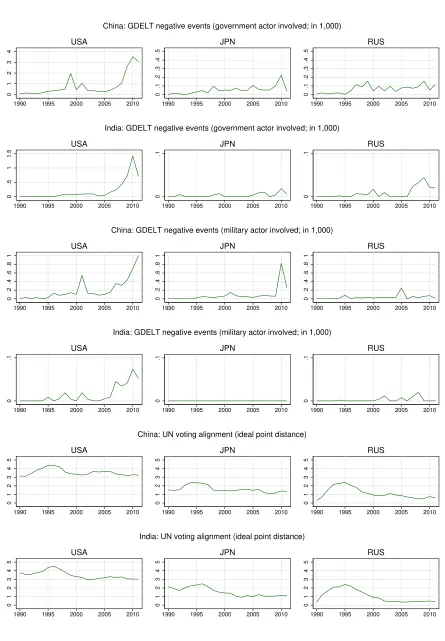
Figure 2 plots the weighted number of negative events that occurred after 1990 between China (first
and third panel) and India (second and fourth panel) with three major partners—the United States (left),
Japan (center) and Russia (right). The events measure here is shown in its unlogged form in units of 1,000
events, and the range of the plots has been adjusted to match the observed variance by country. Prominent
events that have caused bilateral tensions are visible in the data. For example, the US bombing of the
Chinese embassy in Belgrade and the Hainan Island incident, during which the Chinese government
detained the crew of a US Navy Intelligence plane, are reflected in the spikes in negative events in 1999
22The correlation of these measures with the total event count that includes all actors is 90.8 and 81.7
percent, respectively. The correlation of this total event count based on GDELT with a total event count
based on the widely-used King and Lowe (2003) data is 75.1 percent. We do not use the King and Lowe
and 2001 respectively. Similarly, the Japanese government’s 2010 detention of a Chinese fishing vessel
and its captain near the disputed Diaoyu/Senkaku Islands mentioned in the introduction is reflected in
the data. Turning to India, the spikes in both government and military tensions with the U.S. in 1998, for
example, correspond to the events surrounding India’s nuclear weapon tests in Pokhran.
Our third relations variable measures the distance in foreign policy orientation between China or
India and each partner country. Bailey, Strezhnev and Voeten (forthcoming) use UNGA voting data
to construct an annual measure of each country’s ideal point along a single dimension that captures its
positionvis-`a-visa “US-led liberal order.” The resulting scores are differenced to obtain dyadic measures
of the distance between a pair of states in terms of their foreign policy preferences. The measure uses
resolutions that were identical over time to “bridge observations,” allowing researchers to separate out
shifts in state preferences from changes in the UN agenda and make more meaningful comparisons of
state preferences over time. Measuring the gap in preferences between pairs of states by the difference
in their ideal points rather than by the difference in their voting records helps to eliminate noise and
facilitate better comparisons of states’ relative foreign policy orientations.
Figure 2 also plots the ideal point distances between China (fifth panel) and India (sixth panel) and
the U.S., Japan, and Russia. Mirroring divisions between the United States and its allies on one hand,
and the rising powers on the other (see Voeten, 2000), China’s and India’s distance to the three partner
countries looks similar at first sight. Still, there are some striking differences. For example, while the
distances between China and the U.S. and China and Japan remained relatively stable from the
mid-1990s through 2010, India bridged some of its distance with these countries between the mid-mid-1990s and
early 2000s. The plots also reflect the increasing proximity of both China and India with Russia. By
2010, both countries were closer to Russia than to either the U.S. or Japan.
relationships. China’s relations are worst with the United States according to all three measures. Taiwan
occupies the second spot for China in terms of both negative government events and military events but
fails to appear in UNGA voting because it is not recognized as a sovereign country by the United Nations.
Japan, South Korea, and Russia feature prominently on both events lists for China, while Pakistan, the
U.S., Sri Lanka and China are among the countries that experienced the most negative events with India.
Not surprisingly, the countries that experience the fewest events with either China or India are small,
geographically distant countries that would be unlikely to have strong engagement with either country
diplomatically or militarily. Thirty-nine countries were engaged in no government or military events
with China over the sample period, and ninety-seven did not experience any events with India. Moving
to UNGA voting, the patterns for China and India are quite similar; the same ten coutries comprise the
list for both countries with slight differences in order. After the U.S., the countries with which both
China and India are most distant are Israel (average score of 3.1 for China and 3.0 for India) and the UK
(2.6 for China and 2.5 for India). On the flip side, China is most closely aligned with Pakistan (.20) and
0
1
2
3
4
1990 1995 2000 2005 2010 USA 0 .1 .2 .3 .4 .5
1990 1995 2000 2005 2010 JPN 0 .1 .2 .3 .4 .5
1990 1995 2000 2005 2010 RUS
China: GDELT negative events (government actor involved; in 1,000)
0
.5
1
1.5
1990 1995 2000 2005 2010 USA
0
.1
1990 1995 2000 2005 2010 JPN
0
.1
1990 1995 2000 2005 2010 RUS
India: GDELT negative events (government actor involved; in 1,000)
0 .2 .4 .6 .8 1
1990 1995 2000 2005 2010 USA 0 .2 .4 .6 .8 1
1990 1995 2000 2005 2010 JPN 0 .2 .4 .6 .8 1
1990 1995 2000 2005 2010 RUS
China: GDELT negative events (military actor involved; in 1,000)
0
.1
1990 1995 2000 2005 2010 USA
0
.1
1990 1995 2000 2005 2010 JPN
0
.1
1990 1995 2000 2005 2010 RUS
India: GDELT negative events (military actor involved; in 1,000)
0 1 2 3 4 5
1990 1995 2000 2005 2010 USA 0 1 2 3 4 5
1990 1995 2000 2005 2010 JPN 0 1 2 3 4 5
1990 1995 2000 2005 2010 RUS
China: UN voting alignment (ideal point distance)
0 1 2 3 4 5
1990 1995 2000 2005 2010 USA 0 1 2 3 4 5
1990 1995 2000 2005 2010 JPN 0 1 2 3 4 5
1990 1995 2000 2005 2010 RUS
[image:22.612.83.528.68.709.2]India: UN voting alignment (ideal point distance)
China: Negative events (government) China: Negative events (military) China: UNGA voting (ideal point distance)
1 United States of America 1 United States of America 1 United States of America 2 Taiwan (China) 2 Taiwan (China) 2 Israel
3 Papua New Guinea 3 Japan 3 United Kingdom 4 United Kingdom 4 South Korea 4 Palau
5 Australia 5 Russia 5 Micronesia Fed States 6 South Korea 6 Philippines 6 France
7 Russia 7 Vietnam 7 Canada
8 France 8 Pakistan 8 Marshall Islands
9 India 9 Myanmar 9 Belgium
10 Philippines 10 United Kingdom 10 Netherlands
India: Negative events (government) India: Negative events (military) India: UNGA voting (ideal point distance)
1 Pakistan 1 Pakistan 1 United States of America 2 United States of America 2 Sri Lanka 2 Israel
3 China 3 United States of America 3 United Kingdom
4 Venezuela 4 China 4 France
5 Sri Lanka 5 Myanmar 5 Micronesia Fed States 6 Afghanistan 6 American Samoa 6 Palau
7 United Kingdom 7 Bangladesh 7 Canada
8 Bangladesh 8 Russia 8 Marshall Islands
9 Nepal 9 Israel 9 Belgium
[image:23.612.102.684.126.447.2]10 Saudi Arabia 10 United Arab Emirates 10 Netherlands
Table 1:Bad Relations: List of countries with the worst relations with China and India by measure of political relations (1990-2012). Note that we do not observe UN voting alignment with Taiwan (China) because it is not a member of the United Nations.
3
Empirical Analysis
To test our hypothesis, we build on the gravity model of trade, the “workhorse” of the empirical trade
literature (e.g. Tinbergen, 1962; Anderson and van Wincoop, 2003). Trade flows are expected to increase
with both the exporter’s supply and the importer’s demand of goods, proxied by exporter and importer
GDP respectively, and to decrease with trade costs. Geographic distance is used as a proxy for trade costs,
and additional variables, such as common language, measure friction. We model import flows controlled
by state-owned enterprises (SOEs) and those controlled by private enterprises using seemingly unrelated
estimations.23 This approach facilitates our comparison of the relationship between political relations
and imports across the two categories of firm ownership.
Specifically, we estimate the following system of equations:
importsSOE, ijt=β0+β1relationsijt−1+β2GDPijt
−1+β3Xijt−1+νj+τt+εijt (1)
importsprivate,ijt= ˜β0+ ˜β1relationsijt−1+ ˜β2GDPijt−1+ ˜β3Xijt−1 + ˜νj+ ˜τt+ ˜εijt (2)
whereimportsSOE and importsprivate represent (logged) import flows between country i (China or
India) and its trading partner j that are under the control of SOEs or private enterprises, relations
rep-resents each of our three measures of political relations, GDPdenotes the (logged) product of exporter
and importer GDP in constant 2005 US$, X represents a vector of control variables,ν represents a set
of partner-country dummies,τ represents a set of year dummies, andεis the error term. Standard errors
are clustered on partner country. To test our hypothesis, we include each measure ofrelationsseparately.
All measures are logged.
Note that our specification is identical to an estimation of OLS equation-by-equation since both
equations use the same set of regressors. Seemingly unrelated estimations enable us to test whether
the coefficients on our political relations variables differ between SOE and private-enterprise trade. We
expect that political relations play a larger role in trade controlled by SOEs than in trade controlled by
private enterprises. Since larger values correspond with more negative relations, our formal expectation
isβ1 <β˜1.
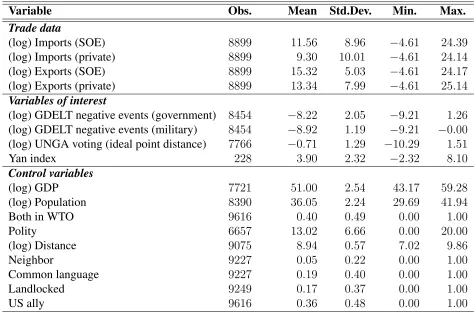
We include GDP from the standard gravity model with data from World Development Indicators
(WDI). Because we employ partner-country fixed effects, we exclude geographic distance and other
time-invariant determinants of bilateral trade flows. Within our set of control variablesX, we first include
market potential, which we proxy as the (logged) product of exporter and importer population size, with
data from WDI. We also add a dummy variable that takes a value of 1 if both countries are members of
the WTO for the majority of a given year (data from the WTO website). Because trade relations have
been found to depend on regime type (see, for example, Mansfield, Milner and Rosendorff, 2000; Aidt
and Gassebner, 2010; Manger and Pickup, 2016), we include the polity2 variable from the Polity IV
Project (Marshall, Gurr and Jaggers, 2013). Polity is a 21-point index, where the largest value refers to a
fully institutionalized democracy.
Finally, to mitigate endogeneity concerns, we lag all covariates by one year. Our analysis begins in
1993 for China, the first year for which Customs Info provides data by ownership type and 1991 for
India, when the country entered its period of economic liberalization. All estimations extend through
2012, which is the limit of our data on trade flows by firm ownership. Table 4 in Online Appendix A lists
3.1
Results for Chinese Imports
Table 2 presents our results for imports to China. Each column shows the results for one of our three
measures of political relations. The upper half of the table displays the results for SOE trade; the lower
half shows the corresponding results for private-enterprise trade.
Beginning with column 1, the coefficient for negative government events between China and its trade
partner has a significant effect to lower SOE imports. There is no significant effect on private-enterprise
trade, and a Wald test (final row of Table 2) shows that the observed difference in the political relations
coefficients for SOE and private trade is statistically significant at the one-percent level. Moreover,
the substantive effects are large; a one-percent increase in our government events index decreases SOE
imports by 0.12 percent. To give an example, Japan’s retention of a Chinese fishing vessel near the
Diaoyu/Senkaku Islands in 2010 registered an increase in negative events of 218 percent; our model
would predict a corresponding 26.2 percent drop in SOE imports from Japan between 2010 and 2011.
In column 2, we see that negative military events produce similar adverse impact on SOE imports.
A one-percent increase in military events decreases SOE imports by 0.16 percent. The coefficient on
negative events is again insignificant for private enterprises. However, the corresponding Wald test does
not show a statistically significant difference between SOEs and private enterprises for military events.
Turning to UN voting (column 3), we again find the effect of political relations on imports to be limited
to SOEs and a statistically significant difference between state and private enterprises, as shown by the
Wald test. A one-percent increase in the ideal point distance between China and a given trade partner
reduces SOE imports by 0.43 percent. Summing up, we find statistically significant effects of political
tensions only on SOE imports. Our findings support the hypothesis that diplomatic tensions have a larger
impact on imports in the state-owned sector of the economy than on private enterprises.
(1) (2) (3)
Imports Imports Imports
Negative events Negative events UNGA voting (government) (military) (ideal point distance) SOE trade
(log) Political relations -0.1201*** -0.1554*** -0.4294*** (0.0400) (0.0360) (0.1089) (log) GDP 1.6200* 1.6353* 1.2317
(0.8330) (0.8399) (0.8718) (log) Population 5.0671** 4.9591** 4.6810** (2.0410) (2.0350) (1.9455) Both in WTO 0.6942 0.7260 0.6527
(0.5784) (0.5768) (0.6028)
Polity 0.0285 0.0303 0.0477
(0.0541) (0.0541) (0.0552) Private enterprise trade
(log) Political relations 0.0593 -0.1278 -0.1124 (0.0575) (0.0944) (0.1344) (log) GDP 2.0588** 2.0289** 2.3234** (1.0250) (1.0273) (1.1232) (log) Population 3.6541** 3.6425** 3.3153* (1.7701) (1.7531) (1.7218) Both in WTO 0.6147 0.5992 1.0065
(1.1017) (1.0986) (1.1302) Polity -0.0589 -0.0622 -0.0683
(0.0572) (0.0571) (0.0579) Number of observations 3003 3003 2973
[image:27.612.87.529.190.577.2]Wald test (p-value) 0.004 0.759 0.034
levels in all equations. Partner-country GDP is a robust predictor of trade through private enterprises.
Polity and WTO membership do not achieve statistical significance at conventional levels in any of the
models.
3.2
Results for Indian Imports
Columns 1-3 of Table 3 present our results for Indian imports. We find that negative events have a
significant impact to reduce imports for both SOE and private-enterprise trade, which is significant at the
one-percent level for events initiated by government and those initiated by military actors. In line with
our hypothesis, the coefficients on negative events are more pronounced for SOE imports. A one-percent
increase in negative government events produces a 0.41 percent decrease in imports for SOEs, while
the comparable effect for negative military events is 0.54 percent. The Wald tests indicate a significant
difference between SOE and private-enterprise imports for military events but not for government events.
For the alternative measures of political relations, we observe a negative effect of UN ideal point distance
for SOEs. In support of our hypothesis, the Wald test shows the difference in the coefficients to be
statistically significant at the five-percent level. Overall, the state-owned sector of the economy appears
to be more responsive to bad political relations than private companies.
Turning to the control variables, the effect of GDP is positive and significant at least at the
five-percent level for both SOEs and private trade in all models. Population is also positive in all models
but only achieves statistical significance in one SOE specification and only at the ten-percent level. The
coefficients on WTO and polity are positive across all models for both SOEs and private enterprises but
never achieve significance at conventional levels.24
24 Contrary to the fixed-effects results, the OLS models excluding country-fixed effects presented in
(1) (2) (3)
Imports Imports Imports
Negative events Negative events UNGA voting (government) (military) (ideal point distance) SOE trade
(log) Political relations -0.4058*** -0.5383*** -0.2529** (0.0645) (0.0859) (0.1245) (log) GDP 2.7808** 3.0373*** 2.8118** (1.1265) (1.1289) (1.3232) (log) Population 4.5555* 4.3917 4.2704
(2.6542) (2.6919) (2.6816) Both in WTO 0.4088 0.5317 0.6146
(0.5797) (0.5843) (0.5786)
Polity 0.0302 0.0293 0.0293
(0.0746) (0.0761) (0.0780) Private enterprise trade
(log) Political relations -0.3906*** -0.4657*** -0.1520 (0.0556) (0.0865) (0.1241) (log) GDP 2.8516** 3.0897*** 2.7590** (1.1743) (1.1707) (1.3468) (log) Population 2.4070 2.2528 2.1433
(2.1974) (2.2433) (2.2379) Both in WTO 0.6177 0.7318 0.8827
(0.5695) (0.5720) (0.5552)
Polity 0.0243 0.0245 0.0386
(0.0718) (0.0732) (0.0754) Number of observations 3179 3179 3144
[image:29.612.86.529.192.578.2]Wald test (p-value) 0.623 0.014 0.046
3.3
Robustness Tests and Extensions
In this subsection, we study the robustness of our findings and discuss extensions of our analysis.
Specif-ically, we examine the sensitivity of our results to the set of countries and years covered, analyze
dif-ferences between oil states and non-oil states, introduce a Chinese measure of political relations for
comparison, remove country-fixed effects, and discuss whether our findings for imports also hold for
export flows.
First, we test whether our findings are driven by single countries. Removing the United States, Japan,
and Pakistan—countries with which China and/or India experience a large number of negative events—as
trade partners does not qualitatively change the results on Chinese and Indian imports, nor does removing
any other single trade partner. Second, we test the robustness of our results with respect to the time period
under analysis. The results demonstrating the impact of both negative events variables on imports are
generally robust to the removal of any particular year. With respect to UN ideal point distance, the China
results are only sensitive to the removal of 1995 (the Wald test does not show a significant difference
between SOE versus private enterprises at conventional levels of significanc, p-value: 0.126); similarly,
the impact of ideal point distance on Indian imports falls below conventional levels of significance if
we remove 1994, 1999 or 2000 (p-values: 0.125, 0.142 and 0.106). Full regression results are available
upon request.
Third, we explore whether political relations have differential effects on imports for oil states and
non-oil states. We define oil states as those countries that show gross revenues from net oil exports that
exceed ten percent of GDP in 2000 (Colgan, 2010). Including a separate coefficient for political relations
with oil states allows the model to estimate distinct effects of political relations on imports conditional on
whether the partner is an oil state. For China we find some evidence that SOE imports from non-oil states
conforms to the expectation that oil-dependent economies have little choice but to continue importing
from an oil-exporting country regardless of any bilateral conflicts that may arise with the state (e.g.
Polachek, 1980). For India the picture is mixed and we do not observe a clear pattern for whether oil
interests shape whether India is more responsive to bad political relations (Table 7). In both cases, our
findings are not systematically driven by oil resources.
Fourth, for our China analysis, we employ an additional measure that captures the overall level of
relations between China and twelve states from a Chinese perspective.25 Developed by Chinese scholar
Yan Xuetong and colleagues, this conflict-cooperation index is based on reports of bilateral political
events from Chinese newspapers (Yan, 2010). Events—both positive and negative—are tallied on a
monthly basis and weighted by the severity of the event and the overall level of relations in the previous
month.26 The final relations score is bounded between -9 and 9, and we would expect a positive effect
given that larger values for this measure correspond with better political relations.27 As can be seen
from the results in Table 8 in the Online Appendix, we find a statistically significant positive effect
of political relations on imports through SOEs but not through private enterprises. The insignificant
25 The twelve countries included in the data are Australia, France, Germany, India, Indonesia, Japan,
Korea, Pakistan, Russia, US, UK, and Vietnam.
26The rationale behind this weighting scheme is that the effect of events should be conditional on the
existing level of relations. For example, a verbal criticism probably affects the overall level of relations
less between two countries already at war than between two countries with cooperative relations. The
change from the previous month is added to the previous month’s overall relations score to form the new
overall relations score.
27 According to the average score on Yan’s scale, Pakistan was the country with the best relations in
the 1990-2011 period (average score of 6.7), followed by Russia (6.3) and Germany (4.4). In line with
coefficient for private imports is large, however, and the corresponding Wald test does not suggest a
significant difference between state-owned and private enterprises. However, this should be interpreted
with caution given that the Yan measure covers only twelve countries and small number of observations.
Fifth, we estimate models without partner-country fixed effects to analyze both the within and
be-tween variation across pooled observations. In these specifications, we add several of the standard
vari-ables usually included in gravity trade models on pooled sample of countries: (logged) bilateral distance,
contiguity, common language, and landlocked (data from (Mayer and Zignago, 2011)). We address the
argument that structural patterns of trade follow alliance blocs (Gowa, 1994), with an indicator for
trad-ing partners that share an alliance with the United States; given that India does not have any formal
alliances of its own, and China has few, US allies proxy for where one could expect a negative security
externality to suppress bilateral trade.28
Table 9 and Table 10 in the Online Appendix show the results of the regressions excluding
partner-country fixed effects. Overall, the results are similar to those obtained using the stricter fixed-effects
specifications. In most models, we find the effect of bad political relations on Chinese or Indian imports
to be significantly more negative in the state-controlled sector of the economy compared to the private
sector.
Finally, we examine the effects of political relations on Chinese and Indian exports rather than
im-ports. In the mercantilist framework of most governments, limiting or seeking other sources of imports
will be preferred to restricting exports. Nevertheless, we recognize that there may be some circumstances
under which states would focus on exports as a tool of statecraft. For example, Russia’s manipulation of
28Alliance data are from the Alliance Treaty Obligations and Provisions (ATOP) project (Leeds et al.,
2002). The data end in 2003; we carry forward the 2003 value to the end of our dataset under the
gas exports in 2006 and 2009 amidst long-standing disputes with Ukraine, China’s restrictions on rare
earth exports, and the West’s blockade of certain technology exports for the Russian energy sector
dur-ing the Ukraine crisis represent high-profile cases where dominant market position over strategic goods
allowed the use of export restrictions as a tool of statecraft.
Table 11 presents our results for estimating Chinese exports with each of our four measures of
po-litical relations. We do not observe a significant effect of government events on either SOE or
private-enterprise exports (column 1). Military events (column 2) and policy distance measured by UN voting
(column 3) produce a negative and significant effect on both SOE and private exports. However, the
impact of military events and policy distance is larger for private enterprises, which differs from our
expectations. From a mercantilist perspective, the Chinese government may be more inclined to impose
pressure on SOE importers than on its SOE export champions which are at the forefront of export-led
de-velopment. Kastner (2007) argues that political tensions do harm trade if domestic actors that gain from
trade are strong politically. Given the described linkages between SOEs and the Chinese government,
this obviously holds for SOEs.
Turning to India in Table 12, we find support for the hypothesis that negative political events harm
ex-ports; the coefficients on both measures of events are negative for both SOEs and private enterprises and
statistically significant at the one-percent level (columns 4 and 5). The Wald test indicates a significantly
larger trade response to military tensions in the state-owned sector. This effect does not extend to ideal
point distance, however (column 6). The coefficient on ideal point distance is negative, as expected, but
never achieves significance for either SOEs or private enterprises. Overall, the coefficients on political
relations for exports are much smaller than for imports. In sum, political relations affect India’s trading
4
Conclusion
Does globalization render economic statecraft obsolete? Our research suggests that the answer is no.
Governments still aspire to use economic tools to influence international politics. Deregulation of
mar-kets, transnational production, and international trade rules have simply narrowed their capacity for
ac-tion. We trace the politicization of trade directly to the role of government in the economy. The literature
on interdependence, which aggregates the incentives of private actors and state intervention, has been
unable to explain how the linkage between trade and foreign policy arises. We identify state control as
the mechanism to explain why import decisions correlate with political relations and bring original data
to test the relationship.
Where governments maintain control over the economy, trade continues to follow the flag. We argue
that this is most likely to occur when the government holds an ownership stake in firms sufficient to
influence their operations. We show that negative political events with a trade partner reduce imports
by China and India respectively, and that the magnitude of the change is greater in the state-controlled
sector of the economy compared to the private sector. More general indicators of political “closeness”
between states, as measured by their UNGA voting alignment, follow a similar pattern. By showing that
the relationship between foreign policy and imports is conditional on state ownership of firms, our study
offers a new perspective on the debate about economic interdependence and cooperation.
The paper also addresses the political economy of state ownership. It is not surprising that state
control over economic actors would shift their behavior. Yet the literature has paid insufficient attention
to how state interests shape trade patterns as a function of state control. Even as market-based economic
policies are the norm, many states continue to exercise (or even expand) control over selected sectors.
With China’s emergence as the world’s second largest economy, state influence over economic actors
the phenomenon is neither “China-specific” nor driven by regime type. Understanding the role of state
ownership is increasingly important as the governments of a number of other emerging countries—
Brazil, Indonesia, Russia, South Africa, and Venezuela among them—have reversed course and taken
steps to preserve or expand the presence of state-owned enterprises in key sectors (World Bank, 2014).
Future research should address the effectiveness of these strategies. From both theoretical and policy
perspectives, it is important to know whether states modify their behavior to avoid negative effects on
trade flows. New studies highlight evidence that China’s commercial relations enhance its foreign policy
influence (Flores-Mac´ıas and Kreps, 2013; Kastner, forthcoming). At the same time, scholars have been
unable to draw strong inferences about the causal effect between political relations and trade given the
challenge to identify exogenous sources of variation in political relations. We circumvent this problem
by comparing import flows across sectors within the same country. Outside of our proposed mechanism,
improved relations would have a similar effect across sectors. In addition, since China and India have
only emerged in the past decade as economic powers with markets large enough to sway other countries,
there is less concern about entrenched patterns of endogenous sanctioning and cooperation. Over time,
partners who trade heavily in the sectors with large shares of state ownership may experience trade
References
Aidt, Toke S. and Martin Gassebner. 2010. “Do Autocratic States Trade Less?” World Bank Economic
Review24:38–76.
Aisbett, Emma and Carol McAusland. 2013. “Firm Characteristics and Influence on Government
Rule-Making: Theory and Evidence.”European Journal of Political Economy29:214–235.
Anderson, James E. and Eric van Wincoop. 2003. “Gravity with Gravitas: A Solution to the Border
Puzzle.”American Economic Review93:170–192.
Baccini, Leonardo, Giammario Impullitti and Edmund J. Malesky. 2013. “Trade Liberalization and
State-Owned Enterprises: Evidence from Vietnam’s Accession to the WTO.”.
URL:http://ssrn.com/abstract=2314897
Bailey, Michael, Anton Strezhnev and Eric Voeten. forthcoming. “Estimating Dynamic State Preferences
from United Nations Voting Data.”Journal of Conflict Resolution.
Berger, Daniel, William Easterly, Nathan Nunn and Shanker Satyanath. 2013. “Commercial
Imperial-ism? Political Influence and Trade During the Cold War.”American Economic Review103:863–896.
Best, Rebecca H., Christine Carpino and Mark J.C. Crescenzi. 2013. “An Analysis of the TABARI
Coding System.”Conflict Management and Peace Science30:335–348.
Boardman, Anthony E. and Aidan R. Vining. 1989. “Ownership and Performance in Competitive
En-vironments: A Comparison of the Performance of Private, Mixed, and State-Owned Enterprises.”
Journal of Law and Economics32:1–33.
Brø dsgaard, Kjeld Erik. 2012. “Politics and Business Group Formation in China: The Party in Control?”
China Quarterly211:624–648.
Brooks, Stephen G. 2007. Producing Security: Multinational Corporations, Globalization, and the
Capobianco, Antonio and Hans Christiansen. 2011. Competitive Neutrality and State-Owned
Enter-prises: Challenges and Policy Options. OECD Corporate Governance Working Paper 1. Paris, France:
OECD.
URL:http://dx.doi.org/10.1787/5kg9xfgjdhg6-en
Carnegie, Allison. 2014. “States Held Hostage: Political Hold-Up Problems and the Effects of
Interna-tional Institutions.”American Political Science Review108:54–70.
Clift, Ben and Cornelia Woll. 2012. “Economic Patriotism: Reinventing State Control Over Open
Mar-kets.”Journal of European Public Policy19:307–323.
Colgan, Jeff D. 2010. “Oil and Revolutionary Governments: Fuel for International Conflict.”
Interna-tional Organization64:661–694.
Davis, Christina L. 2008/9. “Linkage Diplomacy: Economic and Security Bargaining in the
Anglo-Japanese Alliance, 1902-23.”International Security33:143–179.
Davis, Christina and Sophie Meunier. 2011. “Business as Usual? Economic Responses to Political
Tensions.”American Journal of Political Science55:628–646.
DeWenter, Kathryn L. and Paul H. Malatesta. 2001. “State-Owned and Privately-Owned Firms: An
Em-pirical Analysis of Profitability, Leverage, and Labor Intensity.”American Economic Review91:320–
334.
Fisman, Raymond, Yasushi Hamao and Yongxiang Wang. 2014. “Nationalism and Economic Exchange:
Evidence from Shocks to Sino-Japanese Relations.”Review of Financial Studies27:2626–2660.
Flores-Mac´ıas, Gustavo A. and Sarah E. Kreps. 2013. “The Foreign Policy Consequences of Trade:
China’s Commercial Relations with Africa and Latin America, 1992-2006.” Journal of Politics
75:357–371.
Trade.”Journal of International Economics91:164–177.
Gartzke, Erik. 2007. “The Capitalist Peace.”American Journal of Political Science51:166–191.
Gartzke, Erik, Quan Li and Charles Boehmer. 2001. “Investing in the Peace: Economic Interdependence
and International Conflict.”International Organization55:391–438.
Goldstein, Joshua S. 1992. “A Conflict-Cooperation Scale for WEIS Events Data.” Journal of Conflict
Resolution36:369–385.
Gowa, Joanne. 1994. Allies, Adversaries, and International Trade. Princeton, NJ: Princeton University
Press.
Gowa, Joanne and Edward Mansfield. 2004. “Alliances, Imperfect Markets, and Major-Power Trade.”
International Organization58:775–805.
Gowa, Joanne and Raymond Hicks. 2016. “Commerce and Conflict: New Data about the Great War.”
British Journal of Political ScienceFirstView:1–22.
Haley, Usha and George Haley. 2013. Subsidies to Chinese Industry. New York, NY: Oxford University
Press.
Hirschman, Albert O. [1945] 1980. National Power and the Structure of Foreign Trade. Berkeley, CA:
University of California Press.
Jarreau, Joachim and Sandra Poncet. 2014. “Credit Constraints, Firm Ownership and the Structure of
Exports in China.”International Economics139:152–173.
Kastner, Scott L. 2007. “When Do Conflicting Political Relations Affect International Trade?” Journal
of Conflict Resolution51:664–688.
Kastner, Scott L. forthcoming. “Buying Influence? Assessing the Political Effects of China’s
Interna-tional Trade.”Journal of Conflict Resolution.
of Politics in a Simultaneous Model of Interdependence and Armed Conflict.” Journal of Politics
66:1155–1179.
King, Gary and Will Lowe. 2003. “An Automated Information Extraction Tool for International Conflict
Data with Performance as Good as Human Coders: A Rare Events Evaluation Design.”International
Organization57:617–642.
Kowalski, Przemyslaw, Max B¨uge, Monika Sztajerowska and Matias Egeland. 2013. State-Owned
Enter-prises: Trade Effects and Policy Implications. OECD Trade Policy Papers 147. Paris, France: OECD.
Lake, David. 2009. Hierarchy in International Relations. Ithaca, NY: Cornell University Press.
Lee, Hoon and Sara Mitchell. 2012. “Foreign Direct Investment and Territorial Disputes.” Journal of
Conflict Resolution56:675–703.
Leeds, Brett, Jeffrey Ritter, Sara Mitchell and Andrew Long. 2002. “Alliance Treaty Obligations and
Provisions, 1815-1944.”International Interactions28:237–260.
Leetaru, Kalev and Philip Schrodt. 2013. “GDELT: Global Data on Events, Language, and Tone,
1979-2012.”. International Studies Association Annual Conference, April 2013. San Diego, CA.
URL:http://data.gdeltproject.org/documentation/ISA.2013.GDELT.pdf
Levy, J.D. 2006. The State After Statism: New State Activities in the Age of Liberalization. Cambridge,
MA: Harvard University Press.
Li, Quan and David Sacko. 2002. “The (Ir)Relevance of Militarized Interstate Disputes for International
Trade.”International Studies Quarterly46:11–43.
Li, Quan and Guoyang Liang. N.d. “Political Relations and Chinese Outbound Direct Investment:
Evi-dence from Firm- and Dyad-Level Tests.” Research Center for Chinese Politics and Business Working
Paper No. 19.